Minecraft_’s blocky, pixelated aesthetic transfers surprisingly well to 3D printing. You don’t need to worry about making models look realistic or be concerned with curves if you’re a Minecraft_ fan who wants to bring Mojang’s intoxicating world to life.
Portal Space Systems’ Starburst-1 spacecraft is shown in orbit aboard a SpaceX Falcon 9 rocket prior to deployment. (SpaceX Webcast Image)
Portal Space Systems has reached Earth orbit for the second time this year, successfully launching the startup’s first free-flying spacecraft, Starburst-1, aboard a SpaceX Falcon 9 rocket.
Portal’s Starburst-1 lifted off Tuesday at 7:04 a.m. EDT from Space Launch Complex 40 at Cape Canaveral Space Force Station. The spacecraft separated from SpaceX’s Falcon 9 on the Bandwagon-5 rideshare mission about 57 minutes later.
Within hours of deployment, the Bothell, Wash.-based company reported that the desk-sized craft had established ground communications, stabilized itself, and successfully deployed its solar array to become power positive.
It marks the second significant milestone for Portal this year, following the March debut of Mini-Nova — a tissue-box-sized technology demonstration payload that flew on a SpaceX Falcon 9 mission to test critical control and power systems in orbit.
SpaceX’s Bandwagon-5 mission lifts off from Cape Canaveral, Fla., carrying Portal Space Systems’ Starburst-1 satellite. (SpaceX Webcast Image)
Portal self-funded Starburst-1 to accelerate its flight timeline and prove out hardware for prospective customers, achieving orbit in less than a year since introducing the Starburst vehicle concept in November 2025.
Co-founder and CEO Jeff Thornburg emphasized that urgency is baked into the startup’s operational philosophy, noting that customers require spacecraft that can shift rapidly in orbit.
“Speed can’t just be part of the product. It has to be part of the company building it,” Thornburg said in a statement. “Our customers need spacecraft that move quickly in orbit and a company that moves with the same urgency to get them there. We put our own capital behind Starburst-1 because proving hardware in flight is how we earn their confidence.”
Thornburg shared video of the launch and deployment of Starburst-1 on LinkedIn.
Starburst is an ESPA-class spacecraft designed to execute rapid maneuvers within a specific orbital regime, giving commercial and defense operators greater operational flexibility. The vehicle shares the majority of its core systems and manufacturing processes with Supernova, Portal’s larger upcoming spacecraft built for rapid travel across different orbital regimes, with flight data from Starburst-1 directly informing both platforms.
Portal Space Systems co-founders Jeff Thornburg, left, the startup’s CEO, and Prashaanth Ravindran, VP of engineering, call fellow co-founder Ian Vorbach from Kennedy Space Center immediately after the launch of Starburst-1. (Portal Space Systems Photo)
Starburst-1 is carrying experimental technologies from three partner companies to test in orbit:
Zenno Astronautics’ Supertorquer: A superconducting magnetic attitude-control system designed to orient the spacecraft using Earth’s magnetic field — conserving onboard propellant — while testing whether its magnetic field can shield sensitive electronics from radiation.
TRL11’s Fovea M1: A specialized camera system providing live video of Starburst-1 and its surroundings, including visual confirmation of the solar array deployment.
Atomic-6’s Space Armor: Protective tiles engineered to shield the spacecraft from high-speed orbital debris without creating additional secondary debris.
Since emerging from stealth in 2024, Portal has raised $75 million in funding — including a $50 million round in April — from investors including Geodesic Capital, Mach33, Booz Allen Ventures, AlleyCorp, and FUSE, alongside receiving critical SBIR and STRATFI support from the U.S. military.
GeekWire got an inside look at Portal’s 8,000-square-foot Bothell development and testing lab earlier this year. To prepare for future demand — including a dedicated 2028 Falcon 9 mission known as Motus Via Sol that will carry multiple Starburst spacecraft and the first Supernova — Portal has been expanding its footprint.
The company — No. 107 on the GeekWire 200 index of top-ranked Pacific Northwest startups — is in the process of transitioning its satellite manufacturing operations into a new 65,000-square-foot facility in Bothell, which is slated to be fully operational by next year and capable of producing up to 16 Starburst and 12 Supernova spacecraft annually.
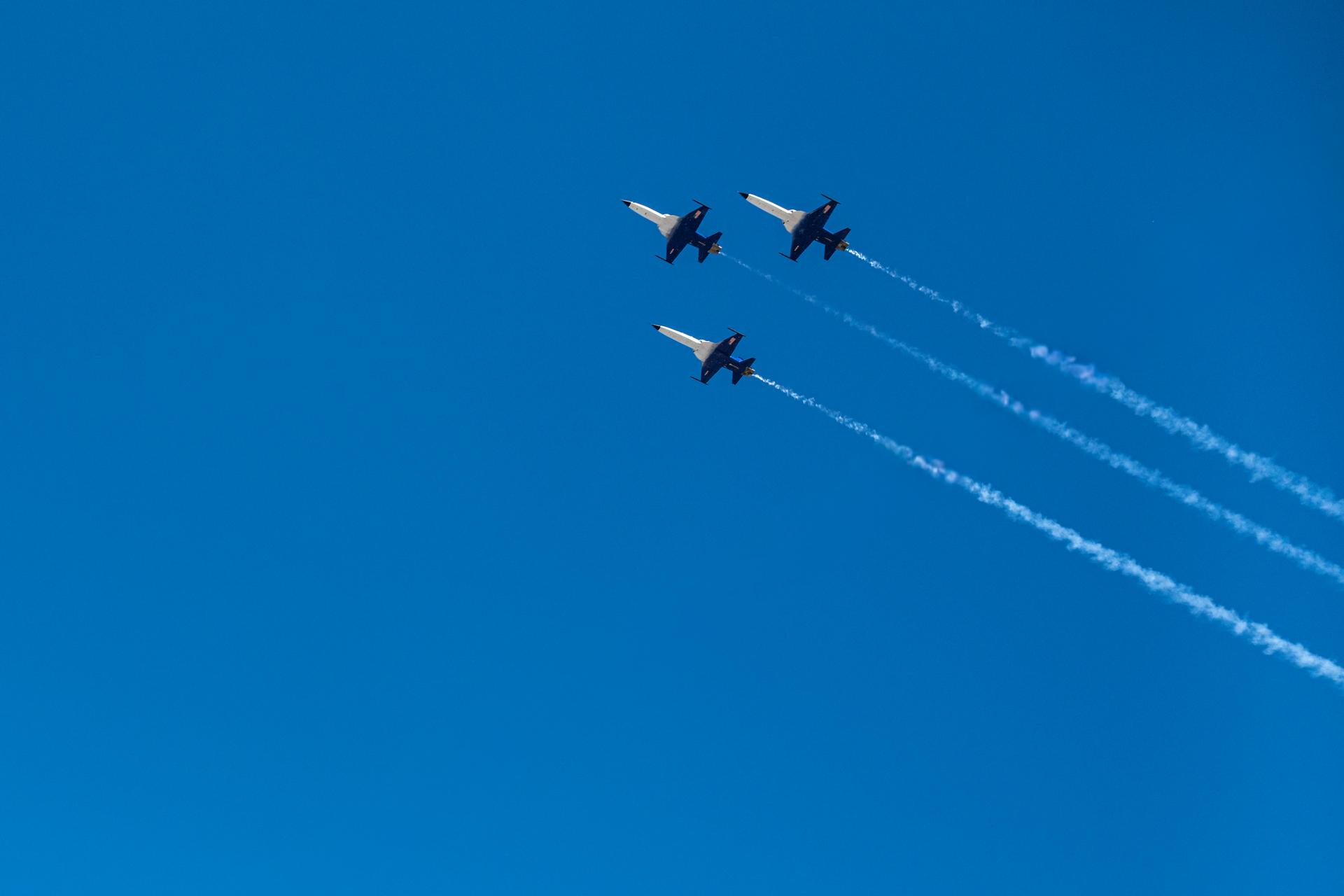
NASA’s Freedom 250 F-5 team, including NASA Administrator Jared Isaacman, performs a flyover during the national anthem at an NFL game between the Cleveland Browns and the Carolina Panthers at Huntington Bank Field, Sept. 27, 2026, in Cleveland.
NASA/Jordan Cochran
As part of the agency’s Inspiration Tour, NASA will conduct a flyover at the University of Alabama vs. Texas A&M football game in Tuscaloosa, Alabama, on Saturday, Oct. 24. NASA Administrator Jared Isaacman will pilot one of three F-5 fighter jets during the flyover, highlighting NASA’s contributions to aeronautics and the agency’s continued commitment to advancing aviation technologies.
Ahead of the game, members of the news media are invited to visit the NASA Experience Zone on Champions Lane, where Isaacman will participate in a media opportunity at 11 a.m. CDT. Media interested in attending should confirm their attendance by 12 p.m. Friday, Oct. 23, with Lance D. Davis at lance.d.davis@nasa.gov to receive additional details and instructions.
Supported by NASA’s Marshall Space Flight Center in Huntsville, Alabama, the NASA Experience Zone will be open to the public from 10:30 a.m. to 2:30 p.m. CDT, with no game ticket required. The experience will give visitors an opportunity to meet NASA team members and learn more about the people and technologies advancing the agency’s missions in aeronautics and space exploration.
Attendees can engage with NASA team members and explore exhibits highlighting the agency’s Artemis campaign and efforts to return astronauts to the Moon, including:
An inflatable SLS (Space Launch System) rocket.
Displays featuring the Starship and Blue Moon human landing systems.
Information about NASA internship opportunities.
Photo opportunities featuring NASA exhibits and displays.
With stops across the nation, NASA’s Inspiration Tour convenes academic, industry, and public sector stakeholders to connect the agency with the people, technologies, and organizations that drive American leadership in space.
The tour will culminate in MAX POWER, a public exposition of American air and space innovation, Saturday, Nov. 7, and Sunday, Nov. 8, on and near the agency’s Kennedy Space Center in Florida. Held in honor of America’s historic 250th anniversary, the multi-day, family-friendly event will showcase the next-generation aircraft, spacecraft, autonomous vehicles, and technologies that will help define the future of transportation in air and space.
For more information about MAX POWER and the agency’s missions, visit:
Rotor blade cross-sections highlight the thinner profile of the roamx-0201 design (right) compared to the more traditional, rounded shape used by NASA’s Ingenuity Mars helicopter, which accomplished the first powered flight on Mars.
NASA researchers are developing the future of flight on Mars, laying the groundwork for helicopters with the ability to fly higher and farther while conducting science on the Red Planet. Using high-fidelity computer simulations and wind tunnel tests, engineers are reimagining the rotorcraft blades that could carry the next generation of Mars flyers.
NASA’s Ingenuity helicopter made history as the first powered aircraft to fly on another planet. The SkyFall mission, scheduled for launch in 2028, builds on that legacy with a trio of helicopters destined for Mars exploration. Both missions utilize a blade designed to operate in Mars’ thin atmosphere, with a curved edge reminiscent of but distinct from blades used on Earth.
Researchers are exploring unconventional blade designs that are thinner and sharper, aiming to enable future missions after Skyfall to expand their single-flight range across Mars. One team at NASA’s Ames Research Center in California’s Silicon Valley is working with Imperial College London, United Kingdom, and Nagoya University, Japan, to test a new blade cross-section, or airfoil, that promises to significantly boost aerodynamic performance on Mars.
Researchers designed the new airfoil, called roamx-0201, using advanced simulations and algorithms tuned to Mars conditions, pointing researchers toward a thinner, asymmetrical shape. Subsequent wind tunnel tests showed that the optimized design boosted performance and was better able to recover in risky flight conditions.
Researchers used high-fidelity simulation tools to analyze the performance of the roamx-0201 airfoil and compare it to Ingenuity’s capacity. They found that the redesigned blades could enable future Mars helicopters to expand the distances that can be covered in one uninterrupted flight from Ingenuity’s 0.7 kilometers to as much as 18.7 kilometers while carrying scientific instruments. The findings were announced in a paper published Sept. 22 in the journal of the American Institute of Aeronautics and Astronautics.
The roamx‑0201 blades performed well in part because they were able to operate longer at higher speeds before experiencing a phenomenon known as “drag divergence”, where performance drops suddenly when the rotors approach the speed of sound, which is lower on Mars than on Earth.
The new blade also differs from earlier designs in how it uses turbulence to create lift. As air flows over a rotorcraft blade, it forms a thin region called the “boundary layer.” The new airfoil intentionally disrupts the flow of that boundary layer at the front of the airfoil directly at the leading edge to create a disturbance that, counterintuitively, pulls the blade upward to help lift the rotorcraft more effectively than with earlier designs.
Another challenge for rotorcraft is “stall,” an aerodynamic condition in which performance drops sharply and flight becomes unstable following a change in the angle of airflow. Ingenuity’s blades experienced steep performance degradation at stall, but under the conditions studied, the roamx-0201 design showed significantly improved stall behavior. That means future helicopters could operate safely at a wider range of flight angles.
While the technology is not yet ready for Mars, tests are helping engineers understand and resolve discrepancies between computational predictions and real-world performance. Ongoing research across NASA aims to enable more efficient Mars helicopters that can fly farther, carry more payload, and unlock new science and discovery missions.
Four Google DeepMind AI agents defeated Minecraft's Ender Dragon after 27 hours and 605 deaths, revealing both the promise and limitations of autonomous AI.
Four Google DeepMind AI agents defeated Minecraft's Ender Dragon after 27 hours and 605 deaths, revealing both the promise and limitations of autonomous AI.
The first viable powered aircraft predated the first proper runway by two decades. While it’s entirely possible to launch some planes from austere dirt or grass strips, the aviation world eventually realized that aircraft would be better off launching from a flat, paved surface.
Over the years, paving technology has gradually improved in the aviation world as it has for roads and highways. Now, there’s a project being built in Charlotte with new digital features that hopes to push the state of the art of runways even further.
Twinsies
Charlotte Douglas International Airport (CLT) serves the city of Charlotte, North Carolina. It’s by no means the most famous airport in the United States; it wouldn’t make the top 10 in notoriety despite being the 11th busiest in the country).. Still, it serves as a major hub for American Airlines, and has three operating runways that are interesting for the fact that they are all laid out parallel to each other.
Much of the work will involve embedding strain gauges in the runway to monitor how loads affect the structure when the runway is in use. Credit: CLT press release
The airport’s major grand project of late has been the installation of its fourth parallel runway, with the official ground breaking taking place in June 2023. The hope is that the new 10,000 foot runway will add significant capacity for both arrivals and departures to keep the airport competitive while also adding resilience in difficult operational conditions. As the new runway is built, the existing runways have been renamed to 19R/1L, 19L/1R, and 18/36 respectively. The fourth runway will wear the designation 19C/1C.
The new Fourth Parallel Runway, as it is otherwise currently known, will be unique for its “smart runway” features. Unlike a smart fridge, smart oven, or smart bulb, it doesn’t just mean that the runway will have a pointless and annoying WiFi connection and dodgy smartphone app. Instead, it’s all about sensing and telemetry, which is intended to create a better understanding of the runway and its performance and state over time.
The strain gauges, seen here assembled on rebar, are to be embedded in the concrete itself, where they will provide the most useful readings. However, this does mean that the sensors will not be practical to maintain or repair over time. Their expected lifetime is approximately ten years. Credit: CLT press release
During construction, over 2,000 sensors will be installed in the 18-inch deep concrete being poured to lay out the Fourth Parallel Runway. The sensors in question will be used to measure everything from engineering basics like stress and strain, as well as tracking factors like moisture ingress, settlement, friction, and the presence of snow and ice.
The sensors are no different from those that have been deployed on highway bridges and interstates previously for similar purposes. However, this will mark the first time that a US runway has been similarly instrumented in such a way, such that the airport can create a “digital twin” of the runway.
Jointmeters will also be installed in the runway to measure the behaviour of expansion joints in the runway. Credit: CLT press release
This is effectively a digital model that is fed by the sensor data and helps authorities determine the condition of the runway, both from an engineering and operational standpoint. Moisture, snow, and ice sensors can be used to guide the employment of deicing resources and what measures to take on the ground, while monitoring the stress and strain on the runway will guide maintenance decisions over the runway’s lifetime. The latter in particular will provide a very clear idea of how aircraft operations are impacting the very structure of the runway itself. The hope is that this data will be a boon for implementing predictive maintenance. In a busy airport, preventing a time-consuming runway shutdown with a little well-placed maintenance could save huge amounts of money by preventing or limiting the number of flight cancellations, to say nothing of the reduced frustrations for travellers passing through.
Of course, the problem with embedding sensors in 18 inches of concrete is that it’s not particularly easy to get at them for service or replacement purposes. The runway’s sensor system is slated for an expected life of 10 years, during which time data will be collected to better understand the runway and its performance and robustness over time. The hope is that by learning exactly what’s going on in the concrete itself, engineering lessons could be learned on how better to build runways in future. It could lead to new guidelines on concrete mixes, thickness, density, or other factors that influence how long the runway holds up under heavy use by commercial airlines. Despite the limited sensor lifetime, though, the runway itself is expected to last much longer, with the pavement itself slated for 30 to 40 years of use.
Embedding sensors into runways won’t always be a seen as a necessity. It’s perfectly possible to build a runway that doesn’t have telemetry, and just exists as a big old slab of concrete that takes a pounding from air traffic on the regular. However, where a greater understanding of the pavement is desirable, instrumentation can help. Time will tell if the lessons learned from the new CLT runway prove useful enough to justify the investment—but it’s easy to imagine that it would only take a couple of runway shutdowns to be avoided to pay for the $6.5 million project cost. Time will tell!
Editor’s Note: This article was originally published on Oct. 15, 2026, and has been updated to correct the location of the flights.
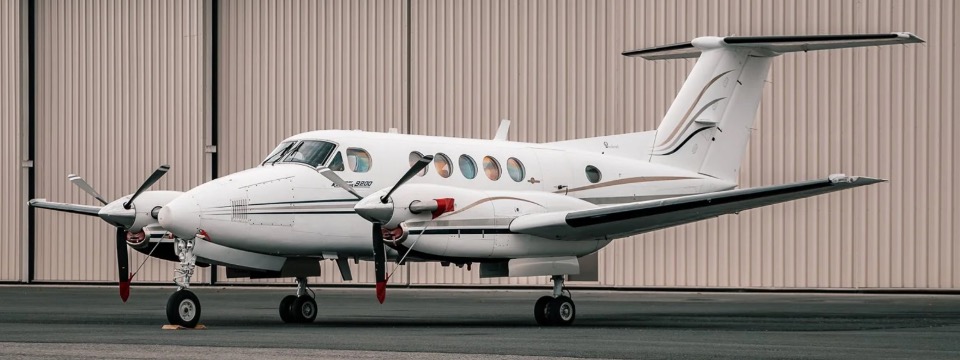
A NASA Dynamic Aviation A200 aircraft will conduct low-flying research flights over farmland near Amarillo, Texas, from Thursday, Oct. 22, through Monday, Nov. 9. These flights will measure gaseous and particulate emissions from animal feeding operations.
A photo of the Dynamic Aviation A200 aircraft, which will conduct low-flying research flights over farmland near Amarillo, Texas, to measure emissions in October and November 2026.
Dynamic Aviation
Agricultural emissions represent an important and understudied part of Earth’s land and atmosphere systems. The FarmFlux mission will deploy more than a dozen sensors to measure ozone, methane, ammonia, particulates, and other pollutants rising from crop lands and livestock farms and their interaction with the Earth’s atmosphere. The mission is jointly led by NASA’s Goddard Space Flight Center in Greenbelt, Maryland; Colorado State University; and Boston University.
Additional low-altitude research flights with a NASA P-3 Orion aircraft are scheduled for the March to July 2027 growing season in the Midwest and California’s Central Valley with a focus on cropland.
For more information about the FarmFlux mission, visit:
NASA’s Freedom 250 F-5 team, including NASA Administrator Jared Isaacman, performs a flyover during the national anthem at an NFL game between the Cleveland Browns and the Carolina Panthers at Huntington Bank Field, Sept. 27, 2026, in Cleveland.
Credit: NASA/Jordan Cochran
As part of the agency’s Inspiration Tour flyover, NASA Administrator Jared Isaacman will pilot one of three F-5 fighter jets to kick off the New York Jets vs. Cleveland Browns game in East Rutherford, New Jersey, on Sunday, Oct. 11.
NASA team members will engage with fans at the agency’s Experience Zone, located at the Jets Tailgate Zone outside the stadium, from 10 a.m. to 1 p.m. EDT before the game. Fans can learn more about NASA’s return to the Moon under the agency’s Artemis dome, enjoy interactive games, and capture photos with a large, inflatable SLS (Space Launch System) rocket.
Isaacman will be available for limited media interviews during the game. To arrange interviews, please contact Camille Gallo at: camille.m.gallo@nasa.gov or 202-531-8057.
With stops across the nation, NASA’s Inspiration Tour convenes academic, industry, and public sector stakeholders to connect the agency with the people, technologies, and organizations that drive American leadership in space.
The tour will culminate in MAX POWER, a public exposition of American air and space innovation, Saturday, Nov. 7, and Sunday, Nov. 8, on and near the agency’s Kennedy Space Center in Florida. Held in honor of America’s historic 250th anniversary, the multi-day, family-friendly event will showcase the next-generation aircraft, spacecraft, autonomous vehicles, and technologies that will help define the future of transportation in air and space.
For more information about MAX POWER and the agency’s missions, visit:
NASA Campaign Explores Clouds Spawned by Wildfires
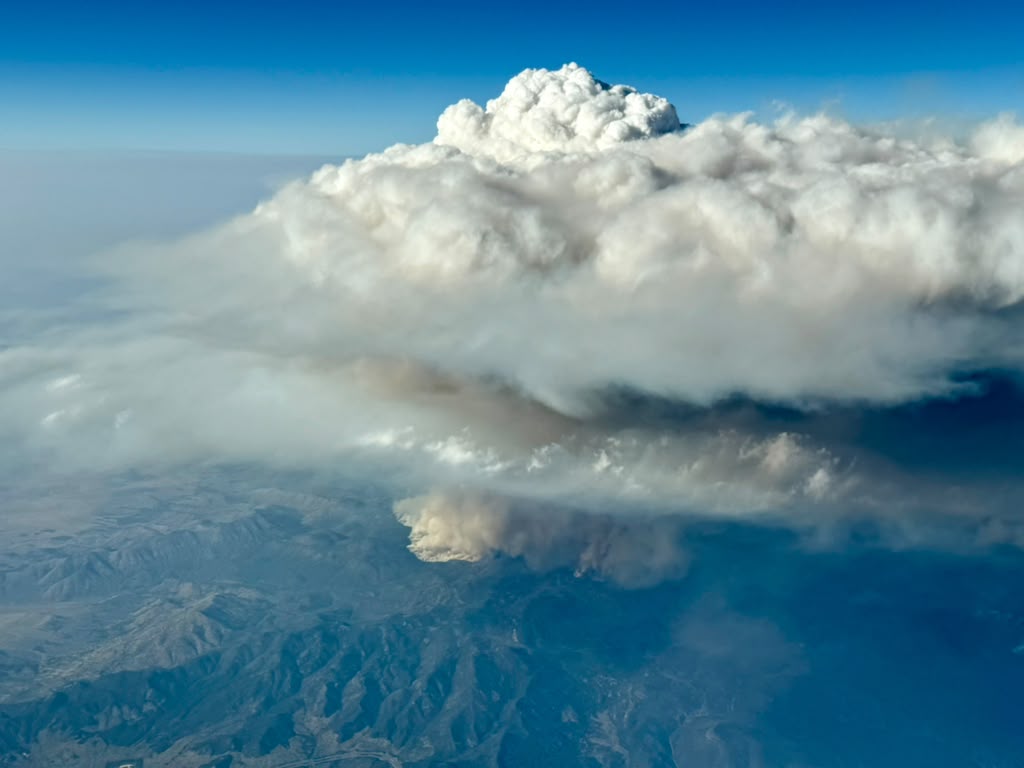
The Wildhorse grass fire in eastern Idaho erupted with a massive pulse of smoke. No one had expected it, but the wildfire had launched what’s known as a pyrocumulonimbus cloud, or pyroCb. It was an elusive weather phenomenon that scientists on NASA’s INSPYRE (INjected Smoke and PYRocumulonimbus Experiment) campaign spent weeks this summer hunting across western North America.
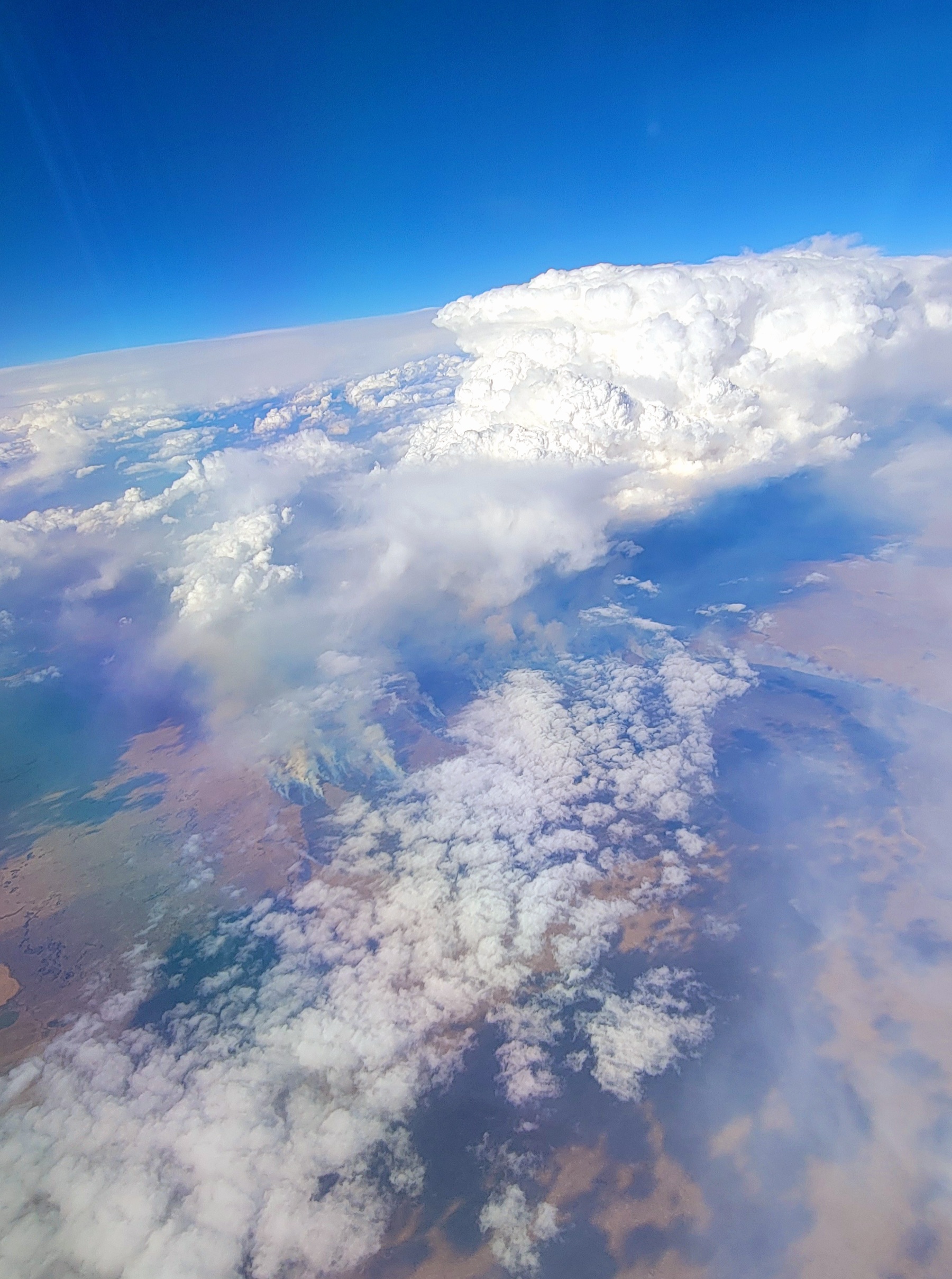
Fire-driven weather about the Widemouth 2 fire in Utah, as seen from the NCAR Gulfstream jet during the fourth INSPYRE campaign research flight on Aug. 3.
INSPYRE/Bernadett Weinzierl
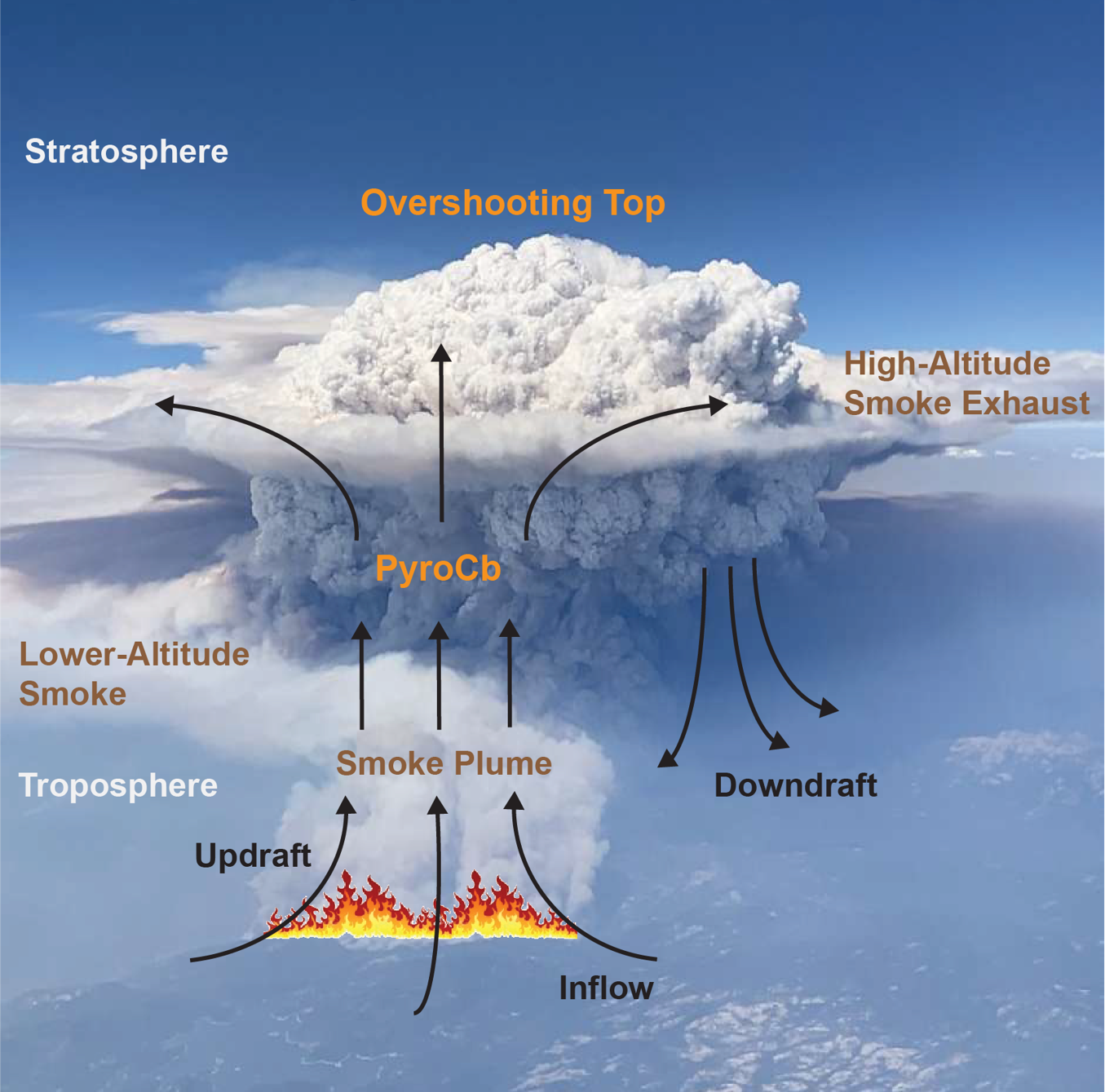
Pyrocumulonimbus clouds rise above intense fires, producing lightning and rain along with powerful winds that can whip the flames below into a fury. The largest pyroCbs funnel smoke 30,000 to 50,000 feet (10 to 15 kilometers) above Earth’s surface, as high as the cruising altitudes of commercial jets and even into the stratosphere.
A pyroCb cloud forms when an intense fire funnels a chimney of smoke into the stratosphere above the height of most clouds formed by normal weather patterns.
NASA/Bill Ingalls, NASA/JSC/Mark Sowa
The significance of pyroCbs emerged around the turn of the 21st century, when satellite observations revealed smoke reaching altitudes previously associated with major volcanic eruptions. Once in the stratosphere, pyroCb smoke can spread across continents, circle the globe, and persist far longer than it would in the lower atmosphere.
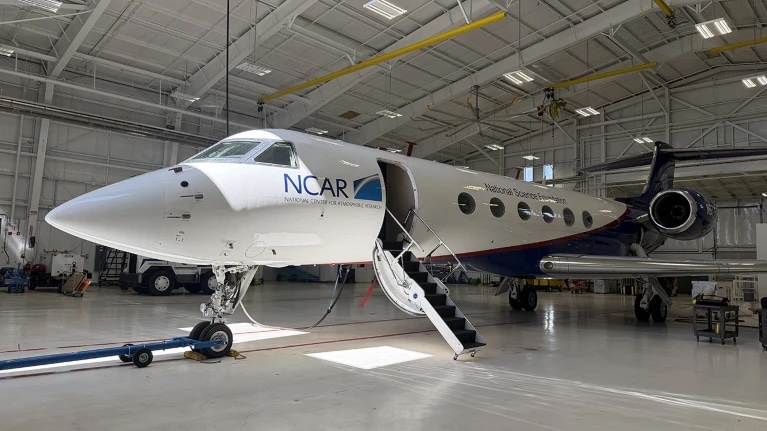
The NCAR Gulfstream jet, outfitted with instrumentation for studying clouds and smoke over wildfires, sits in its hangar at the National Science Foundation’s NCAR Research Aviation Facility in Broomfield, Colorado.
NASA/Bill Ingalls, NASA/JSC/Mark Sowa
Despite their massive size, pyroCb clouds remain mysterious. But it’s important to understand how they form and connect with the atmosphere, because their smoke can affect climate and weather far from the fires that produced them and long after they’ve extinguished. They also can produce dangerous fire-generated winds.
NASA’s ER-2 taxis on the runway during its deployment at the Great Falls International Airport. The high-flying jet launched from Great Falls, Montana, on flights across western North America and as far north as Alaska during the INSPYRE campaign.
NASA/Milan Loiacono
“We still do not understand if they’re driven by fire energetics, or fire intensity, or by atmospheric conditions above,” said Olga Kalashnikova, a researcher with NASA’s Jet Propulsion Laboratory in Southern California, who is one of the principal investigators leading INSPYRE, the first aircraft campaign designed specifically around studying pyroCbs.
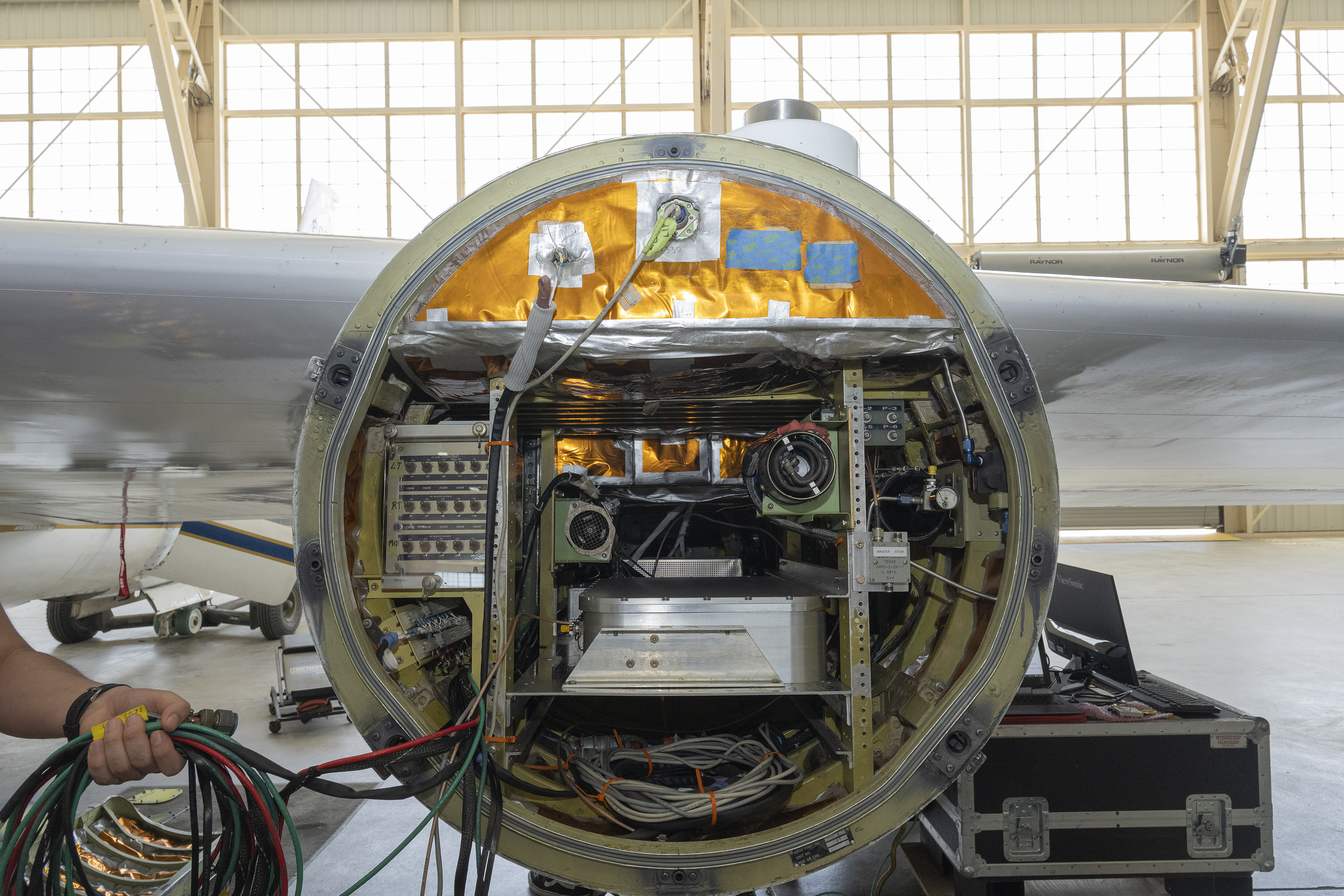
An ER‑2 aircraft based at NASA’s Armstrong Flight Research Center in Edwards, California, carries a pod full of instruments for the INSPYRE campaign.
NASA/Carla Escamilla
For six weeks this summer, INSPYRE researchers climbed aboard a Gulfstream jet for a series of flights from the plane’s home base at the National Center for Atmospheric Research (NCAR) near Boulder, Colorado. Scientists collected smoke particles, sampled gases, photographed ice crystals, and monitored radiation passing through clouds and reflected back into space. The aircraft crisscrossed above, below, and through clouds to get a close-up view of fire-induced weather and smoke.
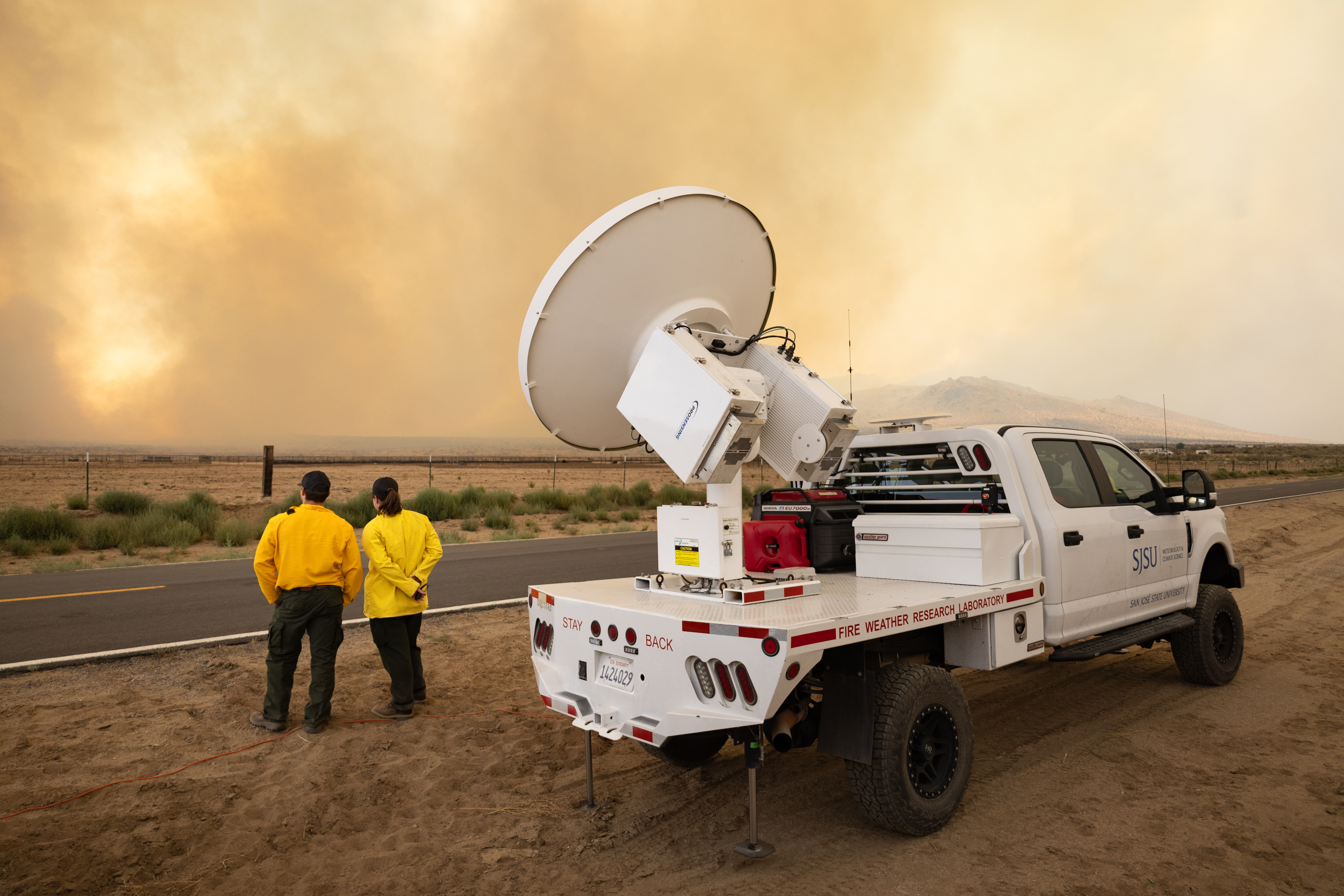
Meanwhile, NASA’s high-flying ER-2 aircraft, loaded with 14 instruments, tracked fire intensity, updraft speeds, smoke, and cloud properties from above, while crews drove trucks equipped with sensors to view the same events from the ground. Ultimately, the team will investigate how wildfire-generated clouds transport smoke upward, how clouds transform particles and gases in smoke, how much reaches the stratosphere, and what happens once it gets there.
From fire forecasts to climate models
Firefighters will benefit from a better understanding of when pyroCbs are likely to develop and how they affect fire conditions on the ground. “A unique thing about pyrocumulonimbus is they are fire-generated weather, meaning the fire makes its own weather,” said Neil Lareau, an atmospheric scientist at the University of Nevada, Reno, who led INSPYRE’s ground observations. “The fire is making its own thunderstorm, and in the process of doing that, it’s also making its own wind.”
A unique thing about pyrocumulonimbus is they are fire-generated weather . . . the fire makes its own weather.
Neil Lareau
University of Nevada
Lareau hopes the research will lead to warnings comparable to the alerts meteorologists issue for severe thunderstorms. For example, he said, a forecast would warn firefighters that a developing cloud could soon produce a dangerous downdraft and wind shift, giving fire managers time to pull personnel off the line.
Ground crews traveled across the western U.S. to monitor wildfires up close during the INSPYRE campaign.
NASA/Milan Loiacono
Additionally, INSPYRE could also improve Earth system models. PyroCbs can carry enormous quantities of smoke into the stratosphere, where particles can persist for months or longer and affect how much solar energy the atmosphere absorbs and how much reaches Earth’s surface. Most numerical prediction models don’t explicitly include the effects of pyroCbs and their smoke injections, said Dave Peterson, a Naval Research Laboratory meteorologist and INSPYRE’s co-principal investigator. Measurements of the particles, gases, and radiation associated with these events will give scientists data to test and improve simulations of their effects on Earth’s weather and climate.
Hunting storms
To study wildfire smoke and clouds, and perhaps catch a pyroCb in action, the INSPYRE team first had to find one. The challenge was getting an aircraft to the right place at the right time. Pyrocumulonimbus clouds can develop in minutes and subside just as quickly, while reaching fires hundreds of miles away takes hours of preparation, flight time, and coordination with air traffic controllers.
Instrumentation racks take the place of passenger seats on the NCAR Gulfstream plane that has been converted from an executive jet to a flying laboratory.
NASA/Katie Jepson
But on Aug. 26, the team got lucky. The Gulfstream was returning from a fire farther west when Sarah Woods, a National Center for Atmospheric Research scientist serving as spotter, got word that the Wildhorse fire was unexpectedly intense.
The fire hadn’t initially attracted much attention. “We knew there was a grass fire there, and everyone’s like, it’s just a grass fire; we’re not going to worry about it,” Peterson said. “And it ended up being the main event.”
We knew there was a grass fire there, and everyone’s like, it’s just a grass fire; we’re not going to worry about it . . . And it ended up being the main event.”
DAVE PETERSON
Naval Research Laboratory
When the flight path neared the Wildhorse fire, Woods spotted the fresh remains of a pyroCb from her cramped jump seat behind the pilots. “It looks just like a big thunderstorm, and so as you approach it, you look for a visual indication of the fire on the ground,” said Woods.
Researchers on an Aug. 26 INSPYRE research flight encountered a pyrocumulonimbus (pyroCb) cloud that unexpectedly formed over the Wildhorse grass fire in eastern Idaho.
INSPYRE/Chris Kruse
Seeing the fire on the ground far below confirmed that the cloud was fire-generated. At Woods’ request, the pilots swung the plane around and spent the next three hours flying back and forth through the cloud plume and the trail of smoke drifting northwest toward Wyoming.
The chance encounter gave the INSPYRE team measurements of a pyroCb plume roughly an hour after the cloud first erupted. Other flights coordinated between the Gulfstream jet and ER-2 added crucial observations of active fire-driven atmospheric airflow that will help document how the resulting smoke plumes evolve over the days and weeks that follow.
Putting pieces together
Measurements from the Gulfstream and ER-2 will now be combined with satellite and ground observations and compared with models.
“When clouds form, they modify chemistry,” said Kalashnikova, the JPL-based principal investigator. That altered smoke can have different effects on radiation, she said, making it important to understand both how pyroCbs form and the smoke that emerges from them.
In the summer of 2026, the challenge was finding the clouds and collecting the measurements. Now comes the work of understanding what they found.
On Sept. 30, 1946, five National Advisory Committee of Aeronautics (NACA) engineers arrived at Muroc Army Airfield in California’s high desert to achieve supersonic flight for the first time. In less than two years, NACA flew the X-1 aircraft faster than the speed of sound, marking an important milestone in aviation history.
Fast forward 80 years, and that former NACA outpost is now NASA’s Armstrong Flight Research Center in Edwards, California, flying the X-59 supersonic X-plane in the same skies to demonstrate that supersonic flight doesn’t have to come with a boom.
Over Armstrong’s 80-year history, the center has supported milestone missions ranging from space shuttle landings to SR-71 flights, shaping the evolution of science, aeronautics, and space research.
This Southern California NASA center is poised to lead the next era of aeronautics and human spaceflight, advancing technologies that will define the future of flight.
Fast facts
NASA Administrator Jared Isaacman recently named Armstrong as the agency’s Center of Excellence for Flight Test and Aircraft Operations, recognizing the center’s unmatched rigor in executing unique missions only NASA can fly.
To support NASA’s Artemis missions and return to the Moon, Armstrong uses research aircraft such as a 737 for astronaut suit testing, the G-III for Artemis II heat-shield data collection, and an F/A-18 aircraft that tested the autopilot for the SLS (Space Launch System) rocket.
NASA’s aeronautics centerpiece, the X-59, is undergoing rigorous testing and a series of flights at Armstrong to prepare for upcoming quiet supersonic demonstrations over U.S. communities.
NASA Armstrong has transformed commercial and military aviation — from early supersonic flight research to digital fly-by-wire — and continues working with other government agencies, industry, and academia to make flying safer, more autonomous, and more efficient.
The center plays a vital role in global science by flying aircraft like the ER-2, C-20A, and Gulfstream G-III/IV/V to collect critical data on wildfires, glacier melt, pollution, minerals, and more.
Behind these achievements are the engineers, pilots, technicians, and mission support teams who continue to push the boundaries of what’s possible.
Red, White, and Boom, the U.S. Air Force Test Center’s celebration of America’s 250th anniversary and NASA Armstrong’s commemoration of its 80th year, was Fr...
The more experienced a hacker becomes, the harder they are to detect. Beginners are often noisy and leave plenty of traces behind. As they gain experience, they learn to think like defenders and understand how detection actually works.
Today, we’re going to look at a tool that can hide your processes. It’s Zapper. We’ve already seen reports of it being used by hackers to masquerade their long running processes and make them look legitimate.
What is Zapper?
Zapper is a tool created by Hacker’s Choice. Unlike a lot of crude hiding methods, it actually works well. Zapper doesn’t need root privileges to run and it can work even as a static binary, one you can rename too.
Not only can you hide the command line itself, but the environment variables of a process too, along with what’s in /proc/<PID>/environ. The tool doesn’t depend on LD_PRELOAD or libc tricks, it uses ptrace() to manipulate the ELF Auxiliary Vector instead. The performance overhead is tiny, so you won’t even notice it.
Using Zapper
First you need to get the binary. Let’s use the command from the project repository:
Defenders often monitor traffic and certain keywords may trigger alerts. So it’s best to rename the tool and then host it on your C2.
bash$ > mv zapper systemd-control
Here we renamed the binary to systemd-control. On many Linux distros, the actual systemd components live inside /lib/systemd, so placing the renamed file there and changing the timestamps can make it hard to catch, unless someone’s monitoring that directory too. That’s basically why you as a defender can’t rely purely on filename based detection.
The help menu has plenty of examples and shows some creative ways you can use the tool:
bash$ > ./systemd-control -h
Hackers can hide binaries along with their child processes. They can create hidden tmux sessions to maintain persistence on a server without showing up in normal process listings. They can also leave the program name exposed but strip all the command line options, making the process look generic.
For the demonstration we’ll hide an nmap scan and all its arguments:
bash$ > exec ./systemd-control -f -a '[kworker/2:2-events_power_efficient]' nmap IP -Pn -sV -sC > /dev/shm/scan.txt &
This command makes it look like a kernel worker thread. Most admins would just ignore it. While it’s running, you won’t find it anywhere with ps or any other tool. The scan results were saved in /dev/shm/scan.txt, that proves it worked.
bash$ > ps aux | grep nmap
# no nmap in ps

bash$ > cat scan.txt
You should try it on a pentest to emulate a realistic threat and see whether defenders can catch it.
Summary
Zapper can help when you need to hide a suspicious long running process. It masquerades them as something legitimate that every admin would just skip past. The commands and arguments can’t be found in /proc either. You don’t need root to work with it, so it’s suitable for a lot of engagements. With all these qualities, it gained popularity fast and has already been seen in DFIR reports on cyberattacks.
If you like Linux and want to advance your skills, consider joining our Advanced Linux for Hackers training.

 Login