The fire department at NASA’s Ames Research Center in California’s Silicon Valley will perform training on the Moffett Federal Airfield beginning Tuesday, Sept. 8 through Friday, Sept. 11. The training will involve the use of a propane-fueled aircraft fire simulator and be conducted from 8 a.m. to 8 p.m. PDT.
Because the aircraft simulator is fueled by propane, very little smoke should be produced during the controlled training fires. However, flames may be visible to drivers on U.S. Highway 101. The training is intended to prepare Ames’ first responders to respond to a variety of realistic aircraft firefighting scenarios.
For more information about NASA’s Ames Research Center, visit:
Jeanne Neal Ames Research Center, Silicon Valley 650-604-4789 Jeanne.c.neal@nasa.gov
To receive local NASA Ames news, email local-reporters-request@lists.arc.nasa.gov with “subscribe” in the subject line. To unsubscribe, email the same address with “unsubscribe” in the subject line.
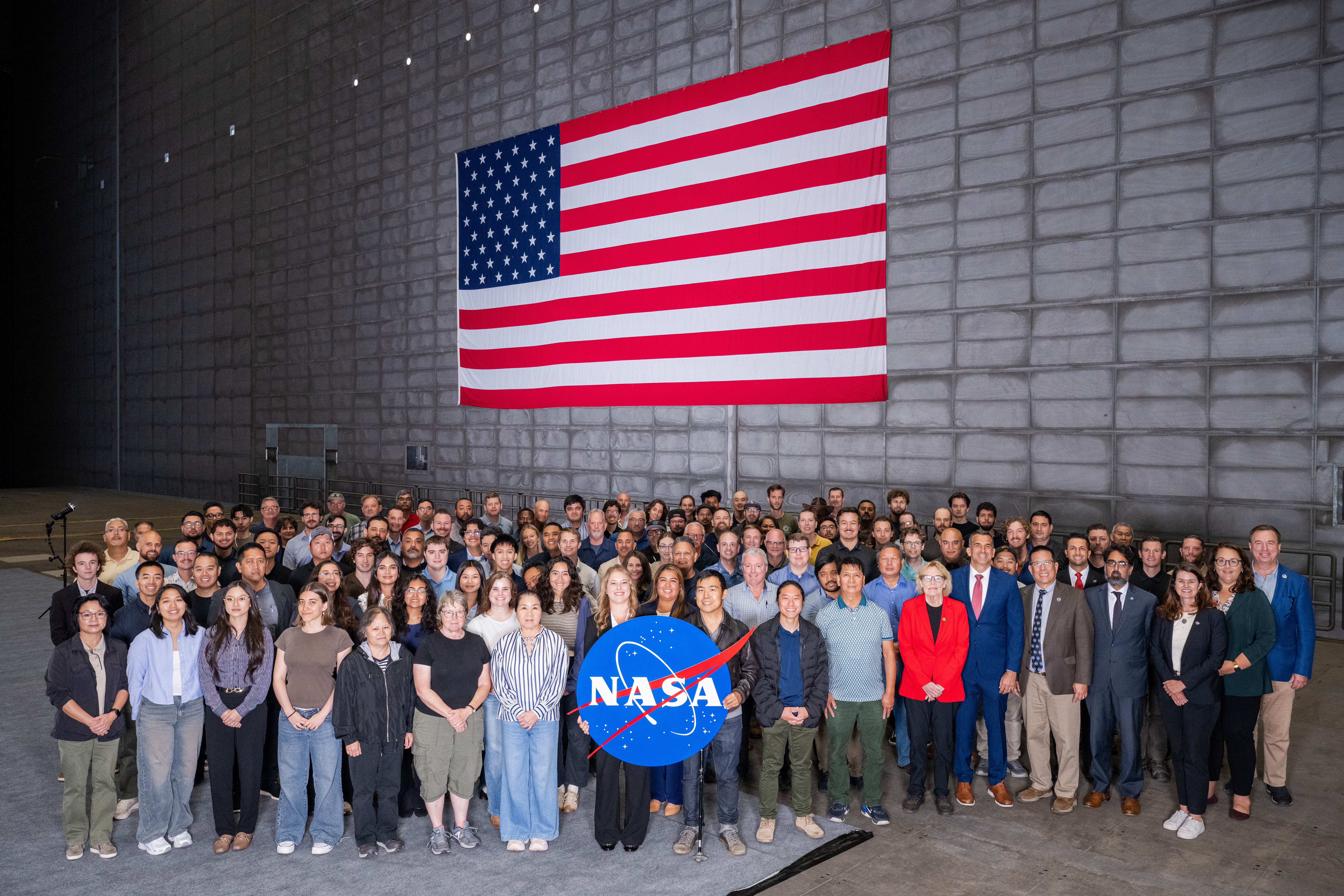
New civil servants and guests pose for a group photo with NASA and center leadership in the National Full-Scale Aerodynamics Complex (NFAC) 80-by-120-foot test section, N221 on Aug. 24, 2026. The civil servants were sworn-in the same day in the largest swearing-in ceremony ever hosted at NASA’s Ames Research Center in California’s Silicon Valley since its inception nearly 87 years ago.
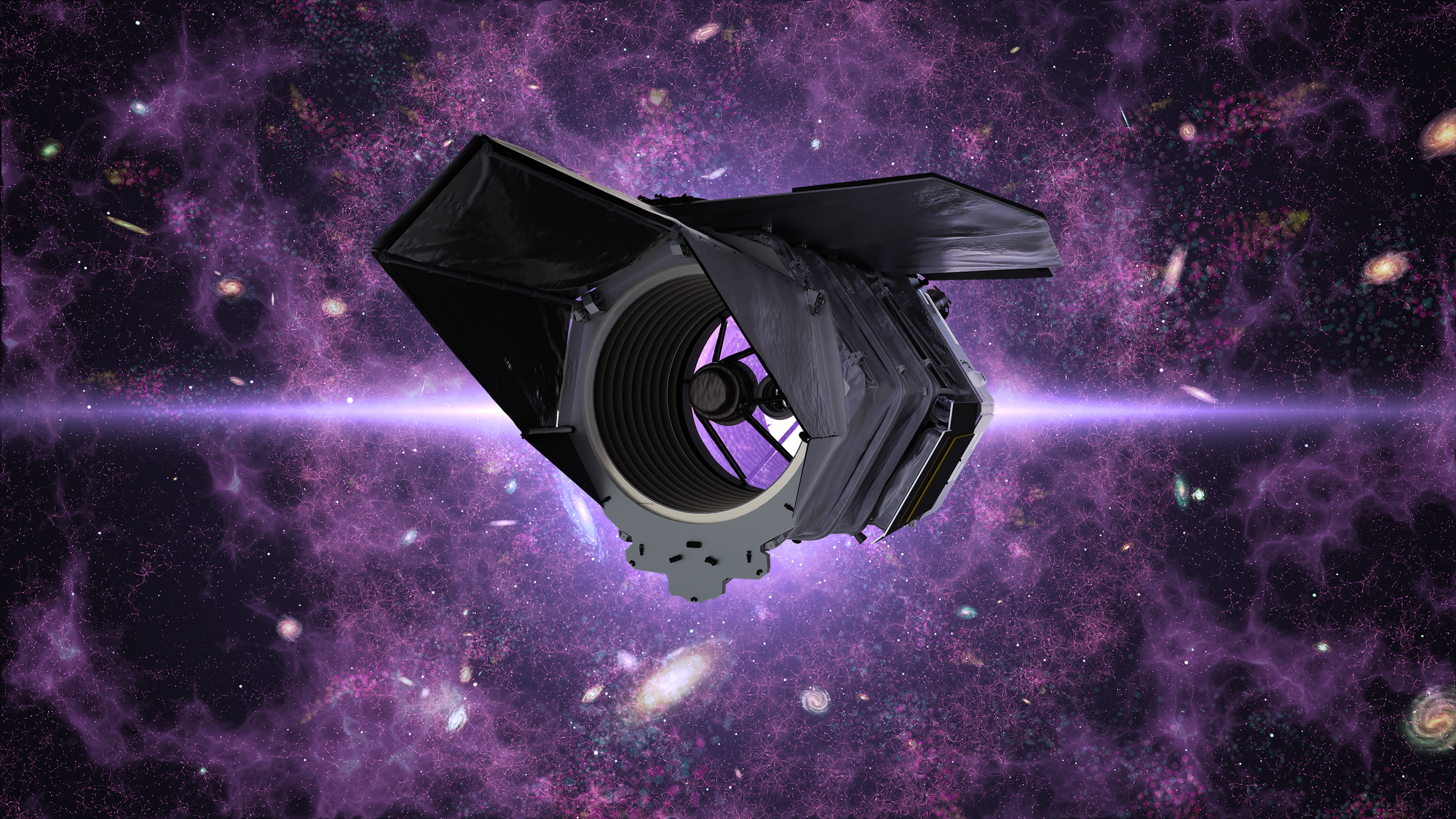
The Nancy Grace Roman Space Telescope is a NASA observatory designed to settle essential questions in the areas of dark energy, exoplanets, and infrared astrophysics.
NASA
Set to launch on Sunday, Aug. 30, NASA’s Nancy Grace Roman Space Telescope will empower astronomers to explore vast regions of the cosmos and settle essential questions in the areas of dark energy, dark matter, planets outside our solar system, and the formation and growth of galaxies over cosmic time. Key contributions to Roman’s mission made by researchers at NASA’s Ames Research Center in California’s Silicon Valley will advance Roman’s science using the center’s facilities, expertise, and innovations.
Tools to predict, remove glare
Roman’s main camera, the Wide Field Instrument, will capture expansive high-resolution pictures of the universe in optical and near-infrared light. These unprecedented images will enable astronomers to decode some of the deepest mysteries of the cosmos.
Forms of glare that Roman’s camera collects diminish image quality and thereby reduce the ability of astronomers to characterize certain cosmic structures. Innovative software developed by a team at NASA Ames, with collaborators at NASA’s Goddard Space Flight Center in Greenbelt, Maryland, and IPAC/Caltech in Pasadena, California, will improve Roman’s images and optimize observing plans. Called ROSALIA (Roman Sky Analyst for Low Surface Brightness Imaging and Astronomy), the software predicts and removes unwanted light from astronomical images captured by Roman’s Wide Field Instrument.
Contaminating stray light occurs when photons scatter inside the telescope’s optical system. Resulting light glints can produce deceptive image artifacts that mimic the appearance of real planets or nebulae. The ROSALIA software will allow astronomers to adjust their observation plans to limit glints from contaminating science targets in Roman’s images.
In addition to bright glints, stray light can also appear as a diffuse background. This form of stray light interferes with observations of the darkest regions of the universe, which is critical to understanding how large structures in the universe were formed.
Another major contributor to obscuring background light is produced by nature itself: zodiacal light. Zodiacal emission originates from the scattering of sunlight by interplanetary dust particles in our solar system. The ROSALIA software predicts and strips away background contamination, including zodiacal and stray light from images, exposing the faint, diffuse emissions at galaxy edges where cosmic evolutionary histories are hidden.
Simulated, unprocessed
Simulated, processed
Simulated unprocessed image, as it would be captured by the Roman Space Telescope’s Wide Field Instrument, showing two interacting galaxies
NASA
Simulated image, as it would be captured by the Roman Space Telescope’s Wide Field Instrument and then processed using NASA’s Roman Sky Analyst for Low Surface Brightness Imaging and Astronomy tools to remove glare, showing two interacting galaxies.
NASA
Simulated unprocessed image, as it would be captured by the Roman Space Telescope’s Wide Field Instrument, showing two interacting galaxies
NASA
Simulated image, as it would be captured by the Roman Space Telescope’s Wide Field Instrument and then processed using NASA’s Roman Sky Analyst for Low Surface Brightness Imaging and Astronomy tools to remove glare, showing two interacting galaxies.
NASA
Simulated, unprocessed
Simulated, processed
BEFORE AND AFTER PROCESSING
Simulated View From Roman’s Wide Field Instrument
Left: Simulated unprocessed image, as it would be captured by the Roman Space Telescope’s Wide Field Instrument, showing two interacting galaxies. Right: Simulated image of the same view after stepwise processing, using NASA’s Roman Sky Analyst for Low Surface Brightness Imaging and Astronomy (ROSALIA) tools, to remove four types of glare: zodiacal light, thermal background, stray-light, and stellar emission. The result is cleaner, sharper images where galaxies can be detected in greater detail. Image credits: NASA/Borlaff, Sanchez-Alarcon, Nickerson, Marcum and ROSALIA team/STScI/FIRE/DREAM
New ‘multi-star’ tech to see exoplanets
The Roman Coronagraph Instrument is one of two instruments flying on Roman. It will demonstrate the most advanced technologies ever flown in space for directly imaging planets around other stars. The Roman Coronagraph uses a series of masks and mirrors, including two deformable mirrors, to suppress starlight. By precisely controlling the shape of the deformable mirrors, it creates a “dark zone” around the star where observers can see the faint reflected light from orbiting planets.
The baseline operating mode of the Roman Coronagraph Instrument supports observation of exoplanets only in single star systems, as current coronagraph instruments cannot typically suppress the additional contaminating starlight in multi-star systems, such as binary star systems.
Our solar system has a single star, the Sun. But roughly half of Sun-like stars are in multi-star systems. Having the ability to directly image exoplanets in multi-star systems will increase the likelihood of detecting life beyond our solar system and will expand our knowledge about how exoplanets form and evolve, since there are major differences in how those processes unfold in single star versus multi-star systems. Eliminating overlapping glares from multiple stars is the key challenge that must be overcome to image planets in such systems.
Researchers at NASA Ames are meeting that challenge with an innovative technology called Multi-Star Wavefront Control (MSWC). This technology includes custom light-blocking masks and accompanying software designed to suppress the light from multiple stars and reveal hidden exoplanets. Through a collaboration with NASA’s Jet Propulsion Laboratory in Southern California, the MSWC masks are included on the Roman Coronagraph’s flight instrument as an added capability beyond Roman’s baseline observation modes. They could be used if additional observation time is granted to the coronagraph team after the primary technology demonstration phase is completed.
The nearest star system to our solar system, Alpha Centauri, is one of the nearest multi-star systems to Earth, at only four light-years away. This triple-star system contains a binary of Sun-like stars – Alpha Centauri AB – orbited by a much smaller and dimmer star – Proxima Centauri. Although no exoplanets are confirmed around the Sun-like stars in this system, a planet candidate has been identified by NASA’s James Webb Space Telescope in the habitable zone of Alpha Centauri A. Researchers, including the Ames MSWC team, are working to develop the capabilities needed to observe this system.
NASA Ames also provides leadership and support for the hardware working group as part of the Roman Coronagraph Participation Program. This program allows international teams of researchers to enable additional capabilities to the Roman Coronagraph beyond its baseline modes; this includes the multi-star modes being developed at NASA Ames that use different masks beyond the baseline or new wavefront control and sensing algorithms.
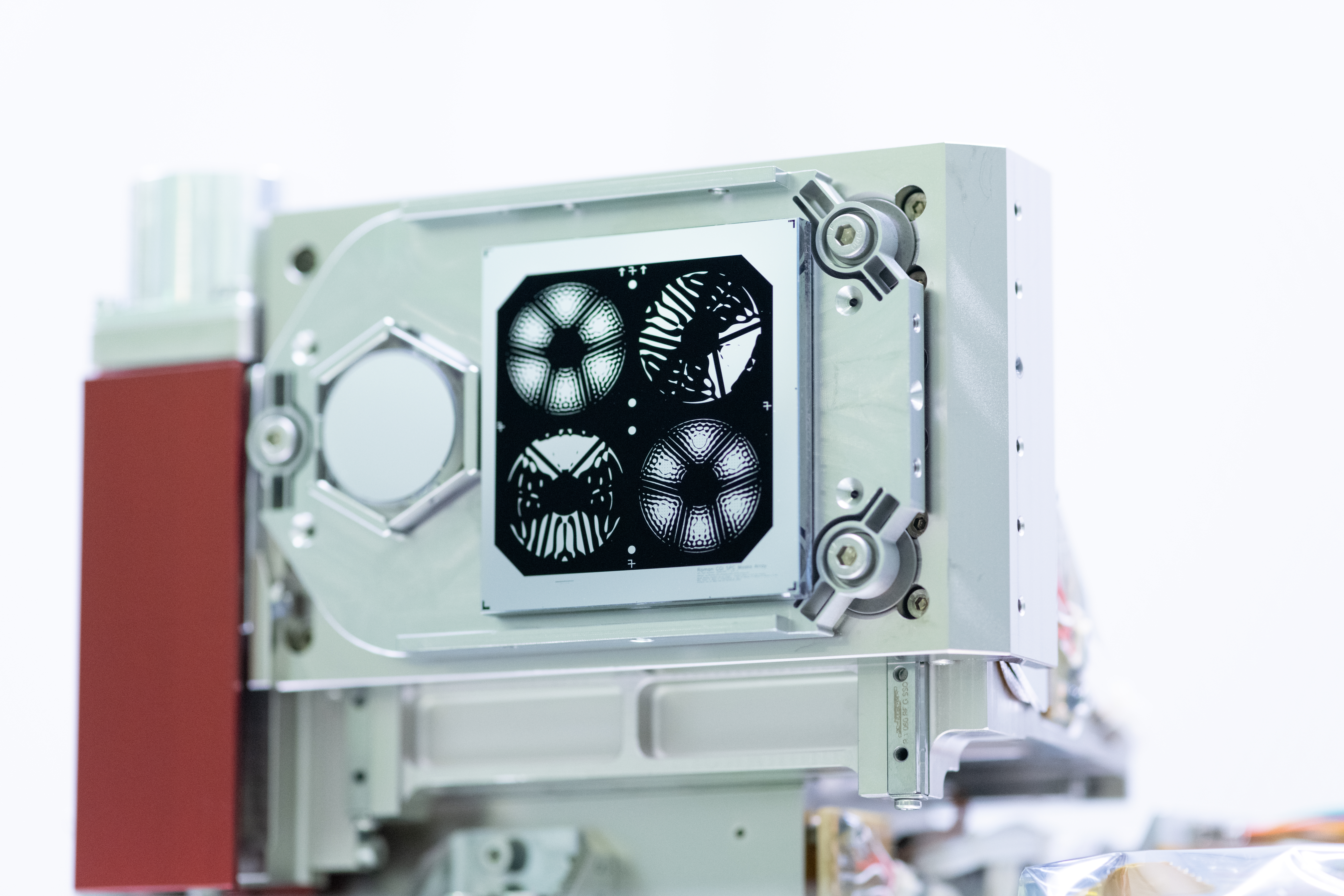
Close-up view of four of the Roman Coronagraph’s optical masks. The bottom-right mask, shaped like a six-petaled flower, is designed to suppress the light from multiple stars and reveal hidden exoplanets.
NASA JPL/Chris Gunn
Advanced supercomputing
Experts at NASA’s Advanced Supercomputing Division at Ames are advancing Roman’s science by bringing extensive experience in data pipelines and mission operations to provide advice and guidance to the Roman project through key mission development phases. This ensures reliable performance of ground-based systems and operations so that science data processing is efficient and the quality and integrity of the resulting science data products is high.
NASA Advanced Supercomputing researchers collaborated with the Ames MSWC team to develop high-performance computing tools for multi-star wavefront control simulations and to conduct studies to assess the feasibility of the MSWC technique.
Learn more about the Nancy Grace Roman Space Telescope mission:
NASA’s Ames Research Center in California’s Silicon Valley invites media to learn more about NASA’s Nancy Grace Roman Space Telescope, scheduled to launch Sunday, Aug. 30, 2026, from NASA’s Kennedy Space Center in Florida. The Roman telescope will provide a wide, detailed view of the universe, helping scientists study dark energy, exoplanets, and cosmic structures. Roman also will test advanced technology designed to directly image planets around nearby stars — a key step in NASA’s search for life beyond Earth.
Ames subject matter experts will be available for virtual interviews to discuss Roman’s goals and the center’s contributions to the mission on Wednesday, Aug. 26, 2026, 10:00 a.m. – 1:00 p.m. PDT.
NASA Ames contributions to Roman
Innovative software developed at NASA Ames, with collaborators at NASA’s Goddard Space Flight Center in Greenbelt, Maryland, and IPAC Caltech in Pasadena, California, is designed to improve Roman’s images and optimize observing plans, enhancing the ability of astronomers to capture expansive high-resolution pictures of the universe in optical and near-infrared light.
Technology called Multi-Star Wavefront Control is designed to suppress excess light and reveal hidden exoplanets by eliminating overlapping glares from multi-star systems.
NASA’s Advanced Supercomputing Division, based at NASA Ames, brings extensive experience in data pipelines and mission operations to advise the Roman project, helping to ensure the reliable performance of Roman’s ground-based systems and operations so that science data processing is efficient and the quality and integrity of the resulting science data products is high.
To request an interview, media can contact the Ames Office of Communications: arc-dl-newsroom@nasa.gov. Media can also request agency interviews about the Roman mission outside of this window by filling out this online form.
NASA Ames Roman subject matter experts
Pamela Marcum, research scientist
Ruslan Belikov, Exoplanet Technologies Group lead
Jon M. Jenkins, TESS (Transiting Exoplanet Survey Satellite) Science Processing Operations Center manager
For more information about NASA’s Roman mission, visit:
Jeanne Neal Ames Research Center, Silicon Valley 650-604-4789 Jeanne.c.neal@nasa.gov
To receive local NASA Ames news, email local-reporters-request@lists.arc.nasa.gov with “subscribe” in the subject line. To unsubscribe, email the same address with “unsubscribe” in the subject line.
NASA’s COFFIES Uses AI to Predict Storm-Causing Active Regions on Sun
As humanity looks to the Moon and stars for future exploration, predicting space weather — conditions in space primarily driven by the Sun — is more important than ever.
Now, a team of astrophysicists and data scientists with NASA’s COFFIES (Consequence Of Fields and Flows in the Interior and Exterior of the Sun) has developed a novel machine-learning model capable of predicting the emergence of active regions on the Sun up to 12 hours before they appear.
The Sun is constantly churning. Intense concentrations of localized magnetic fields can suddenly break through the solar surface, forming sunspots. Space weather forecasters then collectively number and track sunspots since they are visible manifestations of active regions, which serve as the main engines behind severe space weather events such as solar flares and coronal mass ejections. These eruptions send waves of high-energy radiation and charged particles across space, creating storms that can threaten astronauts, disable satellites, and disrupt radio communications on Earth.
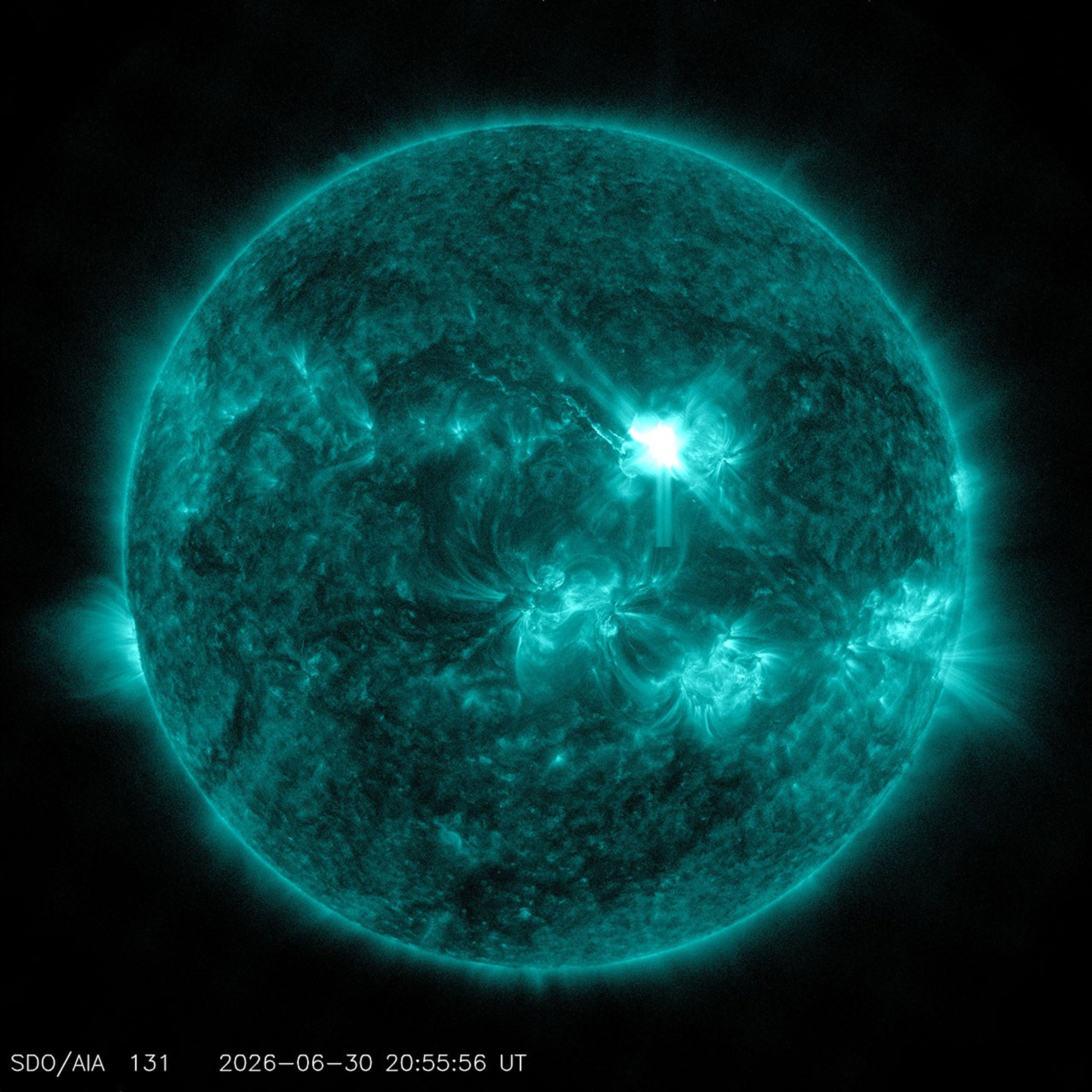
NASA’s Solar Dynamics Observatory captured this image of a solar flare — seen as the bright flash in the upper right — on June 30, 2026. The image shows a subset of extreme ultraviolet light that highlights the extremely hot material in flares and which is colorized in teal.
NASA’s Goddard Space Flight Center/SDO
By bridging expertise across different scientific institutions, COFFIES, a NASA DRIVE (Diversify, Realize, Integrate, Venture, Educate) Science Center, brought together a team of researchers from New Jersey Institute of Technology (NJIT), Princeton University, and NASA’s Ames Research Center in California’s Silicon Valley. The team turned to advanced artificial intelligence architectures — which dictate how data is processed and used to produce reliable predictions or actions — to capture subtle, time-based pattern changes on the solar surface before an active region took shape. By analyzing data captured by the agency’s Solar Dynamics Observatory and using NASA Ames’ supercomputing resources, this new approach, published in the Journal of Geophysical Research: Machine Learning and Computation, looks at fluctuations in acoustic waves caused by sunspot regions when the regions form beneath the solar surface and begin the journey upward to emerge on the surface.
“We cannot directly see the magnetic structure while it is still rising through the solar interior. Instead, we must look for indirect effects — very small changes in the magnetic field and in the pattern of acoustic waves continually traveling through the Sun,” said Alexander Kosovichev, a COFFIES co-investigator at NJIT. “The developed technique identifies precursors associated with an emerging active region in slight changes of the Sun’s acoustic power — more like a slight change in rhythm within a very noisy orchestra.”
This video is an example of what scientists use when analyzing the solar surface. This particular time frame tracks the magnetic field on the Sun’s surface during the emergence of active region AR11158 in February 2011. The blue square grid highlights a target area on the Sun. The squares on the right side translates the data from the target grid area to show opposing magnetic polarities, indicated by the warm and cool-colored tones. The first column of blocks shows targeted areas at original resolution, the middle column displays data as 2D maps, and the right column plots changes in magnetic polarity over time as 1D curves. By watching these blocks, scientists can see signs of active region emergence, such as drops in acoustic waves and rises in magnetic fields.
NASA’s COFFIES DRIVE Science Center/Irina Kitiashvili and Spiridon Kasapis
To develop current operational forecasts, the National Oceanic and Atmospheric Administration’s Space Weather Prediction Center and the United States Air Force monitor active regions that are already visible on the Sun to analyze the regions’ characteristics and estimate the probability of solar flares.
The COFFIES team aims to revolutionize this process. The AI model the team developed a specialized early detection system to handle very long sequences of data — called sliding-window transformer architecture — to use observations to find tiny reductions in the Sun’s acoustic activity and magnetic field, signals that scientists struggled to capture until now. These reductions form patterns that the AI model uses to predict active regions several hours before they become visible on the solar surface. Instead of looking at all activity on the solar surface at once, like earlier deep learning approaches have done, this new model moves a fixed-size “viewing window” across a long timeline of the Sun’s activity to focus on recent data while remembering overall patterns. This method allows forecasters the ability to predict approximate locations of emerging sunspots, rather than relying on counting already visible sunspots.
This promising AI architecture shows how deep machine learning can contribute to heliophysics — the field studying the nature of the Sun and how it influences the very nature of space and the planets that exist there. While the model is not ready for operational real-time forecasting, the team plans to validate the approach across many more known solar events to fine-tune the model.
NASA’s real-time space weather monitoring
As NASA focuses on sending humans to explore the Moon with the Artemis missions and sending the first crewed missions to Mars, monitoring and forecasting space weather is important for ensuring the safety of our astronauts and the equipment they rely on. This predictive leap from the COFFIES team could prove vital for safeguarding technology and deep-space explorers from the volatile environment of our solar system.
NASA’s Moon to Mars Space Weather Analysis Office monitors space weather 7 days a week. This important work helps decision makers not only protect people and equipment but maintain the services our modern society relies on every day. NASA’s space weather monitoring is also critical for safeguarding astronauts as they journey to the Moon and onward to Mars.
NASA/Lacey Young
Teams across NASA and NOAA collaborate to transition research capabilities into actual 360-degree space weather monitoring operational tools — including NASA’s Space Radiation Analysis Group, Moon to Mars Space Weather Analysis Office (M2M SWAO), and Community Coordinated Modeling Center as well as NOAA’s Space Weather Prediction Center. Sunspot region emergence prediction capabilities, especially of the Sun’s far side, could provide new information that supplements current models used by these teams.
“The COFFIES AI model is exciting to our team because it could provide us with new capabilities towards predicting potential flaring locations ahead of time,” said Michelangelo Romano, M2M SWAO deputy director. “With this heads up, we can provide additional support to NASA missions.”
NASA’s COFFIES is one of three DRIVE Science Centers created to encourage collaborative science by establishing centers that are made of multidisciplinary teams from several institutions across the U.S. These pioneering facilities employ modelers, theoreticians, computer scientists, and observers to study important mysteries of our star and its influence, a branch of science known as heliophysics.
The COFFIES team focuses on the interconnected processes behind the Sun’s activity. Understanding the Sun’s interior and magnetic variability is key to advancing our understanding of the Sun’s 11-year activity cycle and fine-tuning space weather forecasting tools.
Preparations for Next Moonwalk Simulations Underway (and Underwater)
The Vertical Motion Simulator at NASA’s Ames Research Center in California’s Silicon Valley is capable of vertical and horizontal motion to simulate a range of flight experiences, such as lunar landers, helicopters, and commercial aircraft.
NASA/Jesse Carpenter
Imagine stepping into a machine that can make you feel like you’re flying a spacecraft, piloting a next generation air taxi, or landing on the Moon, all without leaving the ground. NASA’s Vertical Motion Simulator, the largest of its kind in the world, does exactly that. And now, with new upgrades, it’s more powerful and realistic than before.
The Vertical Motion Simulator, located at NASA’s Ames Research Center in California’s Silicon Valley, has shaped the future of aviation and spaceflight since 1979. It allows pilots and researchers to experience realistic aircraft motion due to its ability to travel 60 feet vertically and 40 feet horizontally, simulating vehicles ranging from helicopters to spacecraft with high accuracy.
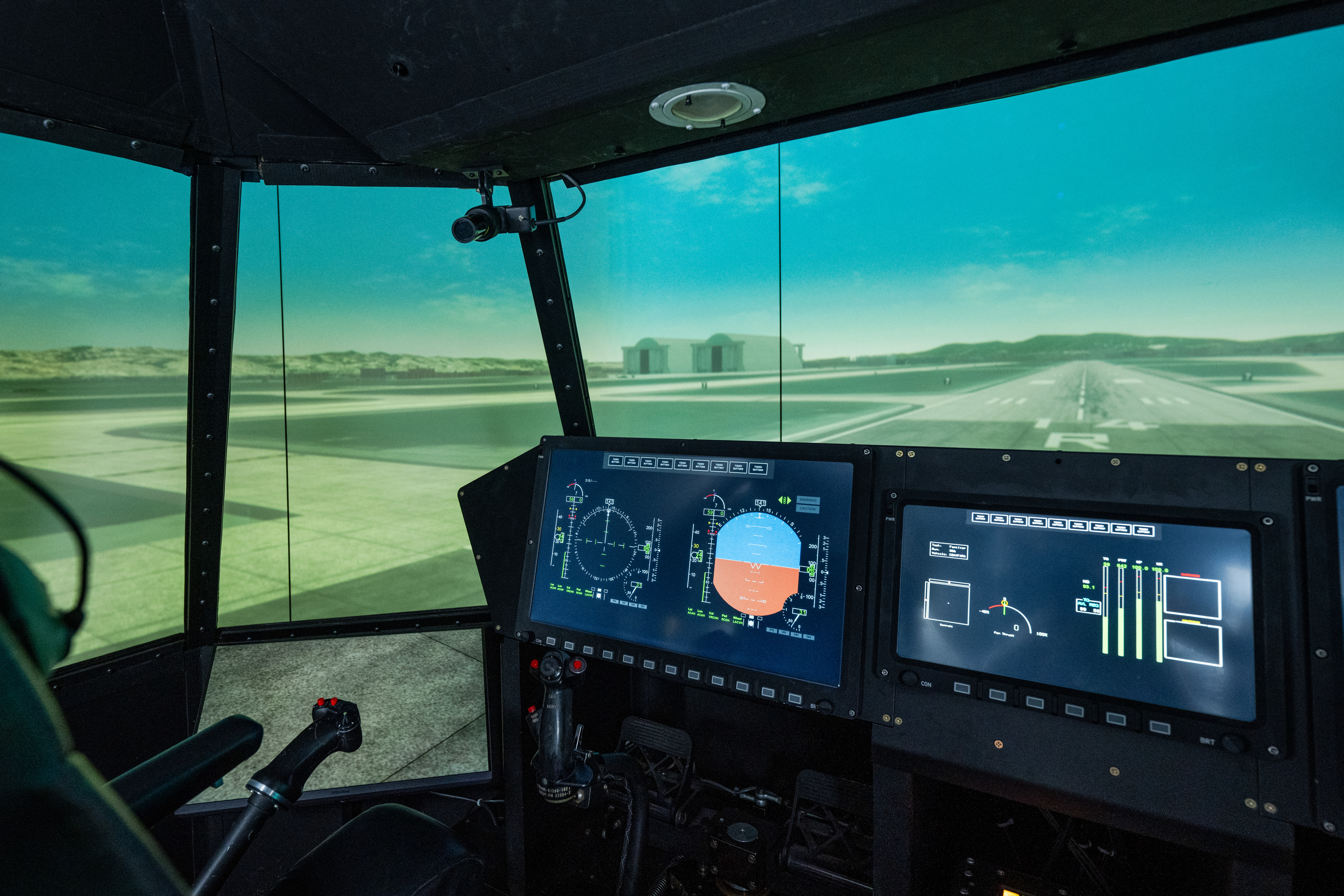
New improvements are making the simulator even more powerful. One of the biggest changes is the switch from analog systems to modern digital technology. This upgrade includes a dome surrounding the simulator’s cockpit with advanced 4K projectors that create visuals with nearly 20/20 clarity, giving pilots clearer, sharper images and a larger field of view of the world outside the cockpit.
The upgraded cab of the Vertical Motion Simulator at NASA’s Ames Research Center in California’s Silicon Valley provides researchers with near-20/20 visual clarity, providing clearer, sharper images.
NASA/Brandon Torres-Navarrete
“The new dome configuration and improved systems can support far more aggressive mission tasks while giving pilots and crews a more realistic environment to work in,” said Diana Acosta, aerospace simulation research and development branch chief at NASA Ames. “It strengthens how teams coordinate, react, and manage challenging scenarios, exactly the kind of preparation we need for the missions coming next.”
The system also can automatically line up and color‑match images to integrate them into a simulated background, a process that used to take hours, or even days, to do by hand.
In the past, changing simulation configurations from lunar lander to air taxi required swapping out the cab, a large, heavy structure that was time‑consuming and complex to move. Instead of replacing an entire cab, teams can use lighter, removable inserts that include only the controls, seats, and panels needed to stand in for a specific vehicle. The inserts drastically reduce physical labor and cut the time needed to configure a simulation in half.
The upgrades to the Vertical Motion Simulator will enable tests of next-generation aircraft and spacecraft before they ever leave the ground, bringing us closer to safer skies, more efficient air travel, and successful human landings on the Moon and Mars.

 Login
Login