Normal view

There are new articles available, click to refresh the page.
Before yesterdayMain stream

How NASA’s Artemis III Lander Test Will Pave Way for Moon Landings

By: Lee Mohon
15 July 2026 at 14:50
7 Min Read

How NASA’s Artemis III Lander Test Will Pave Way for Moon Landings

015B0626.NEF

Before Artemis astronauts land on the Moon’s surface in 2028, NASA will conduct the Artemis III demonstration mission in 2027, allowing teams on Earth and in orbit to practice rendezvous and docking operations between commercial human landing systems and the Orion spacecraft. Data from that mission, along with future uncrewed demonstration missions at the Moon, will support astronaut safety and mission success for crewed lunar landings.

NASA is working with two American companies to develop the human landing systems that will safely transport astronauts from lunar orbit to the Moon’s surface and back for future Artemis missions. For Artemis III, both SpaceX and Blue Origin will fly test versions, or test articles, of the crewed landers that will be used for future Moon landings. The lander test articles will launch by commercial rockets, while the Artemis III crew will launch to low Earth orbit in Orion atop the agency’s SLS (Space Launch System) rocket.

Stage setting for crewed flights

NASA and the human landing system providers have been working closely together to plan and determine capabilities for the Artemis III mission. With missions fast approaching, both SpaceX and Blue Origin are optimizing hardware availability and capability. SpaceX plans to use the company’s latest version of Starship and basis of the future Starship HLS, called Version 3, while Blue Origin will test their planned HLS crew cabin, allowing each company to apply lessons learned prior to uncrewed and crewed missions on the Moon.

“Each human landing system provider has taken a different approach to the Artemis III mission,” said Steve Creech, program manager, Human Landing System Program, NASA’s Marshall Space Flight Center in Huntsville, Alabama. “Ultimately, SpaceX and Blue Origin have put forward a list of aggressive objectives and goals intended to complement upcoming uncrewed demonstration missions at the Moon so that we can gain both understanding and confidence in the spacecraft and launch vehicles prior to a crewed landing. The lander prototype designs will inform future development efforts and will continue to mature over the next year.”

For the Artemis III mission, the Blue Moon test lander will be based on Blue Origin’s current architecture for its Mark 2 crew lander, incorporating all the major avionics and flight software and control systems to ensure flight operations from this demonstration mission can directly translate to crewed lunar flights. Up to two crew members, donning orange Orion crew survival system suits, will open the hatch to enter the Blue Origin test lander. The production hardware must incorporate many of the same systems and subsystems, including an Environmental Control and Life Support System (ECLSS), a crew cabin, and avionics.

These artist’s concepts depict Blue Origin’s Blue Moon Mark 2 human landing system test article in Earth orbit and docked with NASA’s Orion spacecraft as part of NASA’s upcoming Artemis III demonstration mission in low Earth orbit.
Blue Origin
These artist’s concepts depict Blue Origin’s Blue Moon Mark 2 human landing system test article in Earth orbit and docked with NASA’s Orion spacecraft as part of NASA’s upcoming Artemis III demonstration mission in low Earth orbit.
Blue Origin

The Blue Origin lander also will fly with an instrumented lunar surface spacesuit mass simulator. Like the suited “Moonikin” manikin that flew aboard Orion during the uncrewed Artemis I test flight, the low-fidelity spacesuit mass simulator will provide real-time feedback about the environment within the Blue Moon crew cabin.

SpaceX’s Starship lander test article will use a Starship Version 3, currently in production and testing, with an added docking system installed on the nose of the 171-foot (52-m) spacecraft, enabling NASA and SpaceX to evaluate how the entire integrated stack of Orion and the Starship test lander interact. NASA and SpaceX are identifying controllability and communications tests for the Artemis III mission. Astronauts will not enter the Starship test lander during Artemis III.

These artist’s concepts depict NASA’s Orion spacecraft and SpaceX’s Starship human landing system test article during docking operations as part of NASA’s upcoming Artemis III demonstration mission in low Earth orbit.
SpaceX
These artist’s concepts depict NASA’s Orion spacecraft and SpaceX’s Starship human landing system test article during docking operations as part of NASA’s upcoming Artemis III demonstration mission in low Earth orbit.
SpaceX

Launch cadence

NASA, SpaceX, and Blue Origin will launch three of the world’s most powerful rockets within a short timeframe of one another, exercising ground processing, launch crews, and facilities as well as control centers, networking, and data exchange at key sites across the country during two separate, back-to-back rendezvous and docking maneuvers between Orion and the lander test articles, before a safe splashdown of the Artemis III crew in Orion.

“Artemis III will be a highly choreographed dance with a demanding launch sequence across multiple launch pads and equally demanding mission operations for our ground and flight crews, making it one of the most complex and ambitious missions NASA has ever undertaken,” said Jeremy Parsons, Artemis program manager. “The demonstration mission will set the stage before our next giant leap. NASA’s expertise in systems engineering and integration, as well as launch and mission operations in low Earth orbit, will bring the mission together.”

For future crewed missions to the Moon, NASA and one of the commercial lander partners will execute a “dual launch campaign,” prepositioning the lander in orbit to await a crewed Orion, launched on SLS. Launching the three rockets in succession of one another for Artemis III offers a unique opportunity to practice launch processing and operations.

Blue Origin’s lander test article is planned to launch first and will be able to loiter in space for up to 30 days, allowing for checkouts in orbit prior to the launch of SLS and Orion from Launch Complex 39B at NASA’s Kennedy Space Center in Florida. The Blue Origin test article will launch at a set trajectory to meet a designated “parking” orbit for these systems checks.

Artemis III will be a highly choreographed dance with a demanding launch sequence across multiple launch pads and equally demanding mission operations for our ground and flight crews, making it one of the most complex and ambitious missions NASA has ever undertaken.

Jeremy Parsons

Jeremy Parsons

Artemis program manager

Following the completion of Blue Origin’s rendezvous and docking operations testing  and the Artemis III crewed launch on SLS, SpaceX will launch its Starship lander test article to rendezvous with Orion and its crew for its phase of on-orbit testing.

Throughout the Artemis III mission, Orion will fly in a circular orbit. All three rockets will have more launch opportunities than are available for a lunar mission and will be able to reach the designated mission altitude in a single launch.

Docking operations

During docking and undocking operations, Orion and the Artemis III crew will use the lander test articles as the targets, while Orion will operate as the chaser spacecraft. This is the same configuration planned for future crew landing mission to the Moon.

NASA will ensure both test landers are mission ready and crew safe prior to Artemis III. These verifications will be based on functional and performance requirements for the test lander designs and hazard controls for hardware and software, ensuring the Artemis III astronauts inside Orion are safe throughout both docking phases of the mission.

SpaceX and Blue Origin have already tested their docking capabilities for their respective landers on the ground. SpaceX’s docking capability was qualified in 2023; Blue Origin conducted development ground testing on its pressurized docking system earlier this year.

A key difference between the docking capabilities of both lander test articles will be the location of docking. Orion will dock along the side of the Blue Moon test lander, adjacent to the crew cabin. Later, Orion will dock nose-to-nose with the giant SpaceX test lander.

Software testing between spacecrafts will help demonstrate that the commercial human landing system prototypes and Orion can meet at a precise time and location in space. When Orion docks with the Blue Moon test lander, the Orion spacecraft’s software will control the docked spacecraft. Meanwhile, the SpaceX test article will control the docked spacecraft for the second portion of the mission. During the docking phases, teams with NASA and the commercial partners will be able to test hardware and software interoperability, as well as dynamics of how the integrated lander-Orion spacecraft moves in space.

Through the Artemis program, NASA will send astronauts to explore the Moon for scientific discovery, economic benefits, and to build the foundation for the first crewed missions to Mars – for the benefit of all.  

News Media Contact

AmberJacobson
Headquarters, Washington
240.298.1832
amber.c.jacobson@nasa.gov

Corinne Beckinger
Marshall Space Flight Center, Huntsville, Ala.
256-544-0034
corinne.m.beckinger@nasa.gov

About the Author

Corinne Beckinger

Public Affairs Official

Share

Details

Last Updated
Jul 15, 2026
Editor
Lee Mohon
Contact

NASA Space Telescope Maps Magnetic Fields of ‘Lighthouse’ Pulsar

9 July 2026 at 16:08
4 Min Read

NASA Space Telescope Maps Magnetic Fields of ‘Lighthouse’ Pulsar

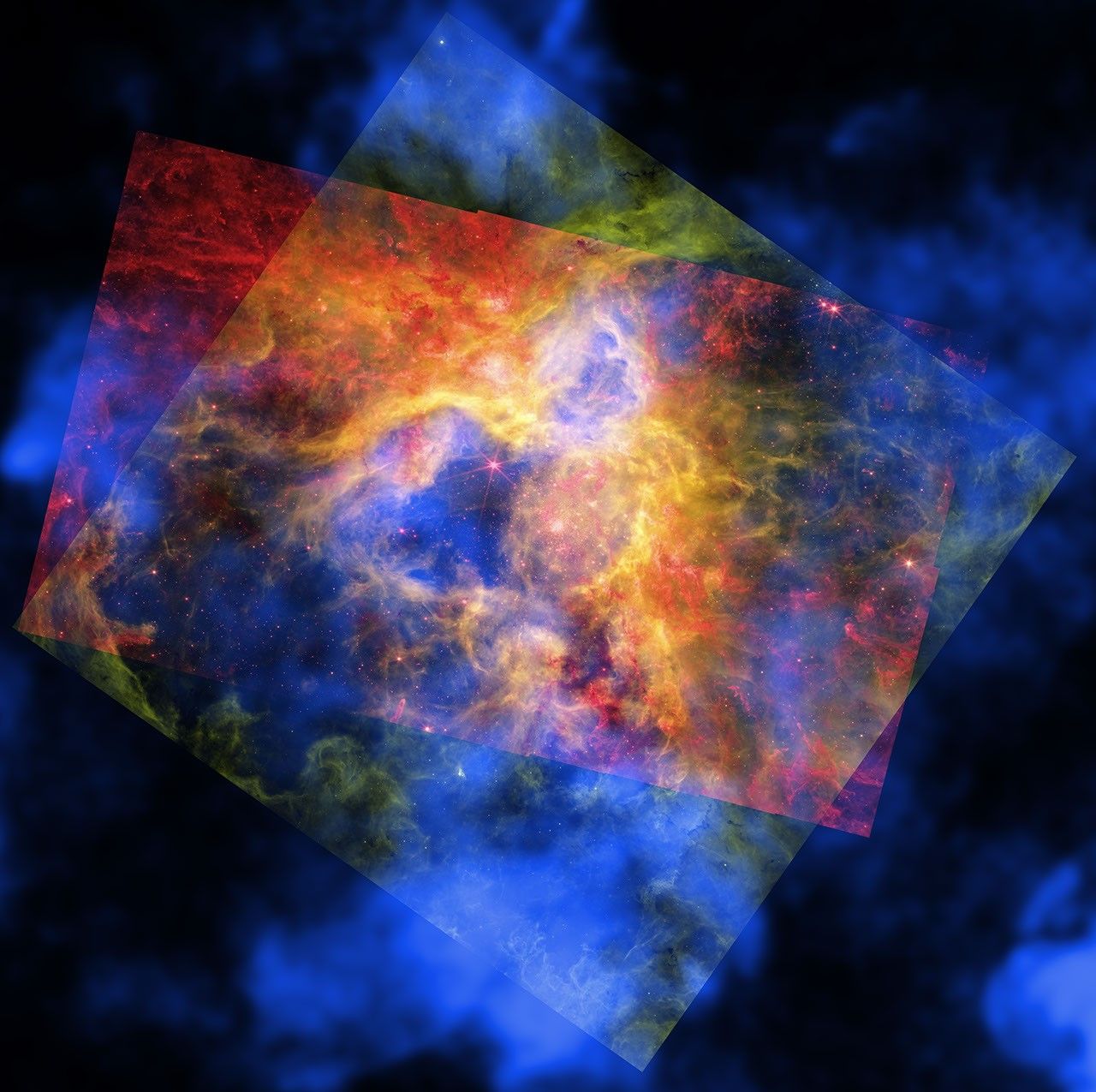
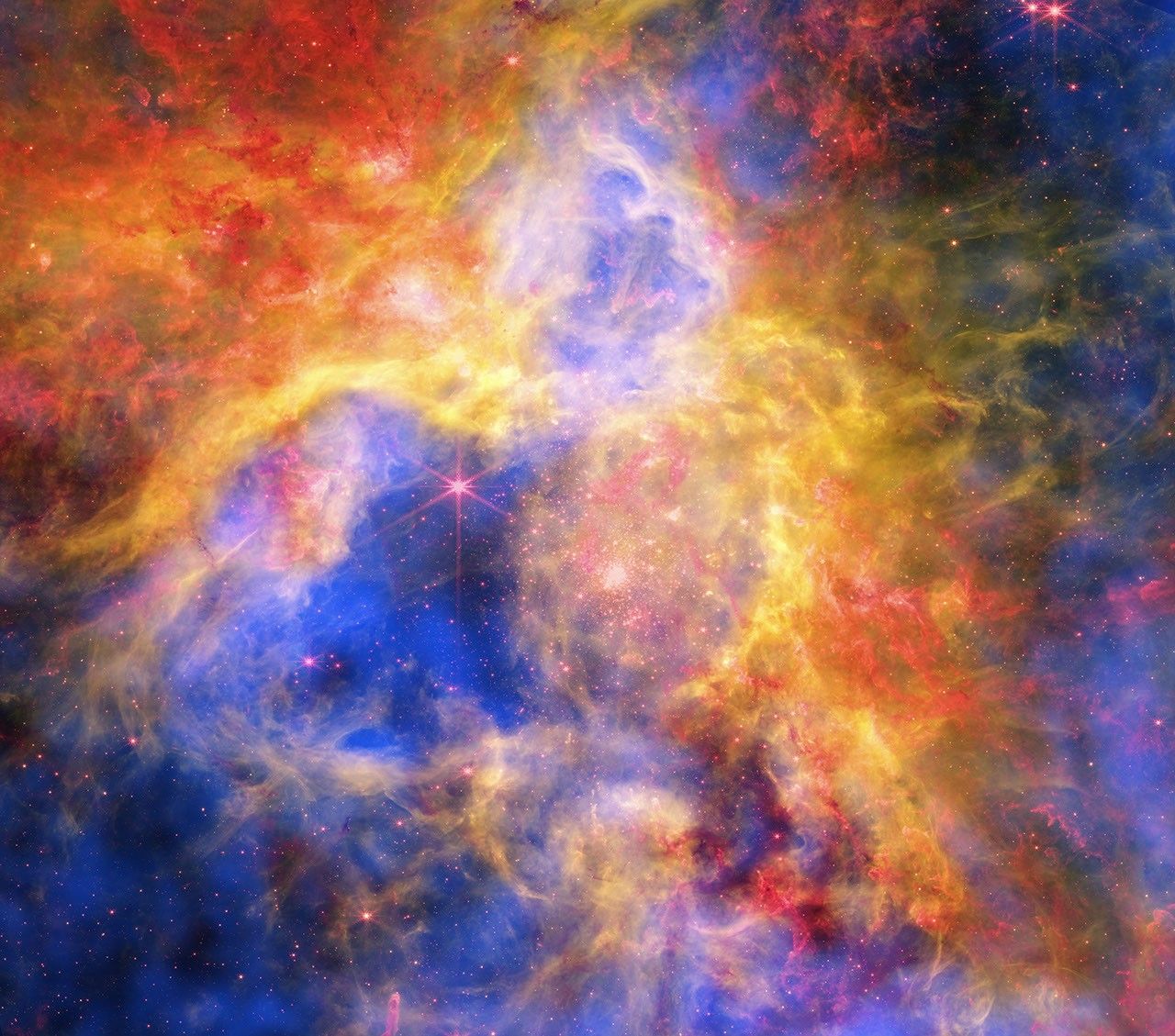
Scientists have successfully measured the magnetic field of the Lighthouse pulsar’s nebula using NASA’s IXPE. Their measurements confirm the theory that high-energy particles escape along the galaxy’s magnetic field lines. This composite image contains X-ray data from IXPE in blue, the Chandra X-ray Observatory in purple, and radio data from CSIRO in green. The starfield is optical data from the 2MASS optical survey.

For the first time, scientists have used NASA’s IXPE (Imaging X-ray Polarimetry Explorer) to directly measure the magnetic fields of PSR J1101−6101, a pulsar located within what is often referred to as the Lighthouse Nebula. The results provide new insight into the structure of some of the most extreme objects in the cosmos, as NASA continues to explore the secrets of how the universe works. A paper describing the results published Thursday in the Astrophysical Journal.

Scientists have successfully measured the magnetic field of the Lighthouse pulsar’s nebula using NASA’s IXPE. Their measurements confirm the theory that high-energy particles escape along the galaxy’s magnetic field lines. This composite image contains X-ray data from IXPE in blue (highlighted in the inset), the Chandra X-ray Observatory in purple, and radio data from CSIRO in green. The starfield is optical data from the 2MASS optical survey.
X-ray: Chandra: NASA/CXC/Stanford Univ./J.T. Dinsmore et al.; IXPE: NASA/MSFC/J.T. Dinsmore et al., Radio: CSIRO/ATNF/ATCA; Optical: 2MASS/UMass/IPAC-Caltech/NASA/NSF; Image processing: NASA/CXC/SAO/L. Frattare

Fast facts

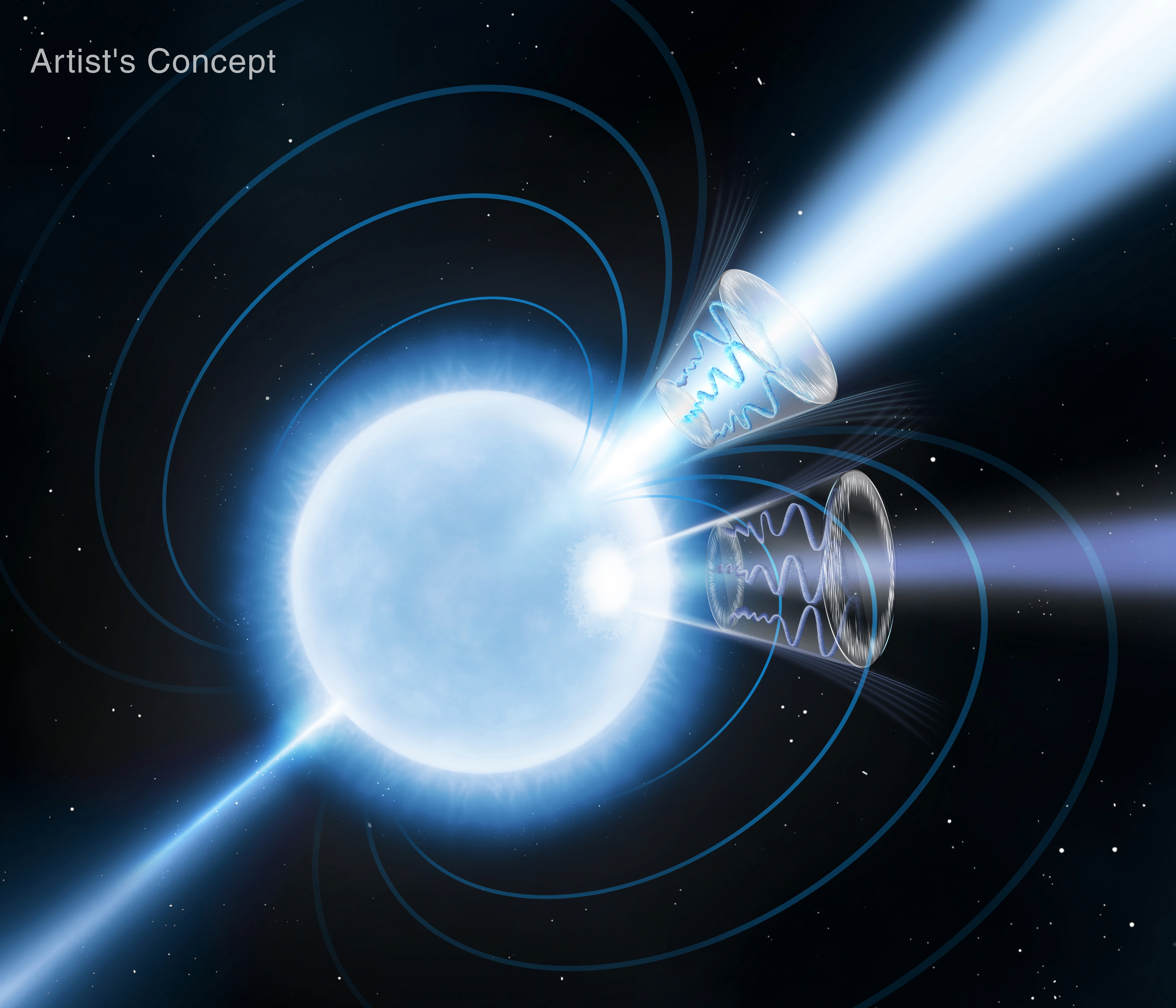
  • A pulsar is a type of neutron star with a strong magnetic field that spins incredibly fast. The pulsar at the center of the Lighthouse Nebula is rotating 16 times per second.
  • Neutron stars are the leftover cores of massive stars, formed at the end of their life cycles, that possess more mass than the Sun. They are condensed down to the size of a city, making them natural laboratories for studying extreme physics.
  • Polarization is a property of light that describes the direction of its electric field vibrations. The polarization degree is a measurement of how aligned those vibrations are with each other.

In June 2025, IXPE spent nearly 18 days focused on the Lighthouse Nebula.

Astronomers studied two narrow X-ray offshoots extending from the pulsar to better understand how electrons at nearly the speed of light interact with this energetic system. The longer offshoot is known as the “filament,” and the shorter one is the “trail.”

When high-energy particles from the pulsar collide with the gas of interstellar space, they form a bow shock, like the bow wave formed at the front of a speeding boat. Most particles become trapped behind this bow shock, forming the turbulent trail behind the pulsar.

Researchers have suspected since 2008 that the highest-energy particles escape through this bow shock into interstellar space, flowing along the galaxy’s magnetic field lines to create the nebula’s long, thin filament.

“We wanted to test that theory,” said Jack Dinsmore, graduate student at Stanford University, who led the study. “The ‘smoking gun’ would come by measuring the polarization of the light, which indicates the magnetic field direction. If the magnetic field points along the filament, that confirms that the filament’s particles are flowing along the field.”

One challenge with these measurements is that the Lighthouse Nebula is relatively faint. To address this, IXPE scientists developed advanced analysis methods that use every bit of data, avoiding simplifying steps that could limit information. With these new tools and the new observations of the Lighthouse, the science team successfully measured the filament’s polarization. These techniques also gave a polarization measurement of the trail, and the pulsar’s emission signal.

Their analysis confirmed with more than 99% confidence that the magnetic field does indeed align with the particles’ flow.

While the parallel direction confirms models for the particle’s motion, the polarization degree was high enough to raise new questions.

“Many of the models for filaments assume strong magnetic turbulence,” said Roger Romani, a Stanford University professor who co-authored this paper. “The high polarization degree we measured indicates lower turbulence than such models require.”

The IXPE observations also showed that the magnetic field responsible for X-ray emission had to be parallel to the trail. However, the authors collected radio frequency observations showing a magnetic field pointing almost exactly perpendicular.

“The striking divergence in magnetic field orientations observed between radio and X-ray wavelengths provides compelling evidence for the highly structured nature of these objects,” said Niccolò Bucciantini of the Italian National Institute for Astrophysics and co-author of the study. “This marks the first clear indication that particles of different energies occupy distinct regions within the system, hinting at the presence of multiple, and potentially very different, acceleration mechanisms at work.”

More about IXPE

The IXPE mission, which continues to provide unprecedented data enabling groundbreaking discoveries about celestial objects across the universe, is a joint NASA and Italian Space Agency mission with partners and science collaborators in 12 countries. It is led by NASA’s Marshall Space Flight Center in Huntsville, Alabama, and BAE Systems, Inc. manages spacecraft operations together with the University of Colorado’s Laboratory for Atmospheric and Space Physics in Boulder. 

Learn more about IXPE’s ongoing mission here: 

https://www.nasa.gov/ixpe

About the Author

Michael Allen

Michael Allen

Share

Details

Last Updated
Jul 13, 2026
Editor
Lee Mohon
Contact
Joel Wallace
Location
Marshall Space Flight Center

NASA’s Chandra Examines Milky Way at Arms’ Length

1 July 2026 at 16:17

5 min read

NASA’s Chandra Examines Milky Way at Arms’ Length

This sequence begins with an artist’s concept showing the Milky Way galaxy as seen from above, with the estimated positions of spiral arms based on previous data. Next is an updated artist’s concept of the Milky Way, where the positions of the two spiral arms most distant from the center of the galaxy have been adjusted based on newly processed X-ray data from NASA’s Chandra X-ray Observatory and ESA’s XMM-Newton. Both arms may be more distant than previously thought.
NASA/CXC/A. Hobart

A new result using NASA’s Chandra X-ray Observatory shows that the outer spiral arms in the Milky Way galaxy may reach wider than previously thought. This finding may lead astronomers to adjust their understanding of our home galaxy’s structure.

A team of astronomers made this discovery by making precise measurements of distances to dust clouds in the Milky Way’s spiral arms using data from both NASA’s Chandra and XMM-Newton, an ESA (European Space Agency) mission with NASA contributions. The results are described in a new paper published Wednesday in the Astronomy & Astrophysics journal.

The researchers determined the distances by studying rings around gamma-ray bursts, some of the brightest bursts of light in the universe, which arise from the collapse of massive stars or the merger of neutron stars. They are located at enormous distances, well beyond the confines of our galaxy.

An artist’s concept showing the Milky Way galaxy as seen from above, with the estimated positions of spiral arms based on previous data, in blue. Overlaid on this is an updated view of the Milky Way showing different positions for the two outermost spiral arms, shown in red and bordered by dashed lines. Both arms may be more distant than previously thought, based on newly processed X-ray data from Chandra and XMM.
NASA/CXC/SAO/M.Weiss

This distance measurement technique capitalized on the phenomenon of light echoes, where the light from the gamma-ray burst bounced off dust clouds in the spiral arms. The diameters of the rings in X-rays give the distances to Earth, with larger rings being generated by dust clouds closer to us.

“This is a very direct way – relying only on geometry – to precisely measure distances to the Milky Way’s spiral arms,” said Beatrice Vaia, who led the study while a PhD student in a joint program between Scuola Universitaria Superiore IUSS Pavia and University of Trento in Italy. “Most other methods rely on assumptions about how the Milky Way rotates, which become increasingly uncertain in the outer regions of our galaxy.”

Despite a century of awareness of the Milky Way’s spiral arms, astronomers are still working toward precise characterization of its arms because of Earth’s position within one. Dust and gas also block the view to other arms.

The researchers used three different gamma-ray bursts to determine the distances to three spiral arms in the Milky Way. In order of increasing distances from the Galactic Center, they are the Perseus, the Outer, and the Outer Scutum-Centaurus arms. Along the direction of one of the bursts, they found that both the Outer and Outer Scutum-Centaurus arms are about 10% more distant than astronomers previously thought.

“The differences are small, but any revision of these distances is important because they are so fundamental for understanding our galaxy,” said co-author Ilaria Fornasiero, who was a PhD student in the same program as the leading author. “For example, this could mean that astronomers have to revise estimates of the mass of the galaxy, because that affects how wide the arms stretch.”

The images include X-ray data from Chandra and optical data from Pan-STARRS. The composite image shows X-ray rings generated by a gamma-ray burst (GRB), a bright X-ray source located outside our galaxy. In a phenomenon called light echoes, the X-rays from the GRB bounced off dust clouds in the spiral arms of our galaxy. The diameters of the rings in the Chandra data give the distances of the dust clouds to Earth, with larger rings being generated by dust clouds closer to us. The GRB is located at the center of the circles defining the rings, to the left of the X-ray data outlined by the white square.
X-ray: NASA/CXC/INAF/B. Vaia et al.; Optical: Pan-STARRS; Image processing: NASA/CXC/SAO/N.Wolk & P.Edmonds

The team also used their data to estimate that the dust cloud in the most distant arm is about 3,500 light-years wide. These findings show that their measurements apply to the full thickness of the spiral arm, rather than a random, isolated dust cloud that may not fully be representative of the arm’s location.

While this technique provided major improvements in accuracy according to the researchers, it may be difficult to use it for further measurements because bright gamma-ray bursts that are visible through the plane of the galaxy are rare.

“We’re relying on the universe to provide us with these events, and so far, over 25 years, we’ve only found a handful that we can use,” said co-author Andrea Tiengo of Scuola Universitaria Superiore IUSS Pavia. “That said, we will continue to be on the lookout for more.”

NASA’s Marshall Space Flight Center in Huntsville, Alabama, manages the Chandra program. The Smithsonian Astrophysical Observatory’s Chandra X-ray Center controls science operations from Cambridge, Massachusetts, and flight operations from Burlington, Massachusetts.

Read more from NASA’s Chandra X-ray Observatory

To learn more about Chandra, visit:

https://nasa.gov/chandra

To learn more about NASA’s Chandra mission, visit:

https://nasa.gov/chandra

Visual Description

This release features a short video and a series of images, all related to an updated understanding of our home galaxy’s structure. By studying rings of X-ray light echoes, researchers now believe that two of the Milky Way’s spiral arms may be more distant from the center of the galaxy than previously thought.

The updated understanding of the structure of the Milky Way is highlighted in a short video, which compares two artist concept images. In both images, our spiral Milky Way galaxy is shown face-on. It has a bright white core with several arms that spiral out from the center, like long thin clouds corkscrewing counterclockwise. The two longest arms make a full rotation of the spiral galaxy, and curve all the way around to the upper right of the images.

The first image in the video shows the previous understanding of the Milky Way. Here, the two longest arms are curled around the core in a fairly tight spiral. In the second image, which represents the updated understanding, the two longest arms are more loosely spiraled. Visually, this means there is more open space between the curving arms, which are further away from the bright galaxy core. The video fades back and forth between the two artist concept images to illustrate the structural differences between the two understandings.

These findings are further shown by a static image which overlays the new understanding on top of the earlier understanding. In this artist’s concept illustration, dotted lines and different colors are used to differentiate between the two.

A team of astronomers made this discovery by studying gamma-ray bursts that bounce off of dust clouds in the galaxy’s spiral arms. The resulting rings of X-rays, known as light echoes, were detected and mapped by NASA’s Chandra X-ray Observatory and ESA’s XMM-Newton. In a supplemental data image, the light echoes resemble concentric arches of neon blue dots trailing across a speckled sky.

Identifying the position of the Milky Way’s spiral arms through X-ray light echoes has allowed astronomers to use geometry, rather than assumptions about galaxy rotation, to better understand the structure of our galaxy.

Share

Details

Last Updated
Jul 02, 2026
Editor
Lee Mohon
Contact
Joel Wallace
Megan Watzke
Location
Marshall Space Flight Center

Share

Details

Last Updated
Jul 02, 2026
Editor
Lee Mohon
Contact
Joel Wallace
Megan Watzke
Location
Marshall Space Flight Center

NASA’s Chandra Reveals ‘Red, White, Blue’ Universe for US 250th

30 June 2026 at 15:54
7 Min Read

NASA’s Chandra Reveals ‘Red, White, Blue’ Universe for US 250th

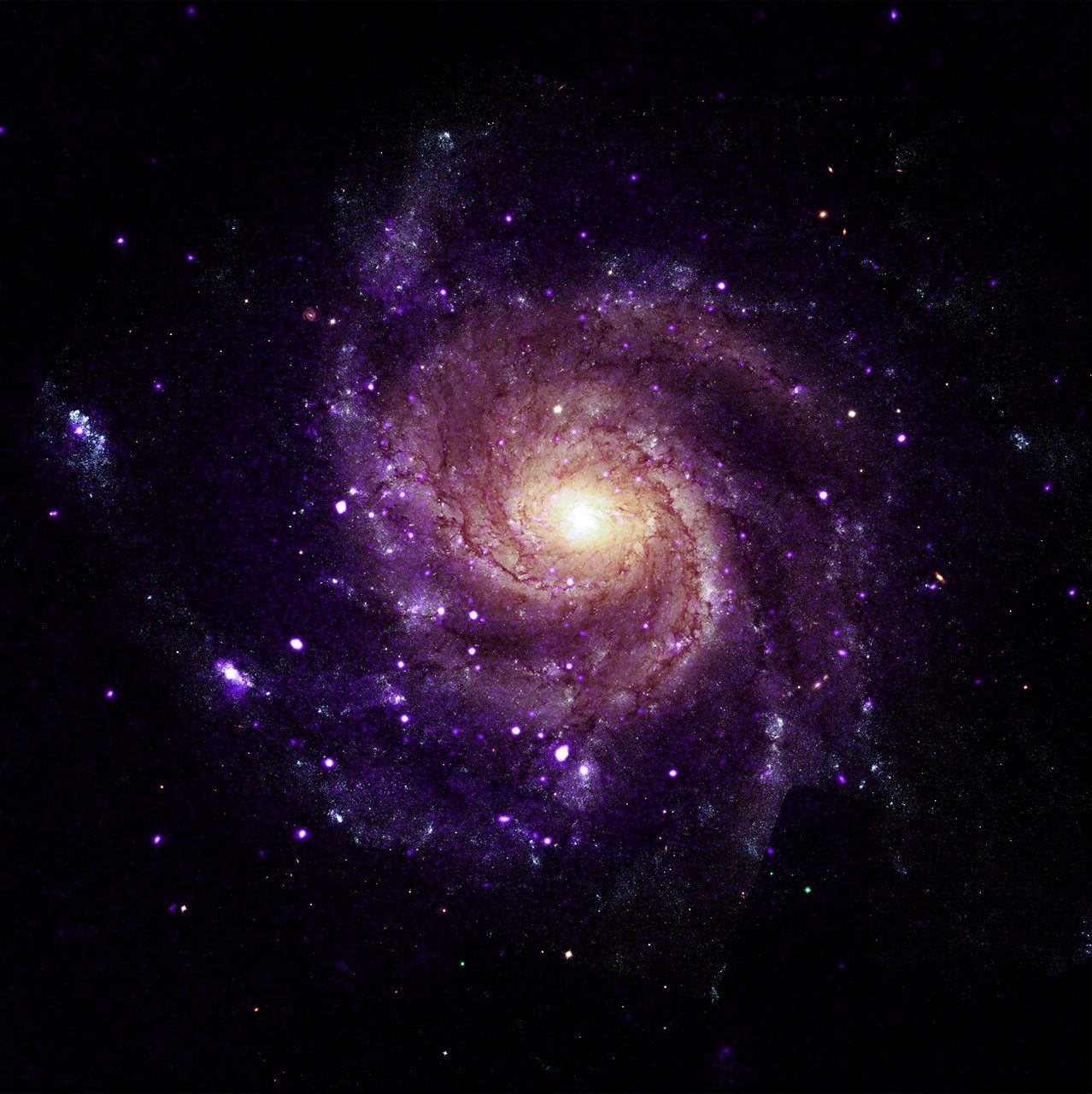
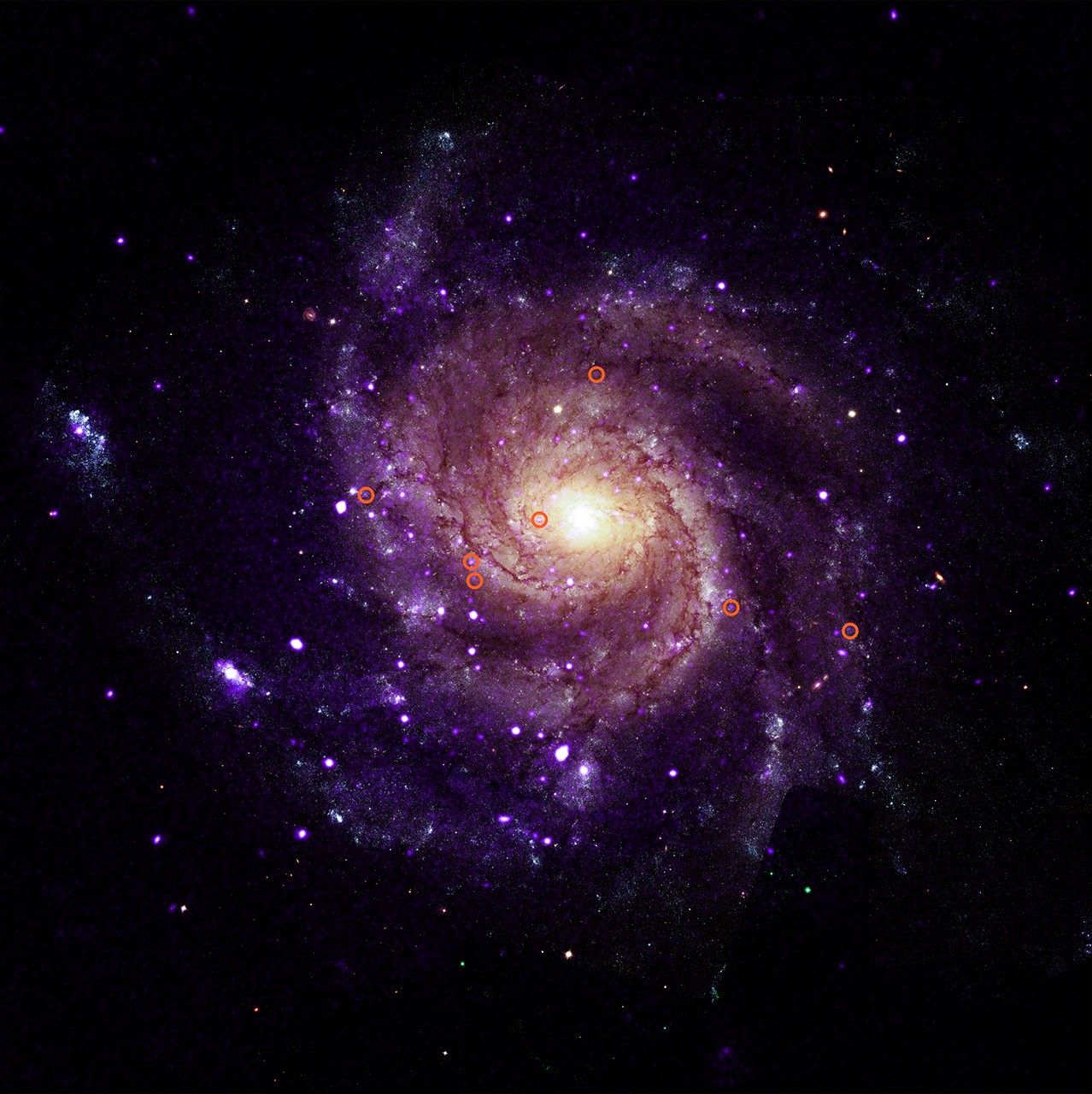
This image shows the galaxy NGC 4736, also known as Messier 94 or M94. X-rays of different wavelengths from Chandra are included along with a striking visible light image from astrophotographers Brian Brennan and Remi Lacasse using their telescopes on the ground. M94 is a spiral galaxy with a bright inner ring around it where new stars are forming called a starburst ring, perhaps fueled by gas driven in from its unique bar-like oval structure. It also has a remarkable outer ring of spiral arms.

In celebration of the 250th birthday of the United States, NASA has unveiled four cosmic images from its Chandra X-ray Observatory rendered in red, white, and blue that represent the wonders of the universe the agency explores. The images are accompanied by a trio of new sonifications – a technique that translates astronomical data into sounds.

In celebration of the 250th birthday of the United States, NASA’s Chandra X-ray Observatory has unveiled four cosmic images rendered in red, white, and blue that represent the wonders of the universe that NASA explores.
NASA/CXC/SAO

The image set begins with Cassiopeia A in the top panel, where X-rays from Chandra (represented in blue and purple) have been combined with an infrared image from NASA’s James Webb Space Telescope (red and white). Chandra’s X-ray vision reveals the blast wave that tore through the star, as well as elements in the debris field like iron, calcium, and oxygen. Webb’s infrared data also shows the expanding shell of material from the explosion and cosmic dust throughout the remnant.

 In the bottom row, the first image on the left is the nebula NGC 3603, which contains a massive cluster of stars and is located in the Milky Way Galaxy. This new composite image contains Chandra’s X-ray data (red and white) and shows diffuse emissions near the galaxy’s center along with point-like X-ray sources throughout the middle of the image. Optical, infrared, and ultraviolet light from NASA’s Hubble Space Telescope (red-orange, green, blue, and yellow) reveal stars in the center of the image and dust and gas toward the bottom. The combined layering of the colors makes this nebula and the stars forming within it appear primarily red, white, and blue, with X-rays showing the sparkling lights of young stars.

The middle panel of the bottom row is a new look at the galaxy NGC 4736, also known as Messier 94. In this image, X-rays of different wavelengths from Chandra (red, orange, and blue) are layered with a visible light image from astrophotographers using their telescopes on the ground (red, green, and blue). Messier 94 is a spiral galaxy with a bright inner ring around it, called a starburst ring, where new stars are forming, perhaps fueled by gas driven in the unique oval-shaped structure seen here.

The final image in this red, white, and blue quartet features ZwCl 0024+1652. This is a distant galaxy cluster in which astronomers have found evidence for dark matter by using specially processed data from Hubble (blue). Another image from Hubble reveals the individual galaxies in the cluster (appearing as yellow and white). X-ray data from Chandra shows the enormous reservoir of superheated gas that pervades this galaxy cluster (red) with much more mass than all the galaxies taken together.

New sonifications of the three images along the bottom row of this mosaic are also available, allowing listeners to experience data through sound.

The translation of NGC 3603 into sound begins with a left to right scan, where the brightnesses of the sources once again dictate volume. Chandra’s observations of compact sources sprinkled throughout the galaxy are heard as piano notes, while the diffuse X-ray emission is mapped to a range of audio frequencies. The Hubble optical data is played as sustained tones and acoustic guitar harmonics.

In the sonification of NGC 4736, the radar-like scan moves clockwise, and the brightness of the sources dictates the volume of the sounds. X-rays from Chandra have been turned into wind-like sounds that follow the shape of the X-ray emission. Neutron stars and stellar-mass black holes (known as “compact sources”) detected by Chandra are mapped to pitched tones on a glass marimba. Optical data from ground-based observations is mapped to musically pitched tones, creating a low drone, while stars and background galaxies are heard as a soft piano.

For ZwCl 0024+1652, the sonification begins as a circle on the outside of the image and moves inward. The volume is linked to the brightness of the data, reaching one peak as the circle passes over the dark matter detected by inference from Hubble optical observations and another as it reaches the core. The background stars are heard as a swelling glockenspiel-like sound, and the galaxies are played on a piano. Chandra’s X-rays, which dominate the center of the galaxy cluster and reveal superheated gas, are represented by airy synthesizer notes.

The sonification program is led by the Chandra X-ray Center (CXC) and included as part of NASA’s Universe of Learning program. The collaboration was driven by visualization scientist Kimberly Arcand, (CXC), Matt Russo, astrophysicist; and Andrew Santaguida, musician, SYSTEM Sounds project; along with Christine Malec, consultant. Previously released sonifications of data from Cassiopeia A can be found at chandra.si.edu/sound.

NASA’s Marshall Space Flight Center in Huntsville, Alabama, manages the Chandra program. The Smithsonian Astrophysical Observatory’s Chandra X-ray Center controls science operations from Cambridge, Massachusetts, and flight operations from Burlington, Massachusetts.

To learn more about NASA’s Chandra mission, visit:

https://nasa.gov/chandra

Visual Description

In celebration of the 250th birthday of the United States, this release includes a series of images featuring four wonders of the universe, rendered in red, white, and blue. The images contain X-ray data from the Chandra X-ray Observatory, optical and infrared data from the Hubble Space Telescope and the James Webb Space Telescope, as well as ground-based telescopes.

The main image set features composite images of the four individual objects; Cassiopeia A, NGC 3603, M94/NGC 4736, and ZwCl 0024+1652.

Cassiopeia A occupies the top panel of the frame, significantly larger than the other images in the set. The cloudy blast-wave of the supernova remnant is ring-like in shape, streaked with veins of iron, calcium, and oxygen. Here, presented in red, white, and blue, the remnant resembles an electrified donut, crackling with marbled veins of strawberry and blueberry icing.

At our lower left of the image set is the nebula NCG 3603, which contains a massive cluster of stars on the other side of the Milky Way galaxy. Here, a tight cluster of neon red and white stars packs the center of the image, dissipating as it reaches the outer edges of the panel. Sweeping in at the lower corners of the image are hazy blue clouds resembling sheets of gauze.

Centered at the bottom of the image set is the galaxy NGC 4736, also known as Messier 94 (M94). Here, the spiral galaxy is seen face on, with concentric pale violet cloud rings flecked with scores of stars in white, pale blue, soft red, and golden yellow. The inner ring of the galaxy is bright, and rosy yellow in color. This is a starburst ring, where new stars are forming.

At our bottom right of the image set is the distant galaxy cluster ZwCl 0024+1652. The image is packed with streaks and specks in golden yellow and brilliant white. Upon close inspection, each streak and speck is revealed to be an individual galaxy, some with discernible spiral shapes. At the center of the image is a round pool of bright red light, surrounded by royal blue haze. The red light represents X-ray observations by Chandra, which reveal an enormous reservoir of superheated gas pervading the cluster. The blue haze represents specially-processed data from Hubble, suggesting evidence of dark matter.

This release also includes new sonifications of the three images presented in the bottom row of this data set, allowing listeners to experience the data through sound.

Read more from NASA’s Chandra X-ray Observatory

News Media Contact

Megan Watzke
Chandra X-ray Center
Cambridge, Mass.
617-496-7998
mwatzke@cfa.harvard.edu

Joel Wallace
Marshall Space Flight Center, Huntsville, Alabama
256-544-0034
joel.w.wallace@nasa.gov

Share

Details

Last Updated
Jun 30, 2026
Editor
Lee Mohon
Contact
Joel Wallace
Location
Marshall Space Flight Center
❌
❌