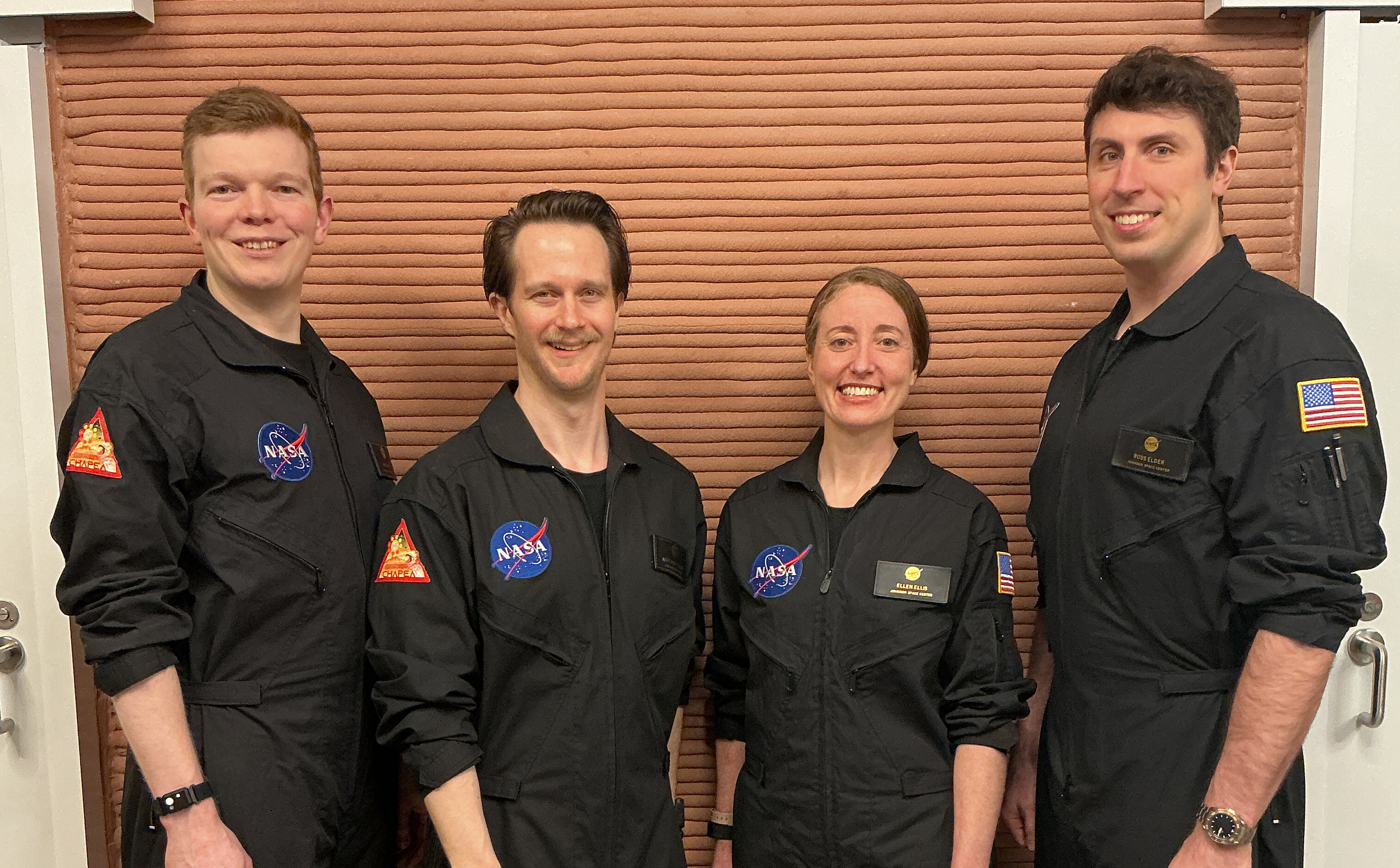
Members of NASA’s CHAPEA (Crew Health and Performance Exploration Analog) Mission 2 crew stands in their workspace after spending a year in their isolated and confined habitat at NASA’s Johnson Space Center in Houston. (from left: James Spicer, Matthew Montgomery, Ellen Ellis, and Ross Elder).
NASA
The four crew members in NASA’s simulated Mars mission have spent the past year living and working in isolation in a confined habitat at NASA’s Johnson Space Center in Houston. For the past 365 days, the Crew Health and Performance Exploration Analog (CHAPEA) Mission 2 crew members have operated as though they were on the Red Planet, growing crops, managing limited resources, navigating communication delays, and conducting suited extravehicular activities on a simulated Martian surface.
Crew members include Ross Elder, mission commander; Ellen Ellis, medical officer; Matthew Montgomery, science officer; and James Spicer, flight engineer. They entered their 1,700 square foot 3D-printed habitat Oct. 19, 2025. Leading up to the one-year mark of their 378‑day mission, science teams at NASA prepared to process health and performance data collected on the crew. This critical data can help NASA balance priorities and develop methods that counter spaceflight risks during future long-duration missions on Mars.
“We are extremely proud of the crew for their commitment and achievements over the last year on such a fast-paced, highly demanding mission,” said Grace Douglas, CHAPEA principal investigator. “The entire CHAPEA team is excited to congratulate the crew in person.”
The crew will exit their habitat on Saturday, Oct. 31, to conclude their mission. They will have a chance to reconnect with their families, who they’ve only spoken with via email over the course of their mission with a Mars-like communication delay. The crew will then begin two weeks of post-mission evaluations and debriefs with NASA scientists.
These debriefs and evaluations will help scientists learn what it takes for crews to adapt to the routines and demands of daily life on long-duration missions, giving NASA insight into what future explorers may need to stay healthy, productive, and connected during missions far from Earth.
For example, data could shed light on how limited food and exercise systems will influence NASA’s ability to achieve mission objectives, including spacewalks on the surface of Mars. Some data also could help NASA foster autonomy and build decision-making support systems that best aid crew with communication delays lasting up to 45 minutes each way.
“This mission has been incredibly valuable in starting to teach ushow to understand requirements for year-long missions, including medical and psychological care, via communication delays,” said Michael Stenger, chief scientist for NASA’s Human Research Program. “When combining this Mars-realistic mission analog with a suite of physiological, psychological, and performance measures in a rigorously controlled environment, we’ll be able to translate the knowledge from these experiences to Moon Base and beyond.”
To watch the CHAPEA Mission 2 egress ceremony on Oct. 31, visit:
James Spicer, Crew Health and Performance Exploration Analog (CHAPEA) Mission 2 flight engineer, participates in an extravehicular geological activity.
NASA
Ellen Ellis, CHAPEA Mission 2 medical officer, performs a medical task with Ross Elder, mission commander.
NASA
The CHAPEA crew showcases the instruments they brought on their mission. The crew elected to include instruments as part of their personal item allowance. From left: James Spicer, Ellen Ellis, Matthew Montgomery, and Ross Elder.
NASA
CHAPEA Mission 2 crew members Ellen Ellis (left) and Ross Elder (right) conduct a maintenance task during a simulated extravehicular activity, also known as a spacewalk.
NASA
Photos that the CHAPEA Mission 2 crew arranged around a boot print in the simulated Martian sand outside their habitat.
NASA
____
NASA’s Human Research Program
NASA’s Human Research Program pursues methods and technologies to support safe, productive human space travel. Through science conducted in laboratories, ground-based analogs, commercial missions, the International Space Station and Artemis missions, the program scrutinizes how spaceflight affects human bodies and behaviors. Such research drives the program’s quest to innovate ways that keep astronauts healthy and mission ready as human space exploration expands to the Moon, Mars, and beyond.
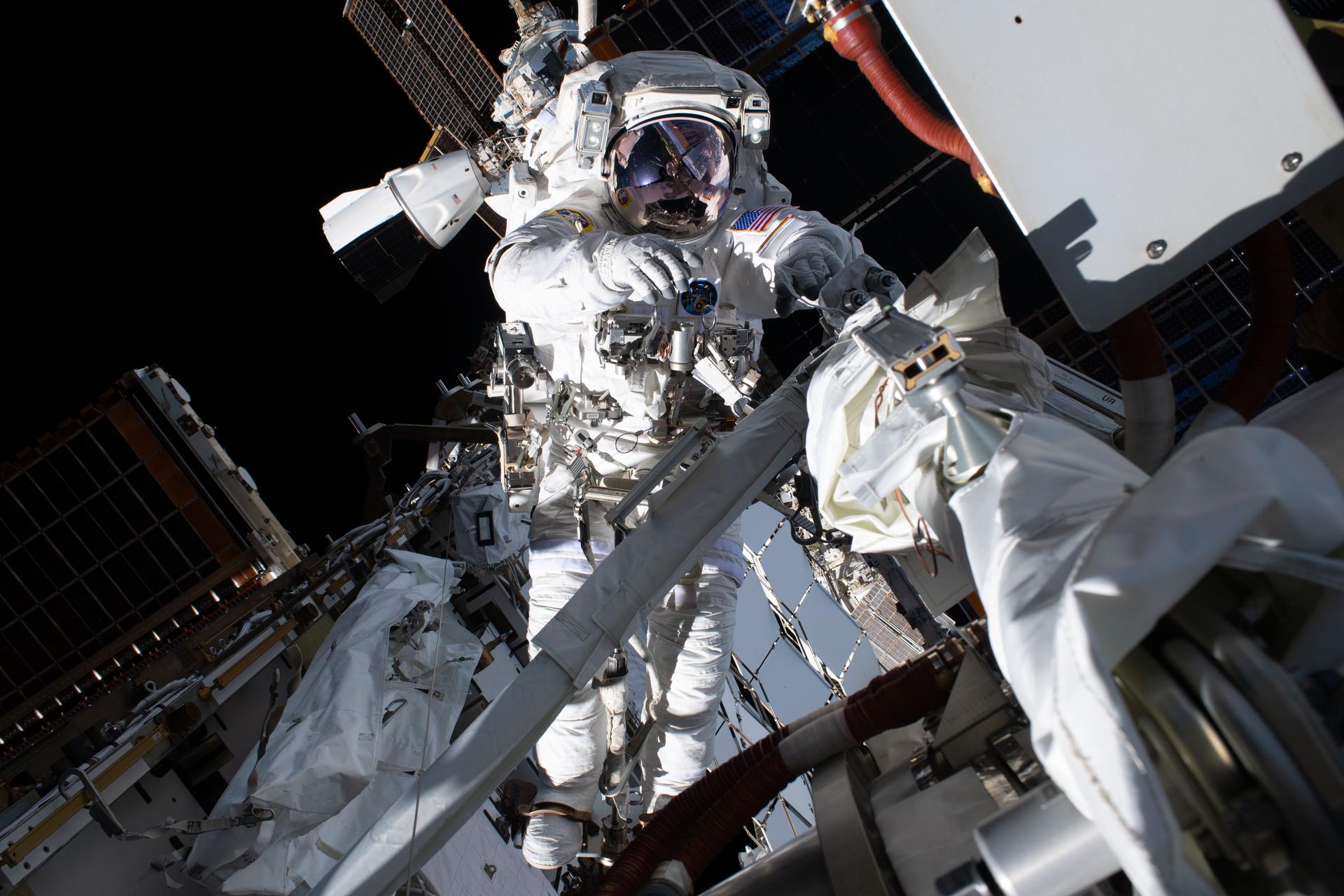
NASA astronaut Anil Menon conducts a spacewalk on Aug. 6, 2026, to prepare the International Space Station for future upgrades to its power system.
Credit: NASA
NASA will preview two upcoming spacewalks to complete solar array installation and power augmentation of the International Space Station during a news conference at 2 p.m. EDT, Tuesday, Oct. 20, from NASA’s Johnson Space Center in Houston.
NASA will stream the event through a variety of platforms. Learn where to watch online:
United States-based media interested in attending in person must contact the Johnson newsroom no later than 3 p.m., Monday, Oct. 19, at: jsccommu@mail.nasa.gov. Media joining by phone should request dial-in details by the same deadline. To ask a question, media must dial in no later than 15 minutes before the start of the news conference.
Thursday, Oct. 29
During U.S. spacewalk 100, NASA astronaut Anil Menon and CSA (Canadian Space Agency) astronaut Joshua Kutryk will exit the station’s Quest airlock to install and deploy an International Space Station Roll-Out Solar Array (IROSA) on the 2A electrical power channel. The solar array will be the seventh IROSA and will provide additional power to support critical station operations, including its safe and controlled deorbit.
Thursday, Nov. 5
During U.S. spacewalk 101, Menon and Kutryk will install and deploy the eighth and final IROSA on the 3B channel of the space station, completing the power augmentation upgrades.
The final two roll-out solar arrays will complete the space station’s power system augmentation. Together, the eight roll-out arrays will increase available power by up to 30%, boosting the station’s electric power generation capacity from 160 kilowatts to approximately 215 kilowatts.
NASA will share additional coverage details about U.S. spacewalks 100 and 101 closer to each operation on the agency’s live events web page and the space station blog. The spacewalks will be the 285th and 286th conducted in support of space station assembly, maintenance, and upgrades.
To learn more about International Space Station research, operations, and its crews, visit:
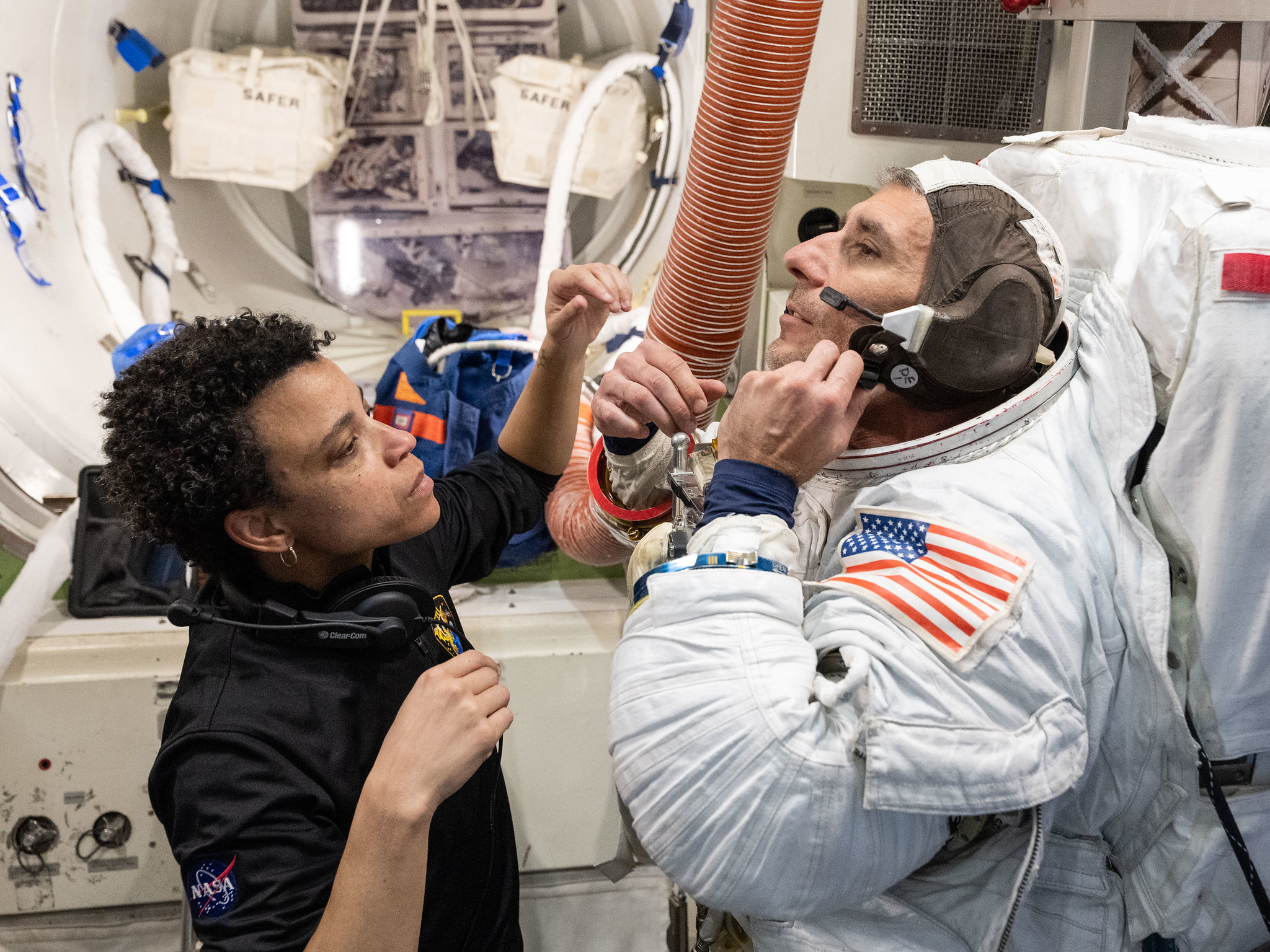
NASA astronaut Jessica Watkins assists NASA astronaut Luke Delaney as he practices suiting up in a spacesuit in an International Space Station airlock simulator on May 5, 2026, at the agency’s Johnson Space Center Space Vehicle Mockup Facility in Houston.
Credit: NASA
Editor’s Note: This article was updated Thursday, Oct. 15, 2026, to reflect a change to the event start time.
Students in Florida will hear from NASA astronauts Jessica Watkins and Luke Delaney as they answer prerecorded STEM questions while aboard the International Space Station.
The Earth-to-space call will begin at 12:30 p.m. EDT Friday, Oct. 16, and will stream live on the agency’s Learn With NASA YouTube channel.
This event is hosted by Sally Ride Elementary School in Orlando, Florida, for students in grades K-12, and the community. This unique opportunity aims to deepen understanding of space exploration and enhance awareness of STEM careers.
Media interested in covering the event must RSVP no later than 5 p.m. EDT, Thursday, Oct. 15, to Jenny Morgan at (407) 858-3100, or at jenny.morgan@ocps.net.
For more than 25 years, people have lived and worked continuously aboard the International Space Station, advancing scientific knowledge and making research breakthroughs not possible on Earth. The space station helps NASA understand and overcome the challenges of human spaceflight, expand commercial opportunities in low Earth orbit, and build on the foundation for long-duration missions to the Moon, as part of the Artemis program, and to Mars.
For more information on NASA in-flight calls, visit:
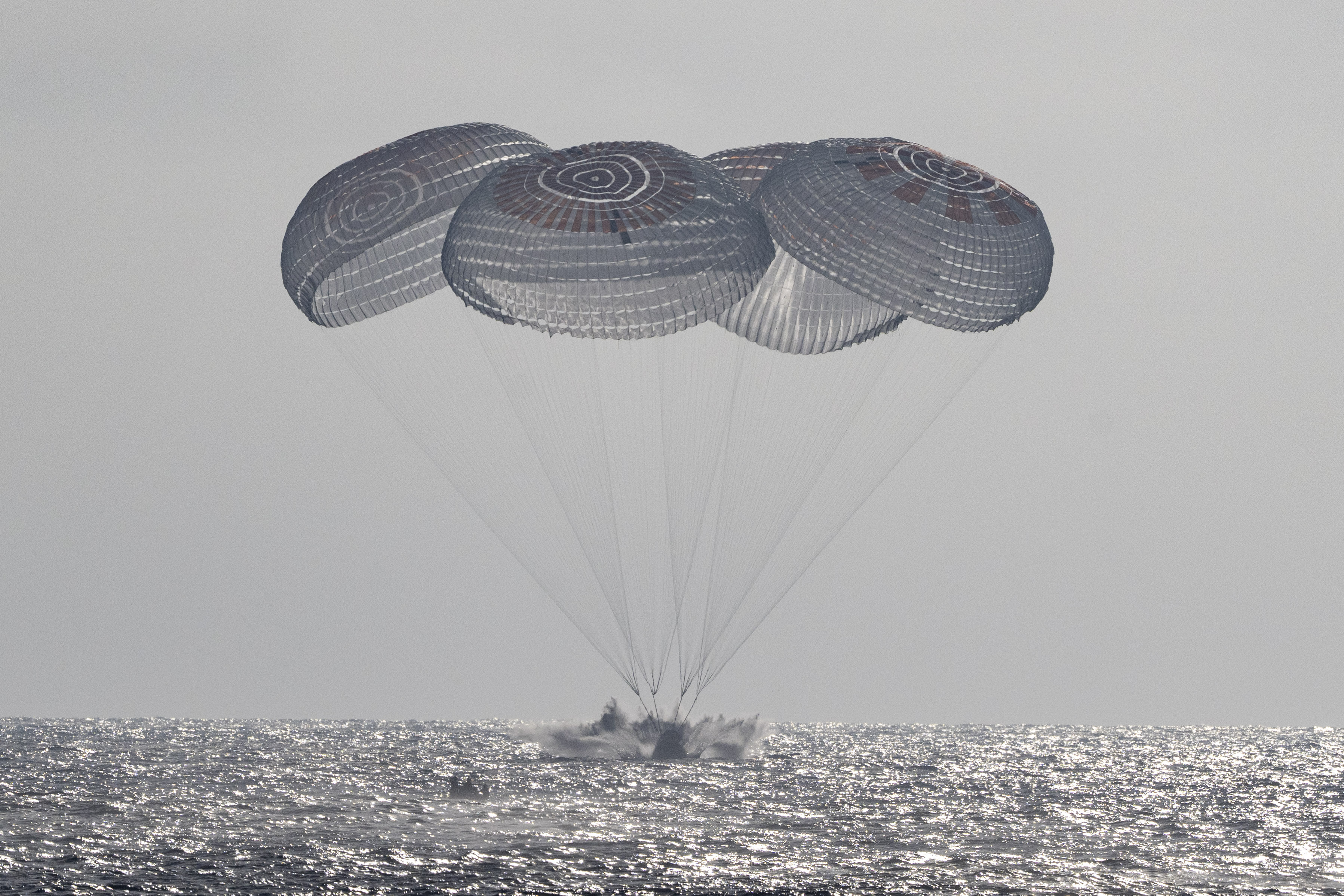
The SpaceX Crew Dragon Freedom spacecraft is seen as it lands with NASA astronauts Jessica Meir, Jack Hathaway, ESA (European Space Agency) astronaut Sophie Adenot, and Roscosmos cosmonaut Andrey Fedyaev aboard in the Pacific Ocean off the coast of Los Angeles on Oct. 8, 2026.
Credit: NASA/Keegan Barber
After more than seven months aboard the International Space Station, NASA’s SpaceX Crew-12 mission safely splashed down Thursday in the Pacific Ocean off the coast of Los Angeles. The crew members will discuss their science mission during a news conference at 3:30 p.m. EDT, Thursday, Oct. 15, at the agency’s Johnson Space Center in Houston.
“Jessica, Jack, Sophie, and Andrey spent 237 days living and working in orbit, traveled more than 100 million miles, advanced important science, and returned safely home because of the extraordinary expertise and competence of thousands across NASA, SpaceX, and our international partners,” said NASA Administrator Jared Isaacman. “Building the capability, experience, and confidence to do this repeatedly is exactly what will allow us to go farther, and I am grateful to Crew-12 and their families for their service to humanity’s greatest adventure.”
NASA astronauts Jessica Meir and Jack Hathaway, ESA (European Space Agency) astronaut Sophie Adenot, and Roscosmos cosmonaut Andrey Fedyaev returned to Earth at 8:34 a.m. PDT. Teams aboard SpaceX recovery vessels retrieved the spacecraft and its crew shortly after. Following standard postflight medical screenings, the crew will fly to shore before returning to NASA’s Johnson Space Center in Houston.
“NASA’s activities supporting the International Space Station — transporting crew, conducting impactful research, and maintaining critical national assets — enable the science, engineering, and risk‑reduction needed for future missions across the solar system,” said Dana Weigel, manager of NASA’s Low Earth Orbit Program at the agency’s Johnson Space Center. “We’re grateful for the dedication across the human spaceflight team that makes this possible, and we’re thrilled to welcome Jessica, Jack, Sophie, and Andrey home.”
During their 237-day mission, the four crew members traveled more than 100 million miles and completed more than 3,792 orbits around Earth. The mission was the second for Meir and Fedyaev and the first for Hathaway and Adenot. Crew-12 lifted off at 5:15 a.m. EST on Feb. 13 and docked to the orbiting laboratory a day later.
Crew‑12 logged hundreds of hours of scientific research to support human exploration beyond low Earth orbit and advance benefits for people on Earth. The crew members’ work included testing stem cell production for cell‑based therapies, demonstrating on‑demand IV fluid generation for future missions, and studying how the bacteria that causes pneumonia can lead to long‑term heart damage. The crew also conducted nutrition-focused research and examined how physical characteristics may affect blood flow during spaceflight to help keep astronauts safe and healthy on future missions. Research conducted aboard the space station advances knowledge and demonstrates new technologies that enable us to prepare for human exploration of the Moon and Mars.
Meir completed four spacewalks, bringing her career total to seven. That places her third all-time in total spacewalks among women at NASA, behind former agency astronauts Peggy Whitson and Suni Williams. Adenot completed three spacewalks, becoming the first French woman to venture outside the orbital outpost.
United States-based media interested in attending the crew news conference in person with Meir, Hathaway, and Fedyaev, must contact the NASA Johnson newsroom no later than 5 p.m. EDT, Tuesday, Oct. 13, at jsc-newsroom@mail.nasa.gov. Media joining by phone must request dial-in details by 9:30 a.m., Oct. 15. To ask a question, media must join no later than 15 minutes before the start of the news conference. The agency’s media credentialing policy is available online. Adenot will return to Europe and not be available during the news conference.
NASA’s Low Earth Orbit Program provides reliable access to space, maximizing the use of the International Space Station for research and development by partnering with private U.S. companies, including SpaceX, to transport astronauts to and from the space station.
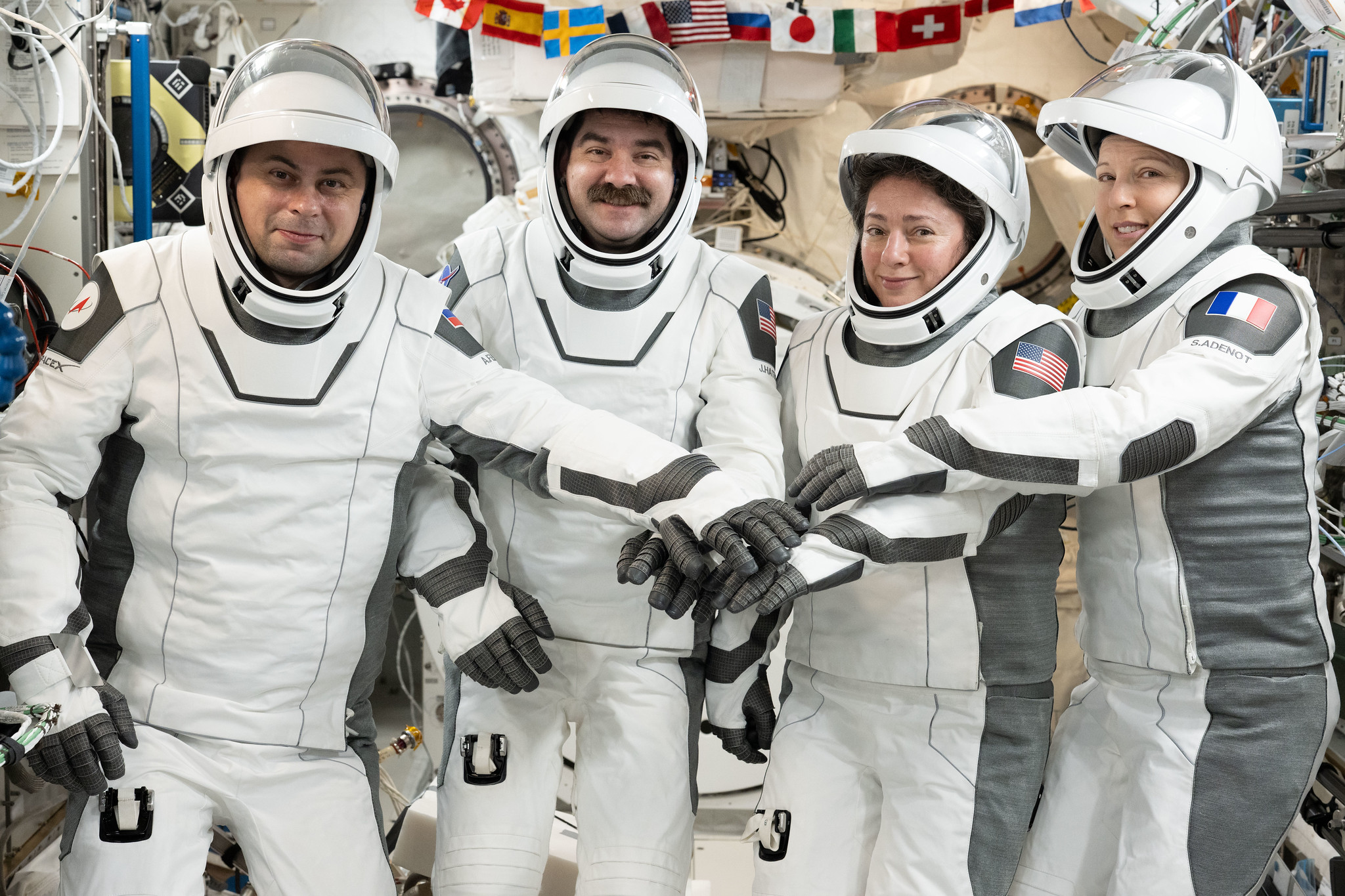
NASA’s SpaceX Crew-12 members gather for a portrait in the pressure suits they will wear when they depart the International Space Station inside the SpaceX Dragon spacecraft. From left, Roscosmos cosmonaut and mission specialist Andrey Fedyaev, NASA astronauts Jack Hathaway and Jessica Meir, Crew-12 pilot and commander respectively, and ESA (European Space Agency) astronaut and mission specialist Sophie Adenot.
Credit: NASA/Anil Menon
NASA and SpaceX are targeting no earlier than 8:05 a.m. EDT, Wednesday, Oct. 7, for the undocking of the agency’s SpaceX Crew-12 mission from the International Space Station, pending weather conditions.
An Oct. 7 undock puts NASA astronauts Jessica Meir and Jack Hathaway, ESA (European Space Agency) astronaut Sophie Adenot, and Roscosmos cosmonaut Andrey Fedyaev on schedule to splash down off the coast of California at approximately 11:34 a.m. on Thursday, Oct. 8.
NASA’s live Crew-12 return coverage will stream through a variety of platforms. Learn where to watch online:
Mission managers continue monitoring conditions in the recovery area, as undocking of the SpaceX Dragon depends on spacecraft readiness, recovery team readiness, weather conditions in the Pacific off the coast of California, and other factors.
NASA’s coverage is as follows (all times Eastern and subject to change based on real-time operations):
Wednesday, Oct. 7
6 a.m.: Hatch closure coverage begins
6:20 a.m.: Hatch closing
7:45 a.m.: Undocking coverage begins
8:05 a.m.: Undocking
Following the conclusion of undocking coverage, NASA will provide audio-only communications between Crew-12, the space station, and flight controllers during Dragon’s transit away from the orbital complex.
Bill Spetch, deputy manager of Commercial, NASA’s Low Earth Orbit Program
Dr. Liz Warren, deputy chief scientist, NASA’s Low Earth Orbit Program
Lee Echerd, senior mission manager, Customer Operations and Integration, SpaceX
Andreas Mogensen, leader, Human Exploration Group, ESA
To participate virtually in the teleconference, media must contact the NASA Johnson newsroom for call details by 12 p.m., Oct. 8, at: jsccommu@mail.nasa.gov or 281-483-5111. To ask questions, media must dial in no later than 10 minutes before the start of the call. The agency’s media credentialing policy is available online.
For more information about the Crew-12 mission, visit:
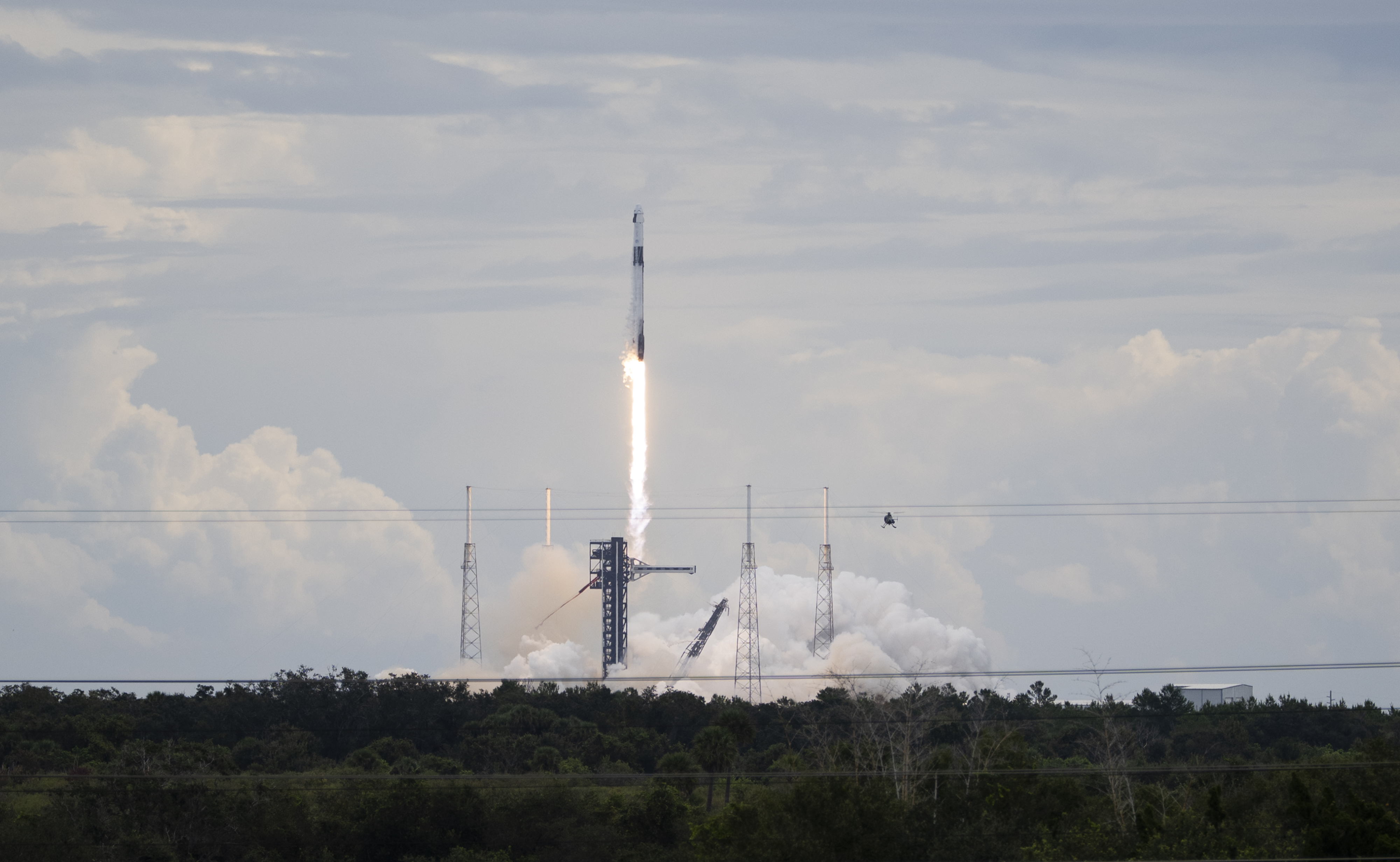
A SpaceX Falcon 9 rocket carrying the company’s Dragon spacecraft launched on NASA’s SpaceX Crew-13 mission to the International Space Station with NASA astronauts Jessica Watkins and Luke Delaney, CSA (Canadian Space Agency) astronaut Joshua Kutryk, and Roscosmos cosmonaut Sergey Teteryatnikov onboard, Thursday, Oct. 1, 2026, from Cape Canaveral Space Force Station in Florida.
Credit: NASA/Joel Kowsky
Four crew members of NASA’s SpaceX Crew-13 mission launched at 11:10 a.m. EDT Thursday from Space Launch Complex 40 at Cape Canaveral Space Force Station in Florida for a science expedition aboard the International Space Station.
“Crew-13 is another demonstration of America’s unmatched capability in human spaceflight and the strength of our commercial partnerships,” said NASA Administrator Jared Isaacman. “Jessica, Luke, Joshua, and Sergey will carry forward important work aboard the International Space Station while helping us build the experience and capabilities needed for ambitious missions to the Moon and beyond. Congratulations to the crew and the NASA and SpaceX teams who made today’s launch possible.”
A SpaceX Falcon 9 rocket propelled a Dragon spacecraft into orbit carrying NASA astronauts Jessica Watkins and Luke Delaney, CSA (Canadian Space Agency) astronaut Joshua Kutryk, and Roscosmos cosmonaut Sergey Teteryatnikov. The spacecraft will dock autonomously to the forward port of the station’s Harmony module at approximately 7 p.m., making it the fastest launch-to-docking by a U.S. spacecraft in the history of the International Space Station.
“Our steady cadence of commercial crew launches demonstrates the essential role the International Space Station plays in sustaining our presence in Earth’s orbit and sharpening the tools we’ll take forward to the Moon and Mars,” said Dr. Lori Glaze, associate administrator of NASA’s Human Spaceflight Mission Directorate at the agency’s headquarters in Washington. “Each space station mission adds to our blueprint for exploration, and the work our crews carry out guides our plans while ensuring we keep pushing the boundaries of what’s possible in human spaceflight.”
During Dragon’s approximately 7-hour, 50-minute flight, SpaceX will monitor a series of automatic spacecraft maneuvers from its mission control center in Hawthorne, California. NASA will monitor space station operations throughout the flight from the Mission Control Center at the agency’s Johnson Space Center in Houston.
NASA’s live arrival coverage begins at 5:20 p.m. for rendezvous, docking, and hatch opening. After docking, the crew members will change out of their spacesuits and prepare cargo for offload before opening the hatch to the station’s Harmony module around 8:45 p.m.
NASA will stream Crew‑13’s arrival across multiple platforms. Learn where to watch at:
Watkins, Delaney, Kutryk, and Teteryatnikov will join the Expedition 75 crew, which includes NASA astronaut Anil Menon and Roscosmos cosmonauts Pyotr Dubrov and Anna Kikina already aboard the station. After a brief handover, NASA’s SpaceX Crew‑12 mission, with agency astronauts Jessica Meir and Jack Hathaway, ESA (European Space Agency) astronaut Sophie Adenot, and Roscosmos cosmonaut Andrey Fedyaev, will return to Earth.
During its mission, Crew‑13 will help advance research aboard the orbiting laboratory by using microgravity to produce human stem cell‑derived tissues for improved personalized medicine, disease modeling, and pharmaceutical testing for conditions such as heart disease and Parkinson’s. The crew also will explore crop production through a new, mostly autonomous plant growth system and test how plants grow outside dedicated facilities. In addition, the crew members will continue human‑health studies that examine factors linked to blood-flow abnormalities in microgravity and will test a new inflight diagnostic device to monitor astronaut health.
Crew-13 is part of NASA’s Low Earth Orbit Program, which partners with private companies to provide reliable access to space, support research and development aboard the space station, and enable future missions beyond low Earth orbit.
Preparations for Next Moonwalk Simulations Underway (and Underwater)
Banner image for 2027 Human Lander Challenge.
NASA
NASA’s 2027 Human Lander Challenge is seeking ideas from college and university students to help address one of the most critical needs for sustained lunar exploration: reliable communications.
As NASA prepares for long-term human presence on the Moon through the Artemis and Moon Base programs, communications systems will be just as important as spacecraft and rockets. A resilient communications system will connect astronauts, rovers, habitats, landers, mission support teams on Earth, and more. Reliable communications are essential for ensuring safety, coordinating complex operations, and enabling timely decision-making in the harsh and remote lunar environment.
“Reliable communications will be at the heart of our ability to explore and operate on the Moon,” said Jeremy Del Greco, Human Landing System program communications integration lead at NASA’s Marshall Space Flight Center in Huntsville, Alabama. “As Artemis and Moon Base missions expand our presence beyond Earth, we will need dependable connections across the lunar surface and beyond. The 2027 Human Lander Challenge gives students the opportunity to help shape the communications capabilities of tomorrow and support future lunar exploration.”
The 2027 competition invites United States-based collegiate teams and their faculty advisers to develop innovative, systems-level solutions to better understand, establish, and optimize lunar communications for landers and surface operations that can be implemented within three to five years.
Teams should submit a non-binding notice of intent by Thursday, Oct. 15, if they would like to participate. Proposal packages, including a five to seven-page proposal and a two-minute video, are due March 4, 2027.
While teams may propose solutions outside of the focus areas, NASA has identified three main categories to advance future lunar communications capabilities:
Hardware:
Space-rated wireless networks and electronics
Antenna signal propagation, modeling, and environmental mitigation
Software:
Data efficiency and link optimization
Network management and scheduling
Architecture
Surface communications system architecture
Orbital communications system architecture
Based on proposal package evaluations in phase 1, up to 12 finalist teams will be selected to receive $9,000 and advance to phase 2 of the competition, which includes a final design review in Huntsville, Alabama, home of NASA’s Marshall Space Flight Center, June 21–24, 2027. The top three teams from phase 2 will share a total prize of $18,000.
The Human Lander Challenge is administered by the National Institute of Aerospace on behalf of the agency and supports NASA’s efforts to foster innovative solutions to a variety of areas for long-duration human spaceflight plans at the Moon. The Human Lander Challenge is sponsored by the agency’s Human Spaceflight Mission Directorate’s Human Landing System Program Office.
Through the Artemis program, NASA will send astronauts to explore the Moon for scientific discovery, economic benefits, and to build the foundation for the first crewed missions to Mars – for the benefit of all.
For more information on NASA’s Human Lander Challenge and how to participate, visit:
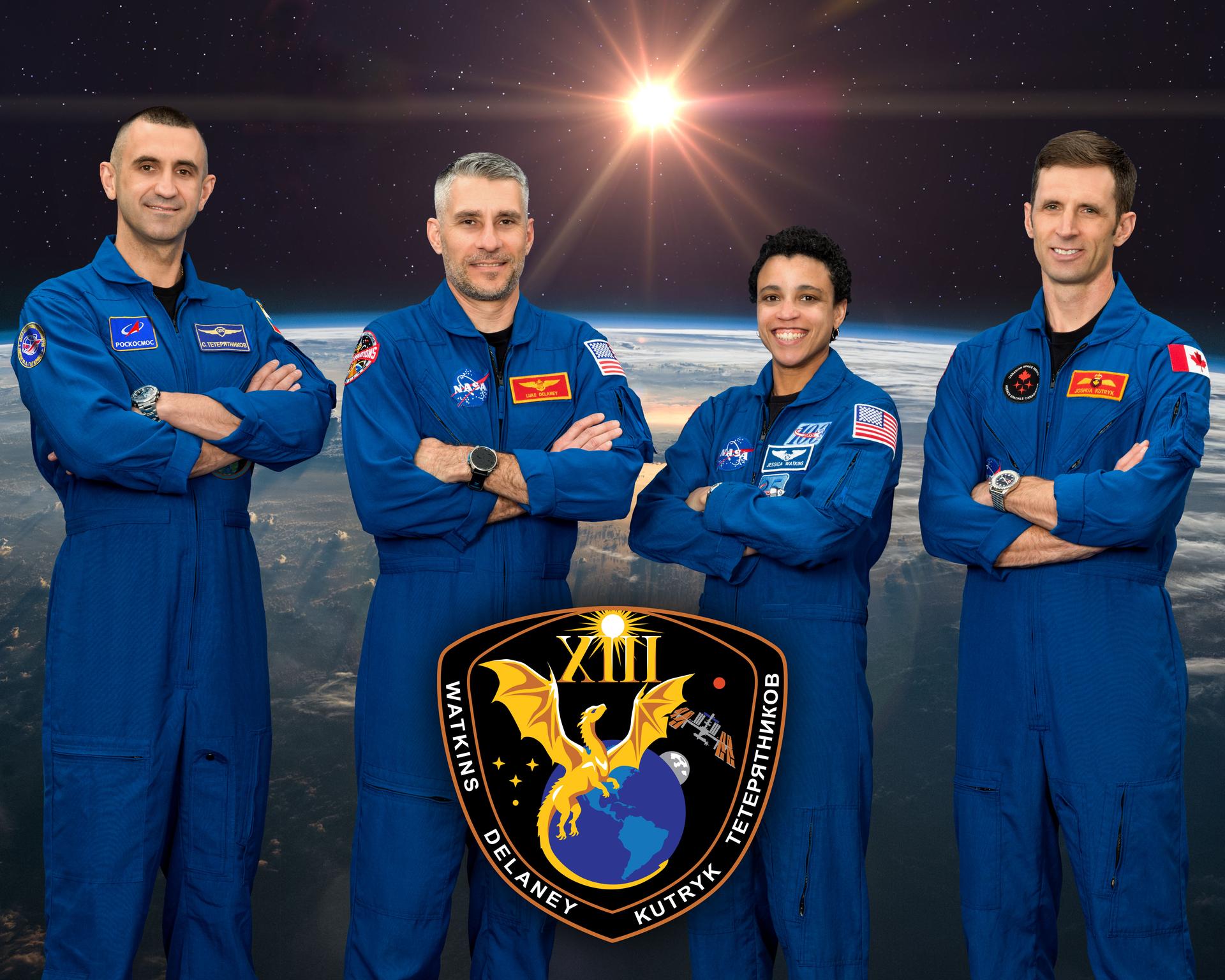
The four members of NASA’s SpaceX Crew-13 mission to the International Space Station pose together for an official crew portrait. From left are Roscosmos cosmonaut Sergey Teteryatnikov, NASA astronauts Luke Delaney and Jessica Watkins, and CSA (Canadian Space Agency) astronaut Joshua Kutryk.
Credit: NASA/Bill Stafford
Editor’s note: This advisory was updated Sept. 30, 2026 with an updated time for the prelaunch news conference.
NASA will provide live coverage of prelaunch, launch, and docking activities for the agency’s SpaceX Crew‑13 mission to the International Space Station.
Live coverage will stream through a variety of platforms. Learn where to watch online:
Crew‑13 is scheduled to launch at 11:10 a.m. EDT, Thursday, Oct. 1, from Space Launch Complex 40 at Cape Canaveral Space Force Station in Florida, with docking planned for about 7 p.m. The SpaceX Dragon spacecraft will carry NASA astronauts Jessica Watkins and Luke Delaney, CSA (Canadian Space Agency) astronaut Joshua Kutryk, and Roscosmos cosmonaut Sergey Teteryatnikov to the International Space Station for a long-duration science mission.
Any events in person are only open to previously credentialed media. Call details are available to media upon request.
NASA’s Crew-13 mission coverage is as follows (all times Eastern and subject to change based on real-time operations):
Wednesday, Sept. 30
6 p.m.: Prelaunch news conference with the following participants:
Dr. Lori Glaze, associate administrator, Human Spaceflight Mission Directorate, NASA Headquarters
Dana Weigel, manager, Low Earth Orbit Program, NASA’s Johnson Space Center in Houston
Mathieu Caron, director, Astronauts, Life Sciences, and Space Medicine, CSA
William Gerstenmaier, vice president, Build and Flight Reliability, SpaceX
Arlena Moses, launch weather officer, Cape Canaveral Space Force Station’s 45th Weather Squadron
Media may ask questions in person and via phone. Limited auditorium space will be available for in-person participation. For the dial-in number and passcode, please contact the NASA Kennedy newsroom no later than one hour prior to the beginning of the news conference at: ksc-newsroom@mail.nasa.gov.
Thursday, Oct. 1
9:20 a.m.: Launch coverage begins
11:10 a.m.: Launch
Following the conclusion of launch coverage, NASA will provide audio-only discussions between Crew-13, the space station, and flight controllers during Dragon’s transit to the orbital complex.
12:45 p.m.: Postlaunch news conference with the following participants:
NASA Administrator Jared Isaacman
Dr. Lori Glaze, associate administrator, Human Spaceflight Mission Directorate, NASA Headquarters
Dana Weigel, manager, Low Earth Orbit Program, NASA Johnson
Mathieu Caron, director, Astronauts, Life Sciences, and Space Medicine, CSA
Julianna Scheiman, director, NASA Science and Dragon Programs, SpaceX
Media may ask questions in person and via phone. Limited auditorium space will be available for in-person participation. For the dial-in number and passcode, please contact the NASA Kennedy newsroom no later than one hour prior to the beginning of the news conference at: ksc-newsroom@mail.nasa.gov.
NASA’s live Crew-13 coverage returns with rendezvous and docking streaming on a variety of platforms. The planned 7-hour, 50-minute trip from launch to docking on Oct. 1 will be the fastest by a U.S. spacecraft in space station history.
5:20 p.m.: Arrival coverage begins
7 p.m.: Targeted docking to the forward-facing port of the station’s Harmony module
8:45 p.m.: Hatch opening followed by welcome remarks
All times are estimates and could be adjusted based on real-time operations after launch. Follow the space station blog for the most up-to-date operational information.
Once aboard the station, the crew members will conduct a brief handover with the agency’s SpaceX Crew-12 mission, which is expected to begin its return to Earth no earlier than Monday, Oct. 5. NASA will share additional details on Crew-12’s return after Crew-13’s arrival.
NASA will provide a live video feed of Space Launch Complex 40 approximately six hours prior to the planned liftoff of the Crew-13 mission. Pending unlikely technical issues, the feed will be uninterrupted until the prelaunch broadcast begins on NASA+, approximately two hours prior to launch. Once the feed is live, find it online at: http://youtube.com/kscnewsroom.
Media who need access to NASA live video feeds may subscribe to the agency’s media resources distribution list to receive daily updates and links.
Audio-only coverage
Launch audio also will be available on Launch Information Service and Amateur Television System’s VHF radio frequency 146.940 MHz and KSC Amateur Radio Club’s UHF radio frequency 444.925 MHz, FM mode, heard within Brevard County on the Space Coast.
Attend launch virtually
Members of the public may register to attend this launch virtually. NASA’s virtual guest program for this mission also includes curated launch resources, notifications about related opportunities or changes, and a stamp for the NASA virtual guest passport following launch.
NASA website launch coverage
Launch day coverage of the mission will be available on the NASA website. Coverage will include live streaming at 9:10 a.m. on Oct. 1, and blog updates as the countdown milestones occur.
On-demand streaming video and photos of the launch will be available shortly after liftoff. For questions about countdown coverage, contact the NASA Kennedy newsroom at 321-867-2468. Follow countdown coverage on the commercial crew blog.
Watch, engage on social media
Follow the Crew-13 mission on X, Facebook, and Instagram by following and tagging these accounts:
NASA has delivered on its goal of safe, reliable, and cost-effective transportation to and from the International Space Station from the United States through a partnership with American private industry. This partnership is opening access to low Earth orbit and the International Space Station to more people, more science, and more commercial opportunities. For more than 25 years, people have continuously lived and worked aboard the space station, advancing scientific knowledge and demonstrating new technologies that enable us to prepare for human exploration of the Moon as we prepare for Mars.
For more information about the Crew-13 mission, visit:

 Login