President Donald Trump presents an executive order establishing the United States Space Academy during an event to award the Congressional Space Medal of Honor to the Artemis II crew as Michael Kratsios, director of the Office of Science and Technology Policy, left; Kevin Hassett, director of the National Economic Council, third from left; and NASA Administrator Jared Isaacman, right, applaud, Friday, Aug. 28, 2026, at NASA’s Johnson Space Center in Houston.
Credit: NASA/John Kraus
Less than two weeks after an Executive Order was signed to create the first United States Space Academy, NASA-led work is in full swing to make the academy a reality and shape the future of America’s aerospace workforce and leadership.
NASA Administrator Jared Isaacman chaired the first Presidential Commission on the United States Space Academy meeting on Sept. 9. Following that meeting, NASA published a Request for Information Thursday seeking input from governors or their designees interested in hosting and sponsoring the up-and-coming academy in their state.
“Our first Commission meeting made clear how much talent and commitment we have behind President Trump’s vision for the U.S. Space Academy,” said NASA Administrator Jared Isaacman. “I’m grateful to our partners across government for getting right to work. Now, with the RFI underway, states across the country have an opportunity to help us shape a legacy institution built for America’s future in space.”
Isaacman and Deputy Administrator Matt Anderson welcomed key commission members from multiple agencies and organizations to NASA Headquarters in Washington for a collaborative Commission discussion. Participants included U.S. Secretary of War Pete Hegseth, Director of the National Economic Council Kevin Hassett, Secretary of the United States Air Force Troy Meink, and U.S. Chief Technology Officer Ethan Klein, representing Director of Office and Technology Policy Michael Kratsios, along with representatives from the U.S. Office of Management and Budget, the National Security Council, and the White House.
During the meeting, commission members began working through the structure and priorities of the proposed U.S. Space Academy, including its governance, curriculum, service commitments, partnerships, and implementation.
“The location of the U.S. Space Academy is foundational to its success,” said Anderson. “We’re asking states to bring their strongest vision — the infrastructure, the partnerships, and the community that can compete with the elite options this caliber of student will have and match the boundless ambition of our future space leaders.”
The commission’s 120-day mandate to develop recommendations for President Trump on how to establish the academy and build the technical talent and leadership pipeline needed to support America’s long-term goals in space began when the President signed the Executive Order on Aug. 28.
Responses to the RFI will help inform the commission’s path forward to selecting a location for the institution and are due by 6 p.m. EDT on Monday, Oct. 26. An ambitious timeline is outlined in the request, calling for a groundbreaking no later than 2027, temporarily hosting the first 300 students in 2028, and a permanent location in operation by 2031.
Each state is allowed one submission to the Announcement via its governor’s designee. In addition to details about resources available to support the academy, input sought on the potential campus includes:
Location information
Site readiness
Environmental and regulatory considerations
Proximity and supporting ecosystems
A fact sheet on the U.S. Space Academy is available on The White House website.
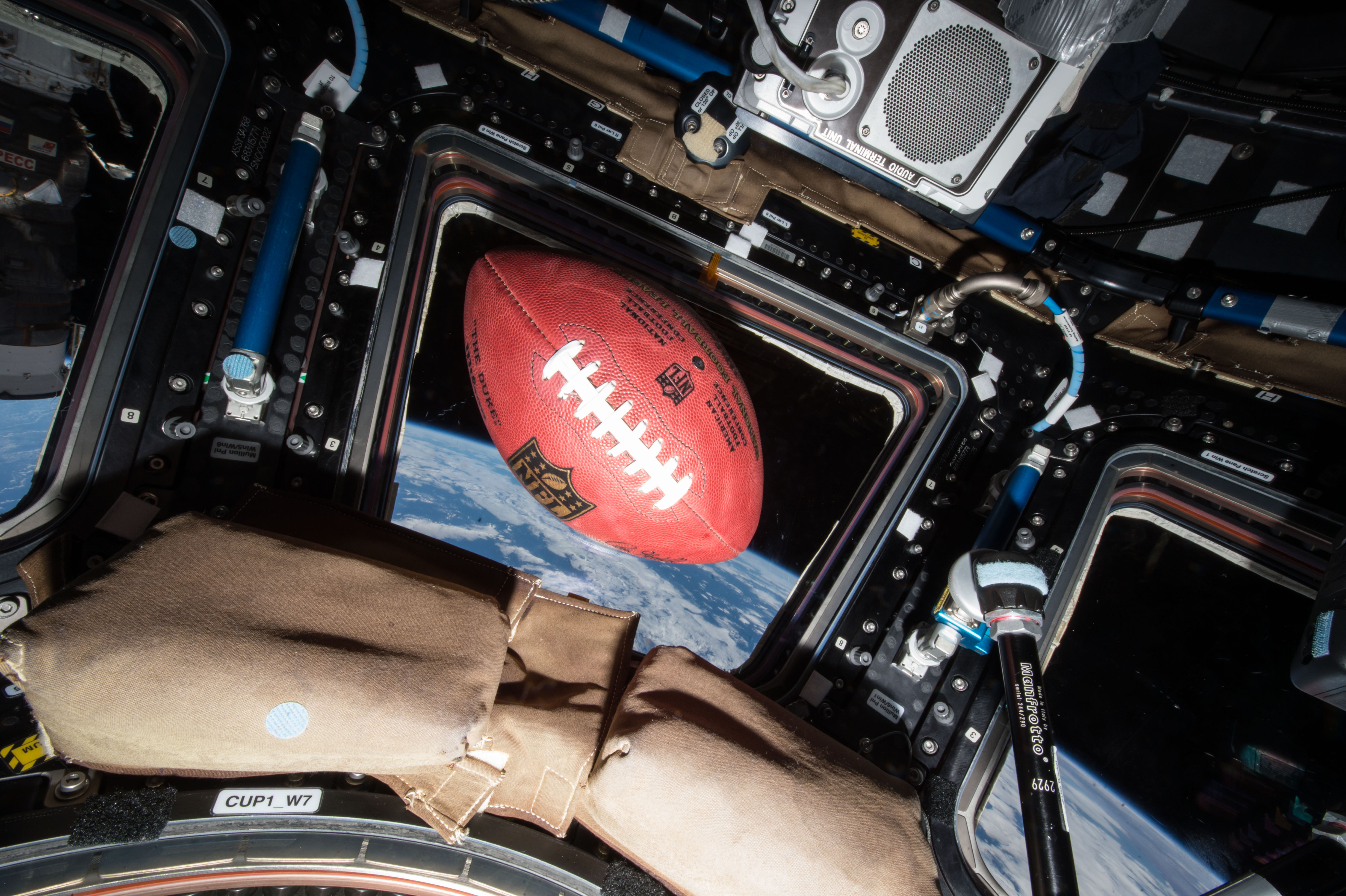
A football floats in microgravity aboard the International Space Station, high above the Earth.
Credit: NASA
Through a new collaboration between NASA and the National Football League (NFL), the agency will soon bring America’s strengths in space exploration and aeronautics innovation to the football field.
NASA will conduct flyovers, astronaut appearances, and fan engagement at NFL games across the United States as part of its new Inspiration Tour.
“This is the first season NASA is taking part in flyovers at NFL games, bringing the excitement of America’s space program directly to fans across the country,” said NASA Administrator Jared Isaacman. “We’re returning to the Moon, building a Moon Base, advancing fission-powered spacecraft, and pushing the boundaries in aeronautics, science, and discovery. Achieving those ambitions will take the very best of America, and partnering with the NFL gives us an incredible platform to inspire the next generation to look up and imagine the possibilities.”
NASA participation is targeted for the following games. Additional details will be released prior to each game, and more dates may be added:
1 p.m., Sunday, Sept. 13: Pittsburgh Steelers vs. Atlanta Falcons in Pittsburgh
1 p.m., Sunday, Sept. 20: Baltimore Ravens vs. New Orleans Saints in Baltimore
1 p.m., Sunday, Oct. 4: Philadelphia Eagles vs. Los Angeles Rams in Philadelphia
1 p.m., Sunday, Oct. 11: New York Jets vs. Cleveland Browns in East Rutherford, New Jersey
Flyovers scheduled at some of the games will showcase NASA’s fleet of aircraft, which are used for high-speed testing, high-altitude research, astronaut training, and more. Regularly flying the aircraft maintains the health of the fleet and publicly demonstrates new technologies that may be applied to future commercial air travel.
With stops across the nation and led by Isaacman, NASA’s Inspiration Tour convenes academic, industry, and public sector stakeholders to connect the agency with the people, technologies, and organizations that drive American leadership in space.
The tour will culminate in MAX POWER, a public exposition of American air and space innovation, Nov. 7 and Nov. 8, on and near the agency’s Kennedy Space Center in Florida. Held in honor of America’s historic 250th anniversary, the multi-day, family-friendly event will showcase the next-generation aircraft, spacecraft, autonomous vehicles, and technologies that will help define the future of transportation in air and space.
For more information about MAX POWER and the agency’s missions, visit:
Jaden Caradine knew he wanted to be an engineer at eight years old. He just took a winding road to get there.
Before he enrolled at Embry-Riddle Aeronautical University, before he discovered the field that would become his focus, and before he landed a Pathways internship at NASA’s Langley Research Center in Hampton, Virginia, Caradine spent five years as a mechanic in the United States Marine Corps, four of them stationed in Japan. It was a deliberate detour, one that shaped how he approaches everything since.
“I’ve kind of always known I wanted to be an engineer,” he says. “I just had to figure out what kind.”
NASA Pathways intern Jaden Caradine
Credit: NASA
Finding the Overlap
Caradine grew up in the Salt Lake City area, raised by a mother who put him on a snowboard at four and on a rock face not long after. He was the kind of kid who learned to love science not for its own sake, but for what it could do. “Math is an enabling skill,” he says. “It’s not about doing the math. Math has a purpose and it’s useful.”
By the time someone asked young Jaden what he wanted to be, the answer was immediate. “I was building Legos,” he says, “and I just thought — I want to build stuff. I can’t really see myself being anything other than an engineer.”
Right out of high school, Caradine enlisted in the Marines, trained as a mechanic, and shipped out to Japan. During those five years, between the technical work and the distance from home, he started reading books on decision-making, career planning, and long-term thinking. He found a framework he keeps coming back to: ikigai, a Japanese concept that maps the intersection of what you’re good at, what you enjoy, what the world needs, and what you’re paid to do.
Caradine at the Sapporo Snow Festival in Hokkaido, Japan, while serving as a U.S. Marine Credit: Jaden Caradine
“Your ikigai is the thing where all of those overlap,” he says. Engineering was already in the picture. The question was what kind.
Chasing the Signal
The answer arrived through research and a company Caradine stumbled on while scanning the landscape of emerging aerospace technology. They were using magnets to spin a launch system to 14,000 or 15,000 RPM and release small satellites into orbit, recovering the energy on the way down through the same magnetic system. “I thought that was awesome,” he recalls. “So, I started looking into aerospace engineering, and it was a good fit.”
Once he had the field, the destination wasn’t hard to find. Caradine transferred to Embry-Riddle Aeronautical University’s Daytona Beach campus to study aerospace engineering and immediately started showing up everywhere he could — satellite conferences at Kennedy Space Center, industry events in Orlando, small satellite gatherings back in Salt Lake City. “I went to all the career fairs, even though I wasn’t looking for a job yet,” he says. “I just wanted to learn as much as I could, as fast as I could.”
At every NASA booth, he asked questions. He learned about Pathways, the program that places undergraduate and graduate students at NASA centers with the potential to convert to full-time civil service positions, but he waited a year to apply. “I hadn’t really done the things I wanted to do in order to write a strong application yet,” he says. He wrote the next application with the intention of using it as a practice run. He got in.
His reason for choosing NASA over industry was simple and firm. “NASA doesn’t work for profit,” he says. “We’re here to remove barriers so that industry can eventually do the things they weren’t able to do before.”
“Human beings are far more capable than we give ourselves credit for. A journey of a thousand miles starts with a single step and can only be taken one step at a time.”
Work Worth Doing
At NASA Langley, Caradine is part of the Systems Analysis and Concepts Directorate, where “we help agency leaders figure out why they should make certain decisions, especially those that have lots of moving parts,” he explains. Specifically, he works with the in-space servicing, assembly, and manufacturing (ISAM) team, a group focused on the emerging field of building and maintaining infrastructure in space, rather than simply launching and discarding it.
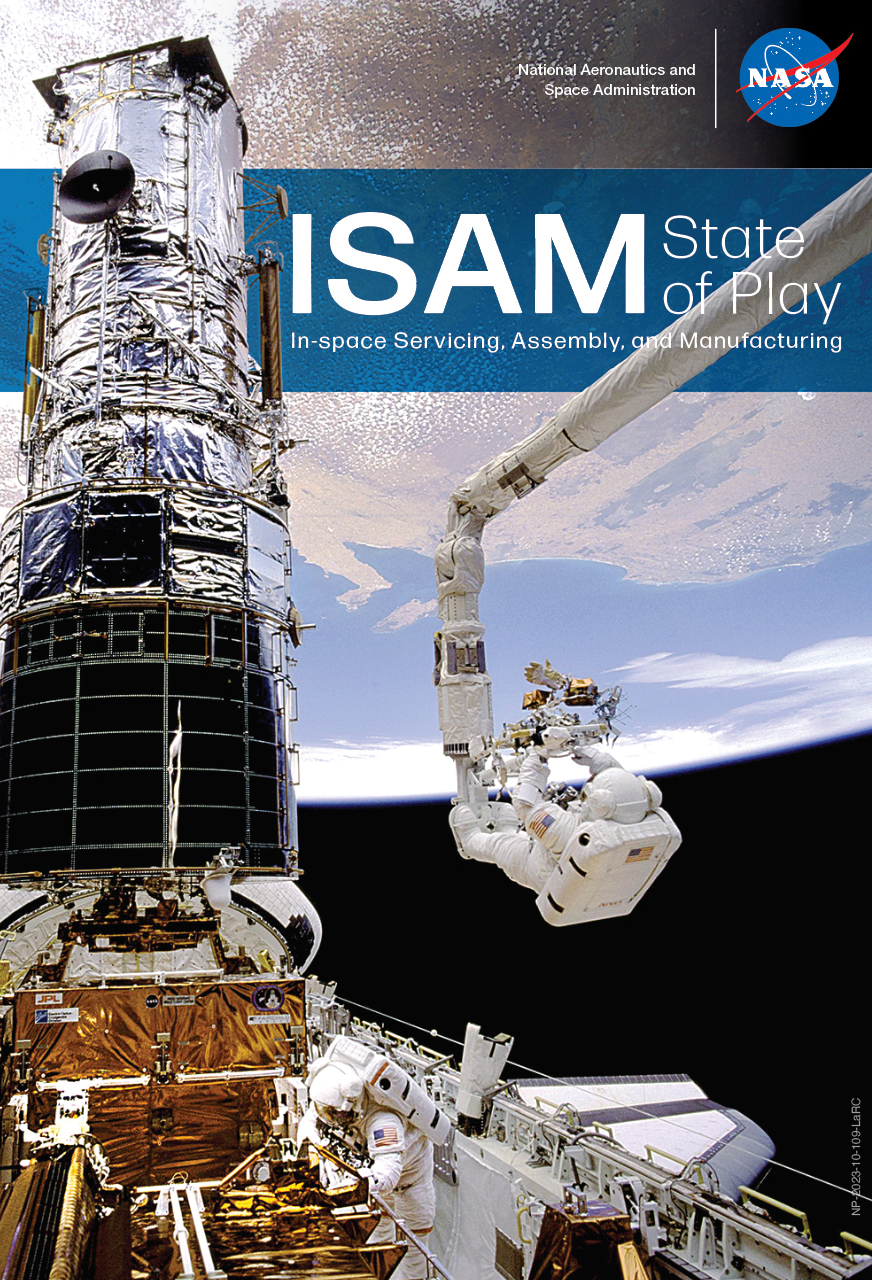
A major part of his summer was curating the State of Play, a comprehensive document that consolidates everything happening in the ISAM sector across government, academia, and industry into a single, navigable resource.
“Jaden joined the team and immediately contributed to this year’s State of Play update,” says Dale Arney, aerospace engineer and Caradine’s mentor. “He also created an automated tool that will help the team create future updates more quickly.”
The ISAM State of Play document is a survey of past, present, and near-future ISAM capabilities across industry, academia, and government agencies.
Credit: NASA
That tool scrapes aerospace news from across the web, compiles relevant updates into organized tables, and produces a readable summary on a regular cadence. “It kind of replaced the need for everyone on the team to spend 30 or 40 minutes every day scrolling through news to keep up,” he says.
“Jaden was constantly looking for ways to improve himself, the team, and our products,” Arney adds. “He was eager to take the lead in trying a number of new processes and ideas to try to make them work for us.”
No Silos
The thing that surprised Caradine most about NASA Langley had nothing to do with the technical work. He had expected some departmental siloing that could develop in large organizations, where people become experts in narrow areas with limited cross-pollination among teams.
“That’s not something I’ve experienced here,” he says. “We all talk to each other, across all teams. We share resources. We collaborate quite extensively.” He describes a culture that expects everyone to engage with the whole problem, not just their corner of it. “Everyone kind of bounces around on different teams to learn the whole aspect of the problem and support each other.”
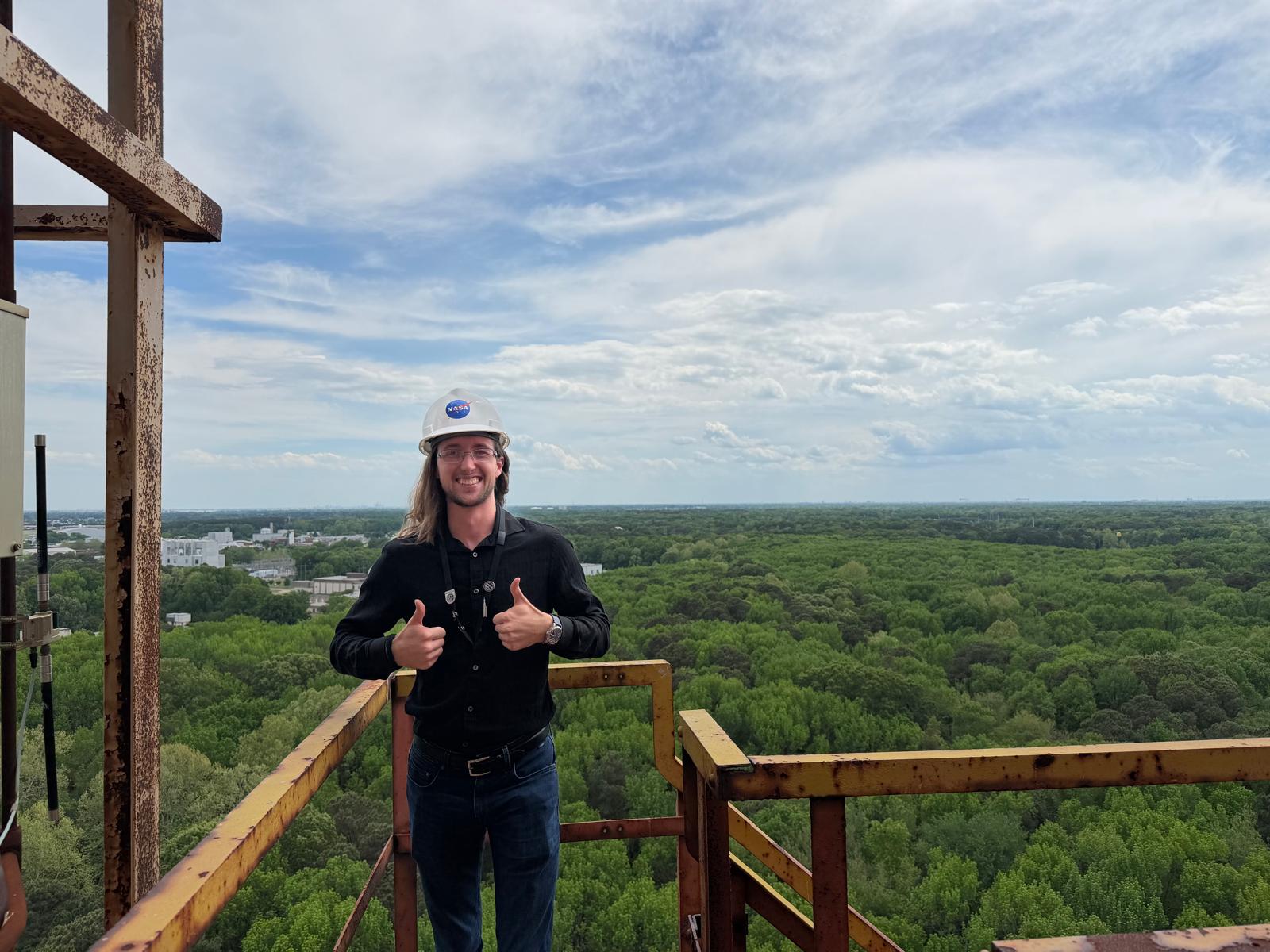
Caradine at NASA Langley’s Impact Dynamics Facility, enjoying the view at the top of the gantry
Credit: NASA
For anyone considering the Pathways program, his advice is direct. “Do it,” he says. “Human beings are far more capable than we give ourselves credit for. If it seems like too much, break it down. A journey of a thousand miles starts with a single step and can only be taken one step at a time.”
Caradine heads back to Embry-Riddle as a junior this fall, with plans to return to Langley next summer. Grad school is on the horizon, and he’s exploring programs that nurture important analysis skills for SMAB, including decision, strategic, and systems analysis.
“Before coming here, I was trying to do everything and cast a wide net,” he says. “Now I know what I need to know how to do. That’ll give me the opportunity to focus my efforts on the high-value skill sets.”
On Caradine’s Sci-Fi Shelf
The Sirens of Titan by Kurt Vonnegut
Dungeon Crawler Carl by Matt Dinniman
Caradine’s instinct runs more toward fantasy than science fiction, but this one, he says, hits something real.
“I enjoy the leveling aspect — constantly improving, constantly getting better. In books it might be physical strength, but in reality, strength takes on many different forms. Constant improvement is quite rewarding in real life, as it is in books.”
The audiobook production, he adds, is its own experience: full sound design, character actors, the works. “It’s like listening to a movie.”
The team also recently convinced him to start Dune, by Frank Herbert. He’s about halfway through.
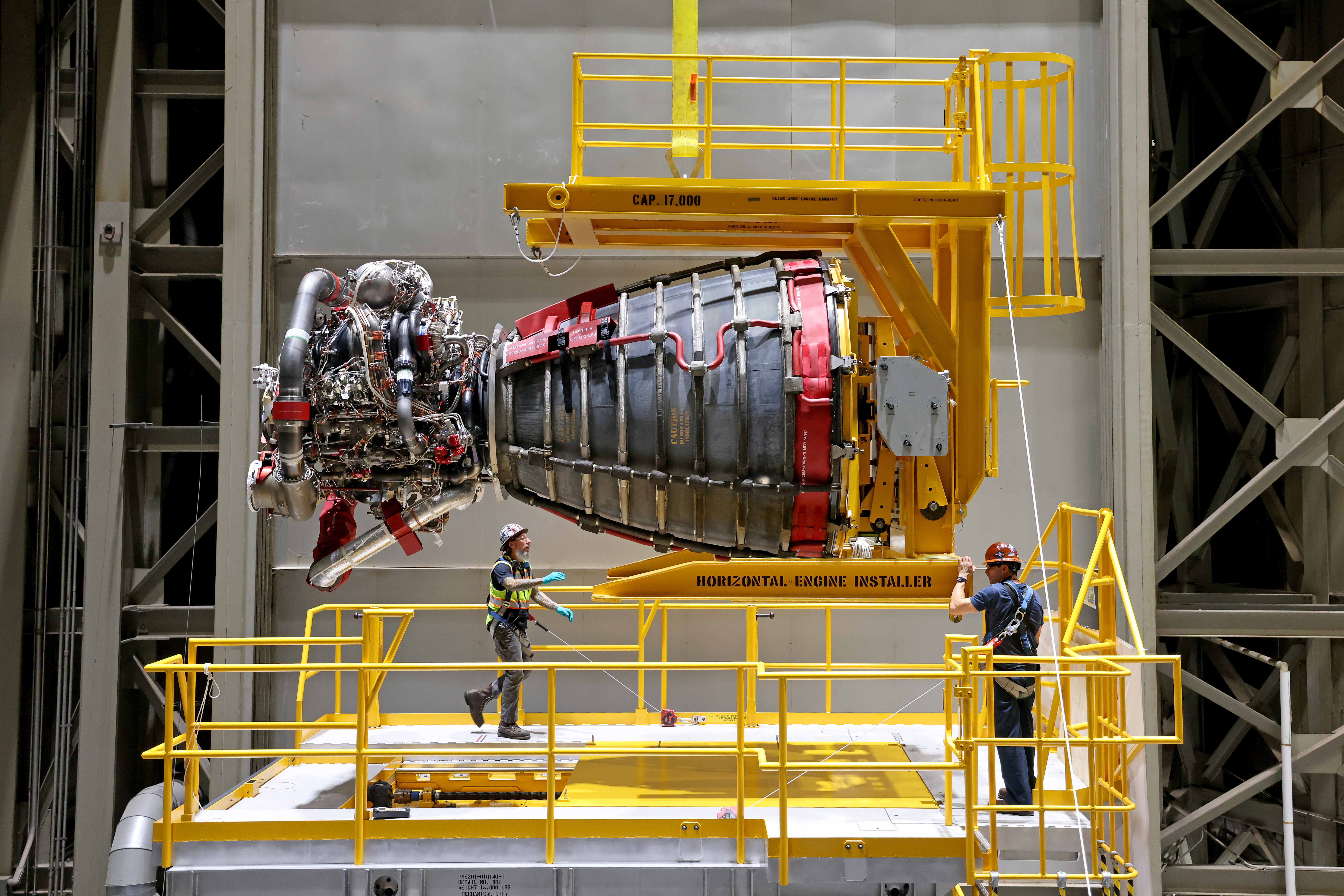
Two technicians at NASA’s Michoud Assembly Facility in New Orleans stand around one of the four RS-25 engines for the agency’s SLS (Space Launch System) rocket on Sept. 8, 2023. The RS-25 engine looks like a bell-shaped nozzle attached to a network of pipes. The engine is being lifted by the horizontal engine installer so it appears to be lying on its side. The RS-25 engine is about the size of a large pickup truck. The technicians are wearing hard hats and safety harnesses.
Credit: NASA/Michael Democker
NASA will host a virtual webinar at 2 p.m. EDT on Friday, Oct. 2, titled “The RS-25 Engine and the Future of Artemis Missions: An Accessible Webinar for the Blind and Low-Vision Community.” This webinar is open to the public, however it is tailored specifically for a blind and low-vision audience.
The webinar will last about two hours and include an audio-described video of an RS-25 engine test, a Q&A session with an Artemis engineer, and a panel about accessibility in space and science. The event will be hosted on the Zoom platform.
Participants in the session include:
Dr. Kimberly Arcand, visualization scientist, NASA’s Chandra X-ray Observatory
Josh Greiner, test director, NASA’s Stennis Space Center in Bay St. Louis, Mississippi
Dr. Craig Moore, materials engineer, NASA’s Marshall Space Flight Center in Huntsville, Alabama
Dr. Robert Shelton, lead simulation engineer, NASA’s Johnson Space Center in Houston
Christine Malec, freelance writer and consultant
Those interested in attending the webinar must RSVP using this form by Friday, Sept. 25. Any questions can be directed to thalia.k.patrinos@nasa.gov. The details of the webinar will be emailed to registrants in the days leading up to the event.
NASA’s Artemis program will send astronauts on increasingly difficult missions to explore the Moon and establish a Moon Base on the lunar surface. For additional information on the Artemis missions, visit:
FILE - In this Tuesday, Aug. 18, 2020, file photo, a person drops applications for mail-in-ballots into a mailbox in Omaha, Neb. Data obtained by The Associated Press shows Postal Service districts across the nation are missing the agency’s own standards for on-time delivery as millions of Americans prepare to vote by mail. (AP Photo/Nati Harnik, File)
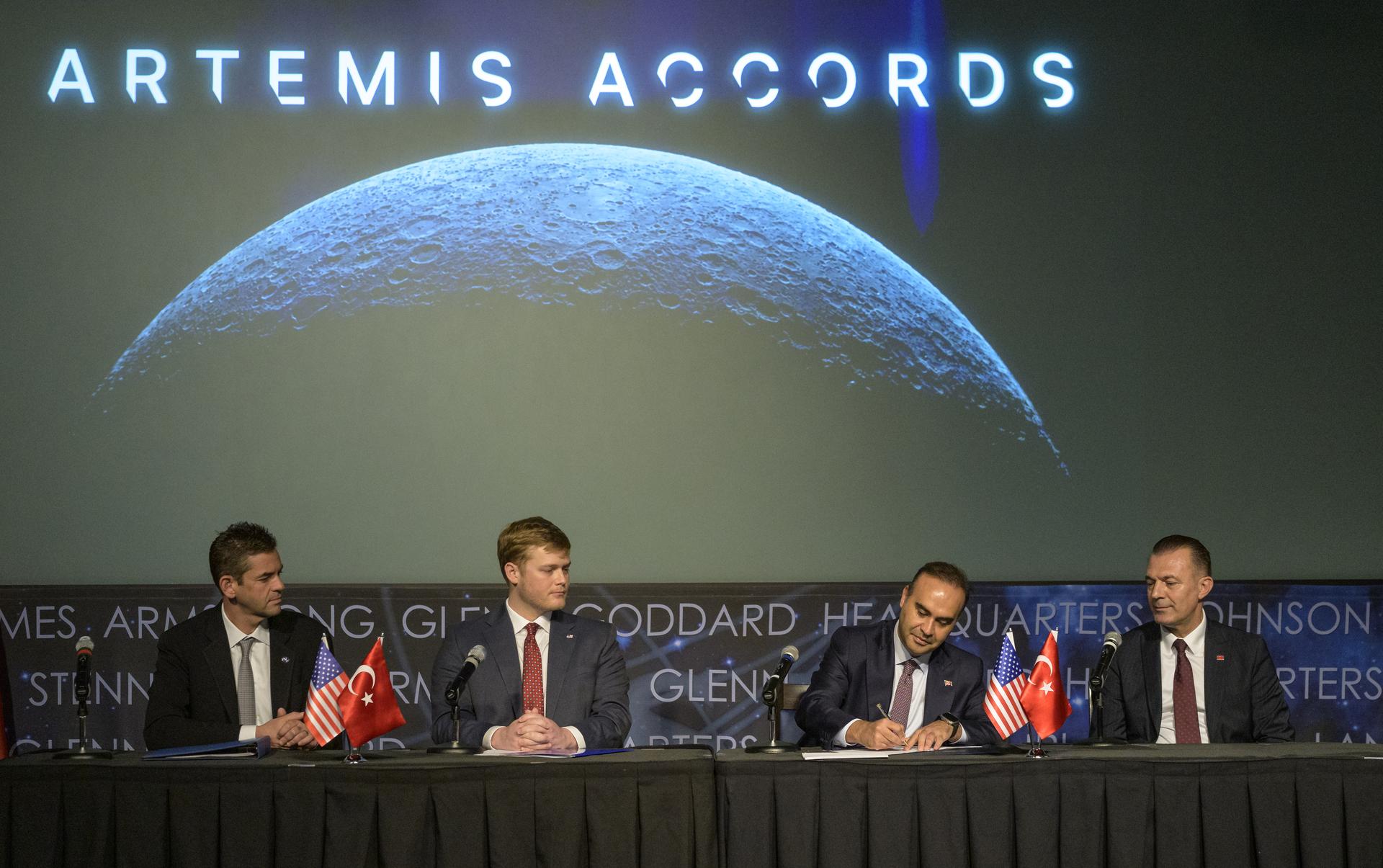
Turkish Minister of Industry and Technology, Mehmet Fatih Kacır, 3rd from left, signs the Artemis Accords for the Republic of Türkiye as NASA Administrator Jared Isaacman, left, U.S. Deputy Assistant Secretary of State for Space and Environment Connor Tomlinson, and Turkish Space Agency President, Yusuf Kıraç, right, look on, Monday, August 31, 2026, at the Mary W. Jackson NASA Headquarters building in Washington.
NASA/Bill Ingalls
During a ceremony hosted by NASA Administrator Jared Isaacman at the agency’s headquarters in Washington on Monday, the Republic of Türkiye signed the Artemis Accords, joining the growing international coalition of like-minded nations dedicated to peaceful, transparent space exploration.
“It is my privilege to welcome the Republic of Türkiye as the 71st signatory of the Artemis Accords,” said Isaacman. “Last year, President Trump directed NASA to accelerate its return to the lunar surface and establish humanity’s first enduring presence on another world, a Moon Base, as well as lay the foundation for the manned exploration of Mars. NASA never undertakes these grand endeavors alone. On the Moon Base, we’re taking the Artemis Accords principles and putting them into practice on the lunar surface. NASA has invited every signatory to take part in this endeavor, creating opportunities for nations to contribute major pieces of hardware, scientific payloads, technology demonstrations, CubeSats, and other capabilities to future Artemis missions.”
Turkish Minister of Industry and Technology Mehmet Fatih Kacır signed on behalf of Türkiye. The President of the Turkish Space Agency Yusuf Kıraç, and the U.S. Deputy Assistant Secretary of State for Space and Environment Connor Tomlinson, also participated in the event.
Türkiye’s recent achievements in human spaceflight underscore its commitment to space exploration. In 2024, the country’s first astronaut, Alper Gezervaci, traveled to the International Space Station on Axiom Mission 3 and conducted scientific research alongside NASA astronauts. That same year, a second Turkish astronaut, Tuva Atasever, flew on Virgin Galactic 07 suborbital mission, conducting experiments and physiology research.
Türkiye will soon launch its first lunar mission, AYAP-1, joining the small but growing group of countries building and launching their own satellites to the Moon.
The country’s signing also comes as the country prepares to host the International Astronautical Congress in Antalya this October. Dozens of Artemis Accords signatories are expected to attend to discuss the future of peaceful and transparent space exploration.
In 2020, NASA and the State Department joined with seven other founding nations to establish the Artemis Accords, responding to the growing interest in lunar activities by both governments and private companies. They introduced the first set of practical principles aimed at enhancing the safety and coordination between nations as they explore the Moon, Mars, and beyond, committing nations to:
explore peaceably and transparently
render aid to those in need
enable access to scientific data
ensure activities do not interfere with those of others
preserve historically significant sites and artifacts by developing best practices
By signing the Artemis Accords, nations open the door to opportunities for future lunar exploration with NASA, advancing humanity’s return to the Moon, and shaping the Golden Age of space exploration and innovation.
NASA Begins Moon Mission Plume-Surface Interaction Tests
A run of the plume-surface interaction testing with the ethane nozzle firing into the simulated lunar dirt.
Credits: NASA
EDITOR’S NOTE: This story, originally published in December, was revised Aug. 26, 2026 with an update on a new phase of testing, including video from a recent test run and new images.
To help NASA and commercial partners better understand the science of lunar landings, specifically the hazards that may occur when a lander’s engine plumes blast away at lunar dust, soil, and rocks, a team at NASA’s Langley Research Center in Hampton, Virginia, has initiated a series of plume-surface interaction tests inside a massive 60-foot spherical vacuum chamber.
As NASA works to return humans to the Moon starting with Artemis IV in 2028 and develop a Moon Base, the tests will provide a trove of data for researchers to use to improve predictive models and influence the design of space hardware.
“This plume-surface interaction ground test is the most complex test of its kind to be undertaken in a vacuum chamber,” said Ashley Korzun, testing lead at NASA Langley. “If I’m in a spacecraft and I’m going to move all that regolith while landing, some of that’s going to hit my lander. Some of it’s going to go out toward other things — payloads, science experiments, eventually rovers and other assets. Understanding those physics is pivotal to ensuring crew safety and mission success.”
The campaign involves multiple NASA centers, academic institutions, and commercial entities both small and large.
Korzun’ s team will test two types of propulsion systems in the vacuum sphere. For the first round of tests, they are using an ethane plume simulation system designed by NASA’s Stennis Space Center near Bay St. Louis, Mississippi, and built and operated by Purdue University. The ethane system generates a maximum of about 100 pounds of thrust — imagine the force necessary to lift or support a 100-pound person. It heats up but doesn’t burn.
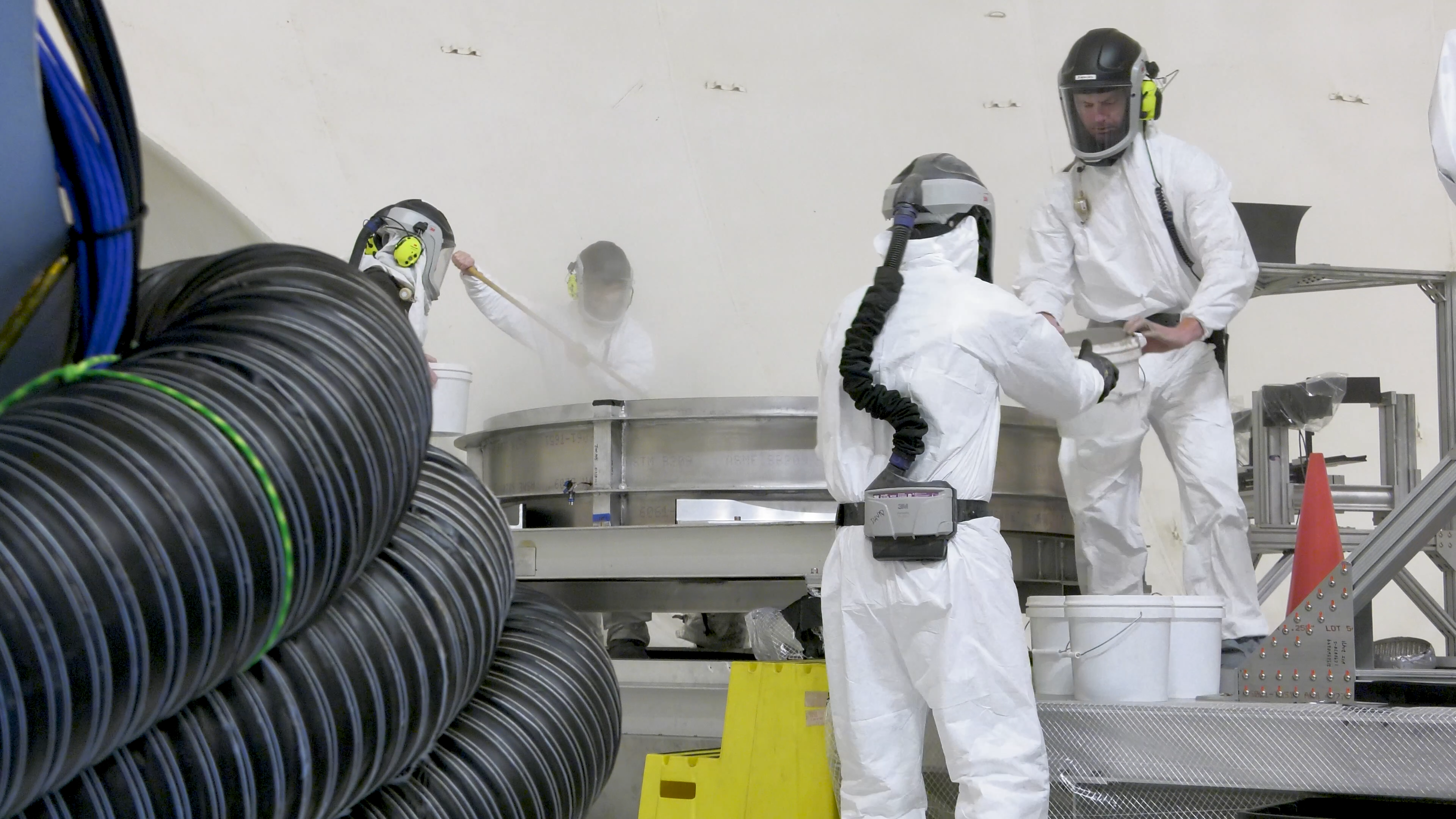
The team recently began firing the system into a roughly six-and-a-half-foot diameter, one-foot-deep bin of simulated lunar regolith, called Black Point-1, that has jagged, cohesive properties similar to actual lunar regolith.
A number of different instruments, including a version of the Stereo Cameras for Lunar Plume Surface Studies system that imaged the plume-surface interaction when Firefly’s Blue Ghost Mission-1 landed on the Moon in 2025, are capturing data and imagery from the tests, which will only last about six seconds each. The instruments are measuring things such as crater formation, angle and height of the ejecta sheet, spatial distribution of solid ejecta, and the speed of the regolith particles as they get blasted out of the bin.
A crew loads simulated lunar dirt into the test bin in the 60′ vacuum sphere.
NASA/Rob Lorkiewicz
Later this year, a second round of tests will involve a 14-inch, 3D-printed hybrid rocket motor developed at Utah State University in Logan, Utah, and tested at NASA’s Marshall Space Flight Center in Huntsville, Alabama. It produces around 35 pounds of thrust, igniting both solid propellant and a stream of gaseous oxygen to create a hot, powerful stream of rocket exhaust, simulating a real rocket engine but at smaller scale for this test series. Researchers will test both propulsion systems at various heights.
“It gives us a huge range of test conditions,” Korzun said, “to be able to talk about spacecraft of all different kinds going to the Moon, and for us to understand what they’re going to do as they land or try to take back off from the surface.”
Korzun sees this test campaign as more than a one-shot, Moon-specific thing. The entire operation is modular by design and also can prepare NASA for missions to Mars. The lunar regolith simulant can be replaced with a Mars simulant that’s more like sand. Pieces of hardware and instrumentation can be unbolted and replaced to represent future Mars landers. Rather than take the vacuum sphere down to really low pressure like on the Moon, it can be adjusted to a pressure that simulates the atmosphere on the Red Planet.
“Mars has always been in our road maps,” Korzun said.
But for now, the Moon looms large.
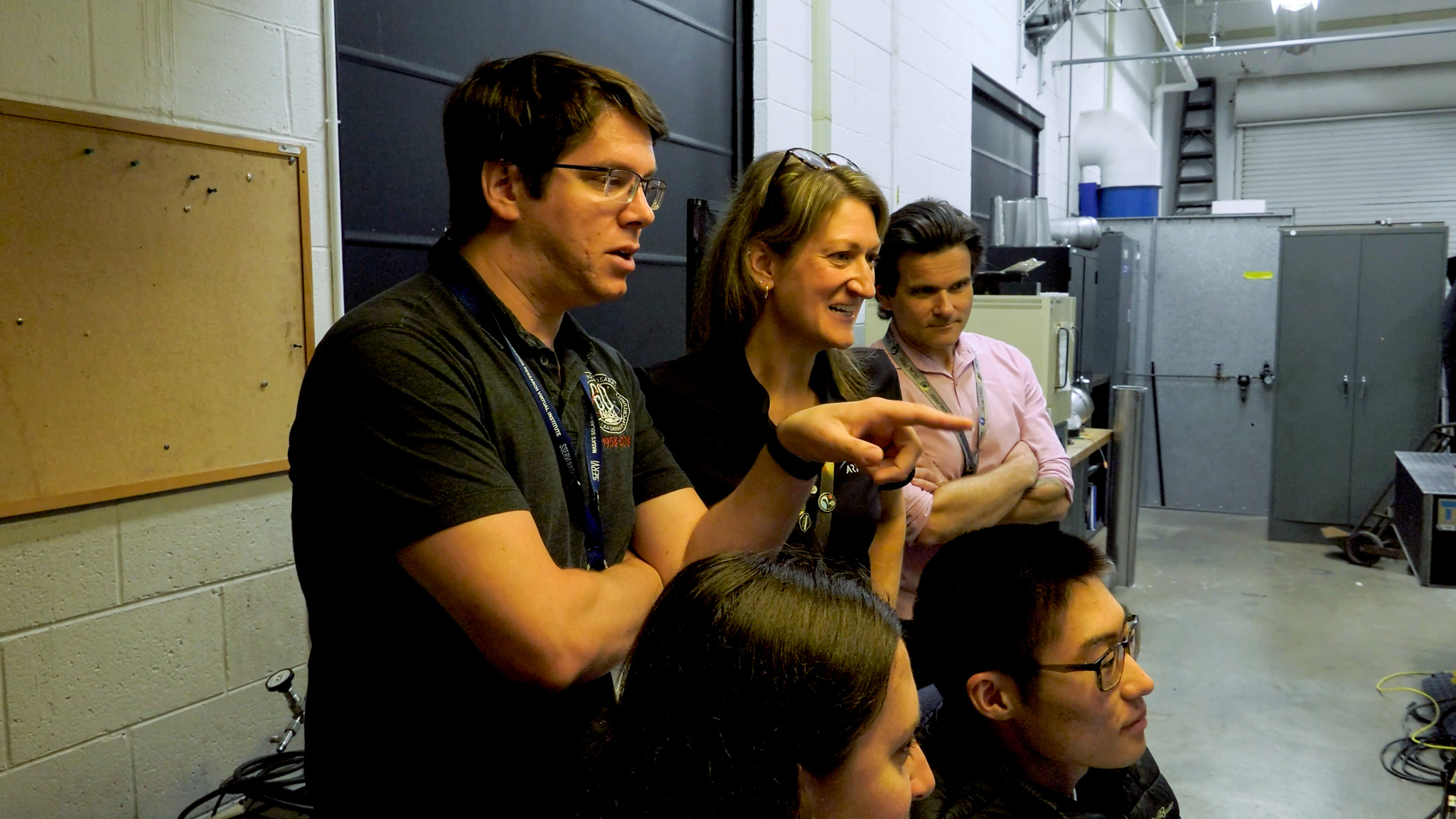
Clockwise from left: Wesley Chambers, deputy principal investigator for the PSI tests from Marshall’s Space Flight Center in Huntsville, Alabama; Ashley Korzun, test lead and principal investigator; Dave Lehotay, project manager; and Tylor Takahashi and Olivia Tyrrell, both from the SCALPSS instrument team, watch test footage in the control room.
NASA/Rob Lorkiewicz
“This test campaign is one of the most flight-relevant and highly instrumented plume-surface interaction test series NASA has ever conducted,” said Daniel Stubbs, an engineer with the Human Landing Systems plume and aero environments team at NASA Marshall. “The data from these tests at NASA Langley will be critical in developing and validating models to predict the effects of plume-surface interaction for landing on the Moon and even Mars, ensuring mission success for the human landing systems and the safety of our astronauts.”
Through the Artemis program, NASA will send astronauts on increasingly complex missions to explore the Moon for scientific discovery, economic benefits, establish an enduring human presence on the lunar surface, and to build on our foundation for the first crewed missions to Mars.
To help NASA and commercial partners better understand the science of lunar landings, specifically the hazards that may occur when a lander’s engine plumes b...
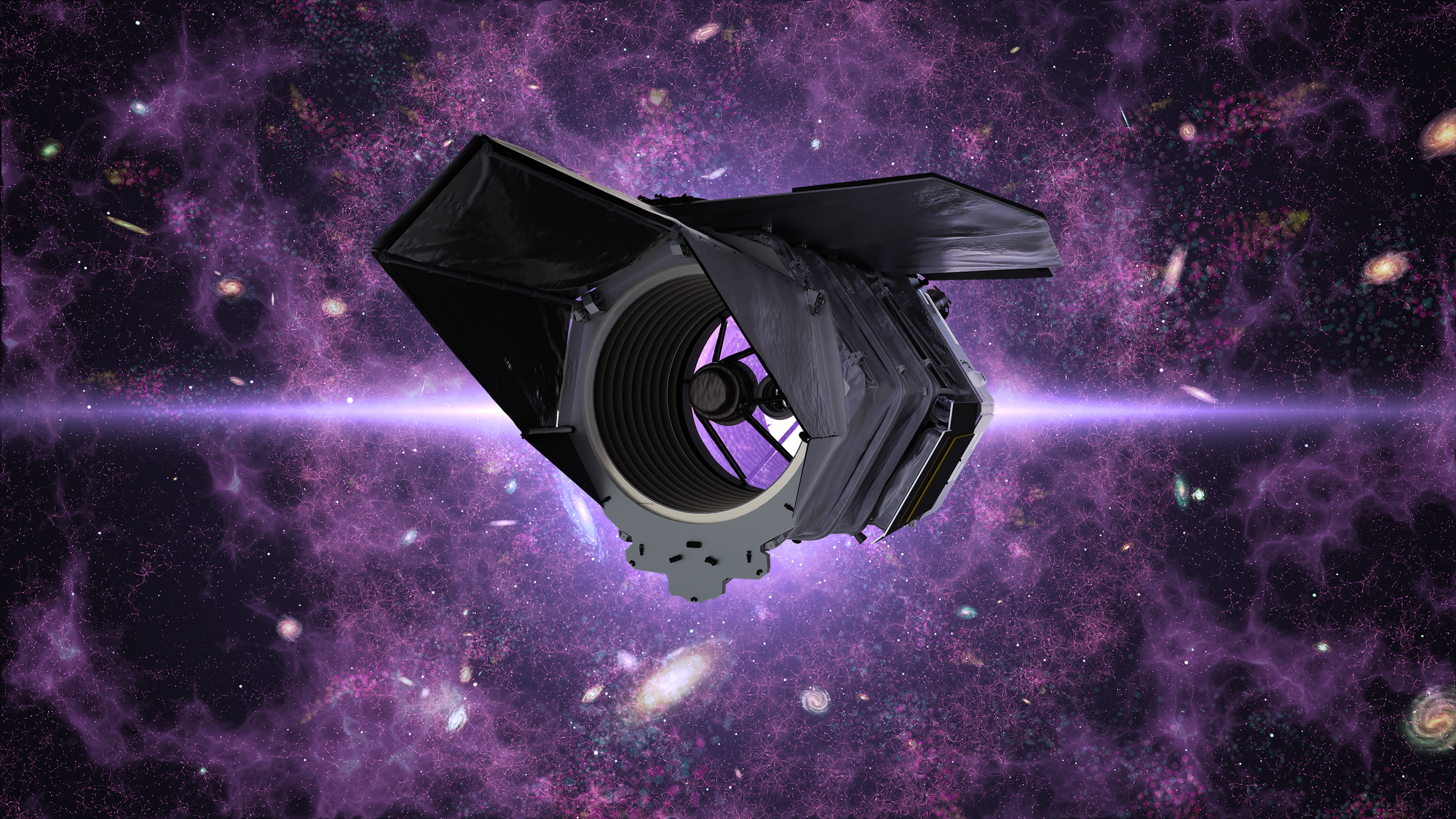
The Nancy Grace Roman Space Telescope is a NASA observatory designed to settle essential questions in the areas of dark energy, exoplanets, and infrared astrophysics.
NASA
Set to launch on Sunday, Aug. 30, NASA’s Nancy Grace Roman Space Telescope will empower astronomers to explore vast regions of the cosmos and settle essential questions in the areas of dark energy, dark matter, planets outside our solar system, and the formation and growth of galaxies over cosmic time. Key contributions to Roman’s mission made by researchers at NASA’s Ames Research Center in California’s Silicon Valley will advance Roman’s science using the center’s facilities, expertise, and innovations.
Tools to predict, remove glare
Roman’s main camera, the Wide Field Instrument, will capture expansive high-resolution pictures of the universe in optical and near-infrared light. These unprecedented images will enable astronomers to decode some of the deepest mysteries of the cosmos.
Forms of glare that Roman’s camera collects diminish image quality and thereby reduce the ability of astronomers to characterize certain cosmic structures. Innovative software developed by a team at NASA Ames, with collaborators at NASA’s Goddard Space Flight Center in Greenbelt, Maryland, and IPAC/Caltech in Pasadena, California, will improve Roman’s images and optimize observing plans. Called ROSALIA (Roman Sky Analyst for Low Surface Brightness Imaging and Astronomy), the software predicts and removes unwanted light from astronomical images captured by Roman’s Wide Field Instrument.
Contaminating stray light occurs when photons scatter inside the telescope’s optical system. Resulting light glints can produce deceptive image artifacts that mimic the appearance of real planets or nebulae. The ROSALIA software will allow astronomers to adjust their observation plans to limit glints from contaminating science targets in Roman’s images.
In addition to bright glints, stray light can also appear as a diffuse background. This form of stray light interferes with observations of the darkest regions of the universe, which is critical to understanding how large structures in the universe were formed.
Another major contributor to obscuring background light is produced by nature itself: zodiacal light. Zodiacal emission originates from the scattering of sunlight by interplanetary dust particles in our solar system. The ROSALIA software predicts and strips away background contamination, including zodiacal and stray light from images, exposing the faint, diffuse emissions at galaxy edges where cosmic evolutionary histories are hidden.
Simulated, unprocessed
Simulated, processed
Simulated unprocessed image, as it would be captured by the Roman Space Telescope’s Wide Field Instrument, showing two interacting galaxies
NASA
Simulated image, as it would be captured by the Roman Space Telescope’s Wide Field Instrument and then processed using NASA’s Roman Sky Analyst for Low Surface Brightness Imaging and Astronomy tools to remove glare, showing two interacting galaxies.
NASA
Simulated unprocessed image, as it would be captured by the Roman Space Telescope’s Wide Field Instrument, showing two interacting galaxies
NASA
Simulated image, as it would be captured by the Roman Space Telescope’s Wide Field Instrument and then processed using NASA’s Roman Sky Analyst for Low Surface Brightness Imaging and Astronomy tools to remove glare, showing two interacting galaxies.
NASA
Simulated, unprocessed
Simulated, processed
BEFORE AND AFTER PROCESSING
Simulated View From Roman’s Wide Field Instrument
Left: Simulated unprocessed image, as it would be captured by the Roman Space Telescope’s Wide Field Instrument, showing two interacting galaxies. Right: Simulated image of the same view after stepwise processing, using NASA’s Roman Sky Analyst for Low Surface Brightness Imaging and Astronomy (ROSALIA) tools, to remove four types of glare: zodiacal light, thermal background, stray-light, and stellar emission. The result is cleaner, sharper images where galaxies can be detected in greater detail. Image credits: NASA/Borlaff, Sanchez-Alarcon, Nickerson, Marcum and ROSALIA team/STScI/FIRE/DREAM
New ‘multi-star’ tech to see exoplanets
The Roman Coronagraph Instrument is one of two instruments flying on Roman. It will demonstrate the most advanced technologies ever flown in space for directly imaging planets around other stars. The Roman Coronagraph uses a series of masks and mirrors, including two deformable mirrors, to suppress starlight. By precisely controlling the shape of the deformable mirrors, it creates a “dark zone” around the star where observers can see the faint reflected light from orbiting planets.
The baseline operating mode of the Roman Coronagraph Instrument supports observation of exoplanets only in single star systems, as current coronagraph instruments cannot typically suppress the additional contaminating starlight in multi-star systems, such as binary star systems.
Our solar system has a single star, the Sun. But roughly half of Sun-like stars are in multi-star systems. Having the ability to directly image exoplanets in multi-star systems will increase the likelihood of detecting life beyond our solar system and will expand our knowledge about how exoplanets form and evolve, since there are major differences in how those processes unfold in single star versus multi-star systems. Eliminating overlapping glares from multiple stars is the key challenge that must be overcome to image planets in such systems.
Researchers at NASA Ames are meeting that challenge with an innovative technology called Multi-Star Wavefront Control (MSWC). This technology includes custom light-blocking masks and accompanying software designed to suppress the light from multiple stars and reveal hidden exoplanets. Through a collaboration with NASA’s Jet Propulsion Laboratory in Southern California, the MSWC masks are included on the Roman Coronagraph’s flight instrument as an added capability beyond Roman’s baseline observation modes. They could be used if additional observation time is granted to the coronagraph team after the primary technology demonstration phase is completed.
The nearest star system to our solar system, Alpha Centauri, is one of the nearest multi-star systems to Earth, at only four light-years away. This triple-star system contains a binary of Sun-like stars – Alpha Centauri AB – orbited by a much smaller and dimmer star – Proxima Centauri. Although no exoplanets are confirmed around the Sun-like stars in this system, a planet candidate has been identified by NASA’s James Webb Space Telescope in the habitable zone of Alpha Centauri A. Researchers, including the Ames MSWC team, are working to develop the capabilities needed to observe this system.
NASA Ames also provides leadership and support for the hardware working group as part of the Roman Coronagraph Participation Program. This program allows international teams of researchers to enable additional capabilities to the Roman Coronagraph beyond its baseline modes; this includes the multi-star modes being developed at NASA Ames that use different masks beyond the baseline or new wavefront control and sensing algorithms.
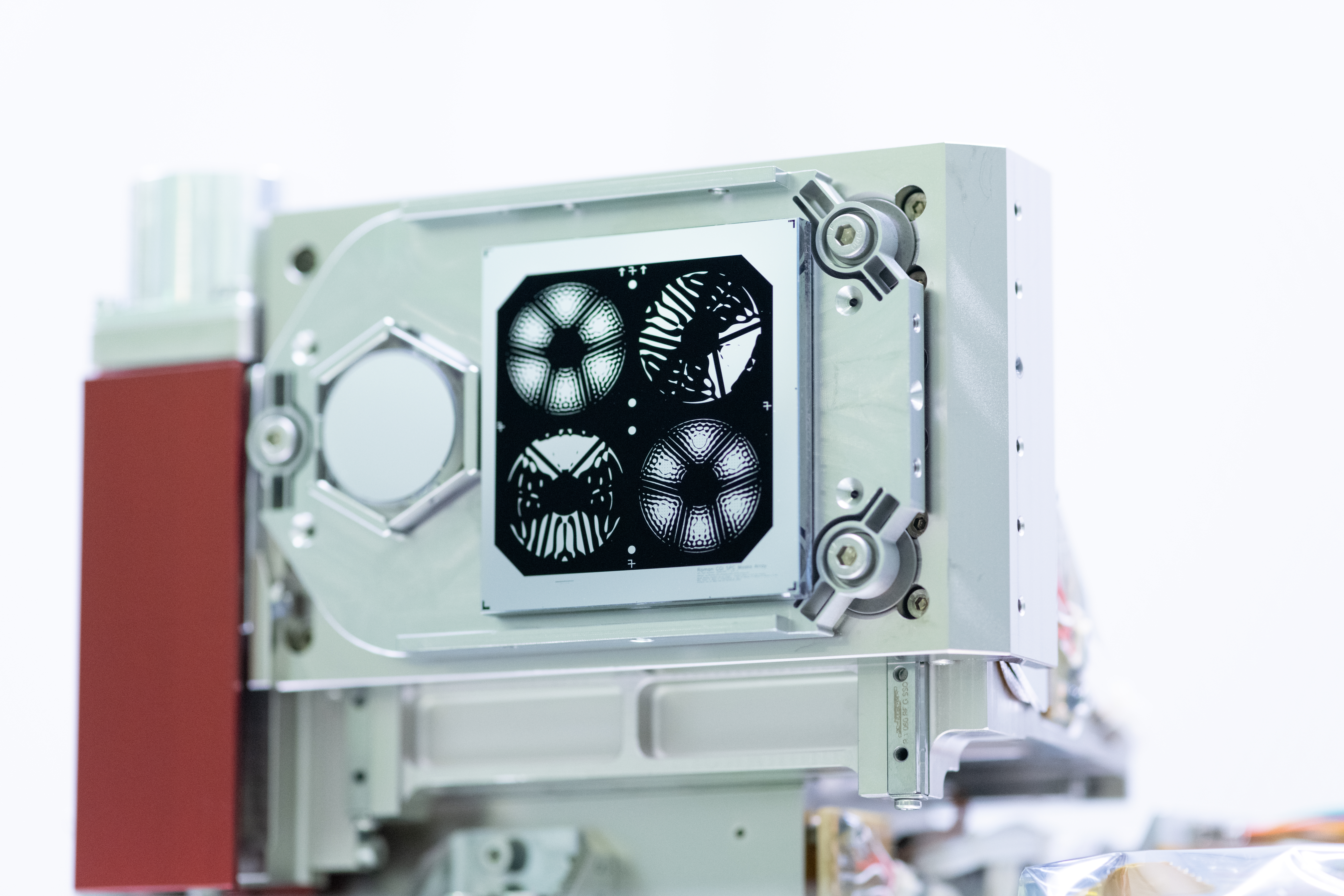
Close-up view of four of the Roman Coronagraph’s optical masks. The bottom-right mask, shaped like a six-petaled flower, is designed to suppress the light from multiple stars and reveal hidden exoplanets.
NASA JPL/Chris Gunn
Advanced supercomputing
Experts at NASA’s Advanced Supercomputing Division at Ames are advancing Roman’s science by bringing extensive experience in data pipelines and mission operations to provide advice and guidance to the Roman project through key mission development phases. This ensures reliable performance of ground-based systems and operations so that science data processing is efficient and the quality and integrity of the resulting science data products is high.
NASA Advanced Supercomputing researchers collaborated with the Ames MSWC team to develop high-performance computing tools for multi-star wavefront control simulations and to conduct studies to assess the feasibility of the MSWC technique.
Learn more about the Nancy Grace Roman Space Telescope mission:
FILE - A sign stands at the National Security Administration (NSA) campus in Fort Meade, Md., June 6, 2013. Jareh Sebastian Dalke, 30, a former National Security Agency employee from Colorado who is accused of trying to sell classified information to Russia, will remain behind bars while he is prosecuted, a magistrate judge ruled Tuesday, Oct. 11, 2022. (AP Photo/Patrick Semansky, File)
Zillow and Redfin settled an antitrust case with the Federal Trade Commission and five states Monday, just as a trial was set to begin, agreeing to undo part of a $100 million partnership that the government said effectively paid Redfin to stop competing in apartment rental advertising.
The companies, both based in Seattle, have been rivals in online real estate and related services for the better part of two decades, expanding into rentals to build their businesses beyond the market for single-family homes. The FTC alleged the deal combined two of the three largest online apartment listing services against one main competitor, CoStar’s Apartments.com.
The proposed settlement requires Redfin, now owned by Rocket Cos., to relaunch its apartment advertising operation within six months — hiring a general manager, a sales force and a trained customer support team, while committing to spend millions of dollars to grow the business.
Redfin faces fines if it misses deadlines, and must report regularly to the FTC on its progress.
Zillow’s apartment listings will still appear on Redfin.com, Rent.com and ApartmentGuide, and Redfin will keep syndicating them, so Zillow is holding onto the audience it gained in the 2025 deal. The companies say the syndication will run through at least 2030.
What ends is the exclusive nature of the partnership: As part of the FTC settlement, Redfin is no longer barred from selling its own advertising alongside those listings, or from doing business on its own with the property managers shifted to Zillow under their original deal.
Zillow also must help Redfin rebuild. Under the order, which runs 10 years, Zillow is required to give Redfin employee information so it can recruit Zillow workers, waive any noncompete or anti-poaching agreements blocking those hires, and let apartment advertisers locked into Zillow contracts renegotiate without penalty for nine months after Redfin relaunches.
The companies will also pay the states $2 million in costs and fees, according to Washington Attorney General Nick Brown, who co-led the five-state coalition.
Zillow said the partnership “will continue unchanged,” and framed the standalone advertising products both companies plan to launch in 2027 as added flexibility for property managers.
“This resolution is a win for renters and multifamily housing providers,” said Michael Sherman, general manager and senior vice president of Zillow Rentals, in a statement. He said the partnership has brought “more leads and leases to property managers and more options to renters,” and that the standalone products will let Zillow “do even more to support the marketplace.”
The FTC offered its own take: “Today’s settlement unwinds an agreement under which Zillow paid Redfin $100 million to stop competing and hand off all its customers to Zillow,” said Daniel Guarnera, director of the FTC’s Bureau of Competition. “This kind of payment to a competitor to exit a market and stop competing violates the antitrust laws.”
FTC Chairman Andrew Ferguson called it “a complete victory for the American people” in a thread on X early Monday. He added, “This anticompetitive agreement is now history under our proposed settlement.”
Guarnera said the settlement “delivers better, quicker, more certain results” than the agency would have been able to achieve if it had gone to trial and prevailed.
“Today’s settlement will restore competition by paving the way for Redfin to re-enter the market as a stronger competitor,” Brown said in a statement. “Most importantly, consumers will have more choices and won’t be subjected to illegally manipulated prices.”
The FTC and state cases were consolidated last year. Zillow and Redfin moved to dismiss in January, and U.S. District Judge Anthony Trenga denied that motion in May, according to Real Estate News. However, the FTC’s case had met resistance in July, when Trenga denied its request to declare the deal presumptively unlawful, finding genuine disputes of material fact.
Redfin called the outcome “a significant win for Redfin and consumers across the country.”
“This agreement allows us to maintain our rental partnership with Zillow through at least 2030, while building and investing in a standalone rentals business of our own,” a spokesperson said, adding that renters “will continue to have access to the rental inventory they rely on today.”
The proposed settlement, announced Monday morning, requires court approval.
Updated with details from Washington AG Nick Brown.
Behind the Lens: Meet NASA Johnson’s Photographers
NASA Johnson Space Center’s Imagery Acquisition Group poses for a group photo on Aug. 10, 2026.
Credits: NASA/Robert Markowitz
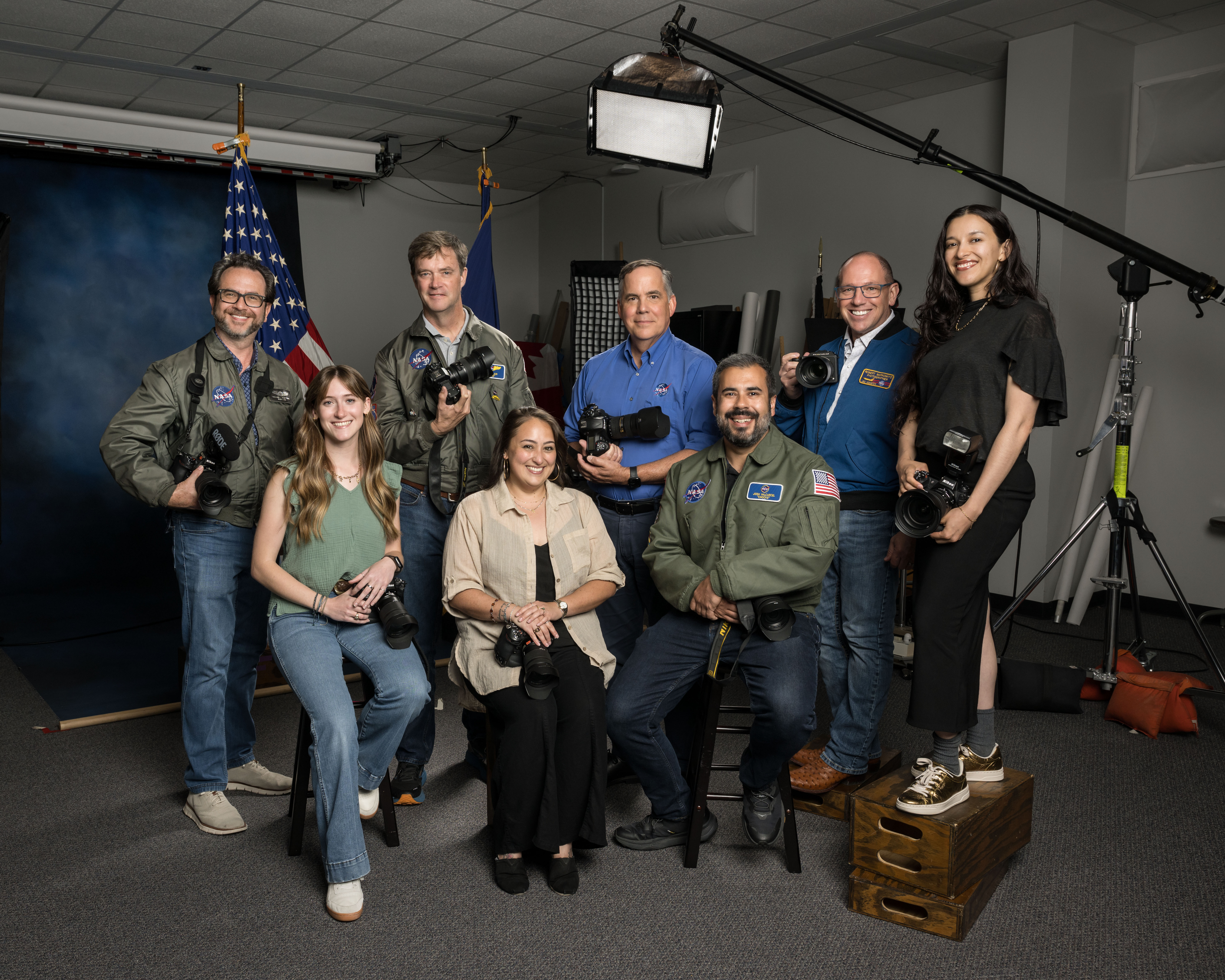
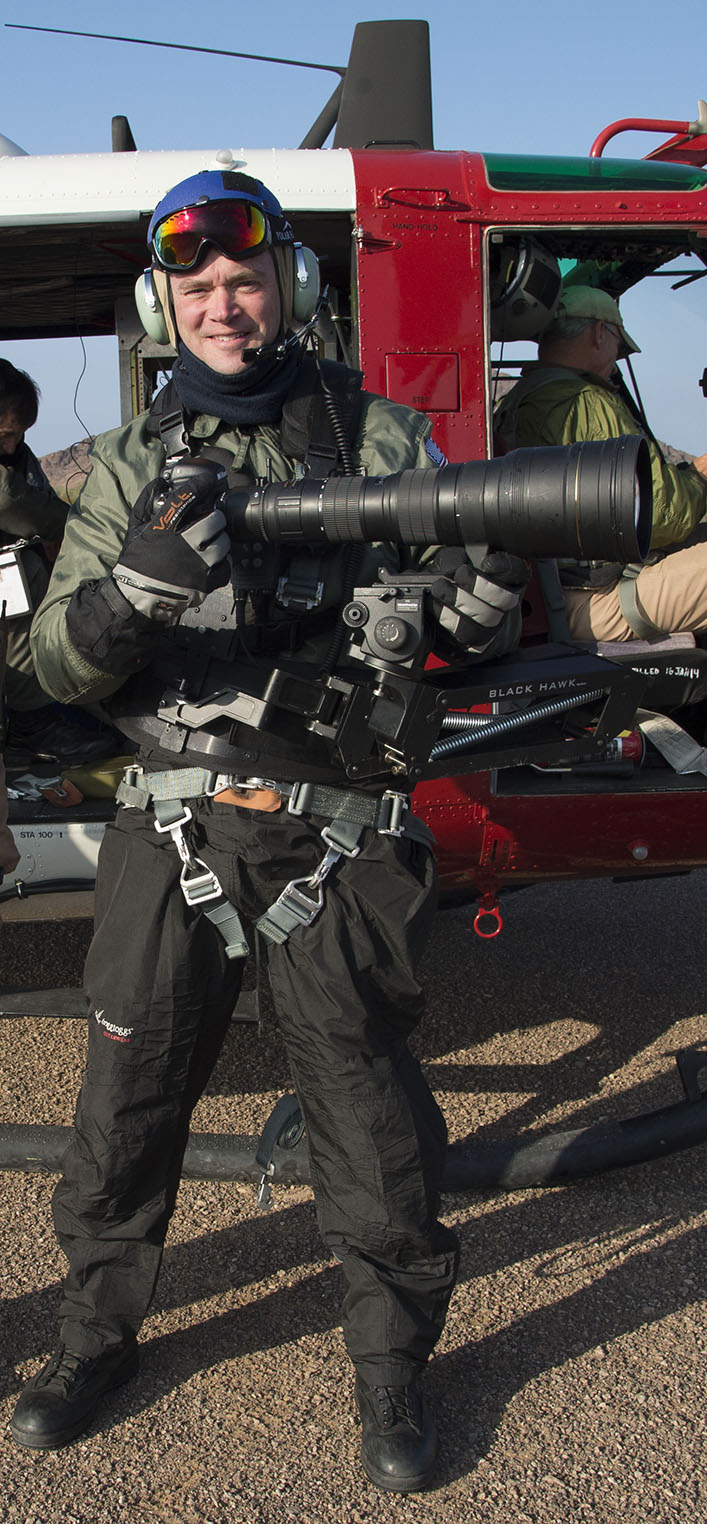
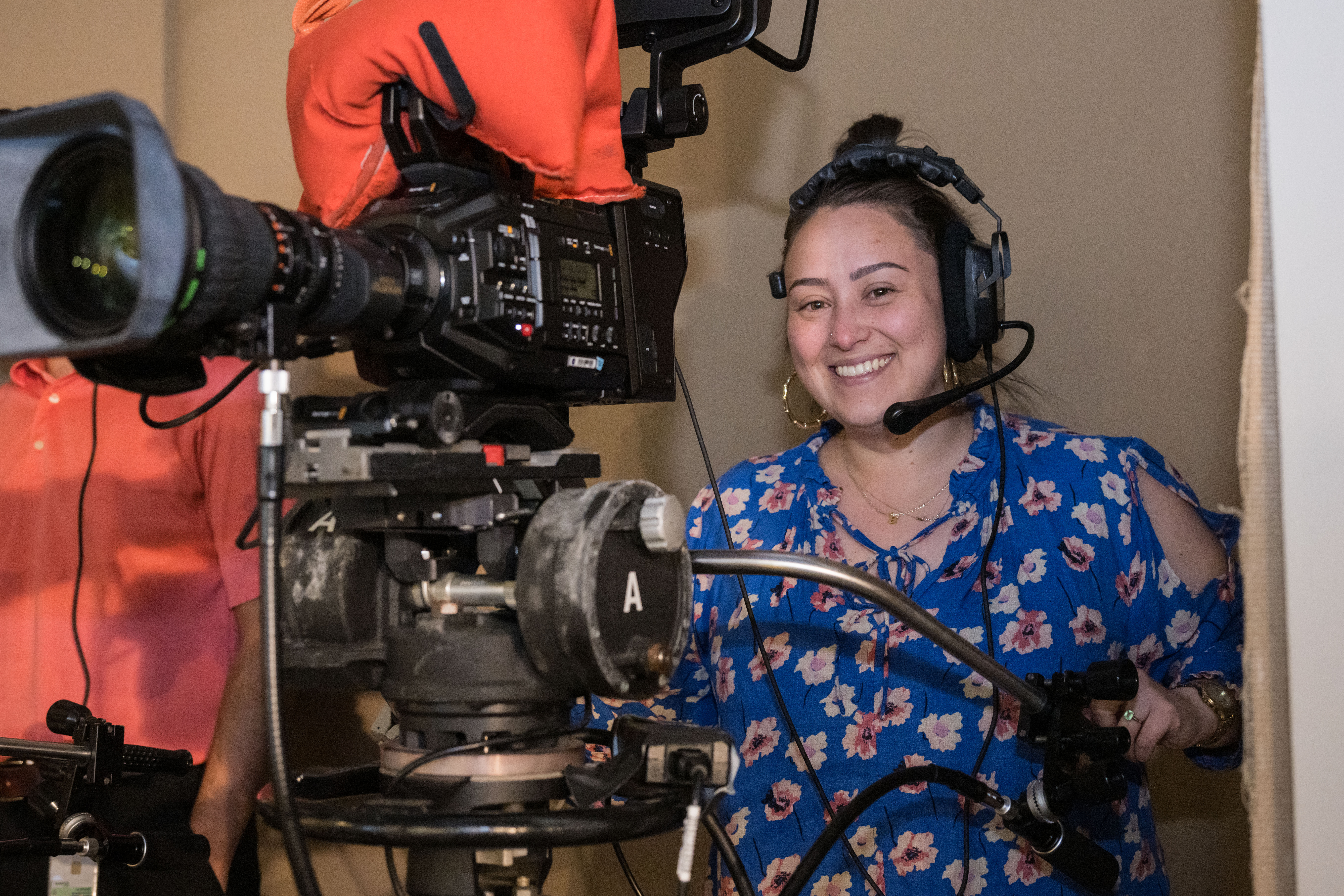
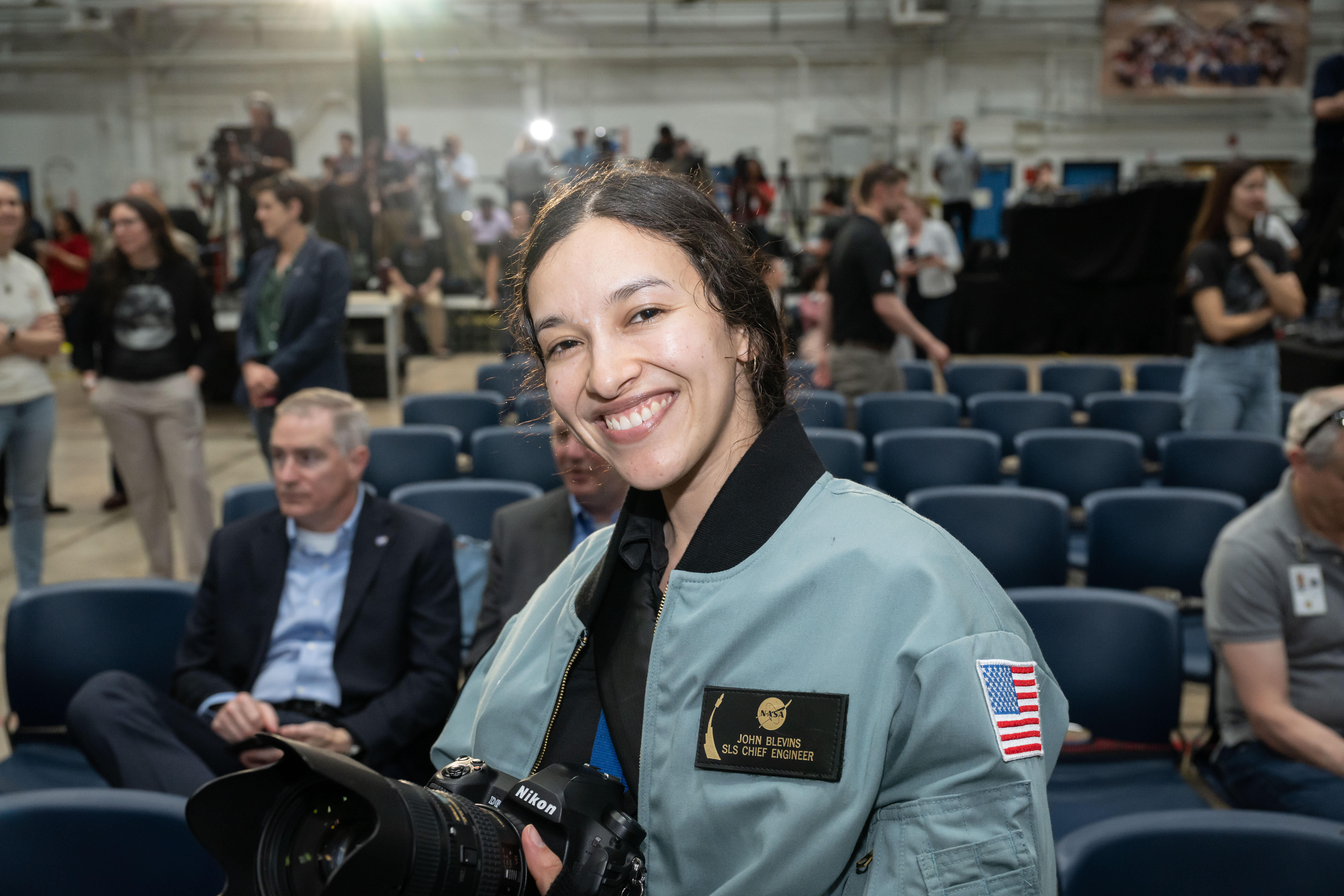
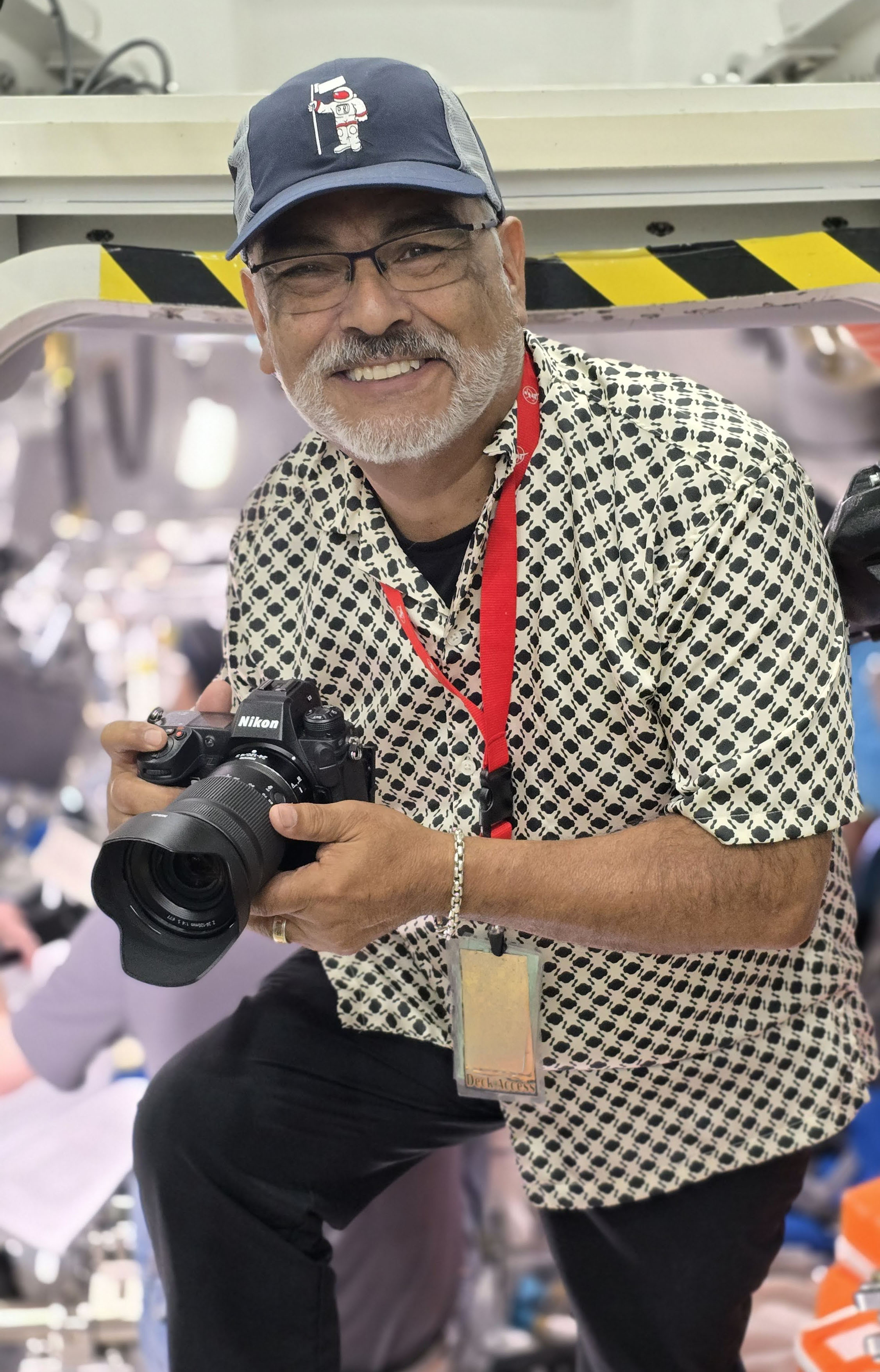
The Imagery Acquisition Group at NASA’s Johnson Space Center poses for a group photo in Houston, Texas on Aug. 10, 2026. Back row, from left, are NASA photographers Bill Stafford, James Blair, supervisor Mark Sowa, and NASA photographers Robert Markowitz and Luna Posadas Nava. Front row, from left, are NASA photographers Morgan Gridley, Helen Arase Vargas, and former NASA photographer Josh Valcarcel.
NASA/Robert Markowitz
Photographers at NASA’s Johnson Space Center in Houston have documented some of the most defining moments in human spaceflight.
From astronaut training and engineering tests to mission control operations and milestone celebrations, their images preserve the history of exploration while capturing the people and teams behind the missions shaping the next era.
Meet the photographers behind the lens and explore the stories behind the images that have helped tell NASA’s story.
Robert Markowitz
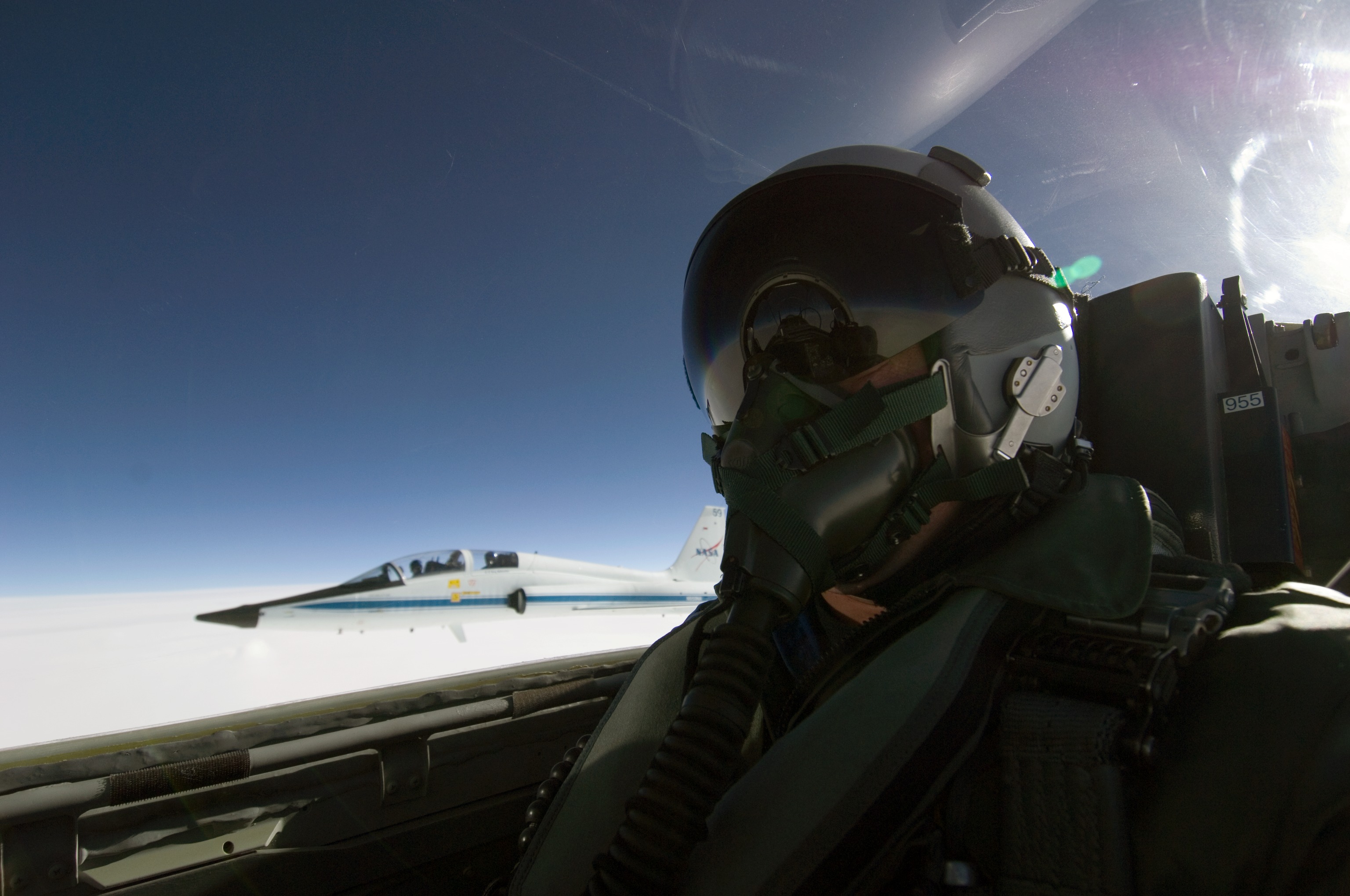
NASA photographer Robert Markowitz flies aboard a T-38 aircraft during flight operations.
NASA/Robert Markowitz
Being able to help tell the human spaceflight story, frame by frame, has been an incredible adventure.
“My favorite part of this job has always come down to the range of assignments we take on and the people I get to work with every day,” Markowitz said.
One of Markowitz’s early career highlights came during the filming of “Apollo 13,” when he served as the behind-the-scenes still photographer for nearly every KC-135 zero-gravity flight. “Looking back as a 25-year-old photographer at Johnson, I don’t think I fully appreciated how unique an opportunity it was to be there documenting those moments,” he said.
Markowitz says the job has challenged him to grow as both a photographer and a communicator. Whether photographing dozens of individual portraits in a day or coordinating a 300-person group photo, each assignment has strengthened his ability to adapt, collaborate, and connect with people.
“This work has shaped not just my career, but my life,” he said. “Being part of a team that captures and preserves the story of human spaceflight continues to be one of the great honors of my time at Johnson.”
NASA’s Artemis II flight control team works on console in the White Flight Control Room in the Mission Control Center in Houston during the mission’s lunar flyby on April 6, 2026.
NASA/Robert Markowitz
Former Expedition 1 crewmembers Yuri Gidzenko, Bill Shepherd, and Sergei Krikalev celebrate the International Space Station’s 25th anniversary of continuous human habitation at Space Center Houston on Jan. 19, 2026.
NASA/Robert Markowitz
The Counterweight-Offload Astronaut Suited Test and Evaluation Rig is displayed in Johnson’s Space Vehicle Mockup Facility.
NASA/Robert Markowitz
NASA’s Artemis II training team gathers in front of the Orion spacecraft mockup at the Space Vehicle Mockup Facility at Johnson Space Center on May 6, 2026.
NASA/Robert Markowitz
Country music artist Garth Brooks performs from mission control during a live event with the Expedition 52 crew aboard the International Space Station. From left are Dina Contella, deputy manager for the International Space Station in NASA’s Low Earth Orbit Program; NASA astronaut Stephanie Wilson; Garth Brooks; and Norm Knight, Flight Operations Director.
NASA/Robert Markowitz
Members of the Apollo 13 movie cast and crew take part in a zero-gravity flight aboard a KC-135 aircraft, owned by NASA at the time. Floating from left are actor Tom Hanks, who portrayed astronaut Jim Lovell; director Ron Howard; actor Bill Paxton, who portrayed astronaut Fred Haise; actor Kevin Bacon, who portrayed astronaut Jack Swigert; actor Gary Sinise, who portrayed astronaut Thomas Mattingly; and executive producer Todd Hallowell.
NASA/Robert Markowitz
Bill Stafford
NASA photographer Bill Stafford photographs an event in the Teague Auditorium at NASA’s Johnson Space Center in Houston.
NASA/David DeHoyos
I love figuring out how to frame a single image so it captures not just a moment, but the significance behind it.
Bill Stafford
NASA Photographer
NASA photographer Bill Stafford’s path to Johnson began during his senior year of college, when a friend who was completing a photography internship at the center told him about an opening on the photography team. With a longtime interest in science and technology, Stafford saw the opportunity to combine those interests with photography in an extraordinary environment.
Stafford approaches each assignment as a technical challenge and a storytelling opportunity. Whether working around constraints in lighting, timing, or access, he uses composition, visual psychology, and an understanding of how a viewer’s eye moves through an image to shape the final photograph.
“My favorite part of the job is the problem-solving that comes with it,” Stafford said.
Working at Johnson has sharpened those instincts as he photographs spacecraft, hardware, astronauts, and the people behind NASA’s human spaceflight missions.
“So many of the subjects I photograph carry weight and history that I want the image to reflect,” he said.
NASA astronauts Reid Wiseman (right) and Victor Glover (left) participate in an Artemis II entry simulation at NASA’s Johnson Space Center in Houston.
NASA/Bill Stafford
NASA’s Joint Extravehicular Activity and Human Surface Mobility Program test team conducts a mock spacewalk to prepare for lunar surface operations and technology development for future Artemis missions.
NASA/Bill Stafford
NASA astronaut and Expedition 75 Flight Engineer Anil Menon participates in photography training at NASA’s Johnson Space Center in Houston.
NASA/Bill Stafford
NASA’s Exploration Extravehicular Mobility Unit is photographed inside a thermal vacuum chamber at NASA’s Johnson Space Center in Houston.
NASA/Bill Stafford
Participants test technology during NASA Spacesuit User Interface Technologies for Students (SUITS) test week at NASA’s Johnson Space Center in Houston.
NASA/Bill Stafford
James Blair
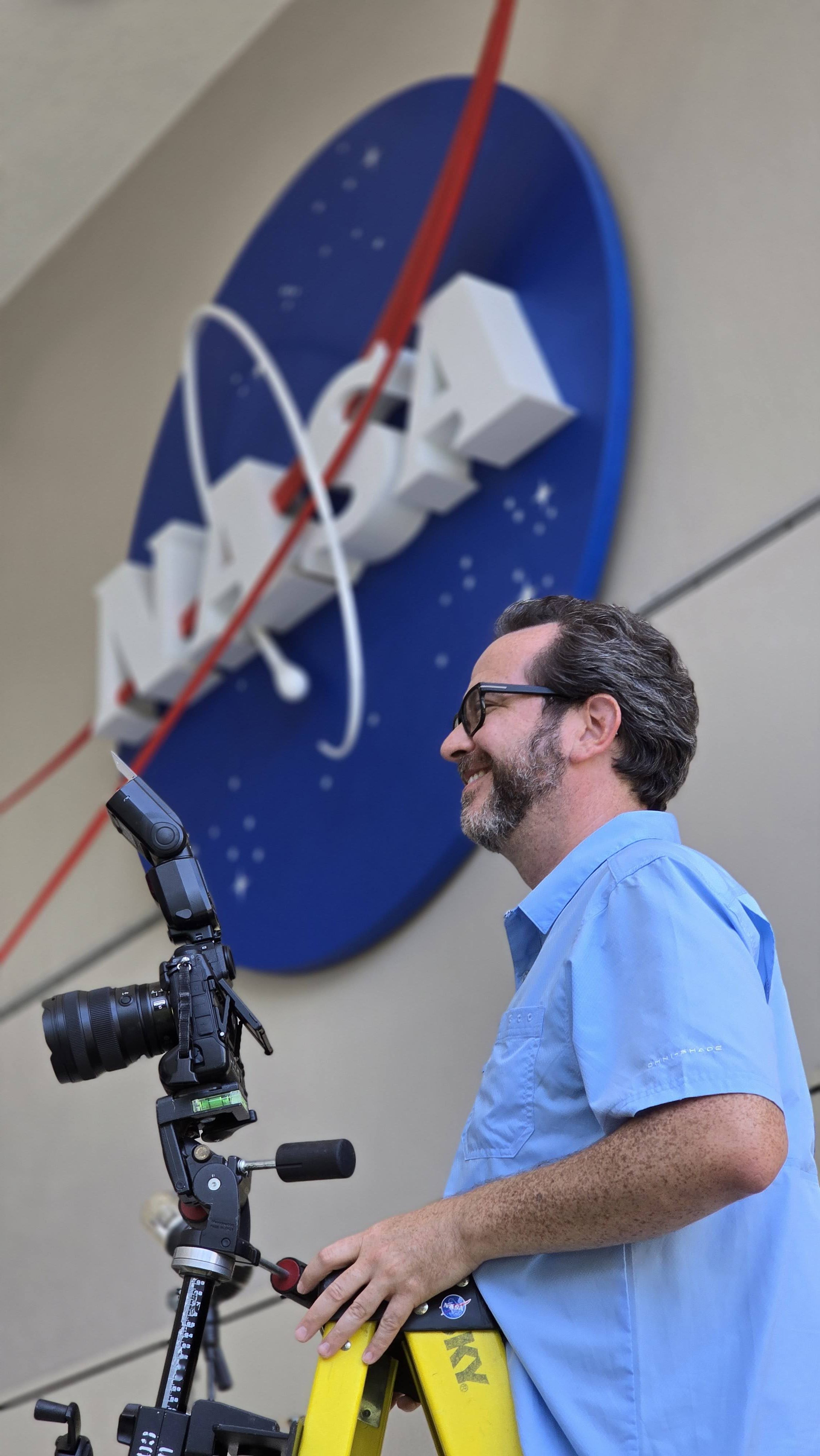
NASA photographer James Blair prepares to capture imagery during a flight operations assignment.
NASA
I truly enjoy capturing candid photos of people during decisive moments.
James Blair
NASA Photographer
From newspapers across the country to working as a photographer and photo editor for a publication in Ecuador, NASA photographer James Blair began his career in photojournalism. Photography has taken him around the world, a path that has continued at Johnson with assignments ranging from astronaut training to geology field training in Iceland.
“Since I was very young, I have always been fascinated by spaceflight and the technology it takes to reach beyond Earth’s atmosphere,” Blair said.
At Johnson, Blair combines that fascination with his photojournalism background to document the people and technology shaping NASA’s next era of exploration.
“I enjoy documenting the new hardware that is being developed to return us to the Moon,” he said. “From spacesuits to rovers and potential lunar habitats, I get to show the world what NASA has in store for the future of human spaceflight.”
U.S. Navy divers and Artemis II astronauts aboard an inflatable raft are approached by helicopters and lifted away to the recovery ship after egressing NASA’s Orion spacecraft.
NASA/James Blair
Artemis II crew members Christina Koch (middle) and Victor Glover (right) participate in an Artemis lunar imaging training using an Orion crew configuration at NASA’s Johnson Space Center.
NASA/James Blair
From left, JAXA (Japan Aerospace Exploration Agency) astronaut Aki Hoshide and NASA astronaut candidates Yuri Kubo and Cameron Jones participate in an Artemis geology field training expedition in Iceland.
From left, EVA task officer Bridget Scheib, chief training officer John Ray, NASA astronaut candidate Cameron Jones, geology instructor and Artemis science officer Kelsey Young, associate research scientist Patrick Whelley, geology instructor and Artemis curation lead Juliane Gross, and JAXA (Japan Aerospace Exploration Agency) astronaut Aki Hoshide participate in an Artemis geology field training expedition in Iceland.
NASA/James Blair
From left, Artemis IV chief training officer Bryce Prescott, geology instructor Jacob Richardson, and NASA astronaut Zena Cardman participate in an Artemis geology field training expedition in Iceland.
NASA/James Blair
Helen Arase Vargas
NASA photographer Helen Arase Vargas captures a news conference on lunar terrain vehicles for Artemis missions at NASA’s Johnson Space Center in Houston on April 3, 2024.
NASA/Robert Markowitz
I’ve always liked the idea of my work serving the public interest.
Helen Arase Vargas
NASA Photographer
NASA photographer Helen Arase Vargas began her career in photojournalism and reporting in Southern California before joining Boeing’s scientific photography team in El Segundo. Her experience photographing aerospace sparked an unexpected interest that eventually led her to Johnson.
“The best part of the job is my coworkers; cheesy, but there is so much to learn from everyone,” Arase Vargas said. “Our core team has so much knowledge. They are all quick to offer help and are great humans.”
Arase Vargas says much of the work at Johnson reflects the journalism ethics she learned early in her career and fulfills her desire to serve the public interest.
The range and volume of assignments also helped her become more comfortable working in different environments while continuing to develop her craft.
For Arase Vargas, documenting the Artemis II crew’s return to Ellington Field in Houston came with a heightened sense of responsibility.
“The world is watching, and all that imagery must be rushed out by the lab,” she said. “Your photo could be the one that ends up on every news site, and you don’t want to miss capturing the joy and celebration the moment deserves.”
NASA’s Artemis II crew returns to Ellington Field in Houston following the mission on April 11, 2026.
NASA/Helen Arase Vargas
The Artemis III crew poses for an official portrait in Houston, Texas. In the back row, from left, are NASA astronauts Andre Douglas and Frank Rubio. In the front row, from left, are ESA (European Space Agency) astronaut Luca Parmitano and NASA astronaut Randy Bresnik.
NASA/Helen Arase Vargas
ESA (European Space Agency) astronaut Sophie Adenot poses in an Extravehicular Mobility Unit during a portrait session at NASA’s Johnson Space Center.
NASA/Helen Arase Vargas
NASA’s 2025 Astronaut Candidate Class participates in geology training at Rio Grande del Norte National Monument in New Mexico on May 20, 2026.
NASA/Helen Arase Vargas
The 2025 Astronaut Candidate Class poses for a holiday photo during wilderness survival training at Fort Rucker in Alabama.
NASA/Helen Arase Vargas
NASA teams conduct nighttime operations training with a Lunar Terrain Vehicle Ground Test Unit at Johnson Space Center’s Rock Yard.
NASA/Helen Arase Vargas
Luna Posadas Nava
NASA photographer Luna Posadas Nava documents the Artemis II crew return at Ellington Field in Houston.
NASA/Luna Posadas Nava
I have used the camera as a bridge between curiosity and understanding.
Luna Posadas Nava
NASA Photographer
NASA photographer Luna Posadas Nava’s path to Johnson spans emerging technology, optics and imaging systems, and photographing artists across the East Coast. Her work grew from a desire to visualize and expand the boundaries of what is possible.
Joining Johnson shortly before the launch of NASA’s Artemis II mission, one of Posadas Nava’s first experiences was helping bring Moon Joy to the world. She documented the Science Evaluation Room, where scientists worked together to conduct real-time lunar science observations during the mission’s lunar flyby.
Posadas Nava said it was inspiring to witness the team at work and especially meaningful to see so many women contributing to the mission’s science.
Seeing the response from women in her own life and online reinforced for Posadas Nava the power of representation through photography.
“When we see ourselves in stories, we imagine new futures,” she said. “I hope my work helps more people see themselves in the story of exploration, because what we see shapes what we believe is possible.”
The Artemis II lunar science team celebrates in the Science Evaluation Room following the mission’s successful lunar flyby. Artemis II Deputy Lunar Science Lead Marie Henderson stands at left. From the right foreground are lunar science team members Ariel Deutsch; Maria Banks, behind her; Ryan Watkins, to her right; and Sara Schmidt.
NASA/Luna Posadas Nava
Artemis II deputy lunar science lead Jacob Richardson, left, and Artemis II lunar science team member Kiarre Dumes react to the astronauts’ verbal observations of the Moon during the mission’s lunar flyby on April 6, 2026.
NASA/Luna Posadas Nava
Artemis II science officer Angela Garcia, left, and lunar science team member Kiarre Dumes discuss science operations in the Science Evaluation Room at NASA’s Johnson Space Center.
NASA/Luna Posadas Nava
NASA engineers and teams from the Rock and Roll with NASA Challenge test rover prototypes at NASA’s Johnson Space Center Rock Yard in Houston on July 31, 2026.
NASA/Luna Posadas Nava
NASA’s Artemis III crew participates in a video shoot for the crew announcement at NASA’s Johnson Space Center on June 3, 2026.
NASA/Luna Posadas Nava
The Expedition 73 crew attends a debrief and awards ceremony at Space Center Houston on June 16, 2026.
NASA/Luna Posadas Nava
David DeHoyos
NASA photographer David DeHoyos is photographed during an assignment in the Space Vehicle Mockup Facility at NASA’s Johnson Space Center in Houston.
NASA
I am very aware of the importance of preserving history and what it means to others when our images are shared with the world.
David DeHoyos
NASA Photographer
Growing up in Houston during the Apollo era, NASA photographer David DeHoyos knew from an early age that he wanted to be part of the space industry. His interest in photography began with his mother’s Kodak Instamatic camera and continued through school and a decade working in photo labs. In 1991, that path brought him to Johnson’s photo lab and eventually behind the camera as a NASA photographer.
After more than three decades at Johnson, DeHoyos says connecting with people remains one of his favorite parts of the job. He enjoys learning about the people he photographs, sharing what he has learned about Johnson with visitors and new employees, and encouraging the next generation.
“I keep an assortment of NASA goodies in my camera bag, and the ultimate joy I get is giving a pin or sticker to a child and seeing their little faces just light up,” DeHoyos said. “It just warms my heart to encourage a youngster to work hard and pursue their dreams because that’s how I got here.”
For DeHoyos, photography is also about preserving moments that can take on greater meaning over time.
“I love the process of figuring out technical details to create an image that will make someone say, ‘Wow, cool shot, how did you do that?’” he said.
NASA’s Artemis II commander Reid Wiseman participates in emergency cabin leak training for the Orion spacecraft at NASA’s Johnson Space Center in Houston.
NASA/DavidDeHoyos
Artemis II Pilot Victor Glover returns to Ellington Field in Houston following the crew’s nearly 10-day mission around the Moon on April 11, 2026.
NASA/David DeHoyos
NASA astronaut Zena Cardman participates in emergency consultation training at NASA’s Johnson Space Center in Houston.
NASA/David DeHoyos
Members of NASA Johnson’s Extravehicular Activity, Robotics, and Crew Operations Division gather for a group photo in the Neutral Buoyancy Laboratory high bay.
NASA/David DeHoyos
NASA astronaut Anil Menon participates in a hardware review run at NASA’s Neutral Buoyancy Laboratory in Houston on April 23, 2025.
NASA/David DeHoyos
The Honeybee Robotics prototype undergoes lunar VSAT (Vertical Solar Array Technology) testing inside Chamber A at NASA’s Johnson Space Center in Houston.
Preparations for Next Moonwalk Simulations Underway (and Underwater)
Credit: National Institute of Aerospace
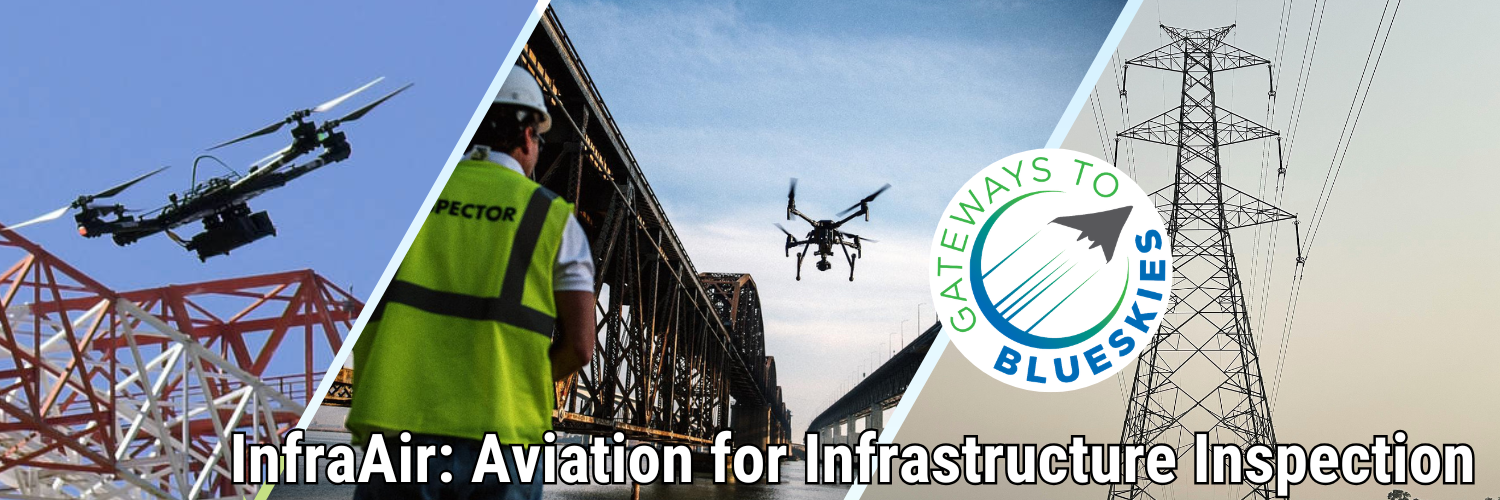
NASA’s next Gateways to Blue Skies competition invites collegiate teams to imagine innovative new ways aircraft could inspect land-based infrastructure, such as bridges and tunnels, to improve safety, reliability, and costs by 2035 or sooner.
Infrastructure is the foundation of the nation’s strong economy, global competitiveness, and daily quality of life. When that infrastructure is damaged or in disrepair, it restricts the movement of people, goods, and critical resources like water and energy. Inspections are important throughout the lifetime of infrastructure projects, but they often come with challenges.
Structures such as tunnels, bridges, highways, railways, and electric grids can be massive in size and difficult to reach. They can require disruptive shutdowns to access, or force workers to navigate extreme heights, confined spaces, and hazardous environments. As infrastructure ages and expands, there are opportunities to use innovative airborne platforms to improve current inspection practices.
“The demands for creative solutions like airborne platforms to improve the infrastructure sector are increasing exponentially,” said Steven Holz, Gateways to Blue Skies competition lead, NASA’s Langley Research Center in Hampton, Virginia. “The time is ripe for innovative students to transform how we work with our critical infrastructure, and this competition gives talented students the opportunity to do so.”
Sponsored by NASA’s University Innovation Project, the 2027 Gateways to Blue Skies competition encourages multidisciplinary teams of college students to conceptualize innovations in the world of aviation. Each year, the competition selects a new theme based on a complex challenge facing the Nation. It aims to engage as many students as possible from all backgrounds, majors, and collegiate levels.
The competition is open to teams of two to six students and divided into two phases. In Phase 1, teams will submit a proposal and an accompanying two-minute video, which will be judged by NASA and industry experts. Up to eight finalist teams will each receive a $9,000 prize and advance to Phase 2, where they will present their updated work to a panel of NASA and industry experts at a forum in May 2027. Winners will be offered the opportunity to intern with NASA Aeronautics in the academic year following the forum.
Teams interested in participating in the competition can review guidelines and eligibility requirements posted on the competition website. Teams are encouraged to submit a non-binding Notice of Intent by Monday, Oct. 12, via the website to stay apprised of competition news. Proposal and video submissions are due Feb. 22, 2027. The Gateway to Blue Skies Competition is run by the Aeronautics Division in NASA’s Research and Technology Mission Directorate. NASA’s Center of Excellence for Collaborative Innovation, part of the Prizes, Challenges, and Crowdsourcing Program within the Research and Technology Mission Directorate, manages the challenge contract. The National Institute of Aerospace administers the challenge on behalf of NASA.
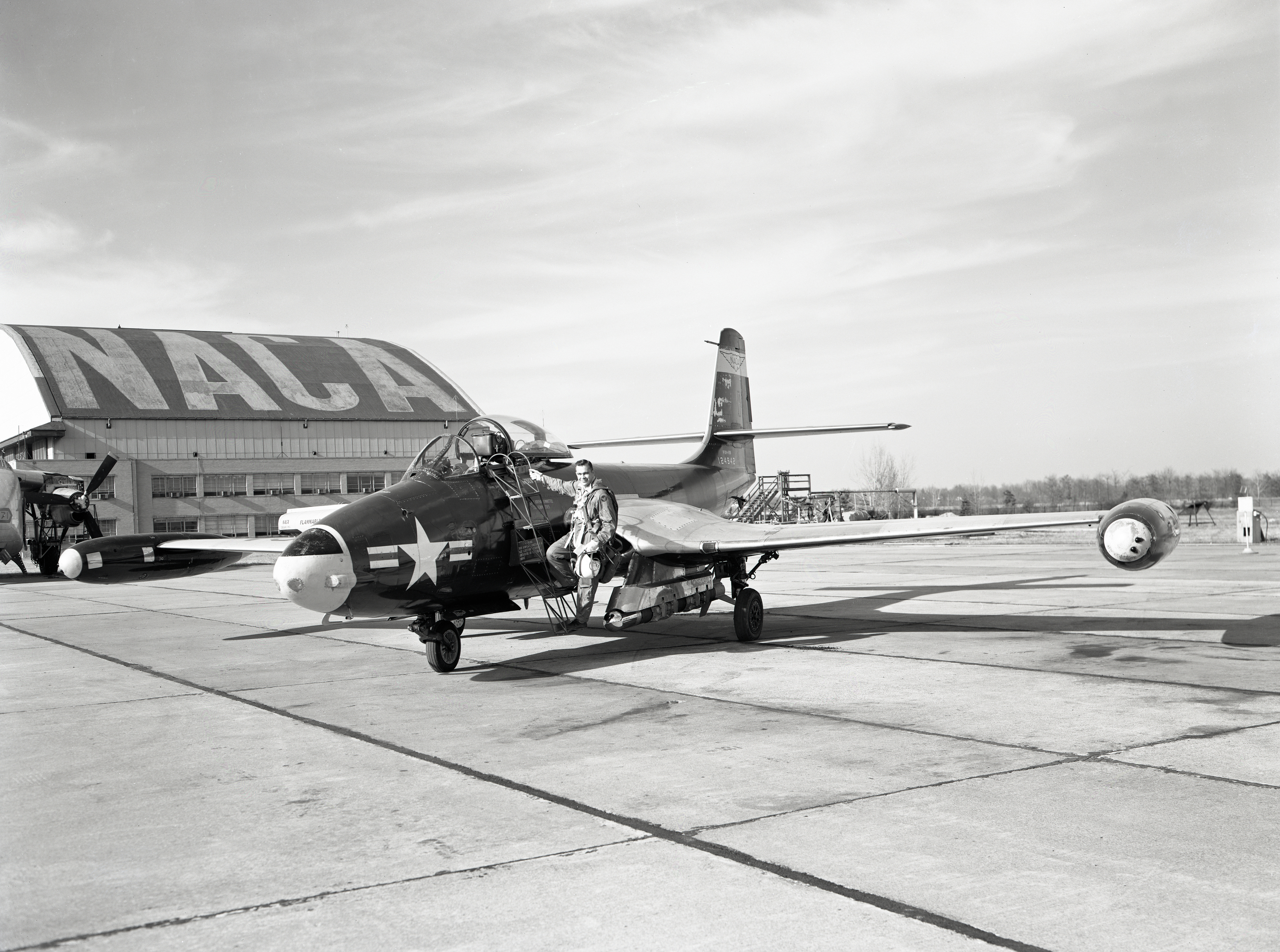
William “Bill” Swann, one of the first-generation pilots at the National Advisory Committee for Aeronautics’ Flight Propulsion Research Laboratory (predecessor to NASA’s Glenn Research Center in Cleveland), prepares to board a McDonnell F2H-2B airplane on Nov. 6, 1956.
Credit: NASA
Many of NASA’s most important aerospace breakthroughs that began in the laboratory were ultimately proven in the sky. For decades, experts at NASA’s Glenn Research Center in Cleveland conducted flight tests — piloting aircraft into targeted environments such as icing clouds and carefully defined atmospheric routes. This approach allowed them to collect measurements directly in flight, providing critical data that linked laboratory theories to practical performance.
The center’s flight research dates to the 1940s, when NASA Glenn was known as the Aircraft Engine Research Laboratory for the National Advisory Committee for Aeronautics, NASA’s predecessor agency. During World War II, engineers and pilots worked to improve aircraft performance and increase high-altitude reliability. In the mid-to-late-1940s, flight research helped make early jet and ramjet engines practical. Later, Glenn’s flight programs helped improve the efficiency and environmental performance of aircraft engines — primarily conventional jet engines.
Behind those early flight programs was a pioneering group of pilots who helped establish NASA Glenn’s reputation for airborne research. The center’s first generation of pilots, including Howard Lilly, Joseph Walker, William Swann, and William “Ed” Gough, helped lay the groundwork for more than two dozen other Glenn pilots, including future astronauts Neil A. Armstrong and Fred Haise.
Together with Glenn’s researchers, engineers, and support staff, these pilots established airborne research capabilities that NASA continues to rely on today. Their work demonstrated how flight testing could bridge the gap between laboratory research and real-world performance.
“These missions transformed aircraft into flying laboratories,” said Mark Russell, a NASA safety officer and pilot who served as the former acting chief of Aircraft Operations at Glenn. “They bridged the gap between ground testing and full-scale flight, proving the measurements needed to connect theory with performance. The testing also helped validate technologies and procedures later used aboard spacecraft and orbital missions.”
Research workhorses
From the start, NASA put its aircraft to work on a wide range of research challenges.
For decades, NASA Glenn aircraft have been used to study in-flight icing hazards, collecting data that has helped make commercial aviation safer. For nearly 40 years, NASA Glenn’s De Havilland DHC-6 Twin Otter served as the center’s workhorse for icing research, gathering data that helped shape modern aviation safety standards.
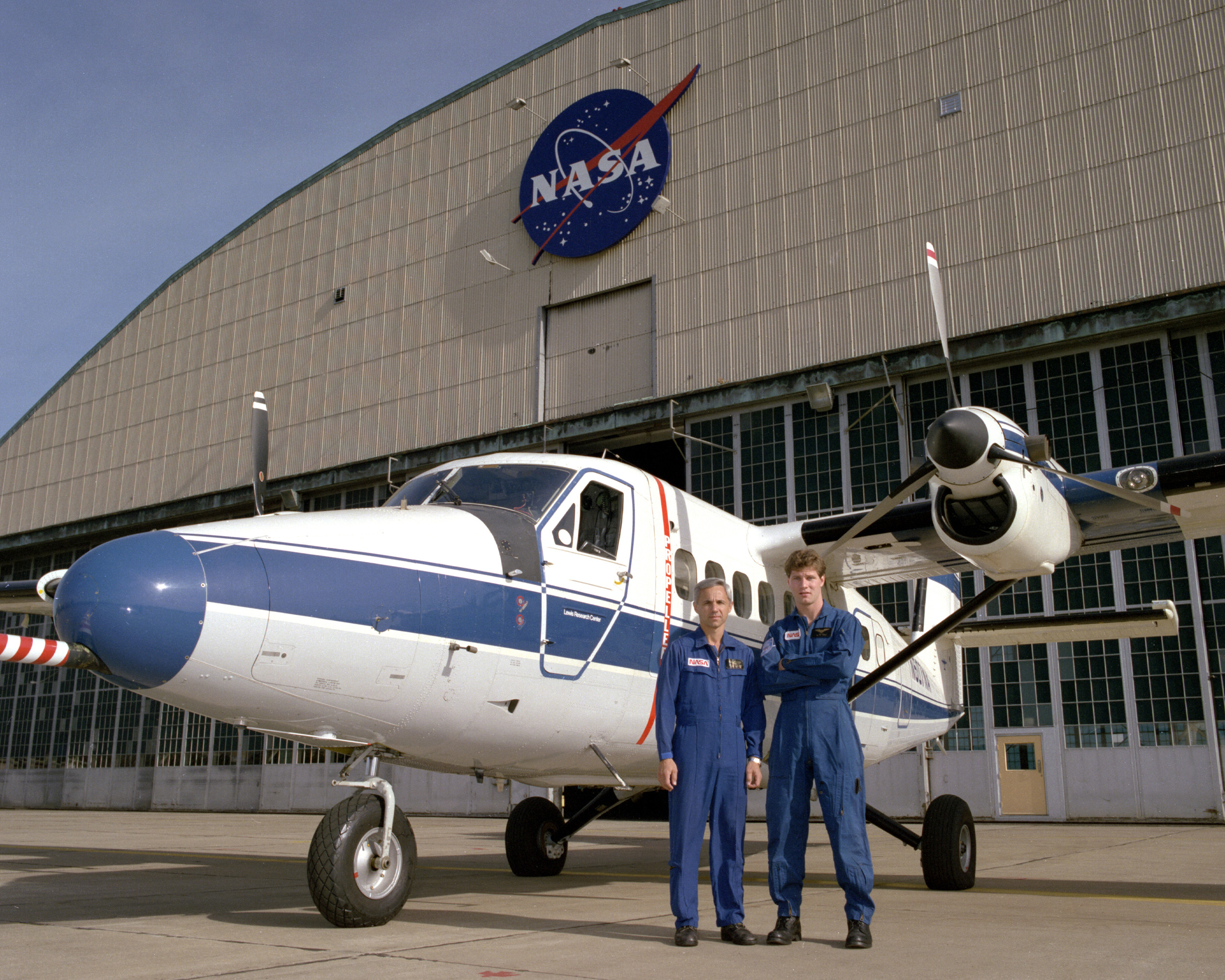
Pilot Richard Ranaudo, left, and engineer Thomas Ratvasky with the De Havilland Twin Otter at NASA’s Glenn (then Lewis) Research Center in Cleveland on Feb. 23, 1993. The aircraft helped advance global aviation safety by defining the precise atmospheric physics of supercooled clouds and validating critical modern technologies used to predict, detect, and prevent in-flight icing hazards.
Credit: NASA/Tom Jares
Beyond improving aviation safety, Glenn’s flight research also explored new propulsion technologies that could transform the future of flight. Today, researchers are exploring hydrogen as an aviation fuel. But NASA Glenn helped show its potential viability decades ago using its Martin B-57B Canberra aircraft. After developing a hydrogen fuel system for the B-57B, a team tested it safely from February to April 1957. The flights showed the system’s reliable operation and advanced efficiency, marking a major milestone in aviation technology.
Flight testing also supported technologies destined for use beyond Earth, helping researchers evaluate hardware under conditions that closely resembled space. Beginning in 1963, the center began a program to test and measure how well solar cells worked under conditions similar to those in space. Using specially modified airplanes, including Learjets, NASA conducted flights to help recreate some of the sunlight and atmospheric conditions that solar cells would experience outside Earth’s atmosphere. The program lasted decades, supporting space technology calibration through numerous high-altitude flights and adapting to newer aircraft over time.
Researchers later applied these airborne capabilities to environmental science, extending their value beyond aviation and space technology. Using the Twin Otter and S-3B Viking over the Great Lakes, researchers tracked harmful algal blooms on Lake Erie by measuring changes in water color and composition. The data improved satellite systems used to monitor water quality and ecosystem health.
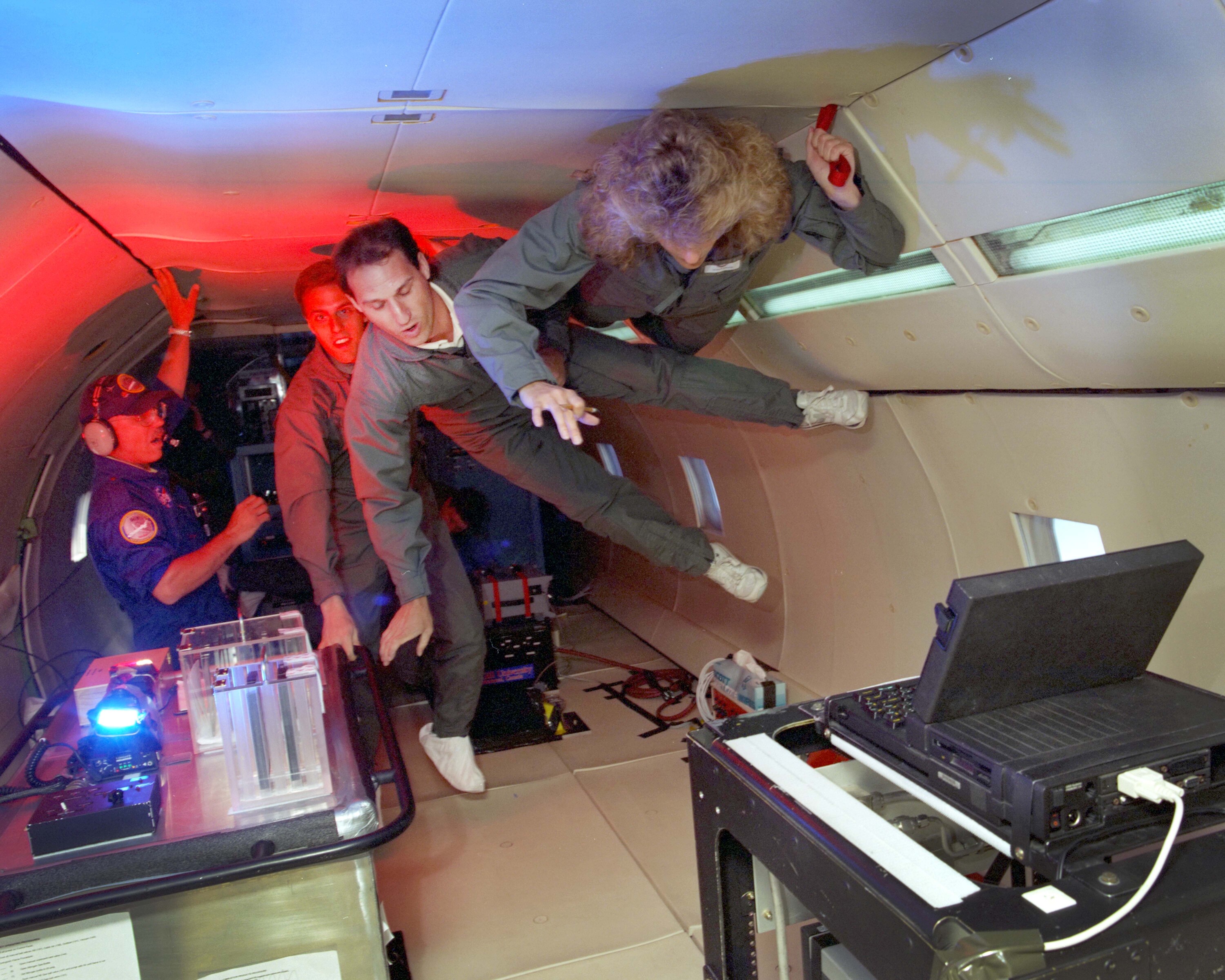
Glenn’s research aircraft also played an important role in preparing technologies and experiments for spaceflight through microgravity testing. NASA Glenn advanced microgravity research through in-flight testing using specially modified aircraft, such as its DC-9, to create short periods of weightlessness during parabolic maneuvers. These flights allowed researchers to study how fluids, combustion, materials, and experimental equipment behaved in near-zero gravity before experiments were conducted in space.
NASA’s Glenn (then Lewis) Research Center in Cleveland conducted microgravity research using the DC-9 airplane. Pictured, back to front, John Yaniec, Mike Mahn, Michael Capelety, and Susan Motil conduct microgravity research during a flight on July 10, 1996.
Credit: NASA/Quentin Schwinn
Recent breakthroughs
Other significant accomplishments enabled by Glenn’s flight research include supporting the development and testing of sustainable aviation technologies, including research related to more fuel-efficient engines and sustainable aviation fuels, and advancing in-flight instrumentation and measurement techniques used across aeronautics research.
In 2024, Glenn’s Flight Operations participated in an optical communications study using the center’s Pilatus PC-12 NG aircraft. This mission successfully demonstrated the ability to transmit large volumes of data through a laser communication system across NASA’s legacy infrastructure. The work contributed to NASA’s broader effort to advance optical communications for future missions. NASA further tested optical communications on the Artemis II mission and effectively transmitted substantial amounts of data from the Orion capsule to multiple ground stations over the course of the 10-day journey.
A team at NASA’s Glenn Research Center in Cleveland streamed 4K video footage from a Pilatus airplane to the International Space Station and back for the first time using optical, or laser, communications. Pictured on June 13, 2024, left to right, James Demers, Adam Wroblewski, Shaun McKeehan, and Kurt Blakenship.
Credit: NASA/Sara Lowthian-Hanna
As NASA’s flight research enterprise evolved, the agency also restructured how it manages its research aircraft. In October 2025, NASA streamlined its aircraft flight operations, relocating its aircraft from Glenn to NASA’s Armstrong Flight Research Center in Edwards, California. NASA Glenn continues its important icing and propulsion research and communications technology development in collaboration with Armstrong.
From its historical roots in wartime engine development to modern work on aircraft safety, Glenn’s airborne research has consistently moved innovative ideas from the laboratory to real-world application. For more than eight decades, NASA Glenn has transformed ideas first proven in the laboratory into innovations validated in the sky — a legacy that continues to shape the future of aviation and space exploration.
March 17, 1943
Researchers at the National Advisory Committee for Aeronautics’ Aircraft Engine Research Laboratory (AERL), the historical name for NASA’s Glenn Research Center in Cleveland, prepare to embark on the first AERL flight test using the Martin B-26C airplane at the center on March 17, 1943.
Credit: NASA
April 21, 1946
These aircraft were used in the 1940s for research at the National Advisory Committee for Aeronautics’ Aircraft Engine Research Laboratory in Cleveland (the predecessor to NASA’s Glenn Research Center). This photo was taken on April 21, 1946.
Credit: NASA
April 13, 1976
Pilots and staff recognize the 100th research flight of the F-106B Delta Dart aircraft at NASA’s Glenn (then Lewis) Research Center in Cleveland on April 13, 1976. From left to right, John Burke, Casey Blaze, Thomas Mayher, Bernard Smith, William Bohrer, William Wildenhein, James Potantus, Maurice Collier, James Cery, Joseph Sikosky, Jack Salzman, Earl Boyer, Frank Hvizdos, Anthony Mastronuzzi, Carl Hembly, Gary Thomas, Carl McLucas, and Russell Hart. Previously used by the U.S. Air Force, the plane was converted to test supersonic nozzle and inlet variations.
Credit: NASA
July 14, 1997
NASA Glenn (then Lewis) Research Center’s aircraft fleet consisted of a, clockwise from bottom, T-34 Mentor, De Havilland Twin Otter, McDonnell Douglas DC-9, North American OV-10A, and Learjet, pictured here on July 14, 1997.
Credit: NASA/Christopher Lynch
June 13, 2018
Mark Russell, a NASA safety officer and pilot who served as the former acting chief of Aircraft Operations at NASA’s Glenn Research Center in Cleveland, climbs into a T-34 Mentor aircraft on June 13, 2018.
Preparations for Next Moonwalk Simulations Underway (and Underwater)
The Vertical Motion Simulator at NASA’s Ames Research Center in California’s Silicon Valley is capable of vertical and horizontal motion to simulate a range of flight experiences, such as lunar landers, helicopters, and commercial aircraft.
NASA/Jesse Carpenter
Imagine stepping into a machine that can make you feel like you’re flying a spacecraft, piloting a next generation air taxi, or landing on the Moon, all without leaving the ground. NASA’s Vertical Motion Simulator, the largest of its kind in the world, does exactly that. And now, with new upgrades, it’s more powerful and realistic than before.
The Vertical Motion Simulator, located at NASA’s Ames Research Center in California’s Silicon Valley, has shaped the future of aviation and spaceflight since 1979. It allows pilots and researchers to experience realistic aircraft motion due to its ability to travel 60 feet vertically and 40 feet horizontally, simulating vehicles ranging from helicopters to spacecraft with high accuracy.
New improvements are making the simulator even more powerful. One of the biggest changes is the switch from analog systems to modern digital technology. This upgrade includes a dome surrounding the simulator’s cockpit with advanced 4K projectors that create visuals with nearly 20/20 clarity, giving pilots clearer, sharper images and a larger field of view of the world outside the cockpit.
The upgraded cab of the Vertical Motion Simulator at NASA’s Ames Research Center in California’s Silicon Valley provides researchers with near-20/20 visual clarity, providing clearer, sharper images.
NASA/Brandon Torres-Navarrete
“The new dome configuration and improved systems can support far more aggressive mission tasks while giving pilots and crews a more realistic environment to work in,” said Diana Acosta, aerospace simulation research and development branch chief at NASA Ames. “It strengthens how teams coordinate, react, and manage challenging scenarios, exactly the kind of preparation we need for the missions coming next.”
The system also can automatically line up and color‑match images to integrate them into a simulated background, a process that used to take hours, or even days, to do by hand.
In the past, changing simulation configurations from lunar lander to air taxi required swapping out the cab, a large, heavy structure that was time‑consuming and complex to move. Instead of replacing an entire cab, teams can use lighter, removable inserts that include only the controls, seats, and panels needed to stand in for a specific vehicle. The inserts drastically reduce physical labor and cut the time needed to configure a simulation in half.
The upgrades to the Vertical Motion Simulator will enable tests of next-generation aircraft and spacecraft before they ever leave the ground, bringing us closer to safer skies, more efficient air travel, and successful human landings on the Moon and Mars.
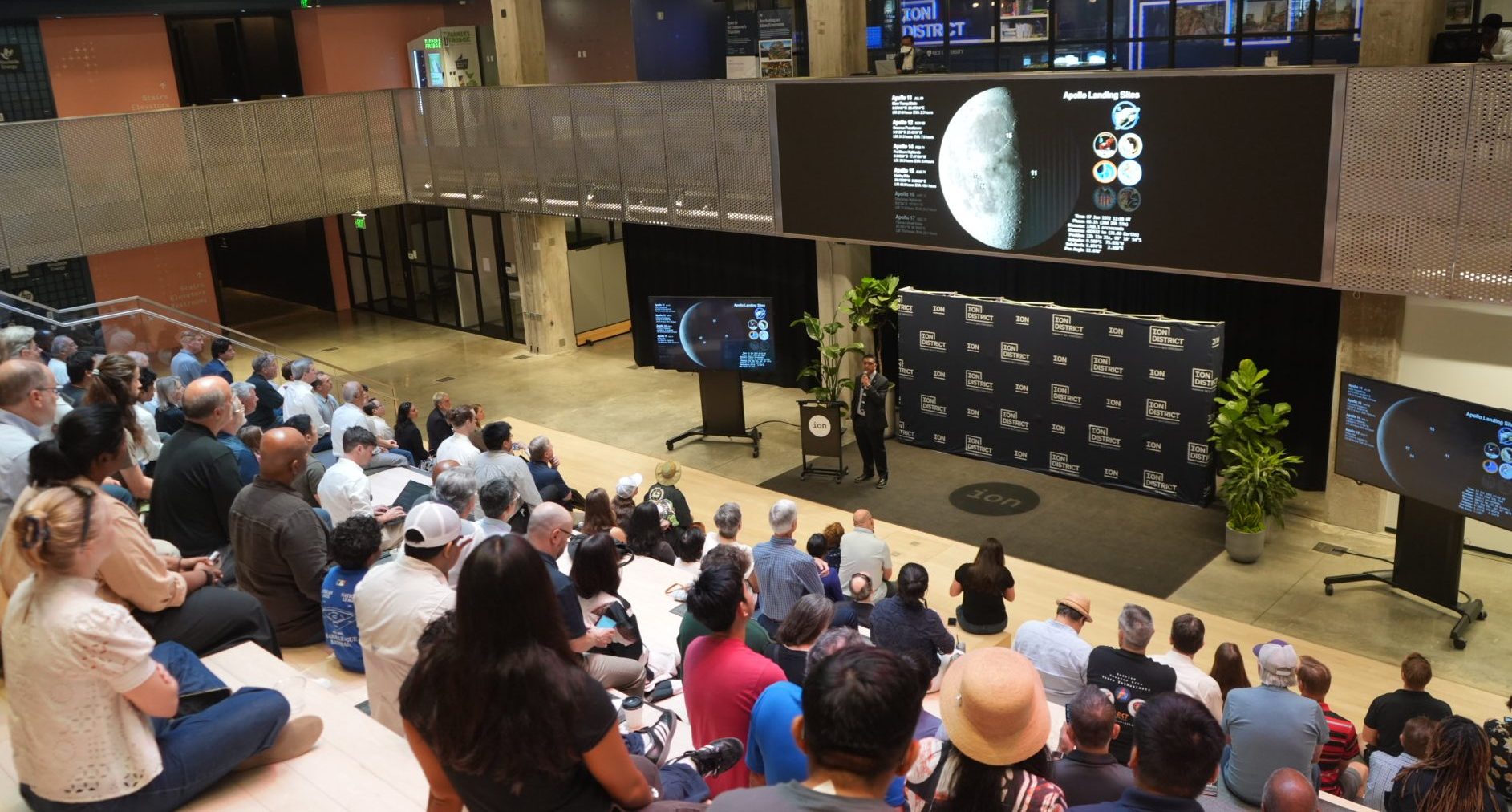
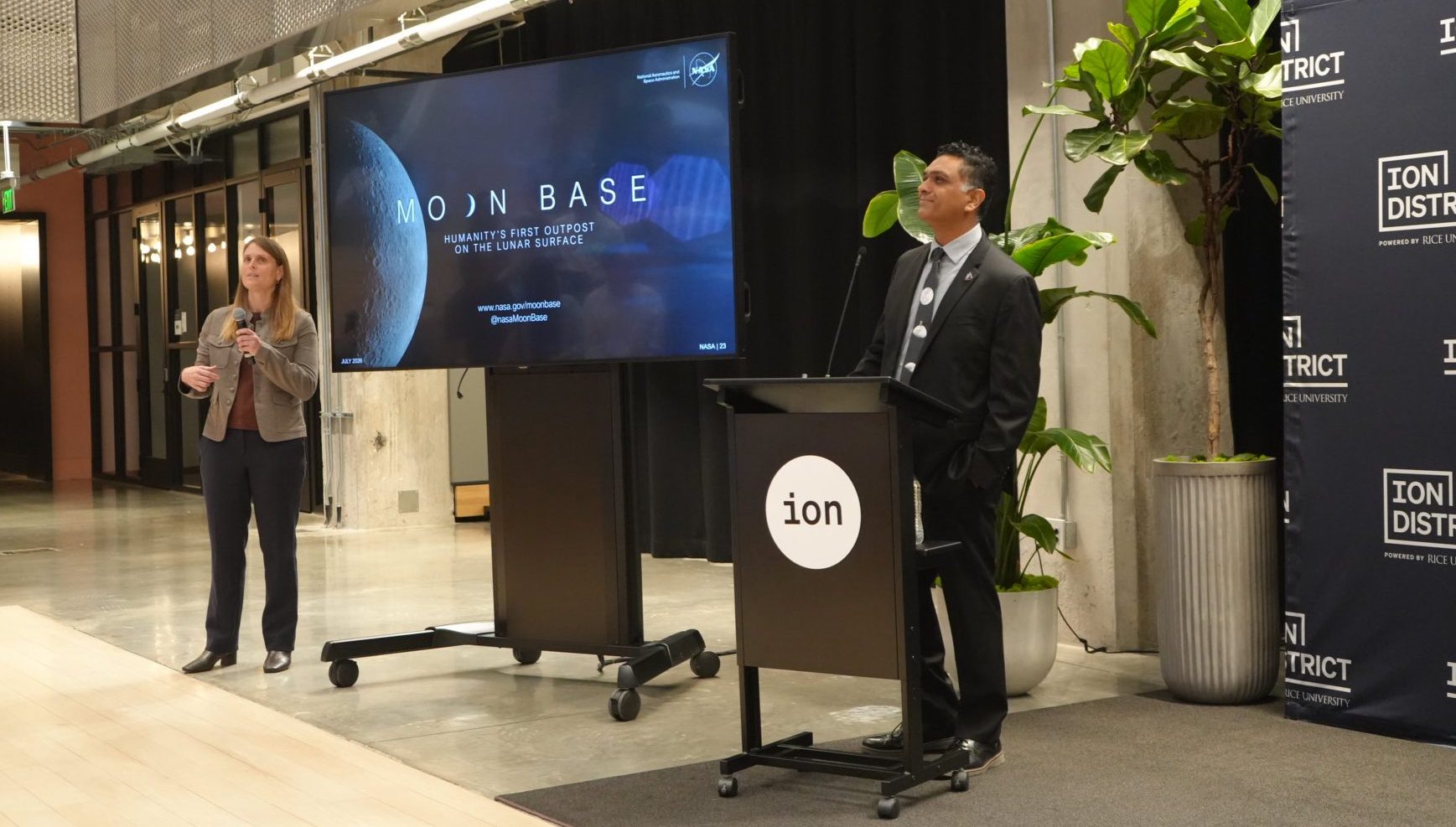
Shatel Bhakta, principal systems engineer for NASA’s Moon Base Program, gives a presentation during NASA Stories at the Ion in Houston on July 30, 2026.
Credits: NASA/Sumer Loggins
Shatel Bhakta, principal systems engineer for NASA’s Moon Base Program, gives a presentation during NASA Stories at the Ion in Houston on July 30, 2026.
NASA/Sumer Loggins
As NASA prepares to return astronauts to the lunar surface for longer stays and increasingly complex operations, building the Moon Base will require new ideas, advanced technologies, and expertise across many fields.
During NASA Stories at the Ion on July 30, Shatel Bhakta, principal systems engineer for NASA’s Moon Base Program, presented “Building the Moon Base: Challenges and Opportunities at the Lunar South Pole.” He discussed the work required to establish a sustained human presence at the Moon.
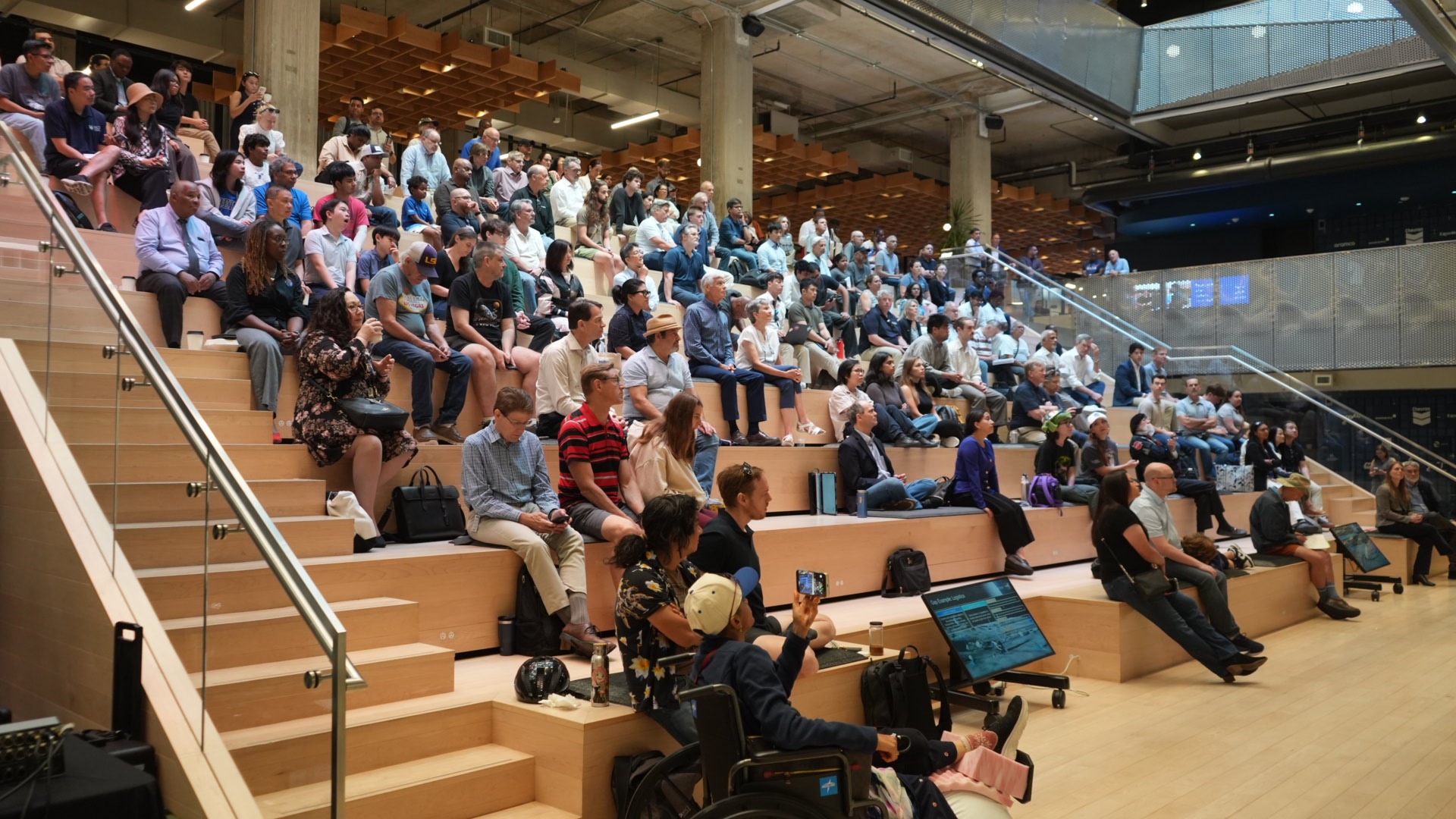
Through its growing partnership with Rice University and the Ion, NASA’s Johnson Space Center in Houston hosts recurring talks connecting agency experts with entrepreneurs, researchers, students, and industry leaders. The series gives Houston’s innovation community a closer look at the people and ideas shaping the future of exploration.
Shatel Bhakta, principal systems engineer for NASA’s Moon Base Program, presents during NASA Stories at the Ion. At left is Laura Neder, head of platform for the Rice Alliance for Technology and Entrepreneurship and the Ion District.
NASA/Sumer Loggins
Laura Neder, head of platform for the Rice Alliance for Technology and Entrepreneurship and the Ion District, welcomed attendees and introduced Monte Goforth, acting director of Business Development and Technology Integration at Johnson. Goforth delivered opening remarks on the value of sharing NASA’s work beyond the agency and bringing people together to support future exploration before introducing Bhakta.
Bhakta outlined how NASA is working toward long-duration human exploration of the lunar South Pole through the agency’s Moon Base Program.
As part of that effort, NASA is taking a step-by-step approach to Moon Base development. Early robotic missions and technology demonstrations will help NASA gather data about the lunar environment, test systems, and reduce risks before expanding infrastructure and human operations.
“This is probably going to be the most challenging endeavor NASA has ever undertaken,” Bhakta said.
Meeting that challenge will require collaboration between NASA and its commercial and international partners to develop solutions for operating in extreme environmental conditions.
Unlike the Apollo landing sites, areas near the lunar South Pole contain steep slopes, deep craters, and lighting conditions that change throughout the year. The Sun remains low on the horizon, creating shifting shadows that can complicate navigation and leave solar panels without sunlight for extended periods, increasing the need for energy storage and other power sources.
Because of the region’s rugged terrain, crews, rovers, and other surface systems may not always have a clear line of sight to Earth. NASA will need communications infrastructure to relay signals across the lunar South Pole.
Bhakta explained that Moon Base may not be a single cluster of connected structures. Terrain, lighting, power, and landing constraints could require habitats and other systems to be distributed across the lunar surface.
Attendees listen as Shatel Bhakta, principal systems engineer for NASA’s Moon Base Program, discusses the challenges of establishing a sustained human presence at the Moon.
NASA/Sumer Loggins
Lunar regolith, or Moon dust, remains one of the greatest challenges. Without mitigation, the sharp and clingy substance could damage equipment and spacesuits while posing health risks to astronauts. Its electrostatic properties can also change depending on lighting and environmental conditions.
Understanding how lunar regolith behaves will be essential to ensuring crews can safely live and work on the lunar surface.
Some permanently shadowed regions near the lunar South Pole may not have received direct sunlight for billions of years and may contain water ice and other volatile materials. These resources could support future exploration, but using them will require new mobility, power, and processing systems.
The Moon will also serve as a proving ground for missions farther into the solar system. Operating on the lunar surface will help NASA learn how crews, equipment, and infrastructure perform away from Earth before future human missions to Mars.
As NASA develops these capabilities, Bhakta explained that keeping the Moon Base architecture adaptable will require understanding how individual systems connect and work together.
“Don’t deal with the technology directly,” Bhakta said. “Deal with the interfaces.”
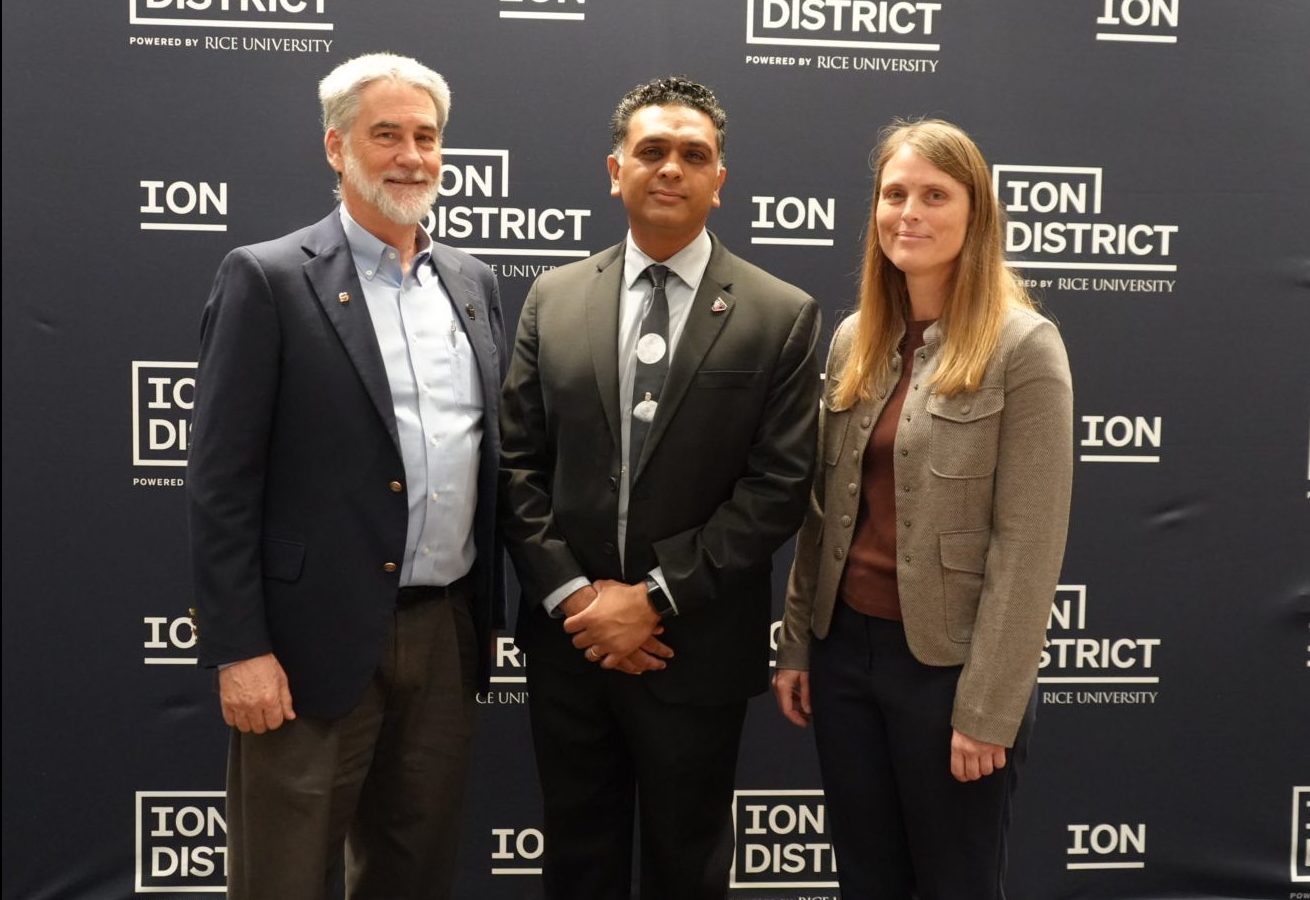
From left, Monte Goforth, acting director of Business Development and Technology Integration at NASA’s Johnson Space Center; Shatel Bhakta, principal systems engineer for NASA’s Moon Base Program; and Laura Neder, head of platform for the Rice Alliance for Technology and Entrepreneurship and the Ion District, pose during NASA Stories at the Ion.
NASA/Sumer Loggins
Building the Moon Base will take more than engineers and scientists. NASA will need communicators, business professionals, researchers, and people from many other fields to help solve problems and share the agency’s work.
“There are many ways to contribute,” Bhakta said. “Don’t be afraid that your skill set does not fit in.”
Moon Base build-up will offer multiple entry points for industry and international collaborators to participate, innovate, and contribute. From early demonstrations to long-term surface operations, there are multiple solicitations currently open.
NASA’s Lunar Development and Test Facility Prepares Artemis Hardware for Moon
The Handheld Lunar Electrostatic Dust Mitigation tool is tested inside the Lunar Development and Test Facility at NASA’s Johnson Space Center in Houston.
Credits: NASA/Josh Valcarcel
Before astronauts return to the Moon’s surface through NASA’s Artemis program, the hardware they depend on must first prove it can survive the unforgiving lunar environment. At NASA’s Johnson Space Center in Houston, engineers at the Lunar Development and Test Facility are tackling one of exploration’s biggest challenges: Moon dust.
Unlike sand on Earth, lunar dust is sharp, abrasive, and clings to nearly everything. Without mitigation, lunar dust could damage equipment and spacesuits while posing health risks to astronauts. Understanding and mitigating the effects of lunar dust is essential as astronauts prepare to live and work on the surface of the Moon.
The Handheld Lunar Electrostatic Dust Mitigation tool is tested inside the Lunar Development and Test Facility at NASA’s Johnson Space Center in Houston.
NASA/Josh Valcarcel
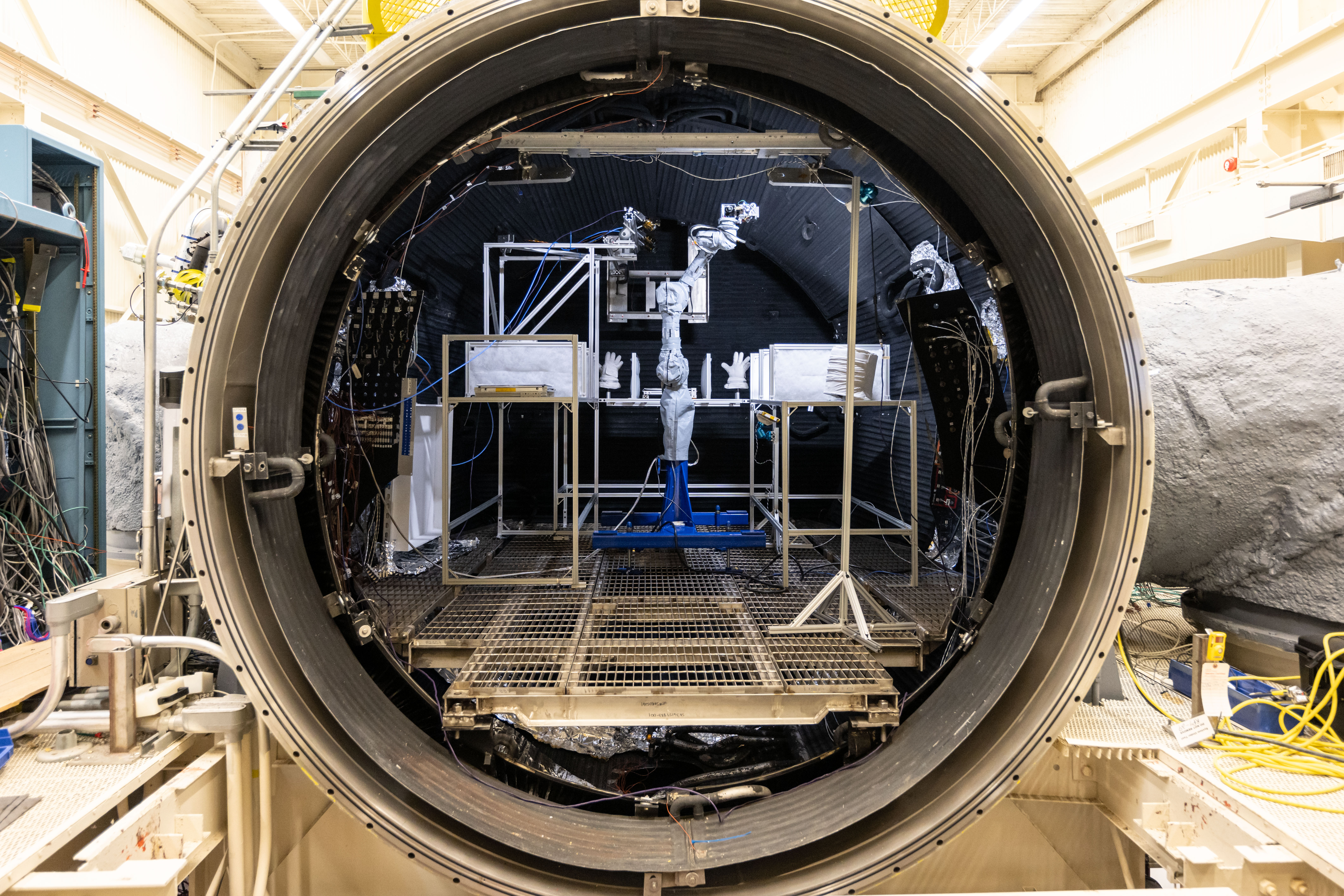
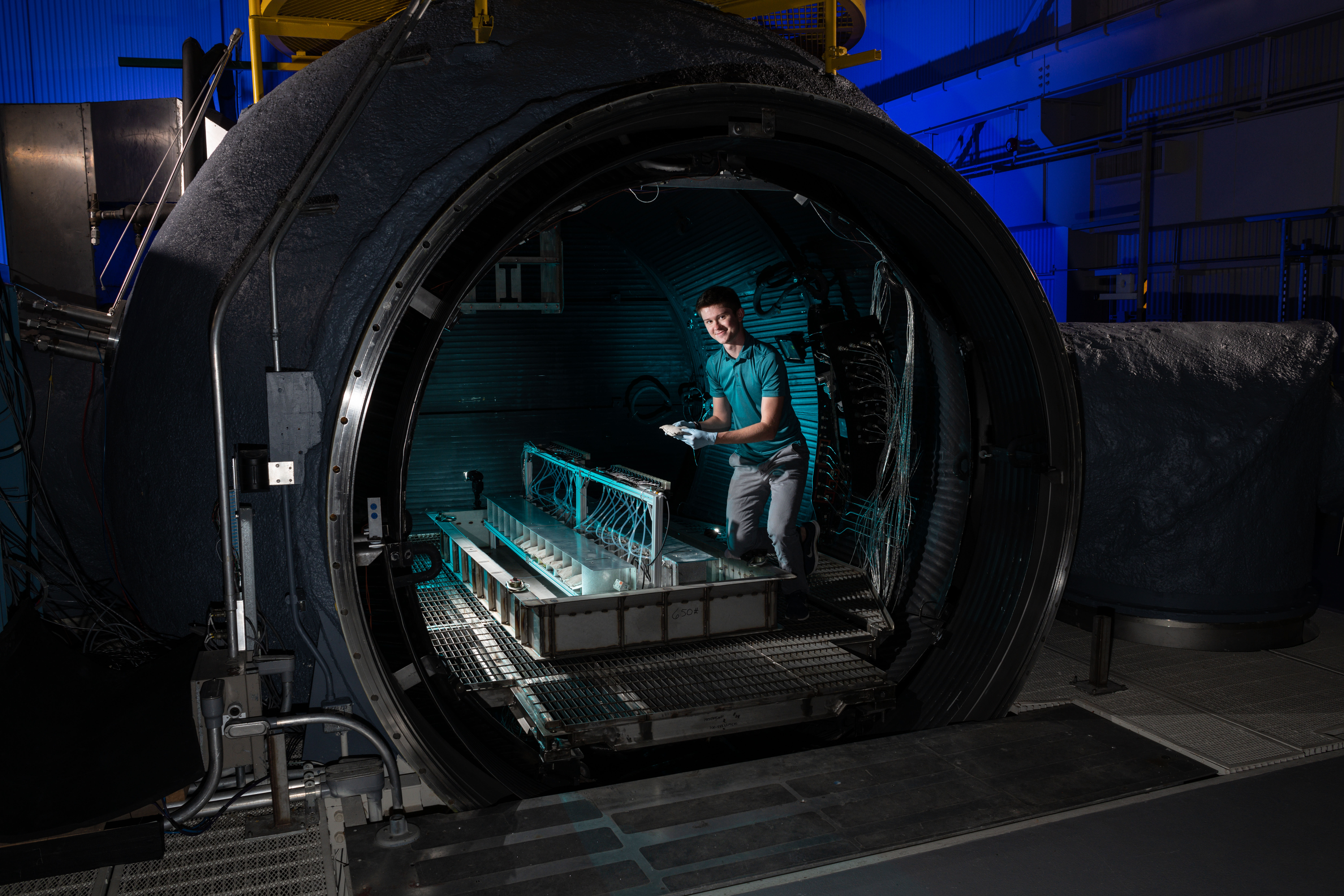
Located within the Energy Systems Test Area and managed by NASA engineers, the Lunar Development and Test Facility supports the development and testing of hardware in simulated lunar conditions. Engineers evaluate systems and subsystems inside vacuum chambers using lunar regolith simulant to better understand how spacesuits, spacecraft components, and mechanisms with moving parts and joints will perform during future Artemis missions.
Lunar spacewalking tools undergo a dust mitigation test inside Johnson’s thermal vacuum chamber.
NASA/Bill Stafford
NASA Johnson’s Propulsion and Power Division developed specialized systems that make the facility’s lunar simulations possible. The facility includes a dust containment and preparation laboratory for ambient testing, a 3-foot cube vacuum chamber, and a 15-foot thermal vacuum chamber.
Inside the chamber, engineers test hardware under realistic lunar conditions using lunar regolith simulant. The chamber uses a closed-loop nitrogen system to recreate the harsh lunar environment.
“The facility helps develop and test technologies needed for long-duration lunar exploration,” said Mike Salinas, Propulsion and Power Division branch deputy chief. “Engineers are advancing techniques to extract resources from lunar regolith, which can be turned into oxygen for astronauts and liquid oxygen for rocket propellant.”
The spirit of exploration extends beyond the facility’s walls. Its exterior features a large-scale mural depicting astronauts exploring the lunar surface beneath a view of the cosmos. Completed in 2024 by artist Sebastian Boileau, the artwork celebrates the innovation, ingenuity, and discovery happening inside the building every day.
Artist Sebastien Boileau, left, and Margaret Braun pose in front of Johnson’s Lunar Development and Test Facility after the mural’s completion on Feb. 7, 2024.
NASA/Josh Valcarcel
Now, anyone can step inside the facility from anywhere. Explore NASA’s new 3D virtual tour of the Lunar Development and Test Facility to see where engineers are helping prepare the technologies that support this Golden Age of exploration and innovation.
The NASA Ames Science Directorate recognizes the outstanding contributions of (pictured left to right) Danielle Lopez, Jennifer Claudio, and Duncan Mifsud. Their commitment to the NASA mission represents the entrepreneurial spirit, technical expertise, and collaborative disposition needed to explore this world and beyond.
Space Biosciences Star of the Month: Danielle Lopez
Danielle Lopez is the Deputy Project Manager for the Open Science Data Repository with Amentum in the Space Biosciences Division. She is recognized for her management efforts that have been critical to the success of Open Science at NASA including collaborations across directorates at Ames, across NASA centers, and with the public. Danielle has been a critical stabilizing force during challenging and tumultuous times, keeping multiple projects not only on track, but at the forefront of Open Science for the entire Agency.
Space Biosciences Star of the Month: Jennifer Claudio
Jennifer Claudio is a research staff member with Blue Marble Space in the Space Biosciences Division. Jennifer has made outstanding contributions in supporting the 2026 GeneLab for High School (GL4HS) summer program. She is recognized for her efficiency and initiative executing the program. Notably, Jennifer swiftly and successfully overcame a security breach of the GL4HS learning platform, demonstrating her resourcefulness and commitment to the program.
Astrophysics Star of the Month: Duncan Mifsud
Duncan Mifsud is a postdoctoral research scientist for the Bay Area Environmental Research Institute (BAERI) in the Astrophysics Division. Duncan is recognized this month for his exceptional work on the infrared analysis of several laboratory samples produced from the ultraviolet irradiation of soluble organic molecules as well as extraterrestrial sample returned from asteroid Bennu by NASA’s OSIRIS-REx mission.

 Login
Login