❌

Normal view

There are new articles available, click to refresh the page.
Before yesterdayMain stream

NASA Experimental Mars Helicopter Blade Designs Target Longer Flights 

20 October 2026 at 12:02
Ingenuity
roamx-0201
A close-up view of a cross-section of the Ingenuity rotor blade, also called an airfoil. The blade is shaped like an arched teardrop with holes drilled into the side.
A close-up view of a cross section of a rotor blade, also called an airfoil. The thin, gray material is slightly arched and sits atop a black stand against a ruler.
Ingenuity
roamx-0201
Rotor blade cross-sections highlight the thinner profile of the roamx-0201 design (right) compared to the more traditional, rounded shape used by NASA’s Ingenuity Mars helicopter, which accomplished the first powered flight on Mars.

NASA researchers are developing the future of flight on Mars, laying the groundwork for helicopters with the ability to fly higher and farther while conducting science on the Red Planet. Using high-fidelity computer simulations and wind tunnel tests, engineers are reimagining the rotorcraft blades that could carry the next generation of Mars flyers.
 
NASA’s Ingenuity helicopter made history as the first powered aircraft to fly on another planet. The SkyFall mission, scheduled for launch in 2028, builds on that legacy with a trio of helicopters destined for Mars exploration. Both missions utilize a blade designed to operate in Mars’ thin atmosphere, with a curved edge reminiscent of but distinct from blades used on Earth.
 
Researchers are exploring unconventional blade designs that are thinner and sharper, aiming to enable future missions after Skyfall to expand their single-flight range across Mars. One team at NASA’s Ames Research Center in California’s Silicon Valley is working with Imperial College London, United Kingdom, and Nagoya University, Japan, to test a new blade cross-section, or airfoil, that promises to significantly boost aerodynamic performance on Mars.
 
Researchers designed the new airfoil, called roamx-0201, using advanced simulations and algorithms tuned to Mars conditions, pointing researchers toward a thinner, asymmetrical shape. Subsequent wind tunnel tests showed that the optimized design boosted performance and was better able to recover in risky flight conditions.
 
Researchers used high-fidelity simulation tools to analyze the performance of the roamx-0201 airfoil and compare it to Ingenuity’s capacity. They found that the redesigned blades could enable future Mars helicopters to expand the distances that can be covered in one uninterrupted flight from Ingenuity’s 0.7 kilometers to as much as 18.7 kilometers while carrying scientific instruments. The findings were announced in a paper published Sept. 22 in the journal of the American Institute of Aeronautics and Astronautics.
 
The roamx‑0201 blades performed well in part because they were able to operate longer at higher speeds before experiencing a phenomenon known as “drag divergence”, where performance drops suddenly when the rotors approach the speed of sound, which is lower on Mars than on Earth.
 
The new blade also differs from earlier designs in how it uses turbulence to create lift. As air flows over a rotorcraft blade, it forms a thin region called the “boundary layer.” The new airfoil intentionally disrupts the flow of that boundary layer at the front of the airfoil directly at the leading edge to create a disturbance that, counterintuitively, pulls the blade upward to help lift the rotorcraft more effectively than with earlier designs.
 
Another challenge for rotorcraft is “stall,” an aerodynamic condition in which performance drops sharply and flight becomes unstable following a change in the angle of airflow. Ingenuity’s blades experienced steep performance degradation at stall, but under the conditions studied, the roamx-0201 design showed significantly improved stall behavior. That means future helicopters could operate safely at a wider range of flight angles.
 
While the technology is not yet ready for Mars, tests are helping engineers understand and resolve discrepancies between computational predictions and real-world performance. Ongoing research across NASA aims to enable more efficient Mars helicopters that can fly farther, carry more payload, and unlock new science and discovery missions.

Software

19 October 2026 at 14:11

5 min read

Preparations for Next Moonwalk Simulations Underway (and Underwater)

Research teams at NASA’s Glenn Research Center are involved in developing theory and software to predict the noise from aircraft engines. This software helps engineers to design and analyze new and improved aircraft propulsion systems. Copies of our software can be requested from NASA’s Software Catalog.

Aerodynamic predictions of a the hot exhaust flow through a dual stream nozzle with chevrons.
NASA

JeNo

Development of jet noise prediction codes is multifaceted. Since JeNo predicts jet noise using Lilley’s Acoustic Analogy and the mean flow solutions from a Reynolds-Averaged Navier-Stokes (RANS) code, accurate acoustic predictions hinge on accurate aerodynamic predictions. This is why acoustic source modeling and turbulence modeling, together with the development of advanced measurement systems, are the leading areas of research in jet noise prediction at NASA Glenn. RANS-based jet noise prediction schemes based on Lilley’s Acoustic Analogy offer relatively quick answers compared to those from alternative methods like Large-Eddy Simulations (LES) or Direct Numerical Simulation (DNS).

The JeNo jet noise prediction code calculates the far-field sound spectral density produced by axisymmetric jets at a user-specified observer location and frequency range. Currently, JeNo has been validated for subsonic and low supersonic, unheated axisymmetric jets. Copies of the JeNo code can be requested from NASA’s Software Catalog.

MGBK

Development of the MGBK code preceeded JeNo. Researchers at NASA GRC have used MGBK to predict trends in jet noise for complicated aircraft engine exhaust nozzles. MGBK was used to analyze the noise reduction benefits of chevrons–serrations on teh edge of turbofan nozzles–which are a familiar site on many commercial aircraft engines today. Copies of the MGBK codes can be requested from NASA’s Software Catalog.

V072

Predicated on simplistic models of the fan flow and geometry, V072 has been proven useful in studying rotor/stator interaction tone noise. When you need to design a low-noise fan stage, tone noise level predictions from V072 can help you make smart choices for such important design parameters as blade and vane counts, rotor-stator spacing, and stator vane sweep and lean. When you’re after quick noise estimates early in the design cycle, V072 may be your tool of choice. Copies of V072 can be requested from NASA’s Software Catalog.

TFaNS

Taking rotor/stator interaction noise prediction to the next level, not only can TFaNS calculate the tone noise levels generated by rotor/stator interaction it can also account for the blade row acoustic coupling effects such transmission and reflection and can propagate those tones to the far field. Like V072, TFaNS runs quickly and can be used in early design stages for studying trends. Copies of TFaNS can be requested from NASA’s Software Catalog

Linflux

When simple models are too simple, an analysis with Linflux gives you the power to study realistic, 3-D flows and blade geometries. Compared with V072 and TFaNS, Linflux requires significantly more computational resources since it models much more of the physics involved. Linflux predicts rotor/stator tone noise and, like all the software developed by the NASA Glenn Acoustics Branch, has been rigorously validated against experimental data. Copies of Linflux can be requested from NASA’s Software Catalog.

BFANS

Using estimates of turbulence intensity and characteristic length scale as input, BFANS can be used to calculate the broadband noise generated by turbulence impinging on the leading edges of the rotor blades and stator vanes. Calculations with BFANS, combined with experimental data from tests at facilities like NASA Glenn’s 9’x 15’ Low Speed Wind Tunnel, can be used to hunt down the noisiest components in a fan stage. Copies of BFANS can be requested from NASA’s Software Catalog.

RSI

RSI is a computer code for calculating the spectrum of broadband noise produced as a result of the interaction of the fan rotor wake turbulence with the fan exit guide vanes. The software computes the spectra of acoustic power upstream and downstream of the stator on a mode-by-mode basis at each frequency of interest given information about the incident turbulence characteristics. The target frequencies are arbitary and need not be harmonics of the blade passing frequency of the fan. Copies of RSI can be requested from NASA’s Software Catalog.

WOBBLE

Propeller noise can be strongly affected by any inflow that leads to unsteady blade loading. The WOBBLE code computes the tone noise associated with propellers with varying inflow angle and predicts the axial and circumferential directivity. Inflow angle is specified in terms of yaw, pitch, and roll angles of the aircraft. The acoustic model is exact and accounts for all unsteady sources such as thickness and loading effects from the blades. Copies of WOBBLE can be requested from NASA’s Software Catalog.

MPT

Multiple pure tone noise (aka “buzz saw” noise), created by rotor locked shocks present when the fan blade tip speed is supersonic, can be estimated with the MPT code. The MPT codes also use flow predictions from a Computational Fluid Dynamics (CFD) code as input. This tool can be used by engineers to study the real-world effects of blade-to-blade difference caused during fabrication (manufacturing variations) or during hot-running operation (blade setting angle and untwist variations). Copies of the MPT code can be requested from NASA’s Software Catalog.

ADPAC

Developed by the Allison Engine Company under contracts with Glenn Research Center, ADPAC solves tightly coupled internal/external flows through future-concept short-duct turbofan engines. ADPAC is one of our flexible validated CFD tools. Characteristics of the problems that can be modeled with ADPAC include: 2D/axisymmetric/3D/mixed, steady/unsteady, inviscid/viscous, rotating/non-rotating/mixed components, with bleeds, leakages, and injection. ADPAC was developed specifically for propulsion system aerodynamic analysis Copies of the ADPAC code can be requested from NASA’s Software Catalog.

Contact Us

Need to reach us for more information about our research, software, or data? Get in touch via the link below.

Instrumentation

19 October 2026 at 12:37

3 min read

Preparations for Next Moonwalk Simulations Underway (and Underwater)

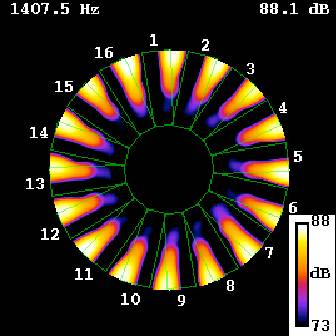
To measure airflow and sound, research teams at the NASA Glenn Research Center use special instrumentation like particle image velocimetry, hot wire anemometry, Raman spectroscopy, microphones in phased arrays or continuously rotating rakes. The global aviation noise reduction community relies on data from NASA GRC experiments to validate theory and noise prediction software.

Rotating Rake Mode Measurement System (RRMS)

Hear an annoying tone from your turbofan engine? Engineers might prescribe an advanced liner or specially tuned active noise control system to quiet it down.

To get it right, though, more information about the modal content of the tone is needed. This kind of data can’t be measured with a stationary microphone, which is why NASA Glenn engineers pioneered procedures using rotating microphones in the 1990s.

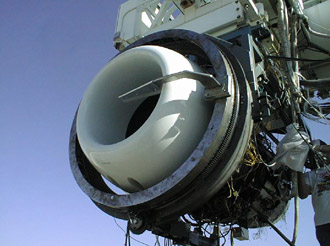
Rotating Microphone Rakes have been used by NASA Glenn researchers in a wide variety of tests ranging from low-speed proof of concept tests in the Advanced Noise Control Fan Rig and 9- by 15-Foot Low Noise Wind Tunnel to full-scale turbofan engine ground tests.

Rotating Rake Mode Measurement System (RRMS)
NASA

Microphone Phased Arrays

In a phased array system, microphones are placed in a 1D, 2D or 3D arrangement and when sound measurements from these microphones are properly processed, noise sources can be pinpointed.

NASA Glenn has an Array48 microphone system that has been used extensively to locate noise sources in scale-model jet flows, a counter-rotating open rotor fan model, and even a full-scale F404 military engine. Through NASA funding, a method has been developed to use microphones embedded in the fan duct of an engine to determine the location of noise sources on the rotating blades.

Phased Array Microphones determining the location of noise sources on the rotating blades.
NASA

Hotwire, Hotfilm, and Laser Doppler Velocimetry

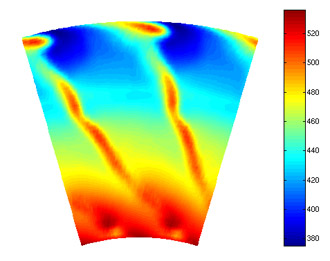
We know that annoying tone noises can be created by periodic disturbances, such as when the wake from a fan blade interacts with a downstream stator vane. We also know that broadband noise is generated when an aircraft engine ingests turbulent air. Therefore, we must be able to record detailed velocity measurements of the air passing through an experimental propulsor so we can identifying noise sources and work to mitigate them. We must use special instrumentation like hotwire probes and Laser Doppler Velocimeters (LDV) to measure the air velocity upstream, downstream, and between the rotor and the stator of an experimental propulsor. Plots of the velocity measurements can be made which allow us to visualize the disturbances that the rotor created. Hotwire and LDV data are routinely used to validate calculations used to estimate noise from turbofan engines.

Hotwire, Hotfilm, and Laser Doppler Velocimetry
NASA

Contact Us

Need to reach us for more information about our research, software, or data? Get in touch via the link below.

❌
❌