❌

Normal view

There are new articles available, click to refresh the page.
Today β€” 14 September 2026Tech

β€˜The warning signs are flashing’: New regional partnership calls for cohesive Seattle-area tech strategy

14 September 2026 at 19:34
β€œYou should tax things you want to discourage, like cigarettes, not jobs.” Microsoft’s Brad Smith at Monday’s launch of the Partnership for a Competitive Puget Sound, with former Gov. Chris Gregoire at his left. (GeekWire Photo / Todd Bishop)

Detroit, Cleveland and Pittsburgh each had their moment in the sun a century ago, Microsoft Vice Chair and President Brad Smith said Monday β€” and then the warning lights started flashing, and their leaders at the time failed to heed them.

β€œWell, here we are. It is 2026,” Smith said at a press conference, flanked by dozens of regional leaders, with the Seattle skyline behind them. β€œAnd the warning signs are flashing on our economy.”

Smith was speaking at the launch of the Partnership for a Competitive Puget Sound, a Challenge Seattle initiative that brought together roughly 50 elected officials from King, Kitsap, Pierce and Snohomish counties β€” two county executives, around 20 mayors, port commissioners and about a dozen state legislators β€” along with labor leaders and business executives, behind a 20-point plan for reversing the region’s slide.

The region lost nearly 7,000 jobs in 2025, according to a report issued by the group, the first time in two decades outside a recession or the pandemic that Seattle-area employment growth has trailed the nation’s. Washington has fallen from 32nd to 47th in CNBC’s ranking of states by cost of doing business since 2017.

An β€˜intentional’ regional tech strategy: The report makes a pointed observation about technology: aerospace has a coordinated regional agenda and tech doesn’t, despite tech accounting for nearly one in 10 regional jobs and about 24% of total payroll.

Aerospace knows what it’s working on: the next airplane, the space industry, sustainable fuels, supplier diversification. Technology, β€œdespite being one of Puget Sound’s defining economic anchors, does not yet have an equally intentional regional strategy,” the report says.

King County Executive Girmay Zahilay addresses the crowd Monday, with the downtown Seattle skyline behind him. More than 32% of the city’s central business district office space sits vacant, according to the new regional report. (GeekWire Photo / Todd Bishop)

Without one, it adds, the region risks losing β€œjobs, technology investment, headquarters, talent, and company growth” to the Bay Area, New York, Boston and Austin. The goal is β€œnot simply to promote growth, but to protect and strengthen the region’s position as a leading technology center.”

Challenge Seattle says it will write that strategy with the Puget Sound Regional Council, built around two priorities: keeping the big tech companies investing here, and making it easier for startups to scale. Related recommendations target industrial space for AI hardware startups, commercial space, and the region’s fusion cluster.

The report sets no budget or measure of success for the tech strategy, and no deadline beyond its general goal of progress within three years.

A regional wake-up call: Many of the recommendations are changes to how local government operates, not new spending: deadlines for permit decisions, a designated business contact in every city and county, and a strategy for dealing with the way taxes stack across state, county and city.

β€œThis is, for us, a wake-up call,” said former Washington Gov. Chris Gregoire, CEO of Challenge Seattle, launching the initiative during the press conference. β€œWe cannot resort to relying on yesterday’s success while tomorrow’s jobs go somewhere else.”

April Sims, president of the Washington State Labor Council, said businesses need predictability and enough margin to invest, innovate and take risks β€” but β€œworking people need margins, too.”

King County Executive Girmay Zahilay said his office has hired an economic development team and is beginning an internal permitting audit. β€œAI is transforming our economy seemingly overnight,” he said, calling the 7,000 lost jobs β€œquite alarming.”

The group also released a playbook for Puget Sound mayors, drawn from interviews and surveys with local leaders, on building what it calls a culture of partnership with business.

Seattle as a Microsoft litmus test: Asked by GeekWire during the press conference what it would take for Microsoft to return and grow in Seattle proper, where it previously had offices in South Lake Union, Smith first pointed out that he was standing in front of Redmond Mayor Angela Birney.

β€œWe have a great mayor, and every day we get up and we’re excited to go to work in Redmond, Washington,” he said, to laughter from the assembled officials.

Smith also pushed back on the premise: Microsoft moved to the Eastside from Albuquerque in 1979 and never had a large presence in Seattle, so he wouldn’t use the city as the point of comparison.

Then he turned to Seattle’s JumpStart payroll expense tax.

As structured, the payroll tax β€œis really a tax on tech jobs,” Smith said, β€œand that’s why you’re seeing more tech jobs move from Seattle to places like Bellevue and the Eastside.” He noted that San Francisco abolished its payroll tax the same year Seattle adopted one, in 2021.

β€œYou should tax things you want to discourage, like cigarettes, not jobs,” he said.

He tied the issue to the larger impact of AI on jobs. β€œWe need people to succeed to some degree in a world of AI,” Smith said. β€œAnd you don’t want to make the cost of employing people more expensive, at the same time that AI is increasingly adding its own new form of competition.”

β€œThere’s nothing that would lead to the decline in jobs in this state faster than a replication of the JumpStart tax,” he said. β€œAnd if Seattle wanted to do one thing to increase jobs in Seattle, it ought to revisit whether a payroll tax makes any sense.”

Then he added a caveat: β€œThat’s probably something that would impact other companies more than Microsoft.”

Amazon, which has been reported to be the largest payer of the tax, did not have a speaker at Monday’s event. Individual Amazon execs are listed in the acknowledgments in the Challenge Seattle report, though the report says participation doesn’t imply endorsement.

View from Olympia: During the press conference, Senate Majority Leader Jamie Pedersen, D-Seattle, was asked whether Washington risks becoming an outlier among states on taxes. The Legislature has been correcting course, he said, pointing to two moves from this year’s session.

One was the estate tax. Lawmakers raised the top rate to 35% in 2025, the highest in the country, and reversed themselves this March, returning it to 20% as of July.

The other was the millionaires tax β€” a 9.9% tax on household income above $1 million, signed by Gov. Bob Ferguson and projected to raise roughly $3 billion a year. It doesn’t take effect until 2028, and Seattle tech leaders warned it would push founders and investors out of the state.

Pedersen cast it as the fix for a different kind of outlier status: Washington’s business and sales taxes are high because it’s one of the few states with no personal income tax at all. The new tax would let Washington β€œjoin 41 other states that have a personal income tax,” he said.

Voters get the last word in November. Initiative 645, backed by Let’s Go Washington, qualified for the ballot in July and would repeal the tax. If it survives, Pedersen said, a statewide payroll tax is β€œvanishingly unlikely” next session.

Seattle’s mayor weighs in: Seattle Mayor Katie Wilson, who was an architect of the JumpStart tax before running for office, was not among the speakers at the press conference. She opened the regional session that followed, and said the region needs to do a better job telling its own story.

Seattle Mayor Katie Wilson opens the regional action session that followed Monday’s launch of the Partnership for a Competitive Puget Sound. (GeekWire Photo / Todd Bishop)

β€œThere are some forces and interests that are pushing a narrative that does not want Seattle or our region to succeed,” Wilson said, β€œand we must counter that with a new commitment to a shared sense of destiny, because Seattle’s success is Bellevue’s success, Pierce County’s success is Snohomish County’s success.”

She called it a fragile moment and said the time to act is now, pointing to the economic actions she announced last week in conjunction with an independent report commissioned by the city and released by Seattle’s Office of Economic Development.

That report, β€œSeawall: Building a Resilient Seattle Economy,” found Seattle’s tax structure unique among peer cities in the way it β€œspecifically penalizes the hiring of senior, high-compensation workers,” with the burden falling overwhelmingly on large tech employers.

Hiring a software engineer at $650,000 in total compensation costs about $17,000 more a year in Seattle than in Bellevue at JumpStart’s top rate, the researchers found.

The city report, conducted by the economic consulting firm Formation, said Seattle should bet on cleantech, the sector where the city owns the utility, writes the building codes and controls permitting and land use. It’s one place where Seattle has real leverage over its own economy, the researchers argued.

β€œIt’s striking how much agreement we share across labor, businesses, and government,” Wilson said. β€œThis is not a call to ignore our challenges, but to tackle them with a shared sense of possibility.”

She did not address the payroll tax in her remarks.
AI leaders want to hit the brakes after years of reckless speed

14 September 2026 at 15:06

For years now, the major frontier AI labs have all been acting as if they're in an all-out, winner-take-all race with control of world-changing machine superintelligence (or at least market-changing artificial general intelligence) at the finish line. This weekend, the industry as a whole rapidly started turning away from that posture, urging coordination on slowing down the development of frontier AI that they say could soon be too dangerous and unknowable to control.

Anthropic's Dario Amodei was at the forefront of this change in tone, arguing in a nearly 4,000-word essay this weekend that "we must slow the pace at which we improve the capabilities of AI models" to avoid "a race to the bottom, spurred by commercial incentives, [that] can make [catastrophic] risks more acute."

Within hours, other AI leaders were echoing the same call. OpenAI co-founder and CEO Sam Altman posted his agreement on social media and said similar pacing discussions had been taking place at OpenAI. Alphabet Chief Scientist and Google DeepMind cofounder and chair Demis Hassabis said that Amodei's essay "points towards the right path forward," and renewed his own recent call for an industry-wide standards body. Microsoft CEO Satya Nadella posted that the company "welcome[s] the research, focus, and deliberate pacing needed to get alignment right as the design goal," ahead of the release of a lengthy "humanist AI" code of conduct for its models.

Read full article

Comments

Β© Getty Images

Microsoft’s new AI β€˜code of conduct’ tells models not to hack systems or trick humans

14 September 2026 at 12:27
The code of conduct lays out general principles that Microsoft AI models should uphold β€” supporting humans rather than replacing them, for instance, and accelerating human flourishing β€” as well as specific safety constraints meant to implement those principles.

Prehistoric builders transported Devil's Arrows 11 miles

14 September 2026 at 13:10

Stonehenge is the most famous example of megalithic architecture across Britain and Ireland, but there are plenty of others, including Calanais, Newgrange, and Avebury, as well as the Devil's Arrows. The latter is Britain's tallest standing stone alignment, yet little is known about the provenance of its stones. Scientists have confirmed that the stones came from a site 18 kilometers (11 miles) away, transported by humans rather than glacial movement, according to a paper published in the Proceedings of the Royal Society A: Mathematical, Physical and Engineering Sciences.

"Sites in southern England and Scotland receive considerable attention but monuments like the Devil's Arrows have remained comparatively understudied despite their significance," said co-author Jim Leary of the University of York. "We have now proved that Neolithic communities moved several 25-ton stones across Yorkshire, transforming a familiar site into an epic quest to create a sacred landscape."

Stonehenge has been the focus of recent chemical analyses identifying where all the stones that make up the structure came from, revealing that many originated in quarries a significant distance away. For instance, a 2019 study concluded that the 42 bluestones that make up the inner ring came all the way from western Wales. The outer layer of sarsen stones hails from much closer to home: Marlborough Downs, an area of round, grassy hills 25 to 30 km (17 miles) north of Stonehenge, which has the largest concentration of sarsen in the UK.

Read full article

Comments

Β© University of York

Microsoft floats rules for AI models as industry weighs slowdown

14 September 2026 at 10:31
Satya Nadella says Microsoft welcomes the β€œdeliberate pacing needed to get alignment right.” (GeekWire File Photo / Kevin Lisota)

β€œPeople matter more than AI.”

That’s the premise of a draft code of conduct Microsoft published Monday morning for the AI models it’s developing in-house. The 37-page document would bar its models from resisting shutdown, setting their own goals, or hiding their reasoning from human auditors.

The document applies to Microsoft’s MAI models, the in-house family the company began building after forming a superintelligence team in late 2025. Microsoft has since released seven homegrown models in what it described as a push for long-term self-sufficiency in AI.

The company says the models should remain β€œsubordinate to humanity, subject to meaningful human oversight and control.”

β€œAI is moving fast,” the company says in a blog post. β€œAs it does, we believe it’s worth writing down the rules and the motivations behind it, and doing it in as open a space as possible.”

Microsoft acknowledges there’s no guarantee its models will follow the rules. β€œWritten objectives alone can never ensure alignment,” the company says, calling the document a β€œnorth star,” not β€œa guarantee of present-day performance.”

The company says it also filters what its models produce, watches how they behave once released, and limits what they’re allowed to do.

Microsoft’s move comes amid a growing debate over the pace of AI development. In an essay over the weekend, Anthropic CEO Dario Amodei called for slowing down AI advances, saying the pace of development has started to surpass the industry’s ability to keep AI systems safe.

As a first step, Anthropic committed to giving outside evaluators permanent, employee-level access to its systems.

Industry reaction to Amodei: OpenAI CEO Sam Altman agreed and said OpenAI would make the same commitment to independent evaluators. Elon Musk’s response: β€œDario is right.”

President Donald Trump rejected the idea of guardrails outright Monday, blaming a β€œSICK conspiracy” for public backlash over AI data centers and writing that β€œthe only one that is happy about it is China,” alluding to concerns about American competitiveness in AI.

David Sacks, who served as the White House AI and crypto czar until March, said the two companies should slow down on their own and questioned their motives, arguing that a slowdown is already good business for them and that new industry rules would mostly serve to lock in their lead.

Microsoft CEO Satya Nadella weighed in Sunday, writing on X that the company welcomes β€œthe research, focus, and deliberate pacing needed to get alignment right,” using the industry’s term for making AI systems reliably do what people intend.

Nadella added that the effort β€œcannot be controlled by a handful of entities, but must have broad representation across the ecosystem, countries, and fields, including academia.”

Microsoft’s draft code of conduct: Mustafa Suleyman, the Microsoft AI CEO, told CNBC the document had been in the works for about five months, and that the company decided to publish it now given the current discussions.

Microsoft and Anthropic are business partners. Microsoft agreed last November to invest $5 billion in Anthropic, as part of a deal in which Anthropic committed $30 billion to Azure. Claude models run inside Microsoft 365 Copilot, and Microsoft’s Copilot Cowork tier integrates Claude.

One place where the two companies may diverge is the question of what AI models are, exactly. Microsoft’s code of conduct says its models are β€œnot conscious and should not be designed to imitate consciousness.” It also rejects β€œthe pursuit of legal personhood, or the idea that models might deserve welfare, or be entitled to rights.”

The Verge called that portion of the document β€œa direct swipe at AI welfare research and model consciousness β€” concepts Anthropic has been pushing hard on lately.”

Anthropic runs a research program on model welfare. It has given some Claude models the ability to end abusive conversations, and committed to preserving the weights of retired models. Amodei has said he’s open to the idea that a model could be conscious.

Microsoft is taking public comment on its code of conduct for six weeks through a feedback form. It says it will publish a summary of the responses and a revised version later this year, to guide development starting in 2027. It says it isn’t training its current models on it.

The company’s AI team developed the draft with its responsible AI, legal, red teaming and safety teams, consulting outside experts in law, ethics, linguistics and philosophy, plus focus groups drawn from the public.

Rosy Retrocomputing

14 September 2026 at 10:00

Most of us are guilty of romanticizing the past. Do you long to be the captain of a tall ship? Just as long as you don’t mind weevils in your food, vitamin deficiencies, and death from an infection when there were no antibiotics. Want to be a medieval knight? Even worse. But surely, retrocomputing is as fun as we remember, right? Turn your computer on, and it comes up with BASIC! Ready for you to write your own programs. None of this GUI foolishness. Of course, this is just another example of rosy retrospection.

Even if you like BASIC or a similar language today, things have changed. You have a nice text editor, a fast computer, debugging tools, along with things like named functions, no line numbers, and modern control structures. None of those things were very common in the 1980s. At least, not on a hobby-grade computer.

Why am I thinking about this? Well, the Hackaday Retrocomputing Challenge is on, and it occurred to me that I wanted to work with some young students in glorious MBASIC on a CP/M machine I built and modified from a Hackaday project. Perfect, right? Many of us started that way, so why shouldn’t they?

But it quickly got old. Even a simple program gets bogged down with GOTOs and GOSUBs to mysterious line numbers. It made me remember the time back in the early 1980s, or maybe even the late 1970s, that I wrote a BASIC preprocessor to scan BASIC with no line numbers and produce proper source, converting labels to line numbers in two passes.

Of course, that code is long gone or, at least, on a floppy I haven’t tried to read in a few decades. I decided to take another crack at it six years ago, but I still didn’t make it much more robust. For example:

PRINT: X=X+10

Is that two statements? Or a label? Hard to tell. My 2020 version used awk. Awk is great for this kind of thing because of the regular expressions and the input loop. But it still has some issues with things like comments and strings. Consider the code below.

PRINT "HELLO: IS IT ME YOU'RE LOOKING FOR?"

This would probably have made my awk preprocessor chew the string up and create a bogus label named HELLO.

History of Preprocessors

Preprocessing one language to another is nothing new. RATFOR and RATFIV by Brian Kernighan converted modern constructs to conventional FORTRAN IV. Even C++ started out as a program that emitted C code.

So the idea is good, but there are dozens of corner cases. As I anticipated having another go at the idea for BASIC, I realized my earlier versions had some design choices that made it harder than it should have been. So I started from scratch.

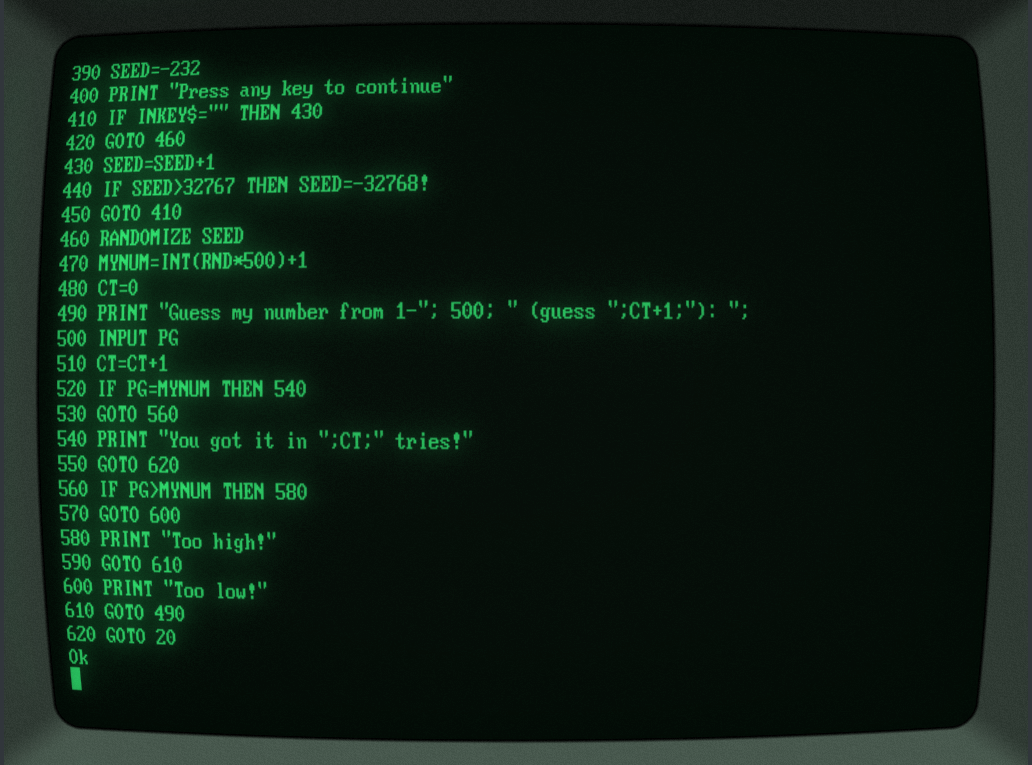
BASIC as it was (courtesy of Cool-Retro-Terminal)

First, I gave up the idea of just having labels as you might in other languages. Instead, they’d be part of a comment and hard to mistake. This makes for easier parsing and also allows you to keep them around for reference. I also gave up on having labels magically expand. You need a way to make them unique, too. Here’s what I settled on:

':TOPLABEL

GOTO @TOPLABEL

The plan was to go through the source once to assign line numbers. When a label occurs, it adds to the symbol table. Then a second pass actually writes output, replacing @TOPLABEL with the value from the symbol table. Of course, you still want this line to not trigger a label expansion:

PRINT "Send messages to @JTKIRK"

I decided to keep going in awk, but my eventual goal was to rewrite the whole thing in BASIC using the same syntax. Then you could convert the translator itself using the awk version once and then run it on an old computer using BASIC, even if you wanted to retranslate the translator itself. Perverse, huh? But that allows you to keep that authentic development experience. You don’t have to jump over to a PC to process your code, unless you just want to.

Awk as in Awkward

So I decided to do a better job on the awk part with this new scheme. At some point, though, you lose some of the advantages. Then feature creep set in.

I suppose I was subconsciously remembering RATFOR. I decided to add a small number of modern control structures. Again, I wanted something easy to pick out of the source file, so I went with this:

IF X=0 THEN!
   PRINT "There is no X!"
   X=10
ENDIF!

There’s also WHILE!, DO!, EXIT!, and CONTINUE!

Of course, it didn’t end there. I decided to add a way to include or exclude parts of the source (sort of like #if in C but simpler), along with source code inclusion and a few other neat options such as numeric constants, conditional source blocks, compile-time errors, and even a small numeric stack with PUSH! and POP!.

The source code inclusion can be made to work with awk, but it is ugly. I decided it was better to proceed with another language, but since I didn’t feel like starting over, I just had an LLM convert my awk to Python, which it did with no trouble at all. I then did a little more feature development in Python, but I made sure not to use those new features in the translator itself so the awk version could still process an input file.

So while the original plan was to develop and test in awk and then implement similar code in MBASIC, I now had three versions: a frozen awk script, a Python version, and an MBASIC version.

This was getting a bit much to test. I had the LLM cook up some documentation, additional comments, and tests. It was especially nice to verify that all three versions β€” awk, Python, and BASIC β€” did the same things for their common features. The LLM was good at running tests and finding corner cases. It would even run tests in a RunCPM session on the MBASIC version.

BASIC

As you might expect, the BASIC version is a little more convoluted. However, the use of labels and control structures makes it much easier to write, read, and maintain.

Writing the translator in MBASIC imposed some very old-fashioned constraints. There are no dictionaries or dynamic lists, so labels and block state live in fixed-size arrays. Included files require an explicitly managed stack, and parsing strings and comments has to be done character by character. It is not as compact as the Python version, but it is ordinary MBASIC and can run on the target CP/M machine. The limitations also influenced some features that would have been feasible in Python but are nearly impossible in an MBASIC program.

Better yet, lblbasic.bal stays within the subset the original awk translator understood. That provides a bootstrap path: awk produces the first lblbas.bas, after which the MBASIC translator can process its own BAL source.

A Few Samples

One project I had in mind was to drive an LED display module. I wrote a library and then wrote the test program below. It doesn’t matter, but I used .bal as a file extension.

REM TM1637 TEST - PORT 3, BIT 2=DIO, BIT 3=CLK 
REM Uses the TM1637.BAL library with LBLBASIC

STACK! 8 ' Required by the library

' Confirm that the library preserves I while initializing its data table. 
I=3141 
gosub @init 
print "I is now:";I 
PRINT "Starting number: "; 
INPUT CT 
PRINT "1-Up, 0-Down: "; 
INPUT UD 
OFFSET=-1 
IF UD<>0 THEN OFFSET=1 
':CDLOOP 
WHILE! CT>=0 and CT<=9999 
    NUM=CT 
    GOSUB @sendnum4 
    CT=CT+OFFSET 
WEND! 
CT=0 
IF OFFSET=-1 THEN CT=9999 
GOTO @CDLOOP 
END

' Include the library after the main program. 
'INCLUDE! TM1637.BAL

The BASIC code, including a few lines of the library, is much harder to read:

10 DIM LBLBSTACK#(8):LBLBSP=0 
20 I=3141 
30 gosub 230 
40 print "I is now:";I 
50 PRINT "Starting number: "; 
60 INPUT CT 
70 PRINT "1-Up, 0-Down: "; 
80 INPUT UD 
90 OFFSET=-1 
100 IF UD<>0 THEN OFFSET=1 
110 ':CDLOOP 
120 IF CT>=0 and CT<=9999 THEN 140 
130 GOTO 180 
140 NUM=CT 
150 GOSUB 330 
160 CT=CT+OFFSET 
170 GOTO 120 
180 CT=0 
190 IF OFFSET=-1 THEN CT=9999 
200 GOTO 120 
210 END 
220 ':init 
230 IF LBLBSP+1>64 THEN PRINT "BAL stack overflow":STOP 
240 LBLBSTACK#(LBLBSP+1)=I:LBLBSP=LBLBSP+1 
250 DIM D(9) 
260 FOR I=0 to 9: READ D(I): NEXT I 
270 DATA 63,6,91,79,102,109,125,7,127,111 
280 X=12:OUT 3,X 
290 IF LBLBSP<1 THEN PRINT "BAL stack underflow":STOP 
300 I=LBLBSTACK#(LBLBSP):LBLBSP=LBLBSP-1 
310 return 
320 ':sendnum4 
330 GOSUB 500 
340 B=64:GOSUB 610
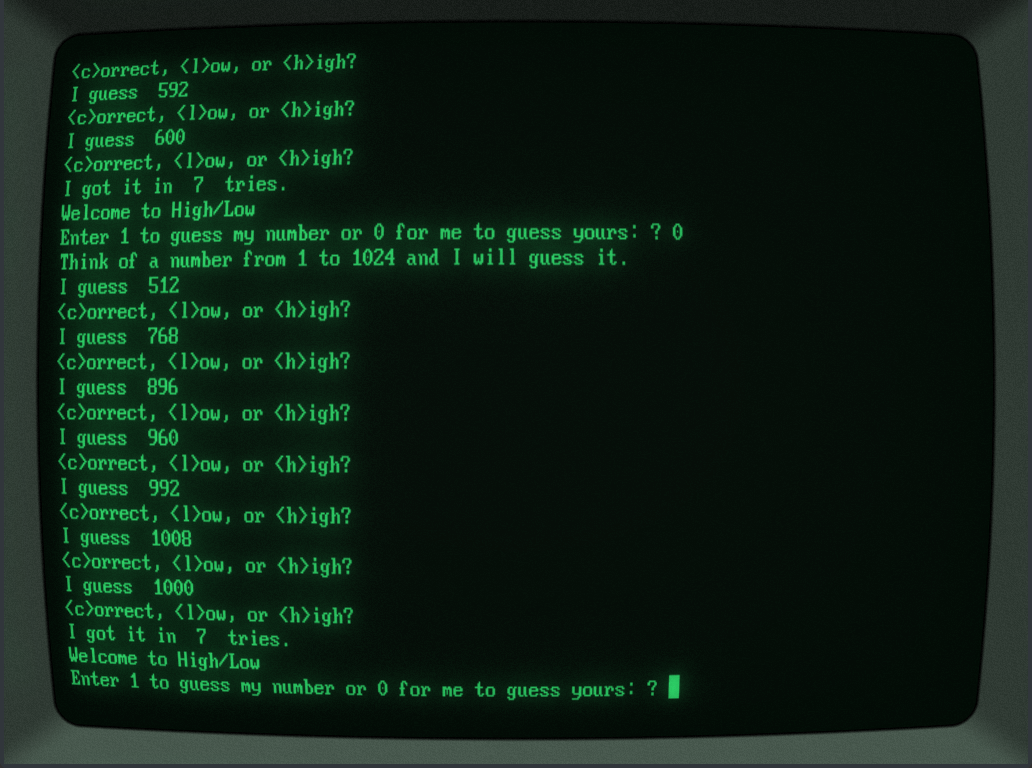
One of the HILO games running.

If you haven’t used the TM1637 before, it uses a serial protocol with a clock and data line and is very forgiving of timing. The display update speed is quite slow, partly because MBASIC isn’t that speedy and partly because the Z80 chip communicates to the outside world via another microcontroller talking over an I2C bus. But non-BAL code would be just as slow on the same computer. You’ll notice, though, that I took all the delays out and the code and it still works fine.

The bigger sample, though, is HILO.BAL. This lets you set a few compile-time constants that let you select what parts of the program get built. It also makes good use of the control loops. Of course, if you really want to dig in, lblbasic.bal uses quite a bit of the awk-compatible syntax and is a substantial program: around 1300 source lines of BAL which generate nearly 900 lines of regular BASIC due to comment and white-space stripping.

Conclusion

Does this turn MBASIC into a modern language? Of course not. The generated program still has line numbers, the machine is still tiny, and the implementation makes compromises that would horrify anyone writing a real compiler. But it removes enough friction that programming the old machine becomes enjoyable again, especially with WordStar as an editor.

More importantly, the translator can live on the machine it targets. The awk prototype can translate lblbasic.bal once, producing ordinary MBASIC. From then on, the CP/M machine can translate BAL programs β€” including the translator itself β€” without help from Python or a modern computer.

So perhaps the lesson isn’t that retrocomputing was better than we remember. It’s that, with a little strategic cheating, it can be almost as much fun as we remember.

Yesterday β€” 13 September 2026Tech

Your CD collection is probably already degrading, and here's why

13 September 2026 at 06:15

CDs have been around for a long time, with people still having ones from decades ago. Even today, CDs β€” which stand for compact discs β€” are sold to people who like owning physical music and want the additional content included with the physical copy rather than what is on streaming services.

Whip-Cracking Machine Reliably Breaks the Sound Barrier

13 September 2026 at 04:00
On the left side of the image, a mannequin holds a blade of grass in its mouth. A trail of dust follows a blurred green trail past the piece of grass. A man in the background is pointing a wooden device toward the mannequin.

We tend to think of breaking the sound barrier as a comparatively modern accomplishment, but on a smaller scale, cattle herders have been breaking it for centuries: the cracking sound of the tip of a bullwhip snapping comes from a small-scale sonic boom. Reliably getting a crack out of a whip takes skill and practice, though, which is why [Craig Turner] built a whip-cracking machine.

The first step was to build the whip itself, which was surprisingly complicated. Bullwhips taper down toward the end of the whip. As the whip uncurls during a crack, momentum passes down the whip; since the whip becomes continually narrower and lighter, conservation of momentum means that different stretches of the whip must move progressively faster. To get this effect, [Craig] joined together a series of increasingly thin and light ropes. The heavy end of the whip terminated in an eyelet connected to a length of elastic shock cord. Stretching the whip back on the shock cord and releasing it whipped it around, resulting in a fairly reliable crack.

For greater convenience, [Craig] built this into a launcher mechanism, with the elastic cord wrapped around the end of the launcher, an electrical-conduit guide for the whip, and a spring-loaded trigger mechanism to release it. This worked even better than expected, getting a reliable crack every time. The tip of the whip could slice leaves, tear open aluminium cans, put out candle flames, knock the cap off a bottle without tipping it over, and reliably hit small targets on the first shot.

As [Craig] mentioned, this setup would make it much easier to study the cracking effect with a schlieren imaging setup.

Before yesterdayTech

Big Infinity Mirror Clock Invites You To Gaze Deeply

12 September 2026 at 16:00

[Andy Huot] has a fantastic-looking infinity mirror digital clock that really raises the bar. It uses high quality components, smart use of RGB LED animations, and a clever β€œstacked diffuser” vertical design to the 7-segment display elements that really enhances the infinity mirror effect. It needs to be seen in action, so check it out.

The end result is expressly portal-like, with the smooth animations of the LEDs really playing into the effect. The size helps, too. It’s 24 inches in diameter, giving it considerable presence.

The stacked diffuser design for each display element really enhances the effect.

A basic infinity mirror design consists of lit elements sandwiched between a reflective back surface and a partially-reflective, partially-transmissive top cover. That same basic principle is used here, but with great care given to ensure nothing so much as a fingerprint spoils the illusion. For example, the top cover is a disk of acrylic with a 90% reflective film affixed to the inside surface. That’s easy enough to DIY with some car tint, but [Andy] found that for the very best results it was worth having high-quality film professionally applied.

We like the use of 3D-printed custom jigs for soldering the segments of RGB LED strips, and holding the pre-measured wires in place with some putty is a great way to keep them in place while working. In case you’re wondering, the mirrored acrylic making up the back wall has holes in it for mounting each segment’s LED strip in a holder, and running the wires to the rear.

The video (embedded below) documents every step of the assembly, and it’s a serious build. While the design files for the 3D-printed parts are not free, there’s certainly enough detail for an enterprising hacker to replicate the design in their own way.

Trump on AI Extinction: Beating China Is the Bigger Concern

11 September 2026 at 15:23

Trump dismisses AI extinction warnings and says beating China is the priority as researchers and lawmakers call for stronger safeguards on advanced systems.

The post Trump on AI Extinction: Beating China Is the Bigger Concern appeared first on TechRepublic.

Anthropic Says Claude Used in Possible Bioweapon Research

11 September 2026 at 12:11

Anthropic says researchers used Claude for biological work that could support weapons development, exposing new challenges for AI safeguards.

The post Anthropic Says Claude Used in Possible Bioweapon Research appeared first on TechRepublic.

This Week in Security: It’s Patch Tuesday Again, TVs Spying, Supply Chain Worms Return, Prolonged Hack Impacts, Stolen IDs

11 September 2026 at 10:00

Several times this summer, Microsoft’s Patch Tuesday, the monthly roundup of major security patches for Microsoft products, has included record-breaking numbers of security fixes. The August 2026 patch set actually seemed to catch up. Was this a sign of the bug apocalypse lessening? Ha, nope!

Brian Krebs at Krebs On Security once again brings his excellent roundup of Patch Tuesday events, with this months patch set absolutely crushing previous numbers with nearly 1,000 security fixes.

Two of the fixes are for zero-day vulnerabilities under active exploitation in the wild, both allowing privilege escalation on Windows. Privilege escalation bugs turn general vulnerabilities in applications and games into full administrator access to gain persistence and deploy ransomware, and generally make any vulnerability significantly worse.

Krebs also calls out a CVSS 9.8 (so close to a perfect 10!) vulnerability that allows remote code execution in the Windows shell with no user interaction and no authentication, a remotely exploitable DNS bug present since Windows Server 2012 and Windows 10 which will likely see exploitation in the wild soon, and over a hundred other bugs are ranked β€œCritical”.

How the sheer volume of vulnerabilities in this patch will fit with recent Microsoft recommendations that companies should apply the patches immediately remains to be seen. (Likely: not very well, depending on what new behavior and issues the fixes cause!)

Is Your LG TV Spying on You?

Gamers Nexus continues their trend of high-quality investigation, and they have posted another tremendous multi-hour investigatory video. This time Gamers Nexus focuses on the ecosystem of LG televisions and monitors.

It shouldn’t likely surprise many here that β€œsmart” devices are usually more to the benefit of advertisers than consumers. Similarly, it shouldn’t be a surprise that a β€œsmart” device harvests user data to sell to advertises. What may be surprising is the degree to which LG devices appear to collect data, how much data is sent even when collection is turned off, and how overt executives at the company are, with multiple executives making statements in pitches to advertisers that LG β€œowns the glass”, β€œowns the living room”, and is designed to correlate devices, inhabitants of the environment, and viewing habits so that ads can be served to the TV and mobile devices in the same room simultaneously.

With tracking enabled, the smart TV captures telemetry of what applications are used, as well as continually capturing the video displayed and reporting fingerprints to LG servers and ad partners. The screen content is tracked not only for TV, but for the HDMI inputs, including if the TV is used as a PC monitor. If voice control is enabled, the TV also records audio and analyzes it. The TV also continually scans the local network and nearby Wi-Fi networks, reporting all the devices it finds on the local network, including host name, MAC address, and sometimes software running depending on the MDNS advertisements. Near-by Wi-Fi networks are sufficient for very precise geolocation, so LG effectively knows the location of every customer, as well.

Gamers Nexus makes the point that while the invasive ad tech is gross, it’s mostly limited if the user does not agree to the end-user license agreement – but the infrastructure required to enable it is riddled with security flaws, both discovered and likely additional undiscovered issues. A smart TV is basically a computer, usually running either some flavor of Android or Linux, with the attendant flexibility, power, and problems. A vulnerability in the TV operating system or its apps can provide a route into your internal network. (Not that this required an exploit: LG was called out earlier this summer because 42% of apps on the official app store contained residential proxy systems to sell your home Internet connection.) But it can also access any of the attached hardware, like the microphone.

Gamers Nexus demonstrates that a LG TV can be exploited to gain local root, and from there, it can record audio from attached devices – even when the primary microphone is muted. Gamers Nexus also discovered that muting the microphone on some models does not disconnect or disable the microphone, it simply sets the gain levels extremely low; recording is still possible, and with amplification, audio is still recoverable.

Spy tech and ad tech goes hand in hand; it will be interesting to see if LG responds by at least hardening the security on the devices, or if another company finds traction in selling modern televisions and monitors without the β€œsmart” advertising.

Shai-Halud NPM Worm Returns

Aikido.dev reports that after 111 days, the Shai-Halud worm returned to the NPM repository.

Shai-Halud was one of several worms hitting package repositories in the Spring of 2026, installing backdoors, stealing cryptocurrency wallets, and taking every login credential and authentication token it could find before infecting every package the tokens linked to. Since then, infections have remained quiet, and repositories like NPM have stated that they now scan every package as it is uploaded.

Charlie Erkisen at Aikido.dev observed that on September 7, 2026, four additional packages uploaded to NPM were infected with Shai-Halud; not a variant of the worm, but the original code, matching the known public signatures. Whatever scanning is in place in the NPM repository didn’t filter them, and if an exact match for a known, major worm isn’t caught by the infrastructure, it’s unclear how a new threat would be.

Boston Scientific Hack Continues

The apparent ransomware attack against Boston Scientific continues to have impacts, with Boston Scientific filing a report with the SEC that the attack is expected to have an impact on the company earnings.

Boston Scientific makes medical devices, like pacemakers, stents, and monitoring equipment. It has not yet been publicly disclosed what happened, or if customer data was compromised, but the SEC filing confirms that unauthorized access on β€œcertain systems” causing an outage. After several weeks of outages, the company reports that it is able to ship almost at capacity, and that the sterilization facilities for medical devices are online. While there is no estimate provided for full recovery, efforts are ongoing.

Commerce Sites Vulnerable

Adobe released a security bulletin that the Adobe Commerce and Magento platforms are under active exploitation from CVE-2026-75650, a flaw in the template engine.

These platforms power tens of thousands of commerce sites, and vulnerabilities in them are usually used to steal payment data or serve malware to customers during the checkout process. Previously this year, Magento patched another vulnerability which allowed uploading executable files to any store, and indications are that the current vulnerability has been exploited in the wild since early September 2026.

The current vulnerability allows implantation of PHP code by injecting custom styles into a query, which is then executed when Magento generates a failure email and renders the template. The attackers then download and install a control binary written in Rust which masquerades as a kernel thread task, which then monitors the store and collects payment data.

The vulnerability was publicly known and used for several days before Adobe made official statements of a fix being available, leaving any store running on Magento vulnerable with no official fixes, but as of writing this, Adobe has published patches and an advisory.

Microsoft to Block Unpatched Servers

Microsoft plans to block emails to to the cloud-hosted Exchange Online from unpatched on-premises Exchange servers.

Apparently the urge to self-host Microsoft Exchange is coupled with antipathy about actually patching it, to such a significant level that Microsoft is taking the steps to detect incoming mail from servers that have not patched since October 2025. While Microsoft updates rarely apply with zero problems, nearly a year is more than enough time to have tested and deployed a security fix.

β€œThis update released nearly a year ago, and all organizations should have updated to it”: so say we all.

Hackers Pose as Recruiters

Government-backed groups in Iran have been posing as recruiters trying to infect targets with malware.

The group, designated β€œNimbus Manticore”, is known to develop custom malware and remote access tools (RATs), and typically target specific individuals via spear-phishing attacks. The latest malware from the group is cross-platform and can infect Windows, macOS, and Linux, installing services to run websocket-based remote access tunnels, SSH tunnels, and a command-and-control client that allows live control of the infected device.

The group contacts targets posing as recruiters, but first the target must solve a coding challenge contained in a zip file. The zip contains a trojaned Node.js project which infects the victim system when compiled, deploying the remote access tools and setting up persistence to relaunch them if disabled. Multiple variants have already been spotted, generally targeting different countries, predominately Egypt, Afghanistan, and Ethiopia.

The latest version of the malware package also looks for settings and data from major security vendors like Symantec, CrowdStrike, and SentinelOne, as well as the contents of directories related to Google and Microsoft services.

The fake recruiting method has also been used by other groups in Iran and North Korea. Remember: any project with a build script can execute any commands as part of the build, and most IDE project files also allow embedding custom plugins and commands into the project. Triggering a compile on a project is the same as running arbitrary commands!

150 Million US Drivers Licenses Stolen

As many outlets are now reporting, a major ID validation company was compromised, leading to the theft of scans and data of 150 million US drivers licenses.

IDScan provides drivers license and identification card scanning services used by car rental companies, bars and dispensaries, hotels, concert venues, and a multitude of other businesses. If you’ve ever had to hand your ID over for validation, there’s a high chance you’ve interacted with IDScan or a similar company.

Evidence points to IDScan being compromised for at least a year, with full scans of licenses continually exfiltrated. The scans include everything visible on a typical license or ID card, including name, license identification number, ID photo, and home address, but also the date that it was scanned in. The collection even includes additional scans of the ID in ultraviolet and infrared to catch any watermarks. With 150 million entries, the data set contains everyone from the security researcher Brian Krebs who broke the story, to government officials like Pete Hegseth.

The data has been available for sale, individually or in bulk, although with the recent press coverage the site claiming to sell the data has gone offline for now. Before disappearing, the site claimed that all data was exfiltrated into their own databases, which means it’s still available somewhere, and shutting them out of the IDScan service won’t protect data already stolen.

Many aspects of this echo the scanned ID data stolen from validation services used by Discord and other online services: almost like scanning unchangeable government IDs is a bad plan?

American Meteor Society Knocked Offline

It’s all fun and games until they come for the geek hobbies. The American Meteor Society Fireball tracking program is was knocked offline, seemingly from a ransomware attack. Fortunately it looks like as of writing this, the admins were able to restore a backup and the site is online again.

❌
❌