
❌

Normal view

There are new articles available, click to refresh the page.
Today β€” 13 September 2026Main stream

Keeping Time on Tumbling Icosahedra

13 September 2026 at 07:00
An angular, 3D-printed base holds two icosahedra with numerals on their faces. Each icosahedron has a zig-zagging path running through it, showing red gears inside.

Clocks are almost the ideal devices to inspire creativity in hackers β€” they have a simple, well-defined task, but there’s an almost unlimited number of ways to carry it out. [ekaggrat singh kalsi]’s OVODYO is a particularly intriguing approach, tumbling a pair of icosahedral counters to display the current time.

Each 3D-printed icosahedron has numerals sunk through each of its twelve sides, and is raised above the base of the clock on a brass support shaft. An inner drive shaft runs through the center of the support shaft and drives a set of beveled gears. These spin the outer shells around two axes, periodically cycling through all twelve faces. The pattern in which an icosahedron rotates means that only set of numerals appears upright at a time, making it easier to distinguish the time.

A split path around the icosahedra both lets them rotate around the support shaft and shows off the internal gearing. On the control side, an ATmega8 drives a pair of stepper motors with drv8833 motor drivers, using a hall effect sensor to detect each indicator’s position. Since the minutes dial only gives the time in five-minute intervals, it also drives an LED strip to indicate the exact minute.

[ekaggrat] has a long history of creative clock designs, from this dynamic chain-link sculpture to a hair-tie clock or a mechanical seven-segment display.
Yesterday β€” 12 September 2026Main stream

Big Infinity Mirror Clock Invites You To Gaze Deeply

12 September 2026 at 16:00

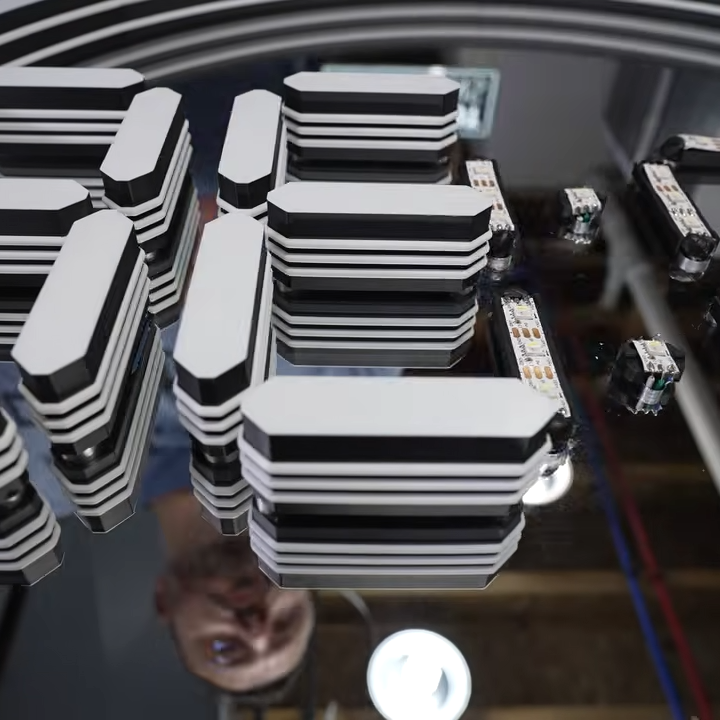
[Andy Huot] has a fantastic-looking infinity mirror digital clock that really raises the bar. It uses high quality components, smart use of RGB LED animations, and a clever β€œstacked diffuser” vertical design to the 7-segment display elements that really enhances the infinity mirror effect. It needs to be seen in action, so check it out.

The end result is expressly portal-like, with the smooth animations of the LEDs really playing into the effect. The size helps, too. It’s 24 inches in diameter, giving it considerable presence.

The stacked diffuser design for each display element really enhances the effect.

A basic infinity mirror design consists of lit elements sandwiched between a reflective back surface and a partially-reflective, partially-transmissive top cover. That same basic principle is used here, but with great care given to ensure nothing so much as a fingerprint spoils the illusion. For example, the top cover is a disk of acrylic with a 90% reflective film affixed to the inside surface. That’s easy enough to DIY with some car tint, but [Andy] found that for the very best results it was worth having high-quality film professionally applied.

We like the use of 3D-printed custom jigs for soldering the segments of RGB LED strips, and holding the pre-measured wires in place with some putty is a great way to keep them in place while working. In case you’re wondering, the mirrored acrylic making up the back wall has holes in it for mounting each segment’s LED strip in a holder, and running the wires to the rear.

The video (embedded below) documents every step of the assembly, and it’s a serious build. While the design files for the 3D-printed parts are not free, there’s certainly enough detail for an enterprising hacker to replicate the design in their own way.

Before yesterdayMain stream

ESP32-P4 Powers Video Alarm Clock

7 September 2026 at 19:00

Once upon a time, you had the option of waking up to a bell, a harsh buzzer, or whatever happened to be on the radio that morning. Now that it’s the 21st century, we’ve gotten used to being able to set our alarms to whatever sound or song we want, but what if you don’t just want to wake up to sound? Enter [Impossible_Agent1436] a.k.a. [brunokeymolen]’s Video Alarm Clock that will wake you up to whatever clip you want, as long as it fits on the 720 pixel square display.

That display is a pre-built Waveshare module powered by an ESP32-P4, which looks like a handy bit of kit aside from being out of stock at the moment. The dev board makes this almost entirely a software project– the only hardware [bruno] had to come up with was the 3D-printed stand to hold it on his bedside. That’s not a slight to [bruno]; it was a good choice in the spirit of β€œwork smarter, not harder”. Sometimes you want to reinvent the wheel, and sometimes you just want an alarm clock.

The module’s RTC means it keeps good time, and the built-in SD card reader means you can load up a whole library of clips to wake up to. The only caveat is that those files have to be AVI containers holding 720Γ—720 MJPEG video with PCM stereo audio at 44.1 kHz, and you’re limited to old FAT filename rules: eight characters, and none of them special.

This is an easier project and a better idea than the exploding capacitor alarm clock, but there’s no arguing which would get us out of bed faster. If you miss the old days of clock radios, you can always bring them back with the right microcontroller.

Story via reddit.

Β 

❌
❌