The reason many of us build smart homes and tinker with microcontrollers is to make the mundane feel a little more special. Though these projects are far from necessary, they can bring a bit of magic to your everyday routines and teach you a thing or two along the way.
You can buy a small ESP32 microcontroller for a few dollars—less than a Starbucks coffee. When you combine it with a special LoRa radio, you can create a device that can send encrypted text messages between locations without relying on a cellular service, Wi-Fi, or satellite data.
I don’t currently have any visible clocks on display in my house. I’m never without my watch or phone, and I decided that if I were to sacrifice some space for a dedicated timepiece, it would need to be something special, different, or interesting.
Stop letting old devices rot in a drawer and bring them back to life with the help of an inexpensive microcontroller and some code. The ESP32 is perfect for this task.
ESP32 boards are incredibly versatile tools. You can use them for a huge range of purposes, and they can also be an extremely cheap way to help you get started in a new creative tech hobby.
Once upon a time, you had to carefully budget your microcontroller’s resources if you wanted to do something as simple as flash a bunch of LEDs. These days, they’re powerful enough to humiliate the game consoles of yesteryear. [alexkid77] demonstrates this well, having the ESP32-P4 run Tomb Raider.
Now, [alexkid77] hasn’t gone so far as to create a PlayStation emulator on the ESP32 or anything quite like that. Instead, this is a port—and not of the original Tomb Raider release, either. [alexkid77] started with OpenLara—the classic game running in an open-source engine. With the ESP32-P4 having two cores running at 400 MHz each, there was plenty of processing power on tap to run the engine with a software renderer at 320×240, which is hardware scaled up to 1024×600 via the Pixel Processing Accelerator (PPA) built into the chip. There’s also stereo audio with an ES8311 codec hooked up, while input is via a USB HID keyboard.
It’s funny to think that it could actually be cheaper and quicker to get Tomb Raider running on an ESP32 and a cheap LCD display versus actually going out to buy a PlayStation and an original game disc. But that’s the way the cookie crumbles in 2026. At least you don’t have to play it on an S3 Verge.
Smart video doorbells can be incredibly useful, but they don't last forever. If you have an old or even broken video doorbell, you don't need to throw it away. There are plenty of ways you can put it to good use.
Raspberry Pis have been popular devices for DIY projects for years. They're ideal for many tech projects, but they're not always the perfect choice. There are many projects where a cheap ESP32 board is a better option, and the benefits go beyond the much lower price.
I use a lot of ESP32 boards around my home, but they don't always have to be stuck indoors. By putting an ESP32 in my car, I'm able to access live engine data from my car that tells me much more than my dashboard does.
I've owned a lot of houseplants in my time and killed many of them. The biggest issue has always been knowing when to water them. Wi-Fi moisture sensors can help, but if you have a lot of plants, the cost can soon add up, and if your Wi-Fi goes down, they become useless. Using an ESP32, you can make a moisture sensor that works offline and is a fraction of the price.
Whether your homelab consists of an ISP-provided router and a mini PC or a whole rack that takes up the corner of your spare room, it could always benefit from a few considered upgrades.
I miss the good old days when you had to queue for a movie, lining up outside the theater and passing the Now Showing posters which would get you excited about what you were about to see. I wanted to build something similar for Jellyfin using a cheap ESP32 display.
Wireless security monitoring in the 2.4 GHz spectrum often depends on active probing, which can not only make the monitoring infrastructure vulnerable to attackers but also clutter the radio frequency environment. On the other hand, taking a passive approach by listening without transmitting allows security teams to detect malicious wireless activity more discreetly and reliably.
To put this idea into practice, the project Travel WiFi Canary was developed. This system serves as an early-warning mechanism using ESP32 microcontrollers. By operating the Wi-Fi radio in promiscuous mode, the device passively captures raw IEEE 802.11 management frames and traffic patterns. This helps identify potential threats such as deauthentication attacks, beacon spam, rogue access points often referred to as Evil Twins, and unauthorized probe requests. Eventually, it provides comprehensive insights into the wireless environment, enabling you to act proactively rather than reactively.
In this article, we will guide you through configuring, flashing, and running Travel WiFi Canary on the LilyGo T3 V1.6.1 development platform. Let’s get rolling!
What is Travel WiFi Canary?
The Travel WiFi Canary is a project that turns a low-cost ESP32 microcontroller into a passive 2.4 GHz threat-detection device. It operates continuously by alternating between active network enumeration and passive promiscuous packet capturing across specified channels.
At its core, the device’s Wi-Fi chip listens directly to raw radio signals passing through the air rather than connecting to a specific network.
When a wireless signal arrives, a fast automated responder checks the basic structure of the incoming data instantly. It identifies network management signals, such as connection requests, disconnection commands, or nearby network announcements, and separates them from standard web traffic.
To handle intense bursts of wireless activity without getting overwhelmed or missing crucial information, the chip places these flagged security signals into a temporary holding queue. This allows the main system to process and analyze the data safely in the background while keeping the hardware radio free to capture new incoming signals without interruption.
The central intelligence of the project relies on a dynamic confidence-scoring engine rather than rigid binary alerts. As the system processes the ring queues and periodic active scans, it evaluates detected anomalies against a local memory table built during the startup baseline phase.
Active scans check nearby Access Points for structural security violations. If an Access Point using an encrypted baseline protocol like WPA2 or WPA3 is detected operating without encryption, the system identifies an open clone attack. Security downgrades, unexpected vendor prefix mismatches on familiar SSIDs, or sudden disappearances of legitimate Access Points during an active open broadcast instantly contribute points to the global confidence score.
Simultaneously, the passive sniffer thread drains the lock-free queues to detect airborne attacks. Deauthentication frame floods are monitored over rolling time windows, assigning score penalties if threshold limits are breached by single sources or broadcast addresses.
The sniffer also inspects the payload fields inside beacon frames to detect Pwnagotchi signatures, parsing JSON structures hidden in vendor tags to determine if the device is operating in an active attack state.
All calculated points feed into a unified state machine. Aggregate scores between zero and two keep the device in a normal state, scores between three and five push it into a caution state, and scores of six or higher escalate the device into an active alert state.
To prevent temporary radio noise or brief packet anomalies from causing permanent alarm states, a background timer executes a score decay routine every minute. This routine gradually reduces the aggregate threat score over time, allowing the system to automatically transition back to a normal state once threat vectors clear the area. Hardware outputs, such as status LEDs or connected display controllers, continuously mirror the internal state variable to provide real-time visual monitoring.
What is LilyGo T3 V1.6.1?
The Travel WiFi Canary was initially made for the M5Stack Atom Lite development board. However, in this demonstration, I will test it on the LilyGo T3 V1.6.1.
The LilyGo T3 V1.6.1, also called the TTGO T3 LoRa32 V1.6.1, is an open-source development board designed for Internet of Things (IoT) projects and long-range RF communication. It has an ESP32 chip that allows for packet sniffing and Wi-Fi scanning. It gives us all the necessary functionality for wireless threat detection required by the Travel WiFi Canary project.
Getting Started with Travel WiFi Canary
The best way to flash the Travel WiFi Canary is by using Visual Studio Code along with the PlatformIO IDE extension. The installation process is fairly simple, so let’s move on to the next step, which is cloning the repository. I will use the modified version designed for the LilyGo T3 device. Here’s the command to do that:
Next, connect your LilyGo T3 V1.6.1 to your computer using a data-capable Micro-USB cable. In Visual Studio Code, click on the PlatformIO status bar at the bottom and select env:esp32dev. Then, you can either click the checkmark icon in the status bar or press Ctrl+Alt+B to compile the firmware.
Once that is complete, click the right arrow icon in the status bar to start the upload process. PlatformIO will automatically detect the serial port, trigger the ESP32 to enter bootloader mode via auto-reset circuitry using the DTR and RTS lines, erase the necessary flash sectors, and upload the binaries seamlessly.
After the upload is complete, you can monitor the device with the built-in command:
pio device monitor -b 115200
At this point, the state machine and scanning engine are fully operational. During its initial scan, it detected seven nearby access points, recording their SSIDs, BSSIDs, signal strengths, channels, and encryption methods in memory.
Now, let’s simulate an open clone of a known encrypted network. The README file provides the following instructions:
I created a Wi-Fi access point from my phone with the same name as the network to which my system is connected, but without a password. Let’s observe how the WiFi Canary responds.
The script successfully identified the clone and granted 4 points to the score, changing the state to caution. The rogue open clone remained active in the following 20-second scan with a strong RSSI, adding another 4 points, which brought the total score to 8 and changed the state to alert. At the 310-second mark, the decay timer activated, decreasing the score from 8 to 7. However, since the score remained above the SCORE_ALERT threshold of 6 or higher, the system continued to maintain its alert state until the threat was resolved and the score naturally decayed back to zero.
Limitations
Despite the benefits of confidence scoring in reducing unexpected alerts, the possibility of false positives still exists. This is particularly true in enterprise networks, multi-node mesh setups, and crowded public venues, which can display behaviors that resemble attack patterns. On the flip side, false negatives may arise if a skilled attacker impersonates a legitimate BSSID while carefully adjusting their transmission power to fit in with normal signal strength variations, thus evading detection.
The limitations of the physical hardware create additional coverage boundaries. Passive detection of deauthentication relies heavily on the distance from the receiving device, meaning that low-power or far-off transmitters may be beyond the reach of the antenna. Furthermore, monitoring is confined solely to the 2.4 GHz spectrum, leaving the 5 GHz and 6 GHz bands completely unmonitored.
Lastly, the design of the radio architecture leads to a temporary gap in scanning whenever the chip switches between promiscuous packet sniffing and active environment scanning, resulting in a three-second blind spot where airborne deauthentication bursts can go unnoticed.
Summary
For many travelers and remote workers, understanding whether the Wi-Fi around them is secure is crucial. Private messages and sensitive information can be easily compromised when malicious actors set up fake hotspots or disrupt local connections. A device like the Travel WiFi Canary can continuously monitor the airwaves and alert you the moment a wireless attack is detected.
This device uses active Wi-Fi scanning and passive signal listening to find threats in real time. It constantly checks nearby networks against a trusted standard to spot fake open hotspots, duplicate routers, or security issues. At the same time, it listens for harmful activities like deauthentication attacks or rogue scanning tools. When it detects a threat, it raises a danger level with an internal scoring system and triggers a clear visual alarm. This alerts you immediately, giving you a warning before your devices may face any risk.
If you’re interested in improving your knowledge of wireless security, take a look at our Wi-Fi Hacking training. This course will guide you on how to assess the security of wireless networks and equip you with modern strategies to protect them effectively.
Those who have never lived in a cold climate might romanticize winters around a fire, keeping warm under blankets while snow gently falls outside. While it certainly can be a cozy experience, using a woodstove comes with a number of pitfalls, and when operated improperly can even cause house-destroying chimney fires. Modern stoves operated properly with properly dried wood make this possibility extremely remote, but it’s still worth keeping an eye on. Reddit user [nas886] built a system called Oru which takes a lot of the guesswork out using one of these pieces of heating equipment.
The real danger of a woodstove isn’t necessarily running the fire too hot, although that can be a problem, but running it too cold. Without full combustion of the wood, flammable creosote builds up on the inside of the chimney which eventually can combust. This system uses a probe placed in the stovepipe to monitor the temperature of the exhaust gasses. If it’s too low an ESP32 notifies [nas886] remotely with with a status LED inside a seperate custom-built walnut enclosure so that more wood can quickly be added or airflow increased to bring up the temperature, and in the case that the fire gets too hot the LED changes to a different color and the air can be closed off a bit.
Woodstoves themselves have quite a bit of variability in the size wood they can burn, the amount they can hold at once, their efficiency, and their thermal mass, so this could find utility for anyone from those with tiny stoves that have to be fed constantly to those trying to get all-night burns in massive units, all without having to constantly sit by the fire and monitor it. [nas886] found initial success selling a few of these custom units and plans to put it into further production as well, but the general idea is not too difficult to replicate for most of us here either.
At first glance, wireless brakes seem like a recipe for disaster. For something as critical as braking, many bicyclists might prefer a physical connection to their method of safely controlling speed. But there are a number of surprising benefits of electronic or wireless braking systems. For one, they can enable systems like anti-lock braking systems and for another they can eliminate cabling or hydraulics on a bicycle. For these reasons, and just for the thrill of it, [Berm Peak] built a set of wireless brakes for his fat tire bicycle to test out the possibilities.
The system uses a set of ESP32 microcontrollers to handle inputs from the braking lever and outputs to the front and rear brakes, as well as a central control unit and display. The brakes themselves are controlled by actuators from car door locks, which when combined with the springs from the stock calipers work to apply a wide range of braking force to the wheels. These did take a bit of prototyping to get working right, by changing to higher quality calipers, increasing the angle of the actuator, and adding longer levers, but eventually a working braking system started to appear.
But replacing a hydraulic system with an electronic one isn’t where something like this shines. [Berm Peak] was able to add in a number of features impossible in traditional braking systems. Not only does this have an ABS system and the possibility to remotely slow down his children’s bikes when they’re riding, but there’s also a braking equalizer that allows the rider to control how much braking there is at certain positions of the brake lever, and another setting called “derp” which doesn’t engage the brakes at all until a certain threshold has passed. This might end up being the next big trend in mountain biking, unlike airless tires.
Since the Game Boy is a relatively simple 8-bit machine that runs at a leisurely 4 MHz or so, it is well within the capabilities of an ESP32 microcontroller to emulate. [Artificial-Age] got an ESP32-S3 and programmed it to do just that. However, there’s a twist—there is no screen hooked up to the microcontroller, nor any buttons. Instead, the board is accessed over a WiFi access point that it hosts itself.
One then opens a web browser, which streams the emulated video and audio from the console, while accepting button inputs from your keyboard or touchscreen, depending on the platform you’re viewing the web interface on. ROMs are stored on the ESP32’s flash storage, and can be uploaded via the web interface.
It’s an interesting setup, and one that perhaps doesn’t make obvious sense at first. After all, any modern smartphone can easily emulate a Game Boy, too. However, this setup makes it easy to share the emulator with other people, who can simply check out the WiFi AP and web interface without having to download or or install anything on their own device. We’ve featured some other fun emulation projects lately, too.
There’s a niche genre of text adventure that’s halfway between a traditional novel and a videogame. Think Zork if it had an extra few novels worth of words of well-crafted story to go with the action. [t0mg] is a fan of such adventures, and also quite enjoys carrying around his palm-sized ESP32 powered Xteink e-ink reader, so decided to create a project to merge the two interests, called eeink.
The Xteink readers have gotten popular lately because their modest internals and size make them very affordable. Not to mention hackable, since they’re basically an ESP32-C3 e-ink dev board that comes with a nice case and battery. The X4 Pro notably comes with an ESP32-S3 which means a lot more RAM, but this project targets both that and the X3/X4 that use the C3 version. Using the C3 means working within some rather stringent limits, as Xteink didn’t spring for any PSRAM, so [t0mg] had less memory to work with than folks did in the 80s.
This project is specifically focused on adventures using the scripting language ink, and comes with its own IDE called eenky to roll your own choose your own adventure book. It’s all on GitHub under an MIT license, and if you want to see it in action there’s a demo video embedded below.
Large language models (LLMs) are generally thought of as machines that accept textual prompts and spit out textual content. However, if you’re creative in the way you interface with them, you can get them to do a wider range of tasks. For example, [Andrea Ricci] figured out how to get one to play DOOM.
For this project, [Andrea] began by porting the game to the SCINTIX P4. It’s a rather interesting device, being a single board designed in the Raspberry Pi CM4/CM5 form factor, but carrying an ESP32-P4 and an ESP32-C6 instead. The game runs on the P4 and is displayed on a 1024×600 MIPI DSI panel, but it’s only stepped through a few frames at a time. These frames are then passed to Claude Sonnet via a WebSockets setup. With only the same information as a human player would get, the LLM has to figure out what it’s looking at, and then respond with movement and fire commands to play the game.
It’s quite interesting to watch the system play—the LLM mostly accurately describes the game world, navigates down corridors, opens doors, and shoots at enemies. There is a bit of work behind the scenes to enable it to see and understand the game world—namely, using a depth fan across the field of view so it can figure out where walls are and how not to bang into them. There’s also an ASCII automap used to allow the system to keep track of where it has already been. But fundamentally, the LLM is playing the game without any other sort of additional assistance.
We’ve seen some other great ways in which AIs have been whipped up to play various games, like Trackmania.
Many pieces of consumer electronics are build down to a price, and the corners cut show up in their performance. The Gameboy Advance from Nintendo is no exception: its audio is a PWM stream that sounds awful through the included amplifier. [Cajun Panda] has a fix though, in the form of a replacement audio chain.
It takes the form of a PCB that hooks into the pads of the removed GBA audio chip, and provides a much cleaner audio path with filtering and EQ and a class D audio amplifier. In addition there’s an audio codec and an ESP32 for Bluetooth connectivity, enabled by a long press of a GBA button and configured via a web interface on the ESP. Best of all there is no case modification, this is designed to remain as stock as possible.
Everything can be found in a GitHub repository should you wish to make your own, so if you want to bring your GBA audio up to scratch you know where to go. If you want to make it even better don’t forget, you can always upgrade the screen.
[Ayushmaan] states up front that most of his free time is spent “building things that probably didn’t need to exist”. Well, this one might be an anomaly, because it seems pretty useful to us.
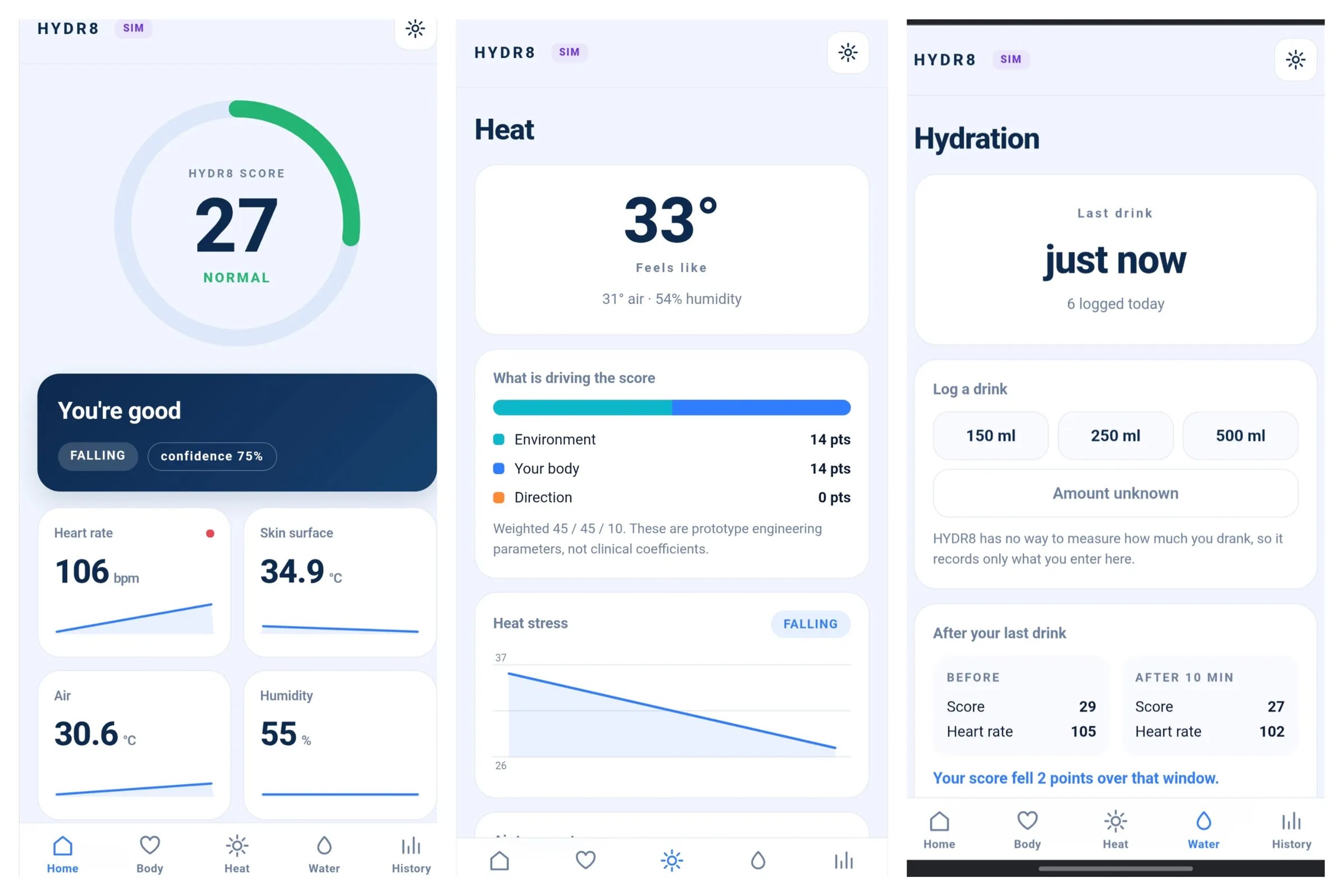
HYDR8, as it says on the tin, is a wearable that knows when it’s time to hydrate. The impetus for this one was something we all chase: the flow state. [Ayushmaan] would sit down, get deep into work, and look up hours later to to find that he had a headache and a full water bottle. Phone reminders were soon swiped away in annoyance.
This wearable is based on a XIAO ESP32-C3. It reads heart rate, oxygenation, skin temperature, and both the ambient temperature and humidity. It also learns your personal resting numbers range.
Taking all of this into consideration, it generates a heat/hydration stress score between 0-100. The thing is, HYDR8 tells you specifically what to do; sometimes it’s ‘drink water’ and other times, it’s ‘find shade’.
The wearable itself, while somewhat chunky, is pretty simple: it only shows the time and a message when it matters. The ESP32 hosts a full dashboard on your phone.
Keep in mind that this is not a medical device, it’s an experiment, a prototype. It can’t measure how hydrated you are. Instead, it measure hydration stress.
If you don’t want to wear anything, here’s a smart straw that uses a tiny turbine flowmeter and a Hall effect sensor to record the volume sipped, and detect whether the sipper is low on fluids. And if you find yourself under the hot lights of a wet bulb event, here’s how to survive it.

 Login
Login