❌

Normal view

There are new articles available, click to refresh the page.
Before yesterdayMain stream

3D Printed Scooter Fits in Your Luggage, Some Assembly Required

10 July 2026 at 11:30

Though [Ivan Miranda] calls the 3D printed vehicle in his recent video a motorbike, what he ultimately pulls out of his suitcase is clearly a scooter. Linguistic confusion aside, the β€œMirandetta” looks like an awesome build andΒ pulling a scooter out of your suitcase and whizzing past everyone in the taxi line just sounds amazing, especially knowing you made it yourself.

Aside from a whole lot of filament, he’s got a couple of tool batteries for hot-swappable energy that Airport security shouldn’t mind too much β€” provided you carry them with you, anyway β€” plus the usual e-bike motor and electronic speed control you might expect, and lawnmower tires which you might not. The narrow 3D printed rims round over the normally-flat tires to make them usable for this application. He seems particularly taken with the bi-stable mechanism he built for the kickstand, and we can’t blame him as we love seeing that kind of thing ourselves. The TPU seat is also a nice touch to keep with β€˜everything printed’ vibe.

Now while the finished product does indeed fit into his suitcase, it needs to be completely disassembled. Well, unless you have an over-sized suitcase, perhaps. So our dreams of zooming away from the luggage line from the first paragraph were perhaps a bit premature. Still, from the footage at Prague Maker Faire at the end of the video, it looks like it was a fun enough ride that we can forgive [Ivan] for our overactive imaginations.

If you want an open-source e-bike, we’ve seen those too β€” but that won’t fit in any kind of suitcase.

2026 Frikkin Lasers Challenge: A 3D-Printed Raman Spectrometer

5 July 2026 at 10:00
A black plastic cube is shown in front of another, larger rectangular black plastic box. The plastic cube has a silver microscope objective protruding from one side, with green light being emitted from it into a small plastic tube held on a positioning stage.

When light reflects off a surface, not all of it reflects off at the same wavelength; some photons impart a portion of their energy to raising the vibrational energy of the surface’s molecules, and are thus scattered away at a lower energy and longer wavelength. This is called Raman scattering, and the precise wavelength shifts are characteristic of the particular molecule being illuminated. It can therefore be used in Raman spectroscopy to identify molecules; these spectrometers are normally elaborate, expensive instruments, but [Allegedly Science] was able to build a simple system with surprising sensitivity.

The system is named the CubeRaman, after the cube-shaped body containing the main optical path. It uses a cheap 532-nm laser module as a monochromatic light source, with a bandpass filter to eliminate stray infrared light. The beam then reflects off a 45-degree dichroic mirror and passes through a microscope objective onto the sample. Raman-shifted light then scatters back through the objective, passes through the dichroic mirror and a long-pass optical filter, and is focused by an achromatic lens onto the slit of a spectrometer. The entire housing is 3D-printed, as are most parts of the kinematic mounts; the kinematic mounts use adjustment screws running through inserts in the mount, with the tips of the screws held in place by magnets.

[Allegedly Science]’s first test was with a raw diamond, which clearly showed the expected Raman shift. When trying to test a chemical inside a glass bottle, it mainly returned the signature of silica, making thin-walled cuvettes essential. Ethanol inside a plastic bottle was similarly interesting; varying the focal distance changed whether it detected the characteristic shift of ethanol or polypropylene. Nevertheless, [Allegedly Science] thinks there’s still room for improvement, particularly by eliminating stray light and using a narrower slit in the spectrometer.

Although we’ve seen an open-source Raman spectrometer before, this design is significantly more accessible. It does still require a separate spectrometer, though, so it might be worth considering some other spectrometer options.

2026 Hackaday Freaking Lasers Contest

Make a DIY E-ink Faceplate For Valve’s Steam Machine

5 July 2026 at 01:00

Valve has always designed hacker-friendly hardware, and in that spirit, [NaKyle Wright] released Inkterface, a design for an E-ink faceplate to fit the recently released Steam Machine. As far as projects go, this one is meticulously documented, so give it a peek.

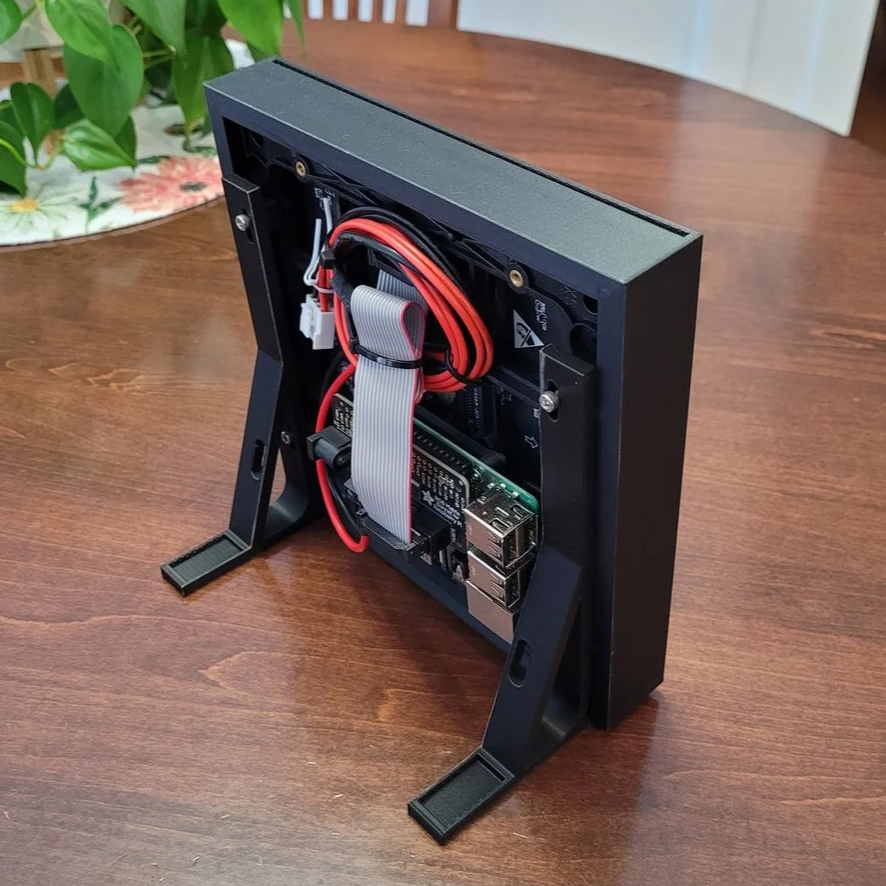
The system uses a selection of components that include a 5.83β€³ E-ink panel and driver board, a small lithium-polymer battery, and an ESP32-based controller board. [NaKyle] used a Feather V2 and display from Adafruit, so you might be in for some GPIO changes if you go with a different board.Β  A cleverly-designed 3D printed frame and bezel hold everything just so, creating a snug assembly with minimal wiring hassles.

A small service can be easily configured to control how the display updates.

The faceplate is wireless and self-contained, attaching with the help of four magnets. On the software side, the host machine communicates over Bluetooth, and a service takes care of pushing updates. An app for configuring and talking to the display will be available on Steam eventually, but in the meantime one can install that part manually.

[NaKyle]’s bill of materials calls for specific components, but the underlying design is very modular. Should one wish to make hardware or component changes, alterations to the 3D printed parts might be needed as well. Fortunately, [NaKyle] includes the .step files alongside the .stl models. We love to see that, because it makes tweaking or customizing so much more accessible. A homebrewed version of this E-ink panel might be just the thing to complement a homebrewed Steam machine.

Be sure to also check out the repository of Steam hardware, which contains drawings and 3D models of the Steam Deck and Steam Controller, useful for designing holders or custom brackets or whatever else one may need.

Piano Escapement Migrates to Drum Kit

29 June 2026 at 16:00

For as popular as the piano is in music studios, homes, and schools, it almost defies logic. Compared to a guitar, harmonica, or drum set, pianos are incredibly complex machines that can have somewhere on the order of 8,000 moving parts in a case that can easily weigh hundreds of pounds and which often responds quite poorly to seasonal changes in temperature and humidity. But for putting up with all of these downsides, musicians are rewarded with an instrument that uniquely responds to touch, style, and emotion. A big reason for that is that mechanical complexity, and [Super Valid Designs] is attempting to bring that design to a drum set.

Compared to the complex machinery that connects the movement of a piano’s key to its hammer striking a string, a kick drum pedal is much simpler. It can only bounce off of the drum or get β€œburied” where the beater remains pressed up against the drum after hitting it. [Super Valid Designs] wanted something with a bit more finesse and control, so he first 3D printed a mechanism that throws the beater towards the drum head and then disconnects it mechanically from the pedal, so that it rebounds even if the pedal stays depressed. The next steps were more difficult, which involved making sure the mechanism reset itself in a repeatable way, without making too much noise of its own. This involved trying out a few different ideas and printing a massive amount of subtly different linkages, but in the end he’s left with a machine that nearly replicates all of the parts of a piano’s escapement,

The end goal of this project wasn’t simply to reproduce piano mechanisms on a drum set, though. [Super Valid Designs] hopes to make a kick drum that’s much smaller than those found in traditional kits, and since smaller drums respond poorly when the beater remains on or near the drum after striking it, a mechanism like this will dramatically improve the performance of the smaller drum and help reduce the requirement for perfect technique. And, maybe in 50 years or so, these types of escapements will take over the drumming world just like the piano escapement took over keyboards after its invention in the 1700s. Some simpler piano actions have been built before, but the complexity seems to be a requirement for all of the tasks they need to do whether its for a piano or a drum.

❌
❌