A surprising number of things we use in everyday life retain most of their design cues from their 19th century ancestors. The bicycle retains the same basic design as it had in 1890, as does the sewing machine, the toilet, the car, and of course, the keyboard and the QWERTY layout from old typewriters. But we aren’t doomed to have our technology perpetually living in the past. [Paul] wanted a keyboard designed around human hands, rather than being designed around a machine, so he built this unique split keyboard.
The design of this specific keyboard went through around 50 iterations before he was comfortable with it. Other design goals here were for it to be portable, and the split nature of this certainly makes it more compact as does the use of low-profile switches. Each finger’s column is angled and spaced based on the needs of that finger, with the ring finger keys sitting higher and the index finger columns angled inward. Each thumb has access to three keys, one of which is the spacebar and the other two layer keys, which is what enables this design to get down to only 36 total keys.
When thinking about it for any length of time, the modern keyboard’s design holdovers from the 1800s are fairly wasteful compared to this split, ergonomic version. Especially when looking at the spacebar, which ties up both thumbs and only performs a single task, there’s a lot of opportunity for modern designs to be more efficient, more portable, and easier on one’s body. Feel free to take this to the extreme and use all three dimensions, as long as you aren’t particularly concerned with portability.
A 1-for-15 split moved one Nasdaq company’s NAV per share from $4.67 to $66.16 without adding a single dollar to the treasury. Here is the difference between arithmetic and value.
On June 20, 2026, Enlivex (Nasdaq: ENLV) reported treasury NAV per share of $4.67.
Twenty-eight days later, the same company reported $66.16.
The treasury did not grow. According to Enlivex, RAIN holdings were valued at approximately $1.14 billion on June 20 and approximately $1.1 billion on July 18. The asset side went slightly down.
Only the denominator moved.
That is the entire lesson of a reverse stock split, and most commentary gets it backwards.
Enlivex treasury disclosures, June 20 vs July 18, 2026. The treasury fell slightly. NAV per share rose roughly 14x.
Fifteen Shares Became One. Nothing Was Created.
On July 7, 2026, Enlivex announced a 1-for-15 reverse split of its ordinary shares, effective for trading on July 9. According to the company’s announcement:
Issued and outstanding shares fell from 252,480,222 to approximately 16,832,015
Authorized ordinary shares were reduced from 2,375,000,000 to 158,333,334
Fractional shares were rounded up to the nearest whole share, not cashed out
The ticker stayed ENLV. Ownership percentages stayed exactly where they were.
If you held one half of one percent of the company on July 8, you held one half of one percent on July 9.
What a Reverse Stock Split Actually Changes
Five things move. Every one of them is mechanical.
Share count. Divided by the ratio.
Quoted price. Multiplied by the ratio, at least at the open.
Every per-share figure. NAV per share, earnings per share, book value per share. Prior periods are restated on a split-adjusted basis, so historical EPS is rewritten in the filings.
Screener and mandate eligibility. Many institutional mandates and margin desks exclude securities trading under $1.00. Some exclude anything under $5.00. Share consolidation reopens that door.
Exchange compliance. This is usually the actual reason.
On that last point, Enlivex disclosed on May 15, 2026 that it had received a notice from Nasdaq stating that its closing bid price over the prior 30 consecutive business days did not meet the $1.00 minimum bid price requirement under Nasdaq Listing Rule 5550(a)(2).
Derivatives adjust as well. Enlivex stated that the exercise price and share count of outstanding warrants and options were proportionately adjusted. No optionholder gained or lost from the ratio itself.
What a Reverse Stock Split Does Not Change
Shorter list. Considerably more important list.
Your ownership percentage. Unchanged, apart from rounding.
Market capitalization. A fifteen-times price against a one-fifteenth share count multiplies back to the same number.
The balance sheet. Not one token, not one dollar of cash, not one patent moves.
The operating business. Trials do not accelerate. Protocol fees do not rise.
Any ratio with “per share” on both sides. This is the one that matters.
Here is the cleanest way to hold it.
A reverse split rewrites every number containing the words “per share.” It rewrites no ratio that contains “per share” twice.
The complete mechanics of a reverse stock split. Everything on the left is arithmetic. Everything on the right is the business.
The One Metric a Split Cannot Touch: mNAV
For digital asset treasury companies, the governing metric is mNAV, the multiple of net asset value. It divides market capitalization by the market value of treasury holdings. Above 1.0 is a premium. Below 1.0 is a discount.
Now run a split through it.
Market capitalization: unchanged
Treasury value: unchanged
mNAV: unchanged
A 1-for-15 split multiplies NAV per share by roughly fifteen and multiplies share price by roughly fifteen. The relationship between them is untouched.
A worked example. The share count changes, the per-share figures change, and mNAV does not move at all.
Work it through with round numbers. A company with a $300 million treasury and 100 million shares carries $3.00 of treasury per share.
Run a 1-for-10 consolidation and it carries $30.00 per share against 10 million shares. The treasury is still $300 million.
Whatever discount or premium the market was applying before the split, it applies after.
This matters well beyond one ticker. As The Block explains in its primer on digital asset treasuries, mNAV is the central health indicator for the model, because a treasury company’s capital-raising engine works at a premium and stalls at a discount.
Anyone describing a reverse split as something that “improved NAV backing per share” is describing division, not value.
Why the Market Still Reads Reverse Splits as a Signal
Because it usually is one. Just not about the split.
Reverse splits cluster among companies whose shares have already fallen, and regulators have noticed the pattern.
Amendments to Nasdaq Listing Rule 5810(c)(3)(A), approved by the SEC in January 2025, restrict how frequently a company may use reverse splits to remedy a bid price deficiency, and remove the compliance period entirely if a split occurred within the prior year.
The digital asset treasury sector has supplied a steady stream of examples. In April 2026, CoinDesk reported that Bitcoin treasury company Nakamoto filed a preliminary proxy seeking a reverse split in a range of 1-for-20 to 1-for-50 in order to regain compliance with the same $1.00 threshold.
Ratios of that size are common when a share price has fallen far enough that a modest consolidation would not clear the bar.
So the honest reading is this.
The split is not the information. The split is a receipt for information the market already had.
The useful question is what sits behind the ratio.
What Was Actually Behind the Ratio
July 2026 was a dense month for Enlivex, and exactly one item on the list was arithmetic.
July 9. The 1-for-15 split took effect. Share count fell to approximately 16.83 million.
July 13. The FDA granted Regenerative Medicine Advanced Therapy designation to Allocetra™ in age-related knee osteoarthritis, according to Enlivex.
July 18. Enlivex reported holdings of 79,550,593,122 RAIN tokens valued at approximately $1.1 billion, alongside NAV per ordinary share of $66.16.
July 28. Enlivex announced a $400,000,000 private placement with a single institutional investor, priced at $5.00 per share when funded in U.S. dollars, USDT or USD Coin, and $6.00 when funded in RAIN tokens. According to the company, those represent premiums of 17.4% and 40.8% to the July 27 closing price.
July 29. Trading volume on the Rain protocol reached $860 million, representing 622% month-over-month growth versus June, according to figures the company attributed to the Rain Foundation.
One month, five events. Four changed the business. One changed the arithmetic.
Four of those five changed the business. One changed the arithmetic.
That distinction is the whole point.
How to Read the Next Reverse Split You See
A short checklist, applicable to any Nasdaq-listed treasury vehicle:
Compare the ratio to the compliance calendar. A ratio sized precisely to clear $1.00 is a compliance action. A ratio sized well above it is a positioning action.
Recompute mNAV before and after. If it moved, something other than the split moved it.
Read the fractional share treatment. Rounding up favors small holders. Cashing out does not.
Check what happened to authorized shares. Enlivex reduced its authorized count proportionally. Many issuers leave authorized shares untouched, which quietly expands future issuance capacity.
Then set the split aside and read the assets. Enlivex publishes unaudited mark-to-market treasury metrics on a public dashboard. That is where the information lives.
Three Questions People Actually Ask
Q. Does a reverse stock split make shareholders lose money?
A. No. The split itself is value-neutral. Ownership percentage, market capitalization and total position value are unchanged at the moment of the split. What happens to the price afterward is a separate question with a separate answer.
Q. Does a reverse stock split reduce dilution?
A. No. A split rescales existing shares. It does not affect whether new shares are issued later. Authorized share capacity is the number to watch there, and it does not always move with the ratio.
Q. Does a reverse split change NAV per share for a crypto treasury company?
A. Yes, and only in the arithmetic sense. Treasury NAV per share rises by the ratio because the same treasury is divided among fewer shares. The treasury itself is untouched. This is precisely why NAV per share is a poor standalone signal and mNAV is the better one.
The Category Behind the Ticker
Prediction markets are no longer a curiosity. Pew Research Center reported that combined monthly trading volume across Kalshi and Polymarket rose from under $5 billion in September 2025 to roughly $24 billion by April 2026.
Citizens Bank estimates the industry now runs at approximately a $3 billion annual revenue run rate, with a path toward $10 billion by 2030.
Against that backdrop, Enlivex operates as a Nasdaq-listed structure anchored in RAIN, where 2.5% of Rain protocol network fees are directed to buy back and burn the token, running alongside a clinical program aimed at a longevity market the company sizes at $314 billion.
Two engines. One ticker. Roughly sixteen million shares instead of two hundred and fifty million.
Same company either way.
A reverse split is a unit conversion. It deserves exactly as much attention as switching from feet to meters, and exactly as much scrutiny as whatever prompted the conversion.
Author’s note: In my view BIP110 is both useless and harmful, and I do expect it to fail (see scenario 1). Despite this I tried to write this article as factually as I could, entertaining different possible scenarios, as I do hope it may provide some clarity on this soft fork attempt.
The OP_RETURN debate has escalated to the point where Bitcoin Knots implemented BIP110: a consensus protocol change that temporarily limits the size of OP_RETURNs and intends to reduce other types of data on Bitcoin’s blockchain as well.
However BIP110 does not have consensus: not everyone agrees there’s a problem that requires solving in the first place, nor that BIP110 solves it in any meaningful manner, while it restricts Bitcoin in potentially harmful ways. Most obviously, Bitcoin Core — still by far the most-used Bitcoin implementation — has not adopted BIP110, while only some 1-2% of hash power has been signaling support for it in recent weeks.
Nevertheless, BIP110-nodes like Bitcoin Knots will soon — starting from block 961,632, to be mined on or around August 8 — reject blocks that don’t signal support for the upgrade.
Here are the three main scenarios for how that could play out.
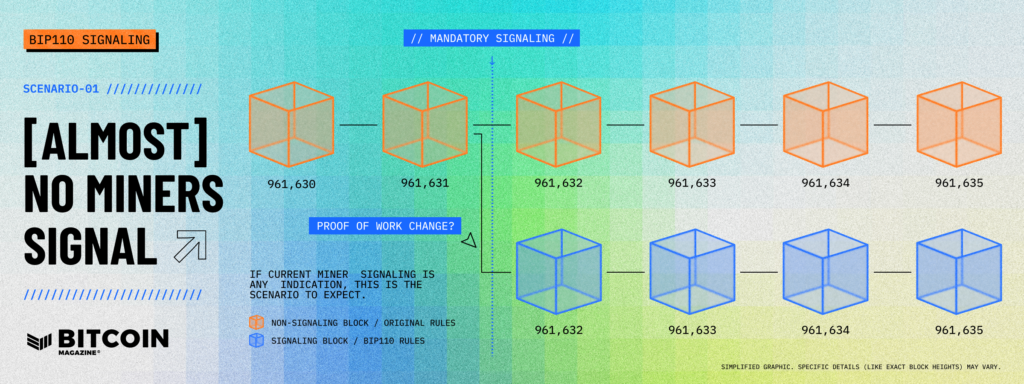
Scenario 1: (almost) no miners signal
If current miner signaling is any indication, this is the scenario to expect.
From the perspective of anyone running Bitcoin Core or other non-BIP110 enforcing nodes and wallets (the vast majority of the Bitcoin ecosystem) blocks will be mined as usual, and transactions will be processed like normal too. Anyone who’s not actively tracking these events on social media or elsewhere may not even be aware that anything unusual is going on, and in a practical sense for them there really won’t be; BIP110 does not affect them.
The same is not true for anyone running Bitcoin Knots or other BIP110-enforcing nodes, however. Since their software will reject non-signaling blocks, they basically wouldn’t see any new blocks at all (or perhaps a few per week), and incoming and outgoing transactions won’t confirm (or incredibly slow). In practical terms, these nodes would stall and become unusable.
If this happens, BIP110 proponents will have to decide between waiting to see if things improve for them (see scenario 3), giving up (switching back to non-BIP110 software), or deploying a next protocol change, like hard forking to a different proof-of-work mining algorithm.
Such a hard fork would possibly allow for mining with GPUs again, therefore letting more people mine new blocks to generate a blockchain with the BIP110 rules enforced. However this would also mean that BIP110/hard fork nodes permanently split off from the rest of the Bitcoin ecosystem to essentially create a new cryptocurrency. (More on this below)
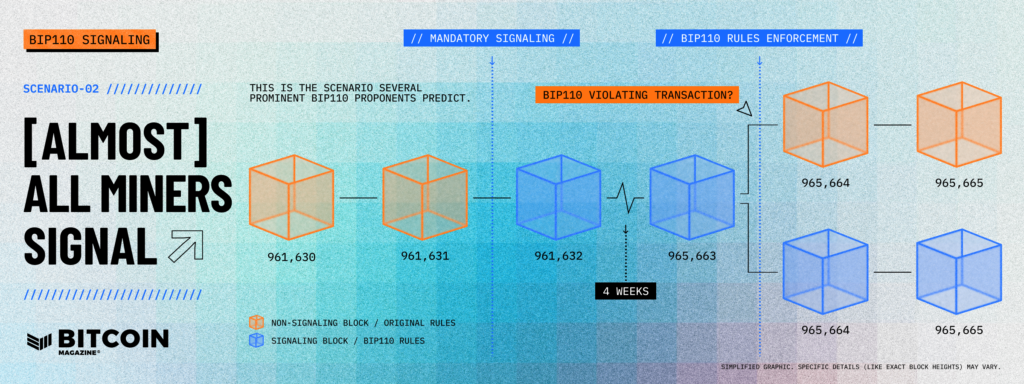
Scenario 2: (almost) all miners signal
This is the scenario several prominent BIP110 proponents predict.
In this scenario, when the mandatory signaling window starts, all miners will suddenly signal for BIP110. Or at least, a majority of miners will signal AND reject any non-signaling blocks, so that all blocks that end up in the blockchain include a BIP110 signal.
If this happens, all Bitcoin nodes (Knots and Core alike) remain compatible, and the signals in the blocks indicate that miners plan to start enforcing the BIP110 rules another two weeks later. BIP110-violating transactions should by early September no longer end up in blocks.
In essence, this is the success scenario for BIP110; although only a small faction of developers, miners and users pushed for it, the upgrade goes into effect across the entire network.
…However even in this scenario there is an important caveat.
Blockchain signaling is a useful coordination mechanism for soft fork deployment, but it technically does not guarantee that the new rules will be enforced. Miners can signal support for the upgrade without actually using BIP110 software, which they for example could elect to do simply to ensure their blocks aren’t rejected by Bitcoin Knots nodes during the mandatory signaling window.
Bitcoin’s protocol rules are ultimately enforced by economic nodes however, and nothing currently indicates that most of these will enforce the BIP110 rules even if all blocks include a signal. So if BIP110-violating transactions are later accepted by most miners regardless, these economic nodes would accept blocks that include them, while BIP110 nodes would not. The blockchain would split between nodes that do and do not enforce BIP110 after all.
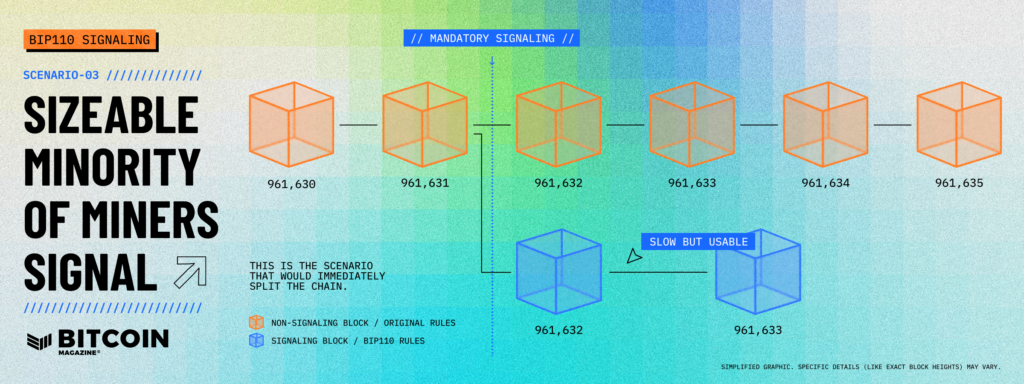
Scenario 3: a sizable minority of miners signal
This is the scenario that would immediately split the chain.
Currently some two percent of miners signal support for BIP110, which is probably too little to be meaningful (see scenario 1). But let’s imagine this quickly increases tenfold or so. We also have to imagine that this sizable minority itself rejects any non-signaling blocks— else it would still be indistinguishable from scenario 1 where BIP110 nodes stall (since they require ALL blocks to include a signal).
If the sizable minority is both signaling and rejecting non-signaling blocks, they’d start to build their own minority blockchain with only signaling blocks in it. Blocks on this minority chain would confirm significantly slower than usual — maybe just one or two per hour — but BIP110 nodes remain reasonably usable. And after a few months the mining difficulty would adjust, so blocks are found (closer to) six times per hour again. Another couple of weeks later the BIP110 rules would go into effect.
Meanwhile, Bitcoin Core and other non-BIP110 enforcing nodes would still operate fairly normally as well. Their blocks will confirm a little bit slower for a while — maybe about four or five per hour — but after a couple weeks mining difficulty adjusts here too, to also bring this back to six per hour on average. The BIP110 rules would never go into effect on this blockchain.
As a result, a BIP110 blockchain and a blockchain with the original rules would then exist side by side as two different cryptocurrencies, indefinitely.
There is one notable caveat to this scenario as well, however. If the BIP110 chain were to overtake the original chain in length later on (due to miners moving to the BIP110 chain), all nodes — Core and Knots alike — would accept the BIP110 chain as the only chain. The original chain would in this case be discarded, or wiped out.
This one-sided wipe out risk is in fact why BIP110 proponents expect all miners to signal preemptively, preventing a split. Miners won’t want to mine on a blockchain that can later be discarded, they argue, as that would also mean losing all block rewards they earned on it.
In actuality, users and miners that want to prevent that the original chain can get wiped out could do so however: they can manually invalidate any block on the minority BIP110 chain while it still is the minority chain. This way their nodes would reject switching to it even if it becomes longer at any point in the future, making the split permanent also.
So what exactly happens if the chain permanently splits? If and when the Bitcoin blockchain permanently splits, it essentially marks the creation of a new cryptocurrency, or forkcoin. Everyone who owns BTC at the time of the split automatically receives the equivalent amount of coins on the new blockchain, not unlike what happened with Bitcoin and Bitcoin Cash in 2017.
However in reality these things aren’t necessarily as straightforward, and if BIP110 does cause a chain split under any of the scenarios above there will likely be some complications.
For one, there’ll almost certainly be disagreement over which side of the chain represents “Bitcoin” (“BTC”), and which side is the new forkcoin. It seems likely however that the blockchain with the original rules will by most people be considered “Bitcoin”, whereas the blockchain with the BIP110 rules will be called something else; we’ll call it “BIP110 coin” for now.
Accessing the BIP110 coins then, will require BIP110-specific software like, indeed, Bitcoin Knots. The new coins won’t show up on Bitcoin Core nodes or most wallets.
However, BIP110 does not currently include replay protection. This means that transactions on one chain can be copied (“replayed”) on the other chain. Instead of just sending BTC, users could unknowingly also send the equivalent BIP110 coin to an identical address on the BIP110 chain— or vice versa.
It’s difficult to estimate at this point how much the forkcoins will be worth, or even if they will be worth anything at all. The lack of interest in buying BIP110 coins via fork future contracts does suggest there may not be much interest to buy them after a split either. But if you nevertheless want to be sure you’ll receive BIP110 coins if there are any, it’s probably best to self-custody your BTC (have access to your private keys), and don’t send any transactions until the dust settles and there is more clarity on how to proceed.

 Login
Login