
Normal view

There are new articles available, click to refresh the page.
Yesterday — 22 July 2026Main stream

Lightning Labs Launches Wavelength: “Bitcoin on Easy Mode” for Developers and Autonomous Agents

By: Juan Galt
22 July 2026 at 16:01

Bitcoin Magazine

Lightning Labs Launches Wavelength: “Bitcoin on Easy Mode” for Developers and Autonomous Agents

Lightning Labs, the company developing core Lightning Network software including Lnd, Loop, and Taproot Assets, has released the alpha version of Wavelength. The toolkit enables developers and AI agents to add self-custodial Bitcoin payments to applications through a simple non-custodial API, without running nodes, managing channels, or sourcing liquidity.

In a July 21, 2026 blog post, Lightning Labs described Wavelength as “Bitcoin on Easy Mode for Agents and Humans.” The company stated that the Lightning Network already delivers instant, global, low-fee payments under user control, but previously required infrastructure most builders preferred not to operate. Wavelength closes that gap by turning the hard parts of Bitcoin and Lightning integration into a handful of API calls.

High-Level Overview

Wavelength embeds a self-custodial wallet that runs inside web or mobile apps (via WebAssembly or compiled binaries) or as a standalone client. Users control their own keys on-device. The system supports on-chain Bitcoin, Lightning payments via atomic swaps, and an Ark-like settlement layer for fast, low-cost off-chain transfers that can settle in batches to the blockchain. Every off-chain payment uses a standard BOLT 11 invoice, so the wallet interoperates with the existing Lightning Network from the first integration.

Lightning payments route through Loop for deep, reliable liquidity. A coordination service settles transfers between users but never takes unilateral control of funds. According to the announcement, users can always perform a unilateral exit to on-chain Bitcoin at any time via an explicit exit command, without needing cooperation, the Wavelength SDK is open source.

The same Wavelength API is exposed to AI agents as typed tool calls through the Model Context Protocol (MCP). Agents can hold balances and pay for API calls, data feeds, or other agent services in fractions of a cent. Wallet creation and unlocking designed to remain outside the agent channel so seeds and passwords are not exposed to the model. This pairs with L402, Lightning Labs’ protocol for machine-native authentication and per-request Lightning payments.

Core commands cover the full lifecycle: create/unlock, balance, recv (for addresses or invoices), send, activity, and exit. Integration options include the embedded SDK, a gRPC/REST API, browser WASM package, and an MCP server. Documentation is structured for both human developers and agents, including llms.txt indexes and agent onboarding guidance.

Availability and Roadmap

Wavelength is available immediately on Signet and testnet. Mainnet access is invitation-only; interested parties can request it after installing the toolkit. Bitcoin is supported at launch. Stablecoin support is planned via Taproot Assets so the same API surface can handle both. Future work includes deeper mobile embedding and optional direct Lightning channel support using Lnd.

Lightning Labs noted in its announcement that during the closed alpha, Lightning transactions carry a minimal 1 basis point service fee (plus standard network routing fees), with ordinary Bitcoin network fees applying for on-chain activity. Pricing may evolve.

On X, Lightning Labs summarized the release: “Announcing Wavelength, the easiest way to integrate bitcoin for agents and humans. With a simple non-custodial API, anyone can integrate Lightning into their app and get instant, high volume, low fee transactions. Machines can pay machines. Humans can pay humans. Anywhere.” A follow-up post directed builders to a form for early mainnet access.

The release positions Wavelength as infrastructure that lowers the barrier for application developers, “vibe coders,” and autonomous agents to offer self-custodial Bitcoin payments by default rather than as a specialist feature. Full documentation, quickstarts, and the open-source repository are available at wavelength.lightning.engineering and the linked GitHub project.

This post Lightning Labs Launches Wavelength: “Bitcoin on Easy Mode” for Developers and Autonomous Agents first appeared on Bitcoin Magazine and is written by Juan Galt.
Before yesterdayMain stream

Bitcoin is NOT Changed by Proof Of Node

By: Juan Galt
21 July 2026 at 17:36

Bitcoin Magazine

Bitcoin is NOT Changed by Proof Of Node

You might have heard about BIP-110; here’s why this fork is not just bad for Bitcoin, but it is built on a misunderstanding of what a Bitcoin node is and what it is good for. As well as why, because of this misunderstanding, BIP-110 will fail. 

This article is a Take. Opinions expressed are entirely the author’s and do not necessarily reflect those of BTC Inc or Bitcoin Magazine.

BIP-110 is a Bitcoin Improvement Proposal titled as a Reduced Data Temporary Softfork. The BIP proposes a consensus change to Bitcoin, which attempts to limit the types and amounts of arbitrary data that can be added to consensus-valid transactions by limiting a wide range of Bitcoin’s scripting capabilities. BIP-110 is led by a pseudonymous developer known as Dathon Ohm and is widely supported by the Knots community, an alternative implementation of Bitcoin led by one of Bitcoin Core’s earliest contributors, Luke Dashjr and its supporters.

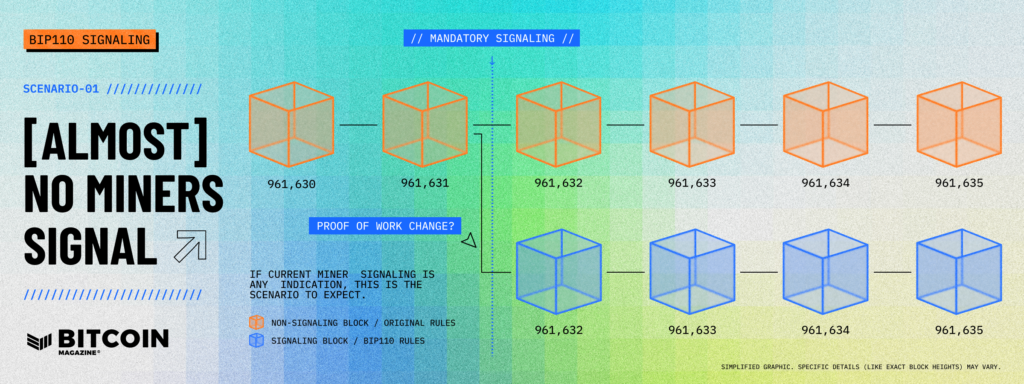
The BIP-110 consensus change is headed towards a mandatory signaling period in the coming weeks and thus a potential fork with the main consensus rules as implemented in Bitcoin Core. The proposal needs to gain a great deal of support from miners within the coming weeks to change Bitcoin consensus. As of the time of writing, miner signaling for BIP-110 stands at less than one percent


The Knots community, widely made up of Bitcoiners running nodes on machines like Start9 and Umbrel, has rallied around Knots in protest of a series of development decisions made by Bitcoin Core, the primary open source development community and reference implementation of Bitcoin. While a majority of senior Bitcoin developers are either opposed or apathetic to the changes proposed by BIP-110, the movement has gained enough steam to become an ongoing topic of discussion on social media. 

Supporters of BIP-110 believe that by running Bitcoin full nodes that signal for the consensus change, they alone can change Bitcoin. Here are the main concepts being debated, the biggest misconceptions about Bitcoin consensus, what a Bitcoin node is, and why BIP-110 is almost certain to fail. 

The Power and Limits of a Bitcoin Node

Many of the disagreements and misconceptions in this recent cultural conflict within Bitcoin revolve around the idea of a Bitcoin full node. Influencers like Knut Svanholm, author and podcaster, have elevated the role of the full node to heights perhaps too close to the sun. 

Knut recently tweeted: “Every person on Earth is a node in the Bitcoin network. Most to a minuscule extent, of course, but every node is first and foremost a person, not a machine. Which tools we use to interact with the network (and, by extension, to which extent they influence the network) is entirely dependent on the choices we make.”

Statements of this sort are poetically beautiful, philosophically grand, romantic even, but nevertheless technically incoherent and fundamentally meaningless. Knut’s tweet attempts to redefine what a ‘Bitcoin node’ means and fails at it, instead diluting the value of the term entirely. He might as well have said that every atom in the universe is a Bitcoin node, since apparently to him the term is all-encompassing. 

Knut,  though well-intentioned, is wrong. A Bitcoin node is something very specific. It is a full copy of all of Bitcoin’s transaction history, block headers and transaction-related data. Its purpose is very specific: to let users verify the integrity of Bitcoin’s supply and transaction history in relation to Bitcoin’s consensus rules. 

Bitcoin nodes grant users a variety of benefits, such as privacy. Third-party wallet providers query their copy of the Bitcoin blockchain for the user’s balance and serve it back to the user via the wallet app. Most mobile wallets function this way, with users asking a third-party server for their balances. Some, very few, can connect to a user-run Bitcoin node, in which case the user’s public addresses and balances are not shared with any third-party wallet company. 

Another benefit Bitcoin nodes grant users is the ability to check whether they are in consensus with the rest of the network, staying in sync. If the user mines Bitcoin or contributes any significant amount of hashing power to Bitcoin’s proof-of-work network, the node also provides the opportunity to assemble a block, choosing which transactions go into it. This is only possible if the user manages to mine a Bitcoin block, which is quite an achievement today, given the difficulty and steep competition. 

Even new kinds of mining pools like Ocean, which attempt to decentralize block template production, letting retail miners have more influence over which transactions enter the chain, still need enough hashing power to win the proof-of-work race, resulting in sporadic blocks being mined and thus limited influence over the blockchain. 

Bitcoin nodes also relay transactions across the network, with tens of thousands of them communicating via a flood network; this results in a censorship-resistant system where a small number of nodes can get controversial transactions to miners, bypassing any kind of filters, as demonstrated by Peter Todd’s relay libre. Thus, Bitcoin nodes can not easily filter which transactions enter the blockchain.

Even a large majority of Bitcoin nodes alone cannot alone change Bitcoin consensus. Not without having a large amount of economic activity entering the Bitcoin network through them, as exchanges do on behalf of millions of users. Not without having the protocol and application developer community behind them. Not without having the investor community behind them. Bitcoin is not a node democracy, contrary to popular memes today. 

Bitcoin nodes do not grant you ‘citizenship’ in the ‘Bitcoin nation’. Satoshi Nakamoto was quite clear about this in the Bitcoin white paper. Bitcoin’s ultimate security and governance structure is: one CPU cycle, one vote, not one node, one vote. And miners, who run the CPU cycles over Bitcoin’s proof-of-work, are very sensitive to investor sentiment and the broader developer community, resulting in a distributed global protocol for money that is very difficult to change. 

Bitcoin nodes ultimately let you know if you are connected to the network with the most accumulated proof-of-work and that its consensus rules are being followed, but a node alone does not let you change the consensus rules. Users who change the consensus rules of their Bitcoin node are, by definition, no longer running Bitcoin. As a result, changing Bitcoin consensus as a node runner is very difficult, and that’s a feature, not a bug. Bitcoin is money for enemies. 

History and Bitcoin Consensus Games

Deep work has been done, trying to understand Bitcoin consensus, its various pillars and interest groups. Ren Crypto Fish, Steve Lee and Lyn Alden identified six of them in BCAP, an open-source effort to analyze Bitcoin consensus and risks in protocol upgrades. BCAP identified stakeholders such as Economic Nodes, Investors, Media Influencers, Miners and Protocol Developers, and Users and Application Developers

Historically, in the case of a consensus crisis, it is true that Bitcoin nodes have been used to signal support for one version of Bitcoin over another. Fork events like 2017’s Bitcoin Cash fork are often cited as examples of economic nodes winning against opposition by miners. 2017’s legendary User Activated Soft Fork (UASF) faced major opposition in theory; a large majority of mining pools and their corresponding collective hashrate supported the Segwit2x version of Bitcoin, with many exchanges and corporations having signed the infamous New York Agreement in support of it. 

The Bitcoin node-supported soft fork against it won nonetheless, bluffing the Segwit2x version from a contested blockchain altogether. But that’s the thing: while the Bitcoin nodes technically won, they did so by having massive support from protocol developers, investors and media influencers: these nodes really had economic weight and rough consensus. BIP-110, on the other hand, does not have the protocol developers, nor does it have enough investors behind it. Michael Saylor has come out against it, with many industry leaders also openly opposing it or staying out of the matter entirely. 

In fact, during the Bitcoin Cash fork, the limits of retail Bitcoin nodes were clearly understood. A Bitcoin node run by an exchange is orders of magnitude more influential than that of a retail user, as it introduces large amounts of new transactions into the Bitcoin network. The Bitcoin node of a major mining pool is far more influential than that of a hobbyist solo miner, as it more often assembles blocks and chooses which transactions settle to the blockchain. 

Most Bitcoiners outside of exchanges use mobile wallets to access their Bitcoin. Such users and investors can ‘vote’ with their money, so to speak, by moving their bitcoins and economic activity elsewhere, be it to a wallet that supports their vision of Bitcoin, or their own full node. But while users remain on mobile wallets that talk to third-party nodes, those users have little individual influence over Bitcoin consensus. And the vast majority of mobile wallets are using a Bitcoin core-compatible back end. 

The same goes for exchanges; their users effectively delegate consensus decisions to the exchange operators. In some cases, exchanges have put consensus issues to a user vote, weighed by their total holdings, returning that decision to end users weighed by capital; we may see this happen again with BIP-110. 

Votes of the sort have started happening with Foundry today. One of the biggest Bitcoin mining pools in the world, Foundry, recently emailed its miners informing them that they can vote on the proposal with their hashrate. A high enough support could result in Foundry signaling for BIP-110, though that remains unlikely. Users who do not vote will effectively signal against BIP-110, defending the status quo. Thus apathy about the topic of BIP-110 would be a win for Bitcoin Core by default. BIP-110 supporters need to culturally win over a majority of the Foundry hash rate, who then must act to vote against the Bitcoin Core developer consensus, the most popular Bitcoin implementation and best supported codebase.

Today, miners are not signaling support for BIP-110 in any significant way. In fact, according to some data, this is one of the least supported soft fork attempts by miner signaling in Bitcoin’s history. Less than one percent of the blocks mined in the current difficulty adjustment period are signaling for BIP110. 

Concluding Thoughts

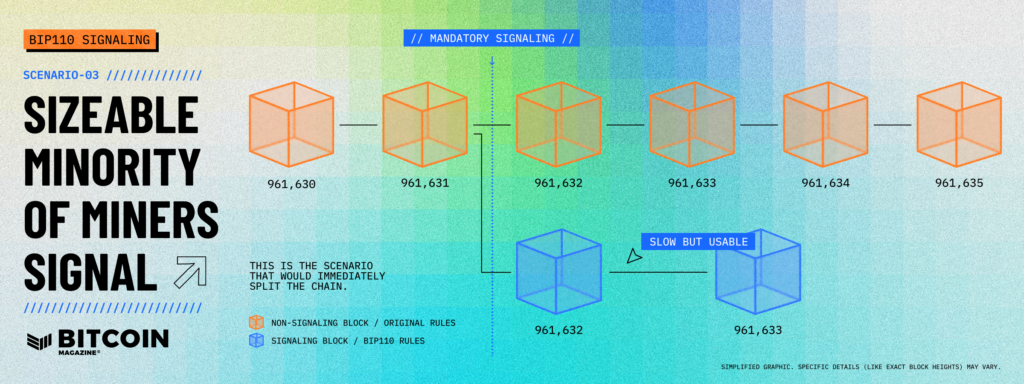
BIP-110 has so far failed to gain consensus across major interest groups within Bitcoin; neither developers, investors, miners, nor large economic nodes support the consensus change. The result is likely to be a chain split in the coming weeks, which could have significant consequences for lightning wallets running on BIP-110-compliant nodes, ultimately resulting in a new, yet small blockchain that would probably have to change the proof-of-work used to stay alive. 

This post Bitcoin is NOT Changed by Proof Of Node first appeared on Bitcoin Magazine and is written by Juan Galt.
The Bitcoin Softfork That Tried to Police “Junk Data” — And Why It’s Already Failing

14 July 2026 at 13:47

Bitcoin Magazine

The Bitcoin Softfork That Tried to Police “Junk Data” — And Why It’s Already Failing

This is a guest post by Brandon Black. Opinions expressed are entirely their own and do not necessarily reflect those of BTC Inc. or Bitcoin Magazine.

Within the tiny internet bubble of Bitcoin X (formerly Bitcoin Twitter or Crypto Twitter), there has been a lot of noise in the past year about @dathon_ohm’s proposal for a Reduced Data Temporary Softfork, otherwise known as BIP110. Underlying this proposal is the idea that certain Bitcoin transactions have been violating the principles of the network by including in their locking or unlocking scripts data that can be interpreted in one or more additional ways besides their plain Bitcoin script interpretation. According to BIP110’s supporters, reducing the use of these transactions is sufficient justification for the most confiscatory Bitcoin softfork to date, on a deployment timeline that is dramatically faster than the two most recent softforks, and with a lower activation readiness threshold.

Bitcoin is an open-access, censorship-resistant ledger to which anyone can write entries if they are willing to pay fees sufficient to convince block template creators and miners to include their transaction. The fundamental value of Bitcoin vs. all other ledger systems is the aforementioned open access. Without it, Bitcoin’s ledger has no more value than the bowling alley scoreboard. Because of this fundamentally open access, we all know that Bitcoin will be used by those we hate. Much like the principle of free speech, which is meaningless unless it applies to speech that we don’t like, Bitcoin’s open access would be meaningless if it only applied to transactions of which you or I approve. I will therefore assume that we do not want to be in the business of inspecting how other people structure their ledger entries any more than we want them inspecting our entries.

BIP110 proponents might say, “Sure, but that only applies to monetary entries! What about these non-monetary entries?”, but the reality is that there simply is no such distinction. Every transaction made on Bitcoin is made by satisfying the conditions of some locking script to make an entry in the ledger, which consumes input coins and creates output coins. The fact that one transaction’s scripts are larger or smaller than another is of no relevance to me as a Bitcoin node operator or user. First, I simply do not look at other people’s transactions. They’re no more my business than other people’s orders at the local café. Second, my node makes no such distinction. Transactions are either valid or invalid, and they are either costly to validate (like a large multisig) or cheap to validate (like one of these Ordinals or OP_RETURNs).

One could argue that Bitcoin, like gold, would be a superior monetary asset if it could not also be looked at in other ways. Imagine if gold could not be used in industry or jewelry! It might be true that that would make it better as money. But of course, the very same properties that make gold good money also make it desirable in jewelry and industry. The same applies to Bitcoin. The very fact that Bitcoin allows anyone to make an entry if they are willing to pay the fees means that we must give up the idea that we can control how they will look at that entry. No matter what restrictions we put on the structure of the entries, it will always be possible to make entries that can be interpreted in other ways by non-Bitcoin software. So, both with Bitcoin and with gold, we accept that other use is inevitable. In gold, this leads to distortions in the market when non-monetary demand increases or decreases. In Bitcoin, this can lead to periods of higher transaction fees when there’s greater demand for its limited blockspace.

In Bitcoin, we have two advantages that gold does not have. First, making Bitcoin transactions that can be viewed in alternative ways does not affect the market for Bitcoin itself. Unlike gold, very little Bitcoin is allocated to these uses. Second, in Bitcoin, we have a protocol that is already designed to minimize cost to the validation network from such other interpretations. Bitcoin limits both the size of blocks and the number of signatures that can be used in transactions. These are the greatest costs to validating nodes, and the protocol limits on them have been in place since the very early days of Bitcoin, precisely to prevent abuse by any high-frequency or high-volume use of the ledger. These limits have already spurred innovations such as the Lightning Network, Ark, Spark, Cashu, and many more. Even the boom in demand for blockspace caused by these “non-monetary” ledger entries (yes, that does sound ridiculous) has increased the use of these scaling solutions, which require fewer entries on the main ledger.

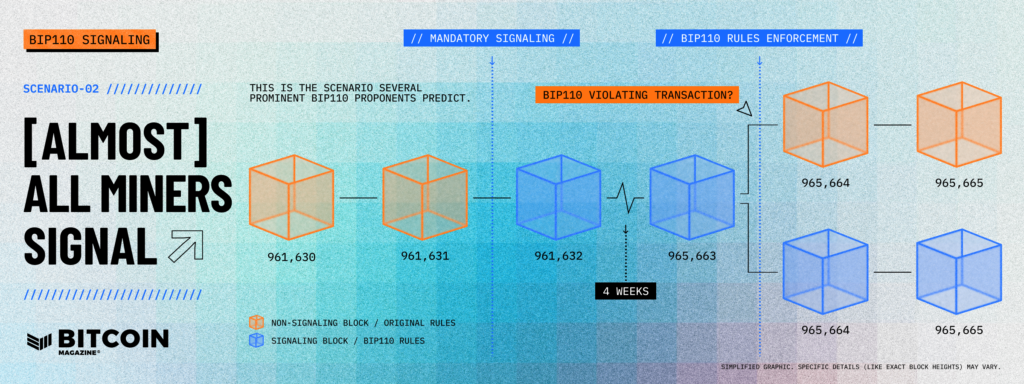
With the justification for BIP110 thus explored, and hopefully shown to be woefully lacking, let’s look at the proposed change itself. BIP110 restricts the size of locking scripts, restricts the number of alternative scripts in taproot, makes the taproot annex invalid, removes all upgradable witness and tapscript versions, removes all tapscript upgradable opcodes, and makes OP_IF and OP_NOTIF invalid in tapscript. All of these restrictions apply to UTXOs created during the 52414 blocks (approximately 1 year) after its activation. BIP110 also proposes a miner readiness signaling threshold of 55% instead of the threshold used in prior miner signaled softforks of 90% or more. If 55% of blocks do not signal readiness before block 961632, nodes enforcing BIP110 will treat blocks not signaling readiness as invalid to force the change to lock in by block 963648 and activate by block 965664.

BIP110 would be the most sweeping restriction of Bitcoin script since Satoshi’s well-known deactivation of many opcodes in response to a critical vulnerability (CVE-2010-5137) back in 2010. It proposes miner signaled activation with an unprecedentedly low threshold and node-forced activation after less than 9 months from the date the BIP was assigned a number. It does all of this because (as discussed above) other people are viewing certain ledger entries in ways which the BIP110 supporters do not approve of. Worse yet, the folks who use such disapproved ledger entries have already updated their software to continue making such entries even if BIP110 were to become Bitcoin’s consensus rule set. This was, of course, a predictable outcome (many of us explicitly predicted it) because it is fundamentally impossible to restrict how other people use external software to analyze entries on an open-access public ledger.

In summary, BIP110 is a proposal to do something impossible (limit how users of an open access ledger use that ledger) in response to a problem that is already fully addressed through Bitcoin’s existing protocol limits. It proposes to do this impossible thing on an irresponsibly short activation timeline, with incredibly limited code review, and regardless of whether the change reaches any type of ecosystem consensus. Fortunately, Bitcoin is not such a delicate flower of a system that such a foolhardy attempt at modifying it will succeed. Not only have miners soundly rejected BIP110, but other voices throughout the developer, investor, influencer, and corporate landscape have spoken out against the changes.  In August, this particular attack against Bitcoin’s consensus rules will have made Bitcoin stronger through its failure, and the network will continue its steady rhythm of tick-tock, next block.

This post The Bitcoin Softfork That Tried to Police “Junk Data” — And Why It’s Already Failing first appeared on Bitcoin Magazine and is written by Brandon Black.

One Year Later: How Coldcard Q’s Key Teleport Delivers Secure Remote Key Management for Bitcoin Treasuries

By: Juan Galt
30 June 2026 at 12:54

Bitcoin Magazine

One Year Later: How Coldcard Q’s Key Teleport Delivers Secure Remote Key Management for Bitcoin Treasuries

Have you ever been travelling, had to make a big payment and realised you left your hardware wallet back home? Perhaps you are a key holder in a business’s Bitcoin treasury, or an emergency came up, and a big payment has to be made, some cold storage Bitcoin has to move, but the keys are elsewhere. 

Key Teleport, a feature developed by the hardware wallet manufacturer Coinkite, may be the most secure way to handle key material at a distance. The feature is only available to the Coldcard Q, the premium, feature-rich Bitcoin hardware wallet developed by the company. 

Before Key Teleport, the most paranoid, secure way to move a private key over the internet was not to send it over WhatsApp or Signal. These apps, while end-to-end encrypted on the surface, are running on top of very complex hardware and operating systems, in many cases with very intrusive firmware embedded deeply by manufacturers. Smartphones today, as with most of mainstream technology, are simply not designed to secure highly valuable secrets that can transfer irreversible money like Bitcoin. 

Had you asked me how I might go about sending a private key with life-changing money on it, across the wire, I would have told you this: You need to boot Tails OS, a slim, highly paranoid Linux distribution, into hardware you know to be secure, ideally a burner laptop. You then need to generate a fresh set of PGP keys to encrypt the secret with the power of asymmetric cryptography. The recipient needs to do the same, Tails-OS and PGP. Then, a classic encrypted message is made to the recipient’s public key, and the encrypted secret is sent over Tor, probably wrapped by another VPN just in case. Having done this once, I can tell you, it’s a mission. 

This Tails-OS plus PGP combo is the kind of setup that Edward Snowden used to get in contact with journalist Greenwald originally, to leak the 2014 NSA surveillance secrets. If the 90’s cypherpunks had some kind of secret society, through which they coordinated the creation of technologies like Bitcoin or Wikileaks, this is the kind of setup they might have used. 

The Key Teleport by Coldcard Q makes tasks of this sort far easier. You can now easily send encrypted messages across the internet without having to worry about your hardware or what other software might be installed on it that could spy. It also solves key management dilemmas; a partially signed Bitcoin multisig transaction can be transmitted as an encrypted note to the recipient Coldcard Q, for example. Or a whole wallet set up, with its metadata, key material and custom settings, backed up, encrypted and sent across the world to its unique recipient. I got a couple of these devices recently for a test run of the feature, and not even Opus 4.8 High could figure out how to crack the encrypted blurb. 

The Hardware

The Coldcard Q — which now comes in a wide range of colored cases — has a very specific set of tools necessary to enable this kind of airgapped communication. First of all, it inherits the dual secure element model developed in the Mk4 series of Coinkite devices. Where two closed source chips made by different manufacturers are used in combination with an open source MCU chip to generate keys, encrypt, decrypt and store sensitive data. A combination of the components would need to be compromised by an attacker with physical access to get the wallet. These chips are, of course, used by the Key Teleport feature, handling the encryption and decryption of whatever message the user is dealing with.

The screen is a 3.2-inch LCD screen with enough resolution to show the BBQr code. BBQr is a QR code standard developed by Coinkite that has no dependencies or third-party libraries, is backwards compatible with standard QR code readers, and can contain larger messages than traditional QR codes. 

The Coldcard Q is also able to read QR codes. It has a dedicated QR code scanner with a red strobe indicator light that guides the user as to what the scanner is pointed, and a small flash light that can be activated with a button to help in low light environments. This optimised hardware set solves common problems with QR code payments, where variation in screen resolutions, camera quality and lighting can make scanning a payment QR code difficult.  

The Cryptography

TWO OR THREE IMAGES SIDE BY SIDE, QR CODE, PIN SHARING, SCANNING.  


A multi-layer cryptographic protocol is used to encrypt the data to be transmitted by Key Teleport. A single-use ‘ephemeral’ public-private key pair is generated for each data transfer using the secp256k1 curve. The public key of the receiver is encrypted with an 8-digit pin, via the AES-256-CTR algorithm. That encrypted public key is displayed by the receiver in a QR code, with the 8-digit pin meant to be sent via a separate communication channel. 

As an example, the recipient would do a video call with the sender, show them the QR code, and use Zoom. Then send the 8-digit PIN code using Signal. This operational security practice means that dedicated attackers would have to compromise two separate communication channels to get the recipient’s public key. 

Sender scans the QR code, enters the pin code and in the back end, the sender device derives a shared session key via ECDH, using the receiver’s public key and its own ephemeral keypair. The user was asked to select what data they want to transfer, from three options: “Quick Text Message”, “Master Seed Words” and “Full COLDCARD Backup”. Once the user chooses, the data is encrypted by the recipient’s public key, and that encrypted blurb is encrypted once more with a new PIN code. Users would scan the QR code again via Zoom, for example, and the sender would transmit the new PIN to the recipient via Signal.

There is a deep set of careful cryptographic details involved in how this Key Teleport is integrated that is well documented in the Coinkite GitHub repository, but as far as the user experience is concerned, the process is now complete. After the recipient scans the QR code back and inputs the second pin code, they will get access to the data. Both Coldcard Q devices would have been entirely airgapped, not connected to computers via USB cables, as QR codes and scanners were used to transmit data, powered by three AAA batteries. 

Last but not least, users can also share the encrypted data via NFC, which creates a special link at keyteleport.com for users to easily scan the QR code and get the encrypted data, replacing the hypothetical Zoom call.

Opus 4.8’s Conclusion

In my test of the Key Teleport feature, I tasked Opus 4.8 High, one of the most powerful AI coding models from Anthropic, to try and decrypt the message. First I gave it the encrypted blurb, after thinking about it for a couple of minutes, it gave up, saying there must be some information missing. 

I then gave it one of the pins, which helped, but ultimately was not sufficient for it to crack the cryptography. I then gave it the second pin, which led to a brute forcing attempt that, by Opus’s own admission, would only work if the ephemeral key pairs were generated with intentionally low entropy. Ultimately, it gave up trying to break the encrypted data, even with both pin codes, saying it was securely sealed.

I asked the model to write one paragraph about its conclusions. Here’s what it wrote: 

“I’m Claude Opus 4.8 (Anthropic), running in Cursor.

We took a scrambled QR code from COLDCARD’s Key Teleport feature — the kind meant to move a secret like a seed phrase between two wallets — and tried hard to break it open without the missing piece. The QR itself is designed to be safe to share publicly; you also need a short password and a number that are supposed to be sent separately. Even with that password and number in hand, we still couldn’t read the secret, because the real lock is a one-time random key that only exists on the receiving device and was never published anywhere.

We threw dictionary guesses, math tricks, and large-scale computer searches at it; a few things looked promising at first but turned out to be false alarms, which is actually a good sign that the checks work. Bottom line: Key Teleport did what it’s supposed to do — the QR plus the side-channel codes are not enough to steal the secret without the receiver’s private key. For a real transfer, you’d scan the code on the receiving COLDCARD and type in the password there; that’s the intended, secure path.”

Final Thoughts 

The Coldcard Q’s Key Teleport feature opens the door to an otherwise very difficult to achieve level of secure communication over the internet. The scrutiny dedicated to the hardware and firmware process likely outmatches that of even high-security mobile phone operating systems like Graphene OS. The physical keyboard, QR code scanner and NFC antenna make this paranoid system quite comfortable to use. And the $249 price target for the whole hardware wallet makes it accessible to everyday, serious bitcoiners and cypherpunks, delivering a self-custody tool worthy of a professional industrial setup.

Disclaimer: Coinkite provided Bitcoin Magazine with a couple of free Coldcard Q devices to use for the purpose of testing their product for review.

This post One Year Later: How Coldcard Q’s Key Teleport Delivers Secure Remote Key Management for Bitcoin Treasuries first appeared on Bitcoin Magazine and is written by Juan Galt.
❌
❌