Seattle Metropolitan Chamber of Commerce CEO Joe Nguyen speaks at the Westin Seattle on Thursday. (GeekWire photo)
Seattle Metropolitan Chamber of Commerce CEO Joe Nguyen delivered a direct message to regional leaders at the organization’s 144th annual meeting on Thursday: Seattle’s progressive social goals cannot exist without a thriving employer base.
Nguyen, a former Washington State Senator and Microsoft manager who served as Director of the Washington State Department of Commerce before taking over the Chamber, used his inaugural annual meeting address to bridge the gap between regional business priorities and broad civic goals.
While political and business leaders often appear at odds in Seattle, Nguyen argued that the two are deeply intertwined and fundamentally interdependent. Having a healthy business community is “not up for debate; it is a requirement,” Nguyen told the audience of more than 800 civic and business leaders.
He continued:
“So I want to be very clear: the progressive values in this region depends on the economic activities and jobs created by strong employers. Housing doesn’t fund itself. Human services do not fund themselves. Public safety and parks do not fund themselves. They are made possible by people creating companies, making payroll, and hiring workers, when businesses succeed, our values get funded. Economic growth is not separate from social progress. In fact, economic growth makes social progress possible. You cannot fund compassion from an empty treasury.”
Nguyen framed his vision for Seattle through a personal lens, detailing his family’s journey arriving in Seattle as refugees from Vietnam with little more than “hope.” A powerful image of his family departing Vietnam on a rickety boat accompanied his remarks.
He recalled his family taking footholds in local business, operating a billiards hall in White Center, working at the Port of Seattle and his mother sewing for JanSport. Nguyen later attended Seattle University on Capitol Hill while washing dishes, went on to work at Microsoft, entered the Washington State Senate representing the 34th District, and eventually joined Governor Bob Ferguson’s administration as Commerce Director.
“The larger lesson from my family story is not about any one company or career,” Nguyen said. “It is about what’s possible when a region creates opportunity. Microsoft opened doors for me that I never knew were even possible as a kid growing up in White Center. The employer community did more than employ my family; it changed the trajectory of our lives.”
Pointing to macro-level data, Nguyen highlighted that the tri-county regional economy (King, Pierce, and Snohomish counties) generates $600 billion in annual economic activity, representing 71% of Washington State’s total economic output and ranking as the 10th largest metro economy in the United States.
Additionally, local business activity funds roughly 70% of the City of Seattle’s budget revenue.
However, Nguyen cautioned against taking the regional economy for granted amid rising operational costs, public safety challenges, and regulatory friction.
“Prosperity is not permanent. It is not part of the scenery like Mount Rainier,” Nguyen said. “It is something a region must earn, protect, and renew… When an employer leaves, we lose jobs, we lose customers for nearby small businesses, we lose charitable giving, we lose future investments, and we lose the public revenue that sustains our shared priorities.”
Nguyen pointed to recent momentum in aligning state and local government with economic development priorities.
Over the past year, state lawmakers introduced a dedicated economic development committee in the legislature, the governor formed a state business council, and the Mayor of Seattle signed an executive order establishing a local Economic Development Council.
The Chamber’s core advocacy pushes remain centered on faster permitting, housing expansion, and addressing public safety as both a quality-of-life and economic imperative.
On the latter issue, Nguyen joined other business leaders earlier Thursday in signing an open letter with executives from Microsoft, Starbucks, and dozens of regional employers demanding a 100-day public safety action plan from City Hall.
The letter, spearheaded by the Chamber, Challenge Seattle and the Washington Roundtable, urged the city to accelerate 911 response times, activate surveillance cameras, and step up foot patrols to protect workers, visitors, and foot traffic across downtown.
“We will partner when partnership produces results. We will push when pushing is necessary,” Nguyen said in his remarks at the annual meeting. “We will be constructive, but we will not be passive. And we will never apologize for standing up for the employers and workers who make this region possible.”
Looking forward, Nguyen urged the region’s tech sector, innovators and policymakers to resist complacency and bet on the future of Seattle. Nguyen concluded his remarks by asking the audience to embrace the future, and he said he’s optimistic about what’s ahead because he sees “people betting on Seattle every single day.”
“I believe that Seattle is at an inflection point. We can give in to complacency… or we can decide that our next chapter will be even more ambitious than the last… Somewhere in this region, an entrepreneur is building our next great company, a scientist is making a discovery that will save lives, and a young person in White Center is imagining a future none of us can see yet. And it is our responsibility to give them that chance.”
We’ll be breaking down Nguyen’s address, the Chamber’s 100-day public safety push and the broader debate over Seattle’s economic future on this weekend’s episode of the GeekWire Podcast. Be sure to tune in here, or wherever you get your podcasts.
Tents in a vacant lot in Seattle’s Belltown neighborhood. (GeekWire Photo / Kurt Schlosser)
A roster of top Seattle business leaders and regional CEOs is demanding urgent action from City Hall on public safety, calling on Mayor Katie Wilson and the City Council to roll out a concrete 100-day action plan backed by measurable goals and transparent progress tracking.
In a letter sent Thursday, executives from major area employers — including Microsoft, Starbucks, Costco, F5, Alaska Airlines, Zillow, and others — urged city leaders to protect and expand public safety funding amid growing skepticism that the city currently has an effective strategy to address crime and homelessness.
The push centers on findings from an August joint public-opinion poll of registered Seattle voters, which revealed that while every proposed safety measure drew at least 75% support across all demographics, only 34% of respondents expressed confidence in the city’s current strategy.
Pointing to severe staffing shortages — noting Seattle has just 1.31 sworn officers per 1,000 residents, far below peer cities like Denver, San Francisco, and Boston — the signatories argued that budget decisions must directly align with measurable safety outcomes.
The effort was spearheaded by major regional business leadership organizations, including the Seattle Metropolitan Chamber of Commerce, Challenge Seattle, and the Washington Roundtable. Their leaders — Joe Nguyễn, former Gov. Chris Gregoire, and Rachel Smith — jointly signed the appeal alongside dozens of local chief executives spanning technology, retail, healthcare, and sports franchises.
“Voters are asking for action, on a timeline, with results they can measure,” the coalition wrote in the letter, emphasizing that their recommendations reflect a broad consensus across the city. “This is not a narrow or partisan agenda, it is a shared baseline that Seattle residents and the business community are asking their elected leaders to deliver both now and as a sustained priority.”
The letter outlines a series of immediate and short-term actions the group is asking City Hall to enact, backed by overwhelming support in their poll:
The letter to Seattle city leaders calls for activation of CCTV cameras as well as increased officer patrols in areas including Pioneer Square, the Stadium District and Little Saigon. (GeekWire Photo / Kurt Schlosser)
CCTV surveillance: Activate CCTV cameras in Pioneer Square, the Stadium District, and other high-event areas to deter crime and assist law enforcement.
Foot and bike patrols: Establish regular police patrols on foot and bicycle in areas facing persistent public safety problems, specifically citing Little Saigon (90% poll support).
911 response accountability: Recommit to a standard 7-minute priority 911 response time, backed by transparent reporting when targets are missed (90% support). The letter noted data from Nordstrom showing only 29% of 911 calls from its flagship downtown store yielded a police response, compared to 100% at its Bellevue and Southcenter locations.
Drug treatment and diversion: Direct CARE Department specialists to offer treatment and shelter first, but require law enforcement to arrest and prosecute repeat offenders who repeatedly refuse help (82% support).
Open-air drug markets: Require SPD and the City Attorney to establish a clear, prioritized pathway for shutting down open-air drug markets (81% support).
Encampment bans and timelines: Institute a policy banning encampments within 250 feet of parks, playgrounds, or schools, and mandate that the city clear encampments in those zones within 72 hours (79% support).
Among those who signed the letter: Brad Smith, Vice Chair & President of Microsoft; Jeremy Wacksman, CEO of Zillow; François Locoh-Donou, CEO of F5; Matt McIlwain, Managing Director at Madrona Venture Group; Julie Sandler, Co-founder & Venture Partner at PSL Ventures; Matt Oppenheimer, Chairman of Remitly; Erik Nordstrom, CEO & Co-President of Nordstrom; Brian Niccol, Chairman & CEO of Starbucks; Ron Vachris, CEO & President of Costco; Ben Minicucci, CEO & President of Alaska Air Group; Mike Sievert, Vice Chairman of T-Mobile; and Ada Healey, Chief Real Estate Officer at Vulcan Real Estate.
The business community’s coordinated push arrives during a pivotal moment for public safety policy in City Hall, where political tensions over policing and crime response have flared in recent weeks.
While overall violent crime and homicides in Seattle dropped during the first half of 2026 compared to last year, high-profile violent incidents continue to fuel public and commercial anxiety. Downtown, Belltown, and high-foot-traffic corridors have experienced recent spikes in gun violence and fatal altercations — including multiple homicides in Belltown and Westlake Park in early September alone.
At the same time, the Seattle Police Department continues to grapple with acute staffing shortages following years of officer departures exceeding hiring goals. The persistent deficit has left response times stretched thin, prompting deep frustration from major employers and pushing retail hubs to demand a more visible police presence.
Policy friction between the Council and Wilson’s administration has also intensified. Debate has centered on the rollout of public surveillance technologies — where the mayor’s office recently paused CCTV camera expansions pending a data privacy audit — as well as ongoing friction surrounding the leadership of the police department.
Responding to the letter, Wilson told GeekWire that her administration shares the business community’s commitment to public safety, noting that “many of the specific requests they made are well underway.”
Wilson highlighted expanded foot and bicycle patrols in neighborhoods like Little Saigon and Belltown, 3,500 police officer applications currently in the queue, and an upcoming gun violence reduction strategy set to roll out next week. While noting that SPD data shows homicides and shootings at 10-year lows, Wilson acknowledged public impatience.
“We have far too much crime and public disorder and people have a right to be frustrated,” she said. “I, like everyone in Seattle, want to see that progress happen faster and steadier.”
The safety campaign comes on the heels of a 127-page independent economic study commissioned by the city, which warned that while Seattle boasts an “almost peerless” tech workforce and key AI assets, its economy is in a fragile position due to heavy corporate concentration and tax policies that penalize senior hiring.
The study noted that Seattle’s tax base remains vulnerable if major employers opt to relocate or grow outside the city limits, reinforcing the business coalition’s argument that public safety is closely tied to the city’s long-term economic stability.
A new report says Seattle’s economy “may not be in decline, but it is in danger.” (GeekWire Photo / Kevin Lisota)
An independent study commissioned by the City of Seattle says the city’s tax structure is unique among its peers in the way it “specifically penalizes the hiring of senior, high-compensation workers,” with that penalty falling overwhelmingly on large tech employers.
Overall, Seattle’s business taxes are actually in line with competing cities, write researchers from the economic consulting firm Formation in the new report. But Seattle’s taxes are “particularly distortionary when it comes to hiring high-wage employees,” they add.
Mayor Katie Wilson helped design the tax, known as JumpStart, before taking office. But even the strongest supporters of new local and state taxes would concede that Seattle is “reaching the limits of how much it can tax the industries and people that it is depending upon to drive its growth,” the researchers write.
Another risk for the city is the resulting concentration of the tax base. Three-quarters of the payroll tax on large employers comes from 10 companies. Nine of them are in tech-related sectors.
A big company shifting 10,000 workers out of Seattle would cost the city about $50 million a year in payroll tax revenue, the researchers say in an accompanying slide deck, without naming Amazon explicitly. That’s more than a quarter of the $175 million deficit the city projects for next year.
In that way, much of the city’s financial future depends “on the marginal location and compensation decisions of a handful of employers,” the report says. Because much of the taxed compensation is vesting stock, it adds, the city’s revenue is exposed to “the single most volatile attribute of these firms — one the city has no ability to forecast or influence.”
Reducing that dependence through growth is the bigger point of the report.
The 127-page assessment, called “Seawall: Building a Resilient Seattle Economy,” goes well beyond the topic of taxes. The title refers to Seattle’s rebuilt waterfront seawall, engineered to hold back the water and also let marine life take hold. The researchers offer this as a model for protecting the city’s economic base while building a more diverse economy on top of it.
A decade of growth lifted wages at every level of the income spectrum, the report finds. Few other U.S. regions spread prosperity as broadly. But the same growth made Seattle far more expensive, especially for families.
Fast-forward to today, and the report sees an economy that’s dangerously concentrated, “significantly more AI-exposed than the national average,” short of the electricity it will need, and no longer producing mid-sized companies.
In danger, not in decline: The report is also careful to point out the city’s unique position and strengths. Seattle’s tech workforce is “almost peerless,” it says: 23% of the nation’s AI engineers are based in the region, and output per tech worker is more than double the national average.
The region also has the rare combination of a big tech industry and a strong manufacturing base.
Seattle “may not be in decline, but it is in danger,” the researchers write — “not because it is losing its place in the industry, but because the industry could undergo a radical change, and arguably already is.”
The concern that Seattle is becoming “the next Cleveland,” raised in a GeekWire column in February by Seattle tech veteran and angel investor Charles Fitzgerald, is “likely hyperbolic,” the researchers write. (They acknowledge that it “caused quite the stir this past winter.”)
The report points instead to Portland and Los Angeles as the more relevant warnings, citing Portland’s pileup of new business taxes and Los Angeles’ failure to turn a deep talent pool into jobs.
Fitzgerald responded Wednesday evening on his blog, Platformonomics, writing that the city “has finally acknowledged there is such a thing as an economy.” His main objection was who wasn’t in the room: “No businesses were involved, but that seems to be the norm hereabouts on economic matters.”
The report’s acknowledgments list dozens of interviewees, including the Seattle Metropolitan Chamber of Commerce, the Washington Roundtable and the Tech Alliance. No large tech employer is among them.
Ryan Donahue, a co-founder and managing partner at Formation, said in an email that the researchers interviewed many business representatives but no large companies directly, saying he expected a predictable message from their government affairs teams.
The person who led the report’s tax and cost analysis previously ran Amazon HQ2 recruitment at the Virginia Economic Development Partnership, the agency that landed the project for Arlington, Va., Donahue said, providing insights into how firms like Amazon weigh those decisions.
A path forward: The report recommends that the city focus on five industries: artificial intelligence, cleantech, maritime, life sciences and space. Cleantech is the priority, the report says, because Seattle owns or regulates much of what the sector needs, from Seattle City Light to building codes, permitting and land use.
The Seattle Office of Economic Development commissioned the report from Formation in 2025, under then-Mayor Bruce Harrell, to examine the drivers of the city’s business climate.
Harrell’s successor, Mayor Wilson, released the report Wednesday afternoon alongside an executive order convening a task force of business, labor, community and civic leaders, directing the city to improve permitting pathways, and calling for a proposal to create a Seattle Strategic Initiatives Fund.
In releasing the report, Wilson’s office said the findings “are independent and are not City policy.” But speaking on KUOW-FM’s Soundside as the report was released, the mayor called it “fantastic,” describing it as “super nuanced,” and urging listeners to take the time to read it.
The cost of a hire: JumpStart, the payroll expense tax, applies to large employers based on the compensation they pay to high-earning workers in Seattle. Approved by the City Council in 2020 and in effect since 2021, it was created to fund affordable housing, small-business support and climate programs, but the city has increasingly used it for general government operations.
Wilson helped create the tax before running for mayor, saying on her campaign website that she “played an instrumental role in designing and passing” the payroll tax.
Under JumpStart, hiring a software engineer at $650,000 in total compensation costs about $17,000 a year more in Seattle than in Bellevue, the report says. For an employee earning more than $1 million, the difference exceeds $33,000. San Francisco imposes no per-employee tax at all, and New York City’s equivalent is less than $6,000, according to the researchers.
That $17,000 reflects the tax’s top rate, which this year applies only to employers with about $1.3 billion or more in Seattle payroll. Two or three companies at most are in that tier, the report says. At the city’s lowest rate for that pay level, the same engineer would cost about $11,800, according to Seattle’s published rates.
The rate rises with an employee’s pay, and a company that crosses one of the city’s payroll thresholds pays the higher rate on every qualifying worker, not just the next hire.
“No other comparison city has a tax with both of these features,” the report says.
An issue of perception: Business leaders interviewed for the study described JumpStart as a problem “not primarily for its cost but because the process of enacting it communicated that the city’s governing orientation is fundamentally extractive.”
The researchers add: “Whether or not that characterization is fair, it is the operating perception, and perception shapes location decisions.”
But the researchers stop short of recommending a change. Taxes have “modest effects on firm location and expansion decisions,” they write, and Seattle is unlikely to lose its biggest employers to other regions, because the alternatives are either more expensive or have weaker talent.
“The Eastside is the only real threat in that regard,” the report says.
The study is blunt about what is at stake in keeping those employers. “If they leave,” it says, “Seattle won’t become more equal, it will just become poorer.”
What to do about taxes? The report does not recommend raising or lowering that top rate. Research on how firms respond to local taxes draws on thousands of firms across dozens of jurisdictions, it says, and “cannot tell us how any one firm will respond to any one tax change.”
With two or three firms in the top tier and “one firm by far the most dominant,” the question “is fundamentally a question about how that single firm will react.” It adds, “That is not a question this report, or the literature it draws on, is equipped to answer.”
GeekWire has contacted Amazon for comment on the report.
Other tax options that have been floated — vacancy taxes, wealth taxes, head taxes beyond JumpStart, expanded gross receipts schemes — are “either disallowed under state law or would, if enacted, likely push out the firms and workers Seattle most needs to retain,” the report says.
And once the state’s new 9.9% tax on income above $1 million takes effect in 2028, Seattle earners above that level will face a combined state and local marginal rate of about 10.5%. Pushing meaningfully above that, the report says, “would be a high-stakes tax experiment.”
Mayor Katie Wilson with business, labor and community leaders after signing an executive order on the economy Wednesday at the Seattle Office of Economic Development. (City of Seattle Photo)
Where Wilson stands: The mayor has already conceded the Bellevue point. “I don’t think it’s good that it is less expensive to do business in Bellevue than in Seattle,” she said in May. “We’re going to be taking that into consideration.”
She defended the tax in June, crediting it with helping Seattle recover from the pandemic and cautioning against blaming downtown’s problems on any single cause.
Her relationship with the tech community has been rockier. At a Seattle University event in April, asked about that state tax, Wilson said concerns about wealthy residents leaving were “super overblown” — then waved and said, “the ones that leave, like, bye.” The moment drew national coverage and criticism from Seattle investors.
A bet on cleantech: Taking a step back, the report says Seattle’s best opportunity is in cleantech, a category it defines broadly to include clean energy generation, energy efficiency and sustainable production methods and materials.
The shift is already showing up in local venture funding. Cleantech and energy companies took 3% of the venture capital raised by Seattle-area private companies from 2016 to 2020, and 20% from 2021 to 2025, according to Crunchbase data cited in the report. Three companies — TerraPower, Helion and Group14 — account for 70% of that.
The city “should be most concerned about AI but most active in cleantech,” the report says.
AI will ultimately be more important to Seattle’s future, the researchers explain, but the city has almost no ability to shape it. Cleantech is different: Seattle owns the electric utility, writes the building codes and controls permitting and much of the land.
The city can also use its own purchasing power to create a market for what these companies build, the report says, pointing to a New York program that used public housing demand to bring a new cold-climate heat pump into production.
To reach the top tier of cleantech ecosystems, the report says, Seattle would need a dedicated entity putting at least $5 million a year into growing the sector, funded through ratepayer charges, philanthropy, corporate sponsorship and competitive federal grants.
What’s next:According to the city, Wilson’s executive order calls for the task force to convene industry roundtables in the coming months. The report’s own first-year list runs to ten items, including a business-led commission on the city’s fiscal exposure, with an emphasis on AI, and structured visits with 50 companies across the five industries it identifies.
Others include naming a senior staffer in the mayor’s office to run the city’s AI agenda, and a childcare cost-sharing pilot split three ways between employee, employer and city, with the city’s share paid out of JumpStart.
On taxes, the report’s primary recommendation looks beyond City Hall. It urges Wilson to build a cross-partisan coalition of mayors and county executives to press Olympia for new municipal revenue tools, including changes to the state’s 1% cap on property tax growth.
A caller on KUOW asked Wilson whether there’s a limit to how much Seattle should grow. She said she shares the concern, then pointed back to the report, which she said makes clear there is “no graceful path” for Seattle to cool down its growth.
Rep. Shelley Kloba, D-Kirkland, has introduced a privacy bill in the Legislature every year since 2021, none of which has reached the House floor due to disagreements over whether consumers should be able to sue. (Washington House Democrats Photo)
More than 20 states have now passed the “Washington model” of privacy legislation. Washington state hasn’t.
In the years since then-state Sen. Reuven Carlyle introduced the Washington State Privacy Act in 2019, the blueprint has been adopted across the country, mandating that companies get the consent of consumers before collecting sensitive personal data, and providing consumers with the right to correct and delete their details in those databases.
In its home state, the bill stalled in negotiations between the House and Senate two years in a row. Every year since, a comprehensive privacy bill has been introduced in the Washington state Legislature but has failed to pass.
Washington state Attorney General Nick Brown released his office’s first data privacy report Aug. 14, calling on lawmakers to pass a privacy law that would limit how much personal information companies can collect and keep in the first place.
But that proposal will face the same hurdle that has blocked efforts to pass a state privacy law for seven years: a fight over whether consumers should be able to sue companies that violate it.
Washington AG Nick Brown
“The attorney general supports greater data privacy protections for Washingtonians,” said Mike Faulk, a spokesperson for the AG’s office. “In our experience, this has proven to be a difficult subject for the Legislature to build consensus on.”
Experts say the stakes are rising as AI systems train on personal data that often falls outside Washington’s existing privacy protections. Without a baseline privacy law, they say, lawmakers also have less to build on when they try to regulate AI itself.
Rethinking privacy
AI has rendered some parts of the Washington model moot, while making others more necessary than ever, according to policy experts.
As states have begun to pass the first AI regulations, one of the highest priorities has been the regulation of AI-based high-risk decisions.
In Washington, for example, the state Legislature passed the Prior Authorization Transparency Act, which bars health insurers from using AI as the only basis to deny, delay or modify care. Washington state lawmakers also considered a bill to regulate the use of AI to make decisions of financial, educational, or legal consequence.
This is proving to be a much easier lift in states that passed the “Washington model,” often years before the current AI craze. That’s because Carlyle’s bill happened to include what’s now known as an automated decision-making technology (ADMT) opt-out clause, which granted residents the right to opt out of automated profiling when used for “legal or similarly significant effects.”
Algorithmic wage and price determinations, as well as AI-based healthcare and employment technologies, could be regulated under the pre-existing privacy act, or by tweaking those laws.
“The states that have passed automated decision making laws have done so on top of existing privacy laws,” said Cobun Zweifel-Keegan, a managing director at the International Association of Privacy Professionals (IAPP). “There’s already restrictions, or at least the beginnings of restrictions, on automated decision making baked into these privacy laws. It’s a natural model to build on top of.”
Meanwhile, AI has made it more dangerous to go without a privacy law, because an absence of privacy legislation means more personal data online for AI models to access, said Kara Williams, counsel at the Electronic Privacy Information Center.
Williams said data minimization could prevent or limit companies from repurposing personal data to train AI systems.
“It goes back to using the data for the purpose you collected it for,” Williams said. “Almost all of the data that companies have used to train AI systems or develop the algorithms that led to this moment were not collected for the purpose of training AI systems.”
Data minimization requires companies to restrict the collection and use of customer data to the service the customer requested. That often precludes secondary uses like selling it to a data broker.
The Washington attorney general’s privacy report also endorsed a data minimization standard, which the original Washington model does not include.
Carlyle said he might have written one in, if he were drafting the bill today.
“We live in an AI world with a giant vacuum in the sky, sucking up every ounce of data that exists on a person,” Carlyle said. “So I think the concept [of data minimization] makes some sense.”
Meanwhile, experts say AI makes some elements of the Washington model irrelevant.
Zweifel-Keegan of IAPP said those elements include the right to control, correct, and delete personal data, which was the bread and butter of Carlyle’s bill. Because LLMs are a weighted map of associated words, there is no straightforward way to selectively delete or change information once a model has been trained.
“That’s just fundamentally how LLMs work. They’re not a table where you can go to my name and see all the other records that are associated with me,” Zweifel-Keegan said. “You can’t go in and selectively delete information.”
While states around the country that have passed the Washington model are now seeking to revise its provisions to meet the AI moment, Washington state has no comprehensive privacy law to start with.
“AI is making us rethink some of our foundational expectations of what a privacy law does,” Zweifel-Keegan said. “Washington could be the place where that happens.”
The story of the “Washington model”
In 2019, when now-retired State Sen. Carlyle introduced the Washington State Privacy Act, it passed the Senate 46-1 before dying in the House. One year later, it passed both chambers but died after a long and heated fight in conference.
Some say the bill didn’t deserve to pass after being “rewritten” by tech lobbyists. Others say the lawmakers who opposed the bill let the perfect be the enemy of the good.
The original bill was based on an opt-out framework, also called “notice and consent,” which required a platform to present a privacy policy to users who consent to the collection of their data by continuing to use the platform. The bill’s sole enforcement mechanism was the state attorney general, and did not offer a private right of action for individuals to sue companies that violated the proposed rules.
In 2019, Carlyle was focused on establishing a baseline notion of consumer rights — one that could be revised later, as other states ultimately did.
“At that time we didn’t have a direct understanding that consumers have a right to correct or delete their personal data, we didn’t have an understanding of what opt out meant for advertising, or an understanding of data brokers and the role that they play,” Carlyle said.
His bill also established special protections for sensitive data and frameworks to hold corporations accountable for complying with transparency and disclosure requirements.
“Those were pretty novel pillars that didn’t exist,” Carlyle said. “That’s why it had a big effect on other state laws.”
By March 2021, Virginia had passed a privacy law closely modeled off of Carlyle’s template, and over the next few years, more than 20 other states did, too.
In Washington, meanwhile, no progress was made. After Microsoft endorsed the Senate bill in 2019, consumer advocacy groups and some state lawmakers said that the tech lobby’s influence had gone too far. The state House countered with a stronger privacy bill, premised on opt-in data collection frameworks and enforced by a private right of action.
Both the 2019 and 2020 legislative sessions ended in failed negotiations between the state Senate and House over their competing privacy laws. Every year since 2021, Rep. Shelley Kloba has introduced a bill that preserves the House’s stronger language. It has yet to make it to the House floor.
A potential compromise
The sticking point for Washington negotiators in 2019 and 2020 was the enforcement mechanism. Carlyle’s bill proposed state attorney general enforcement, while the House bill, led primarily by then-Rep. Zack Hudgins, included an additional private right of action.
Consumer advocacy groups are firm in their support for a private right of action as part of a data privacy law.
“Attorney general enforcement alone is not sufficient to enforce privacy laws, just because of limited resources and staff and funding that attorneys general across the country face,” said Williams, the EPIC counsel. “We need a stronger enforcement mechanism, like a private right of action, that would allow consumers to vindicate their own privacy rights and to take companies to court who have violated their privacy rights.”
For some in the tech industry, a private right of action is seen as unnecessarily harsh, stymieing innovation while AG enforcement would have sufficiently guaranteed compliance.
“I believe that the difference is, are you looking to get companies to comply and have clear enforcement or are you looking to punish?” said Rose Feliciano, TechNet executive director of policy for the Northwest United States. TechNet is a trade association that includes tech industry giants such as Amazon and Google.
Carlyle agreed, saying his efforts failed because the trial attorneys “were not enthusiastic about giving up a right of private action against big tech.” The insistence on letting individuals sue, he said, is a case of “perfect is the enemy of the good.”
“It’s the ultimate representation of, ‘we can’t have any regulation, any policy framework, any guidelines, any protections whatsoever, unless it’s a grand slam home run for individual lawsuits,'” he said.
The private right of action has continued to hold up privacy legislation.
Rep. Kloba’s alternative, the People’s Privacy Act, ties enforcement to the state’s Consumer Protection Act, under which a plaintiff’s private action can seek damages, attorney’s fees, and treble damages capped at $25,000. Her bill treats all violations, including failure to comply with records keeping and timely responses to consumer queries, with the same severity.
This winter, Kloba may be open to changing that. She said she’s willing to consider separating enforcement rules so that some violations would be eligible for a private right of action and others would be subject to civil penalties enforced by the attorney general’s office.
“Over the last eight years, various laws have been put in place in different states and we’ve seen them then go back and improve them over time,” she said, “and so I think it’s time to have that conversation.”
The Lake Washington Ship Canal, the working waterway connecting Lake Union to Puget Sound, where shipyards, fishing boats and houseboats share the shoreline with the region’s new wave of tech startups. (GeekWire Photo / Kevin Lisota)
Opinion: A year ago, GeekWire ran a headline that posed an uncomfortable question to the local startup community: “Seattle is a global AI hub — but where are the superstar startups?”
The answer, we believe, was hiding in plain sight.
Walk a half-mile today along the banks of Lake Union or through the industrial blocks of Kent, and you will pass a unicorn that didn’t exist a half decade back.
The superstar startups are here. They just don’t look like the superstars that came before. Instead of pure software, this new generation is building intelligent machines, physical products like rockets, power plants, and off-road vehicles that operate in the real world.
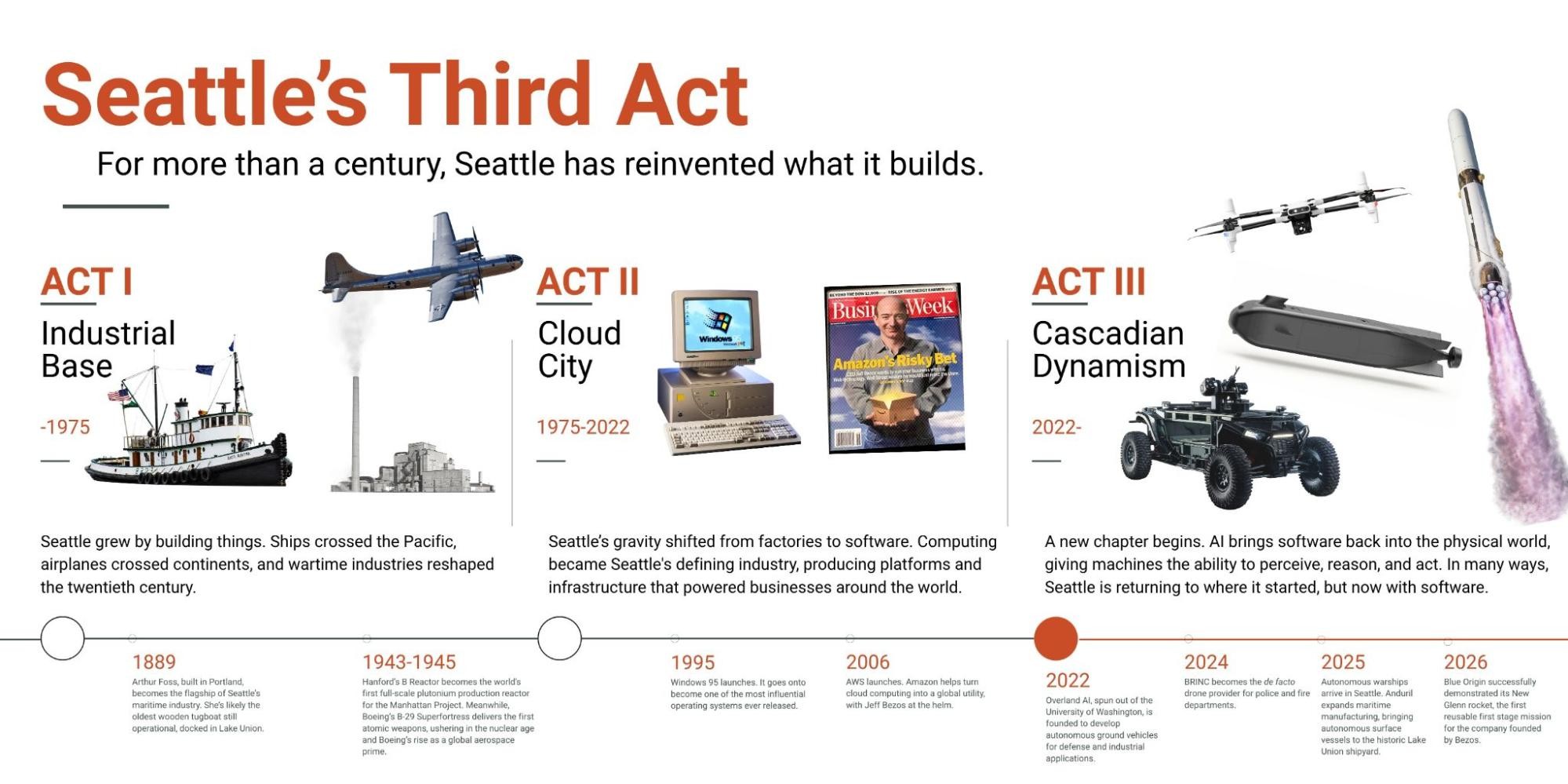
Some call this deep tech. We call it Seattle’s Third Act.
As Seattle-based venture capitalists, we have watched this shift up close, conversation by conversation, founder by founder, dollar by dollar. Out of those data points came a framework, one that we think holds the city’s past, present and future in three acts:
Act I: Maritime and aerospace. These industries taught the city how to build complex hardware and left behind the infrastructure to sustain it, from shipyards to airplane hangars.
Act II: Software and cloud computing. The industry that made the city an economic powerhouse and drew a quarter of the country’s AI engineers to Seattle.
Act III: Intelligent machines. The child of its two predecessors and what’s taking shape today: software-enabled hardware, conceived by the region’s world-class talent and built atop its unique physical infrastructure.
Across the national press and social feeds, the perception of Seattle in 2026 is not a positive one. Downtown office towers sit mostly empty while sweeping layoffs cut tens of thousands from the workforce. Policymakers passed tax legislation, hampering Big Tech and startups alike. And Starbucks, the hometown company, is leaving the hometown.
Despite the city’s sinking reputation as a place to do business, Seattle’s Third Act companies are continuing to double down on the region. Few places on earth hold all three of the ingredients these companies need: legacy industrial infrastructure, world-class AI talent, and deep manufacturing know-how.
Of course, those strengths carry a cost. High taxes and rising overhead mean any company that can grow without the full set has reason to leave — and many already have.
Pure software firms, free to operate from anywhere, drift toward cheaper hubs or the density of the Bay Area. Pure manufacturers, drawing little from the local engineering pool, get priced out by the overhead.
But for companies in robotics, energy, space, and defense, the calculus runs the other way. These are industries that demand all three of the region’s strengths at once, and so the tradeoffs are worth making.
Third Act companies grow in person, by recruiting and managing the best software and hardware talent under one roof. They also need things pure software never did: high-bay space with cranes and roll-up doors, freight and runway access through Sea-Tac and Paine Field, thousands of acres to run a vehicle hard, and protected ports that open to the high seas.
Don’t believe us? Just take a look at some of Seattle’s hottest startups right now:
Endurance Energy, the subsea geothermal startup, works out of a converted fishery on Lake Union, giving its team direct access to the water where they’ll test their first-of-its-kind power plant.
Overland AI, which builds autonomous off-road vehicles, keeps its headquarters in Fremont, manufactures in South Seattle, and tests across a hundred square miles of open terrain in central Washington.
Stoke Space, the reusable-rocket unicorn, co-locates its factory and headquarters in Kent while proving hardware at a 75-acre range in Moses Lake.
Perhaps the strongest vindication for Seattle’s Third Act appeal is the companies and leaders choosing to move here. Emergency response drone-maker Brinc relocated its headquarters from Las Vegas. Orbital data center startup Starcloud left El Segundo after its CEO, Philip Johnston, said “everyone we want to hire is in Redmond.”
Seattle has also cultivated a world-class nuclear ecosystem to match. Fusion pioneers Helion, Zap, and Avalanche have raised nearly $2 billion combined, while TerraPower has broken ground on a $4 billion next-generation fission reactor. Meanwhile, Zeno Power is opening a new factory to produce nuclear batteries.
The foundation for the Third Act is set, but having the raw ingredients is not the same as winning the future.
Taking the next step will require a greater appetite for risk. Young builders have to choose the uncertainty of an early-stage startup over the golden handcuffs of Big Tech. Investors have to write early checks for capital-intensive hardware that may take years to pay off. Founders have to build the culture Silicon Valley made second nature long ago, where resources are pooled, introductions traded, and learnings shared.
The rest falls to our elected officials. Third Act companies build in the physical world, and leaders who want to anchor the region’s economy for a generation have to clear the path. A founder shaping metal and code should spend their days on hard engineering, not on permitting lines, red tape, and taxes that chase ambition to friendlier states.
It seems that every week brings another round of grim economic headlines. This constant drumbeat does little to alter Seattle’s trajectory and a great deal to wear down the people who live here. Maybe what we need most is the promise of an ambitious new chapter worth building toward, rather than a decline to defend against.
The question GeekWire asked a year ago has an answer and an address — or, rather, several of them: a converted fishery on Lake Union, a factory floor in Kent, a proving ground in Monroe, a hundred square miles of central Washington scrubland with a driverless vehicle running hard across it.
Seattle’s superstar startups have been hiding in plain sight. Now, the rest of us have to mobilize behind them: investors writing the early checks, policymakers clearing the way, and founders willing to take the leap and build the next one here.
Consul General Prakash Gupta, left of the flagpole, joins elected officials, tech leaders and guests at the flag-raising for India’s 80th Independence Day in downtown Seattle on Aug. 15. (Consulate General of India Photo)
Note: Former Microsoft and AWS exec Harini Gokul serves on the Medina (Wash.) City Council.
Guest Opinion: Saturday, Aug. 15, was India’s 80th Independence Day. I marked it at the Indian Consulate in Seattle, at a celebration hosted by Consul General Prakash Gupta. The Indian American diaspora attended in full force, from community members to tech CEOs.
The event was open to the public, and the line to get in stretched over a block, a powerful, visible display of India’s economic success and soft power, right here in the Pacific Northwest.
But the more interesting story is not the celebration itself. It is who showed up to celebrate, and why.
Washington Gov. Bob Ferguson issued a statewide proclamation declaring Aug. 15 “India Day.” The mayors of Seattle, Bellevue, Kent, and SeaTac each signed their own municipal declarations, joined by the King County Council, which represents 39 cities across the region. U.S. Reps. Suzan DelBene and Marilyn Strickland sent official messages marking the occasion.
In person, state Sen. Tina Orwall was joined by the mayors of Redmond and Kent, alongside council members from cities including Redmond, Bothell, DuPont, and Medina.
In King County alone, more than 100,000 residents are of Indian origin; statewide, the figure is roughly 200,000. In cities like Redmond and Kent, the Indian American community makes up a meaningful share of the tax base, the school population, and the local business community.
This is one of the reasons elected officials are showing up. Because their Indian American communities are central to their growth story, a constituency whose economic and civic weight has become too significant to ignore.
This momentum has been building in the region for decades. What has changed is the altitude. The same talent pool that once filled engineering organizations is now filling CEO offices, board seats, and, in smaller but growing numbers, elected office.
Business success is turning into civic and cultural presence. Many of our Indian American leaders started in tech. Satya Nadella has run Microsoft since 2014. Anand Eswaran has led Veeam since 2021. Srini Gopalan became CEO of T-Mobile in November 2025.
And increasingly, this leadership is branching out. You see the impact in venture capital, through investors like the late S. “Soma” Somasegar, who moved from Microsoft to Madrona; and in culture, through the Seattle Orcas cricket franchise, launched in 2023 by an investor group including Soma, Satya, Sanjay Parthasarathy, Samir Bodas, and Ashok Krishnamurthi to grow the sport nationally.
With the change in demographics, civic influence is increasing as well. Redmond, Kent, and Bothell all elected Indian-origin council members in the most recent cycle. I represent the trend myself, now serving in my second term as a city council member for Medina, Wash.
My story is an all too familiar one. I came to the U.S. as an engineer two decades ago and grew up alongside this region’s hyperscalers, first at Microsoft, then Amazon. Today I sit on corporate boards and work across private equity and venture, and I have the honor to represent the city I live in. I am one small example of how we are scaling our impact and giving back to our adopted home.
Eighty years after India’s independence, the story of its diaspora in our state has moved well past individual success stories. It’s measurable now, at scale, in the leadership of some of the most important companies in the state, and in its growing influence across culture, economics, and politics.
This is why everyone from the governor’s office to city halls across Washington has decided this partnership is worth investing in and worth showing up for.
From left: Ryan Burns of Responsible AI Washington, Amy Harris of the Washington Technology Industry Association, Yuki Ishizuka of the Washington Attorney General’s Office, and Katy Ruckle of Washington Technology Solutions, at Wednesday’s panel on the state AI task force’s final report. (GeekWire Photo / Grace Kaste)
Members of Washington’s AI task force point to the state’s new AI regulations as evidence that regulation and innovation can coexist, but a panel discussion this week marking the end of their two-year effort showed just how unsettled the core issues remain.
The task force is caught between consumer and labor groups calling for more extensive guardrails, and tech industry representatives concerned about compliance costs, exposing the tension between the demands of the fast-moving AI industry and the risks the technology poses to individuals.
That came to the fore at a panel on Wednesday, held at the Seattle startup incubator AI House, where task force members faced an unusual mix of people: an audience of AI startup founders, plus a roster of pro-regulation experts representing the legal, labor, and consumer protection fields.
Panelists were there to discuss the task force’s final report, which recommended AI regulations to the state legislature. Four of the eleven recommendations were adopted, in part or in full, and passed into law this spring.
“We are here today to see how much of this sentiment — that Washington does not have to choose between embracing innovation and protecting people — comes out in the content of the report,” said Ryan Burns, co-founder of Responsible AI Washington, who moderated the panel.
That line has become a refrain for AI regulators in Washington. Gov. Bob Ferguson, then the state’s attorney general, requested the legislation creating the task force in 2024. He appointed representatives from government, labor, academia, and the tech industry, directing them to explore how AI could be “regulated without stymieing innovation.”
In the final report, published in July 2026, Attorney General Nick Brown wrote that the task force had “made clear” that the two priorities could coexist, despite the federal government’s pro-innovation agenda. But Wednesday’s event showed that might not be so simple.
Narrow regulations passed
Washington passed its first AI regulations this spring, including a requirement that companion chatbots remind users that the bots are not human and another that prohibits medical insurers from denying a patient coverage solely on the basis of an assessment made by AI. For Burns, the laws that did not pass were more telling.
“It did strike me as meaningful that the recommendations that have been adopted pertained to narrower application areas,” Burns said. “The recommendations that have not yet passed were a lot bigger.”
One of those recommendations was to regulate the use of AI for high-risk decision making, meaning applications of AI to hiring processes, algorithmic pricing, criminal justice, and healthcare. A similar law has passed in states such as New York, Connecticut, Illinois, California, and Colorado, but the Washington bill died before reaching a floor vote in either chamber.
The task force’s recommendation to require AI developers to disclose the datasets they are using to train their models, as California does, also died, as did a third recommendation to develop guidelines for the use of AI in the workplace.
In an interview with GeekWire, state Rep. Mia Gregerson, who sponsored some of the comprehensive bills, said she appreciated the work of the task force but maintained that there is much more work to be done.
“We are a tech heavy state, so we have an even bigger responsibility to do good work to catch up to what other states are doing,” Gregerson said. “We are so behind.”
On Wednesday, panelists said broader AI regulations failed in part because they drew less interest from the public.
“What passed in the legislature was more sector specific things where the consumer harm was more clear, and I think that’s a product of political dynamics,” said Yuki Ishizuka, technology policy manager for the Washington State Attorney General’s Office. “It’s harder to connect broader governance or transparency bills to harm to people.”
Broad AI regulations also faced heightened opposition from the tech industry, where a patchwork of state regulations means higher legal fees. At task force meetings, which were open to the public, representatives from the tech industry opposed regulations around AI development that would add “procedural hoops.”
Cost of compliance
Concern about overregulation was echoed by attendees of the event, the majority of whom were founders of small AI startups.
When it came time for the Q&A, multiple audience members asked the task force to consider the financial burden for small startups of complying with complicated state regulations.
The distinction between big tech and startups has become a refrain for AI House, where entrepreneurs met with U.S. Sen. Patty Murray last month to discuss the nuances of AI regulation for so-called “small tech.”
“As these recommendations turn into policy, it’s important that startup founders are part of the conversation,” AI House Managing Director Jacob Colker told GeekWire. “A five-person startup doesn’t have the same legal, compliance, or policy capacity as a trillion-dollar company.”
But Jai Jaisimha, co-founder of a pro-regulation organization called the Transparency Coalition and a former startup founder himself, cautioned against creating legal carve outs for certain AI developers.
“Arguing that you’re exempt because it’s too much data to disclose, or it’s a trade secret, those arguments send a sign that normal software development and governance does not apply to AI,” Jaisimha said. “Disclosure and consumer protection, these are standard practices in other industries.”
While the bills that would have been most costly for developers to comply with did not pass into law, those that did will still create significant legal consequences for AI developers who don’t abide by them.
Panelist and technology law expert Ryan Calo, a University of Washington law professor who was not a member of the task force, said the state’s new companion chatbot law will be “blood in the water for the plaintiffs’ bar” for two separate reasons.
First, any failure to comply could now be treated by the courts as “negligence per se,” meaning that the plaintiff will not have to show broader negligence but will simply have to show that the defendant violated the law.
Second, any failure to follow these regulations is deemed an unfair or deceptive act under Washington’s Consumer Protection Act, giving consumers a private right of action and exposing developers to higher financial penalties.
The question for the tech industry will be about where the state’s attorney general will prioritize enforcement.
“The AG has a lot of power, but not enough to bring every violation of the law. So you have to think of the Eye of Sauron, and whether it will focus on you. If you’re a little startup, probably not, but if you’re Meta, probably yes,” Calo said.
Future AI regulation
As Washington state prepares to implement its new regulations this January, regulators are bracing for backlash from the federal government.
A December executive order from the Trump administration called on Congress to pass a “minimally-burdensome” AI policy preempting state laws, created an AI Litigation Task Force to challenge state laws that don’t “sustain and enhance the United States’ global AI dominance,” and threatened to cut broadband funding to those states. It named Colorado, which enacted the first comprehensive state AI law in 2024.
Federal preemption would require Congress to pass AI regulation of its own, which it has yet to do, but Trump’s order still seems to be having an effect.
This spring, Colorado repealed its AI regulation and replaced it with a more conciliatory law.
In Virginia, where no AI regulations have gained traction, legislators pointed to the federal government’s threats.
And in Utah, lawmakers withdrew a bill to regulate frontier models after the Trump administration sent them a memo criticizing it for “opposing the federal government’s agenda,” according to Politico.
“We believe that, if the federal government is going to act, they should act with meaningful AI regulation, and should not preempt the state’s ability to protect its citizens,” said Ishizuka of the Washington state AG’s office.
The federal pressure has not stopped some leaders from calling for far-reaching regulation. Some members of Wednesday’s second panel, which was made up of representatives from labor, academia, and consumers from outside the task force, proposed redistribution: Future AI regulation should reallocate the profits made by developers to pay for AI’s impending costs, such as cybersecurity improvements, worker retraining, and updates to school curricula.
“My worry is that there is going to be a lot of money being made, and I really think that bill should go to the people that are making a lot of money off of it,” Calo said. “I’m not sure that all of the [task force’s] recommendations directly address that redistribution element.”
Some state lawmakers are ready to address it. Gregerson, whose district includes SeaTac Airport and whose constituency includes many Uber drivers, told GeekWire she hopes to allocate state funds for retraining rideshare drivers who are replaced by autonomous vehicles.
State Rep. Clyde Shavers, who was not present at Wednesday’s panel but was a member of the task force, has said he wants to spend the next session establishing liability frameworks for AI-related harm.
Now that the report has been published, the task force will be disbanded, but the work will continue at the Attorney General’s Office, where a new Tech Policy Team will be led by Ishizuka.
“With the completion of the task force’s work, there is strong interest in the AG’s office to continue to focus on AI policy,” Ishizuka said. “We’ll look at emerging technologies and bring in outside expertise so that there is informed regulation.”
Viet Nguyen in his Seattle home office, with two of the civic sites he built using AI: Culliton2026.org on the monitor and a dashboard on the King County homelessness authority on the laptop. (GeekWire Photo / Todd Bishop)
The tradition of using new technology to shape political discourse goes back centuries in America, to the printing presses that enabled the spread of early publications like Common Sense and the Federalist Papers. Just imagine what Thomas Paine and Alexander Hamilton could have done with access to LLMs and a modest budget of AI tokens.
No, a website that uses artificial intelligence to assess Washington state’s Supreme Court races won’t go down in history alongside the publications that helped launch a revolution and ratify a constitution. But at a basic level, its creator is attempting the same thing: reaching people at a key moment of decision, using the most powerful tools of the day.
The modern-day pamphleteer is Viet Nguyen, a veteran Seattle-based technology communications executive and former political campaign manager.
He built the interactive website using AI to give voters a sense of how each candidate for the state’s high court — starting with those in the Tuesday, Aug. 4, primary — might rule on the state’s new “millionaires’ tax.” Its core feature lets visitors swap in different judicial candidates to see how the outcome could tip the court in either direction, depending on who’s elected.
The site is named after Culliton v. Chase, the 1933 ruling that struck down a graduated income tax in Washington state. The new tax, which some tech and business leaders have warned could drive high earners and businesses out of state, may test that precedent.
Nguyen opposes the new tax — which would apply a 9.9% statewide levy on income above $1 million — and wrote a Seattle Times op-ed calling it unconstitutional. (He noted that he has run political campaigns on both sides of the aisle, and wouldn’t owe the tax himself.)
The home page of Culliton2026.org, Viet Nguyen’s AI-built voter guide to the 2026 Washington Supreme Court races.
For each of the 16 candidates across the five races, the site gives a one-line read: likely to keep the landmark ruling, likely to scrap it, or too close to call. The analysis uses four criteria: who appointed the candidate, what they did before reaching the bench, how they describe their own judicial approach, and anything they’ve said or written about Culliton or the new tax.
“People don’t understand who their Supreme Court justices are,” Nguyen said, describing his motivation. “There’s just zero knowledge about where judges stand on a particular issue.”
A faulty premise? But that very proposition — that anyone or anything can forecast how a judge will rule — is exactly what critics dispute. In a fact-check published last week, Andrew Villeneuve of the Northwest Progressive Institute (NPI), which supports the tax, described Nguyen’s Culliton2026.org as “speculation dressed up as a voter’s guide.”
Judicial-ethics rules bar candidates from saying how they would rule on a case that could come before them. Hugh Spitzer, a retired University of Washington law professor and a leading authority on Culliton, told Villeneuve it isn’t possible to predict how the justices would rule.
“Rather than examining and scoring the candidates on a rubric of qualifications or issues, Nguyen has organized his whole project around attempting to guess how each candidate would rule in a single legal challenge that is not yet before the justices,” wrote Villeneuve, the organization’s founder and executive director, in the article.
NPI runs its own guide to the 2026 Supreme Court elections — the Washington State Supreme Court Elections Visualizer — which sorts candidates by their endorsements and voter-pamphlet statements, but does not make any guess at how they’d rule.
Culliton2026.org is described on its About Page as independent and nonpartisan. It says it doesn’t endorse candidates, isn’t affiliated with any campaign, and isn’t telling people how to vote.
Despite the site’s flagship feature — the “Balance of power” tool that lets visitors swap in candidates and watch the projected ruling shift — the About Page asserts that the site is “not a vote predictor” when it comes to how future Supreme Court justices might rule.
That disclaimer “seems like a tacit acknowledgment that his whole premise is faulty,” Villeneuve wrote in the NPI piece.
The response: Asked about the article, Nguyen called the feedback helpful and said he made a series of updates to address some of the issues raised by Villeneuve in the piece.
For example, he added a “note on the foundations” to the site’s case explainer, granting that Culliton rests on federal precedents the U.S. Supreme Court has since abandoned, and citing Spitzer’s own argument that a future court should weigh the question fresh.
“Reasonable people will disagree on the project’s premise, and that’s fine,” he wrote to Villeneuve in an amicable exchange that he shared with GeekWire.
The article describes Nguyen as right-wing, but he said he tries to stay “in the moderate lane.”
He said he wanted the site “to be less political and more educational, applicable to any voter wishing to know more about the judicial candidates.” In fact, it could be used just as easily by people wanting to align their ballots with the likelihood of upholding the new tax.
How he built it: Nguyen, who is not a software developer, used agentic AI to research the public records and build the entire site from scratch, directing it to rely on sources he considered legitimate (including court opinions, official filings, and news coverage) rather than random blog or Reddit posts.
He also set up a vetting process to fact-check entries before publication.
Nguyen uses Perplexity Computer, an agentic tool that operates a computer on its own (browsing the web, using software and building files) and divides a job among multiple AI agents working in parallel. He’s on the $200 a month Perplexity Max plan.
A sophisticated website or app like this might have required a small team and thousands of dollars in the past. Nguyen built it over the course of a few hours, for about $100 in AI tokens. He says it has attracted “a few hundred thousand page views” since its launch this spring.
“This is where agentic AI steps in and offers a whole roster of skills that I don’t have,” he said. “I would never be able to imagine that I could put something like this together.”
Legal landscape: The Legislature passed the 9.9% tax and Gov. Bob Ferguson signed it in March 2026. It applies to income earned starting in 2028, with the first payments due in 2029.
Culliton2026.org’s assessment is that six of the nine current justices on the court lean toward upholding the tax, two toward striking it down, and one is too uncertain to call.
Five of the court’s nine seats are on the ballot this year, four of them contested in Tuesday’s primary, with the top two in each race advancing to November. Three of the seats on the ballot are held by sitting justices seeking to stay on the court; the other two are open.
A case filed in Klickitat County Superior Court in April, led by former state Attorney General Rob McKenna and former state Supreme Court Justice Phil Talmadge, argues the tax is an unconstitutional income tax and is expected to reach the state Supreme Court. The number of contested seats means the election could reshape the court before the case arrives.
Voters will also weigh in directly in November. Initiative 645, backed by Let’s Go Washington — the group founded by hedge-fund manager Brian Heywood — would repeal the tax before it takes effect in 2028. It qualified for the ballot in July with more than 500,000 signatures.
Nguyen’s background: He arrived in Washington as a 17-month-old refugee from Vietnam in 1975, studied political science at the UW, and got his start in 1996 volunteering on Gary Locke’s campaign for governor, as he noted in the Seattle Times piece.
He ran local races before spending nearly two decades at Microsoft, T-Mobile and 5G Americas, the wireless industry trade group that he led until it wound down this year.
Culliton2026.org is just one of the civic sites Nguyen has built the same way. His Washington Accountability Registry catalogs 87 state and local government cases it labels fraud, conflicts of interest or oversight failures, and, like the Culliton site, calls itself independent and nonpartisan.
Others are more explicit in taking a side: a dashboard about the King County homelessness authority is headlined “One verdict: wind KCRHA down,” and an emergency-clause tracker titled “Locked Out” flags 19 bills the Legislature made “referendum-proof.”
He has also dabbled in AI-generated music videos, including one about Seattle Mayor Katie Wilson with the hook, “Hey Katie, get it together, the city’s falling apart.”
“All AI generated,” Nguyen said of his projects. “We live in a new world.”
Or, as Paine put it in Common Sense, “The birthday of a new world is at hand.”

 Login
Login