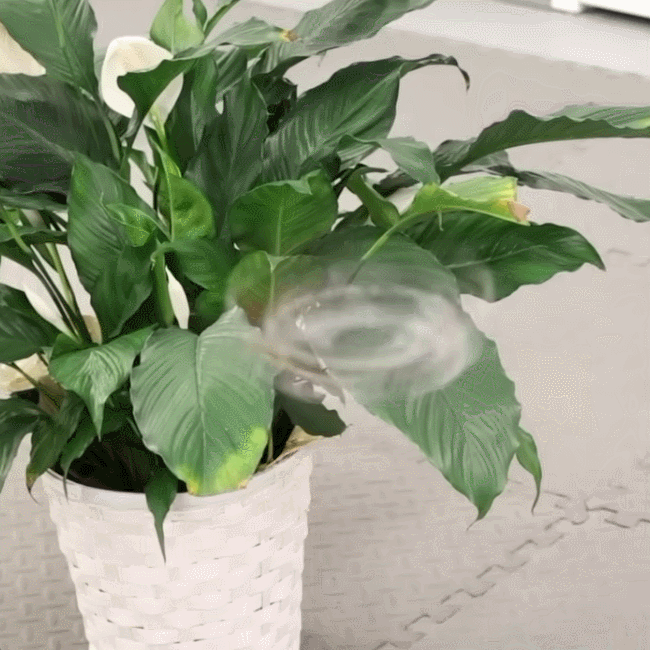
Researchers demonstrate that something interesting happens when a small drone with a spindly airframe spins at a high speed: it very nearly turns invisible. The spidery device is shown mounted in its launcher in the image above. The dark blur at the rightmost side is an outlet on the wall behind the drone, not motion blur from a moving part.
There’s not much to do about the noise, but a high-speed spin becomes nearly invisible.
There’s not a lot of detail about the Phantom Twist’s hardware design but it appears to use a downward-angled motor for lift, relying on a high-speed control system to maneuver and maintain altitude.
This does away with the need for a wing, at the cost of only being stable while rotating at a high speed. We imagine it is also a touchy design that depends greatly on being balanced just so.
A hand launcher spins the device up before releasing it for flight. The visual effect once it is up and running is pretty striking; see for yourself in the short video, embedded just below.
An unmanned fighter jet just fired a live air-to-air missile at a target over the California desert, and a human sitting somewhere else gave the order to pull the trigger. The Department of the Air Force confirmed that a YFQ-44A Collaborative Combat Aircraft, the service’s designation for a new class of autonomous fighter drones built […]
Somewhere on the flight deck of a future U.S. aircraft carrier, a jet could be preparing to launch into contested airspace nearly 1,900 kilometers (1,151 miles) away, refuel itself mid-flight if needed, evade enemy threats, and strike a target, all without a single pilot strapped inside the cockpit. That’s the future the U.S. Navy just […]
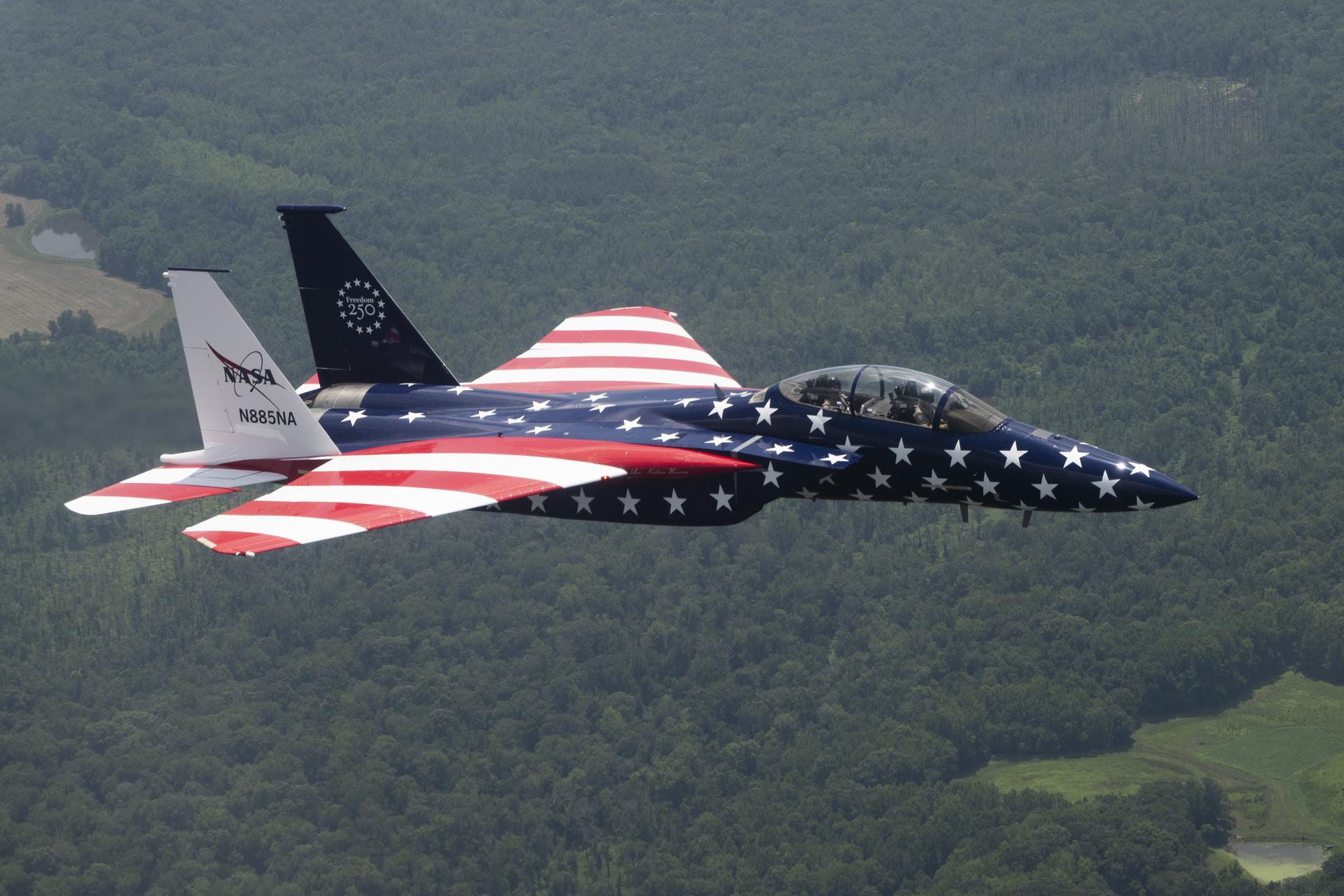
A NASA F-15 aircraft flies above Washington on Saturday, July 4, 2026, as part of a flyover to celebrate America’s 250th birthday. This aircraft is from NASA’s Armstrong Flight Research Center in Edwards, California, and it joined other NASA aircraft for the flyover.
NASA/Jim Ross
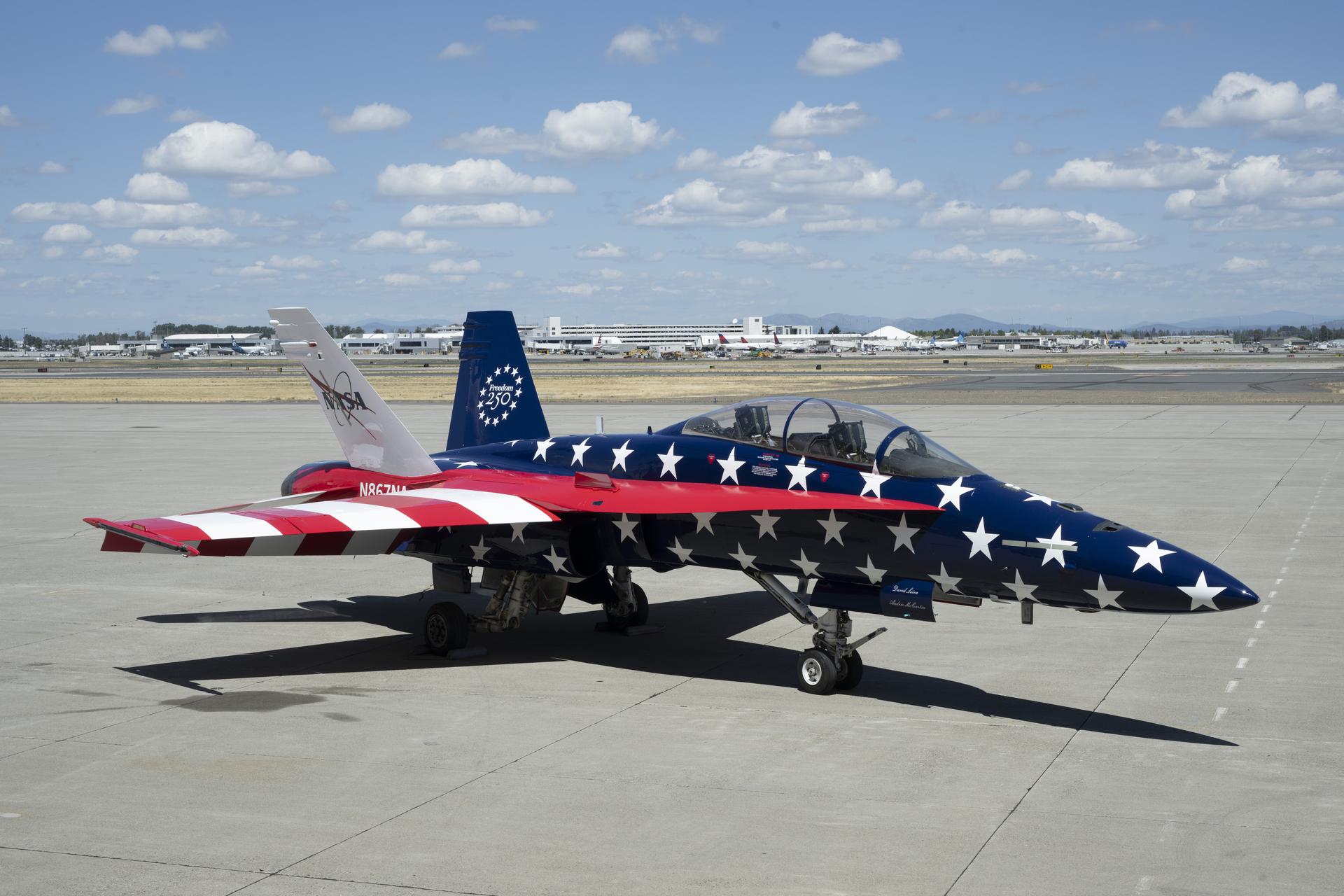
In honor of America’s 250th birthday, two of NASA’s most iconic aircraft got a fresh coat of red, white, and blue paint ahead of a flyover in Washington on July 4, 2026, with other NASA aircraft.
An F-15 and an F/A-18 from NASA’s Armstrong Flight Research Center in Edwards, California, recently were repainted in patriotic colors as a tribute to the past and a salute to the future.
The red, white, and blue commemorative paint and Freedom 250 logo will remain on these aircraft for at least the next year, so be sure to catch these at local air shows and events.
Follow along on social media and at https://www.nasa.gov/freedom250/ to learn more about where to spot the aircraft (dependent upon availability and flying schedules):
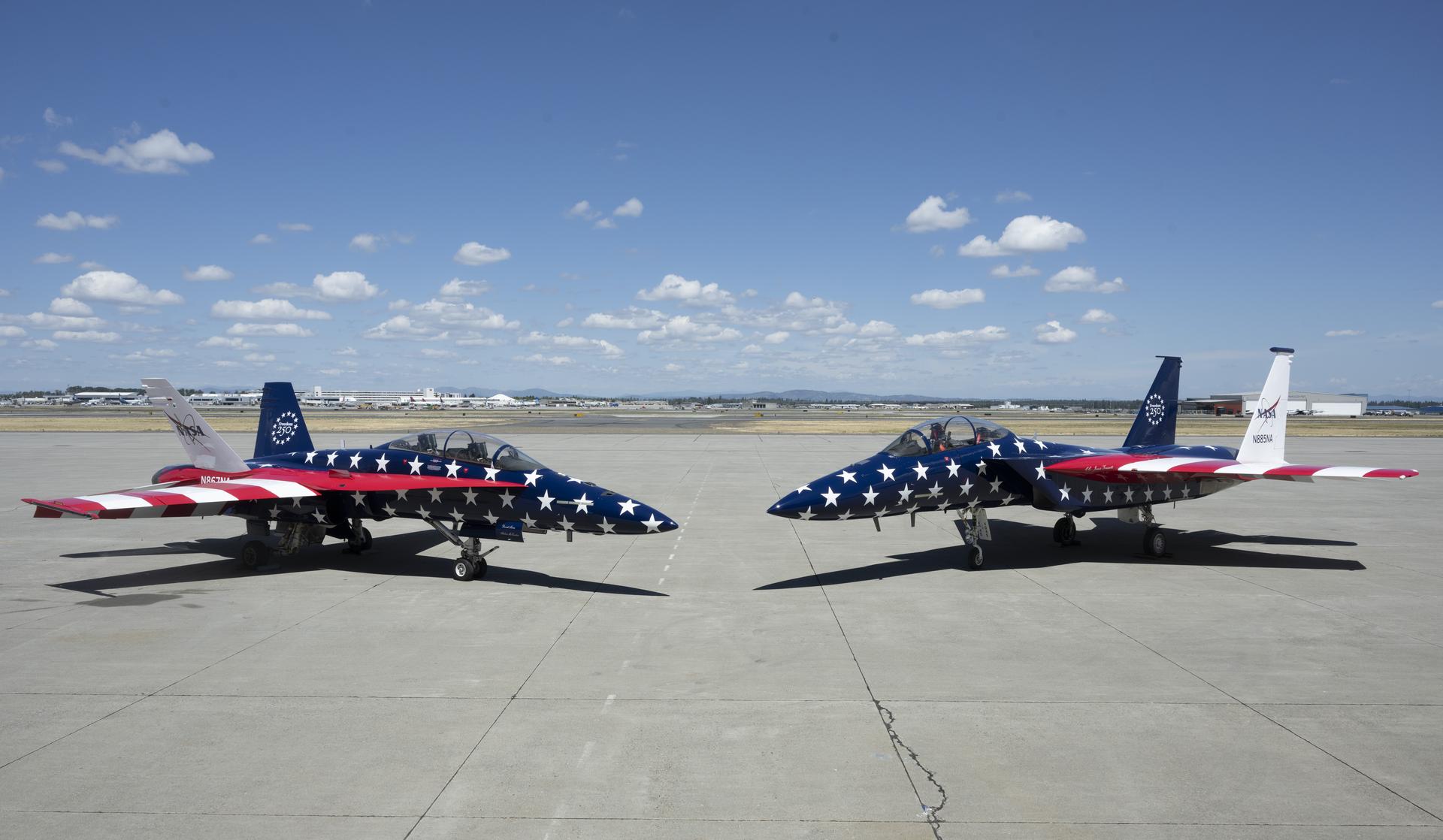
NASA’s F-15, right, and F/A-18 aircraft are shown at International Aerospace Coatings Inc.’s facility in Spokane, Washington, on Thursday, July 2, 2026, with new red, white, and blue paint to celebrate America’s 250th birthday. The aircraft, from NASA’s Armstrong Flight Research Center in Edwards, California, participated in the Freedom 250 flyover in Washington on Saturday, July 4, 2026, with other NASA and military aircraft. NASA/Jim Ross
NASA/Jim Ross
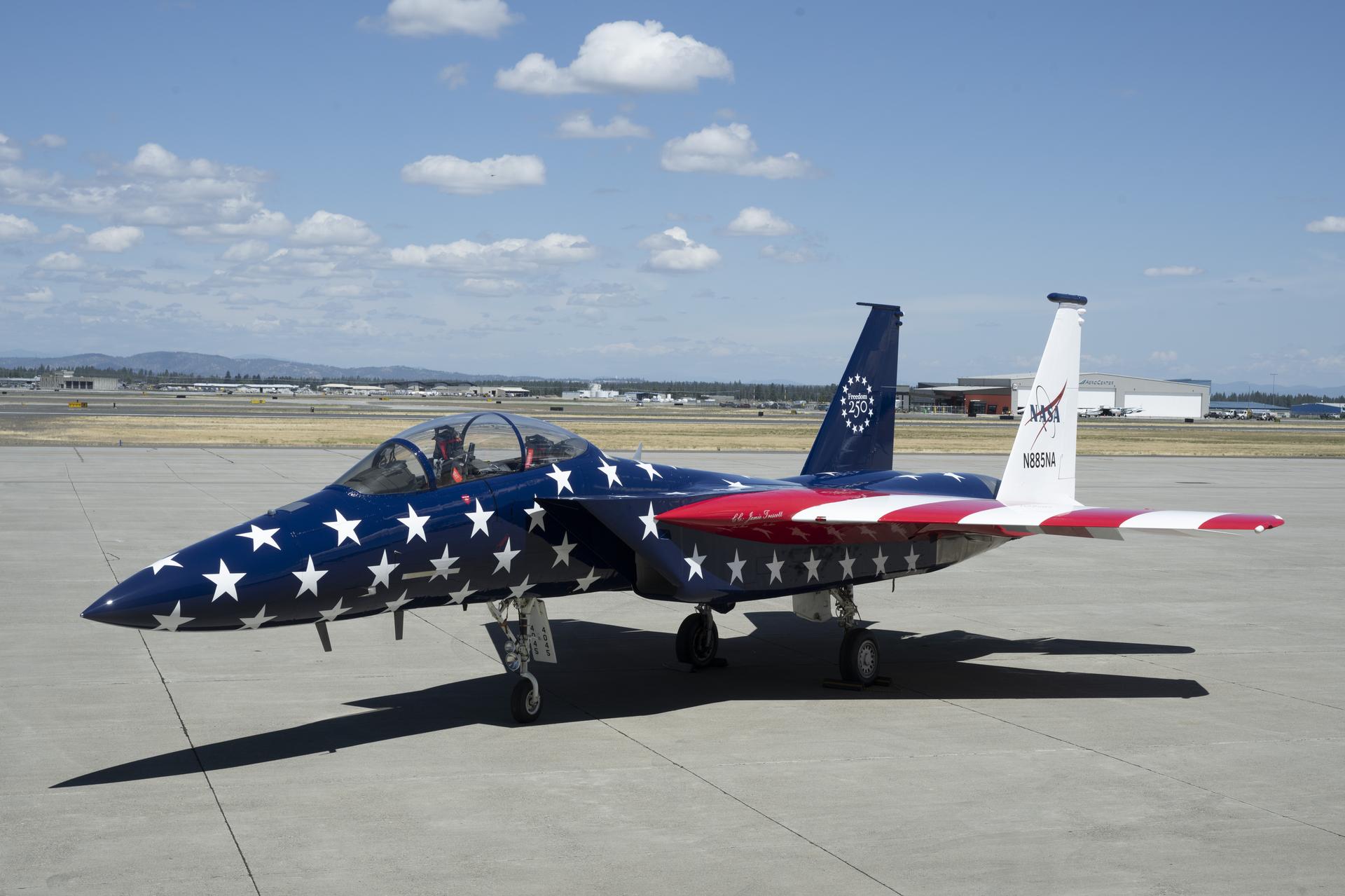
NASA’s F-15 aircraft is shown at International Aerospace Coatings Inc.’s facility in Spokane, Washington, on Thursday, July 2, 2026, with new red, white, and blue paint to celebrate America’s 250th birthday. The aircraft, from NASA’s Armstrong Flight Research Center in Edwards, California, participated in the Freedom 250 flyover in Washington on Saturday, July 4, 2026, with other NASA and military aircraft. NASA/Jim Ross
NASA/Jim Ross
NASA’s F-18 aircraft is shown at International Aerospace Coatings Inc.’s facility in Spokane, Washington, on Thursday, July 2, 2026, with new red, white, and blue paint to celebrate America’s 250th birthday. The aircraft, from NASA’s Armstrong Flight Research Center in Edwards, California, participated in the Freedom 250 flyover in Washington on Saturday, July 4, 2026, with other NASA and military aircraft. NASA/Jim Ross
NASA’s X-59 has reached 924 mph and 55,000 feet, bringing the agency closer to proving that future supersonic passenger flights can avoid thunderous sonic booms.
Preparations for Next Moonwalk Simulations Underway (and Underwater)
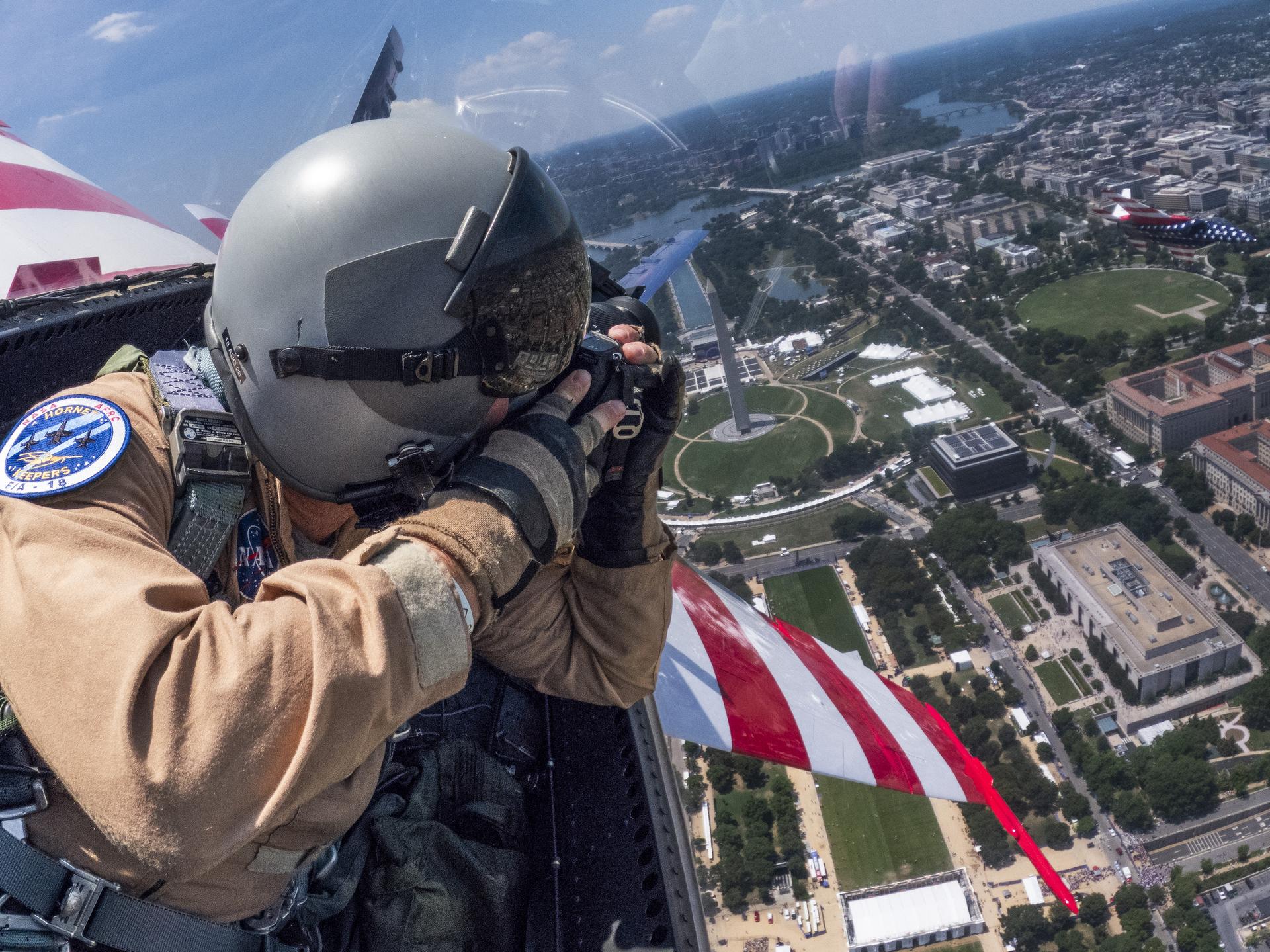
NASA photographer Jim Ross flies above the Washington Monument in Washington on Saturday, July 4, 2026, in an F-18 aircraft, as part of a flyover to celebrate America’s 250th birthday. This aircraft is from NASA’s Armstrong Flight Research Center in Edwards, California, and it joined other NASA aircraft for the flyover.
NASA/Jim Ross
NASA flight photographers capture history from a perspective few ever experience, getting a rare bird’s-eye view of the agency’s missions in action. Their photos document key NASA research and give the public a front-row seat to the work happening behind the scenes.
Jim Ross, a photographer at NASA’s Armstrong Flight Research Center in Edwards, California, flew over Washington during the Fourth of July celebration to document a NASA flyover commemorating America’s 250th birthday. He’s captured some of the agency’s most exhilarating milestones, like early SR-71 flights, the delivery flight of Space Shuttle Endeavour to Los Angeles, and first flights of NASA’s X-59 quiet supersonic research aircraft.
“I grew up in Bozeman, Montana, when it was still considered a small town, so if someone told that little kid that he would be flying in a F-18 over the National Mall, he would have never believed it,” Ross said. “I love documenting history, and having the opportunity to capture flights and launches has kept me doing it for almost 37 years.”
Ross began his aviation photography career in 1989 when he joined the staff at NASA Armstrong (then Dryden). He became the photo lead in 1997, a title he retains.
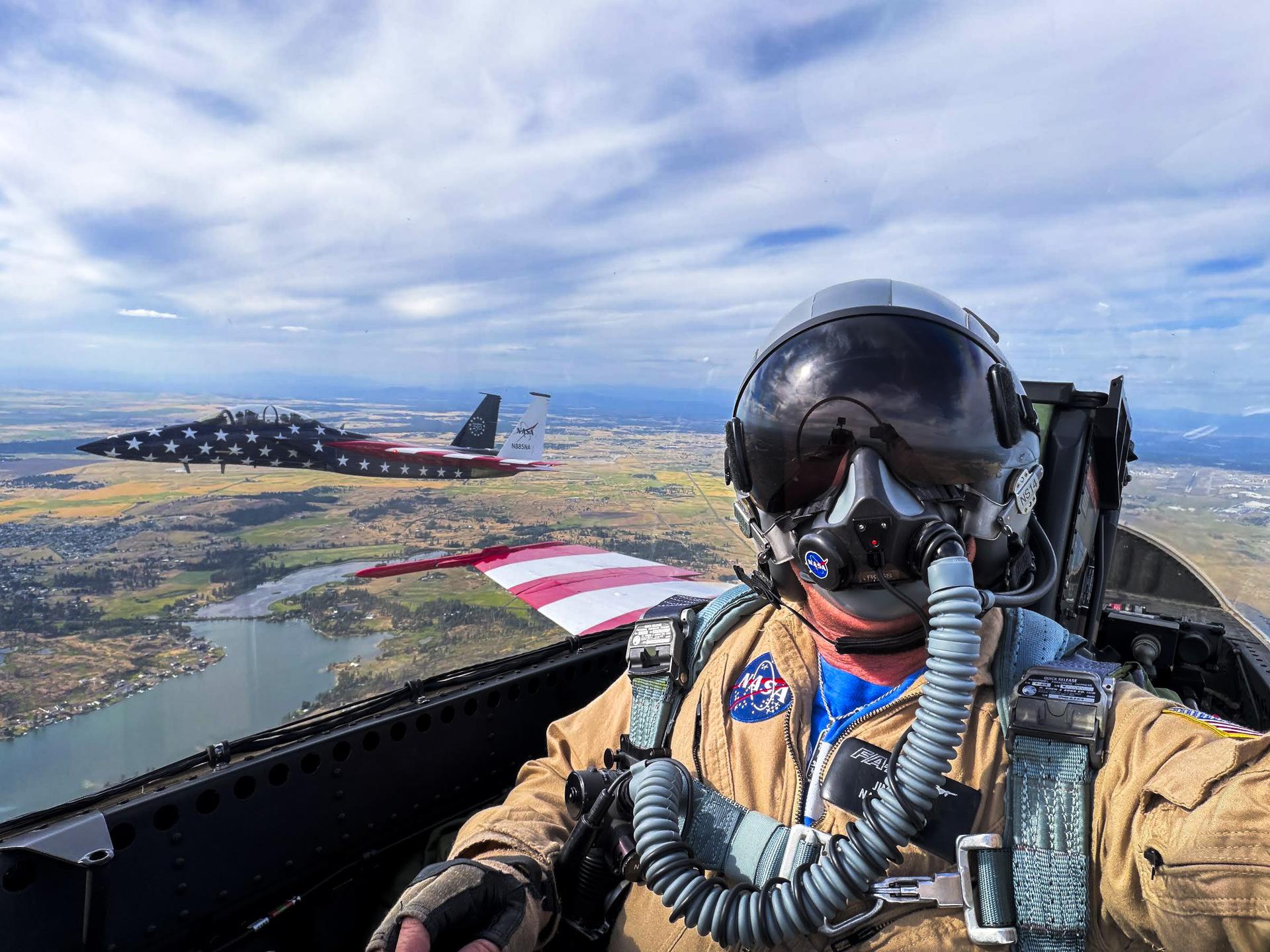
NASA photographer Jim Ross takes a selfie from the rear seat of a NASA F/A‑18 during a cross‑country flight from Spokane, Washington, to Washington, D.C., on Thursday, July 2, 2026. The agency’s F‑15, flying alongside the aircraft, is visible through the window. Both aircraft, from NASA’s Armstrong Flight Research Center in Edwards, California, participated in the Freedom 250 flyover with other NASA and military aircraft on Saturday, July 4, 2026.
NASA/Jim Ross
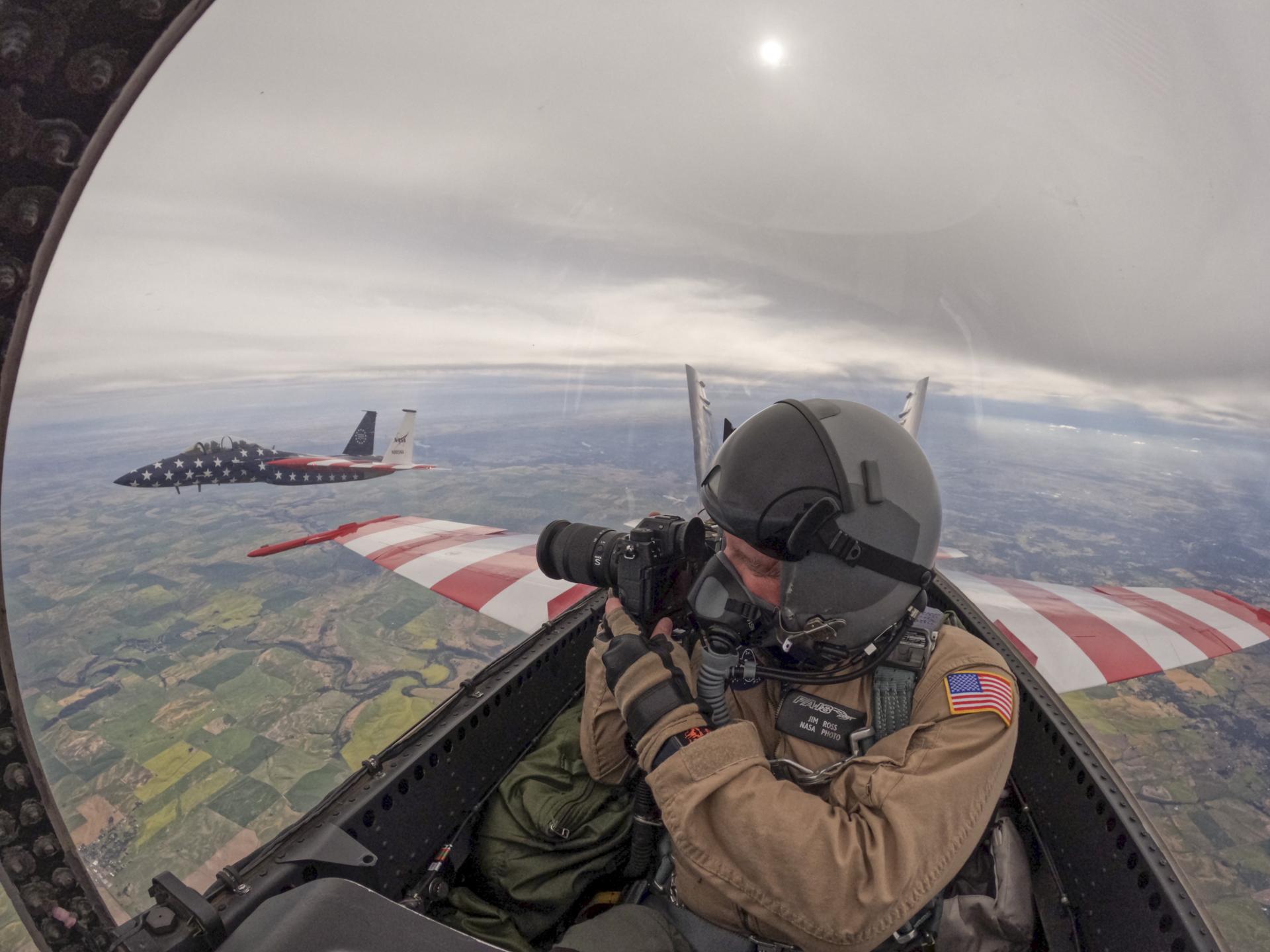
NASA photographer Jim Ross flies above Washington on Saturday, July 4, 2026, in an F-18 aircraft, as part of a flyover to celebrate America’s 250th birthday. This aircraft is from NASA’s Armstrong Flight Research Center in Edwards, California, and it joined other NASA aircraft for the flyover. A NASA F-15 is seen flying to the side of the NASA F-18.
Preparations for Next Moonwalk Simulations Underway (and Underwater)
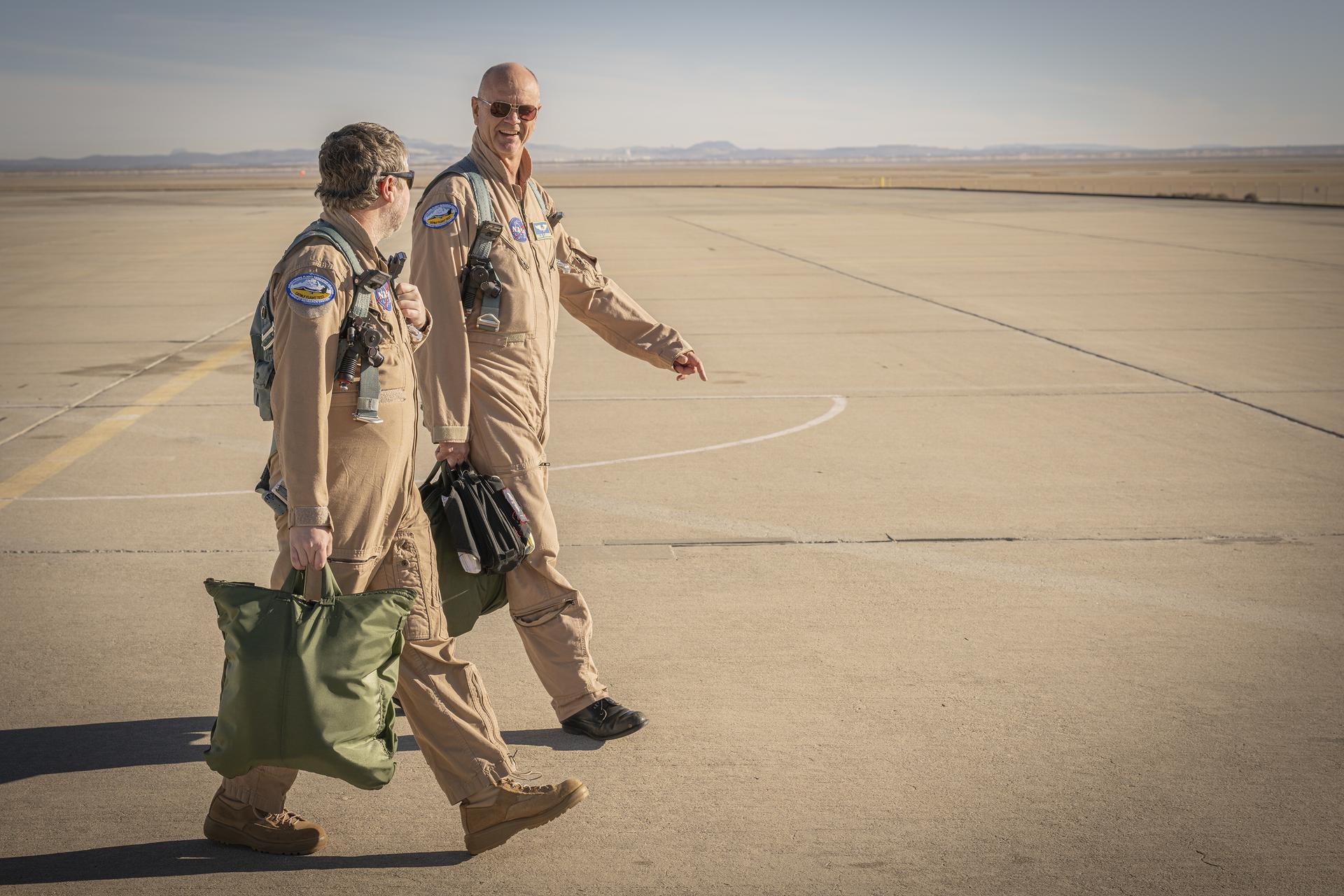
NASA flight test engineer A.J. Jaffe and pilot Nils Larson walk on the ramp before a flight Tuesday, Jan. 13, 2026, at NASA’s Armstrong Flight Research Center in Edwards, California. The two support the agency’s Crossflow Attenuated Natural Laminar Flow (CATNLF) project, which aims to lower fuel costs for future commercial aircraft by testing a scale-model wing designed to improve laminar flow.
NASA/Christopher LC Clark
Flight testing is a team sport. For nearly 80 years, teams at NASA’s Armstrong Flight Research Center in Edwards, California, have used flight testing to push the limits of aerodynamics and advance aviation.
Earlier this year, NASA’s Crossflow Attenuated Natural Laminar Flow (CATNLF) initiative tested a wing concept that would maximize the smooth flow of air known as laminar flow, which could lower fuel costs for future airliners. During flight testing, researchers strapped a scale-model CATNLF wing to the bottom of a NASA F-15 aircraft.
Here’s what a day of CATNLF flight testing looked like.
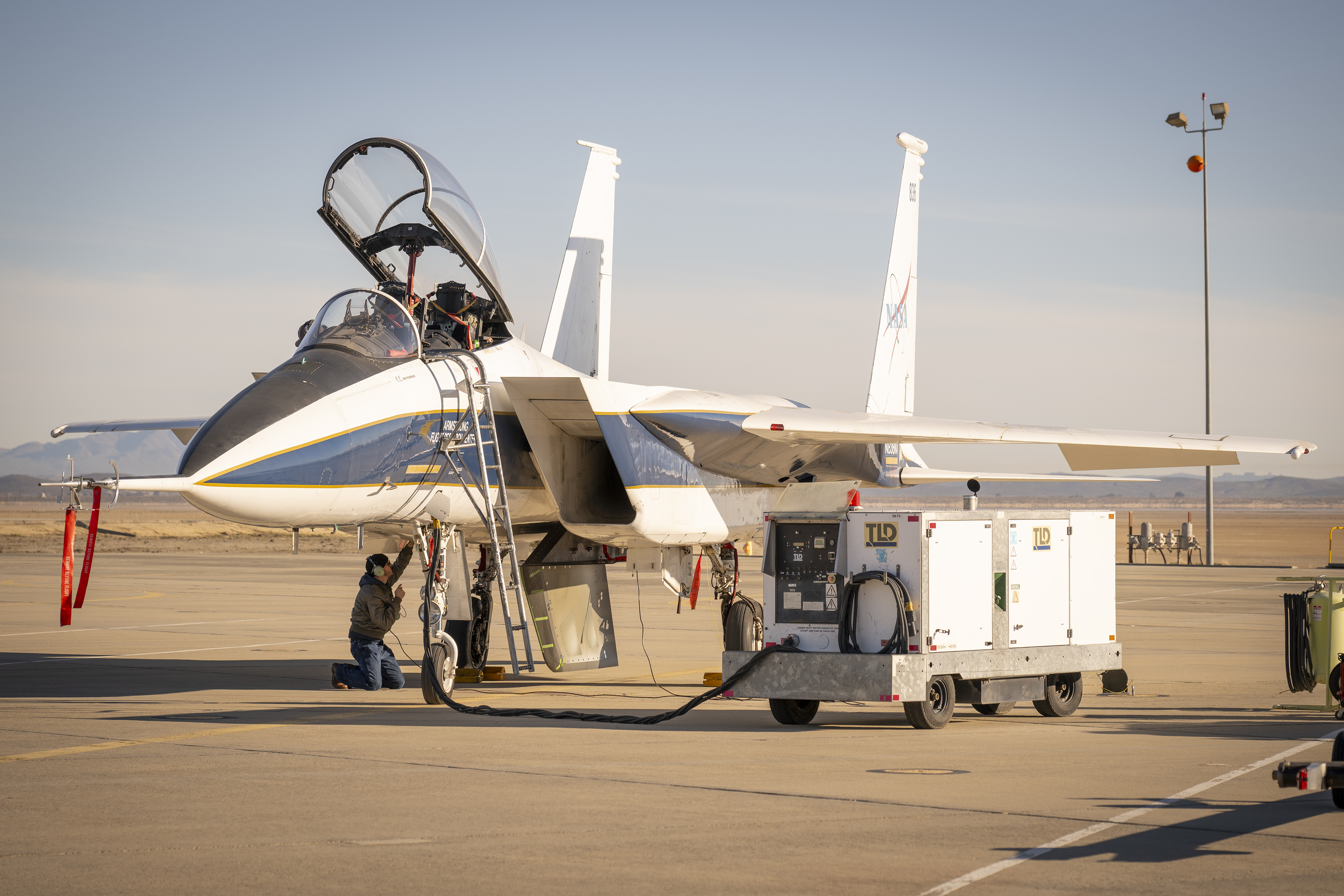
NASA ground crew prepares the agency’s F-15 research aircraft and Cross Flow Attenuated Natural Laminar Flow (CATNLF) test article ahead of its first high-speed taxi test on Tuesday, Jan. 12, 2026, at NASA’s Armstrong Flight Research Center in Edwards, California. The CATNLF design aims to reduce drag on wing surfaces to improve efficiency and, in turn, reduce fuel burn.
NASA/Christopher LC Clark
5 a.m. — Aircraft staging
Ground crews ready the aircraft for the mission. If the operation involves a chase plane — a second aircraft to monitor the test flight — it would also be prepared, along with its crew.
6 a.m. — Crew brief
Pilots, engineers, maintenance techs, project leads, researchers, photographers, and videographers meet to review the flight’s goals, weather reports, and final details.
NASA researchers Mike Frederick, right, and Michelle Banchy, left, along with Ashante Jordan and intern Phillip Nguyen, sit in a control room and prepare for a flight test Thursday, Jan. 29, 2026, at NASA’s Armstrong Flight Research Center in Edwards, California. The agency’s Crossflow Attenuated Natural Laminar Flow (CATNLF) project aims to lower fuel costs for future commercial aircraft by testing a scale-model wing designed to improve laminar flow.
NASA/Christopher LC Clark
6:30 a.m. — Control room checks, air crew suit-up
Researchers head to the control room to complete day-of checks, confirming all communications, displays, and instruments are functioning.
Pilots suit up in life support, including custom‑fit pressure suits, harnesses, helmets, and masks. If a photographer, videographer, or flight test engineer will be in the aircraft’s back seat, they do the same.
6:45 a.m. — Air crew steps, control room preparations
The pilot completes preflight checks with the crew chief and technicians for the aircraft’s electrical systems. The pilot and the crew chief sign a flight preparedness report confirming the aircraft is ready to fly.
Inside the control room, the team prepares to monitor the flight using the same set of test cards, a step-by-step plan for the flight.
7 a.m. — Pilot secured in jet
The pilot and backseat crew member climb into their seats, strap in, and secure any gear they’ve brought for the test. The pilot completes preflight ground checks.
7:15 a.m. — Aircraft taxi
The pilot communicates with the control tower and taxis to the runway. Control room teams at NASA Armstrong monitor the aircraft via radio.
7:30 a.m. — Takeoff
The pilot accelerates down the runway and, at the proper speed, pulls back on the stick to take off. Once airborne, the pilot coordinates with air traffic control at Edwards Air Force Base and the NASA Armstrong control room while flying to the designated test area.
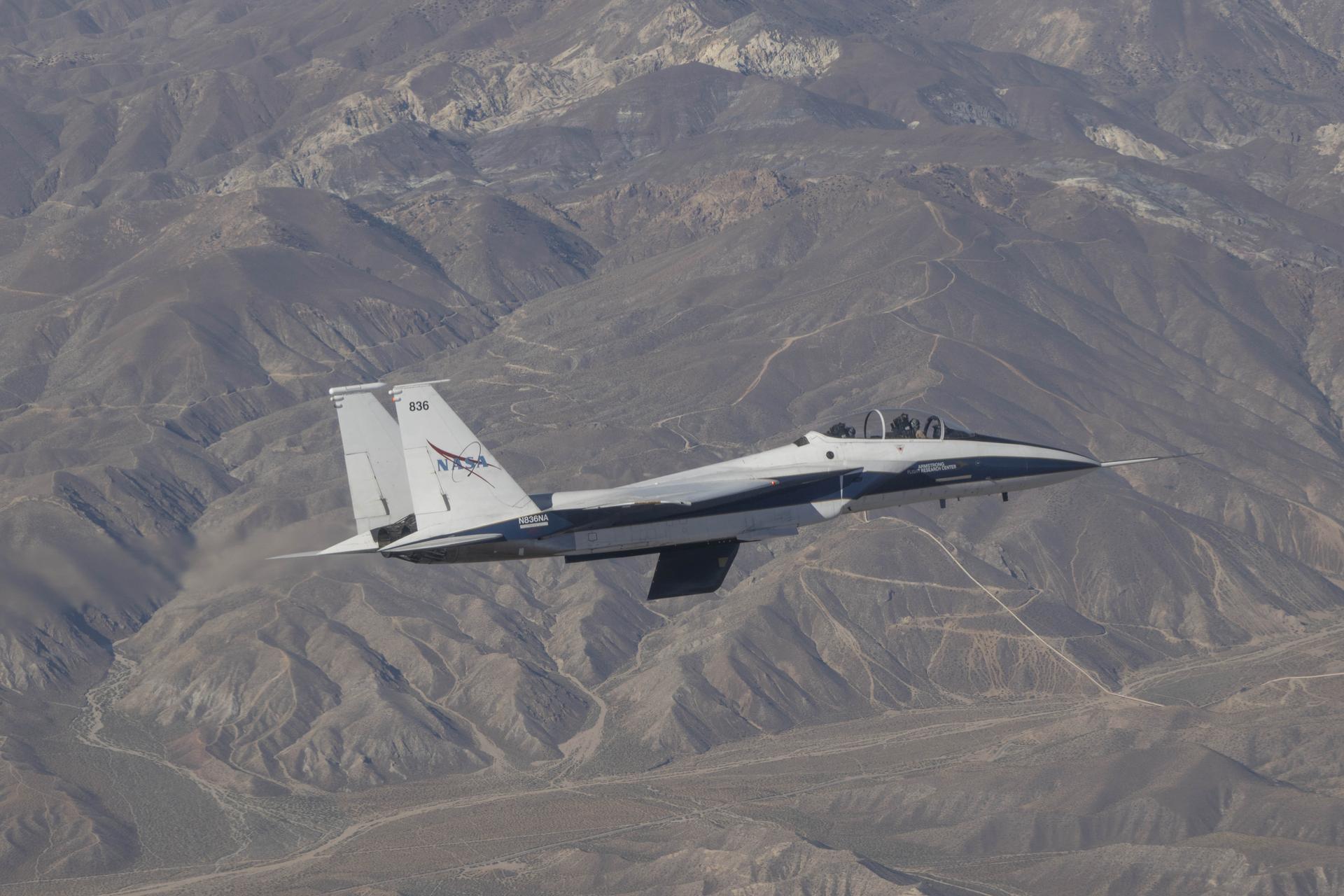
A F-15 aircraft owned by NASA’s Armstrong Flight Research Center in Edwards, California, flies above a mountain range on Tuesday, April 21, 2026. The agency’s Crossflow Attenuated Natural Laminar Flow (CATNLF) test article is attached to the bottom of this F-15. This project aims to lower fuel costs for future commercial aircraft by testing a scale-model wing designed to improve laminar flow.
NASA/Jim Ross
7:30 to 8:30 a.m. — Flight
At the test location, the team coordinates with the pilot on altitude, speed, and maneuvers. The test conductor relays each task, and the pilot completes them one-by-one. The pilot and control room monitor the performance of the hardware, instruments, aircraft, or software throughout the sequence. After completing the test points, the pilot returns to base.
8:45 a.m. — Landing, towing
The pilot lands and taxis to the ramp at NASA Armstrong, where the crew chief meets the jet. After the pilot exits, the aircraft is towed into the hangar for maintenance.
9:30 a.m. — Crew debrief
The pilot, project team, and mission controlstaff return to the briefing room tocapture lessons learned and document items for follow-up.
10 a.m. — Data download, second flight prep
Teams download flight data for analysis. If two flights are scheduled, preparations begin immediately for the second.
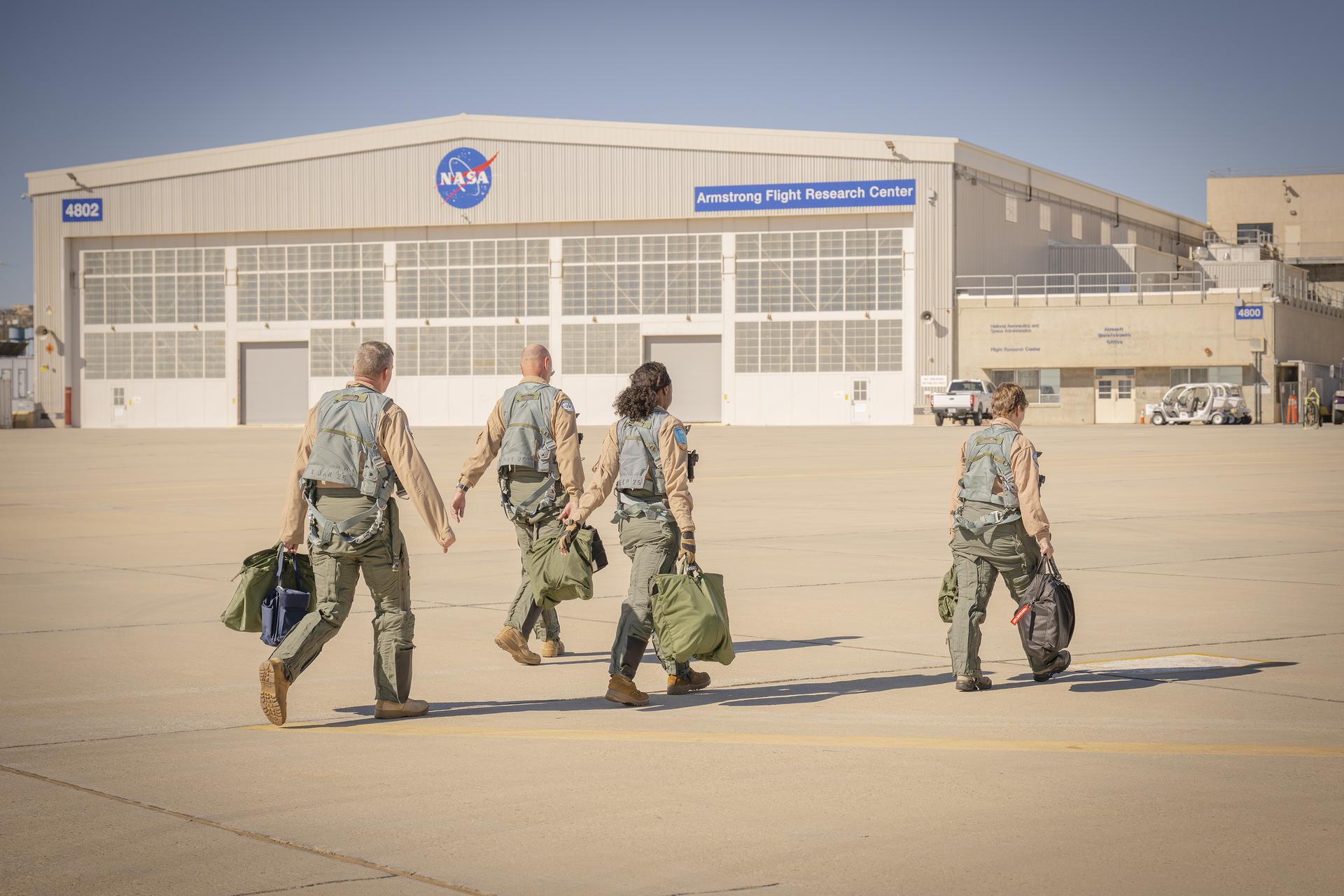
Four NASA employees walk toward a hangar after a flight Thursday, Feb. 4, 2026, at NASA’s Armstrong Flight Research Center in Edwards, California. The team supports the agency’s Crossflow Attenuated Natural Laminar Flow (CATNLF) project, which aims to lower fuel costs for future commercial aircraft by testing a scale-model wing designed to improve laminar flow.
When you’re driving your car, you’re probably regularly looking at the speedometer to make sure you comply with the local speed limits. The method by which it works is simple enough: the rotation of the wheels is sent mechanically via a cable to a dial on the dash, or an electronic sensor counts the rotations of the drivetrain and an electronically-controlled needle or display shows the speed.
But what about if you were in an aircraft, and the wheels had nothing to do with how fast you were going? How would you even begin to measure speed? There are two ways: there’s a convenient solution to this problem rooted in simple fluid mechanics, and a far-more-complex modern solution. Today, we’ll explore how planes and helicopters are able to figure out how fast they’re going, by the old ways and the new.
Classical Methods
Measuring airspeed can be achieved by measuring stagnation pressure with a pitot tube, and comparing this to static pressure. This can be done at different points on the aircraft, or a pitot-static tube can be used, which measures both stagnation pressure and static pressure in a single probe. Credit: Chaos386, CC BY-SA 3.0
A key thing most aviators want to know is how fast their aircraft is going. Specifically, it’s nice to know how fast it’s moving relative to the airstream around it, which is referred to as airspeed. This is important, because it’s the aircraft’s velocity relative to the flow, such as wind, that determines the performance of the airfoils, how much lift is generated, and whether or not the aircraft is approaching a stall condition where it might fall out of the sky.
Bernoulli’s equation, rearranged to find airspeed (u), by subtracting static pressure from stagnation pressure, multiplying it by 2, dividing by fluid density, and taking the square root of that result.
Measuring airspeed is most commonly achieved with the use of a device called a Pitot tube. The pitot tube is a tube with a hole in one end that points directly into the airflow in the direction of travel of the aircraft.
As air flows in, it reaches a dead end and the flow slows to a stop, or stagnates, since it has nowhere to go. This allows a pressure sensor or a manometer or other device to measure the stagnation pressure at this point. The stagnation pressure measurement is related to the flowspeed of the incoming air since the kinetic energy of the flow is converted to pressure as the flow comes to a halt.
A secondary tube, pointing perpendicular to the airflow, is then used to measure the static pressure of the surrounding air, without the ram effect of the air being forced in by the aircraft’s forward motion. Then, it’s possible to calculate the velocity of the aircraft relative to the airstream by plugging the stagnation pressure and static pressure into a rearranged Bernoulli’s equation. If the pitot tube and static tube are hooked up to electronic sensors, the airspeed can be calculated electronically, and fed to a display or digital gauge.
A classic airspeed indicator has the pitot tube and static tube feeding right into the gauge in the cockpit. The pressure differential causes the diaphragm to expand as the airspeed increases, which mvoes a mechanism causing the needle to move on the gauge. Credit: FAA, public domain
Alternatively, it’s possible to effectively do this “calculation” mechanically. In earlier days, static and stagnation pressure captured by each tube would be fed to a gauge. Inside, the stagnation pressure would be fed to a diaphragm which moved due to the difference relative to the static pressure which is fed into the gauge body, and the movement of the diaphragm would, via a simple mechanism, shift the needle on the gauge.
A small General Aviation aircraft might mount a single pitot tube on the aircraft, feeding the air speed instrument in the cockpit. Commercial aircraft might mount two or more for safety’s sake, in case one becomes inoperable, while large airliners may have four or even more to provide a high level of redundancy and error checking. Heaters are commonly included on pitot tubes to ensure they can be kept free of ice, which can otherwise completely block a tube and make it impossible to obtain an airspeed reading.
Pitot tubes sticking out in the airstream underneath a Boeing 777-381. Credit: Cassiopeia sweet, public domain
For pilots, not knowing how fast (or slow) the aircraft is going can be highly dangerous, as it can lead to entering unstable flight regimes such as stall. Thus, it’s imperative that the pitot tubes remain unobstructed and functional for safe flight. Many aircraft accidents have occurred because of blocked or malfunctioning pitot tubes or airspeed instruments.
The New Way
Of course, you could fuss about with pitot tubes and pressure sensors and deicing measures, but that’s all very fiddly and old hat. There is an entirely different way to figure out a plane’s speed, though it’s only been available for the last few decades. It’s as simple as throwing a GNSS receiver on the aircraft.
Yes, whether your particular poison is GPS, Baidou, GLONASS, or Galileo, any major satellite navigation system will be able to tell you the speed of your receiver. Simply measuring the change in the receiver’s position over time is enough to calculate out the speed, and any off-the-shelf receiver will present this information as standard. It’s generally not used as a primary indicator in aircraft, because it reports ground speed, not airspeed, the latter being more relevant for aviation purposes. Still, it can prove to be a useful sense check when traditional airspeed indicators are non-operative or reporting confusing data, and GNSS devices are widely used on many aircraft today.
Flying High
Many modern aircraft have so-called “glass cockpit” displays that include feeds from GNSS receivers, which can provide supplementary data such as satellite-based ground speed measurements. However, these readings are generally not used for the primary task of flying the aircraft. Credit: Bluedisk, CC BY-SA 3.0
If you’ve ever wondered how an aircraft measures its speed as it floats through the amorphous gas cloud we call an atmosphere, now you know. Even to this day, where electronics and computer wizardry control our fanciest aircraft, airspeed measurements are still done with the same simple physics, just with some fancier sensors for help. The fundamentals haven’t changed at all. Now you know, you can always dig deeper into the many other rich applications of Bernoulli’s equation and fluid mechanics in general. Happy learning.

 Login
Login