
Normal view

There are new articles available, click to refresh the page.
Today — 14 September 2026GeekWire

Sophia Space and SLI set the terms for a $300M deal that will finance an orbital computing constellation

14 September 2026 at 00:00
Illustration: Sophia Space satellites flying in orbital formation
An artist’s conception shows several Sophia Space satellites in orbit. (Sophia Space Illustration)

Sophia Space and SLI, an aerospace leasing venture based in Washington, D.C., say they’ve agreed on a $300 million asset-financing framework that will support the creation of a 10-satellite constellation for high-performance computing.

The details of the arrangement are as notable as the bottom line: Sophia Space will build the satellites, leveraging the startup’s patented TILE technology for modular in-space data processing. SLI will purchase the satellites under the terms of a financing agreement.

“SLI as the lessor will purchase the satellites from Sophia, hold title to the assets, and lease them to the end user on a long-term basis in exchange for fixed monthly or quarterly payments,” Max Yergan, the company’s senior vice president for investments, explained in an email. “Full control and operational responsibility for the assets sit with Sophia and the end user, who will determine between them how operations are handled.”

Sophia’s satellites are designed to deliver on-orbit edge data services for a wide variety of applications. “The demand we are underwriting exists today,” Yergan said. “Earth observation, weather and supply-chain analytics, disaster response and defense ISR [intelligence, surveillance and reconnaissance] users all face the same constraint now: They collect far more data than they can bring to the ground, and its value decays while it waits to be downlinked. Processing on orbit addresses that directly.”

The constellation’s first launch is targeted for as early as 2028. SLI would pay out funds linked to development and launch milestones, all the way through verification that the on-orbit network performs to pre-agreed standards.

The arrangement is laid out in a non-binding letter of support. “The non-binding nature is a reflection of where we are in the process, and is typical of large asset financings,” Yergan explained. “It sets the commercial framework so both parties can commit resources while definitive documentation is negotiated.”

Leasing arrangements are often seen in aviation and the maritime industry, but this is a relatively new concept for satellite ventures.

“This is the first time that this approach has been applied to this kind of constellation, but not the first time for in-space assets,” said Gareth Zundel, SLI’s senior vice president for communications. “In December 2025 we announced the acquisition of two AscendArc satellites that will be offered to operators on leasing terms. Then, in March this year, we did a similar deal with ReOrbit. We do believe, however, that we are the first leasing company to specialize in the space sector.”

Rob DeMillo, Sophia Space’s CEO and co-founder, said the arrangement demonstrates how far the commercial space industry has come.

“Asset financing didn’t invent aviation or shipping, but it accelerated them at scale,” he said in a news release. “We’re doing the same for orbital computing. This approach with SLI signals that Sophia Space’s space infrastructure is mature enough to attract the capital structures that have historically built terrestrial infrastructure.”

The approach also gives Sophia Space — which is headquartered in Pasadena, Calif., but also has strong ties to the Seattle area — access to capital without diluting the equity held by current investors, including Unlock Venture Partners in Seattle.

“Sophia has the technology, the team and the vision. What had been missing was access to scalable, non-dilutive capital,” said Praveen Vetrivel, SLI’s CEO. “This framework provides it, giving them the capacity and flexibility they need to build the next layer of digital infrastructure.”

Each of the 10 satellites in the constellation will link together six of Sophia’s TILE (Thermal Integrated LEO Edge) modules, with four Nvidia Jetson processors on each module. That adds up to 240 edge computing servers in orbit.

“These 10 spacecraft are dedicated to this transaction,” Yergan said. “Sophia’s other programs and partnerships involve separate spacecraft and separate funding and are not directly affected by this facility.”

Sophia Space has previously said that it plans to start selling TILE systems and related components to customers in 2028. The company is also collaborating with Axiom Space, Armada and Kepler Communications on separate in-space computing initiatives.

In June, Sophia Space announced the conclusion of a $7 million financing round that brought the company’s total funding to $22 million. That round took advantage of an arrangement known as a Simple Agreement for Future Equity, or SAFE, in which investors provide cash to a startup in exchange for the right to receive stock later.
Before yesterdayGeekWire

General Motors to open downtown Seattle office to bring together remote technical talent

9 September 2026 at 17:01
The West8 office building in Seattle’s Denny Triangle neighborhood. (Image via West8Seattle.com)

General Motors is expanding its presence in the Seattle region with a new downtown office slated to open in early 2027.

The automotive giant signed a lease for a 43,000-square-foot space at West8 in the Denny Triangle neighborhood, with plans to bring together employees across digital products, autonomous vehicles, IT, HR, and marketing, the company announced Wednesday.

GM currently employs about 200 remote workers in the region. A spokesperson said the new office will bring those existing team members together while providing room to recruit additional talent. The layout will feature a mix of traditional workstations, flexible lounge seating, and collaborative huddle spaces.

When the office opens, it will follow GM’s hybrid work policy, requiring employees living within a 50-mile radius to work on-site three days a week.

GM said tapping into Seattle’s deep technology talent pool will help grow its concentration of technical staff and attract engineers specializing in artificial intelligence and machine learning. The company credits its Seattle-area software teams with building the technical foundation behind its on- and off-vehicle platforms.

Located at 2001 8th Ave., the West8 building sits two blocks from Amazon’s headquarters campus and the Spheres. Amenities available to GM staff will include a fitness center, bike storage with showers, an onsite café, outdoor spaces, and covered parking equipped with EV charging stations.

The Seattle footprint adds to GM’s network of major tech hubs outside Michigan, including locations in Austin and the Bay Area.

Stoke Space raises $1B to expand its footprint and upsize its fully reusable Nova rocket

8 September 2026 at 05:00
Stoke Space’s Nova Pathfinder upper stage flight article No. 1 sits at the company’s factory in Kent, Wash. (Stoke Space Photo)

Stoke Space says it has raised roughly $1 billion to get ready for the first launch of its fully reusable Nova rocket — and to scale up the rocket’s design for even bigger payloads.

To accommodate its grander ambitions, the Kent, Wash.-based startup is also scaling up its rocket test facility in Moses Lake, 175 miles to the east.

“We have confidence in the foundation that we’ve laid today, and now it’s time to scale,” Stoke Space CEO and co-founder Andy Lapsa told GeekWire.

The newly announced Series E financing round was co-led by Point72 Ventures and Spark Capital, with participation from General Innovation, Glade Brook Capital, US Innovation Technology, Washington Harbour Partners, Woven Capital, Y Combinator and other investors.


The final figure will be “within rounding error” of a billion dollars, Lapsa said. “Not quite, or a little more,” he said. “The speed with which this has come together is very fast.”

Lapsa said that scaling up the Nova rocket’s design was always part of Stoke Space’s game plan, but that the timeline is being accelerated in response to the growing demand for launches and the shrinking availability of launch opportunities.

The timing of Stoke’s pivot to a bigger launch vehicle wasn’t sparked by a single event, Lapsa said. “The pressure has been growing over the last couple of years,” he said. “It certainly hasn’t slowed down recently.”

From Pathfinder to Block 2

This infographic compares the designs for Nova Pathfinder and Nova Block 2. (Stoke Space Illustration)

The revised plan calls for Stoke to begin launching missions with the initially designed rocket, now known as Nova Pathfinder. Pathfinder’s first stage will be powered by seven of Stoke’s Zenith engines, and the upper stage’s Andromeda engine will have a ring of 24 thrust chambers integrated into an actively cooled metallic heat shield. The rocket will be capable of putting 3 metric tons of payload into low Earth orbit, or LEO.

Pathfinder’s first launch is now scheduled for early 2027 — a slight slip from earlier expectations. It will carry a spacecraft for AstroForge, a California-based asteroid mining company. “We’re going out to the asteroid belt, and yeah, Astroforge is our partner for that one,” Lapsa said. “They’re looking to prospect and ultimately mine asteroids, and bring back rare earths and other important materials.”

The super-sized version of Stoke’s rocket, known as Nova Block 2, is due to make its debut in 2029. Its first stage will have twice as many Zenith engines as Pathfinder. Its upper stage will have 12 independent engines, each with two thrust chambers. That will increase Nova’s lift capability by a factor of five, enabling up to 15 metric tons of payload to be delivered to LEO. More than 4 tons can be sent to geosynchronous transfer orbit, or GTO.

In comparison, SpaceX says its partially reusable Falcon 9 rocket can deliver 18.5 tons to LEO or 5.5 tons to GTO in reusable mode.

Both versions of the Nova rocket are designed to be fully reusable, with the first-stage booster flying itself down to a recovery ship and the upper stage making a separate re-entry. Stoke is only the second company in the space industry to pursue that strategy. SpaceX has designed its Starship launch system for dual-stage reusability but hasn’t yet reached that goal.

Stoke is developing an active-cooling system for upper-stage reusability. Some of the rocket’s cryogenically cooled liquid hydrogen propellant is circulated through channels in the upper stage’s metallic heat shield to absorb the intense heat of atmospheric re-entry. SpaceX has been experimenting with different heat shield strategies for Starship, but some experts have expressed doubts about SpaceX’s approach.

Both versions of Stoke’s rocket are designed to fill a market niche that’s different from Starship’s. The Nova rockets’ capabilities fall close to both ends of the medium-lift spectrum, while SpaceX’s super-heavy-lift Starship is designed to loft 100 to 150 tons of payload to LEO.

Expanding the infrastructure

Stoke Space tested its Zenith rocket engines and Nova Pathfinder’s first stage in Moses Lake in June. (Stoke Space Photo)

Stoke Space’s 168,000-square-foot factory and headquarters facility in Kent was designed from the beginning to manufacture rockets that are bigger than Nova Pathfinder.

“We bring in raw sheet metal, we build our core and we ship a rocket,” Lapsa said. “We can use the same methods and effectively the same tooling to build larger diameters and larger lengths, and that’s very intentional.”

The company’s rocket test facility in Moses Lake is being expanded from 75 to 550 acres to accommodate work on two types of rockets simultaneously.

“We’ve done, I would say, an extremely efficient job at leveraging the 75 acres that we use today,” Lapsa said. “The expansion across the street is going to enable us to test again at rate. … Certain of our facilities have an overlapping blast radius, so they interfere with each other. A big advantage of being able to spread our wings a little bit, and get a little bit more space, is that those test stands can operate in full independence of each other.”

Stoke’s launch facilities at Cape Canaveral Space Force Station in Florida can also accommodate a dual-track approach. A new payload processing facility at the Cape is intentionally sized to support both Nova Pathfinder and Block 2.

In June, Stoke Space’s Moses Lake facility completed what the company called proto-qualification testing of the first-stage booster for its first Nova Pathfinder rocket. “The second stage will ship out pretty soon,” Lapsa said. “That goes to Moses Lake. … This will be acceptance testing of the structure, and then we’ll do a static hot-fire test out there to fully shake down the second stage, and then it ships out to Cape Canaveral.”

The booster is being prepared for shipping to the Cape as well. “We’ll repeat the wet dress rehearsals that we did in Moses Lake, but we’ll do it on the launch pad itself,” Lapsa said. “Then we’ll do the same thing: static fire test on the first stage down there, and then the two stages go together, and we go to space.”

Stoke Space has built a facility at Space Launch Complex 14 at Cape Canaveral Space Force Station in Florida. (Stoke Space Photo)

Stoke Space has been on a phenomenal growth curve since Lapsa and his fellow co-founder, chief technology officer Tom Feldman, left Jeff Bezos’ Blue Origin space venture in 2019 to create the company.

Lapsa said Stoke currently has about 400 employees. “It’s approximately 50 in Moses Lake, 50 in Cape Canaveral. We have a handful of remotes, and then everybody else is in Kent,” he said.

Even though Stoke Space hasn’t yet launched a rocket, the startup’s steady progress toward that milestone — and its long-term vision for total rocket reusability — have been impressive enough to keep investors on board.

“Having supported Stoke through multiple stages of its growth, we believe this company has demonstrated both the exceptional technical progress and the ambition to build a launch system capable of serving the market at industrial scale,” Chris Morales, partner at Point72 Ventures, said today in a news release.

Full reusability is the inevitable end state of the market, providing an order-of-magnitude cost and service advantage over partially reusable rockets,” said Clay Fisher, general partner at Spark Capital. “Stoke had the right thesis seven years ago and has paired that prescient vision with a blistering pace of execution. As a result, they stand uniquely positioned to give customers more choice and capacity when they need it, and to unlock an enormous new economy in space.”

Lapsa said he’s grateful for the vote of confidence.

“We’re humbled by the investment, having great partners behind us,” he said. “It’s an incredibly critical and important moment for us as a civilization to get right. I think space development is really, really important for our ability as a civilization to continue to scale and continue raising the quality of life that we enjoy — and we’re thrilled to be part of it.”

Cowboy Space leases a huge facility in the Seattle area to produce hardware for orbital data centers

5 September 2026 at 16:37
An artist’s conception shows one of Cowboy Space’s data centers in Earth orbit. (Cowboy Space via LinkedIn)

California-based Cowboy Space is leasing a 291,035-square-foot industrial facility in Kent, Wash., to support the production of hardware for its planned constellation of AI data center satellites, according to the company that arranged the lease.

According to Newmark Research, the transaction is the largest industrial lease in the Puget Sound region year-to-date,” Newmark, the real estate broker for the deal, said in a news release. Newmark represented CenterPoint Properties, Cowboy’s new landlord.

The facility at 7650 S. 228th St. previously served as a Costco distribution and delivery center. “This building was originally designed for large-scale logistics users, but Cowboy Space recognized the opportunity to reimagine it as a highly specialized production facility,” said Taylor Hoff, a vice chairman at Newmark’s office in Bellevue, Wash.

Newmark said Cowboy Space plans to convert the facility into a manufacturing operation supporting space and rocket development. The operation is expected to add 300 jobs, Newmark said. Cowboy is currently listing 46 Kent-based positions in its careers database.

The city of Kent, which is about 20 miles south of Seattle, is one of the hotspots for space companies in the Pacific Northwest. Boeing’s Kent Space Center remains active more than 50 years after building NASA’s Apollo moon rovers. The city also hosts Jeff Bezos’ Blue Origin space venture and Stoke Space, which was founded by Blue Origin alumni.

Cowboy Space, previously known as Aetherflux, plans to send its own rockets into low Earth orbit starting as early as 2028, with the upper stages outfitted to serve as solar-powered orbital data centers. The Stampede constellation is one of several planned projects aimed at getting around the land, power and water constraints that have made ground-based AI data centers increasingly controversial.

“We are building what I call the last big clean-sheet launch vehicle in my lifetime, so it’s going to be a very big heavy-lift vehicle, and we’re working every day to bring it to reality,” Warren Lamont, Cowboy Space’s head of launch and propulsion, said this week in a LinkedIn video. Lamont, who previously worked for IonQ and Blue Origin, is one of the executives heading up Cowboy Space’s engineering hub in the Seattle area.

The company announced in May that it raised $275 million in a Series B funding round, in part to expand its production capability. Cowboy is collaborating with Nvidia to deploy the chip giant’s Nvidia Space-1 Vera Rubin Modules in orbit. And in July, it secured a deal to test its propulsion system at NASA’s Stennis Space Center in Mississippi.

“We’re really excited to get into first engine hot-fire next year,” Lamont said.

Cowboy Space’s potential competitors include SpaceX, which wants to launch up to a million AI-processing satellites; and Redmond, Wash.-based Starcloud, which is setting up a production facility in Woodinville, Wash., and seeking authorization for up to 88,000 data center satellites.

Update for 3:30 p.m. PT Sept. 13: Cowboy Space confirmed the opening of its Kent facility in a post to LinkedIn. “Kent will be our launch vehicle and satellite design hub, and we will be building our rocket engines and solar systems here too,” the company said:

NASA’s chief talks up nuclear power during ‘Inspiration Tour’ of Northwest space ventures

3 September 2026 at 22:13
NASA Administrator Jared Isaacman addresses hundreds of Rocketdyne employees during his stopover at the company’s facility in Redmond, Wash. (GeekWire Photo / Alan Boyle)

REDMOND, Wash. — NASA Administrator Jared Isaacman came to Rocketdyne’s facility here today to give a pep talk to the space company’s employees — and lay out his vision for the future of America’s space effort.

Isaacman made clear that nuclear power will be a big part of that vision.

“NASA is at our best when we’re doing the near-impossible,” he said. “There is no obvious revenue model or business case for what we’re doing. We’re just out there pursuing the secrets of the universe, and nuclear or fission-powered spacecraft make sense in that it helps us extend our reach farther into the solar system.”

The pathfinder mission for NASA’s nuclear ambitions is likely to be SR-1 Freedom, a Mars probe that’s scheduled for launch in 2028. SR-1 Freedom is designed to carry a fission reactor and nuclear electric propulsion system.

Rocketdyne’s Redmond facility is working on thrusters for the system. “We built here, in Redmond, the Advanced Electric Propulsion System,” Rocketdyne CEO Kristin Houston told GeekWire before Isaacman’s talk. “It’s a 12-kilowatt Hall-thruster system, and that is going to be the propulsion element on the SR-1 Freedom. So, yeah, we’re really proud of that.”

Today’s visit was part of the Pacific Northwest leg of Isaacman’s nationwide “Inspiration Tour,” aimed at strengthening the connections between NASA and its partners. A similar tour in August brought Isaacman to Idaho National Laboratory, which will play a key role in providing the 20-kilowatt reactor for SR-1 Freedom.

Rocketdyne CEO Kristin Houston delivers remarks during NASA Administrator Jared Isaacman’s stop at the company’s Redmond facility. (GeekWire Photo / Alan Boyle)

In partnership with the U.S. Department of Energy, NASA is also looking into the prospects for putting a nuclear reactor on the lunar surface by 2030 as part of its Moon Base initiative. Houston said Rocketdyne is interested in playing a part in that program.

“That’s not as much out of the Redmond site, but as Rocketdyne, we’re doing a lot of investment in the power conversion and the power management and distribution design that could be used for that,” she said.

Over the course of nearly 60 years, Rocketdyne’s Redmond site has played a role in nearly every interplanetary NASA mission — and has gone through several ownership changes along the way. The company’s latest transition, including its rebranding as Rocketdyne, became official last month after AE Industrial Partners acquired a majority stake from L3Harris.

Nowadays, Rocketdyne is arguably best-known as one of the commercial partners in NASA’s Artemis moon program. “We have 21 engines on the Orion spacecraft,” Houston said. “That’s between the crew module and the service module … all built in Redmond.”

The Redmond facility oversees the refurbishment of space shuttle engines for upcoming Artemis missions and is redesigning the spacecraft’s Orion Main Engine for missions starting with Artemis 7. “Our in-space propulsion business, really based here, has the lead on the entire OME program,” Houston said. “So we’re already concurrently doing the design and test of the new engine while doing all the refurbishment.”

Isaacman said the Artemis program is one of NASA’s top priorities, in part due to geopolitical competition. The current schedule targets a crewed lunar landing in early 2028, followed by initial work on a permanent base near the moon’s south pole later that year.

“NASA is very hot,” he said. “But NASA is hot right now because we are in a great-power competition. That’s across AI, energy and infrastructure, and everything you can imagine militarily, but certainly in the domain of space. We cannot take our foot off the gas. Really, if we miss our time by a matter of months, there are only so many good parking spots in the south pole of the moon, where we want to build our moon base. Well, the Chinese want to build their moon base there, too.”

NASA is relying on Rocketdyne and other commercial partners to set a fast pace.

“For all the great companies, the partners that are contributing to our near-impossible objectives, now is absolutely the time,” Isaacman said. “Just as so many of you were probably inspired by the space race in the 1960s and what we accomplished — all those books and movies that came from it — you’re now contributing to that.”

One of the VIPs in the audience, Redmond Mayor Angela Birney, said she was energized by Isaacman’s visit. “I am so excited that Rocketdyne is on the forefront of missions in space,” she said. “For me, as a former science teacher and someone who’s so interested in encouraging innovation and development, this just feels like a fantastic day to celebrate all of that.”

Rocketdyne wasn’t Isaacman’s only scheduled stop on this week’s tour. Earlier in the week, the administrator and other federal officials paid a visit to Lawrence Livermore National Laboratory and the Castle Air Museum in California’s Central Valley. In addition to Rocketdyne, today’s visits included stopovers at United Precision Corp.’s headquarters in Washougal, Wash., Seattle’s Museum of Flight and Boeing’s Everett facility. Stoke Space is on the agenda for Friday.

After his talk, Isaacman told GeekWire that Washington state is home to a “lot of industry” that’s contributing to America’s space effort.

“It takes contributions from great talent all across the nation to contribute to our world-changing efforts,” he said, “but it just happens to be that a lot of it is here in Washington.”

Blue Ring for a Red Planet: Blue Origin wins $700M from NASA for Mars Telecommunications Orbiter

3 September 2026 at 13:42
An artist's conception shows the Mars Telecommunications Orbiter in Martian orbit. (Blue Origin Photo)
An artist’s conception shows the Mars Telecommunications Orbiter in Martian orbit. (Blue Origin Photo)

Jeff Bezos’ Blue Origin space venture has won a contract worth up to $700 million to boost NASA’s telecommunications capability in Martian orbit, using a version of the company’s Blue Ring multi-mission space platform.

The contract calls on Blue Origin to deliver a high-performance Mars telecommunications orbiter to NASA by the end of 2028, the space agency said in a news release. Blue Origin would also be charged with operating the Mars telecommunications network as part of NASA’s broader space communications and navigation infrastructure.

Blue Origin CEO Dave Limp said the Blue Ring spacecraft for the mission was already in production in Huntsville, Alabama. “Before the first human steps on Mars, we have to build the road. … MTO will enable science, carry payloads, and help lay the foundation for human exploration,” he said in a post to X.

“MTO is the backbone of America’s Mars exploration program for the next decade and beyond, and will provide the reliable communications capacity that will keep future robotic and human missions connected to each other and to Earth,” Tory Bruno, president of Blue Origin’s National Security Group, said in a news release. “This awarded contract is a testament to the Blue Origin team that has been building Blue Ring with exactly this kind of mission in mind. We’re ready, and so is the hardware.”

NASA’s current telecommunications links to Mars rely on an aging set of orbiters, including Mars Odyssey (launched in 2001) and Mars Reconnaissance Orbiter (launched in 2005). The multinational relay network also makes use of the European Space Agency’s Mars Express and ExoMars Trace Gas Orbiter. In addition to the orbiting relay satellites, NASA’s probes on the Martian surface can communicate directly with Earth to a limited degree.

Plans for a new Mars telecommunications orbiter have been under consideration for more than a decade and a half, but had been repeatedly put on hold due to budget concerns. This May, NASA issued a request for proposals relating to a commercial network for the Red Planet, drawing responses from Blue Origin as well as Rocket Lab.

Blue Origin announced three years ago that it was developing its Blue Ring in-space mobility platform for a wide range of potential applications — and last year, the first flight of the company’s New Glenn rocket included a payload that tested communications and control system for Blue Ring.

NASA said the Mars Telecommunications Network would be managed by the space agency’s Space Communications and Navigation program. The network is expected to be operational at Mars by 2030 to support current and future missions to the Red Planet.

Juno Propulsion wins $1.2M grant from NSF to advance non-toxic space propulsion system

1 September 2026 at 13:38
The Juno Propulsion team includes, from left, fluid systems engineer Andrew Adams, facility operations engineer Cody Niggemyer, chief technology officer Ari Martinez and CEO Alexis Harroun. (Juno Propulsion Photo)

The National Science Foundation has awarded a $1.2 million grant to Tukwila, Wash.-based Juno Propulsion to support the startup’s development of a non-toxic propulsion system for in-space applications.

The two-year Phase II project, funded through NSF’s Small Business Innovation Research (SBIR) program, will be conducted in partnership with the University of Washington and UW Professor Carl Knowlen’s lab. The focus of the funding is to support work on Juno’s Product Development Unit (PDU), which uses rotating detonation rocket engine technology.

By combining high-efficiency propulsion with non-toxic propellants, Juno aims to enable spacecraft to maneuver farther and faster while reducing the risks associated with traditional toxic propellants. Work on the PDU is intended to advance Juno’s system to Technology Readiness Level 8, positioning it near production-ready status on the standard 1-to-9 TRL scale.

“This award represents an important milestone in taking our rotating detonation propulsion technology from development and flight demonstration toward a production-ready product,” Juno Propulsion CEO Alexis Harroun said in a news release. “We’re excited to continue our collaboration with the University of Washington and Professor Knowlen’s lab as we take the next step toward delivering this technology to commercial and government customers.”

The Phase II grant, announced last week, follows up on a $275,000 Phase I SBIR grant that was awarded in 2024.

Juno Propulsion’s team is getting ready for Project Iris, an on-orbit demonstration of its propulsion technology that’s due to fly aboard Momentus’ Vigoride 8 satellite platform in 2027. The lessons learned from Project Iris will feed directly into work on the PDU.

The startup was founded in 2023 by Harroun and chief technology officer Ari Martinez, who met while earning their Ph.D.s at Purdue University. Harroun received her undergraduate degree in aeronautics and astronautics from UW and interned at Blue Origin, Boeing and NASA before heading to Purdue.

In June, Juno Propulsion announced the close of a $1.4 million pre-seed financing round, led by SOSV with participation from Hypernova Fund, Leslie Ventures, Activate, Collaborative Fund, Safar Partners and Cape Fear Ventures.

Fermi Explorer team plans to launch a probe that will reach the star system next door … in 80,000 years

1 September 2026 at 06:00
Philip Johnston, co-founder and president of the Fermi Explorer Mission, stands on an outcrop in Chile’s Atacama Desert and points at Alpha Centauri in the heart of our Milky Way galaxy. Johnston and his teammates aim to launch a probe by the end of 2029 that would reach Alpha Centauri roughly 80,000 years later. (Photo Credit: Alexis Trigo)

A Seattle-area nonprofit group known as the Fermi Explorer Mission today unveiled its plans to send a spacecraft on an 80,000-year trip to the nearest alien star system, Alpha Centauri.

If the mission goes as planned, it would mark a milestone for interstellar flight. But Philip Johnston, the group’s co-founder and president, doesn’t expect Fermi Explorer to be humanity’s first visitor to Alpha Centauri. He’s counting on our descendants to figure out faster ways to travel between now and the year 82026.

“We’ll be the first to leave, and the last to arrive,” he said.

The robotic spacecraft won’t be powered by antimatter, dilithium crystals or other science-fiction standbys for traveling between stars. Instead, it will depend on a tried-and-true solar electric propulsion system to build up speed for the 4.4-light-year trip.

Johnston and his teammates laid out the mission requirements for a bidding process that aims to keep the cost of designing, building, launching and operating the probe below $15 million. They’re also soliciting contributions, with launch targeted by the end of 2029.

The mission is contingent on raising the required funds, but Johnston voiced confidence about hitting the $15 million target. “We have raised significant funds already, but the bulk of the raise will kick off after [today’s] announcement,” he told GeekWire in an email. “One billionaire space founder already verbally offered $10M.”

What about NASA? “We are talking with NASA, but they have a very long process for backing missions,” Johnston said. “We would love to have them involved but will complete the mission with or without them.”

Johnston and the group’s other co-founders — Ezra Feilden and Adi Oltean — also founded Redmond, Wash.-based Starcloud, which plans to launch up to 88,000 satellites to serve as AI data centers. Johnston said there is no operational overlap between the two ventures.

Program manager Garrett Jameson, a former U.S. Air Force officer, will lead day-to-day operations. “We chose Garrett to optimize for something actually being launched,” Johnston said. “Rather than getting someone from JPL or an academic background, Garrett has 10 years of experience as an Air Force officer where he delivered on many missions, including space operations. His job will be selecting vendors and ensuring they deliver.”

Ten years ago, billionaire Yuri Milner announced a $100 million initiative called Breakthrough Starshot that aimed to send a swarm of micro-spacecraft to Alpha Centauri — but that effort, backed by the likes of Stephen Hawking and Mark Zuckerberg, never really got off the ground. Last year, Scientific American quoted the project’s executive director, retired Air Force Brig. Gen. Pete Worden, as saying that Starshot was put on hold.

“I spoke with the former program manager there,” Johnston said. “He was trying to do it in a human lifetime. Ours is a very different mission.”

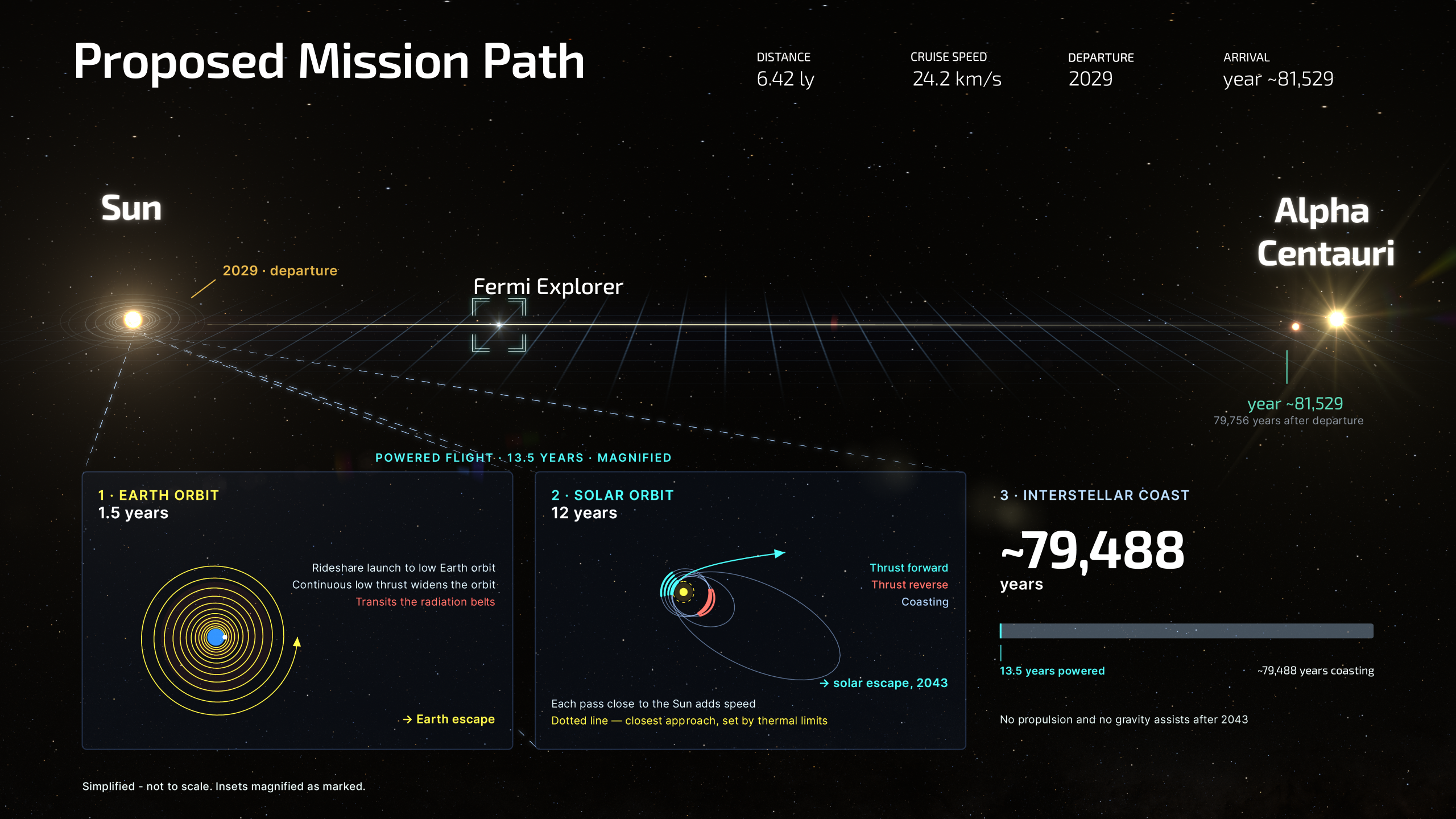
The mission plan calls for the spacecraft to deploy from its launch vehicle and then loop around Earth and the sun to build up speed through a series of perihelion pumping maneuvers. When the probe reaches the planned escape velocity, it will head out for Alpha Centauri. “We will have a 12-year operation period … and then a 79,500-year coast period,” Johnston said.

Chart showing proposed mission path for Fermi Explorer
This Fermi Explorer graphic shows different stages of the spacecraft’s mission. Click on the image for a larger version.

During the cruise, the probe will travel at a speed of 24.2 kilometers per second (54,000 mph). Johnston said the flight through the Alpha Centauri system will occur at a relative velocity of 17.9 km/s (40,000 mph) — roughly 25% faster than New Horizons’ Pluto flyby in 2015.

Specifications call for a minimum payload of 1 kilogram (2.2 pounds) inside a shielded 10-by-10-by-10-centimeter box (4 by 4 by 4 inches). The payloads could include artistic works or scientific experiments — for example, a cosmic-ray ion detector or an interstellar dust catcher. The Fermi Explorer team plans to schedule a three-month solicitation period for such payloads, and will make their selections based on feasibility, cost and other factors.

The team plans to send a digitized and micro-etched copy of the Voyager mission’s Golden Record, plus messages from children around the world. And the project offers several ways for supporters to “make their mark” on the mission, priced from $10 for a website mention to $1 million to place an gem-sized object on the probe.

“The purpose of messages from children is to inspire the next generation,” Johnston said in his email. “Grownups can pay.😅”

There’s no plan to orbit or land on a planet. Instead, the probe will continue outward after the Alpha Centauri encounter. Johnston hopes that future interstellar travelers will intercept it. “That is how we will get the data back,” he said.

The Fermi Explorer team conducted an AI-assisted analysis to verify that the plan was technically feasible. There’s also a board of human advisers, including Rob Meyerson, CEO of Seattle-based Interlune and former president of Blue Origin; Jeff Thornburg, CEO of Bothell, Wash.-based Portal Space Systems and former head of propulsion engineering at SpaceX; AstroForge CEO Matthew Gialich; Astro Digital CEO Chris Biddy; SpaceX engineer Ashkan Borna; and Alex Wissner-Gross, a physicist and inventor at the Massachusetts Institute of Technology.

“Philip and I have been talking about this idea for some time, and he asked me to support him as an adviser,” Meyerson told GeekWire in an email. “I believe in Philip as a leader, and big ideas like this need to be tried. I’m happy to be involved.”

Johnston hinted that SpaceX could play a key role. “We will most likely launch on a SpaceX rideshare, but that will be up to the vendor to select,” he said. When discussing the bidding process for providing the spacecraft, Johnston said that “we already have credible bids from U.S. manufacturers who have completed hundreds of successful missions” — a description that fits SpaceX’s profile.

Will Fermi Explorer actually lift off? The next few months should tell the tale. “The mission will happen,” Johnston insisted. “There will not be a no-go.”

There’s another, even deeper question about the mission: Why do it? Everyone involved in launching the Fermi Explorer will be long gone by the time it gets to Alpha Centauri. And there’s no guarantee that it will actually get there, or that humans will ever know if it does.

The answer lies in the name. “Fermi Explorer” is a reference to the Fermi Paradox, posed by physicist Enrico Fermi in 1950: If intelligent life is common in the universe, where is everybody? Some suggest that a “Great Filter” prevents species from expanding across the stars.

“I’m worried about the implications of the Fermi Paradox for the coming decades (i.e., are we coming up on a Great Filter),” Johnston said in his email. “I am doing the mission mainly to draw attention to the Fermi Paradox, and also to tick off a few more possible Great Filters.”

Learn more about the mission at FermiExplorer.org.

Rivian spinout Also lands in Seattle, with REI vet leading micromobility startup’s new office and retail hub

31 August 2026 at 10:33
Ben Steele, chief commercial officer for Also, poses with the company’s TM-B e-bike on the deck of Also’s new offices in Seattle. (GeekWire Photo / Kurt Schlosser)

Also, a fast-growing electric micromobility startup born out of Rivian in Silicon Valley, has quietly pulled into Seattle and planted a flag at the epicenter of the city’s bike culture with an office on the north end of Lake Union.

The 17,459-square-foot space at 1300 N. Northlake Way — which previously housed military-grade autonomous vehicle startup Overland AI — is situated directly along the Burke-Gilman Trail at the busy intersection of the Fremont and Wallingford neighborhoods. The headquarters for Brooks Running and the flagship store for outdoor retailer Evo are right across the street.

Ben Steele, Also’s chief commercial officer, is heading up the office. A nine-year veteran of REI, he was attracted to Also’s mission-based vision for the future of micromobility. He’s been tasked with building out the startup’s business operations, marketing, and customer functions from scratch.

First he had to find a dynamic office space. He called the location the hottest spot in the No. 1 bike commuting city in America.

“If you do the heat map in Strava for bike commuting, that is the white-hot spot,” Steele told GeekWire during a tour of the office. “When we said where do we want to be, we want to be where our customers are, where they’re working, where they’re living, where they’re shopping. And we want to be where bike commuters are. And this is that hot spot.”

Also’s North Lake Union office space is home to 38 employees so far. (GeekWire Photo / Kurt Schlosser)

Founded inside electric vehicle maker Rivian more than three years ago as a special projects group, Palo Alto, Calif.-based Also officially spun out as an independent company in March 2025. The startup is focused on developing software-defined micromobility solutions designed to replace car trips and last-mile commercial delivery, backed by partnerships with Amazon and DoorDash.

Also was co-founded by Rivian founder and CEO RJ Scaringe alongside Chris Yu, Rivian’s former vice president of future programs, who serves as Also’s president. The startup has already commanded major investor backing, achieving a $1 billion unicorn valuation following its spinout to fund vehicle development and scale its commercial operations.

The Seattle space officially opened in April and is currently home to 38 employees, with capacity to grow to around 60 on a second floor featuring sweeping views of Lake Union and the downtown skyline.

Also employs roughly 350 people globally across Palo Alto, Seattle, and a new commercial team in Ghent, Belgium. The hybrid Seattle office requires employees in three days a week — though Steele notes cross-functional visits regularly push daily headcount past 50. The company has drawn talent from Seattle-area giants like REI, Brooks, Rad Power Bikes, Sonos, and Amazon.

Steele pointed to the city’s unique intersection of cycling culture, software technology, and deep consumer retail roots as the primary draw for building a major presence outside Silicon Valley.

“If you think about retail and commercial talent, innovative companies like Nordstrom and Amazon and Starbucks and yes, REI, the talent pool that we have to draw from for this part of the business, this is really the sweet spot to do it,” Steele said.

Also’s Ben Steel inside the ground-floor space that will become Also’s first retail store. (GeekWire Photo / Kurt Schlosser)

On the ground floor of the building, Also plans to build out its very first dedicated retail store and customer service bay, complete with space for a co-working or food and beverage partner. Steele called the layout a deliberate move to keep the commercial team grounded in real-world rider interactions.

“The theory is, we want our team really living that experience with our customers,” Steele said. “To have our retail and our office together really means we’re not theorizing about what does that experience look like with our customers. We’re living it every day.”

In the meantime, local riders can try Also’s flagship e-bike, the TM-B, across the street through a pop-up at Evo. Seattle is one of 10 initial U.S. markets where mobile sales teams are conducting test spins out of dedicated vans, coffee shops, and partner locations like Evo and Rivian spaces. Nationwide, the company has already surpassed 10,000 test rides for the high-tech bike, which starts at $3,500.

Beyond personal e-bikes, Also is setting its sights on transforming commercial delivery — a push anchored by a high-profile multi-year collaboration with Amazon, headquartered just across the lake in South Lake Union.

The partnership, announced last fall, centers on a customized pedal-assist e-cargo quad (the TM-Q) designed to navigate dense city centers and operate within dedicated bike lanes. Also plans to roll out prototype units with Amazon in two cities later this year before broader expansion in 2027.

“If you think about a city like Paris, where they’ve closed a lot of Paris down to cars, you can use a vehicle like that to get into the city,” Steele said, pointing out that the quad leverages automotive-grade technology to carry heavy delivery loads up steep hills without the high maintenance of traditional bike chains and derailleurs.

With the look of a mini Rivian electric delivery van, Also’s prototype for a customized Amazon Prime e-cargo quad (the TM-Q) is designed to navigate dense city centers. (Also Photo)

The company is also collaborating with DoorDash to test autonomous last-mile delivery using smaller form-factor vehicles capable of traveling up to 30 mph on streets, hopping curbs, and navigating sidewalks directly to a customer’s front door.

Also enters the market as Seattle’s e-bike landscape undergoes a major shift. The city was once ground zero for breakout success Rad Power Bikes, which helped pioneer consumer e-bikes before suffering a steep post-pandemic downturn that culminated in a Chapter 11 bankruptcy filing and an asset sale early this year.

Steele, who watched Rad’s trajectory from his time leading retail operations at REI, noted that Also is taking explicit notes from the broader e-bike industry’s past missteps. Rather than treating their machines like standard bicycles with added batteries, Also is focusing heavily on custom, automotive-grade hardware and software-defined integration — while staying intentionally lean on retail overhead.

“Building the best e-bike is not our mission,” Steele said. “Building the future of micromobility is our mission. And the first thing we’re building is the best e-bike.”

That philosophy directly shapes how Also plans to roll out its physical footprint. With customer orders now converting and initial Launch Edition bikes shipping over the coming weeks, Steele says the startup is taking an adaptable approach rather than rushing to sign leases on traditional retail store networks.

In addition to fixed hubs like the North Lake Union location, Also is launching a national “test spin tour” using mobile vans to bring 10 bikes and dedicated staff to 20 cities across six weeks.

“I don’t want to be beholden to a single model,” Steele said of the expansion plans. “The thing I wanted to not do is say let’s go build 10 stores and then see if that’s right. Long-term vision is to be really adaptable and really agile with how we do it, and to have what’s the right solution in each market versus a single model that we try to drop in everywhere.”

For Steele, bringing Also to Seattle isn’t just about opening an outpost or testing hardware — it’s about actively shaping the daily routine of local commuters along the lake.

“We want this to be a part of that vibrancy of the neighborhood, not just a place you go by,” Steele said.

That civic integration hits close to home for Steele, who lives near the University of Washington and instead of sitting in his car on Montlake, commutes down the Burke-Gilman Trail on an Also e-bike every morning.

“I arrive at work less stressed out on the Burke-Gilman Trail,” Steele said. “I’m living the product benefit every day. It’s pretty awesome.”

Starcloud raises $250M to support the creation of data center satellite network in league with Nvidia

21 August 2026 at 11:57
Illustration: Satellite swinging around Earth
Nvidia’s next-generation AI chip, the Space-1 Vera Rubin Module, is set to be used on Starcloud’s future satellites. (Nvidia Illustration)

Starcloud says it has raised $250 million in new funding to support the creation of a constellation of data center satellites powered by Nvidia’s next-generation AI chips.

The Series A extension funding round was led by Manhattan West, with participation from existing investors including Benchmark, EQT, Soma, NFX and 776. Among the new investors joining for this round are Nvidia, Cisco Investments, Cedar Capital, Goanna Capital and Standard Capital.

Founded in 2024, Starcloud is headquartered in Redmond, Wash., and is building production lines for its Starcloud-3 spacecraft at a new 100,000-square-foot manufacturing facility in Woodinville, Wash. The newly announced round brings the startup’s total capital raised to $450 million, with a post-money valuation of $2.3 billion.

Nvidia’s participation in the funding round brings Starcloud’s collaboration with the computer-chip titan to a new level. In November 2025, Starcloud flew Nvidia’s H100 GPU to orbit for the first time. It used the chip to train a large language model called NanoGPT — marking a milestone in space-based AI data processing.

Starcloud plans to equip future satellites with Nvidia’s Space-1 Vera Rubin Module, which Nvidia says will deliver 25 times as much in-space compute capability as the H100. Starcloud’s satellites will serve as an early flight platform for the space-rated chips.

“This fresh capital empowers us to build the infrastructure to launch many more of Nvidia’s most advanced GPUs into space,” Starcloud co-founder and CEO Philip Johnston said today in a news release.

Portrait of Starcloud founders
Starcloud was founded by chief technology officer Ezra Feilden, CEO Philip Johnston and chief engineer Adi Oltean. (Starcloud Photo)

Starcloud says the new investment will fund the continued buildout of manufacturing capacity, engineering work in collaboration with Nvidia and the procurement of future launch slots. Manhattan West’s Lauren Selig will join Starcloud’s team as a board observer.

Starcloud has filed an application with the Federal Communications Commission to operate as many as 88,000 satellites as orbital data centers for AI and other applications. It’s not the only company targeting the market for orbital data centers. Most notably, SpaceX has filed its own plans to put up to a million data center satellites in space, for a project called Starmind.

The push to move AI infrastructure into space is driven by growing terrestrial bottlenecks surrounding land, power and water consumption — and by the political controversies those bottlenecks have sparked.

Inside the satellite factory: Portal Space Systems gets set for the debut of Starburst and Supernova

20 August 2026 at 09:00
Portal CEO Jeff Thornburg stretching arms out to show Starburst-1 satellite in Bothell lab
Portal Space Systems’ co-founder and CEO, Jeff Thornburg, shows off the Starburst-1 satellite in the company’s Bothell lab. (Portal Space Systems Photo)

BOTHELL, Wash. — Portal Space Systems is getting ready to send its first Starburst spacecraft to Florida for a milestone launch, and at the same time is fleshing out its plans for launching an even more capable spacecraft known as Supernova.

Both spacecraft are designed to offer rapid maneuverability in orbit at low cost, and both will take advantage of Portal’s core technologies, supply chains and manufacturing processes. But Supernova will be heavier than Starburst (1,100 pounds vs. 600 pounds) and will make use of an innovative solar thermal propulsion system to move within a wider range of orbits.

Seventeen months after the official opening of Portal’s 8,000-square-foot development and testing lab in Bothell, I was invited back to the facility to get a peek at Starburst-1 — and get a sense of how far the startup has come.

Starburst: Getting ready for blastoff

Starburst-1 will blaze the trail for Supernova. The desk-sized spacecraft recently returned to the Bothell lab after undergoing a round of vibration testing in California. It’s scheduled for an October launch from Cape Canaveral Space Force Station in Florida on SpaceX’s Bandwagon-5 satellite rideshare mission.

Portal CEO Jeff Thornburg said he expected Starburst-1 to be trucked to Florida in September, after engineers make their final software adjustments.

“Until we get ready to fly, we’ll be constantly testing it and evaluating its health, and making any tweaks that we think we need to make,” he said. “Anything that helps reduce the risk for the first flight, up to the point where we launch — we’ll implement that if we need to.”

Back in March, Portal sent a payload about the size of a tissue box into space to test the electronics and control systems designed for Starburst and Supernova. That instrument package, known as “Mini-Nova,” is still attached to an orbiting space vehicle, but a replica is displayed in a conference room next to the lab.

Starburst-1 takes center stage in the lab’s clean-room enclosure. The satellite’s solar arrays are stacked on top, and several contraptions stick out from the sides. The hardware includes Starburst-1’s star trackers and communications equipment. A full-motion video system, provided by TRL11, will monitor the spacecraft and its orbital surroundings.

Here’s a slideshow featuring Portal’s lab and Starburst-1:

  • Portal team with Starburst-1
    Members of Portal’s Bothell team gather around Starburst-1. (Portal Space System Photo)
  • GeekWire’s Alan Boyle gets a close look at Starburst-1. (Portal Space System Photo)
  • Starburst-1 satellite with payloads attached to the side
    TRL11’s video system and Zenno’s superconducting magnet are attached to Starburst-1.
  • Shipping box for Starburst-1
    Starburst-1 will travel in this shipping container. (Portal Space Systems Photo)
  • Vacuum chamber at Portal lab
    Hardware is tested inside this vacuum chamber. (Portal Space Systems Photo)

One of the boxes attached to Starburst-1 contains a superconducting magnet produced by Zenno, a New Zealand startup that’s in the process of moving its headquarters to Los Angeles. Theoretically, Zenno’s magnet system could be used to maneuver spacecraft in orbit by interacting with Earth’s magnetic field, and it could also serve as a radiation shield for a spacecraft’s sensitive electronics.

“It’s the Star Trek shields coming to life on the spacecraft,” Thornburg said. “That’s probably the use case I’m most excited about.”

Thornburg emphasized that testing the video system and the magnet are secondary mission objectives. The primary objective is to validate Starburst-1’s engineering design over the course of a year or more.

“Everything after a year becomes residual capability,” he said. “If all is healthy, then we’ll basically go into a stable orbit, and then we’ll re-engage this with other Portal spacecraft in the future to practice rendezvous proximity operations, and practice everything we need to refuel these spacecraft.”

By this time next year, Portal’s satellite manufacturing operation will have made the transition over to a much bigger facility in Bothell. “We have 65,000 square feet we’re moving into, just down the road about three miles, and it’ll have the capacity to produce 12 Supernova and 16 Starburst spacecraft a year,” Thornburg said.

Illustrations: Portal's Supernova and Starburst space vehicles
Portal Space Systems is working on two types of highly maneuverable orbital vehicles: Supernova, which uses large mirrors to concentrate sunlight on a heat exchanger / thruster system (at left); and Starburst (at right), a smaller spacecraft that leverages many of the technologies developed for Supernova. (Portal Space Systems Illustrations)

Supernova: Putting the plans in place

Supernova will be the flagship of Portal’s highly maneuverable space fleet. It’s designed to serve as an orbital platform for payloads that have to shift to different orbits in hours or days rather than weeks or months.

Two years after emerging from stealth, Portal has attracted tens of millions of dollars in funding and Pentagon development grants. The company anticipates using Supernova for applications ranging from satellite inspection and protection to orbital trash disposal.

Today Portal announced that its first Supernova space vehicle will be launched in 2028 on a SpaceX Falcon 9 rocket. California-based Maverick Space Systems, which did the vibration testing for Starburst-1, will handle payload accommodation, integration and manifest optimization. Extra capacity on the Falcon 9 will be offered for third-party rideshare payloads.

“We’re designing an optimized payload stack for Portal, and bringing additional rideshare payloads to the mission, helping reduce launch costs for all mission partners,” Vidur Kaushish, Maverick’s chief operating officer and co-founder, said in a news release. “This new rideshare model is precisely what the industry needs. Portal’s ability to maneuver on orbit gives us the flexibility to select orbits that are truly valuable to rideshare customers.”

The key to Supernova’s rapid maneuverability is its solar thermal propulsion system, known as Flare. The system concentrates sunlight to heat up ammonia propellant in a heat exchanger, producing high-efficiency thrust without chemical combustion. Starburst also uses heated ammonia as a propellant, but in a more traditional electrothermal thruster system.

Supernova will be equipped with a battery to store heat when the spacecraft is in Earth’s shadow. “The thermal battery is a material that lives inside our heat exchanger, and it heats up and retains the heat for up to an hour,” Thornburg told me. “So, I don’t need to see the sun to be able to execute a maneuver.”

Supernova’s first mission will be called “Motus Via Sol,” meaning “Movement With the Sun.” And Portal Space Systems will be on the move as well.

“I think the timing will work out where all our future builds will be in our new facility,” Thornburg said. “I’d say in the next six to 12 months, we’ll probably have all of this capability in the new building, and then we’ll vacate this facility. But I’m not rushing engineering, because I don’t need to.”

Thornburg said it was only recently that he realized the full significance of that transition, and what it will mean for “our little mini-facility that did what it needed to do.”

“I was seeing the end of this building,” he said, “and the beginning of the next one.”

Zeno Power reserves a spot on Firefly moon lander to demonstrate its atomic space heater

19 August 2026 at 08:00
An artist’s conception shows Firefly’s Blue Ghost lander on the moon’s surface during the lunar night, with Zeno Power Systems’ radioisotope heater unit highlighted with a blue glow on the left side of the lander’s top deck. (Firefly Aerospace Illustration)

A nuclear-powered heater built by Zeno Power Systems is slated to fly to the moon aboard Firefly Aerospace’s Blue Ghost lunar lander for a demonstration mission that could take place as early as 2028.

Zeno’s Seattle engineering hub played a leading role in developing the radioisotope heater unit, which will be powered by americium-241, a radioactive isotope typically recovered from recycled nuclear material.

The unit will provide 5 watts of thermal energy — enough to sustain the payload during the lunar night, which lasts 14 Earth days. Firefly’s first solar-powered Blue Ghost lander, which touched down on the moon in March 2025, operated successfully through the lunar day but gave up the ghost shortly after sunset.

“Our first Blue Ghost mission gave us firsthand insight into the moon’s extreme thermal environment, where we measured temperatures ranging from more than 230 degrees F during the lunar day to below -275 degrees F at night,” Ray Allensworth, Firefly’s vice president of spacecraft, said today in a news release. “Now we’re looking forward to advancing technologies that can extend missions beyond sunset and support long-duration surface operations required for NASA’s Moon Base initiative and the growing lunar economy.”

This illustration provides a closeup view of Zeno’s radioactive heater unit on a Blue Ghost lander. (Firefly Aerospace Illustration)

The lander will rely on solar power to run NASA-funded science payloads on the moon’s near side during the lunar day. When night falls, Zeno’s payload will go into operation and transmit data back to Earth.

“Hardware capable of surviving the extreme cold of the lunar night will be essential to enabling sustained operations on the moon,” said Tyler Bernstein, CEO and co-founder of Zeno Power. “NASA’s Moon Base program has identified the need for technologies such as radioisotope power systems to support future lunar exploration, and Zeno is proud to answer that call to demonstrate this capability aboard Firefly’s Blue Ghost mission.”

Firefly has two other lunar lander missions on its manifest: a trip to the moon’s far side scheduled for no earlier than 2027; and a mission targeting a region known as the Gruithuisen Domes, set for 2028 or later.

Beyond radioisotope heater units, Zeno is developing radioisotope power generators to supply electricity for missions on the moon and in extreme environments on Earth. “As demand for long-duration lunar infrastructure grows, we are building the production capacity to support future commercial and government missions,” Bernstein said.

In addition to its Seattle engineering hub, Zeno maintains facilities in Washington, D.C., and California. The company reported the completion of a $50 million Series B funding round in May, followed by a $3.6 million funding extension from Seraphim Space.

“Zeno has raised $105 million to date in private investment and has 95 employees,” Kelsey Bates, the company’s communications manager, told GeekWire in an email. The Seattle hub accounts for the largest proportion of those employees.

Blue Origin unveils its Quartz network of ground stations, with RBC Signals serving as a partner

13 August 2026 at 15:08
Bulb-shaped antenna dome in Bermuda
Blue Origin’s ground station network includes a radio antenna in Bermuda. (Blue Origin Photo)

Jeff Bezos’ Blue Origin space venture says it has successfully tested the first three ground stations for a global communications network that will support the company’s missions in Earth orbit and beyond.

The Quartz network’s first ground stations are in Bermuda, New Zealand and Australia. Blue Origin says the network is due to expand to nine sites by the end of the year.

“Ground communications infrastructure has historically been one of the most fragmented and costly elements of space operations, for national security programs, civil and commercial operators alike,” Tory Bruno, president of national security at Blue Origin, said today in a news release. “With Quartz, we’ve built a single, fully integrated network that changes that equation. One interface, one operations team, transparent pricing and a security architecture built to meet the most demanding mission requirements.”

The first phase of the network buildout features 3.7-meter aperture antennas supporting S-band and X-band frequencies for operations in low Earth orbit. Future installations will feature 9-meter apertures supporting L-, S-, X- and Ka-band frequencies — which are suitable for operations in geostationary orbit as well as cislunar and deep-space missions.

To accelerate the buildout, Kent, Wash.-based Blue Origin is partnering with Redmond, Wash.-based RBC Signals, an 11-year-old company that specializes in providing flexible space communications solutions.

RBC Signals is supporting site surveys, antenna procurement, deployment and hosting across the Quartz network. Once deployed, the new antennas will be integrated into RBC Signals’ Global Ground Station Network, with unused capacity made available to RBC’s other commercial customers.

“Our mission is to provide reliable, flexible and innovative communications solutions for the world’s most ambitious space operators,” RBC Signals CEO Ron Faith said in a news release. “Blue Origin’s vision for the future of space exploration aligns perfectly with our capabilities, and we look forward to supporting their missions with a resilient and globally integrated communications network.”

RBC Signals previously collaborated with AWS Ground Station on a separate ground station network designed to give satellite operators low-latency access to AWS cloud infrastructure.

“Blue Origin’s Quartz ground network is independent of the AWS Ground network (just as Blue Origin is independent of AWS),” Faith told GeekWire in an email. “RBC Signals works with multiple ground networks around the world including Blue Origin’s Quartz network as well as the AWS Ground network.”

In other developments:

  • Blue Origin has begun construction of a second launch pad at Cape Canaveral Space Force Station in Florida, complementing a pad that’s being rebuilt after sustaining damage in a rocket explosion in May. Launch Complex 36B will be used for the company’s beefed-up New Glenn 9×4 rockets, while New Glenn 7×2 rockets will use Launch Complex 36A.
  • The anomaly that caused May’s New Glenn rocket explosion has been traced to the main oxygen valve on one of the booster’s BE-4 engines, Blue Origin CEO Dave Limp said in a posting to X. New Glenn launches have been suspended while the investigation continues. “Hope you get back to flight soon,” SpaceX CEO Elon Musk said in a reply to Limp’s post.
  • Blue Origin is looking at sites in Texas and Florida for what’s said to be a $650 million, 1.3-million-square-foot facility that would be used for manufacturing, logistics and research and development, according to the Austin Business Journal. City officials in Hutto, an Austin suburb, reportedly approved a set of economic development incentives for the project.

Self-flying air taxis and drones: Boeing sells key aviation technology businesses to Archer

By: John Cook
10 August 2026 at 13:44
Wisk completed the first flight of its Generation 6 autonomous, all-electric eVTOL last year. Photo via Wisk

Archer Aviation is acquiring three Boeing subsidiaries focused on autonomous aircraft, airspace management and unmanned systems, a deal that will significantly expand the electric aircraft maker’s business into defense and add more than $200 million in annual revenue.

The companies announced the deal Monday, saying Archer will acquire Wisk Aero, SkyGrid and Insitu. The transaction is expected to close by the end of 2026, subject to regulatory and other closing conditions.

The deal brings together Archer’s work on electric vertical takeoff and landing aircraft, unmanned aircraft and artificial intelligence with Boeing’s investments in autonomous flight and defense technologies.

The transaction represents a major expansion by Archer beyond its core effort to develop electric air taxis. The company said the three Boeing businesses operate across 35 countries and collectively have nearly two million flight hours.

Bingen, Wash.-based Insitu, which develops and manufactures uncrewed aircraft systems for intelligence, surveillance and reconnaissance, is the largest piece of the acquisition from a defense perspective. The profitable unit has manufactured and deployed more than 3,500 unmanned aircraft and supports military customers in 35 countries, according to the companies. Founded in 1994, Insitu was acquired by Boeing in 2008 for about $400 million.

Insitu’s portfolio includes small unmanned aircraft systems, vertical-takeoff-and-landing capabilities and software designed to support military intelligence and surveillance operations. It has offices in the U.S., Australia, the U.K. and the United Arab Emirates.

With over 1.6 million combat flight hours, Insitu’s ScanEagle is used in defense. Photo via Insitu

Mountain View, Calif.-based Wisk was formed in 2019 as a joint venture between Boeing and Kitty Hawk Corp. and has since developed autonomous electric aircraft. The company — which raised $450 million from Boeing in 2022 — has designed, built and flown six generations of its eVTOL air taxi systems and conducted more than 1,700 flight tests.

Austin, Texas-based SkyGrid provides software for managing increasingly automated airspace, including systems designed to coordinate aircraft and integrate autonomous vehicles into the broader aviation system.

Archer said it plans to combine those capabilities with its own artificial intelligence platform, known as ZEE, which the company describes as a foundation model for aerospace and defense applications.

“This is a watershed moment for Archer and the future of physical AI in aerospace and defense,” Archer founder and CEO Adam Goldstein said in a statement. “This is the next big step forward in becoming a diversified platform, rapidly growing our revenue base and bringing scale to our business.”

The transaction also creates a new strategic relationship between Archer and Boeing.

As part of the deal, Boeing will take a stake in Archer and enter into a collaboration and technology-sharing agreement with the company. Boeing will receive class A shares in Archer worth approximately 19.75%. After the transaction closes, Boeing’s shares will amount to a roughly 16.5% ownership stake in Archer, according to The New York Times.

It will also retain access to Wisk’s core autonomous flight technology for use in its current and future commercial and defense aircraft.

“This transaction is a win-win for Boeing and Archer,” Brian Yutko, Boeing’s vice president of Commercial Airplanes Product Development, said in a statement. “It allows Wisk, SkyGrid and Insitu to accelerate capability development and time to market while ensuring Boeing capitalizes on its investments in these technologies over the past two decades through continued development in our core businesses.”

For Boeing, the transaction provides a way to retain exposure to the technologies while shifting the three businesses into Archer, where they can be combined with its aircraft and AI efforts.

Archer, based in Silicon Valley, is developing its Midnight electric air taxi which it touts as a “new way to move through cities.” Monday’s deals also increasingly expand Archer’s focus to defense applications and other aircraft technologies.

Shares of Archer soared in Monday trading, up more than 7 percent.

SpaceX earnings: Elon Musk says Starlink could deliver most of the world’s internet within a decade

4 August 2026 at 17:03
A Falcon 9 rocket arcs into the night sky during a February 2023 launch. Most of SpaceX’s launches carry Starlink satellites built at the company’s factory in Redmond, Wash. (SpaceX Photo, licensed under CC BY-NC 2.0)

The satellites rolling off the line in Redmond, Wash., are paying for Elon Musk’s AI ambitions — and he says the company’s satellite internet business is only getting started.

SpaceX’s Starlink connectivity division posted $1.7 billion in operating income for the second quarter, maintaining its status as the company’s only profitable business, according to numbers released Tuesday afternoon as part of its inaugural earnings report as a public company.

The AI division, built around the Grok model and the X social media and technology platform, lost $1.3 billion while spending $15.8 billion on capital projects. That capital spending amounted to more than three times Starlink’s quarterly revenue of $4.3 billion (up 66%).

Musk, the company’s founder and CEO, used the first SpaceX earnings call to make the case that investors are badly underestimating Starlink.

He said a new generation of satellites could increase Starlink revenue tenfold, and the network could deliver “a majority of the world’s internet” in less than 10 years. Musk said AI and robots will drive demand for bandwidth far beyond anything people generate on their own.

“I think Starlink is the only thing that can actually service that bandwidth,” he said.

Amazon is getting in the race, building its own satellite internet network at a factory in nearby Kirkland, Wash. Its Leo constellation has “close to 400 satellites in orbit, enough to begin initial satellite internet service this year,” CEO Andy Jassy told analysts last week.

Overall, SpaceX topped Wall Street expectations with revenue of $7.8 billion for the quarter, up 92% from $4.1 billion a year earlier. It also narrowed its net loss to $541 million from $1 billion.

SpaceX shares closed at $125.33, up 9.4% on the day, then fell nearly 5% in after-hours trading following the report, apparently on concerns about the company’s capital spending.

SpaceX builds its Starlink satellites at a Seattle-area factory that produced about 70 a week from December 2025 to April 2026, according to the company’s IPO filing. The output has put roughly 9,600 Starlink satellites in orbit, about 75% of all active maneuverable satellites circling the planet.

For the second quarter, SpaceX reported 12 million Starlink subscribers, double the number a year earlier and an increase of 1.7 million from the first quarter. The revenue increase in the Starlink division (officially known as “Connectivity”) was driven by a 108% jump in enterprise and government business, which now accounts for more than 40% of the segment’s sales.

The subscriber total was just under the 12.19 million Wall Street had projected, but the segment’s revenue exceeded expectations by about $460 million, more than any other part of the company.

Starlink now brings in $66 a month per subscriber, down from $85 a year ago as it expands overseas and adds cheaper plans. The good news for SpaceX: the figure stopped falling, holding flat from the first quarter, despite the company’s warning to IPO investors that it would keep sliding.

K2 Space raises $500M to boost its drive to build big, powerful satellites

30 July 2026 at 11:33
K2 Space’s Gravitas satellite, shown here during final integration, was launched in March. (K2 Space Photo via PRNewswire)

K2 Space, a California-based satellite company that recently set up an engineering hub in Seattle, has announced a $500 million funding round at a $6.8 billion valuation.

The Series D round was led by Kleiner Perkins and ICONIQ, with participation from CapitalG, Lightspeed, Altimeter, Spark Capital, Sands Capital, ARK Invest, T. Rowe Price Associates and other existing investors.

Since its founding in 2022, K2 Space has raised more than $1 billion in capital and secured an equivalent amount in contracts.

While many satellite companies focus on miniaturization, K2 Space is going big on satellite mass and power. K2 had its first “mega-class” satellite, dubbed Gravitas, launched into orbit on a SpaceX Falcon 9 rocket in March. The two-ton, 20-kilowatt satellite carried a dozen undisclosed payload modules for multiple customers, including the Department of Defense.

K2 is working with commercial satellite provider SES on spacecraft for its “meoSphere” network; with Anduril Industries on satellites for the Golden Dome missile defense system; and with the U.S. Space Force on its Protected Tactical Satcom-Global program.

Karan Kunjur, co-founder and CEO of K2 Space, said the new capital validates the company’s core strategy.

“When my brother Neel and I started K2 four years ago, we took a contrarian bet that building bigger would be the future for exploring and developing space,” Kunjur said today in a news release. “This latest round validates that thesis and gives us the capital to accelerate scaling as we prepare to build up to 100 large satellites per year.”

Interlune builds on partnership with equipment company to lay the groundwork for moon infrastructure

30 July 2026 at 09:00
Prototype excavator on a rocky test range
This full-scale prototype of Interlune’s lunar excavator was developed in partnership with Vermeer in 2025. Testing as shown was done with auxiliary components. (Interlune / Vermeer Photo)

Seattle-based Interlune is expanding its partnership with Vermeer, an Iowa-based industrial equipment manufacturer, to develop construction tools for use on the moon.

The two companies forged their initial strategic partnership to further Interlune’s plans to extract helium-3 from tons of moon dirt and rocks, also known as regolith. Their full-scale prototype of a lunar excavator was unveiled a little more than a year ago.

At the time, Interlune was focused on mining helium-3 and bringing it back to Earth for applications ranging from quantum computing to medical imaging and nuclear fusion. But a major shift came in March when NASA announced a 10-year, $30 billion initiative to build the infrastructure for a moon base.

Interlune co-founder and CEO Rob Meyerson said he and his teammates realized that the partnership with Vermeer could support NASA’s plans. “We went back to Vermeer … and we decided that it made sense to formally expand the partnership to focus on all these other things that we’ve had in mind,” Meyerson told GeekWire.

For example, a lunar construction project is likely to involve building roads, compacting surfaces, digging trenches for underground utilities and moving rocks to clear space for a habitat. Heavy equipment might be needed to build protective berms around nuclear reactors.

Vermeer’s president and CEO, Jason Andringa, said he’s up for the challenge. He noted that before taking charge of the business his grandfather founded nearly 80 years ago, he was a staff engineer at NASA’s Jet Propulsion Laboratory.

“When I left NASA and came to work for Vermeer, my hope always was to be able to re-merge my passion for aerospace, specifically for the human exploration and human colonization of the moon and Mars, with my coming back to my family business … and use what I knew Vermeer was best at on Earth to do important work on the moon and Mars,” he told GeekWire.

Executives get a look at a regolith-processing experiment at an Interlune lab in Seattle. Gary Lai, Interlune’s chief technology officer, is pointing at hardware. Interlune CEO Rob Meyerson is at far left, and Vermeer CEO Jason Andringa is at far right. (Interlune Photo)

Interlune is already working with the Colorado School of Mines on the design of an implement that could be used to dig trenches or excavate lunar soil, under the terms of a $150,000 NASA contract that was awarded earlier this year. Meyerson said the Vermeer partnership will take such projects to the next level.

“We want to really formalize the partnership so that we can start to think beyond prototypes, and think about sustainable operations, systems that are resilient to the environment,” he said. “That is what Interlune and Vermeer bring together as a team.”

Interlune will work with Vermeer to build a demonstration tool that could be put on a lunar vehicle and sent to the moon in 2028 or 2029. “It is going to be something around leveling, rock removal and compaction,” Meyerson said. “That will be the priority for the first one.”

That timeline aligns with NASA’s plans to send Lunar Terrain Vehicles, or LTVs, to the moon for the Artemis 5 mission, which is currently set for launch in late 2028.

Andringa said Vermeer would follow Interlune’s lead on the requirements for a lunar site preparation tool. “It would most likely involve what we call surface mining, which is a big drum attachment on a machine that basically mills out a level of the very top part of the regolith, and then it could be compacted,” he said. “Depending on the exact location on the moon and the exact properties of the material, you might just need to go over it with the drum one time.”

A lunar site-leveling tool could look something like the drum attachment mounted on this surface mining vehicle. (Vermeer Photo)

Over the longer term, Interlune and Vermeer would add to the toolkit. “Sometime in the future, you may have a specific-purpose machine that the two companies put together, that is specially designed just for that industrial operation, rather than the missions that NASA has in mind for the LTV,” Meyerson said.

In the meantime, Interlune is continuing work on its helium-3 mining initiative. The company’s first space mission, known as Crescent Moon, involves sending a multispectral camera to the lunar surface later this year. The camera is designed to estimate how much helium-3 is present in the soil around the landing site.

Interlune’s second mission, Prospect Moon, recently received $6.9 million in NASA funding for design and development. That mission is currently due for launch in 2028 and will test methods for extracting helium-3 and hydrogen from lunar regolith.

“We have the team in place, and things are going well,” Meyerson said. “We’re ticking through all of our milestones with the NASA team.”

Meanwhile, Vermeer is pursuing a separate partnership with Texas-based Astroport Space Technologies, which is developing its own suite of robotic systems for lunar construction projects. “Interlune and Astroport are aware of each other, and both of them feel as though there’s going to be plenty of work to go around,” Andringa said.

Andringa emphasized that the work on lunar construction equipment makes up just a small percentage of what Vermeer does. About 10 of Vermeer’s 4,500 employees are working on moon projects, and even those employees have other projects in their portfolio, he said.

Nevertheless, Andringa acknowledged that there’s something inspirational about extending the company’s reach beyond Earth. “It’s always going to be a small part of Vermeer, but it’s going to be a super-engaging, motivating, fun, stimulating, challenging part of Vermeer,” he said. “And you know what? What we learn to build stuff and fly stuff and operate stuff on the moon is just going to make us even better at the job sites where Vermeer machines work on Earth. That’s the reason we’re doing it.”

AI plus IP: Sophia Space and Caltech secure a patent for orbital data centers that use passive cooling

30 July 2026 at 00:00
An artist’s conception shows a data center satellite that makes use of Sophia Space’s tile-based architecture. (Sophia Space Illustration)

Sophia Space has secured a patent for a technology that could pave the way for solar-powered orbital data centers that passively radiate excess heat into space.

Developed in partnership with Caltech, Sophia’s architecture tackles a major hurdle in orbital computing: how to cool thousands of chips running artificial intelligence applications in space.

Traditional designs rely on satellite-wide radiator systems with heat pumps and circulating fluids. In contrast, Sophia plans to build flat, modular tiles equipped with four processors each. The tiles draw power from solar cells on their sunlit side, and shed heat into the cold vacuum of space from their dark side.

This approach avoids having to put a cooling system in the central bus of every satellite, said Leon Alkalai, Sophia Space’s co-founder, chairman and chief technology officer. “I think you will find in time that our approach is much more favorable when we scale to larger wattage systems, because bringing everything into a bus can only be done until a certain level, and then it becomes almost impossible to do,” he told GeekWire. “Our benefit is really scalability.”

An added benefit of the satellite design is that each tile is powered independently. “The connectivity between the tiles is with fiber optic connectors,” Alkalai said. “Only data is shared. No power, no thermal, no copper wires. It’s just fiber optic links.”

Alkalai and his team came up with a fitting acronym for the design of the modules: TILE, which stands for Thermal Integrated LEO Edge. (LEO stands for “low Earth orbit.”)

Sophia Space’s founder, Leon Alkalai, speaks during a Seattle Tech Week fireside chat. (GeekWire Photo / Alan Boyle)

How it all began

Alkalai founded Sophia Space after he finished up a 32-year career at NASA’s Jet Propulsion Lab and transitioned to the space startup world in 2021. The company is headquartered in Pasadena, Calif., but also has corporate connections to Seattle. This week, Alkalai was one of the featured speakers for Seattle Tech Week.

The TILE approach to orbital electronics came out of a Caltech research project that initially focused on space solar power systems.

“That was before 2022, when ChatGPT was announced,” Alkalai said. “Once that happened, within a year, all hell broke loose in the data center world, saying we need a thousand times more energy to power AI — and our reason to exist just skyrocketed.”

Putting data centers in orbit would get around some of the problems associated with terrestrial data centers — for example, the mushrooming requirements for real estate and the huge drain on electrical grids. But the cooling issue has loomed as a key impediment for orbital computing.

Alkalai said the “eureka moment” came when he and his fellow researchers came up with a way to balance out the solar power absorbed by the front of the tile, the power requirements for the processing chips, and the heat radiating out the back. “We did the basic math and said, ‘Oh my God, this can work,'” he recalled.

The patent application for “Space-Based Data Centers” was filed in October 2024, and the patent was granted to Sophia Space and Caltech on July 14. In addition to Alkalai, six other members of the team are listed as inventors: John Brophy, Jonathan Sauder, Timothy McElrath and Douglas Sheldon at JPL; Sergio Pellegrino at Caltech; and Don Hunter, a JPL retiree.

In a news release, Brophy said the TILE architecture “was developed as part of JPL’s mission to address challenges of national significance by applying unique JPL talent.”

“This is an illustration of how JPL, Caltech and private industry can work together to rapidly develop solutions to difficult technical problems for the benefit of the nation,” he said.

Where it’s all going

Alkalai said his fellow inventors will share in the fruits of the patent. “All of them are involved in Sophia, and they have equity in the company,” he said. “And with Caltech, we’ve signed a contract to continue doing research with Sergio Pellegrino and his students. … We are continuing this effort with the original inventors. They are consulting and are equity holders of Sophia.”

The development timeline calls for Sophia to fly its first technology demonstrator next year. “We’ve announced that we are partnering with Apex satellites,” Alkalai said. “We’re using their Nova bus … and that will be the first-ever tech demo of a tile with four GPUs.”

Alkalai said Sophia Space plans to start selling TILE systems and related components to customers in 2028, and start testing the system’s capabilities with a constellation of four to six satellites in the 2029-2030 time frame.

“What that will do is demonstrate the end-to-end system,” he said. “Then, in the new decade, we can scale up to larger numbers in the constellation, larger numbers of tiles, and so on.”

Computer processing tiles are assembled inside a Sophia Space lab. (Sophia Space Photo)

Alkalai said obtaining the newly issued patent is part of Sophia’s plan to build up a strong portfolio of intellectual property.

“If anybody wants to license or use our TILE and use our scalable approach, we could turn that into a business,” he said. “Protecting your IP is not only to deny, it’s also to enable. And I see it more as the latter. Why would somebody fight it? They could license it, and we could make this applicable all over the world.”

Alkalai said the orbital data centers that are being planned by other companies — for example, SpaceX’s ambitious Starmind network and the satellite constellation envisioned by Redmond, Wash.-based Starcloud — don’t appear to be designed to take advantage of passive cooling and would thus raise no questions of infringement on Sophia Space’s patent. But he suspects that the TILE architecture will eventually become the standard for orbital data centers.

“I’ve been on this quest for five years, and I really feel very, very good about this particular topic, because I think it’s of benefit to humanity,” Alkalai said. “This is not just a money issue, or about benefits to me or my team. I just think this is a good direction for humanity as we evolve into a space economy.”

Seattle Tech Week highlights how unorthodox routes can lead to careers on the space frontier

29 July 2026 at 11:41
Joydeep Hazra, program director for electric vehicles at South Seattle College, holds up a prototype Mars rover during a Seattle Tech Week session. He’s surrounded by, from left, Alec Courtright, technical program manager at EarthDaily Federal, Anjali Roychowdhury, lead software engineer at SpaceX; Kayla VanderPutten, technical recruiter at Anduril Industries; and moderator Amy Miller, head of people and talent at Portal Space Systems. (GeekWire Photo / Alan Boyle)

The road to space isn’t always a straight line. Sometimes, the itinerary for a career in the space industry begins with years of experience in other tech fields. And sometimes, it starts at an espresso stand.

“I actually started as a barista at SpaceX, and I somehow got recruited to go build Starlink satellites,” Kayla VanderPutten, a technical recruiter at Anduril Industries, said Monday at a downtown Seattle Tech Week session focusing on the intersection of space and technology. “I don’t know why they let me do that, but I was there for the first 500 satellites before I transitioned into recruiting.”

Over the course of 25 years, Joydeep Hazra’s career path took him through a series of jobs in telecommunications and network engineering, including management positions at Nokia, Mavenir and TRIDENTX. Now he’s the manager of a federally funded program focusing on electric vehicles at South Seattle College — and he’s getting involved in aerospace as well.

Last week, South Seattle College and the nonprofit Mars Society announced a partnership to build a space research station on campus, complete with a habitat that can be used for simulating missions on the moon or Mars.

The electric vehicle program could help students prepare for careers building Mars rovers, like the Chinese-built prototype rover that Hazra displayed during the Seattle Tech Week session.

Other technical fields could provide further opportunities for space-centric crossovers.

“When you’re building a lunar habitat, there are a lot more things to do than just going up and down in the rocket, and that’s where all of us count,” Hazra said. “Interoperability, frequencies, microgrids, plumbing, psychology, cooking — everything is going to be super-important, because without that, the lunar habitat would only have robots from China, and not our astronauts.”

South Seattle College isn’t the only Seattle-area school expanding into the final frontier: Two years ago, Amazon Leo (formerly known as Project Kuiper) partnered with Lake Washington Institute of Technology in Kirkland to launch a certification program for satellite technicians. Amazon also offers a Career Choice program that gives non-technical employees, such as workers in fulfillment centers, the opportunity to train for satellite manufacturing jobs.

VanderPutten’s career followed a less formal path. While she made coffee for the engineers at SpaceX, she also made conversation about the satellites they were building — and eventually jumped at the opportunity to join them.

“When you’re trying to build 10 satellites a day, it has to be really, really easy to do,” she said. “Once I moved onto the floor, the engineers really wanted my feedback, and I really enjoyed that. I don’t know if they always enjoyed my feedback, because it sometimes created more work for them. But that was probably the biggest surprise — being brand new and having these really talented engineers want my feedback, and want to help improve their designs based on what I was seeing.”

From there, she transitioned into recruiting for tech ventures. In June, she started a new job at Anduril, a defense tech company that’s rapidly expanding in Seattle. So, as a recruiter, what would she tell someone who’s not highly technical but is interested in the space industry?

“I would tell new grads and people who are junior in their careers to be curious, to learn how everything works together, and to ask questions,” she said. “You might feel that your question is silly or dumb, and you don’t want to embarrass yourself. But I can guarantee you that someone else in that room is going to have that question, and now you can go on and help other people.”

Seattle Tech Week panelists laughing at a wry comment
Another Seattle Tech Week panel focused on the impacts that space technology has on society and the economy. Here, a comment from Joseph Gnanapragasam, director of investment banking at BofA Securities, draws laughs from Ginger Florea, a former intelligence official; Portal Space Systems CEO Jeff Thornburg; and KIRO 7 meteorologist Nick Allard, the panel moderator. (GeekWire Photo / Alan Boyle)
❌
❌