The new Highspot by Seismic branding, which replaced the company’s standalone logo Tuesday. (Highspot by Seismic Image)
Highspot’s merger with Seismic was completed Tuesday morning, ending the Seattle-based sales software company’s run as an independent business and folding one of the region’s biggest enterprise technology players into a San Diego-based rival.
The combined company is now operating under the Seismic name, led by Seismic CEO Rob Tarkoff. Highspot co-founder and former CEO Robert Wahbe is expected to join Seismic’s board of directors, as announced in February. Permira, the private equity firm that has backed Seismic since 2020, remains the controlling shareholder.
The Highspot name isn’t disappearing entirely. Its product is now branded “Highspot by Seismic.”
Tuesday’s announcement named Seattle as one of the R&D locations — along with San Diego, Boston, Vancouver, Toronto, London and Hyderabad and other sites — where the combined company’s 700-plus product, engineering, data science and AI employees are based.
Seismic will keep Highspot’s Seattle and Vancouver offices, adding to its global footprint, Tarkoff said in a statement responding to GeekWire’s questions.
The combined company has about 1,700 employees globally. Highspot’s total headcount was more than 700 at the time of the deal closing, according to Seismic. The company didn’t say how many of those employees are in Seattle.
“As with any merger of this scale, Seismic and Highspot are carefully evaluating our organizations to identify areas of overlap and integrate our company for near and long-term growth,” Tarkoff said. “Any decisions will be communicated directly and proactively to employees.”
Seismic says it has 2,500 customers and 3.5 million users, and plans to invest more than $100 million a year in research and development.
Financial terms of the deal, originally announced in February, were not disclosed. Highspot had raised $650 million since launching in 2011. Its last publicly disclosed valuation was $3.5 billion, set in 2022 when it raised $248 million in a round led by B Capital Group and D1 Capital Partners.
Other backers included Madrona, ICONIQ Growth, Salesforce Ventures, Sapphire Ventures and Tiger Global Management.
Highspot held the No. 1 spot on the GeekWire 200, our list of the top privately held tech companies in the Pacific Northwest, until the merger was announced in February. Companies come off the list after mergers and acquisitions that fold them into other entities. Everett-based fusion energy company Helion Energy took over at No. 1 in the March update.
Post updated with comment from Seismic CEO Rob Tarkoff on the Seattle offices and workforce.
This week on the GeekWire Podcast: What should Liverpool FC fans expect from Jeff Bezos as a member of the storied English Premier League club’s new minority ownership group? We consult the Amazon leadership principles for the answer.
Plus, a tip and an SEC filing lead to a scoop on a former Meta AI director’s new startup, the GeekWire Editorial Board convenes to decide whether Dave Clark’s Auger stays on the GeekWire 200 after moving its HQ to Dallas, and Microsoft quietly semi-retires its AI blob.
Auger co-founders Leigh Anne Clark and Dave Clark at the company’s Bellevue, Wash., office. (GeekWire File Photo / Todd Bishop)
One of the Seattle region’s most notable tech startups is moving its headquarters to Texas.
Supply chain technology startup Auger will maintain a major engineering office in Bellevue, Wash., where it got started. But the company’s co-founder and CEO, Dave Clark, the former Amazon operations chief, is officially back in Dallas, and he took the company’s HQ with him.
Founded in 2024, Auger has raised $150 million, including a $50 million Series B round led by Eclipse in July. Its software connects the systems that companies use to run their supply chains, integrating AI to help automate them. Its customers include Meta, Fanatics and Kimberly-Clark.
Clark, in an interview with GeekWire, said the move is about talent and family, not taxes. For one thing, Texas happens to better suit him and Auger co-founder Leigh Anne Clark, his wife. They’re running toward something rather than away, he said. They both grew up in the Southeast, and they had always intended to return to Texas at some point.
“I’d rather have a really hot month of August than a really gray month of February,” he said.
Dallas is also a place where you run into supply chain specialists at the coffee shop like you do software engineers in Seattle, he said. That’s a key talent pool for Auger at this stage in its evolution. Another bonus: Texas is more central to corporate customers across the country.
The magazine D CEO in Dallas, which first reported the news of Auger’s HQ relocation this week, noted that the company did not seek state or local incentives as part of the move.
Clark confirmed in the GeekWire interview Tuesday that taxes weren’t a factor, noting that he couldn’t even quantify what the tax advantages would be. However, he said, “There’s a lot I like about the way the state of Texas manages and works with business.”
When asked what he would say to people in Seattle who might see another warning sign in a startup like Auger moving its HQ somewhere else, he didn’t shoot down the premise.
“If you’re in that position, I think you’re right to be worried, in the sense that there’s a lot of discussion about things in the state of Washington and Seattle that are not particularly friendly to business,” he said.
Clark didn’t point to any particular policy or issue but said he has sensed an “anti-business” sentiment that concerns him since moving back to the Seattle area from Texas to launch Auger.
“Seattle should just be careful,” he said. “It’s not preordained that they win these things. It’s not preordained that these big companies stay in town.”
The Pacific Northwest has enormous resources to compete globally, he added, and there’s no reason it shouldn’t be “a phenomenal draw to anybody and everybody coming in.”
The region has “many, many strengths, and we should leverage them to the advantage of the community,” he said. “And sometimes I think the rhetoric gets in the way of it.”
Auger has about 115 people in Bellevue — engineers and supply chain data scientists — and Clark said he expects that office to grow 20% to 30% over the next year or two. He and Leigh Anne will both be back there regularly, he said, working alongside the team.
“Nothing’s changing there,” he said.
The company’s new HQ in North Dallas occupies part of the 15th floor of One Galleria Tower, centrally located between neighborhoods north and south of the city, with a quick run to DFW International Airport, as Clark pointed out in the D CEO article.
The office currently has about 15 people, most hired in recent months for sales, go-to-market and supply chain roles. Many of them had been traveling to Bellevue until the new space opened. Clark expects to add another 20 to 30 people in Dallas by the middle of next year.
As in Bellevue, where Auger subleased its space from Microsoft and bought the furniture for $1, the Dallas office came furnished. This time the furniture cost $10. (There goes Texas’ reputation for affordability.)
“It cost me 10 times more for the furniture in Dallas,” Clark joked. “I like nice things, cheap.”
Clark spent 23 years at Amazon, rising to lead its global operations and later its worldwide consumer business, and was one of the chief architects of the logistics network behind the company’s delivery operation. He left in 2022 to become CEO of Flexport, departing the freight startup the following year, before starting Auger.
Leigh Anne Clark is Auger’s president of fashion and beauty, leading the company’s work in an industry known for waste-prone supply chains. The couple, who met in Kentucky in 2000 while Dave Clark was at Amazon, have two sons, ages 14 and 11.
With its rapid hiring and significant early funding rounds, Auger rose quickly to No. 31 on the GeekWire 200, our ranking of Pacific Northwest tech startups. Because the GeekWire 200 is limited to companies based in the region, the headquarters move puts Auger’s standing in jeopardy.
Informed of this predicament, Clark made his pitch to stay on. “We still have a lot of dev there,” he said of the Bellevue office. “I think you get grandfathered into the list in some way, right?”
Meanwhile, the business keeps growing. Clark said Auger signed two major contracts Tuesday with customers he declined to name. The Bellevue office marked them with a bell-ringing, and the two offices celebrated together over a video call. A second bell is on order for Dallas.
“We’ll have dual bells that we’ll ring together,” Clark said.
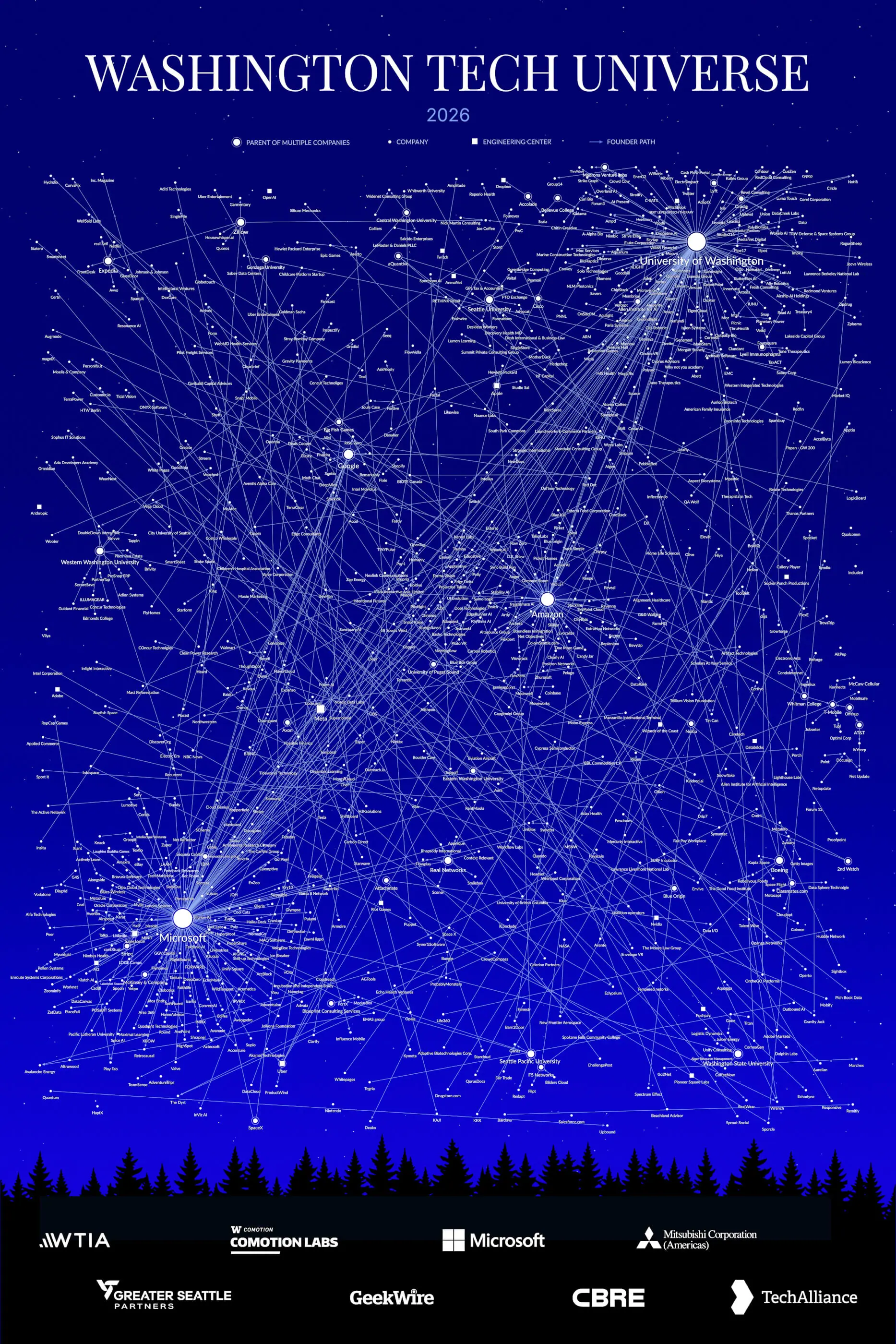
How interconnected is Washington’s tech industry? Enough that a large share of the state’s companies can trace their lineage to Microsoft, the University of Washington, Amazon, and a handful of other institutions.
A new visualization from the Washington Technology Industry Association (WTIA), unveiled this week, charts those family trees. But the “Washington Tech Universe” map offers only a partial view: Washington is home to 25,000 tech companies, and just 625 are featured.
“This is not a ranker of all the best companies,” said Nick Ellingson, WTIA’s vice president of innovation and entrepreneurship, during a presentation at Seattle Tech Week. The point, he said, is to show the region’s connectivity and to make the case for investing in the community as a whole.
The “Tech Universe Map” comes 11 years after the trade group published a similar visualization. According to Ellingson, the update came because people kept asking for it, not because of a single event. It’s unrelated to WTIA’s efforts to help Washington establish a public AI narrative.
That said, the 2026 edition is markedly different from the one in 2015: The new map looks at the entire state, aiming to comprehensively chart the connections among different companies, while the prior version was limited to companies in Seattle, with a more narrow focus on acquisitions and similar data.
Microsoft and UW produce the most founders
WTIA’s data shows that today, Washington has four main founder “hubs,” with Microsoft being the largest. About a quarter of the mapped companies — 161 of 625 — have at least one founder who came out of Microsoft. UW is the second with 143 companies, followed by Amazon, which anchors 58 firms. Google rounds out the group with 20 connections, though it’s a pipeline that didn’t exist in WTIA’s 2015 map.
WTIA’s Vice President of Innovation and Entrepreneurship, Nick Ellingson, unveils the 2026 “Tech Universe Map” at the University of Washington’s Comotion Lab on July 27, 2026, explaining how to read the map. (Photo by Ken Yeung, click to enlarge)
UW isn’t the only school producing founders. WTIA’s map traces company lineages to Washington State, Western Washington, Central Washington, Eastern Washington, Whitman College, Seattle University, and Seattle Pacific. Still, UW accounts for 70% of the map’s university connections.
Broken down, the data shows that nearly two out of three companies (64%) grew out of another company listed on WTIA’s map. A third came out of a university, or out of a company that operates in Washington without being headquartered here.
Google is the clearest example of the latter since it’s based in California but has a significant presence here. Moreover, WTIA found that 44% of mapped companies had founders who previously worked at two or more Washington organizations before starting theirs.
Ellingson called the hubs “gravity wells that bend the entire region toward the next generation of founders” in the announcement.
However, he cautioned that this pipeline concentrated around four main sources could be a risk. Some of the hubs he expects to grow next, such as Google, OpenAI, Anthropic, and Nvidia, are headquartered elsewhere and maintain engineering centers here, a presence that is easier to scale back. Microsoft, Amazon, and UW aren’t going anywhere. The next generation of hubs has no such guarantee.
To mitigate this risk, Ellingson called for broad community support for these hubs, saying it would keep the flywheel going.
These companies, he said, “are growing not just the jobs at their companies, but they’re creating the next employers, venture-scale startups, and tech companies that go on to build amazing things, and hire the next generation of talent here and bring more talent to the area, who then go and create their own startups.”
The next hubs are forming around AI
WTIA also recognized AI’s impact on Washington’s tech ecosystem. Although the technology was not a formal selection criterion, it became evident that AI would be a dominant theme among the featured companies. In fact, firms like Read AI, Karat, Yoodli, Outreach, and Pictory appear on the map for the first time. And Ellingson revealed that “many of the startups on the map are AI startups.”
“Twenty-three percent of the AI talent in the United States is here in Seattle,” he said.
That, along with the burgeoning startup ecosystem, is why organizations like the Allen Institute for AI (Ai2) and AI House, are poised to have large constellations of their own. AI House was formerly the AI2 Incubator. It spun out as an independent entity in 2022 and rebranded in June.
WTIA noted that Ai2 is the first research lab on its map to operate as a “founder factory.”
Other AI companies making their presence known on the “Tech Universe Map” include OpenAI and Anthropic. While not Washington-native, both AI model makers have established or expanded their outposts in the state since 2015.
Ellingson predicted that, like Ai2, both would eventually become major hubs.
How companies were selected
UW alumni Jessica Forcucci explains her design process in creating WTIA’s 2026 “Tech Universe Map.” (Photo by Ken Yeung)
To create the “Tech Universe Map,” WTIA started out with a dataset of 3,500 Washington-based tech companies with at least $1 million in funding or revenue according to PitchBook.
The group was filtered further to those that were headquartered or had notable engineering centers in the state, were still active, and had “meaningful” Washington-grown connections through founder or university lineage. The GeekWire 200 was also used in the process.
WTIA enlisted the help of UW graduate Jessica Forcucci and a team of designers to create the visualization. In brief remarks, Forcucci explained her vision for the “Tech Universe Map,” saying the goal was to “demonstrate the interconnectivity” these companies had with each other.
Predicting what the next map will look like
As Washington’s tech ecosystem evolves, Ellingson predicted there will not only be bigger constellations of AI companies, but also quantum, fusion and advanced energy, and space and defense. He believed more tech clusters will blossom statewide beyond King County.
Ellingson said WTIA is seeing real growth in Wenatchee, the Tri-Cities and Spokane. Those regional clusters are small now, he said, but he expects them to be substantial by 2031.
To make the next map happen, Ellingson urged people to open doors for others, make introductions without expecting anything in return, and give first, building community and forming new constellations.

 Login
Login