❌

Normal view

There are new articles available, click to refresh the page.
Yesterday — 28 October 2026Main stream

A new pal for Pluto? Rubin Observatory finds its first dwarf planet candidate
27 October 2026 at 22:54
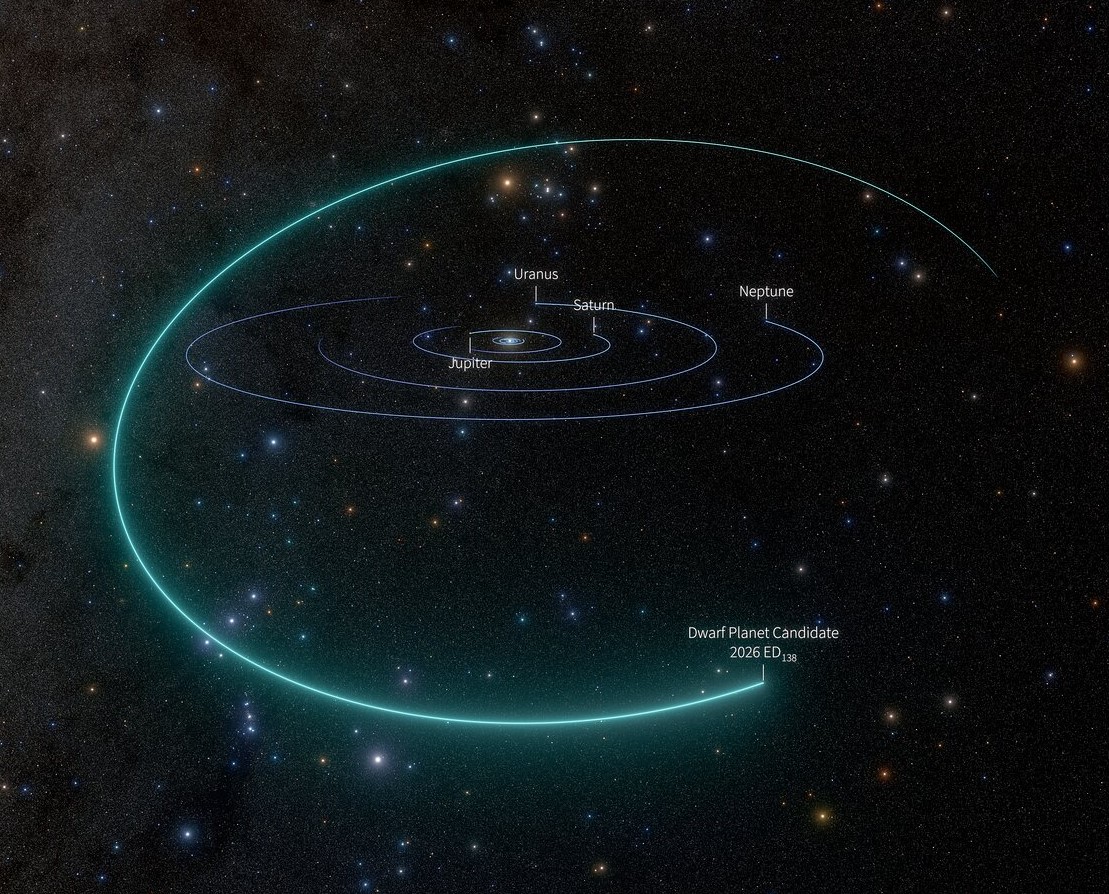
A visualization shows the orbital path of the dwarf planet candidate 2026 ED138 in relation to the orbits of the solar system’s larger planets. Click on the image for a larger version. (Credit: NSF-DOE Vera C. Rubin Observatory / NOIRLab / SLAC /AURA / R. Proctor)

Astronomers sorting through data from the Vera C. Rubin Observatory in Chile have found an icy world that has a good chance of joining Pluto in the solar system’s retinue of dwarf planets.

University of Washington astronomer Mario Jurić joined the astronomer who made the discovery, Matthew Holman of the Harvard & Smithsonian Center for Astrophysics, to announce the findings today at a meeting of the American Astronomical Society’s Division for Planetary Sciences in Spokane, Wash.

Jurić, the Rubin team’s solar system lead scientist, said the observatory’s capabilities made it possible to detect and characterize the new dwarf planet candidate, known as 2026 ED138.

“Rubin is giving us an unprecedented capacity to explore the sky through a combination of speed, depth, and precision,” Jurić said in a news release. “And the discovery is just the beginning: Once we identify a new object, we can search back months, and sometimes even decades, finding it in images where nobody knew to look. This ability to both discover and ‘precover’ objects is transforming how quickly and accurately we can determine their orbits and understand the distant solar system.”

2026 ED138 traces a tilted orbital path that takes it well beyond Pluto, the solar system’s best-known dwarf planet. It’s currently at a distance of 46 astronomical units, where 1 AU equals the average distance between Earth and the sun. Pluto, by comparison, is currently about 40 AU from the sun.

Astronomers suspect ED138 formed billions of years ago closer to the sun before being flung into a wider orbit by gravitational interactions with Neptune.

Based on an analysis of its distance, brightness and assumed composition, ED138 is thought to be somewhere between 600 and 1,500 kilometers (373 to 932 miles) in diameter. At that size, an icy object should possess enough gravity to pull itself into a round shape — satisfying the primary physical criterion for a dwarf planet.

ED138 may be Rubin’s first dwarf planet candidate, but it almost certainly won’t be the last. Thanks to the observatory’s Simonyi Survey Telescope — named after the family of Seattle software billionaire Charles Simonyi — the Rubin team detected more than 11,000 new asteroids even before June’s official start of a 10-year survey of the southern sky.

Rubin’s researchers analyze the data from those scans to find objects of interest — ranging from asteroids to gamma-ray bursts — and track them over time. On Oct. 13, Holman was running data through a search code that he developed with Kevin Napier, a colleague at the Center for Astrophysics. ED138 stood out due to its exceptional size and brightness.

“My first reaction was one of excited disbelief,” Holman said. “Objects like this are very rare, so I immediately started checking whether I or the code had done something wrong.”

To confirm the discovery, Holman, Jurić and their colleagues found 30 archived observations of ED138 dating back to March 4. The Asteroid Institute’s ADAM Precovery service found still more images of the object, going back to 2016, in the archives of a different astronomical survey.

The precovery data confirmed that ED138 was a special case.

“Finding an object this big, roughly 1,000 kilometers across, is something that happens maybe once in a generation,” Jurić said. “It’s the largest trans-Neptunian object found in about 20 years, and Rubin turned it up while we were still commissioning the telescope.”

In 2006, the International Astronomical Union defined dwarf planets as planetary objects that are big enough to crush themselves into a roundish shape — technically speaking, into a state of hydrostatic equilibrium — but not big enough to clear their orbital neighborhood.

So far, the IAU has classified five solar system objects as dwarf planets — including Ceres in the main asteroid belt, plus Pluto, Eris, Haumea and Makemake in the region beyond Neptune. 2026 ED138 joins a host of other celestial objects that are thought to be dwarf planets but haven’t yet been added to the IAU’s official list.

“The official list hasn’t moved since 2008,” Jurić told GeekWire in an email. “I’m not sure if there’s an active process that reviews candidates, and what are the timelines.”

Jurić and his colleagues hope additional observations will boost ED138’s chances of attaining true dwarf planethood.

“The next step in building the case would be to prove it’s round (in hydrostatic equilibrium),” he wrote. “The means to do that would be directly through occultations (and there’s a good chance of that, given it’s in a dense stellar field), and then thermal measurements plus modeling and light curves (or the absence of variability).”

Before yesterdayMain stream

Suspected Second-generation Planet Solves NASA Hubble Cold Case

5 October 2026 at 11:00
 
5 Min Read

Suspected Second-generation Planet Solves NASA Hubble Cold Case

A gaseous planet in the right foreground, seen mostly in silhouette, orbits a small, white star in the background at left. The star is surrounded by a thin, bright white disk tilted from lower left to upper right. A semi-transparent tail of material comes off the planet toward upper right. Distant stars dot the black background of space.
This artist’s concept depicts a possible explanation for the unusual chemical abundances NASA’s Hubble Space Telescope detected in the HS 0209+0832 system: a second-generation planet orbiting a white dwarf star. 
Credits:
Artwork: NASA, ESA, Leah Hustak (STScI)

Diligent sleuthing by astronomers has broken open a cold case in the data archive of NASA’s Hubble Space Telescope. In a study published Monday in Nature Astronomy, researchers report uncovering a surprising chemical clue that indicates the white dwarf star HS 0209+0832 may host a second-generation planet. 

A white dwarf is the remnant core of a low-mass star that has burned through all its nuclear fuel and lost its outer envelope of gas and dust to space. A second-generation planet is a world that forms around the stellar remnant from its cast-off material. 

“Rather than the white dwarf stage being a kind of epilogue to the story of a star and its planets, this research points to the systems we are familiar with only being the first chapter of a potentially much longer tale, with some new characters showing up. That’s a really exciting prospect to pursue,” said Jamie Williams, astronomer and lead author, a doctoral candidate at the University of Warwick in the United Kingdom.

Earth and the other planets in our solar system are first-generation planets, which form from material left over from a star’s birth. 

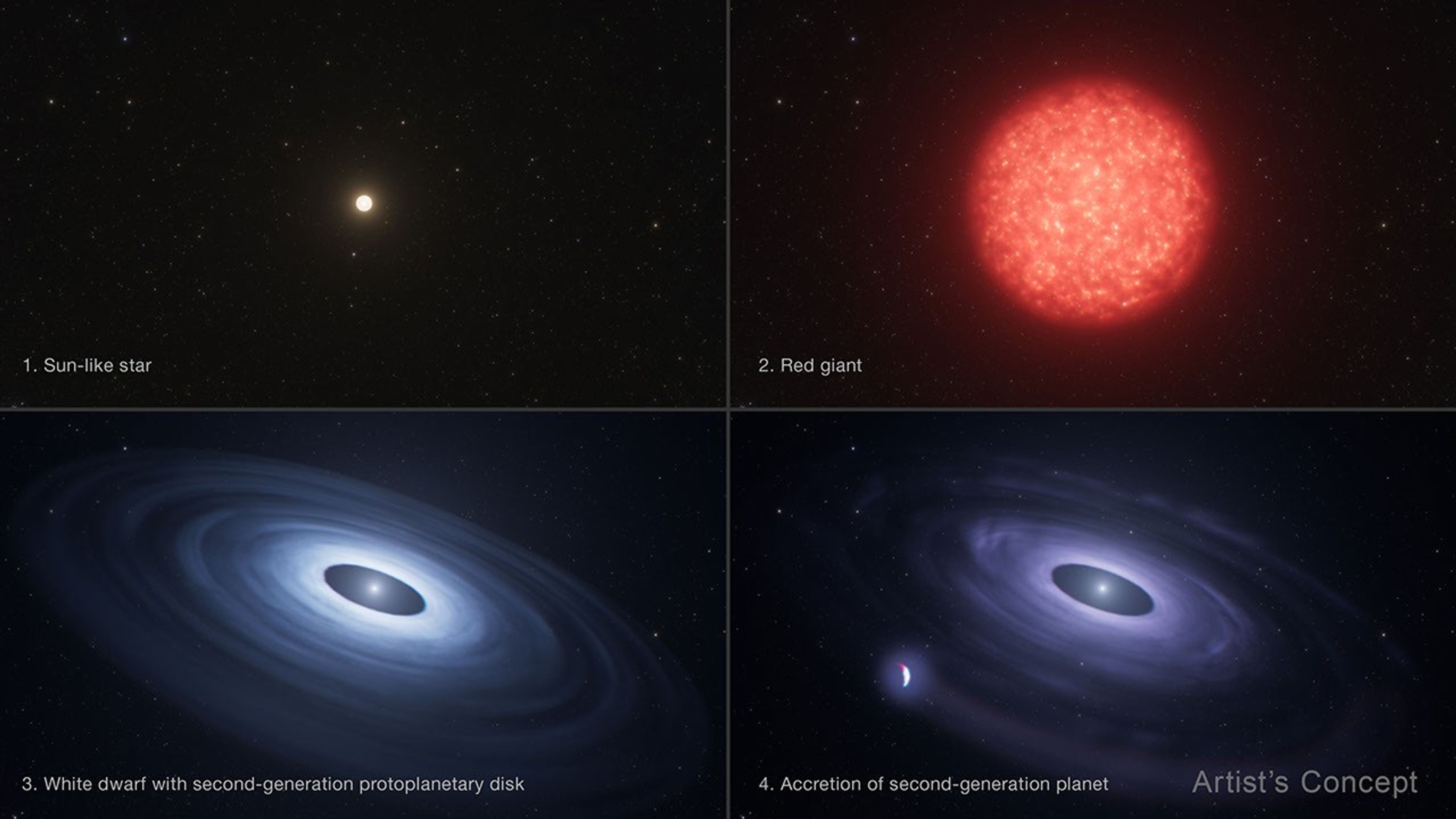
Illustration divided into quadrants, showing the evolution of a star system over time. The upper left is labeled 1. Sun-like star. It shows a small, glowing yellow star centered with other faint stars in the background of space. The upper right quadrant is labeled 2. Red giant. It shows a much larger, puffy orange-red star with a yellow glow within. The bottom left quadrant is labeled 3. White dwarf with second-generation protoplanetary disk, showing a bright white star, smaller than the original Sun-like star, surrounded by a glowing dusty blueish-white disk that is brighter closer to the star. The lower right quadrant is labeled 4. Accretion of a second-generation planet. It shows a similar star to quadrant 3, but the disk is reduced in size and is more purple in color. A planet orbits to the lower left of the star. The planet is larger than the star and has a faint tail leading back to the disk around the star.
This artist’s concept, not to scale, imagines the evolution of a Sun-like star (1) into an aging red giant (2) and then a small, bright white dwarf surrounded by a disk of its expelled outer layers (3), from which a second-generation planet forms (4). 
Illustration: NASA, ESA, Leah Hustak (STScI)

“What Hubble is showing us in this white dwarf system is something we haven’t seen before: a high abundance of the element niobium, the signature of which I was unfamiliar with when I first found it in the archival data,” Williams said.

When Hubble first observed the star in 1999, the data contained roughly 100 chemical features that could not be identified. Williams went back to those records armed with an updated chemical database and found that niobium matched many of the mystery features.

Williams explained that, while niobium is found in our solar system and has multiple uses on Earth, including in jewelry and medical imaging devices, the amount Hubble found in the HS 0209+0832 system points to a planet forming not from a star’s birth, but from the material ejected as it dies. 

“Niobium and other elements heavier than iron are astronomically special because, unlike many common elements, they are not formed in the cores of stars by thermonuclear fusion,” said Nicholas Stone, a theoretical astrophysicist at the University of Wisconsin – Madison and member of the research team. “Instead, these heavy elements can only be synthesized in the exotic conditions that briefly emerge inside dying stars. The presence of niobium is a signpost of these ‘death’ throes, and the expulsion of the dying star’s innards into space.” 

Once the star ejected this chemically enriched material, the team theorizes that some of it coalesced into a gas giant planet. The remainder of the ejecta dispersed long ago, but the planet remains.

“When Jamie asked me about niobium in relation to this study I was truly gobsmacked, as that element had not been reported in any other white dwarf analyzed to date. Once we realized it was there, everything fell into place,” said astronomer and study co-author Boris Gaensicke, also at the University of Warwick.

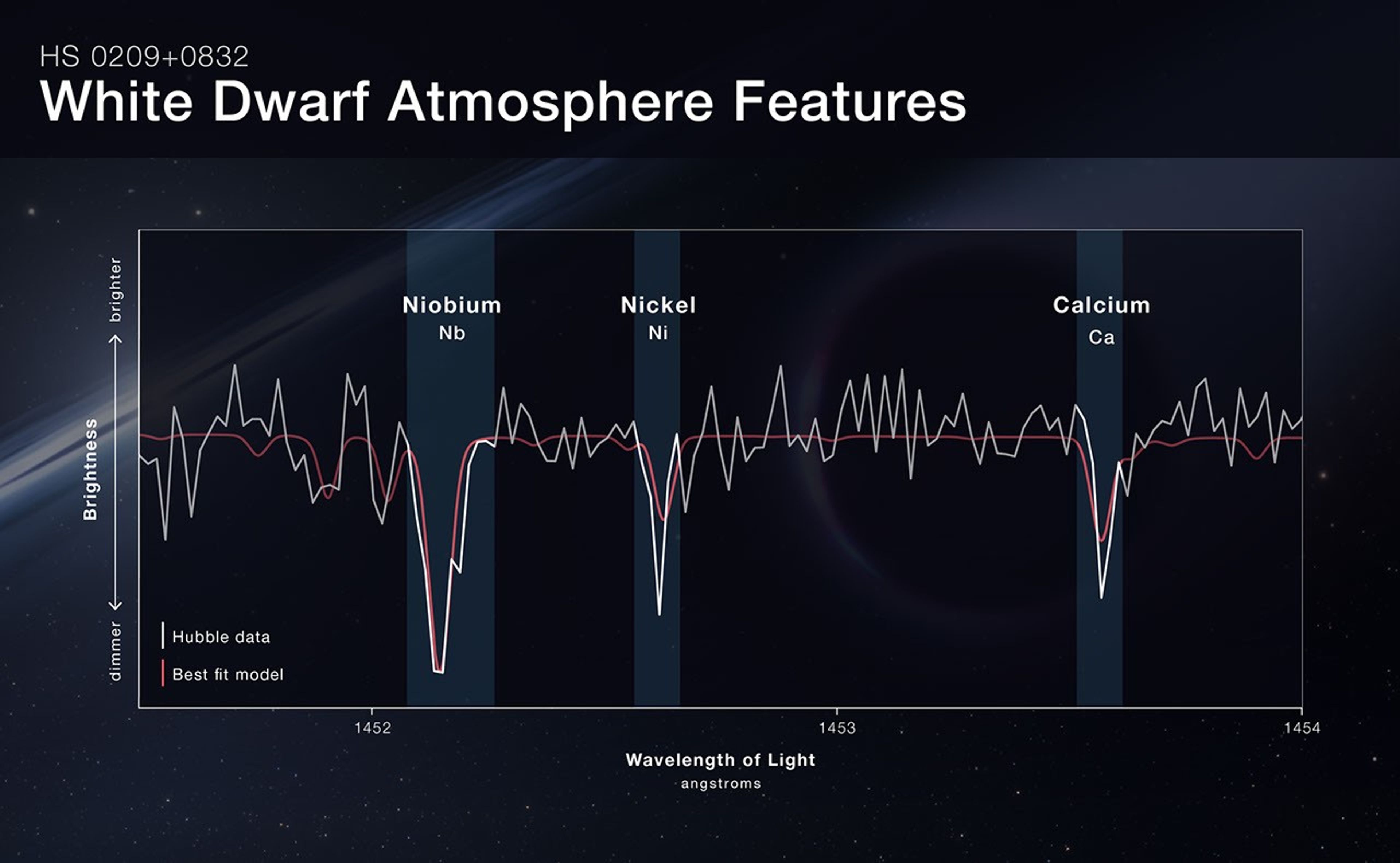
Line graph titled HS 0209+0832, White Dwarf Atmosphere Features. Hubble Space Telescope spectral data is shown in white, compared with a best fit model in red. The vertical y axis is labeled Brightness, with brighter at the top and dimmer at the bottom. The horizontal x axis is labeled Wavelength of light, angstroms. One-third of the way across the x axis is labeled 1452. To the right of the graph’s center is angstrom label 1453, and the right edge of the graph is labeled angstrom 1454.

Three dramatic dips in the spectrum are labeled with element names and abbreviations: Niobium, Nb, Nickel, Ni, and Calcium, Ca. The niobium Hubble data and model match well and appear to the right of the 1452 angstrom label. To the right, Hubble’s nickel data is much dimmer than the model, appearing just left of the graph’s center. Hubble’s data for calcium is a little dimmer than the model, and appears to the right, about one-sixth of the way from the right-hand edge of the graph.
NASA’s Hubble Space Telescope spectrum shows the unusual abundances of certain elements it found in the HS 0209+0832 system. Dips indicate where niobium, nickel, and calcium are absorbing light, so less light in that part of the spectrum reached Hubble. 
Illustration: NASA, ESA, Leah Hustak (STScI)

The research team confirmed the Hubble observations with data from NASA’s retired FUSE (Far Ultraviolet Spectroscopic Explorer) mission, which also showed strong signatures of niobium in the HS 0209+0832 system. 

NASA’s TESS (Transiting Exoplanet Survey Satellite) also observed the white dwarf for four months, allowing it to detect periodic brightness variations that indicate that a planet orbits at a distance of about 3.7 million miles (6 million kilometers), much closer than Mercury orbits the Sun. 

The research team estimates the candidate planet is a gas giant about the size of Jupiter that is rapidly losing atmosphere. Because the white dwarf star is relatively new, it is still very hot and likely blasting this planet with energy that is stripping its outer material. This could result in the planet having a comet-like tail of material that would form a disk around the white dwarf star and fall back on to its surface, leading to Hubble detecting the niobium when studying the star. Despite this mass loss, Williams said that the planet is likely not a temporary blip on the cosmic radar. 

“If the second-generation planet is there, I think it is likely to survive. Eventually the white dwarf will cool and then maintain a consistent temperature, with the planet in its stable habitable zone for millions of years,” Williams said.

Williams added that there is still a lot of work to do to understand these types of systems — how second-generation planets form, how common or rare they are, and how they evolve in orbit around a “dead” star. He’ll use Hubble to explore these questions for the next several years, hoping to build up substantial data and statistics about these new types of celestial bodies.

“I think this research is an important example of the fact that scientific discovery is not a straight path,” Gaensicke said. “It often needs that magical moment when people discuss big questions on their minds and realize that together they can find unexpected answers.”

The Hubble Space Telescope has been operating for more than three decades and continues to make ground-breaking discoveries that shape our fundamental understanding of the universe. Hubble is a project of international cooperation between NASA and ESA (European Space Agency). NASA’s Goddard Space Flight Center in Greenbelt, Maryland, manages the telescope and mission operations. Lockheed Martin Space also supports mission operations at Goddard. The Space Telescope Science Institute in Baltimore, which is operated by the Association of Universities for Research in Astronomy, conducts Hubble science operations for NASA.

Facebook logo
Instagram logo

Related Images & Videos

A gaseous planet in the right foreground, seen mostly in silhouette, orbits a small, white star in the background at left. The star is surrounded by a thin, bright white disk tilted from lower left to upper right. A semi-transparent tail of material comes off the planet toward upper right. Distant stars dot the black background of space.

HS 0209+0832 System (Artist’s Concept)

This artist’s concept depicts a possible explanation for the unusual chemical abundances NASA’s Hubble Space Telescope detected in the HS 0209+0832 system: a second-generation planet orbiting a white dwarf star.

Line graph titled HS 0209+0832, White Dwarf Atmosphere Features. Hubble Space Telescope spectral data is shown in white, compared with a best fit model in red. The vertical y axis is labeled Brightness, with brighter at the top and dimmer at the bottom. The horizontal x axis is labeled Wavelength of light, angstroms. One-third of the way across the x axis is labeled 1452. To the right of the graph’s center is angstrom label 1453, and the right edge of the graph is labeled angstrom 1454. Three dramatic dips in the spectrum are labeled with element names and abbreviations: Niobium, Nb, Nickel, Ni, and Calcium, Ca. The niobium Hubble data and model match well and appear to the right of the 1452 angstrom label. To the right, Hubble’s nickel data is much dimmer than the model, appearing just left of the graph’s center. Hubble’s data for calcium is a little dimmer than the model, and appears to the right, about one-sixth of the way from the right-hand edge of the graph.

Hubble Spectrum of White Dwarf HS 0209+0832

NASA’s Hubble Space Telescope spectrum shows the unusual abundances of certain elements it found in the HS 0209+0832 system. Dips indicate where niobium, nickel, and calcium are absorbing light, so less light in that part of the spectrum reached Hubble.

Illustration divided into quadrants, showing the evolution of a star system over time. The upper left is labeled 1. Sun-like star. It shows a small, glowing yellow star centered with other faint stars in the background of space. The upper right quadrant is labeled 2. Red giant. It shows a much larger, puffy orange-red star with a yellow glow within. The bottom left quadrant is labeled 3. White dwarf with second-generation protoplanetary disk, showing a bright white star, smaller than the original Sun-like star, surrounded by a glowing dusty blueish-white disk that is brighter closer to the star. The lower right quadrant is labeled 4. Accretion of a second-generation planet. It shows a similar star to quadrant 3, but the disk is reduced in size and is more purple in color. A planet orbits to the lower left of the star. The planet is larger than the star and has a faint tail leading back to the disk around the star.

White Dwarf HS 0209+0832 over Time (Artist’s Concept)

This artist’s concept, not to scale, imagines the evolution of a Sun-like star (1) into an aging red giant (2) and then a small, bright white dwarf surrounded by a disk of its expelled outer layers (3), from which a second-generation planet forms (4).

An artist's concept image of a white dwarf star with an orange disk of material around it. The NASA

Dying Star Creates Brand New Planet (Video)

What if a star’s death could give rise to an entirely new planet? New analysis of archival Hubble data points to the possibility of “dead” white dwarf stars hosting second-generation planetary systems. 


Share

Details

Last Updated
Oct 05, 2026
Editor
Andrea Gianopoulos
Contact
Media

Claire Andreoli
NASA’s Goddard Space Flight Center
Greenbelt, Maryland
claire.andreoli@nasa.gov

Leah Ramsay, Christine Pulliam
Space Telescope Science Institute
Baltimore, Maryland

❌
❌