Normal view

There are new articles available, click to refresh the page.
Before yesterdayMain stream

NASA’s Hubble, Webb Find Far-out Solar System Objects ‘Remember’ Past
8 September 2026 at 10:00
 

5 min read

NASA’s Hubble, Webb Find Far-out Solar System Objects ‘Remember’ Past

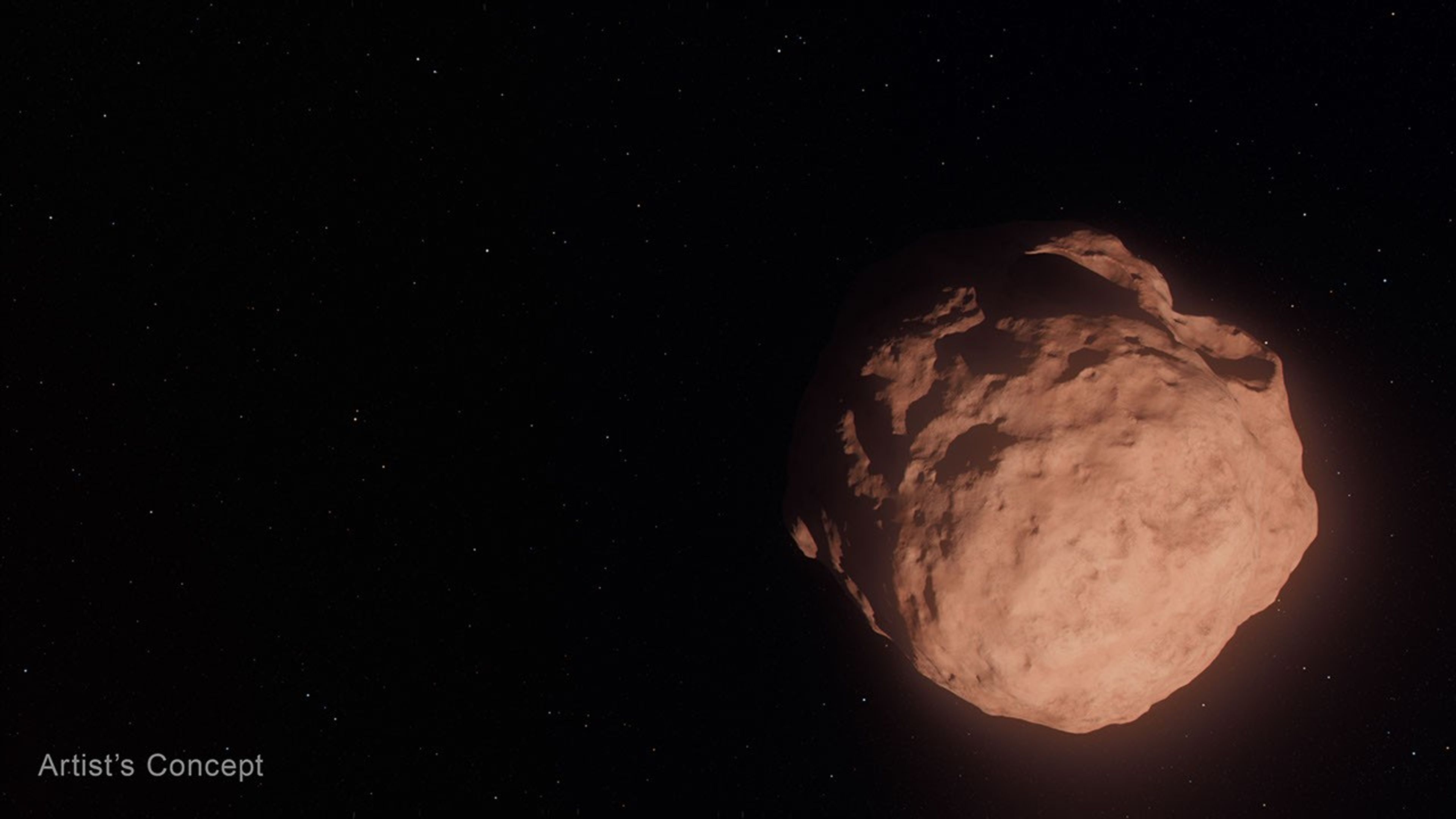
An illustration of a roughly spherical, rocky object against a black background speckled with distant, white stars. The object is the color of red clay and is pockmarked with craters and other geological scars. At the bottom left corner of the illustration in gray lettering is the label “Artist’s Concept.”
This artist’s concept depicts a Trans-Neptunian Object, a small, faint, icy body orbiting the Sun beyond the orbit of Neptune. These objects are so small that even with NASA’s Hubble and Webb space telescopes, they appear only as tiny points of light.
Artwork: NASA, ESA, Leah Hustak (STScI)

For the first time, scientists used the joint power of NASA’s Hubble and James Webb Space Telescopes to study some of the most far-flung bodies in our solar system, Trans-Neptunian Objects (TNOs). Some of these are the smallest and faintest ever directly seen. The researchers unexpectedly found fewer small TNOs than they expected, and that the colors of these bodies followed the same relationships as their larger family members.

These objects are typically small, faint, icy bodies orbiting the Sun beyond the orbit of Neptune. Most are more than 100 million times dimmer than objects visible to the unaided eye. In two complementary papers published Tuesday in The Astronomical Journal, teams analyzed the color, composition, and size distribution of 27 newly discovered tiny, dim TNOs. 

This class of small bodies offers the best view into an early stage of planet-building, when a disk of dust and pebbles in orbit around the Sun coalesced into city-sized “planetesimals” — the solid building blocks that clump together to form planets — but had not yet merged into full-sized worlds.  Beyond Neptune, this second stage never happened, leaving behind a frozen population of planetesimals.

In the deepest TNO survey to date, teams led by PhD candidates from the University of Victoria in Canada, under the guidance of the National Research Council of Canada, and Northern Arizona University in Flagstaff examined a patch of sky simultaneously with Hubble, observing the TNOs’ visible light, and Webb, observing their infrared light. The team of researchers measured the objects’ colors, which are like a fingerprint of the surface composition, as well as their sizes and determined their orbits. 

In the coordinated observations, the teams studied two different types of TNOs. The first, dynamically “cold” TNOs, are on their original, relatively circular orbits around the Sun in the plane of the solar system. The second type, dynamically “hot” TNOs, formed between the current locations of Uranus and Neptune but were pushed outward where they are today when the outer gas giants migrated early in the solar system’s history. Today they reside in highly elliptical orbits and move in and out of the plane of our solar system.

NASA’s Goddard Space Flight Center; Lead Producer: Paul Morris

Prior to these observations, astronomers thought that small TNOs from both hot and cold populations would have undergone many collisions, changing their surfaces compared to larger TNOs. But that’s not what the observations showed. Instead, the small bodies look like their larger counterparts. This implies that collisions are not changing the surfaces significantly—perhaps because there are fewer collisions than expected, or because the TNOs somehow retain their primordial, pre-collision compositions. The teams are still trying to unravel this mystery.

“You could imagine a scenario where getting knocked around and fragmented would change the surface composition, and then you would see a different surface color for tiny TNOs compared to their larger siblings. So it’s really fascinating to see that the smallest objects are somehow ‘remembering’ and preserving the history of how they were made,” said Northern Arizona University PhD candidate Anastasia Morgan, who led the study of color and composition

“These dynamically ‘hot’ TNOs retain a signature of where they were born, even though they’ve been orbitally scrambled since then,” said co-author David Trilling of Northern Arizona University.

Both the “hot” and “cold” populations seem to keep the same colors as when they were formed, with little change since the birth of the solar system. 

The Webb data also allowed researchers to measure the number of objects of each size. They found that the overall size distributions for both populations were surprisingly similar.

“It’s very interesting that the process of planetesimal formation ends up producing the same distribution of sizes for both cold and hot populations, despite forming in different regions of the early solar system. The process seems to be insensitive to disk conditions, producing similar planetesimal sizes whether the disk is hot or cold, and dense or fluffy,” said University of Victoria PhD candidate Marielle Eduardo, who led the study on size distribution

Researchers also found fewer of these very small bodies than they expected based on some planet formation models. Webb discovered 27 new, remarkably dim TNOs, one so faint it is equivalent to standing on Earth and seeing a small swarm of fireflies on the Moon. The smallest one they observed has a diameter of about 3 miles (5 kilometers), which is about five times smaller than what is possible to detect with the most sensitive ground-based telescopes.

This project would not have been possible without Hubble and Webb working together to detect and characterize these TNOs. With Hubble’s sensitivity in visible light and Webb’s in infrared, the space telescopes provide more insights than either can on its own.

The Hubble Space Telescope has been operating for over three decades and continues to make ground-breaking discoveries that shape our fundamental understanding of the universe. Hubble is a project of international cooperation between NASA and ESA (European Space Agency). NASA’s Goddard Space Flight Center in Greenbelt, Maryland, manages the telescope and mission operations. Lockheed Martin Space, based in Denver, also supports mission operations at Goddard. The Space Telescope Science Institute in Baltimore, which is operated by the Association of Universities for Research in Astronomy, conducts Hubble science operations for NASA.

Facebook logo
Instagram logo

The James Webb Space Telescope is the world’s premier space science observatory. Webb is solving mysteries in our solar system, looking beyond to distant worlds around other stars, and probing the mysterious structures and origins of our universe and our place in it. Webb is an international program led by NASA with its partners, ESA (European Space Agency) and CSA (Canadian Space Agency).

Facebook logo
Instagram logo

To learn more about NASA’s space telescopes, visit:
https://science.nasa.gov/universe

Related Images & Videos

An illustration of a roughly spherical, rocky object against a black background speckled with distant, white stars. The object is the color of red clay and is pockmarked with craters and other geological scars. At the bottom left corner of the illustration in gray lettering is the label “Artist’s Concept.”

Trans-Neptunian Object Illustration

This artist’s concept depicts a Trans-Neptunian Object, a small, faint, icy body orbiting the Sun beyond the orbit of Neptune. These objects are so small that even with NASA’s Hubble and Webb space telescopes, they appear only as tiny points of light.

An illustration of a roughly spherical, rocky object against a black background speckled with distant, white stars. The object is the color of red clay and is pockmarked with craters and other geological scars. At the bottom left corner of the illustration in gray lettering is the label “Artist’s Concept.”

Tiny Worlds Discovered by Hubble and Webb

This video explains how Hubble and Webb are giving scientists a new look at some of the solar system’s oldest survivors and revealing new clues about how the building blocks of planets, including Earth, first formed.

Explore More

Illustration of two large, cratered rocks in the foreground right. Another rock is seen in the distance to the left. The black background of space shows the hazy Sun and zodiacal light due to dust in the solar system, as well as scattered distant stars. The words

NASA’s Hubble Finds Kuiper Belt Duo May Be Trio

A team of researchers found a potential three-body system in the Kuiper Belt. The system, known as the Altjira, challenges traditional collision theories by suggesting that these triple systems might form directly from the gravitational collapse of material in the early solar disk.

A rock that looks like a red space snowman

NASA’s Webb Reveals the Ancient Surfaces of Trans-Neptunian Objects

Within the first two years of science operations, Webb took high-quality spectra of over 75 TNOs and provided the first comprehensive look at what they are made of.

A purplish-gray sphere against the backdrop of space, black with countless multicolored stars and the bright disk of the milky way. The right side of the sphere is lit up, showing a pockmarked surface (including three large craters) while the left side is in darkness.

Uncovering Icy Objects in the Kuiper Belt

Hubble observations of the outskirts of our solar system found a moon orbiting Makemake and several new moons around Pluto. These observations played a critical role in helping NASA plan the New Horizons spacecraft’s flyby of Pluto and beyond.

Trans-Neptunian Object

Hubble Harvests Distant Solar System Objects

Astronomers using clever techniques to cull the data archives of NASA’s Hubble Space Telescope have added 14 new TNOs to the catalog. 

A rock that looks like a red space snowman

Kuiper Belt: Exploration

The Kuiper Belt is a doughnut-shaped region of icy objects beyond the orbit of Neptune. It is home to Pluto and most of the known dwarf planets and some comets.


Share

Details

Last Updated
Sep 09, 2026
Editor
Andrea Gianopoulos

Contact
Media

Claire Andreoli
NASA’s Goddard Space Flight Center
Greenbelt, Maryland
claire.andreoli@nasa.gov

Ann Jenkins, Christine Pulliam
Space Telescope Science Institute
Baltimore, Maryland

NASA’s Hubble Spies Superbubble Scene

3 September 2026 at 09:16

3 min read

NASA’s Hubble Spies Superbubble Scene

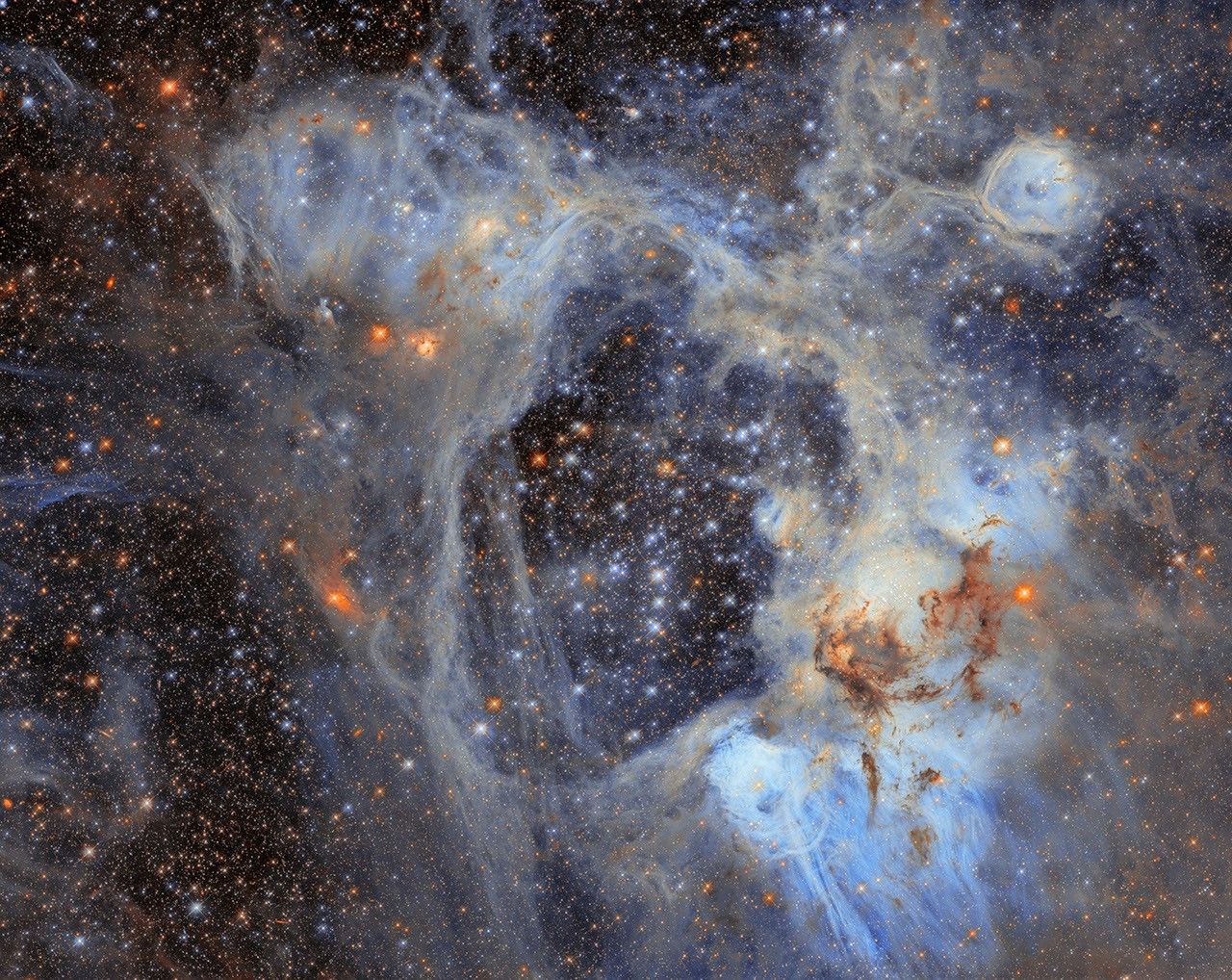
A dense field of stars fills the image, surrounded by wispy clouds of gas and dust. Pale blue and grey nebulosity forms an intricate web across the scene, with darker clouds of dust concentrated towards the lower right. Numerous bright stars appear in shades of blue, white, and orange.
This Hubble Space Telescope image features the picturesque nebula LHA 120-N44, or N44.
NASA, ESA/Hubble, D. Gouliermis

This NASA/ESA Hubble Space Telescope image features a sprawling cosmic vista in the Large Magellanic Cloud, or LMC, the largest of the small galaxies that orbit our Milky Way galaxy. At just 160,000 light-years away, the LMC offers a close look at highly active star birth sites like the one in this image. This photogenic nebula, named LHA 120-N44, or N44, is in the constellation Dorado.

N44 is dominated by two features: a vast central void and a shell of dense, dusty gas. The central void is a ‘superbubble’ spanning roughly 210 by 140 light-years across. The glittering stars at the center of the void are responsible for its creation; through their powerful stellar winds and explosive supernovae, these stars expelled much of the gas from which they were born.

When the stars of N44’s central star cluster swept away this gas, the expelled gas compressed and formed a shell around the superbubble. New stars are forming in this compressed gas shell, making N44 an interesting target for astronomers who are using the nebula to study how stars form in this environment. Their goal is to understand how long it takes from the collapse of cold gas clouds into dense knots to the moment nuclear fusion ignites in the heart of a newborn star.

The data in this image is from an observing program (#14689; PI: Gouliermis) that used Hubble to survey N44 and take a census of its stars, cataloging nearly half a million stars within the cluster as well as interlopers drifting in front of it. Of the stars surveyed, nearly 30,000 are what astronomers call pre-main-sequence stars, which have yet to begin fusing hydrogen into helium in their cores. Astronomers discovered this treasure trove of baby stars thanks to the high sensitivity and fine spatial resolution of Hubble’s instruments that can pick out faint objects in crowded clusters.

The gas shell surrounding the superbubble is energized by ultraviolet radiation from massive stars, causing it to glow and highlighting several distinct features. Each feature within the broader N44 star-forming complex was cataloged by astronomer Karl Henize in the 1950s. One feature is a smaller bubble, cataloged as N44F, that is located near the upper-right corner of this image. N44F is an interstellar bubble blown by the intense stellar winds of a single hot and massive star. As this previously released Hubble closeup shows, the star’s furious winds and radiation have sculpted the surrounding bubble and created pillars of dusty gas.

Hubble’s sensitive observations of the lowest-mass stars in this region open a new window onto star formation in regions that, like the LMC or the galaxies in the early universe, are poor in elements heavier than helium.

Text Credit: ESA/Hubble

Facebook logo
Instagram logo

Media Contact:

Claire Andreoli
NASA’s Goddard Space Flight CenterGreenbelt, MD
claire.andreoli@nasa.gov

Explore More

Download image of N44

Hubble’s Inside The Image: N44 Superbubble

In this YouTube video, Dr. Ken Carpenter takes us on a journey through the Nebula, teaching us some of the interesting science behind this famous Hubble image.

Download image of N44

Hubble Views N44 Superbubble

N44 is a complex nebula filled with glowing hydrogen gas, dark lanes of dust, massive stars, and many populations of stars of different ages. One of its most distinctive features, however, is the dark, starry gap called a “superbubble,” visible in this Hubble image in the upper central region. 

Download image of N44

Large N44 Mosaic Image

Download various sizes of Hubble’s large N44 mosaic, including a high resolution, 14,478 x 19,908 pixel (1.6 GB) image

NASA’s Hubble Tracks New Decagon Encircling Saturn’s South Pole

2 September 2026 at 14:00
 

5 min read

NASA’s Hubble Tracks New Decagon Encircling Saturn’s South Pole

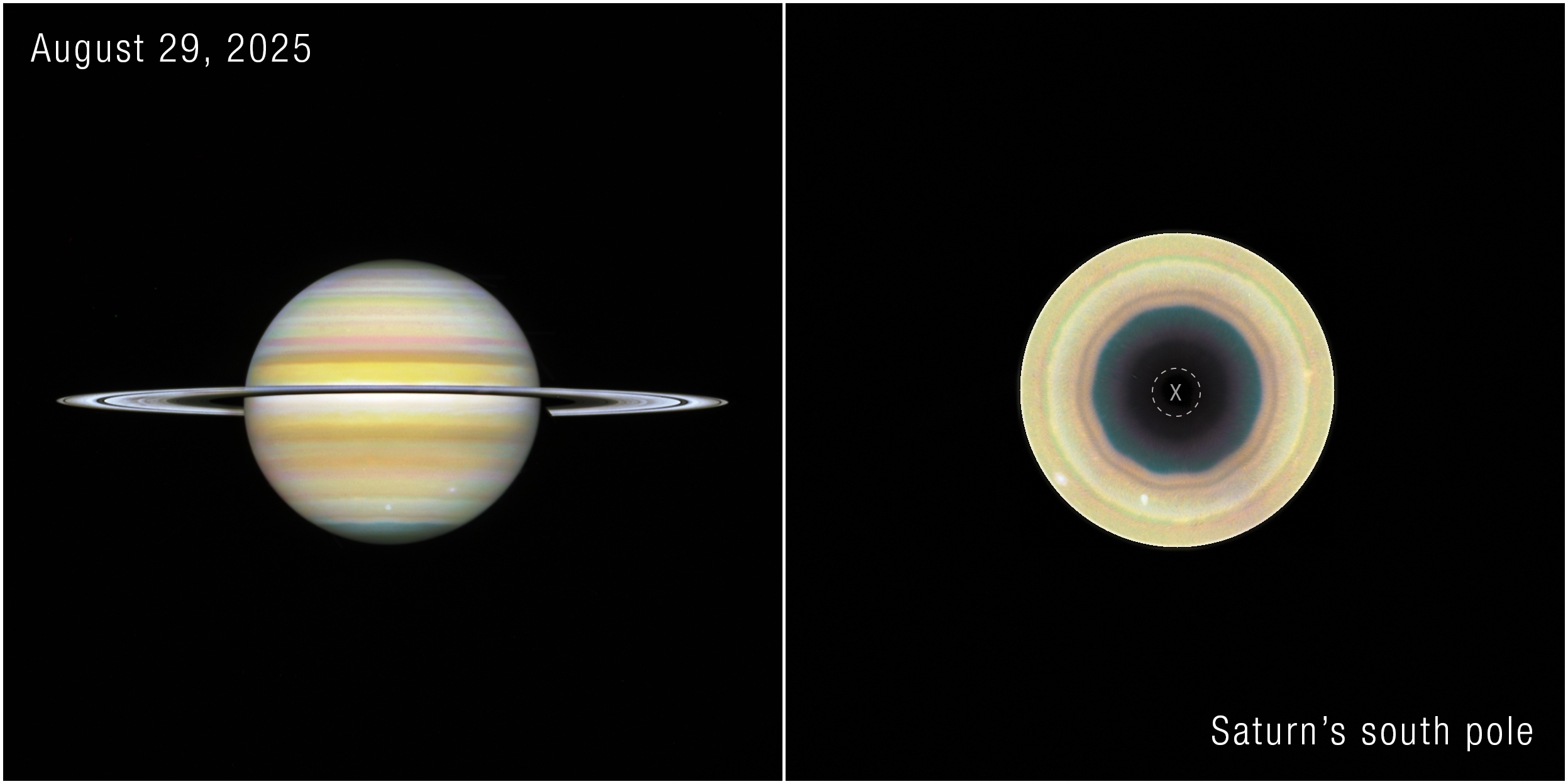
Side-by-side comparison of two views of the gas giant Saturn, labeled “August 29, 2025” at the top left corner. At left is a straight-on view of Saturn, a globe with pale yellow horizontal bands at the equator and orange and pink at the mid-latitudes. Some bands towards the north and south pole have a light blue hue. There are prominent horizontal rings circling at the equator. At right, labeled “Saturn’s south pole,” the south-polar view of Saturn shows concentric bands in its atmosphere, mostly tan and orange, surrounding a dark central region that has a 10-sided outline. A small, dashed circle at the very center of the pole with an “X” inside denotes missing data.
Recent NASA Hubble Space Telescope images show the gas giant Saturn and its southern pole, where astronomers have discovered a 10-sided atmospheric wave. Observations show the decagon extends through multiple layers of Saturn’s atmosphere.
Image: NASA, ESA, STScI, Agustin Sánchez-Lavega (UPV), Amy Simon (NASA-GSFC), Michael Wong (UC Berkeley); Image Processing: Alyssa Pagan

Recent observations with NASA’s Hubble Space Telescope have revealed a giant, evolving, 10-sided atmospheric wave encircling Saturn’s south pole. This discovery marks the first time a large, regular-sided jet pattern has been observed in the planet’s southern hemisphere. The feature appears remarkably similar to Saturn’s famous hexagon at its northern pole, but is also distinctly different, suggesting scientists may be witnessing a new atmospheric phenomenon develop on the iconic gas giant.

The results published Wednesday in the journal Science Advances. 

By piecing together several years of Hubble observations dating back to 2023, researchers found subtle hints of the structure beginning to emerge before it became a clearly defined pattern. Those observations were taken as part of Hubble’s Outer Planet Atmospheres Legacy (OPAL) program, which has photographed the outer planets annually for more than a decade

“We’ve never seen anything quite like this in Saturn’s southern hemisphere,” said Amy Simon, study co-author and OPAL principal investigator, NASA’s Goddard Space Flight Center in Greenbelt, Maryland. “The northern hexagon has been there every time we’ve looked for more than 40 years. This feature is different — it appears to be strengthening, giving us the rare opportunity to watch a giant atmospheric pattern develop.”

The discovery was possible because Saturn’s changing seasons gradually brought the planet’s south pole back into view from Earth, where astronomers who collectively analyze images of Saturn from ground-based observatories first identified it.

Agustín Sánchez-Lavega, lead author of the new study, is a researcher at the University of the Basque Country in Spain. The university manages a website, called Planetary Virtual Observatory Laboratory, that accepts ground-based images of solar system planets contributed by observers all over the world. It was in those images, first in 2024, that Sánchez-Lavega and amateur astronomers Trevor Barry and Jean-Paul Oger noticed a subtle undulating band along the southern pole. Additional 2025 imagery taken from the ground hinted even more strongly toward this decagon structure.

That’s when the Hubble observations come into the picture. Hubble’s view from space offers unmatched image sharpness and spatial resolution over full rotations of Saturn, without smearing by Earth’s atmosphere. 

“Given Saturn’s symmetry in its north-south jet stream system, we have been searching for a counterpart to Saturn’s northern hexagon on the south pole in Hubble images since 1990,” Sánchez-Lavega said. “Images from NASA’s Cassini spacecraft, which orbited Saturn between 2004 and 2017, showed no inkling of a long-lived formation, either. The Hubble data confirmed the feature’s presence back to 2023.”

A black and white view of Saturn’s south pole, labeled “August 29, 2025” and “F763M.” The south-polar view of Saturn shows concentric bands of its atmosphere, transitioning from bright outer bands to a dark central region outlined in a 10-sided pattern. This outline is labeled “decagon.” A small, dashed circle at the very center of the pole with an “X” inside denotes missing data.
A single filter from NASA’s Hubble Space Telescope distinctly shows a 10-sided wave encircling Saturn’s south pole, labeled “decagon”. An “X” denotes where data was not captured.
Image: NASA, ESA, STScI, Agustin Sánchez-Lavega (UPV), Amy Simon (NASA-GSFC), Michael Wong (UC Berkeley); Image Processing: Alyssa Pagan

The wave sits within one of Saturn’s powerful jet streams and extends through multiple layers of the atmosphere, indicating it is not just a cloud-level feature, but a vertically extended atmospheric structure. The decagon’s apparent position shifts slightly, because Hubble captures images from different wavelengths. Those different wavelengths probe different altitudes in Saturn’s atmosphere.

“The most intriguing part to me is that this seems to have just formed recently,” said Simon. “The question is, why did it suddenly form now when we haven’t seen one before?” 

The authors say further study is needed from Hubble and NASA’s James Webb Space Telescope, as well as analysis of computer models, to understand how the decagon formed, how long it may last, and how it compares to the long-lived hexagon in the north.

Hubble’s long duration in operation has allowed astronomers to track changes over time in solar system planets and other astronomical objects as well.

Rather than providing a single snapshot, the OPAL program allows scientists to follow seasonal changes, track short-lived storms, and identify other atmospheric features that evolve slowly over time.

“When we started the OPAL program, we expected compelling surprises, but we didn’t know what to expect specifically,” said Mike Wong, study co-author, University of California, Berkeley. “A lot of the discoveries we see coming from OPAL are not just based on one observation, but on years and years of data. Regular observations over time are enabling a lot of new findings.”

The team plans to continue observing Saturn to determine whether the decagon settles into a long-lived, stable configuration like the northern hexagon or continues to evolve. Future observations also could help scientists determine what drives the wave, what it reveals about the atmospheric dynamics of giant planets throughout the solar system, and how they may relate to those we see here on Earth.

The Hubble Space Telescope has been operating for more than three decades and continues to make ground-breaking discoveries that shape our fundamental understanding of the universe. Hubble is a project of international cooperation between NASA and ESA (European Space Agency). NASA’s Goddard Space Flight Center in Greenbelt, Maryland, manages the telescope and mission operations. Lockheed Martin Space also supports mission operations at Goddard. The Space Telescope Science Institute in Baltimore, which is operated by the Association of Universities for Research in Astronomy, conducts Hubble science operations for NASA.

Facebook logo
Instagram logo

Related Images & Videos

Side-by-side comparison of two views of the gas giant Saturn, labeled “August 29, 2025” at the top left corner. At left is a straight-on view of Saturn, a globe with pale yellow horizontal bands at the equator and orange and pink at the mid-latitudes. Some bands towards the north and south pole have a light blue hue. There are prominent horizontal rings circling at the equator. At right, labeled “Saturn’s south pole,” the south-polar view of Saturn shows concentric bands in its atmosphere, mostly tan and orange, surrounding a dark central region that has a 10-sided outline. A small, dashed circle at the very center of the pole with an “X” inside denotes missing data.

Decagon on Saturn’s South Pole (Color)

Recent NASA Hubble Space Telescope images show the gas giant Saturn and its southern pole, where astronomers have discovered a 10-sided atmospheric wave. Observations show the decagon extends through multiple layers of Saturn’s atmosphere.

A black and white view of Saturn’s south pole, labeled “August 29, 2025” and “F763M.” The south-polar view of Saturn shows concentric bands of its atmosphere, transitioning from bright outer bands to a dark central region outlined in a 10-sided pattern. This outline is labeled “decagon.” A small, dashed circle at the very center of the pole with an “X” inside denotes missing data.

Decagon on Saturn’s South Pole (Single Filter)

A single filter from NASA’s Hubble Space Telescope distinctly shows a 10-sided wave encircling Saturn’s south pole, labeled “decagon”. An “X” denotes where data was not captured.


Share

Details

Last Updated
Sep 02, 2026
Editor
Andrea Gianopoulos
Contact
Media

Claire Andreoli
NASA’s Goddard Space Flight Center
Greenbelt, Maryland
claire.andreoli@nasa.gov

Hannah Braun
Space Telescope Science Institute
Baltimore, Maryland

Hubble Solves Merger Mystery From Milky Way’s Early Years

17 August 2026 at 11:00

5 min read

Hubble Solves Merger Mystery From Milky Way’s Early Years

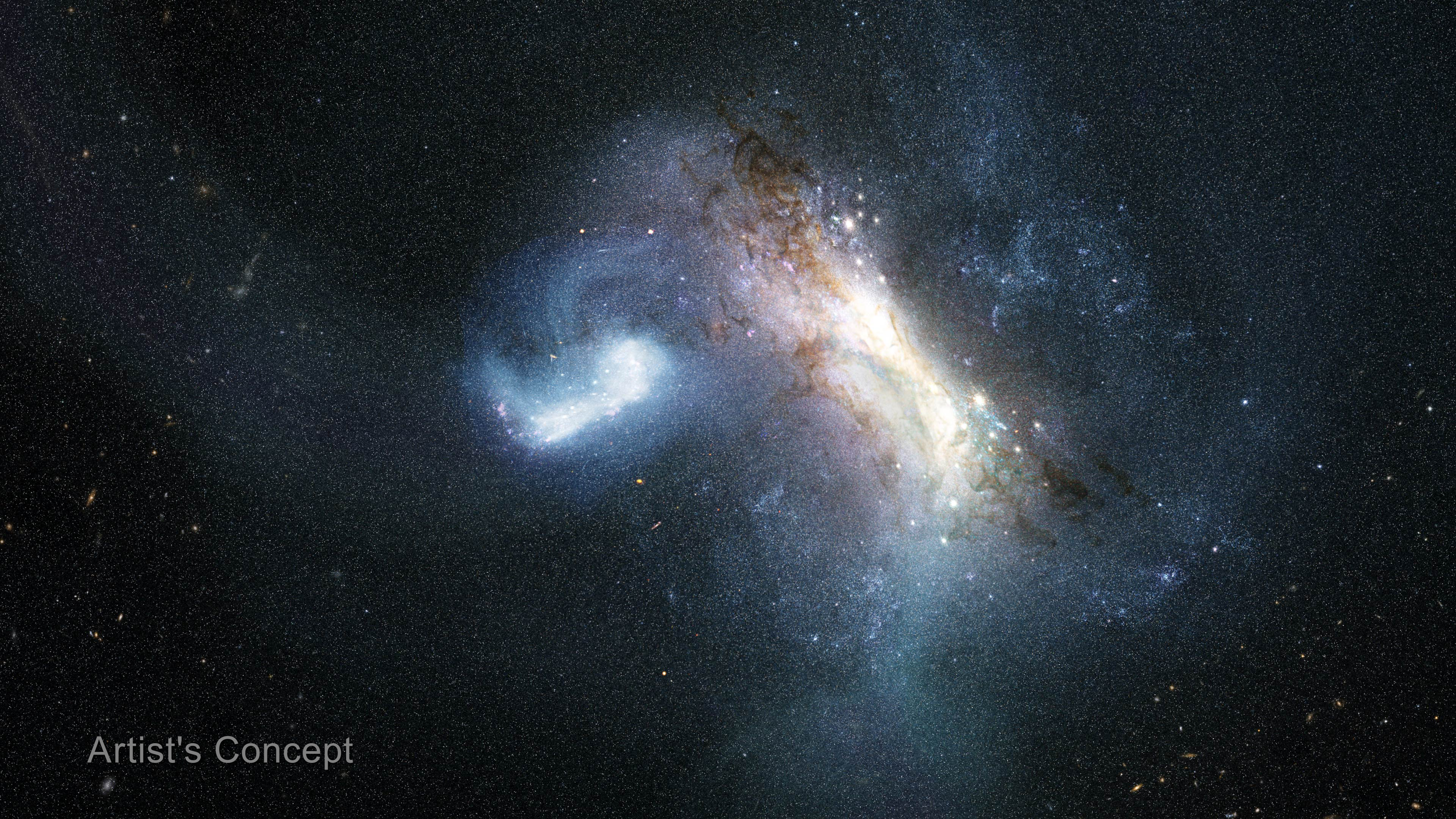
An illustration of two galaxies in the midst of a collision against a dark, star-filled background.  The collision takes up the middle third of the illustration. On the right, a larger galaxy is viewed at an angle from 11 ou2019clock to 4 ou2019clock, with a white-yellow core surrounded by mottled brown dust lanes and faint bluish spiral arms. To the left, a smaller, bright blue-white galaxy is stretched into a curved, hook-like shape as gravity distorts it. A broad, glowing bridge of pale blue gas and stars extends off the galaxy at the left, while wispy streams extend above and below the larger galaxy at the right. The words u201cArtistu2019s Conceptu201d appear in the lower left corner.
About 12 billion years ago, a dwarf galaxy known as LKH collided with a young Milky Way and merged with it. This artist’s concept portrays that collision. NASA’s Hubble Space Telescope uncovered definitive evidence of this collision by studying globular star clusters.
Illustration: NASA, ESA, Joseph Olmsted (STScI)

Our home galaxy, the Milky Way, grew to its current size in part by consuming smaller galaxies. Now, new data from NASA’s Hubble Space Telescope shows definitive evidence of a dwarf galaxy merging with the young Milky Way galaxy in the earliest phases of its evolution. This finding extends our knowledge of our galaxy’s history 1.8 billion years farther back in time than before.

The results published Monday in the journal Nature Astronomy.

The Milky Way today is a massive spiral galaxy home to hundreds of billions of stars. However, our galaxy wasn’t always so large; it has grown by forming new stars from its gas clouds as well as collecting stars, gas, and dark matter from other galaxies through mergers.

The most recent massive merger in our galaxy’s history took place with the Sagittarius dwarf galaxy, beginning over 6 billion years ago and still ongoing today. Looking back into the even more distant past, researchers learned that the Milky Way galaxy consumed another dwarf galaxy called Gaia-Sausage-Enceladus 10 billion years ago. This ancient merger greatly affected the structure of our galaxy’s disk of stars. Other, smaller mergers occurred between these two.

But our galaxy’s history doesn’t stop there. Both observations and simulations have suggested that another large merger preceded these two, though the specifics of the event have been heavily debated. Now, Hubble has uncovered definitive evidence of an earlier merger that occurred about 11.8 billion years ago, or just 2 billion years after the big bang.

“Our home is the Milky Way galaxy, but we do not know how our house was built,” said Davide Massari, lead author, Astrophysics and Space Science Observatory of Bologna in Italy. “In this paper we discover where the first significant batch of bricks came from: a dwarf galaxy that we call LKH.”

Cosmic archaeological sites

Immense astronomical surveys and precision data from spacecraft like ESA’s (European Space Agency’s) Gaia mission have been instrumental in piecing together the history of our galaxy. The farther back into our galaxy’s history that scientists attempt to look, the more difficult it becomes to tell what happened. When our galaxy was young, it was smaller and much closer in size to the galaxies it clashed with. It was also more chaotic, and it’s possible that the signs of mergers have been erased over billions of years.

It’s into this murky past that Hubble peered. Researchers used Hubble to study some of the Milky Way galaxy’s globular clusters: immense, roughly spherical collections of tens of thousands to a few million stars. Globular clusters contain some of the oldest stars in our galaxy, and they can act as cosmic archaeological sites that preserve stars from other galaxies the Milky Way galaxy has collected.

“Thanks to the high resolution and depth of Hubble imaging, we could measure the age and the metal content of these clusters with unprecedented precision,” said Chiara Zerbinati, study co-author, University of Bologna in Italy. “Coupled with measurements from Gaia, this made it possible to distinguish a population of globular clusters that are different from the others. These are the clusters that were born in LKH, and they tell us when that galaxy was devoured by ours, and how massive it was.”

The team analyzed Hubble observations of 39 globular clusters in the inner 20,000 light-years of our galaxy, where evidence of the most ancient mergers should be preserved. They expected this sample to contain globular clusters that formed within the young Milky Way galaxy as well as those collected from the Gaia-Sausage-Enceladus dwarf galaxy about 10 billion years ago.

Using Hubble’s sensitive observations to determine each cluster’s precise age and associated metallicity — the abundance of elements heavier than helium — they determined there was a third population of globular clusters in the inner regions of our galaxy. The team found that these clusters are older than the group collected in the Gaia-Sausage-Enceladus merger, but younger than those born in the Milky Way, regardless of their metal content. These  clusters, therefore, came from a separate and even earlier merger — in which the Milky Way galaxy absorbed a dwarf galaxy containing roughly 500 million times the mass of the Sun in stars, a significant fraction of our galaxy’s mass at the time. They named this dwarf galaxy Low-energy-Kraken-Heracles, or LKH, in honor of three earlier research papers that championed the idea of a merger early in our galaxy’s history.

Such a large merger so early in the Milky Way galaxy’s formation has profound implications for the evolution of our galaxy.

“Some past studies have argued that the earliest phases of our galaxy’s evolution were defined by stars born only in our galaxy,” says Massari. “Here, we have shown that stars born in external galaxies also need to be considered.”

The team plans to continue their work to unravel the history of the Milky Way galaxy by studying its globular clusters, aiming to characterize all the massive mergers that our galaxy has experienced across cosmic history.

“Hubble is observing globular clusters that have never been studied before, and this will help us characterize the merger events that are far back in time in the Milky Way galaxy’s history,” said Fernando Aguado-Agelet, co-author, University of Vigo and the University of La Laguna in Spain.

The Hubble Space Telescope has been operating for more than three decades and continues to make ground-breaking discoveries that shape our fundamental understanding of the universe. Hubble is a project of international cooperation between NASA and ESA (European Space Agency). NASA’s Goddard Space Flight Center in Greenbelt, Maryland, manages the telescope and mission operations. Lockheed Martin Space also supports mission operations at Goddard. The Space Telescope Science Institute in Baltimore, which is operated by the Association of Universities for Research in Astronomy, conducts Hubble science operations for NASA.

Facebook logo
Instagram logo

Related Images & Videos

An illustration of two galaxies in the midst of a collision against a dark, star-filled background.  The collision takes up the middle third of the illustration. On the right, a larger galaxy is viewed at an angle from 11 ou2019clock to 4 ou2019clock, with a white-yellow core surrounded by mottled brown dust lanes and faint bluish spiral arms. To the left, a smaller, bright blue-white galaxy is stretched into a curved, hook-like shape as gravity distorts it. A broad, glowing bridge of pale blue gas and stars extends off the galaxy at the left, while wispy streams extend above and below the larger galaxy at the right. The words u201cArtistu2019s Conceptu201d appear in the lower left corner.

LKH Milky Way Merger Illustration

About 12 billion years ago, a dwarf galaxy known as LKH collided with a young Milky Way and merged with it. This artist’s concept portrays that collision. NASA’s Hubble Space Telescope uncovered definitive evidence of this collision by studying globular star clusters.

Share

Details

Last Updated
Aug 18, 2026
Editor
Andrea Gianopoulos
Contact
Media

Claire Andreoli
NASA’s Goddard Space Flight Center
Greenbelt, Maryland
claire.andreoli@nasa.gov

Bethany Downer
ESA/Hubble
Baltimore, US

Christine Pulliam
Space Telescope Science Institute
Baltimore, Maryland

❌
❌