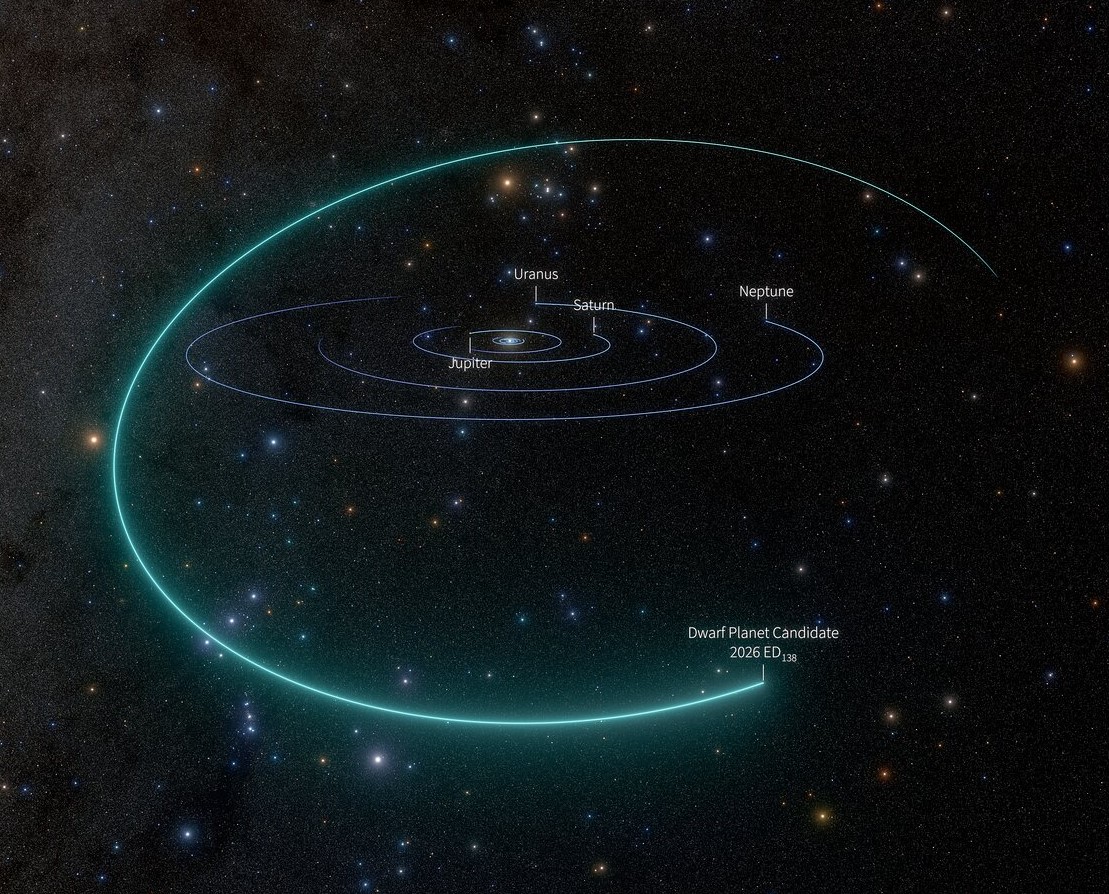
Lying beyond Pluto, 2026 ED138 could be as large as 1,500 kilometers in diameter. Astronomers are still working to confirm whether it meets the criteria for a dwarf planet.
United Launch Alliance announced Wednesday it plans to return its Vulcan rocket to service on November 13, nine months after a solid rocket booster anomaly threw the company's 2026 launch schedule into oblivion.
The return-to-flight mission will launch 40 satellites for the Amazon Leo broadband constellation, the first of 38 Vulcan flights Amazon has booked to deploy the bulk of its network. The mission will lift off from Cape Canaveral Space Force Station, Florida, and ULA said the launch date is pending range approval.
The launch is critical for ULA after its new flagship rocket suffered nozzle failures on its solid rocket boosters on two of its first four missions, most recently during a flight in February. In both cases, the rocket overcame the nozzle failure and completed its mission, but officials at the US Space Force, ULA's primary customer, lost confidence in Vulcan.
The private space tourism era looked so very promising five years ago. Blue Origin and Virgin Galactic had begun flying customers—real people with zero space experience—on suborbital missions. And at about the same time, private citizens were going to orbit for days at a time aboard SpaceX's Crew Dragon.
But that was then. Consider the state of play today:
It has been 10 months since Blue Origin's New Shepard spacecraft flew its last mission in January. The program was subsequently "paused," but let's be real. Blue Origin has moved on. New Shepard's engineering teams are now supporting the New Glenn rocket and Blue Moon lander programs.
SpaceX flew its final free-flyer mission on Dragon, Fram2, in April 2025. A handful of non-NASA missions bound for space stations remain on the spacecraft's manifest, but all are likely to carry at least one government astronaut. Then Dragon will be retired. There is no credible timeline for SpaceX's Starship to fly humans into space from Earth.
As for Virgin Galactic, the company flew its final suborbital mission on the VSS Unity spacecraft more than two years ago, in June 2024.
So we are now 10 months, and counting, without a space tourism mission in the United States.
The Prologis Park SeaTac 3 industrial building in Des Moines, Wash. (Prologis Photo)
Blue Origin is taking over an industrial building in Des Moines, Wash., where the Jeff Bezos-founded space company plans a mix of lab, development and light production work, the company confirmed to GeekWire.
The 265,922-square-foot facility, known as Prologis Park SeaTac 3, was previously a Bartell Drugs distribution center just south of Seattle-Tacoma International Airport. Blue Origin said that at full capacity over the long term, the site is expected to support hundreds of employees.
KING 5 first reported the news Tuesday, citing a state environmental application filed in September that lists Blue Origin Manufacturing LLC at the building’s address, 21202 24th Ave. S. A pre-application under review by the city indicates the property could be used for research and development of commercial satellites, the station reported.
Commercial real estate firm Newmark announced a lease for the entire building last week without naming the tenant.
“The manufacturing project that will be using this property is cutting-edge and we are excited about the job growth and possibilities that it represents for our region,” Newmark Executive Vice Chairman Thad Mallory said in a news release.
With roughly 33,000 residents, the small city of Des Moines is becoming something of an aerospace hub.
Blue Origin’s new location is around the corner from where Shield AI is building X-Forge 3, a 420,000-square-foot facility that will make the company’s X-BAT autonomous fighter jet. Shield AI said last month it expects to have 4,000 workers in the region by the early 2030s, and that it’s looking for another 1 million square feet.
“It’s all about labor and access to power,” Mallory told KING 5, referring to the advanced manufacturing projects coming to the area.
Blue Origin is headquartered in nearby Kent, Wash., about 5 miles from the Des Moines site.
The company is working to get its New Glenn rocket flying again after one exploded during a ground engine test in May, which damaged its Florida launch pad. New Glenn is slated to carry Blue’s Blue Moon Mark 2 lander on NASA’s Artemis 3 mission, a test in Earth orbit planned for mid-2027 ahead of a crewed moon landing targeted for 2028.
A Cambridge-led study suggests comets rarely delivered useful quantities of life’s molecular ingredients to early Earth because impacts destroyed them and surviving material wouldn’t have stayed concentrated at the surface for long.
Astronomers using the Vera C. Rubin Observatory have discovered 2026 ED138, a large object beyond Neptune that could become the solar system's sixth recognized dwarf planet if further observations confirm it is massive enough to be round. Located about 46 times farther from the Sun than Earth, the object is estimated to be 600 to 1,500 kilometers wide and had remained hidden because it lies against a particularly crowded field of Milky Way stars. Scientific American reports: The discovery was made by running billions of pieces of data collected by the Rubin Observatory through a search code developed by Center for Astrophysics | Harvard & Smithsonian astronomers Matthew Holman and Kevin Napier. "My first reaction was one of excited disbelief," Holman said in a statement. "Objects like this are very rare, so I immediately started checking whether I or the code had done something wrong."
When Holman and his colleague Mario Juric of the University of Washington went to double-check, they found 30 more observations of the object by Rubin that dated to between March and July 2026. Looking at other observation tools, the pair found even more sightings going back to 2016. Together, these data allowed the astronomers to begin mapping out 2026 ED138's orbit. The suspected dwarf planet is about 46 times as far from the sun as Earth, making it even more remote than Pluto, which is just 40 times as far. The object is also tilted off the solar system's plane by around 25 degrees, an arrangement that could be linked to disruptions caused by Neptune's gravitational pull.
Initial measurements indicate that 2026 ED138 has a diameter between 600 and 1,500 kilometers (373 and 932 miles), which makes it one of the largest dwarf planet candidates yet detected. But size isn't all that matters: further observations are required to determine if the object has enough mass to be pulled into a round shape, which is a key requirement for a dwarf planet. Despite its size, 2026 ED138 was able to avoid detection for all these years because it's located in a part of the night sky that's crowded with stars whose light drowned it out.
A visualization shows the orbital path of the dwarf planet candidate 2026 ED138 in relation to the orbits of the solar system’s larger planets. Click on the image for a larger version. (Credit: NSF-DOE Vera C. Rubin Observatory / NOIRLab / SLAC /AURA / R. Proctor)
Astronomers sorting through data from the Vera C. Rubin Observatory in Chile have found an icy world that has a good chance of joining Pluto in the solar system’s retinue of dwarf planets.
University of Washington astronomer Mario Jurić joined the astronomer who made the discovery, Matthew Holman of the Harvard & Smithsonian Center for Astrophysics, to announce the findings today at a meeting of the American Astronomical Society’s Division for Planetary Sciences in Spokane, Wash.
Jurić, the Rubin team’s solar system lead scientist, said the observatory’s capabilities made it possible to detect and characterize the new dwarf planet candidate, known as 2026 ED138.
“Rubin is giving us an unprecedented capacity to explore the sky through a combination of speed, depth, and precision,” Jurić said in a news release. “And the discovery is just the beginning: Once we identify a new object, we can search back months, and sometimes even decades, finding it in images where nobody knew to look. This ability to both discover and ‘precover’ objects is transforming how quickly and accurately we can determine their orbits and understand the distant solar system.”
2026 ED138 traces a tilted orbital path that takes it well beyond Pluto, the solar system’s best-known dwarf planet. It’s currently at a distance of 46 astronomical units, where 1 AU equals the average distance between Earth and the sun. Pluto, by comparison, is currently about 40 AU from the sun.
Astronomers suspect ED138 formed billions of years ago closer to the sun before being flung into a wider orbit by gravitational interactions with Neptune.
Based on an analysis of its distance, brightness and assumed composition, ED138 is thought to be somewhere between 600 and 1,500 kilometers (373 to 932 miles) in diameter. At that size, an icy object should possess enough gravity to pull itself into a round shape — satisfying the primary physical criterion for a dwarf planet.
Rubin’s researchers analyze the data from those scans to find objects of interest — ranging from asteroids to gamma-ray bursts — and track them over time. On Oct. 13, Holman was running data through a search code that he developed with Kevin Napier, a colleague at the Center for Astrophysics. ED138 stood out due to its exceptional size and brightness.
“My first reaction was one of excited disbelief,” Holman said. “Objects like this are very rare, so I immediately started checking whether I or the code had done something wrong.”
To confirm the discovery, Holman, Jurić and their colleagues found 30 archived observations of ED138 dating back to March 4. The Asteroid Institute’s ADAM Precovery service found still more images of the object, going back to 2016, in the archives of a different astronomical survey.
The precovery data confirmed that ED138 was a special case.
“Finding an object this big, roughly 1,000 kilometers across, is something that happens maybe once in a generation,” Jurić said. “It’s the largest trans-Neptunian object found in about 20 years, and Rubin turned it up while we were still commissioning the telescope.”
In 2006, the International Astronomical Union defined dwarf planets as planetary objects that are big enough to crush themselves into a roundish shape — technically speaking, into a state of hydrostatic equilibrium — but not big enough to clear their orbital neighborhood.
So far, the IAU has classified five solar system objects as dwarf planets — including Ceres in the main asteroid belt, plus Pluto, Eris, Haumea and Makemake in the region beyond Neptune. 2026 ED138 joins a host of other celestial objects that are thought to be dwarf planets but haven’t yet been added to the IAU’s official list.
“The official list hasn’t moved since 2008,” Jurić told GeekWire in an email. “I’m not sure if there’s an active process that reviews candidates, and what are the timelines.”
Jurić and his colleagues hope additional observations will boost ED138’s chances of attaining true dwarf planethood.
“The next step in building the case would be to prove it’s round (in hydrostatic equilibrium),” he wrote. “The means to do that would be directly through occultations (and there’s a good chance of that, given it’s in a dense stellar field), and then thermal measurements plus modeling and light curves (or the absence of variability).”
A winged Chinese spacecraft bearing a strong resemblance to the US military's X-37B spaceplane was photographed in orbit by a passing US-owned commercial satellite in 2024, and we finally have the image.
The Chinese spaceplane has delta wings, payload bay doors, a dark heat shield, and a rear-mounted service module with power-generating solar arrays. In other words, the design of the winged ship is, to a great degree, a copy of the X-37B spaceplane flown by the US Space Force.
The photo was taken by a commercial imaging satellite owned by a company called Vantor, known as Maxar in 2024. Vantor is one of several companies that provide reconnaissance imagery of locations around the world to the US military and US intelligence agencies. The same Earth-imaging satellites can point their telescopes at objects in space.
Two orbiters have long outlasted their expected lifespans and completely reshaped our understanding of the Red Planet, all while operating 140 million miles from Earth.
Stoke Space’s existing Cape Canaveral launch site in Florida. (Stoke Space Photo)
Kent, Wash.-based Stoke Space has secured a conditional commitment for a $150 million loan from the Department of War’s Office of Strategic Capital to build a second launch pad at Cape Canaveral for a larger version of its fully reusable rocket.
The loan isn’t final until Stoke meets a list of financial, legal, technical and due-diligence requirements. The announcement Monday comes less than two months after Stoke raised roughly $1 billion in a Series E round, bringing its total funding to about $2.3 billion.
The new pad would serve Stoke’s Nova Block 2 rocket, which is designed to carry up to 15 metric tons to low Earth orbit. That’s five times the capacity of Nova Pathfinder, which Stoke plans to launch for the first time from its existing pad in early 2027. Block 2 is slated to debut in 2029.
The loan would be paired with private capital to pay for the pad, according to the Department of War. Jordan Sebold, senior managing director for investments at the Office of Strategic Capital, said in a statement that adding launch infrastructure would “enhance the overall capacity and resilience of the commercial space industrial base.”
The Office of Strategic Capital was set up in 2022 to draw private investment into technologies seen as critical to national security. The following year, Congress gave it the power to make loans and loan guarantees to companies in those fields. Space launch is one of the technology categories it targets.
“By expanding domestic launch facility capacity, this investment enables launch service providers to ensure our commercial and defense partners have reliable, high-cadence access to space,” David Lorch, the office’s director, said in the news release.
Stoke is already lined up for military launch work. In 2025, the Space Force added the company to a pool of providers that can compete for national security missions under Lane 1 of the program’s third phase. Lane 1 is the tier meant for newer launch companies and less demanding payloads. Stoke can’t bid on those missions until it completes a successful orbital flight.
The company has other federal ties as well. The Defense Innovation Unit awarded Stoke a $4.5 million contract in 2024 to study rapid delivery of cargo to orbit, and possibly back to Earth. In June, Stoke was one of 37 companies NASA chose for unfunded partnerships. Stoke’s project focuses on returning Nova’s upper stage safely through the atmosphere.
Nova is designed so both of its stages can return and fly again. The booster flies itself back for recovery. The upper stage uses a metal heat shield cooled by liquid hydrogen that circulates through channels inside it, to survive the heat of reentry. Only SpaceX, with its much larger Starship, is pursuing the same goal, and it hasn’t fully achieved it yet. Stoke has yet to launch a rocket to orbit.
Stoke was founded in 2019 by two Blue Origin veterans: Andy Lapsa, the CEO, and Tom Feldman, the chief technology officer. The company has about 400 employees. Most work at its 168,000-square-foot factory and headquarters in Kent, and about 50 are at its test site in Moses Lake, which is expanding from 75 to 550 acres. About 50 more work at Cape Canaveral.
GeekWire reached out to Stoke Space for comment and we’ll update this story when we hear back.
Turkish Aerospace’s Aksungur long-endurance drone has completed its mission with Aselsan’s aselBUOY 100P underwater acoustic listening system during the Turkish Naval Forces’ TURNAs-2026 unmanned maritime systems exercise, the company announced on X on Oct. 24, adding a new capability to the drone’s set of maritime missions. “With this integration, which offers an important capability for […]
The Webb telescope sees tiny red dots everywhere. Astronomers can’t agree on what they are, but some believe they may be enormous stars with black holes inside.
During a lengthy news conference on Friday, NASA provided a detailed overview of how it plans to return astronauts to the lunar surface as soon as 2028 as part of its Artemis Program.
Although much of the information behind these plans has been previously reported at Ars Technica and elsewhere, this marked the first time NASA has laid them out in detail and acknowledged some substantial changes in the architecture.
Most notably, for SpaceX's Starship vehicle, the revised plan calls for the Orion spacecraft to dock with the Starship lunar lander in high-Earth orbit before transiting to the Moon. And for Blue Origin, the mission architecture includes four launches of the New Glenn rocket, but no spacecraft-to-spacecraft refuelings. Additionally, the Blue Origin plan allows for the possibility of its Blue Moon lander rendezvousing with Orion in low-lunar orbit.
Leaders in the US Space Force would like to have a new spaceport up and running in four years, adding a third heavy-lift launch site to relieve pressure from bases in Florida and California that have shot rockets into orbit for nearly 70 years.
The obvious problem with that ambition is 2030 is four years away, and Pentagon officials have not determined where the new spaceport should go or how to acquire land for it.
Air Force Secretary Troy Meink first mentioned the service's search for a third launch base in May. A congressionally mandated study of the Space Force's launch infrastructure identified the need for "another site that's capable of heavy and super heavy launch capability," Meink said in a House Armed Services Committee hearing.
Welcome to Edition 9.16 of the Rocket Report! Lots of SpaceX-related news this week including a couple of Thursday shockers. In one story, the company told the US Space Force thanks, but no thanks after being offered three military launch contracts. Then, on the civil space side of things, SpaceX's Starship may required up to 22 refuelings to support a lunar landing, a NASA safety panel said.
As always, we welcome reader submissions, and if you don't want to miss an issue, please subscribe using the box below (the form will not appear on AMP-enabled versions of the site). Each report will include information on small-, medium-, and heavy-lift rockets as well as a quick look ahead at the next three launches on the calendar.
Miura 5 getting closer to launch. PLD Space says its Miura 5 rocket, due to undertake its inaugural launch next year, is nearing final integration, Aviation Week reports. The rocket is one of three Miura 5s the company has already manufactured, with the other two designed to qualify key system elements, CEO Raúl Torres said in an October 19 program update. PLD Space now targets a first flight of the small-lift vehicle before mid-2027.

 Login