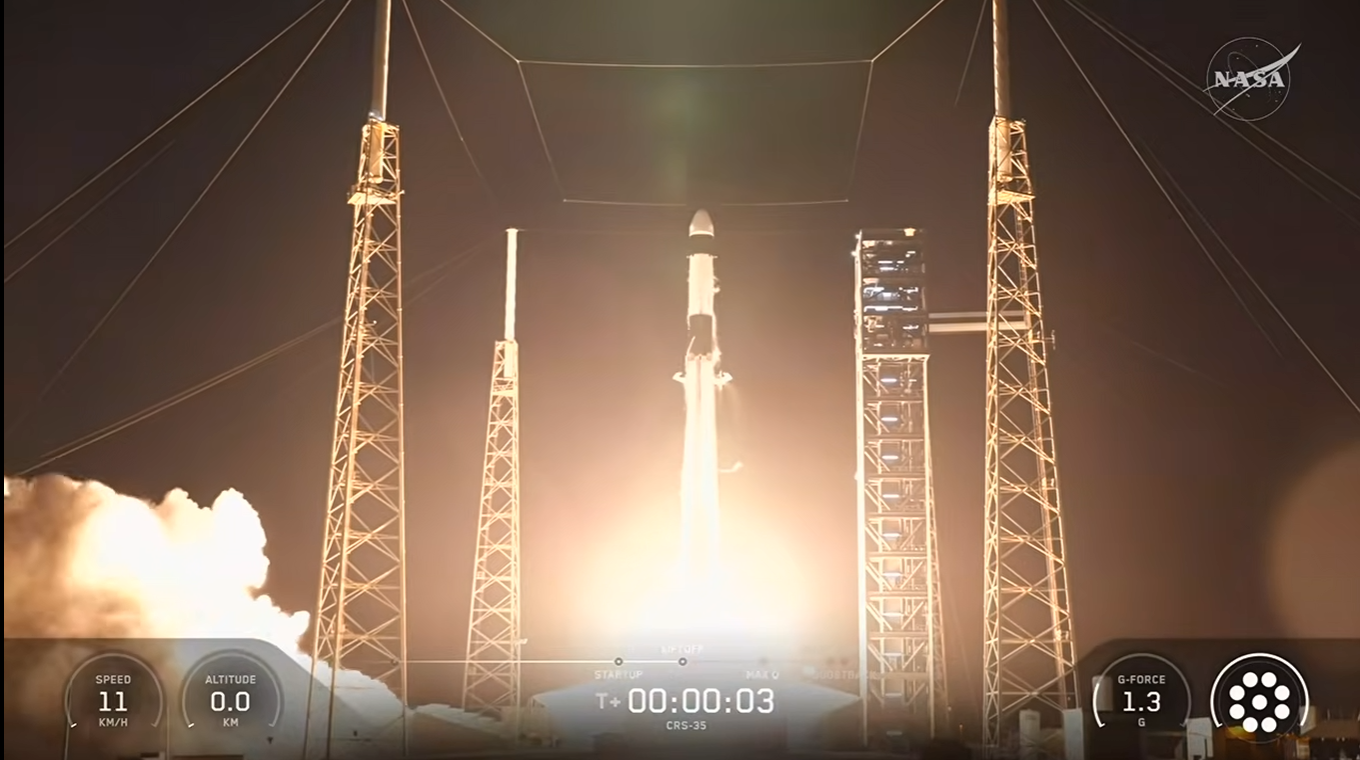
A SpaceX Falcon 9 rocket and Dragon spacecraft launched on Tuesday, Oct. 13, 2026, from Space Launch Complex 40 at Cape Canaveral Space Force Station in Florida as part of the company’s 35th Commercial Resupply Services mission to the International Space Station for NASA.
Credit: NASA
NASA’s SpaceX 35th commercial resupply mission lifted off at 6:33 a.m. EDT Tuesday aboard a Falcon 9 rocket from Space Launch Complex 40 at Cape Canaveral Space Force Station in Florida, carrying more than 6,300 pounds of supplies and hardware, bound for the International Space Station. Following its successful launch, the SpaceX Dragon spacecraft will carry new scientific experiments, cargo, and the final pair of International Space Station Roll-Out Solar Arrays to the orbiting laboratory.
Dragon is scheduled to autonomously dock at 11 a.m., Thursday, Oct. 15, to the space-facing port of the space station’s Harmony module. NASA will stream rendezvous and docking coverage beginning at 9:15 a.m., through a variety of platforms. Learn where to watch online:
The final pair of solar arrays will complete the space station’s power system augmentation, boosting available electricity for research, operations, and the station’s safe, controlled deorbit. Astronauts will install the arrays during a series of spacewalks planned for later this fall.
Dragon also is delivering several new experiments, including hardware to manufacture artificial retinas in microgravity that could help restore vision for patients on Earth and 3D heart tissue models to advance large-scale drug testing on future space missions. Dragon also will carry materials to study how a new type of glass is formed in microgravity, and brain organoids that could uncover potential treatment targets for neurodegenerative diseases like Alzheimer’s, Parkinson’s, and multiple sclerosis.
These are just a sample of the hundreds of investigations conducted aboard the orbiting laboratory in the areas of biology and biotechnology, physical sciences, and Earth and space science. Research and technology investigations taking place aboard the space station benefit people on Earth and lay the groundwork for other agency deep space missions. As part of NASA’s Artemis program, the agency will send astronauts to the Moon to prepare for future human exploration of Mars, inspiring the world through discovery in a new Golden Age of innovation and exploration.
The Dragon spacecraft is scheduled to remain at the space station until mid-November when it will depart and return to Earth with time-critical research and cargo, splashing down off the coast of California.
Learn more about the International Space Station, its research, and crew, at:
NASA is advancing American leadership in space by taking the next step toward a future where commercial space stations lead the way in low Earth orbit. On Friday, the agency released its final Request for Proposals inviting industry to submit plans for the next generation of commercial space stations.
“In alignment with the President’s National Space Policy, NASA is committed to maintaining a sustained American presence in low Earth orbit long after the International Space Station retires,” said NASA Administrator Jared Isaacman. “We will continue to need a place to conduct research, develop technologies, train crews, and prepare for missions to the Moon and Mars. Commercial space stations may provide that capability while creating new opportunities for American industry and allowing NASA to concentrate more of our resources on the near-impossible missions ahead.”
Building on the agency’s Ignition event earlier this year, NASA regularly has engaged with private industry to shape the agency’s future direction in low Earth orbit. This included publishing two Requests for Information in March to gather industry’s perspective on low Earth orbit destinations and transportation. The agency also published a draft Request for Proposals in July, followed by an industry day and one-on-one meetings that allowed interested companies to review and comment on the planned acquisition approach.
“We’ve made it clear that NASA will never give up its presence in low Earth orbit,” said Isaacman. “Since Ignition, we have spent a lot of time listening to industry and working through what it will take to make this transition successful. The opportunity is significant, but the economics ultimately have to work. We want to see credible plans, strong technical execution, and companies prepared to invest in destinations that can serve NASA while developing additional customers and markets of their own.”
Proposals are due Tuesday, Dec. 8, with contract awards expected in spring 2027.
Under the solicitation, NASA outlines requirements for companies interested in designing, building, testing, certifying, and operating commercial low Earth orbit destinations capable of providing end-to-end destination and transportation services for human spaceflight use.
NASA intends to award firm-fixed-price, multi-award, indefinite-delivery/indefinite-quantity contracts supporting development, certification, and services for continued low Earth orbit research and exploration. This will allow NASA to select two or more contractors through early development, followed by a competitive task order for final design, test, and evaluation, as well as certification and services from one or more contractors.
Learn more about NASA’s missions on the agency’s website:
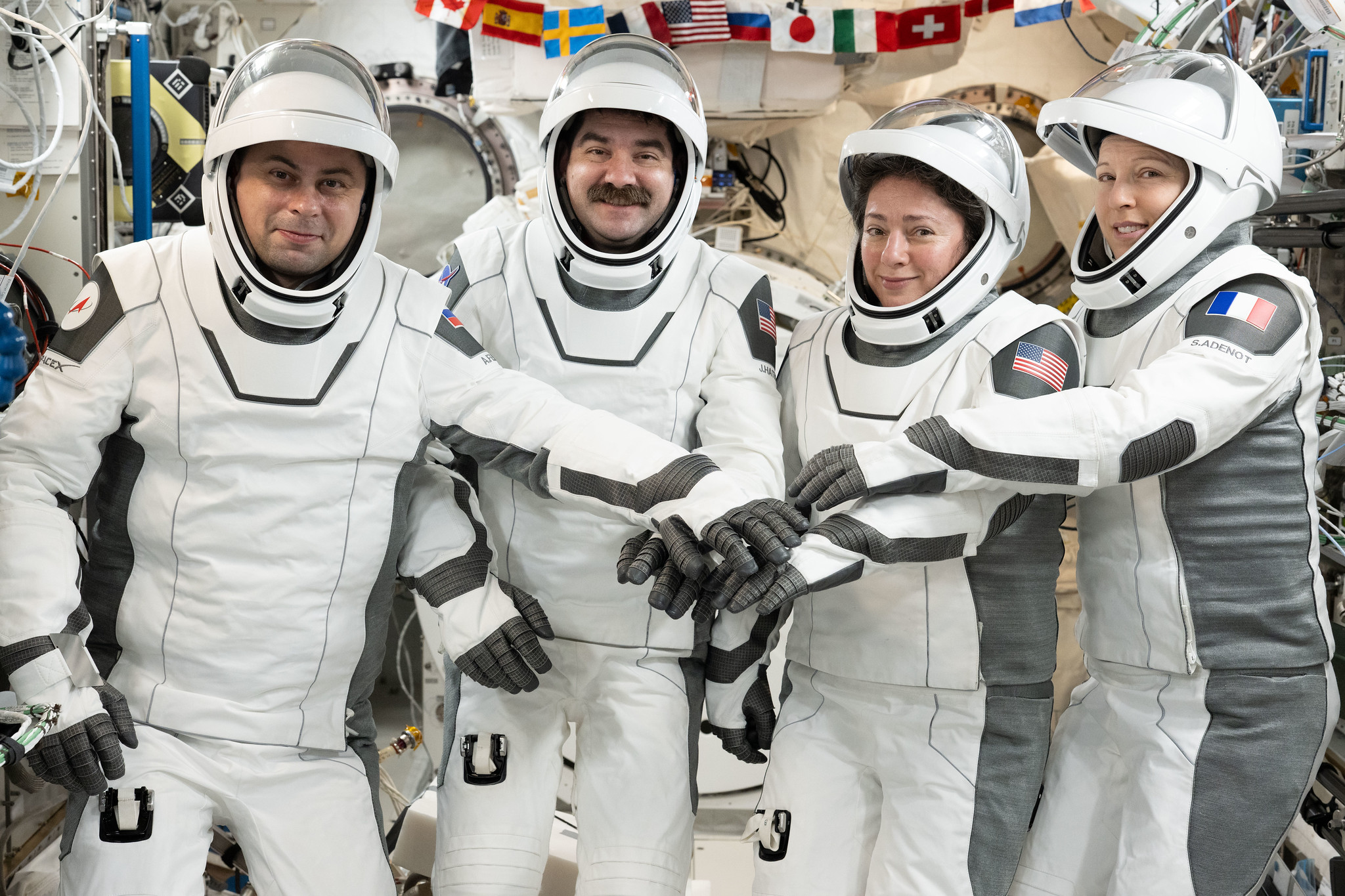
NASA’s SpaceX Crew-12 members gather for a portrait in the pressure suits they will wear when they depart the International Space Station inside the SpaceX Dragon spacecraft. From left, Roscosmos cosmonaut and mission specialist Andrey Fedyaev, NASA astronauts Jack Hathaway and Jessica Meir, Crew-12 pilot and commander respectively, and ESA (European Space Agency) astronaut and mission specialist Sophie Adenot.
Credit: NASA/Anil Menon
NASA and SpaceX are targeting no earlier than 8:05 a.m. EDT, Wednesday, Oct. 7, for the undocking of the agency’s SpaceX Crew-12 mission from the International Space Station, pending weather conditions.
An Oct. 7 undock puts NASA astronauts Jessica Meir and Jack Hathaway, ESA (European Space Agency) astronaut Sophie Adenot, and Roscosmos cosmonaut Andrey Fedyaev on schedule to splash down off the coast of California at approximately 11:34 a.m. on Thursday, Oct. 8.
NASA’s live Crew-12 return coverage will stream through a variety of platforms. Learn where to watch online:
Mission managers continue monitoring conditions in the recovery area, as undocking of the SpaceX Dragon depends on spacecraft readiness, recovery team readiness, weather conditions in the Pacific off the coast of California, and other factors.
NASA’s coverage is as follows (all times Eastern and subject to change based on real-time operations):
Wednesday, Oct. 7
6 a.m.: Hatch closure coverage begins
6:20 a.m.: Hatch closing
7:45 a.m.: Undocking coverage begins
8:05 a.m.: Undocking
Following the conclusion of undocking coverage, NASA will provide audio-only communications between Crew-12, the space station, and flight controllers during Dragon’s transit away from the orbital complex.
Bill Spetch, deputy manager of Commercial, NASA’s Low Earth Orbit Program
Dr. Liz Warren, deputy chief scientist, NASA’s Low Earth Orbit Program
Lee Echerd, senior mission manager, Customer Operations and Integration, SpaceX
Andreas Mogensen, leader, Human Exploration Group, ESA
To participate virtually in the teleconference, media must contact the NASA Johnson newsroom for call details by 12 p.m., Oct. 8, at: jsccommu@mail.nasa.gov or 281-483-5111. To ask questions, media must dial in no later than 10 minutes before the start of the call. The agency’s media credentialing policy is available online.
For more information about the Crew-12 mission, visit:
Dale Goulding, chief operating officer at Forge Digital, chats with Michael Reilly, chief strategy officer at Varda Space Industries, at the Space Northwest Symposium in Federal Way, Wash. One of Varda’s orbital capsules is on display in front of them. (GeekWire Photo / Alan Boyle)
How high can Washington state’s space industry rise?
Preliminary findings suggest that the economic impact of the state’s space sector more than doubled between 2018 and 2022, and nearly doubled again between 2022 and now. But at the same time, some leaders of the space community are questioning whether the Pacific Northwest can keep pace with other regional clusters in, say, Florida, Texas and Colorado.
Ferguson isn’t the only elected official trying to make sure the Seattle area keeps up on the space frontier. Dana Ralph, the mayor of Kent, Wash., where Stoke is headquartered, made that clear in her remarks during the kickoff for Seattle Space Week at the Museum of Flight.
“We don’t take you for granted,” said Ralph, addressing a gathering of CEOs, investors and other VIPs. “I want you to hear that out loud: We don’t take you for granted.”
Seattle Space Week — highlighted by Tuesday’s Space Northwest Symposium in Federal Way — provided plenty of opportunities for discussing the challenges facing Washington state’s space ventures. Here are four problems to face, and four prospects to look forward to.
‘We have a problem’
The launch crisis: The availability of launch opportunities has shrunk dramatically. “It’s just crazy how there’s this mismatch between supply and demand right now in the industry,” said Tim Beard, Stoke Space’s chief financial officer. “It’s becoming a crisis.”
One factor is the increased demand for deploying satellite constellations for broadband data services (such as Starlink and Amazon Leo) and for future AI data processing (such as Starcloud, SpaceX’s Starmind and Google’s Project Suncatcher).
Another factor is reduced supply: Blue Origin and United Launch Alliance are dealing with setbacks in their next-generation rocket programs. Meanwhile, SpaceX is talking about phasing out its workhorse Falcon 9 rocket as it makes the transition to Starship. The resulting launch crunch is an industry-wide problem, but it hits Seattle’s satellite ventures especially hard.
The workforce challenge: There’s also a limited supply of skilled technicians and engineers. Bill Bruner, CEO of New Frontier Aerospace, ranks that as his No. 1 challenge. “It’s finding skilled, trained people to do, not just the hard engineering work, but the Grade 13, Grade 14 graduate technical work,” he said. “We need a national solution to that problem.”
Ralph said Kent and other Seattle-area municipalities need to partner with state government and commercial ventures to address the challenge. “We should be able to make it easier for employers to invest in apprenticeship, credentials and on-the-job training,” she said. “We need to build a workforce system that moves with industry, not several years behind it.”
Funding from faraway: Much of the funding that fuels Seattle’s space ventures comes from elsewhere. “There are a lot of VCs in Seattle, but they’re not necessarily space VCs,” said Mike Reilly, chief strategy officer for Varda Space Industries. “I feel like a lot of the space money comes out of L.A. and San Francisco.”
Brian Monnin, co-founder and chief commercial officer at Sophia Space, said midsize space ventures need to find ways to fill their funding gaps. “Debt financing is one way,” he said. “But I think there should be more public-private combinations of firms, traditional banks working alongside debt financiers, working alongside the public for us to fill that vast middle.”
Regional rivalries: Several executives said other states are much more aggressive than Washington when it comes to attracting space ventures. “The incentives just aren’t here,” Monnin said. “We’re looking at where we build our Factory One for Sophia Space tiles, and you have to look at the incentives from sovereign funds in New Mexico, Louisiana and others. They’re far more attractive than they are in this state currently.”
The inter-regional competition was one of the challenges cited by Stoke Space CEO Andy Lapsa — and by his CFO as well. “I need to be pretty direct in that we’re being actively courted by any number of states: Colorado, Texas, Florida,” Beard said. “They want us to move there, but Washington state is the right place for Stoke. … I hope our policymakers in Olympia, throughout the state, our senators hear this. We want to stay in Washington state. Help us do that.”
‘Light this candle’
Public-private partnerships: The newly announced Washington Space Council isn’t likely to set up a multibillion-dollar fund for space ventures anytime soon, but it could serve as a forum for business executives and government officials to work out realistic ways to foster the state’s space industry.
Will the work of the council go beyond virtue-signaling? Last year, the Governor’s Economic Development Strategic Reserve Fund awarded $350,000 to support Portal Space Systems’ expansion into a 50,000-square-foot satellite manufacturing facility in Bothell, Wash. Such grants may serve as a model for future financial incentives.
Just as Google and Meta maintain engineering hubs in the Seattle area, out-of-state satellite ventures are likely to establish Seattle-area outposts. “The fundamentals that made this region are still here: talent, a deep supply chain, industrial capacity, a culture of making things, and generations of knowledge that you simply cannot re-create overnight,” Ralph said.
Coming attractions: The silver lining to the launch crisis is that Stoke Space and other commercial space ventures plan to fill the gap. And when SpaceX’s Starship enters service, that could dramatically change the parameters of the launch market. Ron Faith, CEO of RBC Signals, said this week’s first orbital Starship flight was “a pretty big milestone event.”
“Having Starship go into orbit and deploy real satellites … that’s a significant increase in capacity for launch,” he said. “But with that said, we’re also seeing many, many more launchers come online.” The list includes Blue Origin’s New Glenn, United Launch Alliance’s Vulcan, Rocket Lab’s Neutron, Firefly Aerospace’s Alpha, Relativity Space’s Terran R — and yes, Stoke Space’s Nova.
An artist’s conception shows Stoke Space’s Nova Pathfinder rocket rising into Earth orbit. (Stoke Space Illustration)
A pad of our own: When it comes to space facilities, the Seattle area lacks two big items: a nearby NASA center and an orbital launch pad.
During a recent visit to Redmond, NASA Administrator Jared Isaacman didn’t offer much encouragement for the space agency’s fans in the Pacific Northwest. “I think it’s unlikely we’re going to be adding any additional centers right now,” he told me.
But at the Museum of Flight, Ferguson said the Washington Space Council “will look for ways we might be able to develop Washington-based commercial launch capabilities.”
At the Space Northwest Symposium, Monnin wondered why the Seattle area’s space ventures haven’t forged closer ties with the region’s military installations. “It’s a shame that over the last few decades we haven’t seen the affinity toward Fort Lewis-McChord or the naval base in Bremerton as innovation centers … because from an orbital compute standpoint, the biggest need is defense- or security-related,” he said. “How we haven’t tapped into that as a state, I think, is a miss.”
The Pacific Northwest’s geography would make it difficult to put a launch pad in a place that avoids posing a significant risk to populated areas. That’s why Blue Origin and Stoke Space have their orbital launch pads in Florida instead of Washington. But when Beard was asked about the prospect of using a pad closer to home, he wasn’t dismissive.
“Launching from the Washington coast would be fantastic,” he said. “Also, my geography is not great, but I think it’s slightly closer to ship a rocket to the Washington coast than it is all the way down to Cape Canaveral. So, that’s one advantage as well. We’d love to see launch here, and I think that we’d be good partners to do that with.”
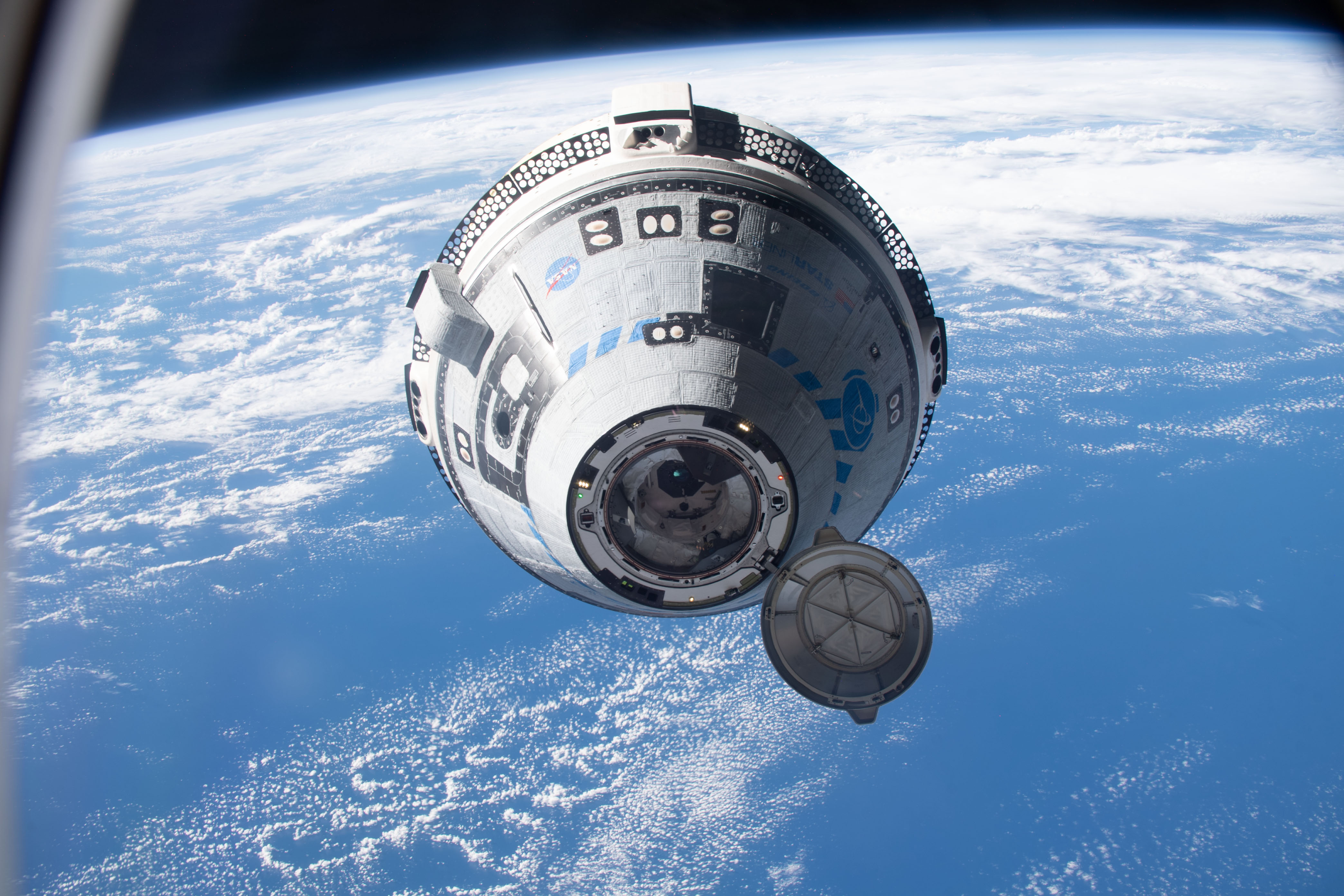
Boeing’s Starliner spacecraft that launched NASA’s Crew Flight Test astronauts Butch Wilmore and Suni Williams to the International Space Station is pictured docked to the Harmony module’s forward port. This long-duration photograph was taken on July 3, 2024, from the orbital complex as it soared 256 miles above the Arabian Sea off the coast of Mumbai, India.
Credit: NASA
On Monday, NASA and Boeing provided an update on the company’s Starliner spacecraft, including adding additional crew missions and certifying a new rocket for crew transportation to low Earth orbit.
“We are living through the most exciting era of space exploration since Apollo,” said NASA Administrator Jared Isaacman. “As this domain continues to open, there will be growing demand for launch vehicles, transfer stages, landers, and, of course, spacecraft that carry astronauts. NASA has been committed to having multiple crew transportation options since the beginning of the Commercial Crew Program. We have worked closely with Boeing to address the issues identified on previous Starliner flights, and we intend to see this vehicle return to flight in support of the International Space Station and future commercial destinations.”
The agency intends to exercise options for a fifth and sixth flight to and from the space station using Starliner, and will work with Boeing and United Launch Alliance to certify the Vulcan rocket for use after the Atlas V rocket’s final flight.
“We are starting with an uncrewed Starliner-1 mission to the International Space Station to validate the improvements made to the spacecraft and gather the flight data we need,” said Isaacman. “From there, we will use what we learn, continue implementing the corrective actions identified by our Program Investigation Team, and complete the testing and certification required for crewed flight. Our current plan is to return astronauts on Starliner-2 by 2028.”
NASA’s commercial crew efforts aim to preserve a U.S. crew transportation capability for ensuring continued access to space. The work is challenging, however, it is essential for responsibly concluding space station operations, transitioning to commercial space stations, and expanding commercial access.
In February, NASA released findings from the agency’s Program Investigation Team outlining the programmatic and technical issues resulting in an uncrewed return of the Starliner during its first crewed flight in 2024. In total, the investigation identified 61 recommendations to NASA to ensure that future missions meet the high standards required for human spaceflight.
The report specifically identified issues with Starliner’s service module reaction control thrusters operating outside of their engineering qualification, which resulted in the loss of control experienced during its Crew Flight Test. Through significant ground testing and analysis, NASA and Boeing learned the service module thruster performance issues resulted from a combination of factors, including the thermal environment and features inherent in its design.
Based on the findings, Boeing has made thermal modifications to the spacecraft’s service module which NASA will evaluate for improved performance on Starliner-1. NASA and Boeing also have jointly decided to implement an additional thruster valve design modification in support of spacecraft certification and future crewed flights.
The uncrewed Starliner-1 has the potential to fly in December of this year or January 2027. It will serve as an engineering evaluation mission to verify improved thermal environments, obtain necessary performance data for system qualification, and identify residual risk ahead of crewed missions.
“Starliner’s next flight is a critical step on the path to achieving full system certification and ensuring a sustained human presence in low Earth orbit,” said Dana Weigel, manager of NASA’s Low Earth Orbit Program. “With the safety of our space station crew and the public as our highest priority, we will test Starliner’s propulsion system through targeted demonstration objectives and disciplined operational controls. These steps are essential to validating Starliner’s thermal performance which is a key element for the certification.”
Following the flight, NASA and Boeing will complete the service module thruster valve design modification, which is focused on addressing poppet seal extrusion and its adverse effects on thruster performance. Boeing also will implement other improvements across the spacecraft including installation of new crew module thrusters, batteries, and minor modifications to the parachute system for increased performance and reliability in support of system certification.
A photo of Boeing’s Starliner spacecraft that launched NASA’s Crew Flight Test astronauts Butch Wilmore and Suni Williams to the International Space Station.
Credit: NASA
During a news conference at 3 p.m. EDT on Monday, Sept. 28, NASA and Boeing leadership will discuss Starliner’s development and plans for regular crew flights to and from the International Space Station.
Dana Weigel, manager, NASA’s Low Earth Orbit Program
Woody Hoburg, NASA astronaut
John Mulholland, vice president and program manager, Boeing Commercial Crew
Media already credentialed for Crew-13 may participate in person at NASA’s Kennedy Space Center in Florida. To ask questions, media must request the dial-in number from the Kennedy newsroom by emailing: ksc-newsroom@mail.nasa.gov no later than one hour prior to the start of the call. A copy of NASA’s media accreditation policy is online.
For NASA’s blog and more information about the agency’s missions, visit:

 Login