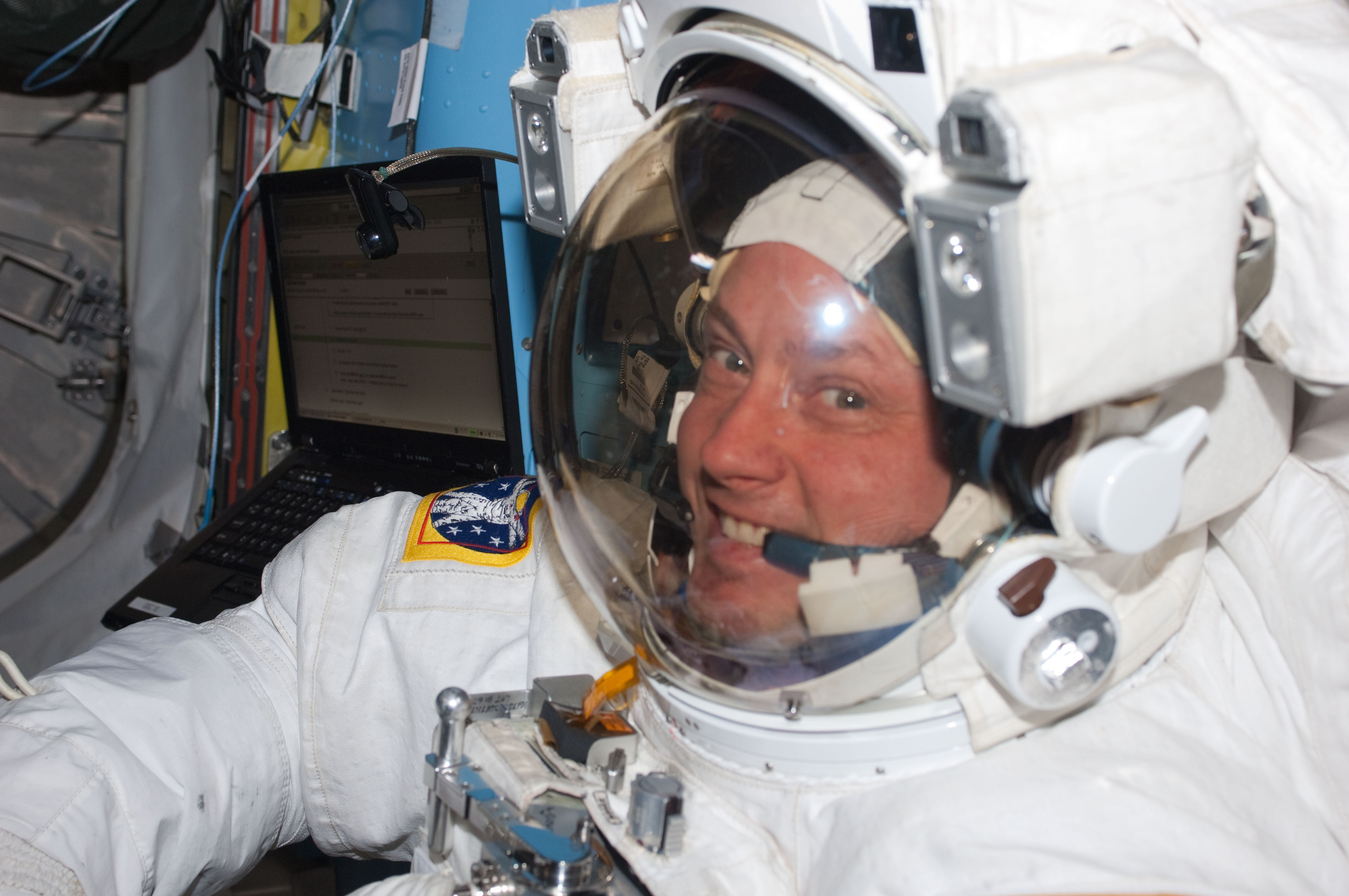
NASA’s SpaceX Crew-12 members suit up in the Neil A. Armstrong Operations and Checkout Building at the agency’s Kennedy Space Center in Florida ahead of launch to the International Space Station on Feb. 13, 2026. From left, Roscosmos cosmonaut Andrey Fedyaev, NASA astronauts Jack Hathaway and Jessica Meir, and ESA (European Space Agency) astronaut Sophie Adenot.
Credit: NASA/Kim Shiflett
Media are invited to hear from NASA’s SpaceX Crew-12 astronauts during a news conference beginning at 2:45 p.m. EDT, Wednesday, Sept. 16, from the International Space Station.
NASA astronauts Jessica Meir and Jack Hathaway, ESA (European Space Agency) astronaut Sophie Adenot, and Roscosmos cosmonaut Andrey Fedyaev will discuss their upcoming return to Earth. Learn where to watch online:
Media interested in participating must contact the newsroom at NASA’s Johnson Space Center in Houston no later than 5 p.m., Tuesday, Sept. 15, at 281-483-5111 or jsccommu@mail.nasa.gov. To ask questions, media must dial into the news conference no later than 10 minutes prior to the start of the call. A copy of NASA’s media accreditation policy is online.
Crew-12 joined Expedition 74/75 crew members aboard the space station and contributed to hundreds of experiments to prepare for human exploration beyond low Earth orbit and to benefit humanity on Earth. Research included studying pneumonia-causing bacteria to improve cardiovascular treatments, on-demand intravenous fluid generation for future space missions, and how physical characteristics may affect blood flow during spaceflight.
The crew will depart the space station after the arrival of Crew-13 and a short handover period. Ahead of Crew-12’s return, mission teams will review weather conditions at the splashdown sites off the coast of California prior to departure from station.
For more than 25 years, people have lived and worked continuously aboard the International Space Station, advancing scientific knowledge and making research breakthroughs not possible on Earth. The space station helps NASA understand and overcome the challenges of human spaceflight, expand commercial opportunities in low Earth orbit, and build on the foundation for long-duration missions to the Moon, as part of the Artemis program, and to Mars.
Learn more about the International Space Station, its research, and crew, at:
Jaden Caradine knew he wanted to be an engineer at eight years old. He just took a winding road to get there.
Before he enrolled at Embry-Riddle Aeronautical University, before he discovered the field that would become his focus, and before he landed a Pathways internship at NASA’s Langley Research Center in Hampton, Virginia, Caradine spent five years as a mechanic in the United States Marine Corps, four of them stationed in Japan. It was a deliberate detour, one that shaped how he approaches everything since.
“I’ve kind of always known I wanted to be an engineer,” he says. “I just had to figure out what kind.”
NASA Pathways intern Jaden Caradine
Credit: NASA
Finding the Overlap
Caradine grew up in the Salt Lake City area, raised by a mother who put him on a snowboard at four and on a rock face not long after. He was the kind of kid who learned to love science not for its own sake, but for what it could do. “Math is an enabling skill,” he says. “It’s not about doing the math. Math has a purpose and it’s useful.”
By the time someone asked young Jaden what he wanted to be, the answer was immediate. “I was building Legos,” he says, “and I just thought — I want to build stuff. I can’t really see myself being anything other than an engineer.”
Right out of high school, Caradine enlisted in the Marines, trained as a mechanic, and shipped out to Japan. During those five years, between the technical work and the distance from home, he started reading books on decision-making, career planning, and long-term thinking. He found a framework he keeps coming back to: ikigai, a Japanese concept that maps the intersection of what you’re good at, what you enjoy, what the world needs, and what you’re paid to do.
Caradine at the Sapporo Snow Festival in Hokkaido, Japan, while serving as a U.S. Marine Credit: Jaden Caradine
“Your ikigai is the thing where all of those overlap,” he says. Engineering was already in the picture. The question was what kind.
Chasing the Signal
The answer arrived through research and a company Caradine stumbled on while scanning the landscape of emerging aerospace technology. They were using magnets to spin a launch system to 14,000 or 15,000 RPM and release small satellites into orbit, recovering the energy on the way down through the same magnetic system. “I thought that was awesome,” he recalls. “So, I started looking into aerospace engineering, and it was a good fit.”
Once he had the field, the destination wasn’t hard to find. Caradine transferred to Embry-Riddle Aeronautical University’s Daytona Beach campus to study aerospace engineering and immediately started showing up everywhere he could — satellite conferences at Kennedy Space Center, industry events in Orlando, small satellite gatherings back in Salt Lake City. “I went to all the career fairs, even though I wasn’t looking for a job yet,” he says. “I just wanted to learn as much as I could, as fast as I could.”
At every NASA booth, he asked questions. He learned about Pathways, the program that places undergraduate and graduate students at NASA centers with the potential to convert to full-time civil service positions, but he waited a year to apply. “I hadn’t really done the things I wanted to do in order to write a strong application yet,” he says. He wrote the next application with the intention of using it as a practice run. He got in.
His reason for choosing NASA over industry was simple and firm. “NASA doesn’t work for profit,” he says. “We’re here to remove barriers so that industry can eventually do the things they weren’t able to do before.”
“Human beings are far more capable than we give ourselves credit for. A journey of a thousand miles starts with a single step and can only be taken one step at a time.”
Work Worth Doing
At NASA Langley, Caradine is part of the Systems Analysis and Concepts Directorate, where “we help agency leaders figure out why they should make certain decisions, especially those that have lots of moving parts,” he explains. Specifically, he works with the in-space servicing, assembly, and manufacturing (ISAM) team, a group focused on the emerging field of building and maintaining infrastructure in space, rather than simply launching and discarding it.
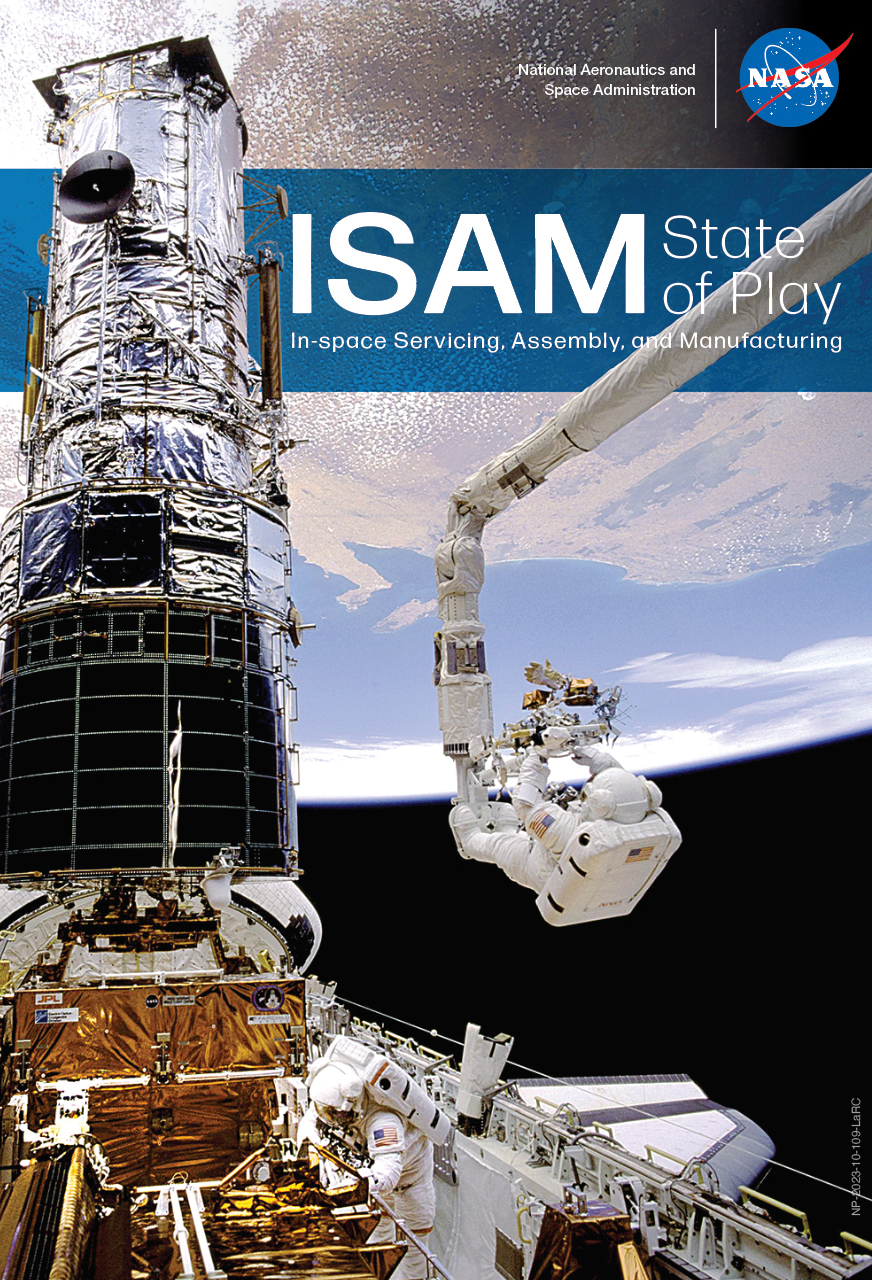
A major part of his summer was curating the State of Play, a comprehensive document that consolidates everything happening in the ISAM sector across government, academia, and industry into a single, navigable resource.
“Jaden joined the team and immediately contributed to this year’s State of Play update,” says Dale Arney, aerospace engineer and Caradine’s mentor. “He also created an automated tool that will help the team create future updates more quickly.”
The ISAM State of Play document is a survey of past, present, and near-future ISAM capabilities across industry, academia, and government agencies.
Credit: NASA
That tool scrapes aerospace news from across the web, compiles relevant updates into organized tables, and produces a readable summary on a regular cadence. “It kind of replaced the need for everyone on the team to spend 30 or 40 minutes every day scrolling through news to keep up,” he says.
“Jaden was constantly looking for ways to improve himself, the team, and our products,” Arney adds. “He was eager to take the lead in trying a number of new processes and ideas to try to make them work for us.”
No Silos
The thing that surprised Caradine most about NASA Langley had nothing to do with the technical work. He had expected some departmental siloing that could develop in large organizations, where people become experts in narrow areas with limited cross-pollination among teams.
“That’s not something I’ve experienced here,” he says. “We all talk to each other, across all teams. We share resources. We collaborate quite extensively.” He describes a culture that expects everyone to engage with the whole problem, not just their corner of it. “Everyone kind of bounces around on different teams to learn the whole aspect of the problem and support each other.”
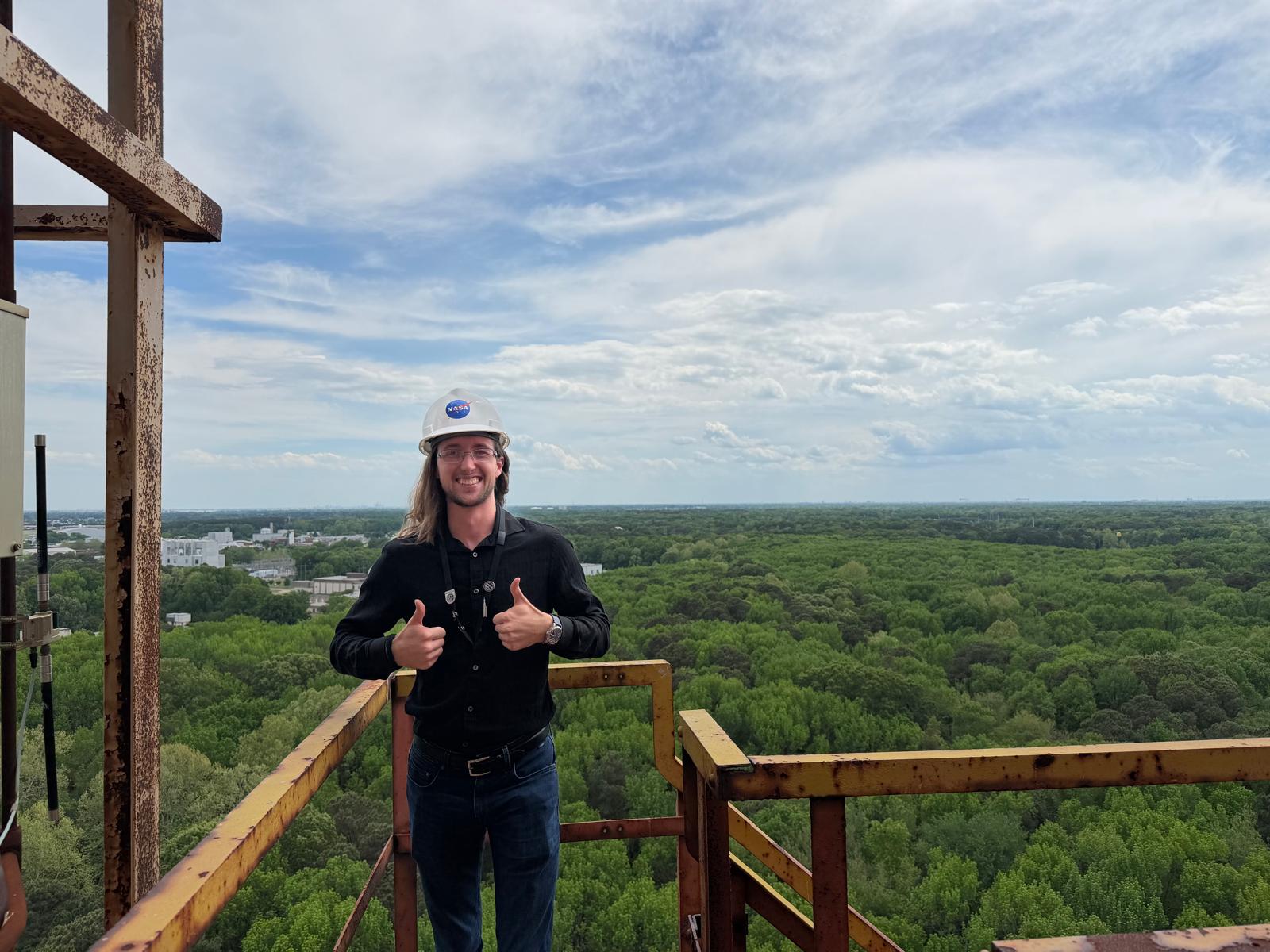
Caradine at NASA Langley’s Impact Dynamics Facility, enjoying the view at the top of the gantry
Credit: NASA
For anyone considering the Pathways program, his advice is direct. “Do it,” he says. “Human beings are far more capable than we give ourselves credit for. If it seems like too much, break it down. A journey of a thousand miles starts with a single step and can only be taken one step at a time.”
Caradine heads back to Embry-Riddle as a junior this fall, with plans to return to Langley next summer. Grad school is on the horizon, and he’s exploring programs that nurture important analysis skills for SMAB, including decision, strategic, and systems analysis.
“Before coming here, I was trying to do everything and cast a wide net,” he says. “Now I know what I need to know how to do. That’ll give me the opportunity to focus my efforts on the high-value skill sets.”
On Caradine’s Sci-Fi Shelf
The Sirens of Titan by Kurt Vonnegut
Dungeon Crawler Carl by Matt Dinniman
Caradine’s instinct runs more toward fantasy than science fiction, but this one, he says, hits something real.
“I enjoy the leveling aspect — constantly improving, constantly getting better. In books it might be physical strength, but in reality, strength takes on many different forms. Constant improvement is quite rewarding in real life, as it is in books.”
The audiobook production, he adds, is its own experience: full sound design, character actors, the works. “It’s like listening to a movie.”
The team also recently convinced him to start Dune, by Frank Herbert. He’s about halfway through.
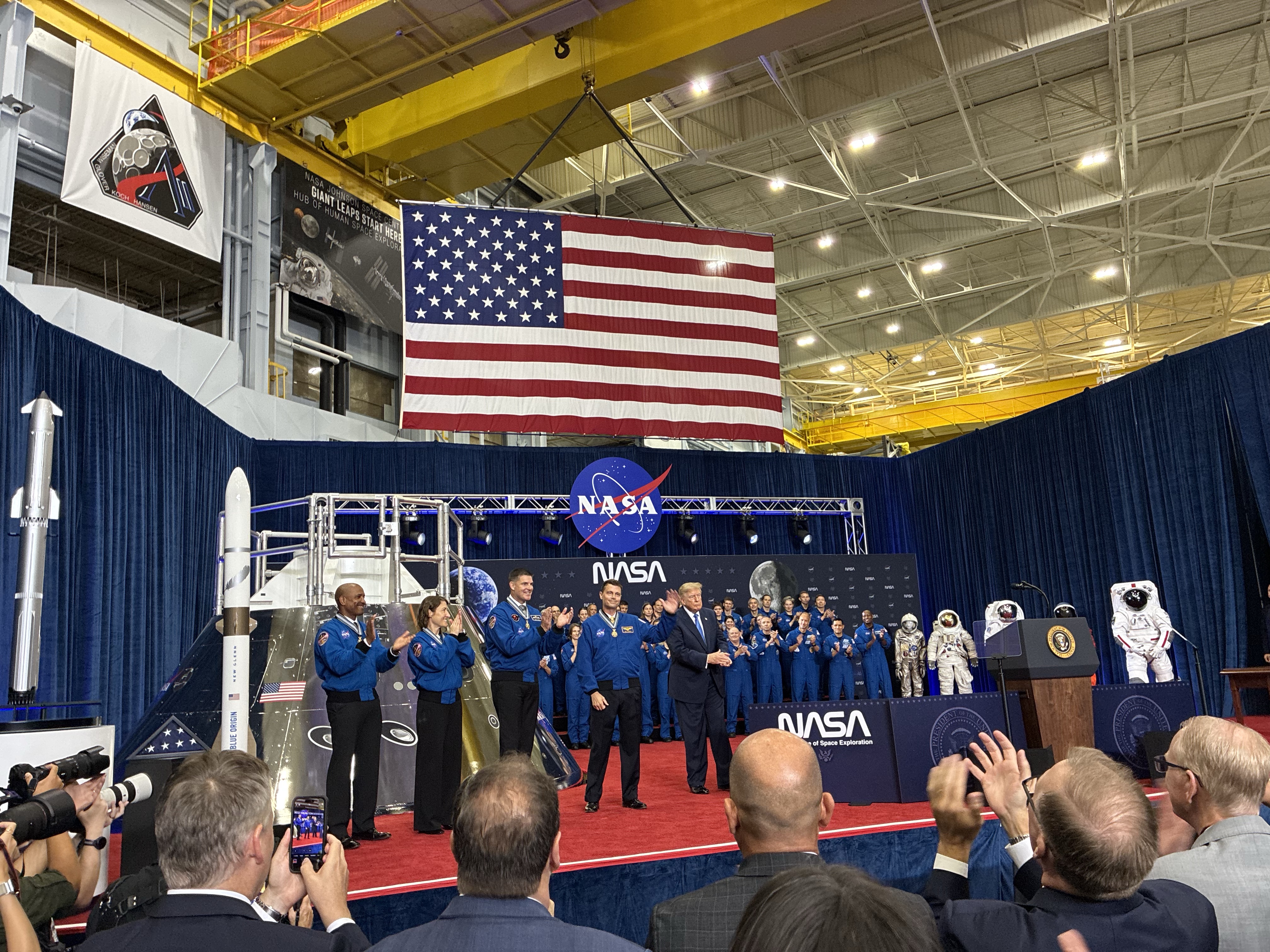
President Donald J. Trump awarded NASA astronauts Reid Wiseman, Victor Glover, and Christina Koch, and CSA (Canadian Space Agency) astronaut Jeremy Hansen with the Congressional Space Medal of Honor on Aug. 28, 2026, at NASA’s Johnson Space Center in Houston.
Credit: NASA
President Donald J. Trump awarded NASA astronauts Reid Wiseman, Victor Glover, and Christina Koch, and CSA (Canadian Space Agency) astronaut Jeremy Hansen with the Congressional Space Medal of Honor Friday for their service during the Artemis II mission. He presented the awards during a ceremony at NASA’s Johnson Space Center in Houston, honoring the first medal recipients since 2023.
NASA’s historic Artemis II mission launched on April 1, and splashed down safely in the Pacific Ocean on April 10. The crew members were the first astronauts to launch on the agency’s SLS (Space Launch System) rocket, flying aboard NASA’s Orion spacecraft, which the crew named Integrity. During their record-setting mission, the astronauts traveled 252,756 miles from Earth, farther than any humans have traveled before, surpassing a previous record set by Apollo 13 astronauts in 1970. In total, they flew 695,081 miles, including a lunar flyby.
“We gather on these historic grounds to celebrate the immense courage of four intrepid space heroes whose sense of daring and adventure led them further from Earth than anyone has ever traveled ever before,” said President Trump. “Today we’re proudly awarding the Congressional Space Medal of Honor to the remarkable crew of Artemis II. These astronauts did not do it alone. I want to salute all of the engineers, and scientists, launch and landing specialists, everyone at NASA who helped make this mission a great success.”
The Congressional Space Medal of Honor was authorized by Congress in 1969 to recognize an astronaut who in the performance of duties has distinguished himself or herself by exceptionally brave and meritorious efforts, and contributions to the welfare of the nation and humanity. There now are 34 recipients of the award since the beginning of the space program, including the crews of Apollo 1, Challenger, and Columbia who received the award posthumously.
“President Trump’s leadership has put America back on a path to lead the world in space, from creating the Artemis program to giving NASA the resources and mandate to win this new space race,” said NASA Administrator Jared Isaacman. “The Artemis II crew answered that call with extraordinary skill and courage, showing the world the Moon again and what American leadership and exploration look like at their best. Their achievement was made possible by the exceptional NASA workforce, alongside our industry and international partners, who showed once again what can be accomplished when we commit to big, bold endeavors. We will build on this success as we return to the lunar surface and establish an enduring presence on the Moon.”
The first crewed mission under NASA’s Artemis program paved the way for the 2027 Artemis III test flight in low Earth orbit to demonstrate rendezvous and docking capabilities between Orion and commercial human landing systems, and the Artemis IV mission in 2028, which will return American astronauts to the lunar surface.
“It was the honor of my lifetime to fly on Integrity around the Moon with Victor, Christina, and Jeremy. Having President Trump here at the agency’s Johnson Space Center to honor NASA and my crew underscores the significance of what our teams accomplished,” said Wiseman, who served as commander of the mission. “I can’t wait to see my friends continue this legacy on Artemis III.”
Glover served as pilot of the Orion spacecraft.
“Piloting Orion for the first time in space was a profound honor, made possible because of the years of hard work, dedication, and expertise by countless individuals dedicating their time and talents to the mission,” said Glover. “We share this recognition with the thousands of people who launched us around the Moon and brought us safely back to Earth.”
Koch served as a mission specialist.
“The response to our mission here on Earth was beyond anything we ever imagined and all we ever hoped for. We are grateful every time we hear from people who followed along with our journey. As team members on this shared mission, we accept this award to honor those who made it happen, from factory floors to clean rooms and mission control rooms,” said Koch.
Hansen also served as a mission specialist.
“It is a privilege to receive the Congressional Space Medal of Honor alongside my Artemis II crewmates,” said Hansen. “I share this recognition with the dedicated teams in Canada, the United States, and our international partners who made the mission possible. Artemis II showed what we can accomplish for humanity when we set ambitious goals and work together. For Canada, the mission and the Artemis program as a whole are about much more than just going back to the Moon. It is about the pursuit of excellence and collaboration.”
As part of a Golden Age of innovation and exploration, NASA will send Artemis astronauts on a series of challenging missions to explore more of the Moon and establish a Moon Base on the lunar surface for long-term exploration. These missions will set the stage for sending the first astronauts — Americans — to Mars. Learn more:
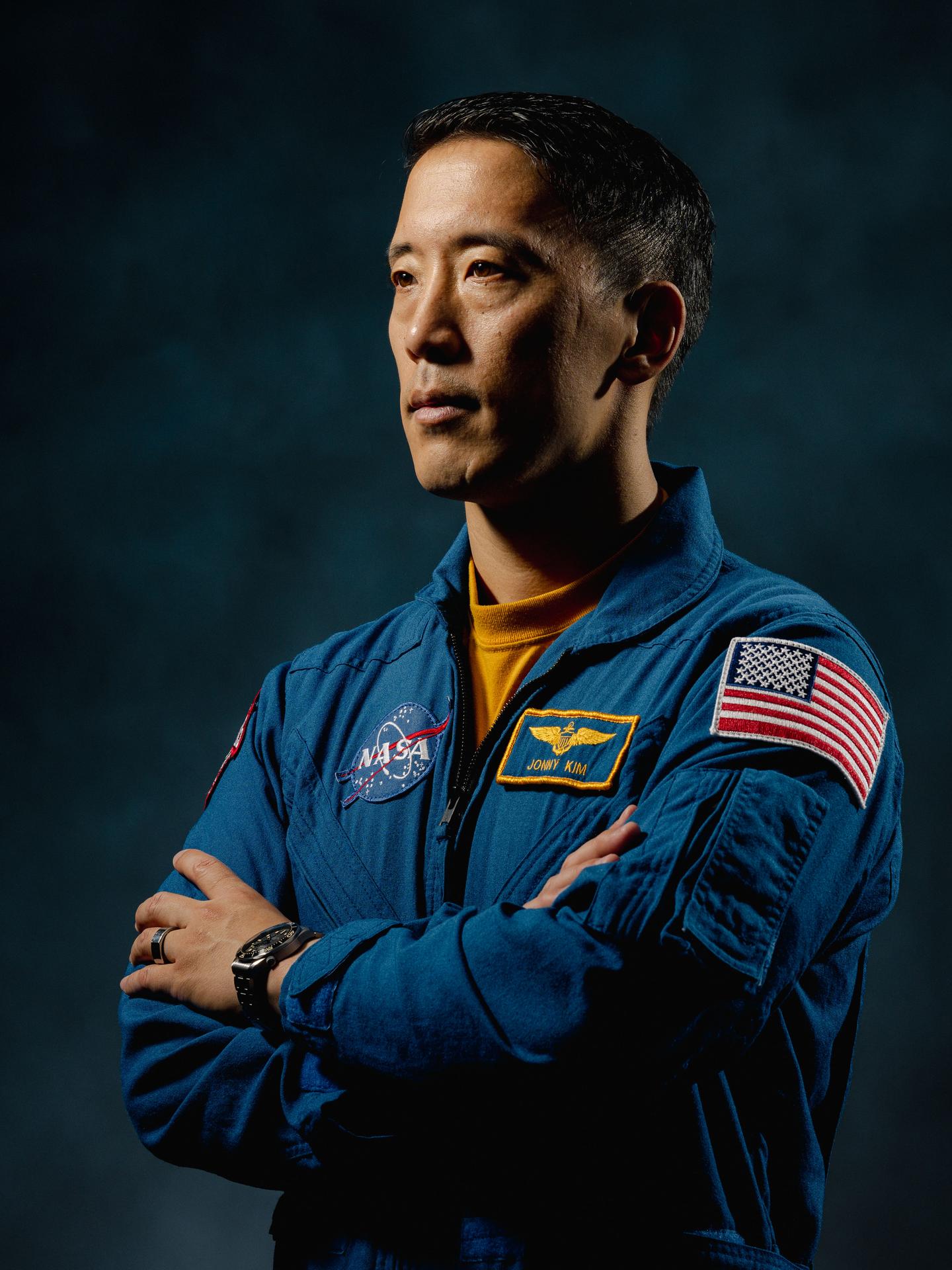
NASA astronaut Jonny Kim poses for a portrait at NASA’s Johnson Space Center in Houston.
Credit: NASA/Josh Valcarcel
After nearly a decade of service to NASA, including an eight-month science expedition aboard the International Space Station, astronaut Jonny Kim’s last day at the agency is Thursday. He will continue serving as lieutenant commander in the U.S. Navy.
Kim launched to the space station in April 2025 aboard the Soyuz MS‑27 spacecraft to conduct scientific research as a flight engineer during Expeditions 72/73. During the mission, he orbited Earth 3,920 times, traveled nearly 104 million miles, and contributed to a broad range of scientific investigations spanning technology development, Earth science, biology, and human research critical for future exploration.
“Jonny Kim represents the very best of NASA, a person who continually pushed the boundaries of exploration while inspiring countless others,” said NASA Administrator Jared Isaacman. “His contributions aboard the International Space Station advanced critical science that will shape NASA’s future missions for decades to come. We are grateful for his dedication to our nation and to the pursuit of knowledge, and we wish him success as he continues his service in the U.S. Navy.”
Serving as the U.S. Operating Segment lead for the second half of Expedition 73, Kim oversaw operations across the station’s international modules. During the expedition, the station achieved a historic milestone when every available docking port was occupied for the first time in 25 years. He also commanded the Canadarm2 robotic arm during the first capture of Northrop Grumman’s new Cygnus XL spacecraft, securing 11,000 pounds of supplies for the station. Kim and his Roscosmos crewmates landed safely in Kazakhstan in December 2025.
“Jonny has been an integral part of the agency, and his immeasurable impact will be felt for generations to come,” said Vanessa Wyche, director of NASA’s Johnson Space Center in Houston. “From advancing groundbreaking science to inspiring the next generation, Jonny has been an incredible source of inspiration to our nation. His exceptional talent, determination, and grit will leave a lasting legacy at NASA.”
Kim was selected as a NASA astronaut in 2017 and completed two years of astronaut candidate training, which included instruction in space station systems, Russian language, robotics, T‑38 flight operations, geology, survival training, and spacewalk preparation.
He later supported station operations as a capsule communicator, or capcom, in NASA’s Mission Control Center at Johnson. Kim also contributed to Artemis program development through his work in the astronaut exploration branch, leading the astronaut crew operations branch, and serving as increment lead for Expedition 65. His experiences as a Navy SEAL, physician, and naval aviator provided unique perspectives in mission operations and crew support.
“Jonny approached every assignment with humility, precision, and steadfast commitment to the mission,” said Scott Tingle, chief of the Astronaut Office at NASA Johnson. “His combination of medical training, operational experience, and engineering insight strengthened our team and contributed to advancements in exploration and space station operations.”
Born in Los Angeles, Kim enlisted in the U.S. Navy after graduating high school in 2002. He trained as a hospital corpsman and completed Basic Underwater Demolition/SEAL training before joining SEAL Team Three. Over the course of more than 100 combat operations, he served as a medic, sniper, navigator, and point man, earning the Silver Star, Bronze Star with Combat “V,” and numerous additional commendations.
He earned a bachelor’s degree in mathematics from the University of San Diego and a doctor of medicine from Harvard Medical School. He completed his internship at Massachusetts General Hospital and Brigham and Women’s Hospital in Boston. Kim became a dual-designated naval aviator and flight surgeon, completing flight training at Naval Air Stations Corpus Christi in Texas and Whiting Field in Florida, and aerospace medical training at the Naval Aerospace Medical Institute at Naval Air Station Pensacola.
Kim is returning to active duty to finish out the remainder of his military career within naval aviation training.
“Contributing to space exploration and serving NASA has been the honor of a lifetime,” said Kim. “Throughout my career, I’ve learned that beyond the missions, the training, and the hardware, success always comes down to the people. They are our greatest asset, and leading with love and empathy is how we achieve the impossible. I look forward to carrying my commitment to service, my enduring love for space and technology, and the hard-earned lessons of this past decade into my next chapter to make a meaningful impact on humanity’s future.”
To learn more about NASA’s astronauts and human space exploration, visit:
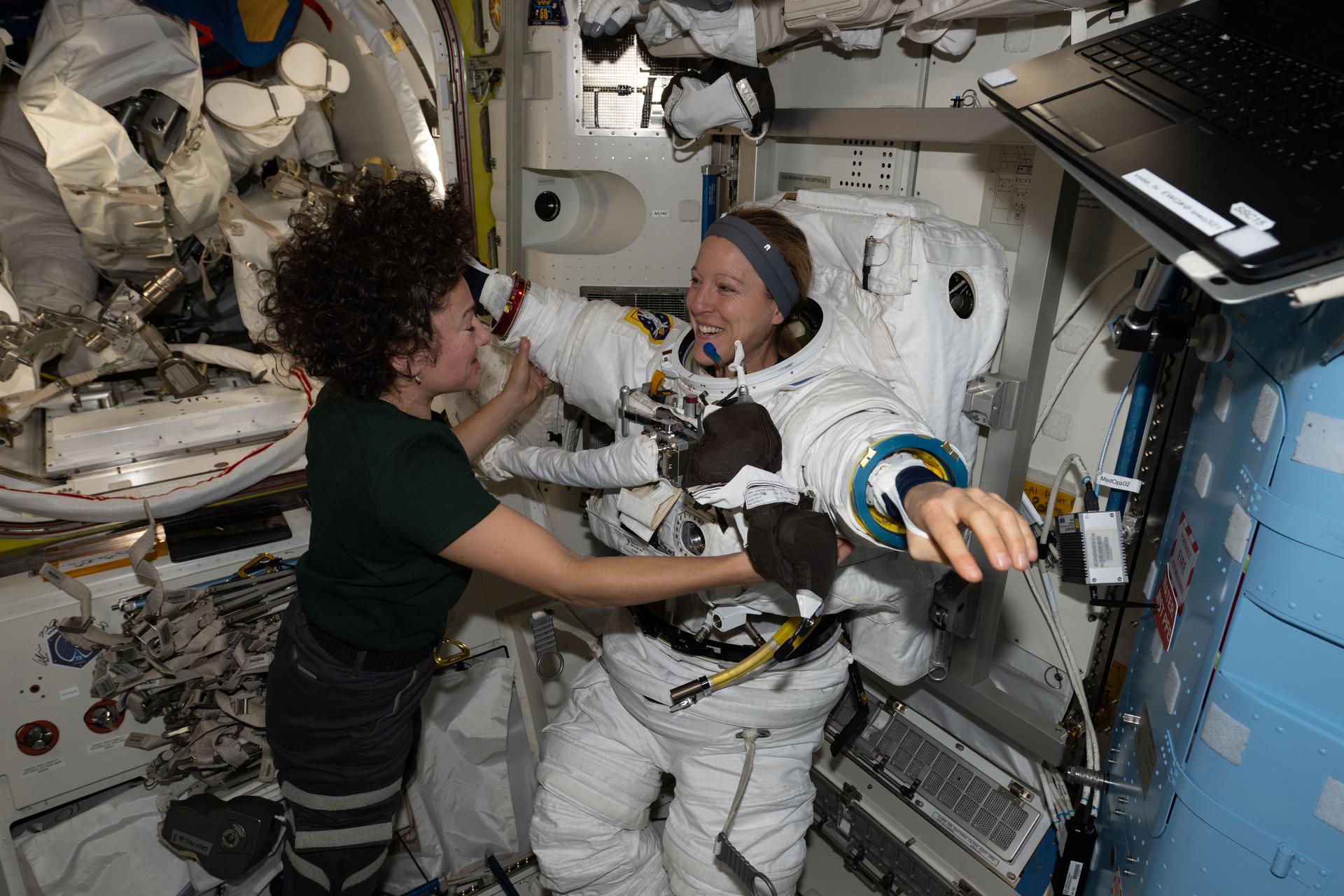
NASA astronaut Jessica Meir and ESA (European Space Agency) astronaut Sophie Adenot work together inside the International Space Station’s Quest airlock during spacesuit fit and leak checks.
Credit: NASA
NASA will provide coverage as two astronauts step outside the International Space Station on Tuesday, Sept. 1, to replace a spacecraft navigational aid and complete several maintenance tasks in support of space station operations.
Watch live coverage beginning at 7 a.m. EDT. The spacewalk is expected to start at approximately 8:30 a.m. and last about six and a half hours. NASA’s spacewalk coverage will stream through a variety of platforms. Learn where to watch online:
During U.S. spacewalk 99, NASA astronaut Jessica Meir and ESA (European Space Agency) astronaut Sophie Adenot will replace a retroreflector on the forward port of the space station’s Harmony module to support spacecraft navigation during rendezvous and docking operations. After installing the reflector, the crew will work to install jumper cables for the data-relay systems, prepare the Alpha Magnetic Spectrometer’s radiator for future maintenance, and replace a high-definition camera on the station’s truss.
Adenot will serve as spacewalk crew member 1 and will wear a suit with red stripes. Meir will serve as crew member 2 and will wear an unmarked suit.
This will be Meir’s seventh spacewalk and Adenot’s third. Meir will move into third all-time for total spacewalks among women at NASA, trailing Peggy Whitson (10) and Suni Williams (9). The excursion also marks the 284th spacewalk supporting space station assembly, maintenance, and upgrades.
To learn more about International Space Station research, operations, and its crews, visit:
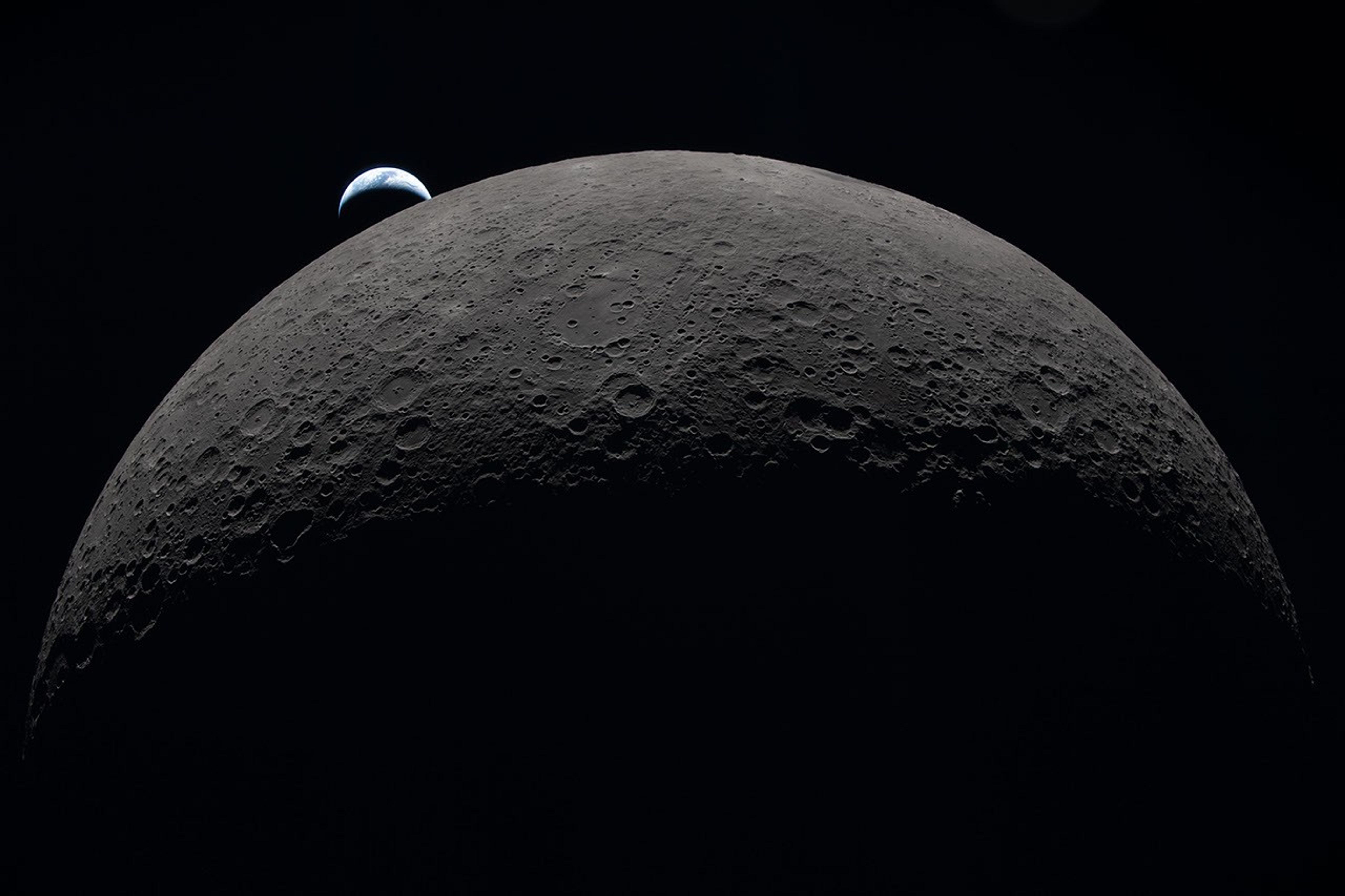
This image was taken by an Artemis II astronaut from the Orion capsule in April 2026, as the spacecraft traveled past the Moon and back over 10 days. The gray-brown, heavily cratered Moon dominates the frame against black space, with a partially lit crescent Earth setting behind its upper-left edge.
Some of Earth’s microbes likely to hitch a ride to space with human explorers could survive in the shaded nooks and crannies of the Moon’s South Pole region, NASA scientists say.
Published on Aug. 19, 2026, in Science Advances, these findings highlight a need to better understand microbial persistence in extreme lunar environments. As humans build a permanent presence on the Moon, it may become difficult to distinguish ancient lunar chemistry from contamination delivered by visiting astronauts. The concern extends beyond the Moon and on to Mars, scientists say.
“Humans are natural explorers, and with them come their voices, their memories … and their microbes,” said Prabal Saxena, a planetary scientist who led the study from NASA’s Goddard Space Flight Center in Greenbelt, Maryland. “For some scientists, myself included, that reality can be unsettling. But it also creates an opportunity to turn an imperfect situation into a useful experiment.”
Bringing microbes along is unavoidable: Humans have, on average, 1 million bacteria living on each patch of skin the size of a pencil eraser, for example. These bacteria vent from spacesuits and habitats. Though the paper’s authors worry about contamination interfering with the search for chemical clues to ancient geology or biology, they also argue that the Moon should be used as a natural lab. In shaded areas around the South Pole, scientists could carefully test the real-life limits of microbial survival in an environment that can’t easily be reproduced on Earth.
The Apollo program landed six pairs of astronauts on the Moon between 1969 and 1972. All six landing sites are near the lunar equator. In this visualization, the Apollo sites are contrasted with the South Pole, an area with enormous potential for future exploration. Time passes as we zoom toward Shackleton crater at the South Pole, revealing illumination conditions quite different from those near the equator. While many craters remain in permanent shadow, some nearby mountains and ridges are in persistent sunshine, making them attractive candidates for solar power and long-term habitation.
Before any surface science can happen, scientists need a baseline measurement of what contaminants humans bring, the authors say.
“We need to understand what was there before us, because when we go to Mars to search for signs of life beyond our planet, we will want to make sure it’s not stuff we brought,” said Andrew Needham, a NASA Goddard-based paper co-author who is an Artemis contamination‑control scientist for lunar samples.
Even with strict sterilization procedures, some organisms are stubbornly resilient. A good example is Aspergillus niger, which is a fungus that thrives in warm, damp places like household bathrooms and heating, ventilation, and air conditioning systems. Astronauts have sampled it inside the International Space Station, and experiments demonstrate that the fungus can survive outside the station as well. Aspergillus niger was one of five microbes, including bacteria and fungi, selected for this study because of its known toughness in spaceflight environments.
That microbes survived on the space station’s exterior surprised scientists. These species are typically not considered “extremophiles” that can withstand harsh conditions, such as the vacuum of space, according to Aaron Regberg, a geomicrobiologist at NASA’s Johnson Space Center in Houston.
“I would have expected these microbes to have dried out,” said Regberg, who studies space station bacteria and was a co-author on the paper.
NASA astronaut Kate Rubins on Oct. 14, 2016, collecting microbes in the Japanese Experiment Module aboard the International Space Station.
JAXA/Takuya Onishi
He pointed out that NASA often bakes robotic spacecraft at temperatures above 400 degrees Fahrenheit to reduce the number of living organisms on them. But that’s not possible with astronauts, so contamination concerns take on new meaning in crewed exploration of the Moon’s south polar environment.
A clearer picture of where microbes might survive comes from understanding how sunlight behaves at the poles. Survival in this study means the microbe can stay alive for at least one Earth day, which does not mean that it can grow and reproduce.
Because the Moon has a very small tilt on its axis, the view from its poles is of a Sun that appears to hover just above the horizon, skimming the surface like a flashlight laying on a table. As a result, elevated parts of the surface, including crater ridges, mountains, and even small bumps, block light from reaching low-lying terrain. This produces pockets of shadowed areas that can remain cold and preserve water, as well as shield fragile molecules and possible microorganisms from lethal radiation.
With that scientific context in mind, the team set out to test which Earth microbes could survive extreme polar conditions. They focused on organisms commonly found in spaceflight environments and those common on human skin. Besides Aspergillus niger, these included Bacillus subtilis, Staphylococcus aureus, Deinococcus radiodurans, and several species of Fusarium. Based on an analysis of previous studies, the scientists noted the maximum amount of heat and ultraviolet (UV) radiation each organism can withstand.
Then, the organisms were tested in simulations of three regions near the lunar South Pole — Nobile Rim, Connecting Ridge, and De Gerlache Rim. Those simulations used detailed environmental maps built from elevation and temperature data collected by instruments aboard NASA’s Lunar Reconnaissance Orbiter, combined with models of how radiation strikes the surface.
The models showed maps of “survivable niches” that range in size from a miles-wide crater floor to an astronaut’s boot print. Aspergillus niger, which was most resistant to UV radiation, was able to survive even in areas with some sunlight exposure. UV radiation is so deadly to most microbes that it’s used for sterilization in hospitals.
“When we think of the Moon, we don’t typically think of biology,” said Heather Graham, a paper co-author at NASA Goddard who helps develop tools and techniques for detecting biology that may look nothing like Earth’s. “But the Moon is a place where a cell can survive, so our first exploration of these sites should pay extra attention to our microbial hitchhikers and work hard to characterize lunar chemistry before our visits change what we will find.”
The authors note that while some microbes can survive in a dormant state in regions around the South Pole, and thereby confuse some future scientific investigations, there is no evidence the Moon has key ingredients to sustain growth and replication. Such ingredients include liquid water, which typically requires an atmosphere and moderate temperatures.
International Observe the Moon Night, Sept. 19, 2026
Each year, observers around the world come together to celebrate Earth’s Moon through direct observations, hands-on activities, lunar-themed music, artwork, readings, and more.
The Moon
From lighting up our skies to preserving evidence of our solar system’s history, Earth’s closest neighbor plays a pivotal role in the study of our planet and beyond.
About the Author
Lonnie Shekhtman
Senior Science Writer
Shekhtman helps communicate NASA planetary science to the world through news and feature stories on NASA.gov, videos for NASA+ and YouTube, and by working with the media. She reports on lunar and Mars science and exploration; NASA’s search for life; missions to Venus, Titan, and Jupiter’s Trojan asteroids; and many other topics related to NASA’s exploration of our solar system and beyond.
NASA’s LRO Images Falcon 9 Crater on Moon, Learns New Details
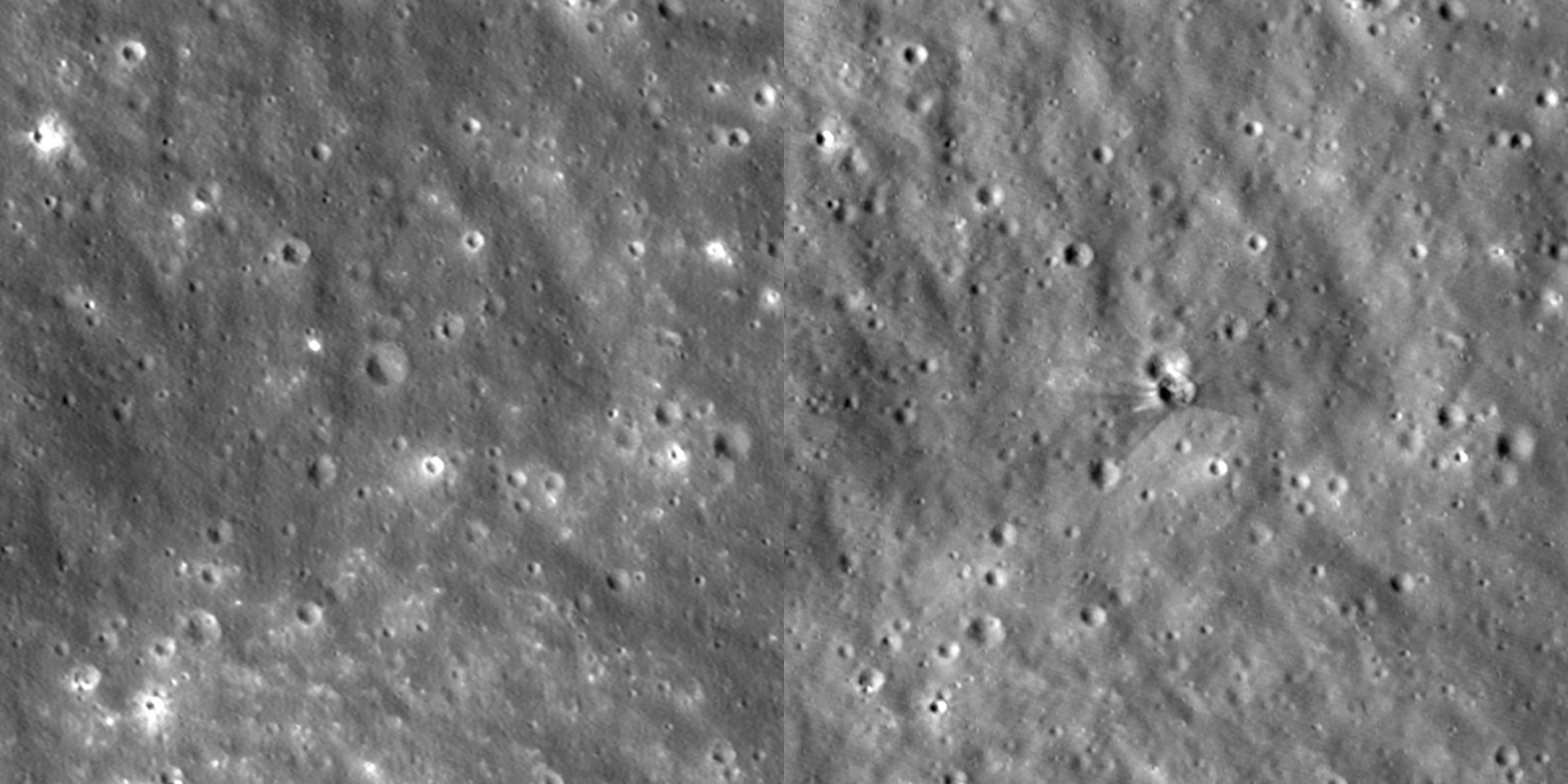
This is an animated before-and-after view of the crater formed after a Falcon 9 upper stage struck the Moon’s surface on Aug. 5, 2026. These images were taken between Aug. 11 and 12 by the Narrow-Angle Camera on NASA’s Lunar Reconnaissance Orbiter. These images are enlarged three times from the original, with north facing up, and they cover an area about a quarter of a mile wide.
NASA Goddard/Intuitive Machines
Between Aug. 11 and 12, NASA’s Lunar Reconnaissance Orbiter (LRO) captured a series of images of a new crater on the Moon. The crater formed on Aug. 5, when a SpaceX Falcon 9 upper stage impacted the surface following its January 2025 launch of the Firefly Blue Ghost 1 mission.
To capture imagery of the impact, engineers tilted the spacecraft so its cameras would point toward the crater each time LRO passed about 60 miles above the Moon, traveling 1 mile per second. The orbiter circles the Moon from pole to pole every two hours, while the Moon slowly rotates underneath it. To photograph a specific spot, the spacecraft must wait until that location turns into view, which took six days in this case.
Getting the pointing right was only half the challenge; timing had to be accurate as well. If the camera snapped even 10 seconds too early or too late, the target would drift off-center by 10 miles.
An artist concept video showing NASA’s Lunar Reconnaissance Orbiter circling the Moon.
NASA’s Goddard Space Flight Center Conceptual Image Lab
Because of the variety of viewing angles, scientists could see the crater under multiple lighting conditions that revealed unique features. In images where the crater rim stood out, scientists measured its 60‑foot width. Scientists also determined the crater is less than 10 feet deep based on the length of its shadow.
To capture these details, LRO used its Narrow-Angle Camera, which can spot features as small as 3 feet wide.
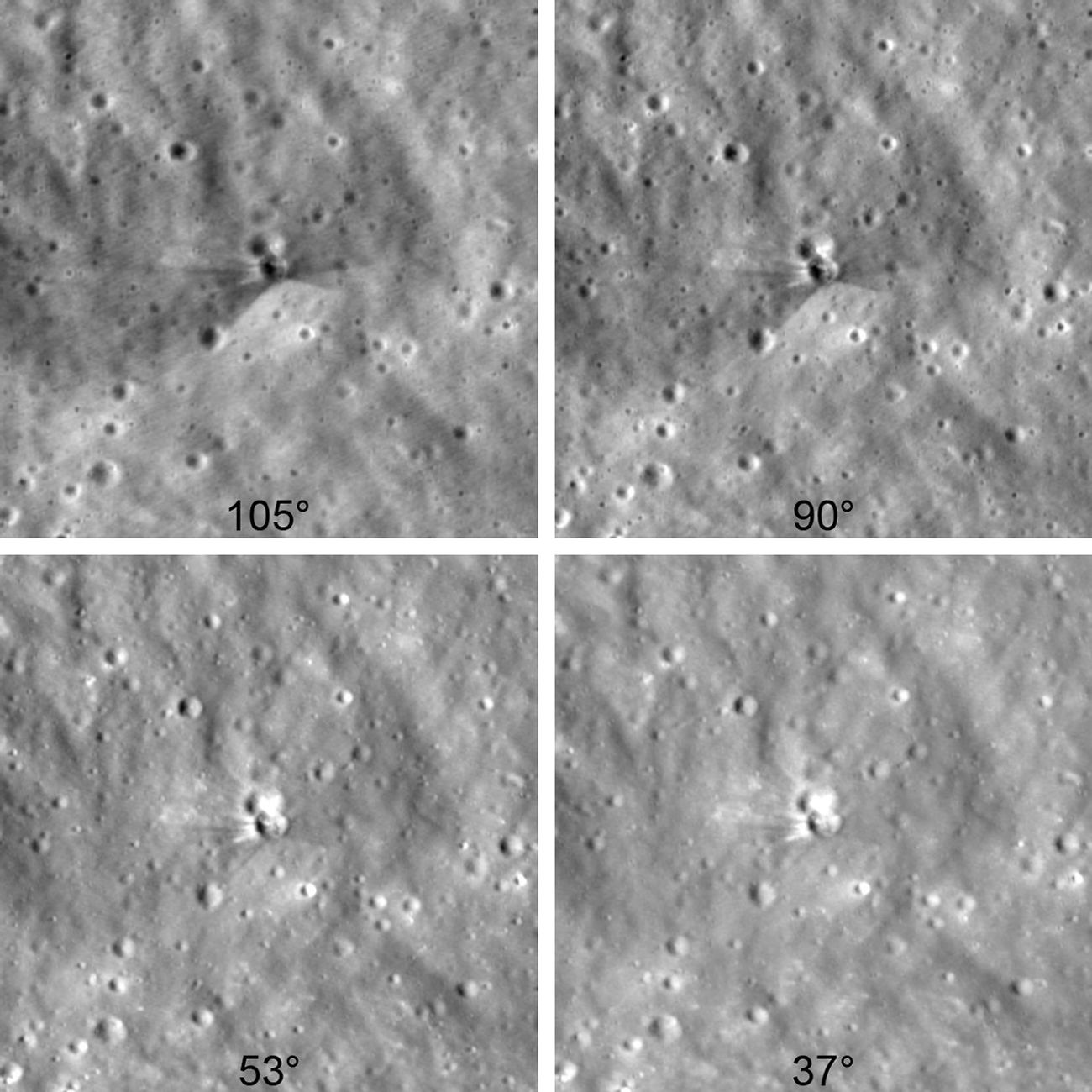
Collected between Aug. 11 and 12 by NASA’s Lunar Reconnaissance Orbiter, six days after a Falcon 9 upper-stage booster impacted the Moon, these images were taken from different viewing angles, bringing out different features. The darker area that fans around the crater in the upper-left image is rougher than the surroundings, as this surface material has been altered over a long time by solar wind, galactic cosmic rays, and micrometeorite impacts. The brighter rays and splotch above the crater in the lower-right image is fresher material that was excavated from deeper below the surface. The pictures are arranged in the order they were taken, starting at the top left and moving toward the bottom right, with the lighting angle from the Sun gradually changing from one image to the next. Each image is enlarged two times and shows an area of the Moon about 1,000 feet wide.
NASA Goddard/Intuitive Machines
The images above show bright and dark rays stretching out from the crater. The darker streaks are made of surface dust and rocks altered over a long time by solar wind, galactic cosmic rays, and micrometeorite impacts. This weathered material was excavated by the collision from 1.5 feet into the lunar surface. The brighter streaks near the crater rim are made of fresh material excavated from deeper underground.
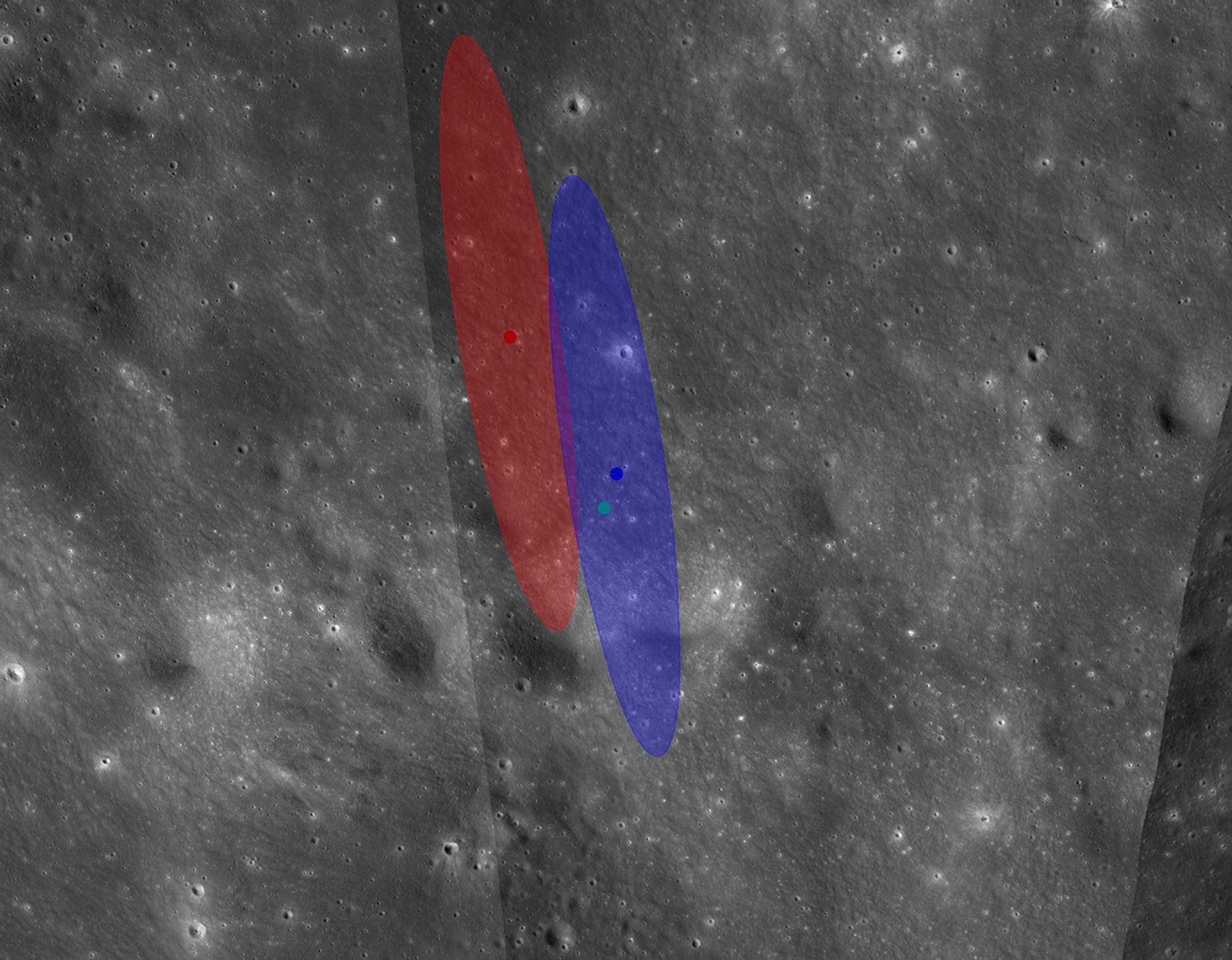
This image from NASA’s Lunar Reconnaissance Orbiter shows two oval regions where the Falcon 9 upper stage was likely to impact the Moon, based on calculations by engineers with NASA’s Center for Near Earth Object Studies. Both ellipses are 2.1 miles long and 0.4 miles wide. Both predictions use the same booster-trajectory calculations, but only the blue ellipse takes into account the lunar terrain. The red and blue dots show predicted impact locations, whereas the cyan dot shows the actual impact site.
NASA/JPL-Caltech
Finding the impact site took global coordination among experts and hobbyists. Independent astronomers first identified the rocket’s trajectory using publicly available data. NASA’s Center for Near Earth Object Studies, which tracks natural objects that could pose hazards to Earth for the agency’s Planetary Defense program, used this opportunity to test and validate tools and techniques for predicting impacts.
Based at NASA’s Jet Propulsion Laboratory in Southern California, the center incrementally refined the trajectory until identifying the location of impact, which it provided to the Republic of Korea for their Korea Pathfinder Lunar Orbiter (Danuri) team. The team used the high-resolution LUTI camera on Danuri a few hours later to image the crater, finding the prediction was accurate to about 0.6 miles.
After capturing images of the crater, the Danuri mission sent coordinates to NASA’s LRO team to help refine their follow-up imaging sequence. Comparing their new crater images with the pre-impact images, the LRO team updated the crater center coordinates: 19.4759°N, 266.7138°E, 511 meters elevation.
NASA astronaut Mike Fincke is pictured inside the International Space Station’s Quest airlock prior to the start of the third spacewalk for the STS-134 mission.
Credit: NASA
NASA astronaut Mike Fincke is departing the agency on Wednesday after 30 years of service. Throughout his career, he flew four missions, spent 549 days in space, and completed nine spacewalks in support of the International Space Station.
“Few people have had the opportunity to shape as many chapters of NASA’s history as Mike Fincke,” said NASA Administrator Jared Isaacman. “Over a remarkable career, Mike served our nation as a pilot, engineer, astronaut, and mentor. From long-duration missions aboard the International Space Station to helping prepare the Artemis generation, his contributions have helped position NASA for what comes next. The success we’re building on today is possible because of people like Mike, who dedicated their careers to moving our space program forward and preparing the next generation to carry the mission even further. I’d like to congratulate Mike on an incredible career and thank him for his decades of service to NASA, our nation, and the countless people who had the opportunity to learn from and fly alongside him.”
He ranks fourth among NASA astronauts in accumulated time in space, and his spacewalks total 48 hours and 37 minutes. Most recently, Fincke piloted NASA’s SpaceX Crew‑11 mission, which launched in August 2025 and returned in January. During the mission, he served as a flight engineer for International Space Station Expedition 73 and commander of Expedition 74.
Fincke joined NASA’s 16th astronaut class in 1996 and first flew to space in 2004 aboard Soyuz TMA‑4 in support of the space station’s Expedition 9. Serving as a science officer and flight engineer, he helped maintain station systems and performed four spacewalks. He returned to space in 2008 on Soyuz TMA‑13 as commander of Expedition 18, preparing the space station for its transition to six‑person crews at the time and completing two more spacewalks.
In 2011, Fincke flew on STS‑134, the final flight of space shuttle Endeavour. As mission specialist and robotic arm operator, he completed three spacewalks and helped deliver and install the Alpha Magnetic Spectrometer.
“Mike’s remarkable career reflects three decades of dedication to NASA’s mission and the advancement of human spaceflight,” said Vanessa Wyche, director of NASA’s Johnson Space Center in Houston. “From his time aboard the International Space Station to his commitment to mentoring the next generation, Mike has made an immense impact across our agency. His legacy of service, mentorship, and dedication to exploration will continue to inspire the generations to come.”
Throughout his career, Fincke bridged spacecraft development, flight testing, and mission operations. Early in the International Space Station Program, he helped test and integrate several of the station’s initial modules before launch. His flight experience spanned multiple generations of human spacecraft, including two missions aboard Soyuz, one aboard the space shuttle, and later piloting the SpaceX Dragon.
Fincke was a foundational contributor to NASA’s Commercial Crew Program. As chief of the Astronaut Office’s Commercial Crew Branch, he worked to ensure astronaut needs, crew safety, and human spaceflight experience informed development of the nation’s next generation of crewed spacecraft. He spent five years supporting Boeing’s Crew Flight Test program training as a crew member and backup pilot, contributing to flight software, systems integration, integrated testing, and spacecraft interfaces.
Fincke also supported station operations from the ground as a crew test support team member in Russia, a capsule communicator, or capcom, and crew procedures team lead. He helped translate complex engineering and operational requirements into clear instructions for crews working in orbit. His continuity across development, integration, mission support, and long‑duration flight gave him an end‑to‑end perspective on space station assembly and operation.
“Mike approached every assignment with experience, humility, and an unwavering focus on the mission,” said Scott Tingle, chief of the Astronaut Office at NASA Johnson. “Whether flying aboard the station, supporting crews from the ground, or helping shape the spacecraft that future crews will rely on, he consistently strengthened our team. His legacy is woven into the way we fly today.”
A native of Emsworth, Pennsylvania, Fincke holds bachelor’s degrees in aeronautics and astronautics and in Earth, atmospheric, and planetary sciences from the Massachusetts Institute of Technology, where he also studied in the Soviet Union through an exchange program with the Moscow Aviation Institute. He earned master’s degrees in aeronautics and astronautics from Stanford University and in planetary geology from the University of Houston, Clear Lake.
Fincke is a retired U.S. Air Force colonel and distinguished graduate of the U.S. Air Force Test Pilot School. He served as a space systems engineer and flight test engineer at Edwards and Eglin Air Force Bases and later as the U.S. flight test liaison to the Japanese‑U.S. XF‑2 fighter program at Gifu Air Base in Japan. He accumulated more than 2,000 flight hours in more than 30 aircraft types.
“After exactly 30 years, I am departing NASA, but I remain deeply committed to the work of exploration.” Fincke said. “NASA gave me the extraordinary privilege of serving alongside remarkable people, flying and helping develop spacecraft, and contributing to the International Space Station from its earliest days through command in orbit. I am profoundly grateful to my crewmates, the teams on the ground, our international partners, and the families who make this work possible. I am excited to carry those lessons forward and help prepare the next generation of engineers, explorers, and leaders. Together, we will return humanity to the Moon, travel to Mars, journey outward to the planets and moons beyond Earth, and someday reach for the stars – all while caring for Earth, the most beautiful planet in our solar system.”
To learn more about NASA’s astronauts and space exploration, visit:

 Login
Login