❌

Normal view

There are new articles available, click to refresh the page.
Yesterday — 28 October 2026Main stream

A new pal for Pluto? Rubin Observatory finds its first dwarf planet candidate
27 October 2026 at 22:54
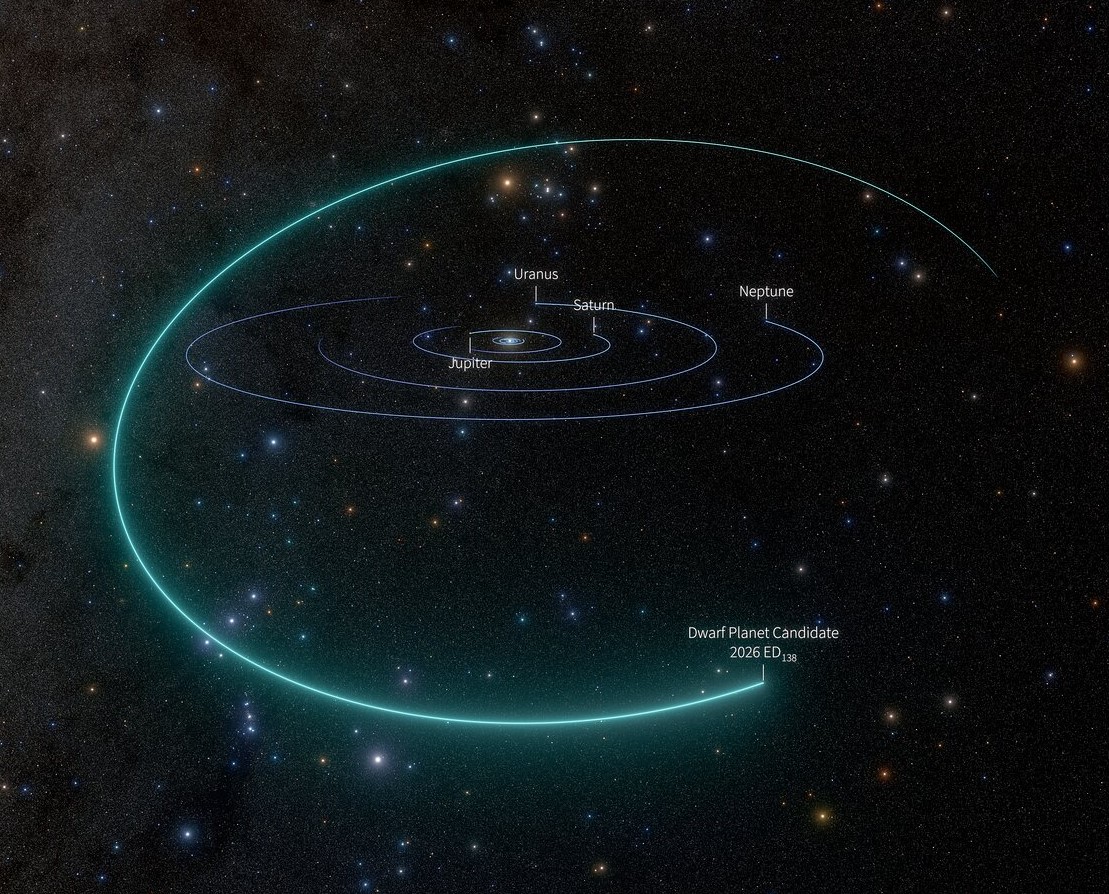
A visualization shows the orbital path of the dwarf planet candidate 2026 ED138 in relation to the orbits of the solar system’s larger planets. Click on the image for a larger version. (Credit: NSF-DOE Vera C. Rubin Observatory / NOIRLab / SLAC /AURA / R. Proctor)

Astronomers sorting through data from the Vera C. Rubin Observatory in Chile have found an icy world that has a good chance of joining Pluto in the solar system’s retinue of dwarf planets.

University of Washington astronomer Mario Jurić joined the astronomer who made the discovery, Matthew Holman of the Harvard & Smithsonian Center for Astrophysics, to announce the findings today at a meeting of the American Astronomical Society’s Division for Planetary Sciences in Spokane, Wash.

Jurić, the Rubin team’s solar system lead scientist, said the observatory’s capabilities made it possible to detect and characterize the new dwarf planet candidate, known as 2026 ED138.

“Rubin is giving us an unprecedented capacity to explore the sky through a combination of speed, depth, and precision,” Jurić said in a news release. “And the discovery is just the beginning: Once we identify a new object, we can search back months, and sometimes even decades, finding it in images where nobody knew to look. This ability to both discover and ‘precover’ objects is transforming how quickly and accurately we can determine their orbits and understand the distant solar system.”

2026 ED138 traces a tilted orbital path that takes it well beyond Pluto, the solar system’s best-known dwarf planet. It’s currently at a distance of 46 astronomical units, where 1 AU equals the average distance between Earth and the sun. Pluto, by comparison, is currently about 40 AU from the sun.

Astronomers suspect ED138 formed billions of years ago closer to the sun before being flung into a wider orbit by gravitational interactions with Neptune.

Based on an analysis of its distance, brightness and assumed composition, ED138 is thought to be somewhere between 600 and 1,500 kilometers (373 to 932 miles) in diameter. At that size, an icy object should possess enough gravity to pull itself into a round shape — satisfying the primary physical criterion for a dwarf planet.

ED138 may be Rubin’s first dwarf planet candidate, but it almost certainly won’t be the last. Thanks to the observatory’s Simonyi Survey Telescope — named after the family of Seattle software billionaire Charles Simonyi — the Rubin team detected more than 11,000 new asteroids even before June’s official start of a 10-year survey of the southern sky.

Rubin’s researchers analyze the data from those scans to find objects of interest — ranging from asteroids to gamma-ray bursts — and track them over time. On Oct. 13, Holman was running data through a search code that he developed with Kevin Napier, a colleague at the Center for Astrophysics. ED138 stood out due to its exceptional size and brightness.

“My first reaction was one of excited disbelief,” Holman said. “Objects like this are very rare, so I immediately started checking whether I or the code had done something wrong.”

To confirm the discovery, Holman, Jurić and their colleagues found 30 archived observations of ED138 dating back to March 4. The Asteroid Institute’s ADAM Precovery service found still more images of the object, going back to 2016, in the archives of a different astronomical survey.

The precovery data confirmed that ED138 was a special case.

“Finding an object this big, roughly 1,000 kilometers across, is something that happens maybe once in a generation,” Jurić said. “It’s the largest trans-Neptunian object found in about 20 years, and Rubin turned it up while we were still commissioning the telescope.”

In 2006, the International Astronomical Union defined dwarf planets as planetary objects that are big enough to crush themselves into a roundish shape — technically speaking, into a state of hydrostatic equilibrium — but not big enough to clear their orbital neighborhood.

So far, the IAU has classified five solar system objects as dwarf planets — including Ceres in the main asteroid belt, plus Pluto, Eris, Haumea and Makemake in the region beyond Neptune. 2026 ED138 joins a host of other celestial objects that are thought to be dwarf planets but haven’t yet been added to the IAU’s official list.

“The official list hasn’t moved since 2008,” Jurić told GeekWire in an email. “I’m not sure if there’s an active process that reviews candidates, and what are the timelines.”

Jurić and his colleagues hope additional observations will boost ED138’s chances of attaining true dwarf planethood.

“The next step in building the case would be to prove it’s round (in hydrostatic equilibrium),” he wrote. “The means to do that would be directly through occultations (and there’s a good chance of that, given it’s in a dense stellar field), and then thermal measurements plus modeling and light curves (or the absence of variability).”


Before yesterdayMain stream

A 1,000-mile cloud on Mars may reveal physics never seen in nature

24 October 2026 at 07:50

Every morning during the Martian spring and summer, a thin and extremely long cloud emerges, only to disappear again. The wispy formation appears near the volcano Arsia Mons and gradually elongates until it reaches over 1,000 miles—about the distance from New York to Kansas City as the crow flies—before dissipating. This cycle then repeats for several months.

Since it was first recorded by a probe in 2018, scientists have been unable to find a plausible explanation for the existence of this cloud, often referred to as the Arsia Mons Elongated Cloud (AMEC). Until now. Recently, researchers successfully modeled the cloud’s formation for the first time, their results suggesting that it may be driven by a physical process that has never been directly observed in any planet's atmosphere.

"We found that we needed to include some exotic physics… physics that, while included in textbooks, is treated as theoretical and usually thought not to happen in nature. It certainly hasn’t been seen in action before," Jorge Hernández-Bernal, a planetary scientist at Paris’ Sorbonne Université and lead author of the study, said in a press release. "Once we included this physics in our simulations, the AMEC emerged just as we hoped.”

Read full article

Comments

© ESA

Japan launches mission to bring home a piece of the Martian moon Phobos

20 October 2026 at 01:59

Japan launched a $578 million mission Monday on a five-year expedition to land on the largest moon of Mars and retrieve samples for return to Earth, a daring international project that could yield new insights into the formation of the Solar System.

The robotic Martian Moons eXploration mission, known as MMX, lifted off at 3:41 pm EDT Monday (4:41 am Japan Standard Time Tuesday) from Tanegashima Space Center in southern Japan.

The MMX spacecraft rode into orbit atop a 207-foot-tall (63-meter) H3 rocket, Japan's flagship launch vehicle. The rocket assigned to MMX debuted a new souped-up configuration with four strap-on solid rocket boosters, full-throttle main engines, and an extended payload shroud to accommodate the demands of Japan's heaviest and most ambitious interplanetary mission to date.

Read full article

Comments

© ESA/DLR/FU Berlin/Andrea Luck

Things are finally looking up for NASA's first missions to Venus in a generation

14 October 2026 at 16:48

Most planetary scientists will tell you the heyday of Venus exploration was more than a generation ago. That is about to change.

Two NASA missions are on track to launch to Venus in the early 2030s. The first, known as the Deep Atmosphere Venus Investigation of Noble gases, Chemistry, and Imaging (DAVINCI), is now scheduled for launch in December 2030, a year earlier than previously planned. DAVINCI will send a parachute-assisted descent probe through the atmosphere of Venus, returning the first direct images of the planet's surface since 1982. A second mission, Venus Emissivity, Radio science, InSAR, Topography, And Spectroscopy (VERITAS), will follow with a launch in November 2032 to map the Venusian surface by radar from orbit.

The European Space Agency is building another orbiter, Envision, for launch to Venus in 2032. The Venus armada might get started as soon as next year, when Rocket Lab aims to launch a privately funded probe to search for signs of organic material in the planet's clouds.

Read full article

Comments

© NASA/Mike Guinto

Scientists Create Hexagonal Packed Ice at Extreme Pressures

6 October 2026 at 14:30

One of the problems with planetary science is that you generally cannot easily investigate the exact conditions in their interior, so you’re left to extrapolate what is happening inside them based on surface scans. One of the resulting questions is what ice giants like Neptune and Uranus in Earth’s solar system have exactly at their core. We do know that it is mostly rocks and ice, but what kind of ice you end up with at these intense pressures is a good question that [Alexis Forestier] et al. set out to answer, with their results published in a Physical Review Letter paper (ArXiv preprint).

It’s noteworthy that there isn’t just water ice at these planetary cores, with this study only investigating water ice specifically. In order to get the water to the pressures it would experience courtesy of ice giant gravity, a diamond anvil was used, with synchrotron x-ray diffraction allowing for the changes to the sample to be observed.

The phase diagram of water includes a number of phases beyond what us Earth-dwellers would call ‘ice’, with at higher pressures above about 80 GPa the formation of ice X, featuring a body-centered cubic (BCC) oxygen sublattice. Subsequent discovered phases were face-centered cubic (FCC) and now hexagonal close-packed (HCP) ice, all differing in the packing of the oxygen sublattice.

In addition to extreme pressures, temperatures also had to be increased by using the laser heating feature of the diamond anvil. At around 2,000K and over 200 GPa the HCP phase was found, with a mixed FCC-HCP phase at intermediate pressures.

Although not immediately providing answers to questions pertaining to the aforementioned ice giants, it gives planetary scientists yet another clue that they can use in future investigations, as well as provide more insight into this most fascinating phase of water that’s actually its own little galaxy of phases.

NASA’s Curiosity Rover Catches Stunning Martian Dawn

6 October 2026 at 11:30

3 min read

Preparations for Next Moonwalk Simulations Underway (and Underwater)

A stark, grayish-tan Martian landscape features jagged rock formations and rolling mountain ridges beneath a pale, hazy sky.
The captivating shapes of wind-carved crags called yardangs are revealed in this zoomed-in crop of a broader panorama captured by NASA’s Curiosity Mars rover on Aug. 11, 2026. Scientists are eager to learn more about how the yardang layer formed.
NASA/JPL-Caltech/MSSS

A newly released panorama captured by NASA’s Curiosity rover offers the most detailed view yet of distant, wind-carved Martian cliffs, highlighting features the mission’s scientists have long been waiting to see up close. The scene was snapped at 8:30 a.m. local Mars time, showing striking blue hues in the foreground as bright morning light illuminates crags known as yardangs on the horizon.  

The panorama was captured by Curiosity’s Mastcam on Aug. 11, the 4,982nd Martian day, or sol, of the mission, and comprises six individual images that were stitched together after being sent to Earth. Unlike most of Curiosity’s Mastcam images, this one was processed without white balancing, preserving the early morning appearance.  

A broad, panoramic view of a stark, grayish-tan Martian landscape features jagged rock formations and rolling mountain ridges beneath a hazy sky. Features in the front are darker while distant rock formations are washed in pale light.
The six shots that make up this panorama, captured by NASA’s Curiosity on Aug. 11, were stitched together after being sent back to Earth. Unlike most images from the rover’s Mastcam, this one was processed without the usual white balancing — an artistic choice that preserves the early morning appearance.
NASA/JPL-Caltech/MSSS

The yardang layer extends roughly 10 miles (16 kilometers) across the northwestern reaches of Mount Sharp, a 3-mile-tall (5-kilometer-tall) mountain that Curiosity has been ascending since 2014. In fact, the rover recently passed another milestone in its ascent, reaching 0.6 miles (1 kilometer) of elevation — the most ever climbed on Mars. As it draws ever-closer to the yardangs, mission scientists expect to get even more amazing imagery — and, they hope, answers to how these cliffs were created. 

Mount Sharp is made up of layers, each recording a distinct period of Mars’ history. By studying them, scientists have been able to learn more about lakes and streams that covered this part of the Red Planet billions of years ago. Eventually, the water dried up and left salty minerals behind. After new material stopped settling on the mountain, some of it may have been stripped away by wind, giving rise to the yardangs. 

A 3D topographical map shows a large Martian crater with a prominent central mountain peak, encircled by a black oval highlighting a specific region near the base of the mound.
This artist’s concept shows Mount Sharp, the 3-mile-tall (5-kilometer-tall) mountain that NASA’s Curiosity has been ascending since 2014. The location of the yardang layer, which the rover recently captured from a distance, is indicated by an ellipse annotation on the mountain’s northwestern shoulder.
NASA/JPL-Caltech/ESA/DLR/FU Berlin/MSSS
A wide panoramic view of a rocky, reddish-brown Martian valley framed by rugged hills under a hazy sky, with a portion of NASA’s Curiosity Mars visible on the far right.
NASA’s Curiosity Mars rover captured this view looking back at the floor of Gale Crater on Sept. 5, 2026. Just nine days prior, the rover had marked 1 kilometer of elevation gain above the crater floor since beginning its ascent of Mount Sharp in 2014.
NASA/JPL-Caltech/MSSS

“The yardang layer looks out of place. It’s the wrong color, the layers tilt at an odd angle, and it almost appears plastered on,” said Ashwin Vasavada, Curiosity project scientist of NASA’s Jet Propulsion Laboratory in Southern California. “But that’s what makes it exciting to reach. No one is sure exactly what created this layer, but one idea is it may be ash deposited by ancient volcanic eruptions.” 

Curiosity is in the second year of its fifth extended mission, which started with an exploration of the spiderweb-like boxwork ridges. The rover will spend most of the next year or so driving through layers enriched with sulfates and carbonates, both signs of ancient drying on the surface. Sometime in 2027, scientists hope to reach the base of the yardangs, where Curiosity will be able to use its robotic arm to collect one-of-a-kind data on these mysterious features. 

More about Curiosity 

Curiosity was built by NASA JPL, which is managed by Caltech in Pasadena, California. NASA JPL leads the mission on behalf of the agency’s Science Mission Directorate in Washington as part of its Mars Exploration Program portfolio. Malin Space Science Systems in San Diego built and operates Mastcam. 

To learn more about Curiosity, visit:

https://science.nasa.gov/mission/msl-curiosity

News Media Contacts

Andrew Good
Jet Propulsion Laboratory, Pasadena, Calif.
818-393-2433
andrew.c.good@jpl.nasa.gov


Karen Fox / Alana Johnson
NASA Headquarters, Washington
240-285-5155 / 202-672-4780
karen.c.fox@nasa.gov / alana.r.johnson@nasa.gov

2026-067

❌
❌
