❌

Normal view

There are new articles available, click to refresh the page.
Before yesterdayMain stream

Japan Launches Mission to Study Martian Moon

By: Tom Nardi
22 October 2026 at 10:00

Humanity has been sending robotic explorers to Mars since the 1970s, and for our efforts we’ve been rewarded with not only incredible imagery of the Red Planet’s magnificent desolation, but a wealth of information about the alien world and how it’s changed over the last several billion years. But comparatively, we know almost nothing about the planet’s two moons, Phobos and Deimos. In fact, as recently as the 1960s, there were some scientists that believed the unusual shape, mass, and orbit of Phobos hinted at the possibility that it was no moon at all, and was in actuality a derelict spacecraft of some type.
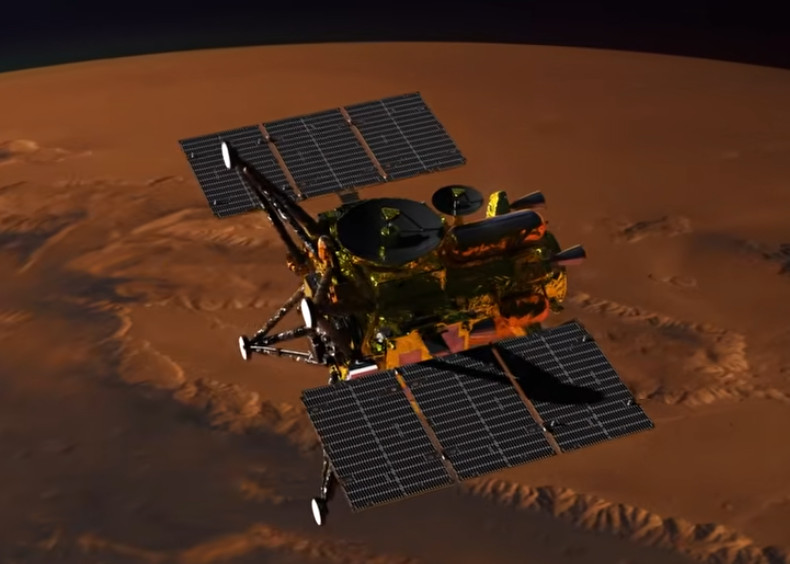
Martian Moons eXploration Spacecraft

Once the first Viking probes arrived at Mars, we had the photographic evidence and up-close measurements to prove that Phobos wasn’t artificial. But even today, we still don’t know exactly what it is. The data suggests that it’s not solid rock, and that large voids may be hiding under its surface. While we can be fairly sure there won’t be any mummified remains of Martian astronauts to be found within Phobos, vast deposits of ice are a tantalizing possibility.

With the launch of the Martian Moons eXploration (MMX) mission earlier this week, the Japan Aerospace Exploration Agency (JAXA) hopes to bring us one step closer to understanding the formation and structure of Phobos. Should everything go to plan, MMX will deploy a small rover to its tenuous surface in 2029, and by 2031, a sample return capsule will bring pieces of the mysterious moon back to Earth for further study.

A Delicate Operation

It’s only natural that we’d imagine Phobos and Deimos to be similar to Earth’s moon, but the reality of the situation is very different. For one thing, the Martian moons are absolutely dwarfed by our nearest celestial neighbor. Phobos has a diameter of just 22.2 kilometers (13.8 miles), and Deimos is even smaller at roughly 12.6 km (7.8 miles). For reference, Luna is approximately 3,474 km (2,159 miles) across.
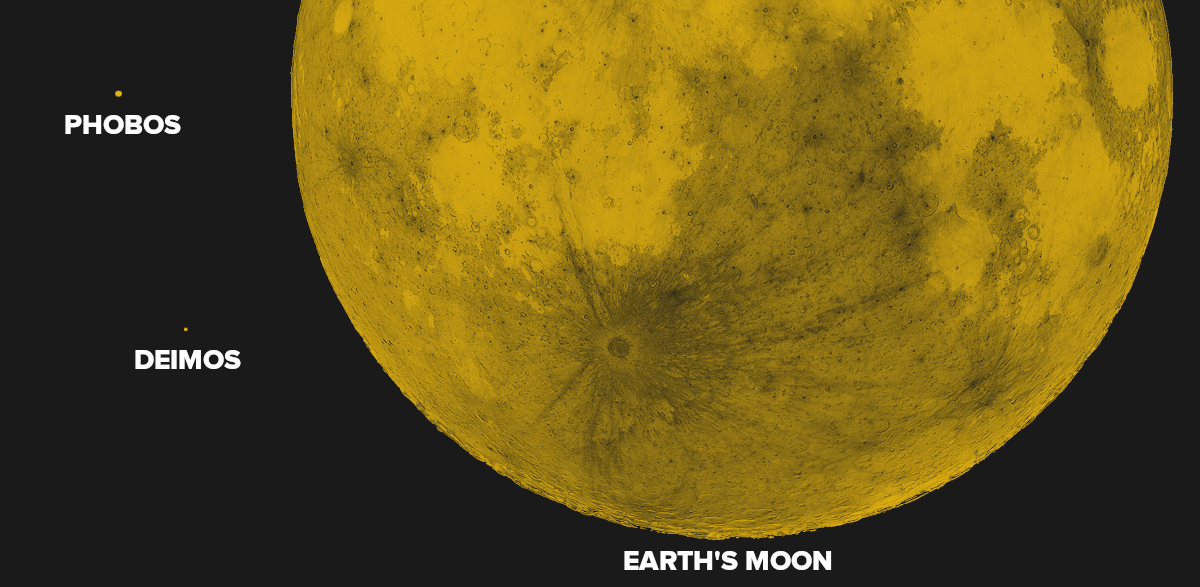
Due to their low mass, putting a spacecraft into a stable orbit around either of the Martian moons isn’t really an option. Some clever maneuvering will put the MMX mission within range of both Phobos and Deimos at different points during the mission, but it won’t be able to stay around for long.

As such, final approach to Phobos will look more like a slow-motion “crash” than a traditional landing. A close comparison would be the OSIRIS-REx mission, where the spacecraft effectively “bumped” into the asteroid Bennu while collecting its samples. The impact velocity will need to be very low to prevent the spacecraft from bouncing off, and even then, some reports indicate that JAXA expects the craft to make at couple of hops before finally settling down.

The situation is compounded by the fact that we still don’t know what the surface conditions are like on Phobos. Based on previous observations, it’s expected that the moon is covered with a layer of fine regolith that could make traversal difficult for the mission’s Idefix rover. Indeed, one of the rover’s primary mission goals is to determine if wheeled motion in such an environment is even viable.

Tiny Moon, Huge Potential

Landing a crewed vehicle on Mars and successfully bringing it back home afterwards is perhaps the most daunting engineering challenge ever conceived. There’s even a solid argument to be made that it’s currently beyond our technological capabilities. The energy requirements of making a propulsive landing on the planet and then lifting off and getting back into orbit are enormous, and will very likely require in situ propellant production to refuel the craft between the two phases of the mission.

Landing on Phobos or Deimos however would require a small fraction of that energy. Moreover, due to their low orbital altitude, the moons would make ideal outposts from which to make detailed observations of Mars. This close proximity to the planet also means human operators on Phobos could directly command robotic vehicles on the Martian surface without the transmission delays that make real-time telerobotics from Earth impossible. While such a mission might not have quite the same symbolic impact of actually putting boots on Mars, it could be a valuable stepping stone towards that eventual goal.

The viability of such a landing may well depend on the findings of Japan’s Martian Moons eXploration mission. Not only in terms of the actual mechanics of rendezvousing with Phobos and touching down on it, but should the mission succeed in returning surface samples, we may be able to confirm whether or not the moon is made from ejected Martian material. Should that be the case, there will likely be even greater interest in studying the planet’s strange little moons up close.
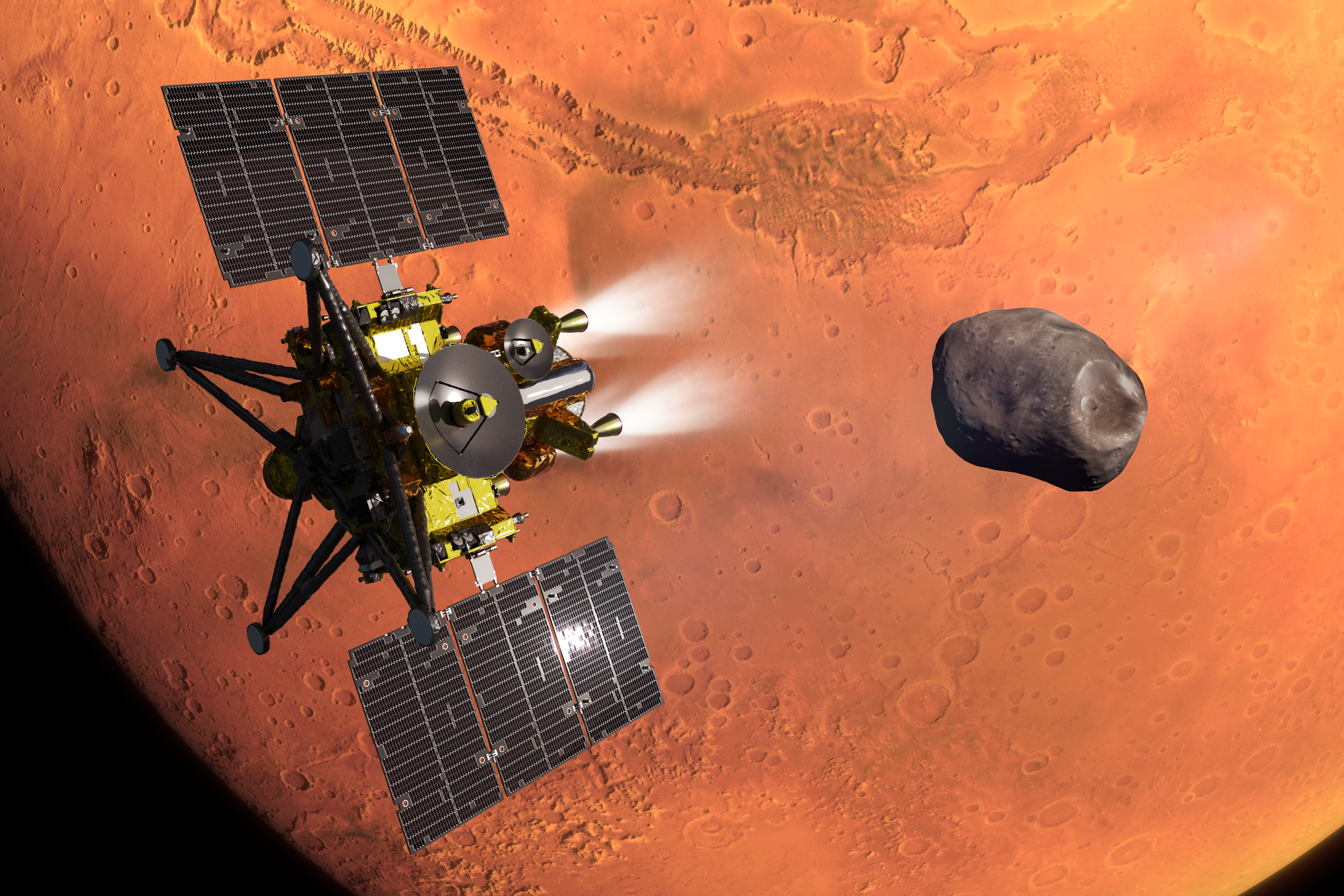
Japan launches mission to bring home a piece of the Martian moon Phobos

20 October 2026 at 01:59

Japan launched a $578 million mission Monday on a five-year expedition to land on the largest moon of Mars and retrieve samples for return to Earth, a daring international project that could yield new insights into the formation of the Solar System.

The robotic Martian Moons eXploration mission, known as MMX, lifted off at 3:41 pm EDT Monday (4:41 am Japan Standard Time Tuesday) from Tanegashima Space Center in southern Japan.

The MMX spacecraft rode into orbit atop a 207-foot-tall (63-meter) H3 rocket, Japan's flagship launch vehicle. The rocket assigned to MMX debuted a new souped-up configuration with four strap-on solid rocket boosters, full-throttle main engines, and an extended payload shroud to accommodate the demands of Japan's heaviest and most ambitious interplanetary mission to date.

Read full article

Comments

© ESA/DLR/FU Berlin/Andrea Luck

The New Phobos Martian Moon Rover that Weighs in at Only 15 Grams

18 October 2026 at 16:00

Although for many decades the planet Mars has been prodded, poked, driven upon, flown over and especially orbited by various spacecraft, landers and rovers sent over by a certain humanoid species on Earth, the two moons that orbit Mars have featured significantly more in science-fiction and video games than in scientific literature. This is now about to change when the Martian Moons eXploration (MMX) mission launches on October 19th, which will include a sample return from Phobos.

So far these two moons of Mars – Phobos and Deimos – have only received a few cursory glances by passing spacecraft, leaving many fundamental questions surrounding their formation and composition very much open. With the MMX mission this should change dramatically, with this spacecraft intended to perform detailed measurements of both moons.

In addition a rover – called Idefix – will perform a landing on Phobos for observations of its surface. This will be quite a feat as despite this lander coming in at 25 kg, on Phobos’ surface it will weigh only 15 grams due to the low gravity, or even less than the diminutive dog companion of Obelix, with potential bouncing as we have seen with previous landing attempts on such small bodies.

After launch, the MMX mission will take a year to arrive at Mars, in August of 2027, with Idefix being released in early 2029 for its hopefully soft paws-down on the surface of Phobos where it can scurry about for a while until the main MMX spacecraft lands later for its sample retrieval and return part of the mission. If everything goes well, this would mean that a sample of Phobos should be landing in Australia in 2031.


NASA to Help Unlock Mysteries of Mars’ Moons in Upcoming Mission

15 October 2026 at 15:58

NASA is playing an important role in JAXA’s (Japan Aerospace Exploration Agency) MMX (Martian Moons eXploration) mission, to advance our understanding of Mars’ moons and build on the agency’s long history of exploring the Red Planet.

The mission aims to characterize and determine the origin of Mars’ moons Phobos and Deimos and deliver a sample of Phobos to Earth. The MMX spacecraft is targeting launch from JAXA’s Tanegashima Space Center in Japan at 3:41 p.m. EDT on Monday, Oct. 19 (4:41 a.m. JST on Tuesday, Oct. 20).

Artist's concept of JAXA's MMX spacecraft with the Martian moon Phobos and planet Mars in the background
An artist’s concept of JAXA’s MMX spacecraft during its Mars’ orbit insertion. The Martian moon Phobos, which MMX will explore and sample, is in the background.
JAXA

“The samples from MMX will bring forth paradigm-shifting science on the Mars system for generations to come, especially as NASA prepares to send the first humans to Mars,” said Nicky Fox, associate administrator, Science Mission Directorate, NASA Headquarters in Washington. “The NASA-JAXA sample curation partnership is extremely valuable, and I am proud that NASA Science is supporting MMX sample curation and will be sharing portions of these samples for study as we continue to expand humanity’s understanding of the universe for the benefit of all.”

NASA’s contributions to the mission include the Mars-moon Exploration with Gamma rays and Neutrons (MEGANE) spectrograph instrument, the Pneumatic Sampler (P-Sampler) technology demonstration, and communications and navigation support from the agency’s Deep Space Network, as well as funding United States scientists participating on the MMX science team.

Scientists have long debated the origin of Mars’ two moons. The data and samples collected by the MMX mission will help answer essential questions about the origins of these moons and the history of the solar system.

“Phobos and Deimos may be the remains of a massive impact on Mars that sent material into orbit around the planet, or they could be ancient asteroids that were captured by Mars’ gravity billions of years ago,” said Tom Statler, MMX program executive and program scientist at NASA Headquarters. “Having the answer will help illuminate that early era when Earth and the other inner planets may have been acquiring much of their water and organic compounds.”

The MEGANE (pronounced meh-GAH-nay, the Japanese word for eyeglasses) spectrograph will help scientists “see” what Phobos is made of by measuring neutrons and gamma rays emitted from the moon’s surface and determining its chemical elemental composition, which will provide important clues about its origin.

Mounted on one of the spacecraft’s landing legs, the P-Sampler is designed to collect a ground sample from Phobos. The system gathers surface material using bursts of high-pressure nitrogen gas, complementing JAXA’s C-Sampler, which will extract cores from a few inches deeper. NASA will obtain and curate about 15% of the total returned sample at the agency’s Johnson Space Center Astromaterials Lab in Houston, making it available for research for decades.

Another key part of NASA’s contribution to MMX is its scientific partnership with JAXA. NASA-supported researchers are working alongside international colleagues to help reveal the story of Phobos and will use mission data and returned samples to uncover new clues about the moon’s origin and the evolution of the Mars system.

The MMX spacecraft will arrive at Mars in August 2027 to begin its survey of the Red Planet’s two moons. After surveying Phobos in detail, the spacecraft will collect a sample of the moon’s surface no earlier than December 2028 and deliver it to Earth in 2031.

The MEGANE instrument was developed by the Johns Hopkins Applied Physics Laboratory. Honeybee Robotics, a Blue Origin company, developed the spacecraft’s pneumatic sampler mechanism. NASA’s contributions to the MMX mission were developed under the agency’s Discovery Program. The Discovery Program is managed by NASA’s Marshall Space Flight Center in Huntsville, Alabama, for the agency’s Science Mission Directorate in Washington.

For more information about the MMX mission, visit:

https://science.nasa.gov/mission/mmx

Karen Fox / Alana Johnson
Headquarters, Washington
240-285-5155 / 202-672-4780
karen.c.fox@nasa.gov / alana.r.johnson@nasa.gov

Facebook logo
Instagram logo
Linkedin logo
❌
❌