Tennessee has launched a bid to host the planned United States Space Academy, proposing a campus at the Coffee County Joint Industrial Park near Tullahoma, minutes from Arnold Air Force Base and about 60 miles (97 km) from Huntsville, Alabama. Gov. Bill Lee announced the bid on Oct. 28 alongside U.S. Sens. Marsha Blackburn and […]
Allium confirms unauthorized access to its systems, revokes API keys and restores core services as the blockchain data provider investigates the breach.
Four financial and cryptocurrency companies have reported data security incidents involving customer contact details and internal business information, with Coinbase, Bithumb, Mirae Asset Global Investments and Daishin Securities disclosing separate breaches. According to Reuters, three of the incidents were reported…
Coinbase has built partnerships with PNC, JPMorgan Chase, and Citi covering Bitcoin trading, account funding, and stablecoin payments, with PNC’s service allowing eligible private banking clients to buy, sell, and hold BTC inside its digital banking platform. PNC announced the…
Seven of the largest banks in the world are now running on Coinbase infrastructure, and Brett Tejpaul, Co-CEO of Coinbase Institutional, says they’re having a “Kodak moment.” He joins Grace Remington and Sean Hagan to explain why the driver has shifted from Bitcoin ETFs to stablecoin payments now that money can move from a Citi account to USDC, across the blockchain in a second, and into a corporate account on the other side. He also gives a candid read on Bitcoin: the macro setup is great, the performance has been disappointing, and institutions aren’t yet treating it as anything but a tech trade.
Chapters: 0:00 Seven of the World’s Largest Banks Are Using Coinbase Infrastructure 1:19 From ETFs to Payments: Citi, USDC and Instant Bank-to-Blockchain Transfers 2:44 $400 Million an Hour in Stablecoins and the Banks’ “Kodak Moment” 4:38 Stablecoins Are a “Speck of Dust”: Payment Providers First, Then Banks 6:10 Agentic Commerce Arriving at the Same Time as the Big Players 6:49 Is Bitcoin Still a Leveraged Tech Trade? “Disappointing” Performance, Great Setup 8:44 Connecting U.S. Funds to Deribit’s 85% Options Market Share 11:06 The Second Wave: Net-New Entrants and Coinbase’s “Amazon to AWS” Pivot 12:57 Activating the Whole U.S. Through Coinbase Infrastructure 13:56 Quantum, 90% ETF Custody Share and “Safe Forever”
DISCLAIMER: The views and opinions expressed in this show are those of the participants and do not necessarily reflect the official policy or position of BTC Inc., Bitcoin Magazine, or any affiliated entities. This content is provided for informational and educational purposes only and should not be construed as investment, legal, tax, or accounting advice. Nothing contained in this show constitutes a solicitation, recommendation, endorsement, or offer to buy or sell any securities or financial instruments. Viewers should consult their own advisors before making financial or business decisions.
Kadena Air Base in Okinawa will bar all vehicles made by Chinese electric carmaker BYD from entering the installation starting Oct. 26 over concerns that the cars could expose sensitive military information, Kangnam Times reported. The ban covers privately owned cars as well as contractor vehicles, taxis, delivery vans and other commercial vehicles. The 18th […]
The Royal Canadian Air Force has taken delivery of its first two CF-35A stealth fighters, the Canadian version of the Lockheed Martin F-35A Lightning II, at Luke Air Force Base in Arizona, the service announced. The jets will stay at Luke, a major U.S. Air Force training base for F-35 pilots from the United States […]
"To be clear to the market and to our partners — we're moving out. Good news is there is no gap, only consistent desire to move faster," Marc Andersen said.
Before astronauts return to the lunar surface, NASA will first conduct one of the most ambitious and complex test missions in the agency’s history.
Launching in 2027, Artemis III will send NASA astronauts Randy Bresnik, Frank Rubio, Andre Douglas, and ESA (European Space Agency) astronaut Luca Parmitano aboard the Orion spacecraft into low Earth orbit to perform a series of demonstrations with test versions, or test articles, of human landing systems being developed by industry partners Blue Origin and SpaceX. During the planned 14-day mission, crews and flight controllers will practice the rendezvous, docking, habitation, and operational procedures that will be essential when Artemis astronauts begin landing near the Moon’s South Pole in 2028. The mission is designed to reduce risk, validate hardware, and gain operational experience before NASA attempts a crewed lunar landing.
“Every piece of this mission in Earth orbit is designed to reduce risk before we put astronauts back on the Moon,” said Jeremy Parsons, NASA’s Artemis program manager. “We’re launching three spacecraft on three different rockets and testing how they operate together — something NASA has never attempted. Every lesson we learn here gets us closer to landing on the Moon in 2028.”
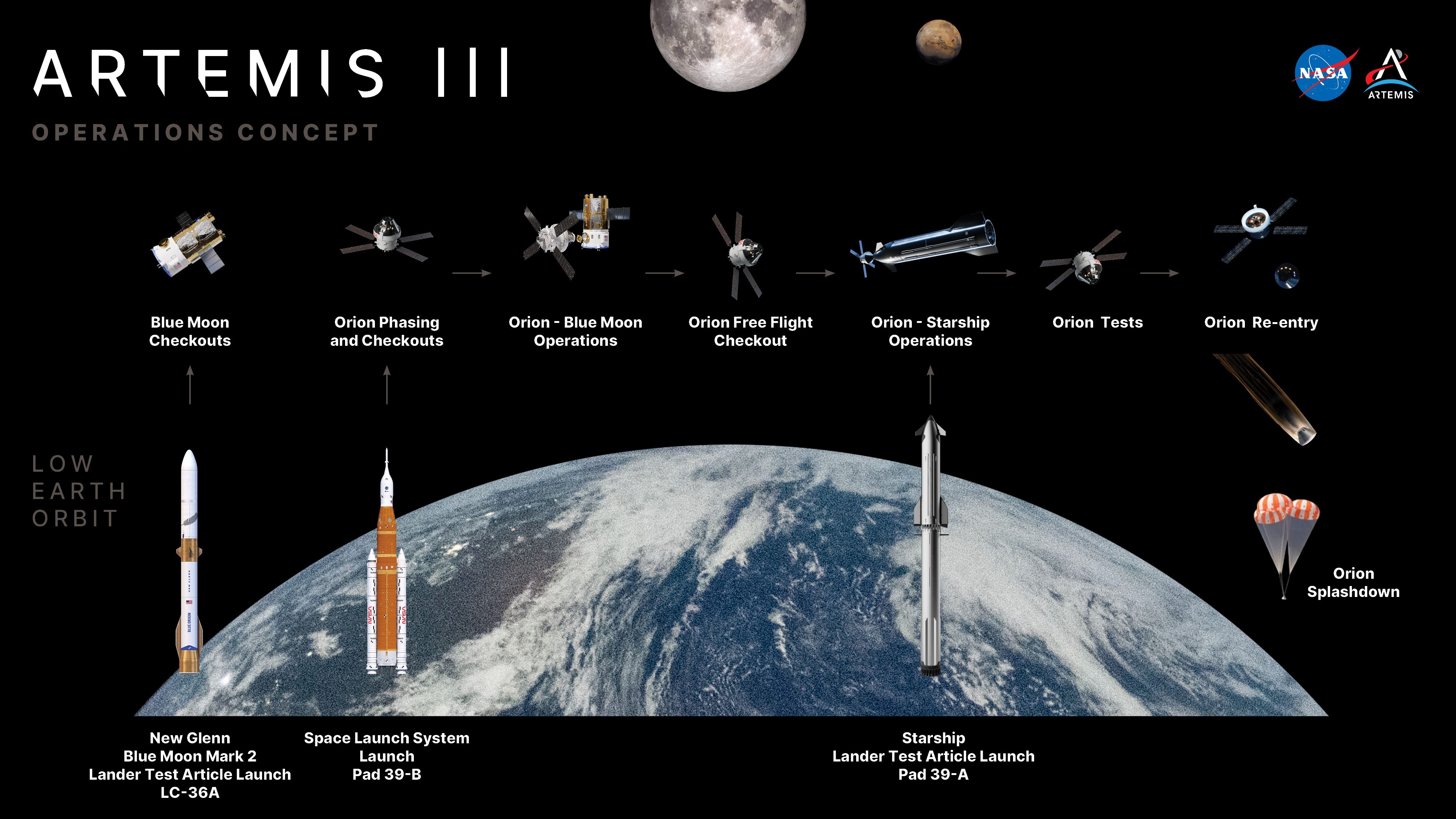
This graphic shows NASA’s concept of operations for Artemis III. The mission will send four astronauts to low Earth orbit next year to test critical systems needed for future lunar landings.
NASA
First stop: Blue Origin’s lunar lander test article
Earlier Artemis missions used only NASA’s SLS (Space Launch System) rocket and Orion spacecraft. Artemis III will involve three separate spacecraft launched on three different heavy-lift rockets within a relatively short period of time.
The mission begins with Blue Origin launching a test version of its Blue Moon Mark 2 lander into a circular low Earth orbit approximately 273 miles (237 nautical miles) above Earth. The spacecraft can remain on orbit for up to 30 days providing schedule flexibility. Artemis III is designed as a tightly choreographed campaign, with NASA planning to launch Orion on top of SLS from the agency’s Kennedy Space Center in Florida only days after the Blue Moon test article launch and confirmation the vehicle is healthy and ready for joint operations.
Following launch, Orion will initially enter an elliptical Earth orbit of 18 x 1122 miles (16 x 975 nautical miles). It will use its service module to perform a series of maneuvers to transition to a circular orbit at about 345 miles (300 nautical miles) for thermal stabilization before then gradually setting up its rendezvous with the waiting Blue Moon lander test article. Because each spacecraft operates in slightly different orbital regimes optimized for its mission requirements, Artemis III requires a carefully choreographed sequence of orbital maneuvers and rendezvous operations throughout the flight.
During the first two days of flight, the crew will check out Orion’s systems, prepare for proximity operations, and gradually position themselves for the mission’s first major objective: rendezvous and docking with the Blue Moon test vehicle.
The operation represents NASA’s first opportunity to evaluate how Orion and a commercial lunar lander work together in space. Engineers will assess how software aboard both spacecraft, guidance systems, communications systems, and operational procedures perform in real-world conditions, while flight controllers gain experience coordinating activities across multiple teams and organizations.
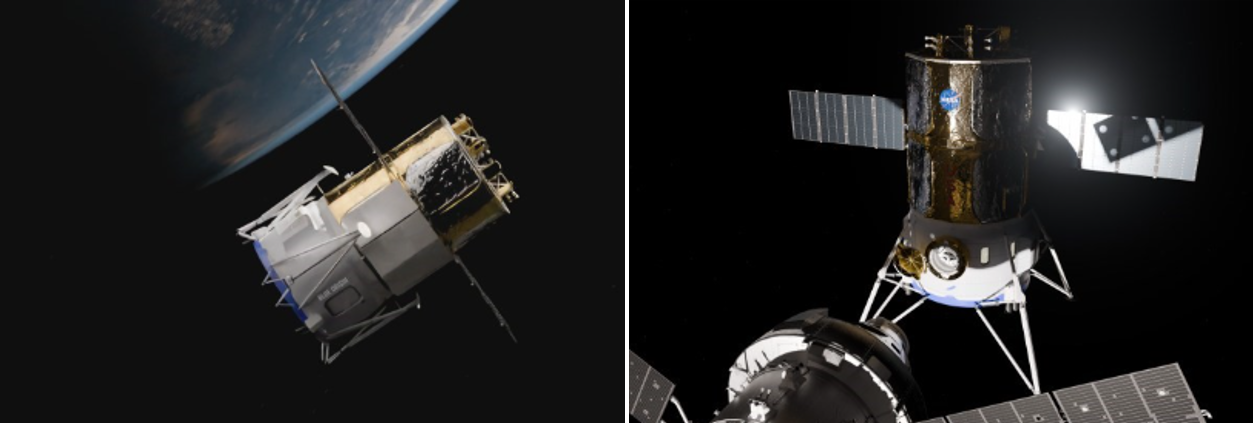
These artist’s concepts depict Blue Origin’s Blue Moon Mark 2 human landing system test article in Earth orbit and docked with NASA’s Orion spacecraft as part of NASA’s upcoming Artemis III demonstration mission in low Earth orbit.
Blue Origin
Once docked, astronauts will spend approximately two days conducting evaluations aboard the Blue Moon test article. Crew members will open the hatch and enter the spacecraft, allowing them to assess the cabin environment, controls, and life-support systems firsthand. Teams will verify the spacecraft’s ability to maintain the proper atmosphere and pressure.
The Blue Moon test article incorporates many of the avionics, software, flight-control systems, crew-cabin technologies, and life-support functions planned for future lunar missions. Testing those systems in orbit will provide the first opportunity to evaluate how many of the lander’s flight systems perform in space as an integrated vehicle.
By the time Orion undocks, NASA will have completed its first evaluation of a commercial lunar lander with crew, gathering data on spacecraft systems, crew operations, and spacecraft interoperability not possible on the ground.
Starship docking demonstration
After completing operations with Blue Origin’s lander, Orion will undock and reposition to support the next phase of the mission: a second rendezvous operation.
SpaceX will launch a Starship Version 3 test article from Florida. Because Starship is designed for a much shorter on-orbit lifetime than Blue Origin’s lander, launch occurs later in the mission, allowing NASA to efficiently sequence the two docking demonstrations. Starship will enter a lower orbit at 206 nautical miles, optimized for communications coverage, and will carry an added docking system mounted at the forward end.
These artist’s concepts depict NASA’s Orion spacecraft and SpaceX’s Starship human landing system test article during docking operations as part of NASA’s upcoming Artemis III demonstration mission in low Earth orbit.
SpaceX
Orion will rendezvous and dock with the spacecraft during a test expected to last up to two hours. Crew will not enter Starship during this test. The demonstration is focused on validating how Orion and Starship interact as a docked system in space. NASA and SpaceX plan to evaluate spacecraft controllability, communications, integrated software performance, and the dynamics associated with docking and undocking operations.
The docking itself also presents a unique test, using different docking geometries. Orion will connect to a port beside Blue Moon’s crew cabin, then later align its forward docking system with the one at Starship’s nose. Testing both approaches during a single mission gives NASA an opportunity to assess different operational concepts while gathering valuable engineering data.
Together, the two docking campaigns will demonstrate how Orion interfaces with two very different commercial lander architectures during a single mission.
Testing Orion for future exploration
Even after docking activities are complete, Artemis III will continue generating data that supports future missions.
Once the Starship demonstration is complete, Orion and its crew will have up to five additional days available in orbit before beginning preparations for the journey home. NASA plans to use this time to complete a variety of test objectives that support future Artemis missions, including additional evaluations of the Orion Crew Survival System suits, docking sensor tests, acoustic and thermal measurements, human-factors assessments, and a range of science and technology demonstrations.
Several investigations led by NASA will build on studies conducted during Artemis II, collecting additional data that will help inform future deep-space missions. The crew also will conduct a proof-of-concept study examining how astronauts could perform health-related assessments when they are unable to communicate directly with mission control, an important capability for future lunar surface expeditions and other missions farther from Earth.
NASA also plans to fly a cellular biology experiment during the mission while researchers use the flight to test concepts for returning lunar samples to Earth. Teams will evaluate how future samples could be transported, received, and moved into curation facilities after landing, while also conducting assessments of Orion’s environment to better understand potential contamination considerations for future lunar missions.
The mission also will include Earth and solar observations that help astronauts continue developing critical observation skills while taking advantage of the spacecraft’s unique orbital vantage point. Plant seeds will fly aboard Orion as well, providing opportunities for scientific study and educational engagement following the mission.
Mission planners have also built flexibility into the flight timeline, providing additional opportunities to complete test objectives depending on how operations unfold in real time.
When ready, Orion will begin phasing for return, and the crew will configure the cabin for reentry and splashdown, which will occur in the Pacific Ocean, off the coast of California. Orion and its crew will be recovered by NASA personnel and the United States Navy.
Practicing for Moon missions
Every activity performed during Artemis III supports a larger goal: reducing risk before astronauts return to the lunar surface.
The mission will provide NASA with experience operating alongside multiple commercial partners while managing complex rendezvous and docking operations involving three different spacecraft. Engineers will gain insight into spacecraft interoperability, mission-control coordination, communications architecture, crew operations, and hardware performance.
By the time Artemis III concludes with Orion’s splashdown on Earth, NASA will have demonstrated technologies and operational concepts that future lunar crews will rely on as they travel to and from the Moon.
Most importantly, Artemis III will provide the operational experience needed to transform plans for future lunar landings into proven flight procedures. The lessons learned throughout the mission will help refine future exploration plans, strengthen partnerships with industry, and ensure astronauts are prepared for humanity’s next giant leap at the Moon.
As part of a Golden Age of innovation and exploration, NASA will send Artemis astronauts on increasingly difficult missions near the lunar South Pole to explore more of the Moon than ever before. In addition to providing economic benefits and advancing scientific discovery through its Moon missions, NASA will establish an enduring human presence on the lunar surface and build on the agency’s foundation for the first crewed mission to Mars.
TL;DR: Ireland’s central bank imposed a €3.25 million penalty on Coinbase Ireland over electronic-money safeguarding and outsourcing failings, subject to High Court confirmation.
Ireland's central bank has fined Coinbase Ireland €3,252,618 after finding failures in the way the company safeguarded electronic-money customer funds and oversaw outsourced arrangements.
The action, announced Thursday, concerns compliance with Ireland's electronic-money rules over a period spanning 2020 to 2025. It is important to identify the regulated activity precisely: the decision is about safeguarding funds associated with electronic-money services, not an allegation that Coinbase's blockchain itself suffered a security breach.
What the regulator says went wrong
Electronic-money institutions must maintain arrangements that separate relevant customer money from the firm's own funds and protect it under the governing rules. The Central Bank of Ireland said Coinbase Ireland did not consistently maintain the required amount in designated safeguarding accounts and failed to meet related governance and outsourcing obligations.
Safeguarding failures matter even when customers do not report an immediate loss. They weaken the controls designed to ensure funds are available if a business runs into trouble, and they can leave regulators without a reliable picture of where protected balances actually sit.
The central bank's notice says Coinbase Ireland admitted the breaches. The monetary sanction reflects a starting penalty of €4,646,597 reduced by 30% under the regulator's settlement-discount scheme. The sanction is subject to confirmation by Ireland's High Court, a procedural qualification that should not be lost in the headline.
A wider message for crypto payments businesses
Crypto companies often hold multiple regulatory permissions that govern different pieces of a customer relationship. Safeguarding rules for an electronic-money business are not identical to the rules governing an exchange, a wallet provider or a bank deposit.
That distinction has become more important as exchanges add payment accounts, stablecoin access and other bank-like features. A company may deliver technically functioning transactions while still falling short on operational records, third-party oversight or reconciliation of the money behind those services.
Coinbase is a prominent global exchange, so a national enforcement action carries reputational weight. It does not, by itself, establish that Coinbase customers lost €3.25 million; that figure is the fine, not a documented customer loss.
The practical takeaway is that consumer confidence in digital finance depends on more than cryptographic security. Conventional controls over client funds remain essential, and regulators are prepared to enforce them even at firms whose public identity is rooted in cryptocurrency.
The Central Bank of Ireland has fined Coinbase Ireland Limited €3.25 million ($3.65 million) for failing to safeguard customer funds and for leaning on its US parent to run compliance functions it was supposed to control itself.
The regulator announced the penalty on Thursday, one day after it reached a settlement with the Coinbase subsidiary.
The breaches ran from November 2020 to August 2025 under Ireland’s Electronic Money Regulations. Coinbase Ireland, an e-money institution, issues the euro and dollar balances European customers use to buy bitcoin and other crypto assets on the Coinbase platform.
The law requires those balances to sit in dedicated safeguarding accounts, walled off from corporate money and from customers of other Coinbase entities.
Coinbase’s three failures
The Central Bank found three failures. Coinbase Ireland placed “excessive reliance” on its US-based group to design and run its safeguarding controls, and it lacked the local expertise to oversee that work.
Its safeguarding account was underfunded “for lengthy periods of time” because of poor system design and weak control testing. And it had no adequate process to flag material changes in its safeguarding practices to the regulator.
That last point drew the sharpest language from Karen O’Leary, the Central Bank’s director of enforcement. The regulator said the exchange Ireland promised “robust and automated safeguards” when it sought authorisation in 2019, and that the firm’s practices drifted from those commitments without notice.
“Failing to adhere to the assurances made during the authorisation process or to inform us of material changes as happened in this case is completely unacceptable,” O’Leary said. “Payment and e-money firms have a fundamental obligation to fully safeguard customers’ funds. The Central Bank has made its supervisory expectations in this regard clear: we have no tolerance for weaknesses in safeguarding arrangements.”
The Central Bank set the base penalty at €4.65 million and applied a 30% discount for settling. The fine and a reprimand await confirmation from Ireland’s High Court. It is the regulator’s 164th enforcement outcome, bringing its lifetime fines past €432 million.
Coinbase’s response
In a blog post, Coinbase said it self-reported “many of the items described in the settlement” in January 2024 and fixed most of the underlying control issues that same year. The company stressed that no customer lost money or lost access to funds.
Coinbase laid out five problem areas. During the March 2023 US banking crisis, as Silvergate Bank neared collapse, Coinbase Ireland directed 30 customers to deposit dollars into a Coinbase, Inc. account at another US bank, mixing their funds with those of a separate Coinbase entity.
After Brexit forced the migration of European customers from the company’s UK affiliate, some kept sending deposits to the old UK accounts. Euro withdrawals for US and UK customers of other Coinbase units were at times paid out of the Irish safeguarding account for liquidity reasons, the exchange said.
Coding errors in an internal dashboard left the safeguarding account underfunded by an average of roughly 0.54% of its total obligation through 2023 and the first half of 2024. And the firm did not tell the Central Bank about changes to its practices.
A daily “Treasury Rebalancing Process” moved funds back into the correct account each day, the exchange said, but that did not prevent the initial commingling.
“These issues largely arose in the context of Coinbase taking steps to protect customers during periods of significant disruption,” a company spokesperson toldReuters.
The exchange said it has since redesigned its safeguarding calculation, passed two third-party validations with no open findings, posted a €25 million guaranty bond and hired a dedicated head of safeguarding.
Second Irish fine in a year
The penalty follows a €21.5 million fine the Central Bank imposed on Coinbase Europe in November 2025 for failing to monitor more than 30 million transactions for money laundering and terrorist financing risk.
That unit’s Irish registration lapsed at the end of 2025 as the exchange shifted its European headquarters to Luxembourg under a MiCA license from the country’s financial regulator.
Coinbase is the largest US crypto exchange and the world’s biggest custodian of bitcoin, holding coins on behalf of most US spot bitcoin ETFs.
U.S. Air Force F-22 Raptor stealth fighters from Alaska are operating from Tsuiki Air Base on Japan’s southern island of Kyushu as part of Keen Sword 27, the largest iteration so far of the biennial U.S.-Japan military exercise. A photo released by the U.S. military shows an F-22 from the 525th Expeditionary Fighter Squadron parked […]
TL;DR: Sophon has warned users to withdraw remaining assets by November 25 ahead of the planned shutdown of its standalone chain at the end of the month.
The end of a blockchain isn’t always announced with a hack or a dramatic market collapse. Sometimes it arrives as a deadline: move your tokens, claim your rewards and make sure nothing important is still sitting on infrastructure that is about to disappear.
Sophon has set November 25 as the withdrawal deadline for assets on its network, ahead of a planned permanent mainnet shutdown on November 30. The notice covers remaining balances and rewards that users may need to claim before related services go offline.
The project previously signalled a broader change in direction, away from maintaining its own chain and toward building consumer applications on Base. The final withdrawal timetable makes that strategic decision an immediate operational issue for holders.
Anyone with funds still on Sophon needs to verify the latest official instructions and the status of individual bridges and applications rather than assuming everything will migrate automatically. Shutdown announcements can attract phishing attempts, so links circulating in unsolicited messages deserve particular caution.
Sophon is one example of a wider reality for blockchain projects: operating a network has ongoing technical and economic costs. The fact that a chain can be launched does not guarantee it will remain worthwhile to support indefinitely.
For affected users, however, the lesson is more immediate. Deadlines matter, and withdrawing assets safely is more important than debating the project’s next chapter.
Written by the News Desk and edited by Samuel Rae.
The FBI alerted contractors that North Korean IT workers are trying to obtain positions with cleared defense companies and others with government contracts.
TL;DR: Sophon has warned users to withdraw remaining assets by November 25 ahead of the planned shutdown of its standalone chain at the end of the month.
The end of a blockchain isn’t always announced with a hack or a dramatic market collapse. Sometimes it arrives as a deadline: move your tokens, claim your rewards and make sure nothing important is still sitting on infrastructure that is about to disappear.
Sophon has set November 25 as the withdrawal deadline for assets on its network, ahead of a planned permanent mainnet shutdown on November 30. The notice covers remaining balances and rewards that users may need to claim before related services go offline.
The project previously signalled a broader change in direction, away from maintaining its own chain and toward building consumer applications on Base. The final withdrawal timetable makes that strategic decision an immediate operational issue for holders.
Anyone with funds still on Sophon needs to verify the latest official instructions and the status of individual bridges and applications rather than assuming everything will migrate automatically. Shutdown announcements can attract phishing attempts, so links circulating in unsolicited messages deserve particular caution.
Sophon is one example of a wider reality for blockchain projects: operating a network has ongoing technical and economic costs. The fact that a chain can be launched does not guarantee it will remain worthwhile to support indefinitely.
For affected users, however, the lesson is more immediate. Deadlines matter, and withdrawing assets safely is more important than debating the project’s next chapter.
Written by the News Desk and edited by Samuel Rae.
Preparations for Next Moonwalk Simulations Underway (and Underwater)
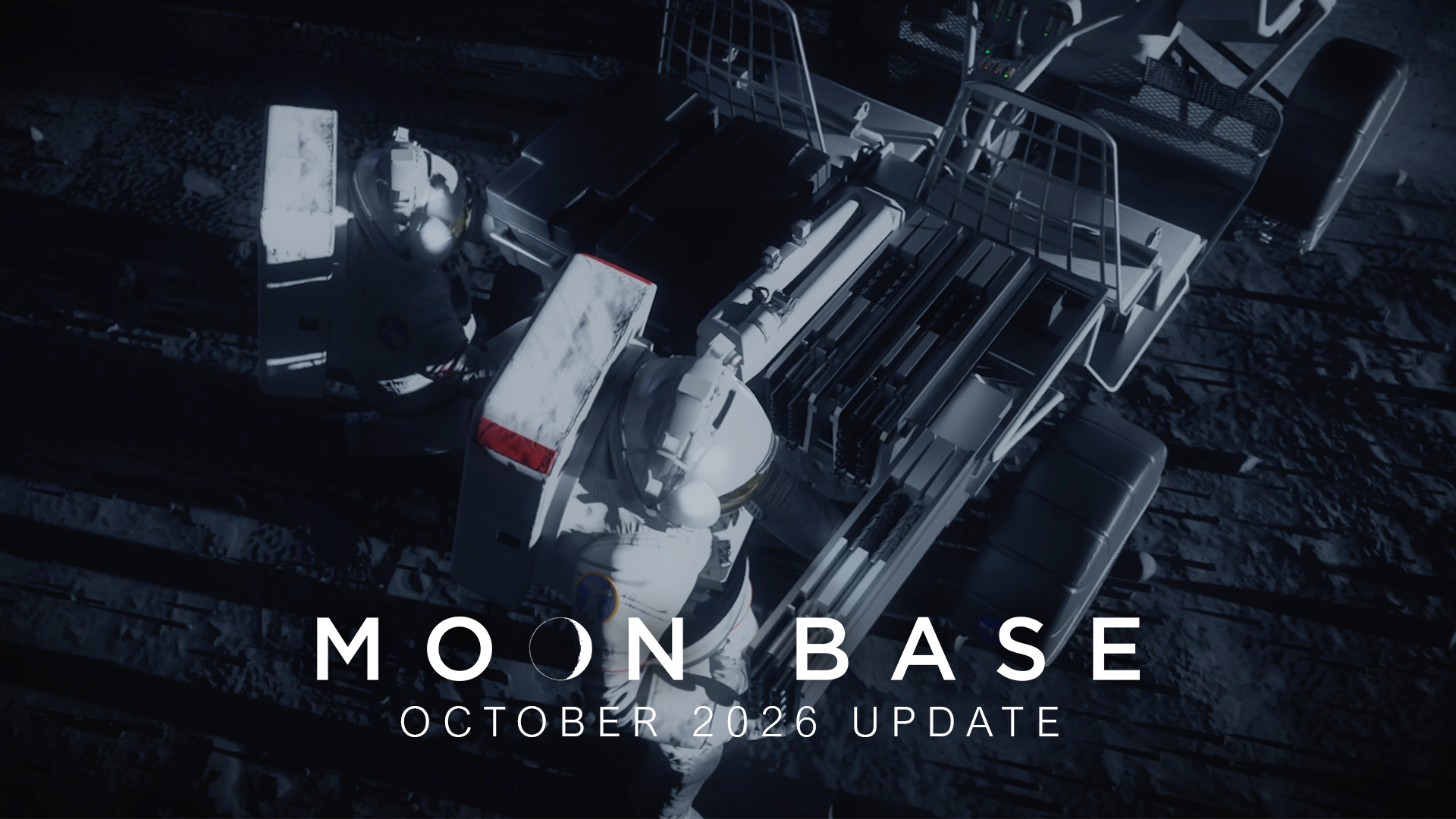
Artist’s rendering of astronauts working next to a lunar terrain vehicle on the lunar surface.
NASA
As NASA works to build the Moon Base, crewed and robotic lunar rovers will play a crucial role during early development through technology demonstrations, astronaut transport, terrain mapping, scientific investigations, and resource prospecting. Data from these early missions will inform future mobility systems and infrastructure needed for astronauts to live and work on the Moon.
On Tuesday, NASA released a Moon Base video update offering a closer look at the progress being made on the commercial lunar terrain vehicles and robotic rovers that will enable the surface mobility needed to build humanity’s first lunar outpost.
“Lunar rovers are central to our surface mobility strategy,” said Robert Pickle, director of the Surface Mobility Office within the agency’s Moon Base Program. “Their performance will lay the groundwork for the mobility systems that will define the next era of exploration and ultimately determine how effectively we can build, operate, and expand the infrastructure required for long‑duration exploration.”
Learn more about NASA’s VIPER
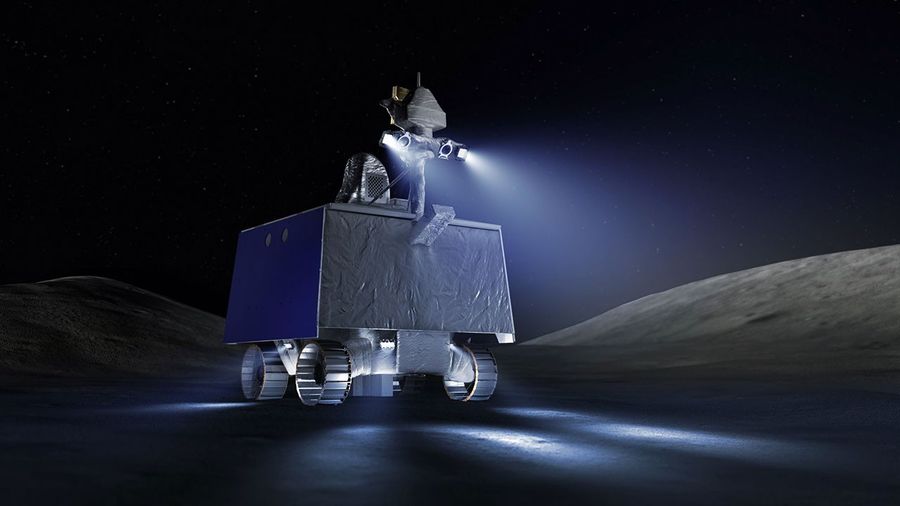
An artist’s concept of NASA’s VIPER lunar rover on the surface of the Moon.
NASA/Daniel Rutter
NASA’s VIPER (Volatiles Investigating Polar Exploration Rover) will embark on a mission to the lunar South Pole region in 2027 to venture into permanently shadowed craters looking for water and other valuable resources essential for sustainable exploration.
After delivery to the lunar surface by a Blue Moon Mark 1 lander, VIPER will travel more than 18 miles (30 kilometers), collecting information about the thermal, lighting, and terrain environment in the Moon’s South Pole region. This data could provide information about the origin and distribution of water on the Moon, help determine how lunar resources could be used for the Moon Base, as well as better understand the history of the Moon, Earth, and the processes that helped shape conditions for life.
Mission operations for VIPER will be run out of NASA’s Ames Research Center in Silicon Valley where teams are simulating possible scenarios for when the rover begins its mission on the Moon.
The VIPER rover is currently at NASA’s Johnson Space Center in Houston where it is fully built and undergoing final testing before traveling to NASA’s Kennedy Space Center in Florida for launch to the Moon.
Lunar terrain vehicles
To advance surface mobility on the Moon, NASA awarded Astrolab and Lunar Outpost task orders to build the first phase of Moon Base rovers capable of carrying crew, called lunar terrain vehicles (LTVs), that will be delivered to the Moon ahead of crewed Artemis missions. NASA awarded Blue Origin a task order to deliver the LTVs to the lunar South Pole region by 2028 through the agency’s CLPS (Commercial Lunar Payload Services) initiative.
The LTVs will be remotely operated from Earth, traversing up to 3.7 miles (6 kilometers) a day, mapping the lunar surface to help scientists produce high-resolution maps of the region, prior to crew arriving on future missions. The rovers also will collect information to help NASA and its partners learn about operating in this extreme environment, such as data on lighting, navigation, and how well the LTVs preserve energy and function when driving in and out of permanently shadowed regions that can reach minus 334°F (minus 203°C). This will help inform Moon Base development and improve on design and capability for future mobility systems, hardware, and infrastructure.
During missions on the lunar surface, Artemis astronauts will drive the LTVs as they explore geologically diverse areas of the lunar South Pole region, gathering geology samples to bring back to Earth for scientists to study. The LTVs will be able to support up to three moonwalks per Artemis mission, transport up to 176 pounds (80 kilograms) of lunar samples and tools, and travel up to six miles (10 kilometers) on a single battery charge.
Astrolab
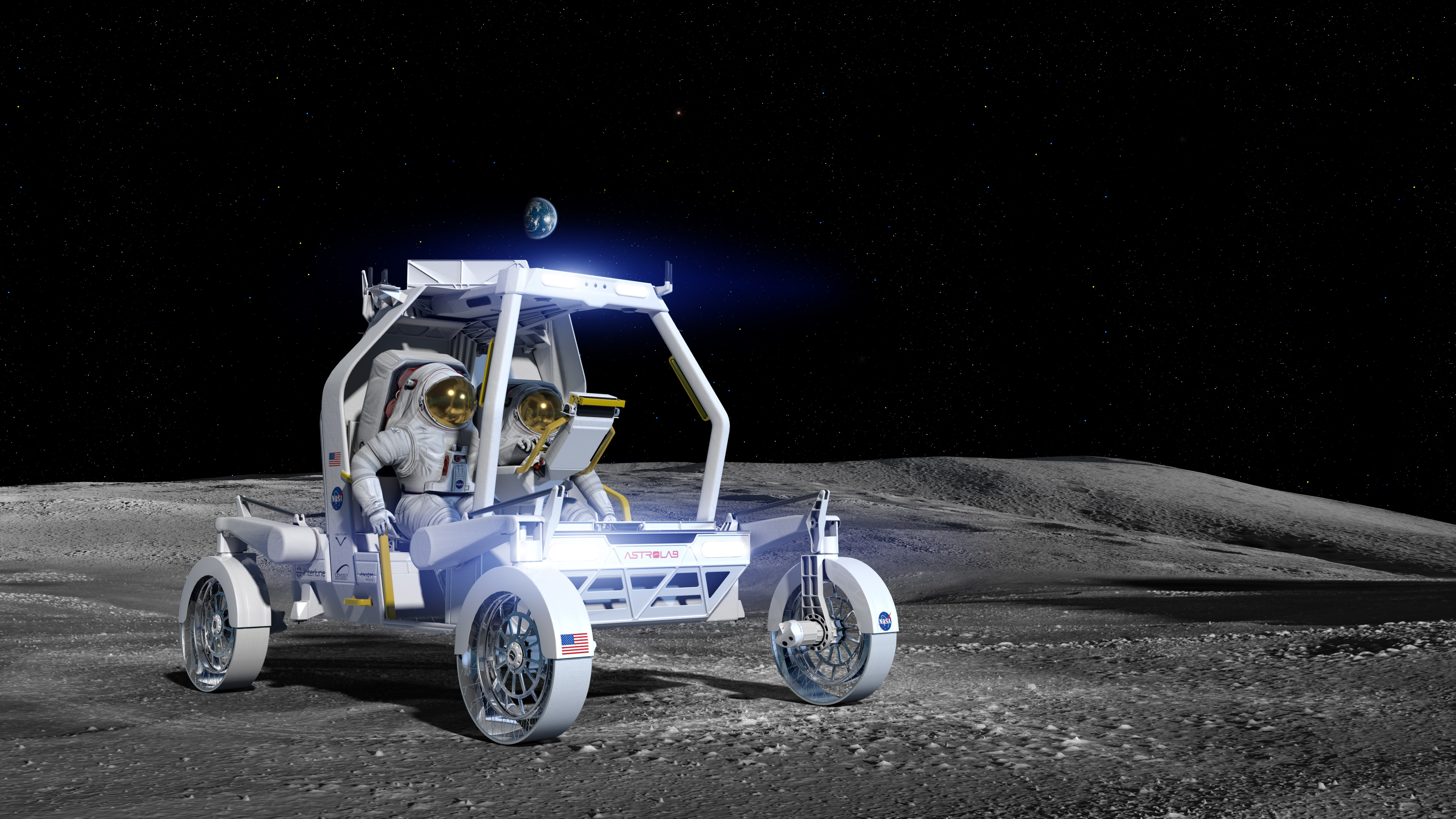
An artist’s concept of Astrolab’s Crewed Lunar Vehicle, or CLV-1, on the surface of the Moon.
Astrolab
Astrolab’s Crewed Lunar Vehicle 1, or CLV-1, is a rover adapted from the company’s FLEX (Flexible Logistics and Exploration Vehicle) LTV architecture. Astrolab recently delivered a mockup of CLV-1 to Axiom Space, where NASA astronauts wore mock-ups of the Artemis lunar spacesuit and evaluated the lunar rover’s design, crew cabin, and display interfaces.
Prior to CLV-1 arriving to the Moon, Astrolab will send its first robotic rover, FLIP (FLEX Lunar Innovation Platform), to the lunar surface as a payload on Voyager Technologies’ Griffin Mission One scheduled to launch in late 2026. FLIP will study the environment of the South Pole and serve as a testbed for critical subsystems on CLV-1, which will include similar tires, batteries, radios, and cameras.
In the next few weeks, Astrolab engineers will head to NASA’s Glenn Research Center in Cleveland where they will use the center’s Simulated Lunar Operations laboratory to evaluate the how CLV-1’s flexible, airless wheels perform while driving on a simulated lunar surface.
Lunar Outpost
A full-scale prototype of Lunar Outpost’s Pegasus lunar terrain vehicle.
Lunar Outpost
Lunar Outpost’s Pegasus crewed LTV is a lighter, mission-ready evolution of the company’s Eagle LTV. Prior to the award, Lunar Outpost built two mockups of Pegasus and recently delivered a third static mockup to NASA’s Johnson Space Center for crewed testing. During the test, NASA astronauts wore pressurized spacesuits and evaluated the rover’s design, usability, and crew comfort.
In 2025, Lunar Outpost’s robotic exploration rover MAPP (Mobile Autonomous Prospecting Platform) operated at the Moon’s South Pole. During the mission, MAPP acted as a testbed and collected data, achieving flight-proven readiness for key hardware and software subsystems, like its automatic thermal control system, navigation cameras, and mission control software that will be used to remotely operate Pegasus. With a second MAPP rover scheduled to launch in early 2027, Lunar Outpost is advancing many of the key technologies that are directly transferable to Pegasus.
In the next few weeks, Lunar Outpost teams also will head to NASA Glenn to test and evaluate the soil mechanics, traction, and mobility of Pegasus’ spring mesh tires.
In the coming months, both Astrolab and Lunar Outpost will test drivable LTV mockups with NASA crew to evaluate how the rovers drive and operate in a simulated lunar environment. Lunar Outpost is scheduled to complete the preliminary design review of their LTV in October, and Astrolab is scheduled to complete their preliminary design review by the end of December. Both companies are on schedule to deliver the flight-ready hardware to NASA at the end of 2027.
As part of a Golden Age of innovation and exploration, NASA will send Artemis astronauts on increasingly difficult missions near the lunar South Pole to explore more of the Moon than ever before. In addition to providing economic benefits and advancing scientific discovery through its Moon missions, NASA will establish an enduring human presence on the lunar surface and build on the agency’s foundation for the first crewed mission to Mars.
There's a lot of ground to cover when you're building a Moon Base. From robotic rovers exploring the rugged lunar landscape to lunar terrain vehicles carryin...

 Login

 Tennessee has launched a bid to host the planned United States Space Academy, proposing a campus at the Coffee County Joint Industrial Park near Tullahoma, minutes from Arnold Air Force Base and about 60 miles (97 km) from Huntsville, Alabama. Gov. Bill Lee announced the bid on Oct. 28 alongside U.S. Sens. Marsha Blackburn and […]