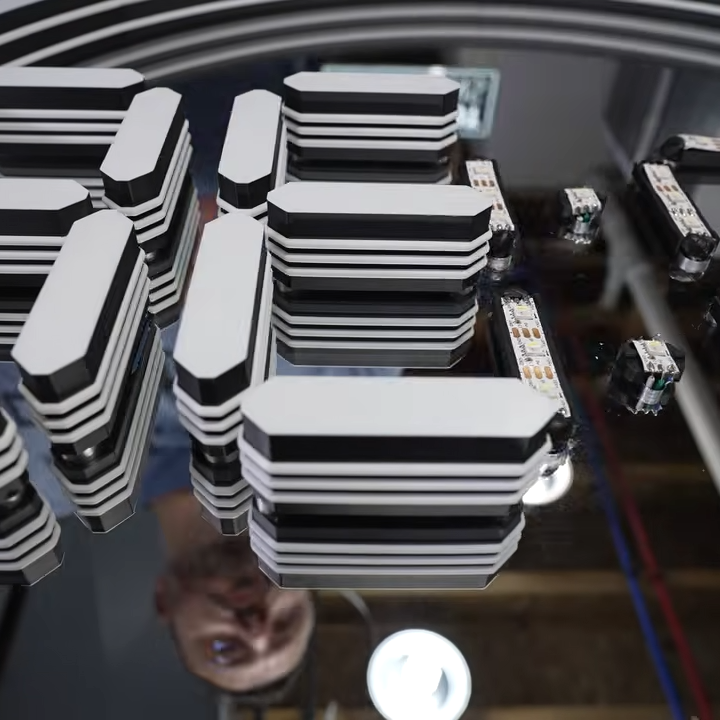
[Andy Huot] has a fantastic-looking infinity mirror digital clock that really raises the bar. It uses high quality components, smart use of RGB LED animations, and a clever “stacked diffuser” vertical design to the 7-segment display elements that really enhances the infinity mirror effect. It needs to be seen in action, so check it out.
The end result is expressly portal-like, with the smooth animations of the LEDs really playing into the effect. The size helps, too. It’s 24 inches in diameter, giving it considerable presence.
The stacked diffuser design for each display element really enhances the effect.
A basic infinity mirror design consists of lit elements sandwiched between a reflective back surface and a partially-reflective, partially-transmissive top cover. That same basic principle is used here, but with great care given to ensure nothing so much as a fingerprint spoils the illusion. For example, the top cover is a disk of acrylic with a 90% reflective film affixed to the inside surface. That’s easy enough to DIY with some car tint, but [Andy] found that for the very best results it was worth having high-quality film professionally applied.
We like the use of 3D-printed custom jigs for soldering the segments of RGB LED strips, and holding the pre-measured wires in place with some putty is a great way to keep them in place while working. In case you’re wondering, the mirrored acrylic making up the back wall has holes in it for mounting each segment’s LED strip in a holder, and running the wires to the rear.
The video (embedded below) documents every step of the assembly, and it’s a serious build. While the design files for the 3D-printed parts are not free, there’s certainly enough detail for an enterprising hacker to replicate the design in their own way.
Nifty little AMOLED screens are easy to get nowadays, and [Sophie D] demonstrates they are both thin and light enough to be worn with OpenChoker, a design for a choker necklace that was a hit at DEF CON.
The choker consists of an AMOLED touchscreen flanked by short RGB LED strips. Behind the display is the PCB which contains an RP2350 and micro SD card slot for external storage, and at the rear of the choker is an 18650 cell to power it all. The display plays an eye-catching animation that gets generated on the fly while the LEDs sparkle away.
[Sophie] shares a number of interesting takeaways from designing and building this device. One is that the bulk of the PCB design work was interfacing to the display, since no existing footprint or reference design could be found. So if you find yourself with a Hello Lighting HL020E21-02 2.14″ touchscreen display you’re hankering to use in your own project, do yourself a favor and check out [Sophie]’s board design instead of starting from scratch.
Battery life was more than enough for a device like this. A single 18650 cell powered the choker effortlessly for a 16-hour stretch and still the cell measured a robust 3.7 V. While a light-up choker used indoors isn’t a great candidate for wearable solar power, it’s encouraging that there’s no need for a tethered battery pack.
Another tip to consider relates to the screen’s touch sensitivity. In short, the capacitive touch screen responded perfectly when plugged into a development computer, but when mounted and isolated on the choker it responded so poorly as to be useless. It didn’t keep the rest of the choker from doing its job, but it might be worth keeping in mind as something to watch out for with a device like this.
There’s one final mystery [Sophie] ran into: with only one day to spare, glue used to affix some wires ended up melting away the wire insulation, revealing bare copper. We’re not sure what happened there, but if nothing else it’s a reminder that Murphy’s Law is always ready to strike when one is on a deadline.
Juicy, spicy and beautifully charred, this smoky chilli garlic grilled chicken marinated in a base of Greek yogurt is an incredibly easy way to make restaurant-style grilled chicken at home!
If you love chicken with a little heat and lots of flavor, this chilli garlic grilled chicken is for you! The smokiness of these grilled chicken is on another level thanks to the cast iron skillet used for grilling!
It's an incredibly simple chicken recipe, but the flavor is anything but ordinary.
Chicken thighs and drumsticks are coated in a creamy Greek yogurt marinade spiked with crispy chilli garlic oil and paprika, then grilled on a cast-iron skillet until juicy on the inside and beautifully charred around the edges.
The Story Behind This Chilli Garlic Grilled Chicken Recipe
I absolutely love recipes that come together from a few simple ingredients but somehow taste like you put in much more effort than you actually did.
This chilli garlic grilled chicken is one of those recipes.
I wanted to make grilled chicken with a really bold chilli-garlic flavor, but without putting together a long list of spices or making a complicated marinade.
So I reached for two ingredients that work beautifully with chicken—Greek yogurt and crispy chilli garlic oil.
The Greek yogurt gives the chicken a lovely tangy coating and helps keep the meat juicy, while the crispy chilli garlic oil brings in the heat, garlic and all those delicious little crispy chilli bits.
A touch of paprika adds warmth and color, and that's pretty much all this chicken needs.
The chicken is then arranged directly on a cast-iron skillet and cooked in a hot oven until completely cooked through and charred around the edges.
And those charred edges? That's where the magic happens!
The result is juicy, tender chicken with a fiery chilli-garlic flavor and beautifully caramelized edges. It's the kind of chicken that works equally well for a weeknight dinner, a weekend barbecue-style meal or even meal prep.
The hope is always that a good business card will leave a good impression. For those in the electronics field, they also serve as an opportunity to showcase creative design skills. [Wilson Harper] demonstrates that ably with a rather nifty energy-harvesting build.
The card is based around a thin PCB in the typical business card size. It’s populated by 21 Charlieplexed LEDs, a small microcontroller, and some supporting components. Now, this is normally where you might expect the device to be powered by a small coin cell, maybe deftly integrated into the PCB thickness itself to make the card less cumbersome. But no—[Wilson] went a different route. The thing is that in 2026, most of us are carrying phones with NFC readers built in. Thus, the card was built to harvest this source of energy with a PCB trace antenna, designed with the aid of STM’s antenna inductance tools and an LLM script lobbed into KiCad. All one needs to do is to pop the card on the back of a phone and the LEDs animate joyfully.
If you love a good chicken wrap but want something lighter, fresher and packed with protein, this high-protein chicken salad wrap is exactly what you need!
Looking for a lunch that is high in protein, packed with crunch and actually exciting to eat? This high-protein chicken salad wrap might just become your new favorite!
Creamy, crunchy, juicy and incredibly satisfying — all wrapped up into one wholesome, protein-packed meal. Perfect for a quick lunch, easy dinner or a delicious meal-prep option!
And there are more than 5 reasons why you will fall for this recipe!
They are high in protein while being low in calories thanks to the Greek yogurt instead of mayo.
Loads of crunch from fresh veggies giving every bite plenty of texture.
Big on flavor from paprika, garlic powder and Italian seasoning.
Perfect for meal prep where you can assemble the wraps whenever you need a quick meal when you have the salad ready!
Skillet-toasted for extra deliciousness - that final golden toast takes these wraps from good to seriously addictive!
What is a High-Protein Chicken Salad Wrap?
A High-Protein Chicken Salad Wrap is a wholesome, satisfying wrap made with tender seasoned chicken, crunchy fresh vegetables and a creamy protein-rich dressing, all wrapped in a soft tortilla.
Unlike a traditional chicken salad that often relies heavily on mayonnaise, this version uses Greek yogurt as the base of the dressing, giving it a creamy texture while adding extra protein.
The chicken is seasoned with paprika, garlic powder, black pepper and Italian herbs, pan-seared until golden, then shredded and tossed with crisp iceberg lettuce, carrot, celery and spring onion greens.
The finished chicken salad is tucked into a wholewheat tortilla and lightly toasted on a skillet until golden and crisp.
The result is a fresh, creamy, crunchy and protein-packed meal that works beautifully for lunch, dinner or a quick meal-prep option.
Impressive as it most certainly is when an amateur fabricates a semiconductor, most of the projects we’ve seen are more demonstrations than workable chips. [Dr. Semiconductor], however, is going much further with his fabrication process, and is already working on a method to bond chips to printed circuit boards. It’s difficult to align a PCB with the pads on the underside of an opaque silicon wafer, however, so as a trial run he’s made and bonded some transparent LED chips.
The starting material for these chips is a gallium nitride (GaN) LED epiwafer, a stacked structure of n-doped GaN, an indium gallium nitride quantum well layer, and p-doped GaN grown on a sapphire substrate. When current passes through the structure, electrons from the n-doped layer and holes from the p-type layer recombine in the quantum well layer, emitting blue light. To make a functional LED from this, [Dr. Semiconductor] needed to make electrical contacts to both the n-type and p-type layers. Making the n-type contact required cutting through the p-type and quantum well layers.
This would normally be done with reactive ion etching in chlorine, but [Dr. Semiconductor] came up with a new process: a 355-nm ultraviolet etching laser causes GaN to break down into gallium and nitrogen, with the resulting cut being cleaned up by a potassium hydroxide etch. To deposit the contacts themselves, [Dr. Semiconductor] formed a photoresist mask, deposited metal (nickel, silver, and titanium) in a sputtering chamber, and used a developer solution to dissolve the mask and lift off the unwanted metal regions.
The LED after bonding and phosphor application.
When [Dr. Semiconductor] applied current between the two contacts, the LED glowed bright blue. The next step was to mount it to a PCB; to do so, he first sliced the wafer into individual LED chips with the ultraviolet laser. He then electroplated indium bumps onto a printed circuit board, positioned the chip above these bumps, added some rosin flux, and melted the indium bumps. This soldered the chip to the board and let the board power the LED.
Like most commercial LEDs, these were blue; most LED assemblies additionally include a phosphor layer which absorbs blue light and emits another color. To create a white LED, for example, [Dr. Semiconductor] mixed cerium-doped yttrium aluminium garnet phosphor powder with clear silicone and spread it over the LED. This absorbs some of the blue light and emits yellow light, and the resulting mixture of blue and yellow light looks white to human eyes.
Much like Apple’s once vaunted super-slim butterfly keyboard, today’s range of portable devices featuring flexible OLED displays – which can fold said display into a much smaller form factor – are a marvel of engineering.
The foldable phone after a dusty encounter. (Credit: iFixit, YouTube)
Unfortunately engineering can only do so much against fundamental flaws. In the case of both these flexible OLEDs and butterfly keyboards the main issue is that of dust intrusion, with a recent teardown by [iFixit] going over the reasons for this.
As test subject we got a Galaxy Z Fold 8, as an example of a modern-day foldable smartphone-tablet hybrid. This phone has an IP48 rating, meaning that it’s water-resistant, but not dust-resistant for particles smaller than 1 mm. To test this, [iFixit] used UV-reactive dust particles, making sure that they got literally everywhere inside the phone’s hinge mechanism.
After this treatment, trying to fold the phone caused the hinge mechanism to make absolutely horrific crunching noises, confirming that it’s reached dust-under-butterfly-keycap levels of unusable. During the subsequent teardown a quick pass with the UV lamp showed that not much of the dust had penetrated into the two halves of the device at least, but the hinge mechanism wasn’t as lucky.
Getting to the hinge is sadly rather destructive, as it involves removing the flexible OLED. Once the hinge was exposed and subjected to UV light the spectacle was something to marvel at, as can be seen in the above screenshot. With the dust caking literally every part of the mechanism, it was little wonder that the hinge had ceased to work.
Although this was obviously an extreme case of dust exposure, and the average flexible OLED screen’s hinge won’t see nearly as much dust, one can’t help but feel slightly disconcerted at that crunching noise, knowing that it’s just one big dust exposure away.
LG Display’s FLiPP OLED technology promises 2.4x longer lifespan, higher brightness, and lower power use, with monitors and tablets set to become its first proving ground.
The Minimal Phone 2 fixes many of the compromises that made the original difficult to live with. Those improvements also raise an awkward question about what made it minimal in the first place.
We tested over 20 top QLED TVs for 2026 to find the best models for brightness, color, and gaming. See our expert picks for every budget and room size.
The XRP Ledger’s core server software has reached version 3.2.0, bringing a symbolic but important naming change: the server binary is moving from `rippled` to `xrpld`.
At first glance, that may sound like a small developer detail. In practice, it says something about where the XRP Ledger ecosystem has been heading for years.
The network is no longer framed only around Ripple the company. XRPL has its own foundation, standards process, developers, validators, and infrastructure teams. Renaming the core server binary under XLS-0095 is part of that broader shift toward XRPL-native identity.
The v3.2.0 release also includes an updated GPG signing key for automatic upgrades, retires legacy amendments, and fixes Single Asset Vault bugs.
So yes, this is partly a technical release. But it is also a useful marker in the XRP Ledger’s long-running effort to separate network infrastructure from old naming conventions.
TL;DR
XRP Ledger server software v3.2.0 has been released.
The core server binary is being renamed from `rippled` to `xrpld`.
The release also updates GPG signing, retires legacy amendments, and fixes Single Asset Vault bugs.
Why The Name Change Matters
Names carry baggage in crypto.
For years, XRP Ledger infrastructure has been tied in the public mind to Ripple. That is understandable, given Ripple’s historical role in developing and supporting the network. But it has also created confusion.
Some users treat Ripple, XRP, and XRPL as interchangeable. They are not.
Ripple is a company. XRP is the native asset. The XRP Ledger is the blockchain network. That distinction matters for developers, regulators, validators, exchanges, and users.
Moving from `rippled` to `xrpld` will not magically solve the branding confusion, but it helps.
The new name better reflects the network itself. It is cleaner for infrastructure providers, node operators, and developers who want language that points to XRPL rather than Ripple the company.
That matters especially as the ecosystem expands beyond payments into lending, vaults, amendments, and other on-chain features.
Node Operators Need To Pay Attention
The release is not just cosmetic.
Node operators need to understand the update because core server software affects how they stay compatible with the network. If operators do not keep up with required versions and amendment support, they can run into local synchronization issues or become amendment blocked.
That does not mean the entire XRP Ledger is about to suffer a network-wide outage. That would overstate the risk.
But individual infrastructure providers, exchanges, validators, and services that run XRPL nodes do need to manage the upgrade carefully.
The updated GPG signing key is particularly relevant for automatic upgrades. Security around software distribution matters, especially for networks that support value transfer. Operators need confidence that they are installing authentic releases, not compromised binaries.
Retiring Legacy Amendments Helps Clean Up The Stack
The retirement of legacy amendments is another piece of the upgrade story.
Blockchain networks accumulate history. Old features, older code paths, outdated assumptions, and unused amendments can make software more complicated over time. Cleaning up legacy components can reduce maintenance burden and help developers focus on current protocol priorities.
That kind of work is not always exciting, but it is important.
Users rarely notice when legacy systems are removed smoothly. They only notice when old technical debt creates problems. Protocol teams therefore spend a lot of time doing maintenance that never becomes a headline.
The v3.2.0 release fits that pattern.
It modernizes naming, updates signing infrastructure, removes older amendment baggage, and fixes issues tied to Single Asset Vaults.
Single Asset Vault Fixes Point To XRPL’s Broader Direction
Single Asset Vaults are part of XRPL’s broader move toward more advanced on-chain financial functionality.
The network has historically been known for payments, transfers, and exchange-style functions. But the ecosystem has been pushing toward more complex primitives, including lending-related standards and vault mechanics.
Bug fixes in this area are worth noting because they show that XRPL development is not standing still.
As the network adds more financial features, the core software has to become more robust. Lending, vaults, and other DeFi-style functions require careful engineering because mistakes can affect user funds, liquidity, and application reliability.
That makes node releases more important than they may look from the outside.
XRPL Infrastructure Is Becoming More Independent
The larger takeaway is that XRPL infrastructure continues to mature.
The move from `rippled` to `xrpld` is symbolic, but symbols can matter when they reflect real ecosystem changes. XRPL is not only a Ripple-linked payments story anymore. It is a network with its own standards, governance discussions, developer activity, and infrastructure roadmap.
The v3.2.0 release reinforces that direction.
For XRP holders, this does not automatically create a market catalyst. A node release does not guarantee token demand or price movement. But it does show that the technical base of the network is still being maintained and modernized.
That is the kind of progress that matters quietly.
Healthy networks need more than headlines. They need clean software releases, responsible upgrade paths, secure signing keys, bug fixes, and infrastructure that developers can rely on.
XRPL v3.2.0 is one of those updates.
It may not be flashy, but for the people running the network’s core infrastructure, it is exactly the kind of release that deserves attention.
XRP Ledger Amendments Near Validator Vote Deadline
The XRP Ledger is approaching a key validator voting window for proposed protocol amendments, putting attention back on how XRPL upgrades move from code into live network features.
The amendments are tracked through the rippled release process and validator voting system. Like other XRPL changes, they require broad validator support before activation. The validated materials point to the standard 80% agreement threshold, which must be maintained for a sustained period before an amendment becomes active.
That makes this a governance and infrastructure story rather than a simple price headline.
XRPL upgrades do not activate just because developers release code. Validators have to support them, and the network has to maintain enough agreement over time. That process is designed to avoid rushed changes and give participants time to assess new features.
For XRP holders, the voting window matters because protocol-level changes can shape future utility across payments, asset issuance, and decentralized exchange functions.
TL;DR
XRP Ledger amendments are nearing an important validator voting window.
Proposed changes require 80% validator support for activation.
The process highlights how XRPL upgrades move through network governance.
How XRPL Amendments Work
The XRP Ledger uses an amendment process for protocol upgrades.
When new features are added to rippled, they do not automatically become active across the network. Instead, validators vote on whether to enable them. If an amendment maintains the required level of support for the required period, it can activate.
That model gives the network a measured upgrade path.
It allows developers to ship code, but it also gives validators a role in deciding whether the network is ready to adopt the changes. If support is not strong enough, the amendment does not activate.
The 80% threshold is important because it forces broad agreement.
That can slow down upgrades, but it also reduces the risk that controversial or poorly understood changes are pushed through too quickly. For a payments-focused ledger, stability matters.
Why Validator Voting Matters
Validators are central to XRPL governance.
They help determine whether proposed amendments become part of the live protocol. That means their decisions can influence what features developers, exchanges, wallets, and users can rely on.
For the market, validator voting is easy to overlook because it is not as flashy as a token listing, ETF speculation, or price breakout. But it is often more important for long-term network development.
Protocol upgrades can affect smart contract capabilities, asset features, transaction types, decentralized exchange functions, and operational reliability.
If amendments pass, they can expand what developers build on XRPL. If they stall, the ecosystem may have to wait longer for certain capabilities.
That is why the current voting window is worth watching.
Activation Is Not Guaranteed
The key caveat is that pending amendments are not active amendments.
Even if a feature is included in a rippled release, it still needs sufficient validator support. The 80% threshold must also be sustained, not just briefly touched. That means activation can be delayed or fail if validators are not ready.
This is the part traders should not overstate.
A voting deadline does not automatically mean a network upgrade will go live. It means the ecosystem is approaching a decision point. Validators may support the changes, withhold support, or wait for more review.
That is healthy if the process works properly.
Network upgrades should not be treated like marketing events. They need technical confidence, infrastructure readiness, and community awareness.
XRP Utility Depends On Network Progress
For XRP, the amendment process matters because the token’s long-term story is tied to XRPL utility.
The ledger has always been positioned around payments, settlement, asset movement, and efficient transaction processing. New amendments can strengthen that story if they add useful features and attract developers.
But market interest often runs ahead of actual adoption.
A protocol change only matters if it leads to more usage, better tools, or stronger application demand. Validator approval is one step. Developer adoption is another. User demand is the real test.
That is why this story should be framed around infrastructure progress rather than price prediction.
XRP traders may watch amendment votes for signs of ecosystem momentum, but the practical impact depends on what the amendments enable and whether builders use them.
For now, the XRP Ledger is entering another governance checkpoint. The vote will show whether validators are ready to move the next set of protocol changes closer to activation.
This article is based on XRP Ledger rippled release materials.
This article was written by the News Desk and edited by Samuel Rae.
This report is based on information released by GitHub. at GitHub
Scattered Spider Hackers Sentenced over Mass-Affecting Transit Attack Two well-known members of the notorious hacking group Scattered Spider were sentenced to prison in the UK on July 16, 2026. Owen...
These hot honey chicken drumsticks are baked until perfectly juicy, then glazed & rebaked with a luscious mix of honey, hot sauce and lemon juice until beautifully caramelized and finger-licking delicious! The kind of recipe that disappears faster than you can make it!
Sticky, sweet, spicy and completely irresistible - Who's grabbing the first drumstick? 😀
There’s something incredibly satisfying about sticky, glossy chicken drumsticks fresh out of the oven, especially when they strike that perfect balance between sweet and savory goodness with that sizzling touch of heat!
These hot honey chicken drumsticks bring together the comforting familiarity of oven-baked chicken with the irresistible allure of a spicy honey glaze that caramelizes beautifully as it bakes.
The result is a finger-licking dish that feels equally at home on a casual weeknight dinner table or as the star attraction at your next gathering.
What is hot honey chicken drumstick?
These hot honey chicken drumsticks are everything you want in a crowd-pleasing chicken recipe — juicy oven-baked drumsticks coated in a sticky, sweet and spicy hot honey glaze that sticks to the chicken like nobody’s business making it the ultimate finger-licking dinner!
Seasoned with a simple but flavorful blend of garlic powder, onion powder, chilli powder, salt and pepper, the chicken develops a delicious savory base before the magic really begins.

 Login
Login