The commander and pilot of NASA's Artemis II mission have gained a new distinction five months after splashing down from the Moon: They're not fully retiring from the space agency.
Reid Wiseman and Victor Glover are the first astronauts to join NASA's emeritus program, enabling them to continue to support the work being done at Johnson Space Center in Houston. They will remain available to train and mentor the current workforce while still being able to pursue employment and opportunities outside of NASA.
"I have asked NASA ... to not use the term 'retire' as much, but technically emeritus is a retirement program," Glover told collectSPACE.com on Wednesday. "It's something we have typically done for scientists when they have groundbreaking research, and they want to go back to academia to teach or to research and publish."
For the first time in decades, NASA has rolled out one of its iconic astronaut training aircraft with a bold, new look.
The space agency debuted a new livery on one of its T-38 jets in celebration of its program to return astronauts to the Moon. The Artemis design retains nods to what made the "white rocket" immediately recognizable, but adds a new colorway and painted graphics to make clear where NASA is headed.
"This new 'Artemis' livery has a black and white paint scheme with blue and red stripes that separate those two paint schemes," said Sean Brady, who proposed and designed the new livery while serving as the T-38 project pilot in NASA's Aircraft Operations Division (AOD), part of the Flight Operations Directorate at Johnson Space Center in Houston. "The Artemis program logo in the back and a picture of the Moon is on the left and right side of the rear fuselage."
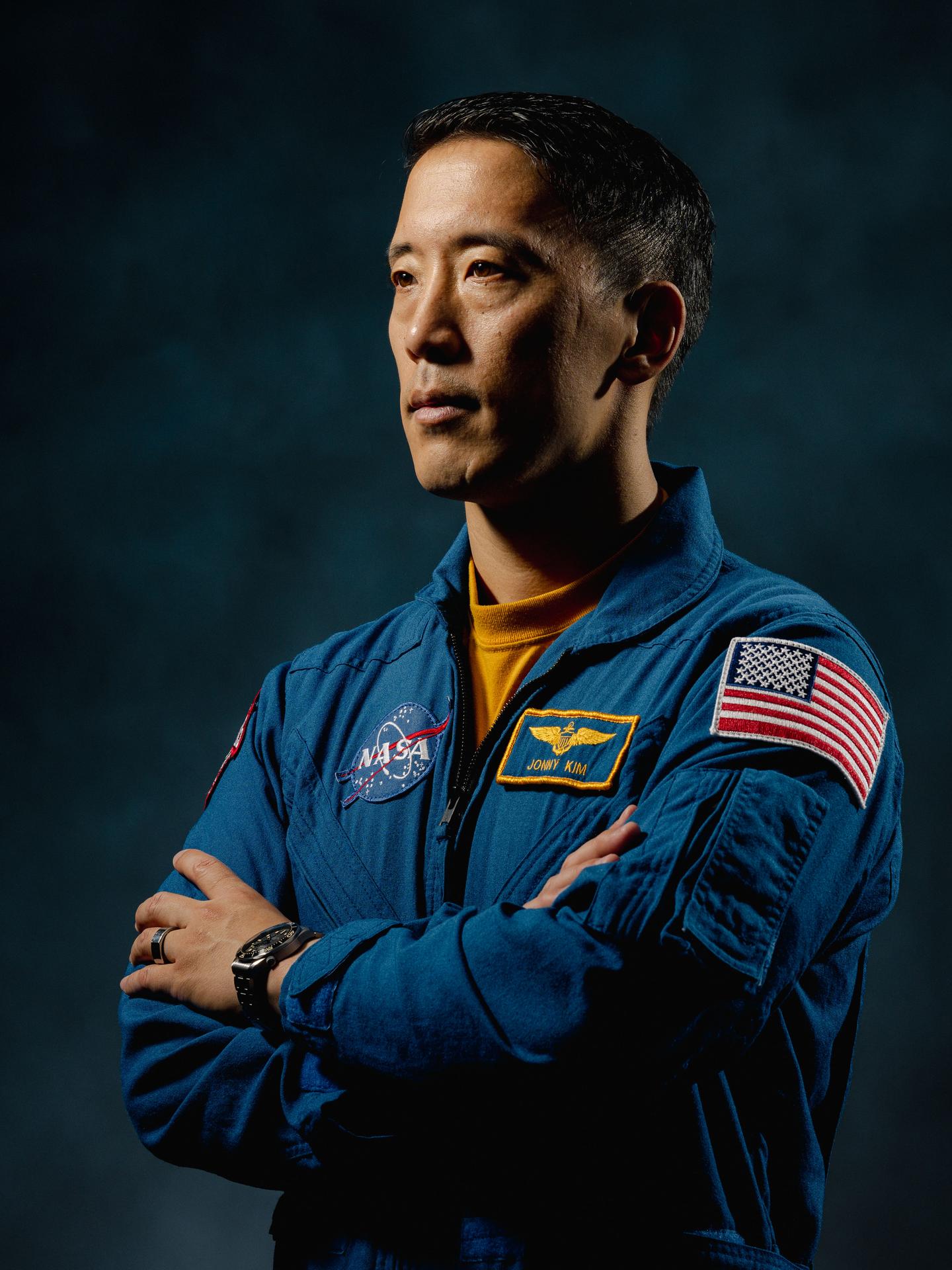
NASA astronaut Jonny Kim poses for a portrait at NASA’s Johnson Space Center in Houston.
Credit: NASA/Josh Valcarcel
After nearly a decade of service to NASA, including an eight-month science expedition aboard the International Space Station, astronaut Jonny Kim’s last day at the agency is Thursday. He will continue serving as lieutenant commander in the U.S. Navy.
Kim launched to the space station in April 2025 aboard the Soyuz MS‑27 spacecraft to conduct scientific research as a flight engineer during Expeditions 72/73. During the mission, he orbited Earth 3,920 times, traveled nearly 104 million miles, and contributed to a broad range of scientific investigations spanning technology development, Earth science, biology, and human research critical for future exploration.
“Jonny Kim represents the very best of NASA, a person who continually pushed the boundaries of exploration while inspiring countless others,” said NASA Administrator Jared Isaacman. “His contributions aboard the International Space Station advanced critical science that will shape NASA’s future missions for decades to come. We are grateful for his dedication to our nation and to the pursuit of knowledge, and we wish him success as he continues his service in the U.S. Navy.”
Serving as the U.S. Operating Segment lead for the second half of Expedition 73, Kim oversaw operations across the station’s international modules. During the expedition, the station achieved a historic milestone when every available docking port was occupied for the first time in 25 years. He also commanded the Canadarm2 robotic arm during the first capture of Northrop Grumman’s new Cygnus XL spacecraft, securing 11,000 pounds of supplies for the station. Kim and his Roscosmos crewmates landed safely in Kazakhstan in December 2025.
“Jonny has been an integral part of the agency, and his immeasurable impact will be felt for generations to come,” said Vanessa Wyche, director of NASA’s Johnson Space Center in Houston. “From advancing groundbreaking science to inspiring the next generation, Jonny has been an incredible source of inspiration to our nation. His exceptional talent, determination, and grit will leave a lasting legacy at NASA.”
Kim was selected as a NASA astronaut in 2017 and completed two years of astronaut candidate training, which included instruction in space station systems, Russian language, robotics, T‑38 flight operations, geology, survival training, and spacewalk preparation.
He later supported station operations as a capsule communicator, or capcom, in NASA’s Mission Control Center at Johnson. Kim also contributed to Artemis program development through his work in the astronaut exploration branch, leading the astronaut crew operations branch, and serving as increment lead for Expedition 65. His experiences as a Navy SEAL, physician, and naval aviator provided unique perspectives in mission operations and crew support.
“Jonny approached every assignment with humility, precision, and steadfast commitment to the mission,” said Scott Tingle, chief of the Astronaut Office at NASA Johnson. “His combination of medical training, operational experience, and engineering insight strengthened our team and contributed to advancements in exploration and space station operations.”
Born in Los Angeles, Kim enlisted in the U.S. Navy after graduating high school in 2002. He trained as a hospital corpsman and completed Basic Underwater Demolition/SEAL training before joining SEAL Team Three. Over the course of more than 100 combat operations, he served as a medic, sniper, navigator, and point man, earning the Silver Star, Bronze Star with Combat “V,” and numerous additional commendations.
He earned a bachelor’s degree in mathematics from the University of San Diego and a doctor of medicine from Harvard Medical School. He completed his internship at Massachusetts General Hospital and Brigham and Women’s Hospital in Boston. Kim became a dual-designated naval aviator and flight surgeon, completing flight training at Naval Air Stations Corpus Christi in Texas and Whiting Field in Florida, and aerospace medical training at the Naval Aerospace Medical Institute at Naval Air Station Pensacola.
Kim is returning to active duty to finish out the remainder of his military career within naval aviation training.
“Contributing to space exploration and serving NASA has been the honor of a lifetime,” said Kim. “Throughout my career, I’ve learned that beyond the missions, the training, and the hardware, success always comes down to the people. They are our greatest asset, and leading with love and empathy is how we achieve the impossible. I look forward to carrying my commitment to service, my enduring love for space and technology, and the hard-earned lessons of this past decade into my next chapter to make a meaningful impact on humanity’s future.”
To learn more about NASA’s astronauts and human space exploration, visit:
NASA Johnson Pilots Chase Moon’s Shadow for Eclipse Science
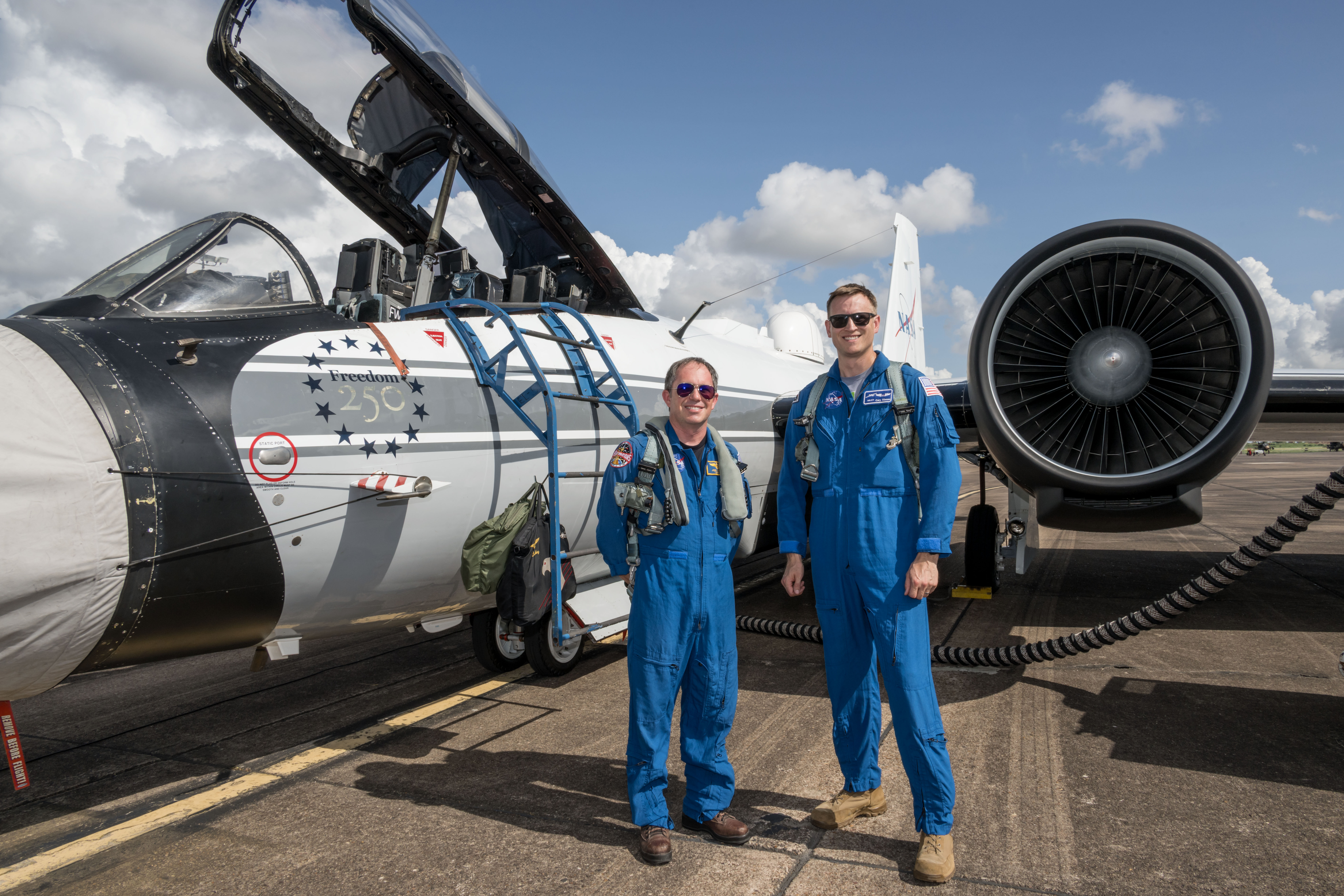
NASA’s WB-57F aircraft prepares for takeoff from Ellington Field in Houston ahead of its mission to observe the Aug. 12, 2026, total solar eclipse from Iceland. From left are John Gustine, NASA WB-57F pilot, and Cary Klemm, sensor equipment operator for NASA’s WB-57F.
NASA/Robert Markowitz
During the Aug. 12 total solar eclipse over Europe, scientists aimed to study a long-standing mystery: why the Sun’s outer atmosphere, the corona, is far hotter than its visible surface. Capturing the data they needed meant being in exactly the right place at the right time.
Pilots from NASA’s Johnson Space Center flew the WB-57F high altitude research aircraft from Ellington Field in Houston to Iceland, their base for flying through the path of totality to give scientists a clearer view of the Sun’s corona.
A total solar eclipse provides a unique opportunity to examine the corona because the Moon temporarily blocks the Sun’s bright surface, revealing its fainter outer atmosphere. Observations collected during this brief window can help scientists better understand how energy and material move through the corona and away from the Sun, improving our understanding of space weather.
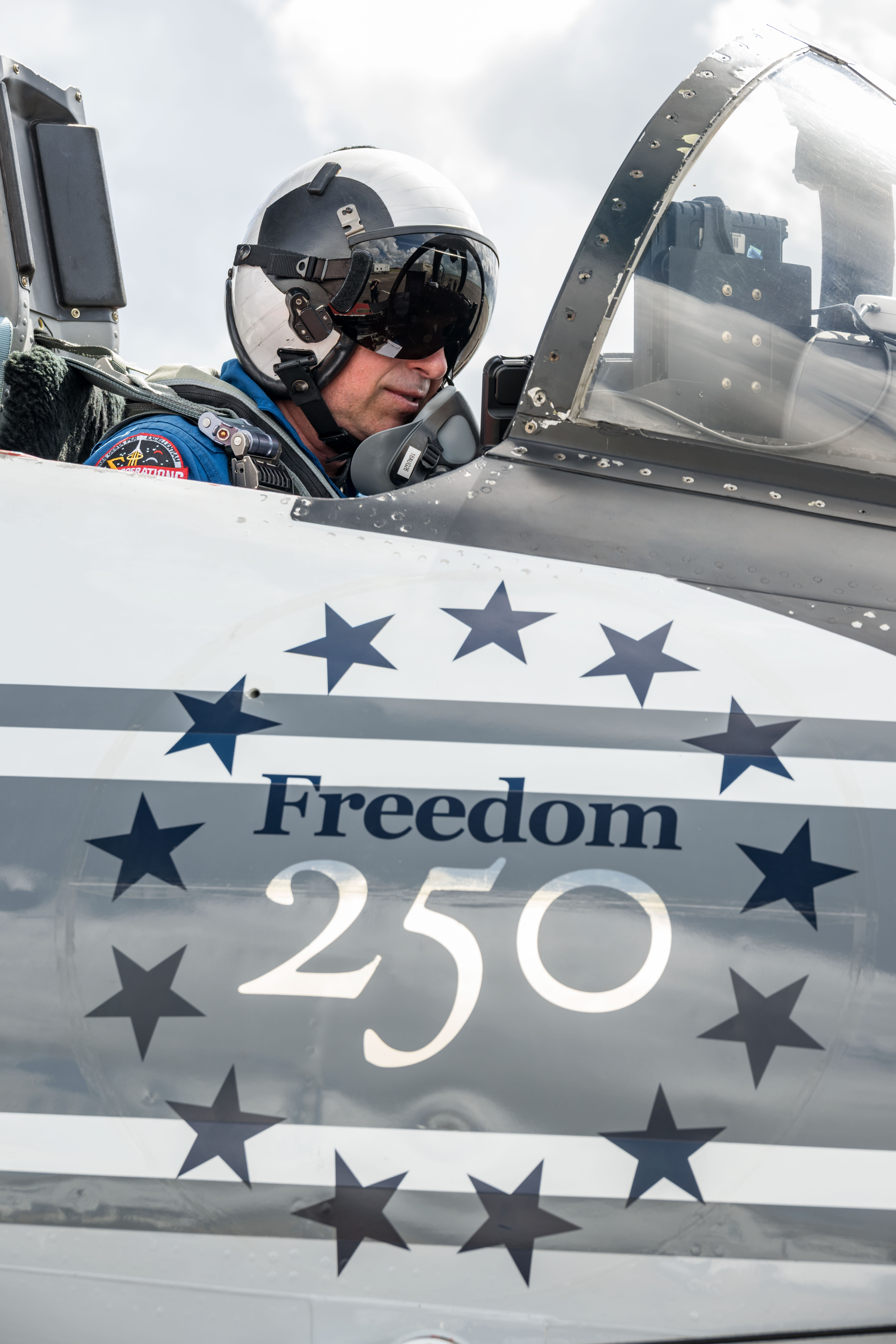
John Gustine, NASA WB-57F pilot, prepares for flight at Ellington Field in Houston ahead of the aircraft’s departure for Iceland to support the Aug. 12 total solar eclipse.
NASA/Robert Markowitz
At about 50,000 feet, the WB-57F flew above most clouds, dust, and water vapor that can interfere with observations from the ground. The altitude reduced atmospheric interference while also allowing the science instruments to observe infrared wavelengths that are largely absorbed lower in Earth’s atmosphere.
Capturing those observations required careful coordination between scientists and the flight crew. Before the mission, teams calculated where the aircraft needed to be as the Moon’s shadow moved across the North Atlantic.
“Going into a mission like this takes a huge team. It starts with the science team establishing the requirements, and then we work closely with them for months leading up to the mission,” said Tom Parent, NASA WB-57F pilot. “We rely heavily on our maintenance team to get the instruments serviced, prepared, loaded onto the aircraft, and flight tested. It’s a huge team effort to get an aircraft like this up there to image and achieve these objectives.”
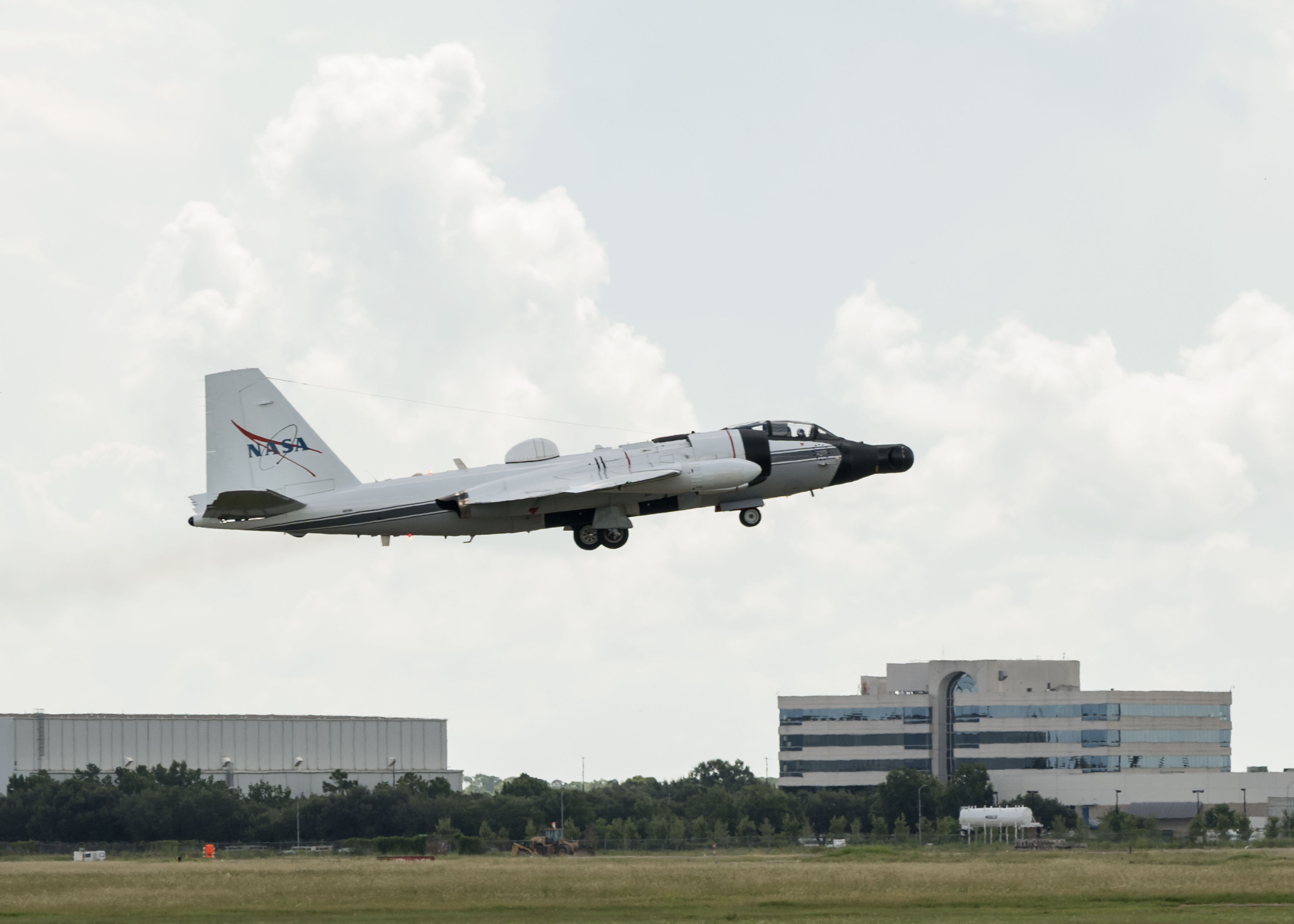
NASA’s WB-57F aircraft takes off from Ellington Field in Houston ahead of its mission supporting the Aug. 12 total solar eclipse from Iceland.
NASA/Robert Markowitz
During totality, NASA WB-57F pilot John Gustine positioned the aircraft along the eclipse path to maximize time in the Moon’s shadow and give scientists as much opportunity as possible to collect data.
From the back seat, Cary Klemm, sensor equipment operator for NASA’s WB-57F, controlled the camera systems, adjusting focus and exposure times while tracking features of interest throughout totality.
With the cameras capturing observations throughout the brief window, every second mattered.
“Every image is another piece of data that could reveal something new about the Sun,” Klemm said.
What scientists can learn from those observations reaches far beyond the eclipse itself. The Sun’s corona is made of plasma shaped by magnetic fields, and many of the same physical processes occur elsewhere in the universe.
“The NASA WB-57F’s unique capabilities of high-altitude flight were truly crucial in providing access to these valuable wavelengths during an eclipse whose path crossed mostly over the ocean in an area where clouds are common,” said Amir Caspi, principal investigator for the study at Southwest Research Institute in Boulder, Colorado. “We could not have achieved this success without this platform, and all of the efforts of the many intrepid ground, air, and science crew members.”
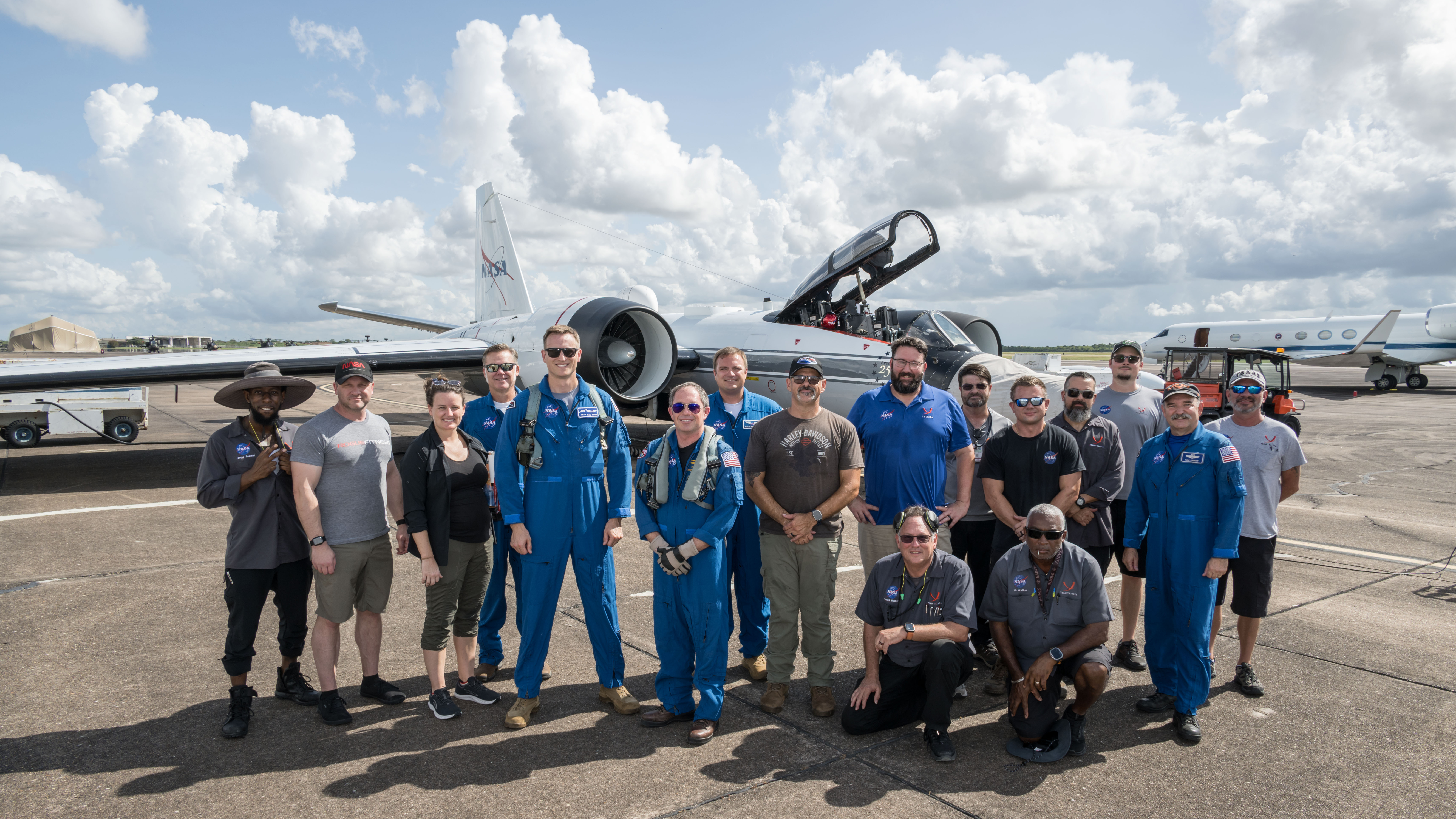
Members of NASA’s WB-57F eclipse mission team gather at Ellington Field in Houston ahead of the aircraft’s departure for Iceland.
NASA/Robert Markowitz
The data gathered during the flight will give scientists another opportunity to investigate the Sun and the processes that influence the space environment around Earth.
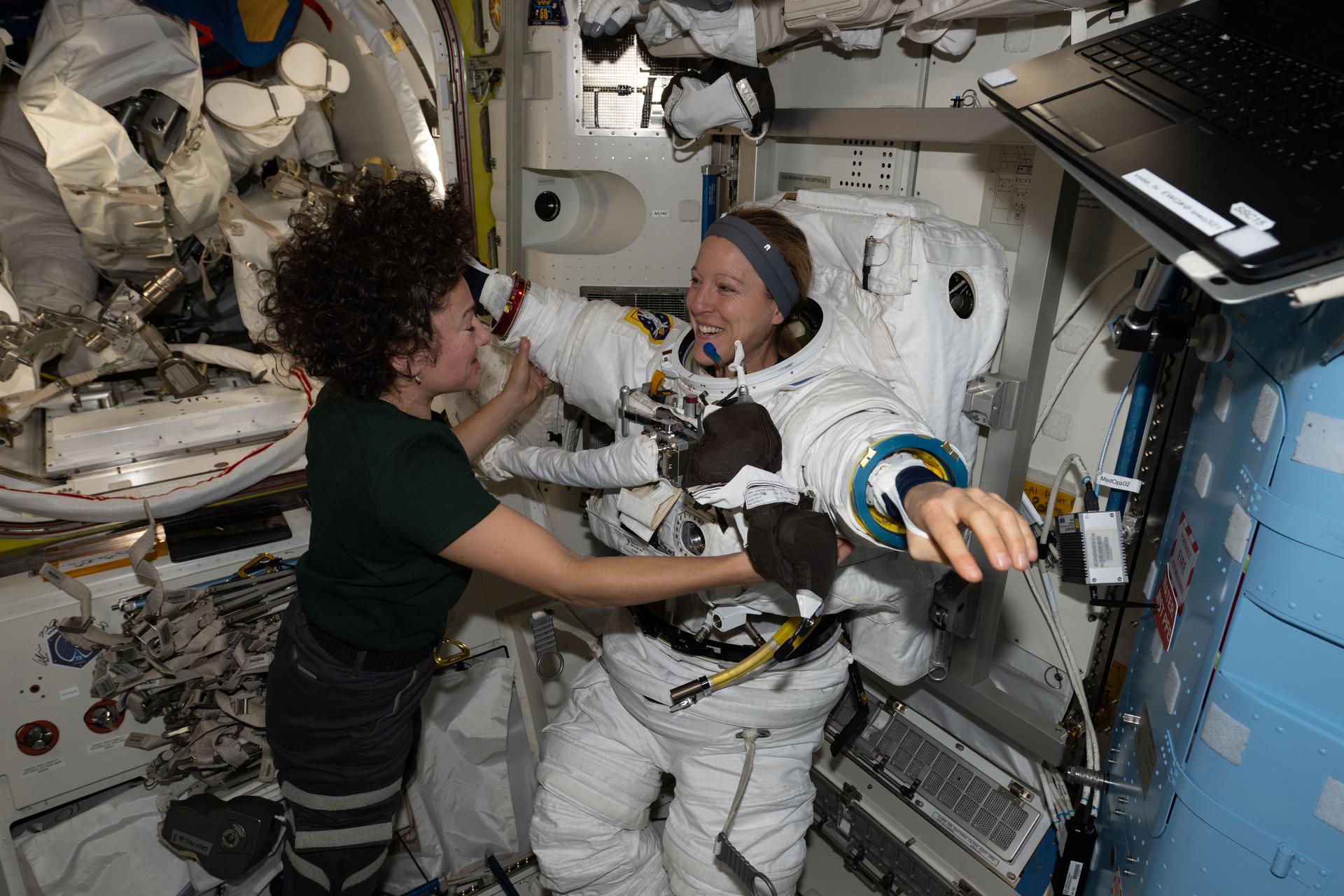
NASA astronaut Jessica Meir and ESA (European Space Agency) astronaut Sophie Adenot work together inside the International Space Station’s Quest airlock during spacesuit fit and leak checks.
Credit: NASA
NASA will provide coverage as two astronauts step outside the International Space Station on Tuesday, Sept. 1, to replace a spacecraft navigational aid and complete several maintenance tasks in support of space station operations.
Watch live coverage beginning at 7 a.m. EDT. The spacewalk is expected to start at approximately 8:30 a.m. and last about six and a half hours. NASA’s spacewalk coverage will stream through a variety of platforms. Learn where to watch online:
During U.S. spacewalk 99, NASA astronaut Jessica Meir and ESA (European Space Agency) astronaut Sophie Adenot will replace a retroreflector on the forward port of the space station’s Harmony module to support spacecraft navigation during rendezvous and docking operations. After installing the reflector, the crew will work to install jumper cables for the data-relay systems, prepare the Alpha Magnetic Spectrometer’s radiator for future maintenance, and replace a high-definition camera on the station’s truss.
Adenot will serve as spacewalk crew member 1 and will wear a suit with red stripes. Meir will serve as crew member 2 and will wear an unmarked suit.
This will be Meir’s seventh spacewalk and Adenot’s third. Meir will move into third all-time for total spacewalks among women at NASA, trailing Peggy Whitson (10) and Suni Williams (9). The excursion also marks the 284th spacewalk supporting space station assembly, maintenance, and upgrades.
To learn more about International Space Station research, operations, and its crews, visit:
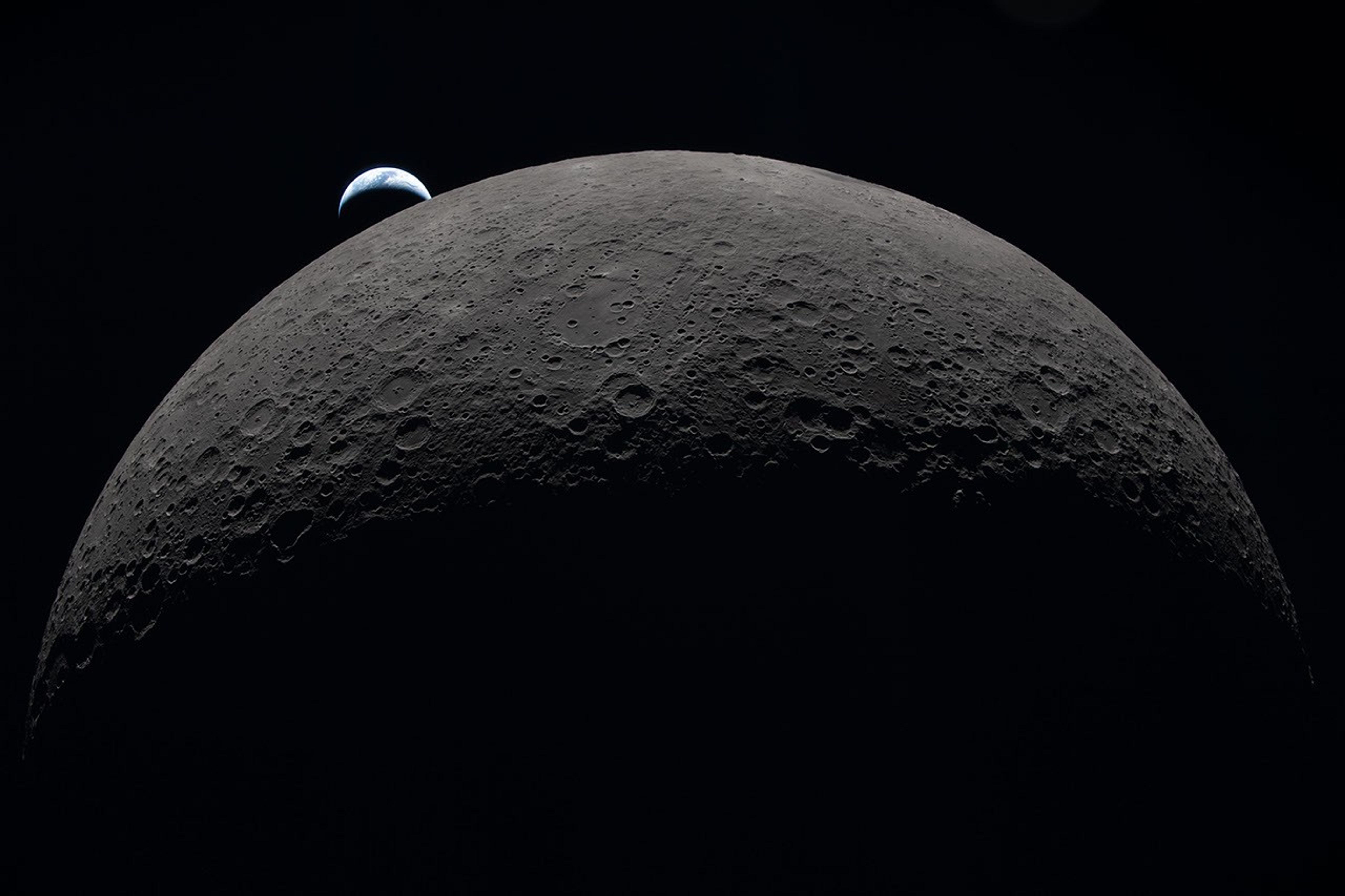
This image was taken by an Artemis II astronaut from the Orion capsule in April 2026, as the spacecraft traveled past the Moon and back over 10 days. The gray-brown, heavily cratered Moon dominates the frame against black space, with a partially lit crescent Earth setting behind its upper-left edge.
Some of Earth’s microbes likely to hitch a ride to space with human explorers could survive in the shaded nooks and crannies of the Moon’s South Pole region, NASA scientists say.
Published on Aug. 19, 2026, in Science Advances, these findings highlight a need to better understand microbial persistence in extreme lunar environments. As humans build a permanent presence on the Moon, it may become difficult to distinguish ancient lunar chemistry from contamination delivered by visiting astronauts. The concern extends beyond the Moon and on to Mars, scientists say.
“Humans are natural explorers, and with them come their voices, their memories … and their microbes,” said Prabal Saxena, a planetary scientist who led the study from NASA’s Goddard Space Flight Center in Greenbelt, Maryland. “For some scientists, myself included, that reality can be unsettling. But it also creates an opportunity to turn an imperfect situation into a useful experiment.”
Bringing microbes along is unavoidable: Humans have, on average, 1 million bacteria living on each patch of skin the size of a pencil eraser, for example. These bacteria vent from spacesuits and habitats. Though the paper’s authors worry about contamination interfering with the search for chemical clues to ancient geology or biology, they also argue that the Moon should be used as a natural lab. In shaded areas around the South Pole, scientists could carefully test the real-life limits of microbial survival in an environment that can’t easily be reproduced on Earth.
The Apollo program landed six pairs of astronauts on the Moon between 1969 and 1972. All six landing sites are near the lunar equator. In this visualization, the Apollo sites are contrasted with the South Pole, an area with enormous potential for future exploration. Time passes as we zoom toward Shackleton crater at the South Pole, revealing illumination conditions quite different from those near the equator. While many craters remain in permanent shadow, some nearby mountains and ridges are in persistent sunshine, making them attractive candidates for solar power and long-term habitation.
Before any surface science can happen, scientists need a baseline measurement of what contaminants humans bring, the authors say.
“We need to understand what was there before us, because when we go to Mars to search for signs of life beyond our planet, we will want to make sure it’s not stuff we brought,” said Andrew Needham, a NASA Goddard-based paper co-author who is an Artemis contamination‑control scientist for lunar samples.
Even with strict sterilization procedures, some organisms are stubbornly resilient. A good example is Aspergillus niger, which is a fungus that thrives in warm, damp places like household bathrooms and heating, ventilation, and air conditioning systems. Astronauts have sampled it inside the International Space Station, and experiments demonstrate that the fungus can survive outside the station as well. Aspergillus niger was one of five microbes, including bacteria and fungi, selected for this study because of its known toughness in spaceflight environments.
That microbes survived on the space station’s exterior surprised scientists. These species are typically not considered “extremophiles” that can withstand harsh conditions, such as the vacuum of space, according to Aaron Regberg, a geomicrobiologist at NASA’s Johnson Space Center in Houston.
“I would have expected these microbes to have dried out,” said Regberg, who studies space station bacteria and was a co-author on the paper.
NASA astronaut Kate Rubins on Oct. 14, 2016, collecting microbes in the Japanese Experiment Module aboard the International Space Station.
JAXA/Takuya Onishi
He pointed out that NASA often bakes robotic spacecraft at temperatures above 400 degrees Fahrenheit to reduce the number of living organisms on them. But that’s not possible with astronauts, so contamination concerns take on new meaning in crewed exploration of the Moon’s south polar environment.
A clearer picture of where microbes might survive comes from understanding how sunlight behaves at the poles. Survival in this study means the microbe can stay alive for at least one Earth day, which does not mean that it can grow and reproduce.
Because the Moon has a very small tilt on its axis, the view from its poles is of a Sun that appears to hover just above the horizon, skimming the surface like a flashlight laying on a table. As a result, elevated parts of the surface, including crater ridges, mountains, and even small bumps, block light from reaching low-lying terrain. This produces pockets of shadowed areas that can remain cold and preserve water, as well as shield fragile molecules and possible microorganisms from lethal radiation.
With that scientific context in mind, the team set out to test which Earth microbes could survive extreme polar conditions. They focused on organisms commonly found in spaceflight environments and those common on human skin. Besides Aspergillus niger, these included Bacillus subtilis, Staphylococcus aureus, Deinococcus radiodurans, and several species of Fusarium. Based on an analysis of previous studies, the scientists noted the maximum amount of heat and ultraviolet (UV) radiation each organism can withstand.
Then, the organisms were tested in simulations of three regions near the lunar South Pole — Nobile Rim, Connecting Ridge, and De Gerlache Rim. Those simulations used detailed environmental maps built from elevation and temperature data collected by instruments aboard NASA’s Lunar Reconnaissance Orbiter, combined with models of how radiation strikes the surface.
The models showed maps of “survivable niches” that range in size from a miles-wide crater floor to an astronaut’s boot print. Aspergillus niger, which was most resistant to UV radiation, was able to survive even in areas with some sunlight exposure. UV radiation is so deadly to most microbes that it’s used for sterilization in hospitals.
“When we think of the Moon, we don’t typically think of biology,” said Heather Graham, a paper co-author at NASA Goddard who helps develop tools and techniques for detecting biology that may look nothing like Earth’s. “But the Moon is a place where a cell can survive, so our first exploration of these sites should pay extra attention to our microbial hitchhikers and work hard to characterize lunar chemistry before our visits change what we will find.”
The authors note that while some microbes can survive in a dormant state in regions around the South Pole, and thereby confuse some future scientific investigations, there is no evidence the Moon has key ingredients to sustain growth and replication. Such ingredients include liquid water, which typically requires an atmosphere and moderate temperatures.
International Observe the Moon Night, Sept. 19, 2026
Each year, observers around the world come together to celebrate Earth’s Moon through direct observations, hands-on activities, lunar-themed music, artwork, readings, and more.
The Moon
From lighting up our skies to preserving evidence of our solar system’s history, Earth’s closest neighbor plays a pivotal role in the study of our planet and beyond.
About the Author
Lonnie Shekhtman
Senior Science Writer
Shekhtman helps communicate NASA planetary science to the world through news and feature stories on NASA.gov, videos for NASA+ and YouTube, and by working with the media. She reports on lunar and Mars science and exploration; NASA’s search for life; missions to Venus, Titan, and Jupiter’s Trojan asteroids; and many other topics related to NASA’s exploration of our solar system and beyond.
Behind the Lens: Meet NASA Johnson’s Photographers
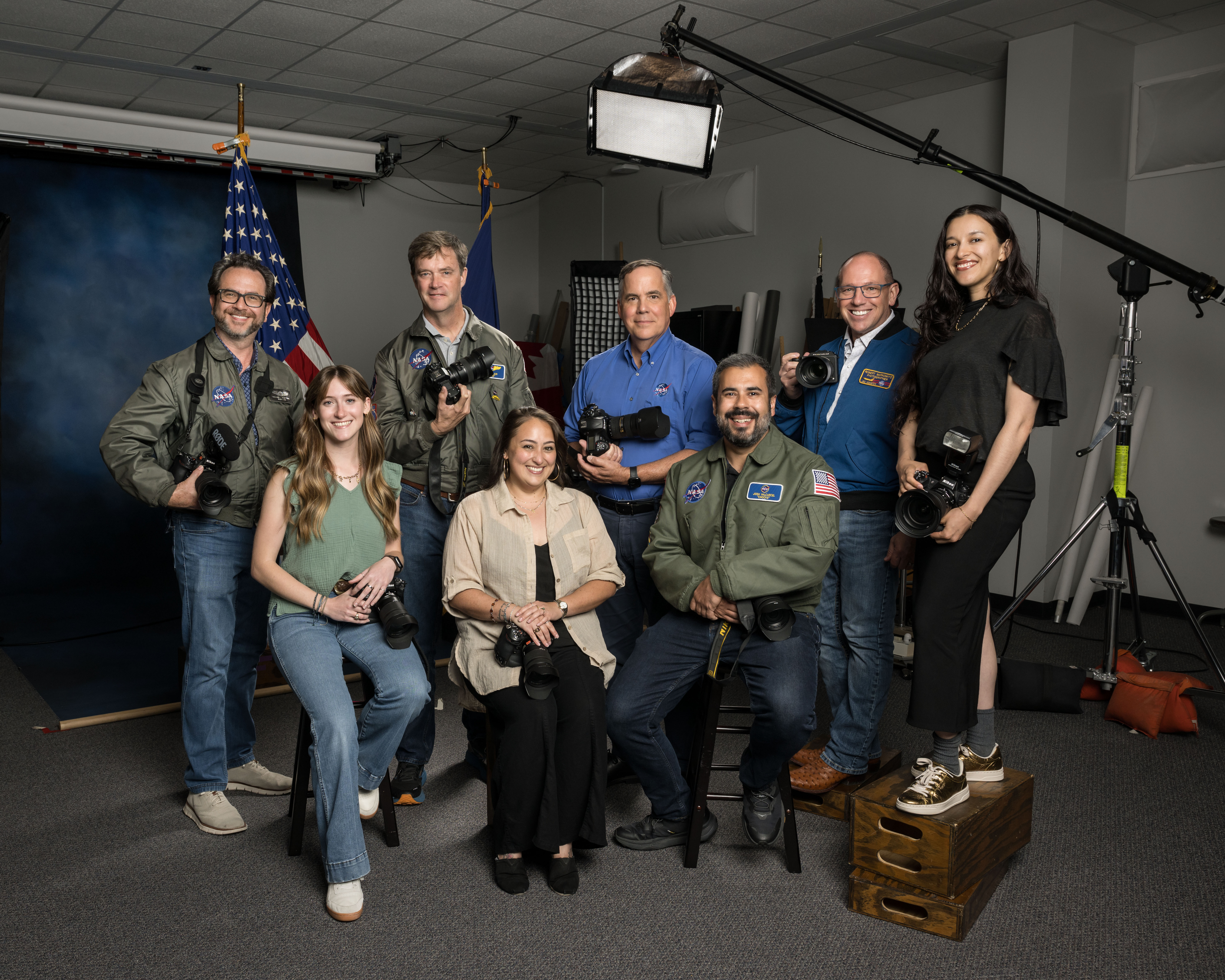
NASA Johnson Space Center’s Imagery Acquisition Group poses for a group photo on Aug. 10, 2026.
Credits: NASA/Robert Markowitz
The Imagery Acquisition Group at NASA’s Johnson Space Center poses for a group photo in Houston, Texas on Aug. 10, 2026. Back row, from left, are NASA photographers Bill Stafford, James Blair, supervisor Mark Sowa, and NASA photographers Robert Markowitz and Luna Posadas Nava. Front row, from left, are NASA photographers Morgan Gridley, Helen Arase Vargas, and former NASA photographer Josh Valcarcel.
NASA/Robert Markowitz
Photographers at NASA’s Johnson Space Center in Houston have documented some of the most defining moments in human spaceflight.
From astronaut training and engineering tests to mission control operations and milestone celebrations, their images preserve the history of exploration while capturing the people and teams behind the missions shaping the next era.
Meet the photographers behind the lens and explore the stories behind the images that have helped tell NASA’s story.
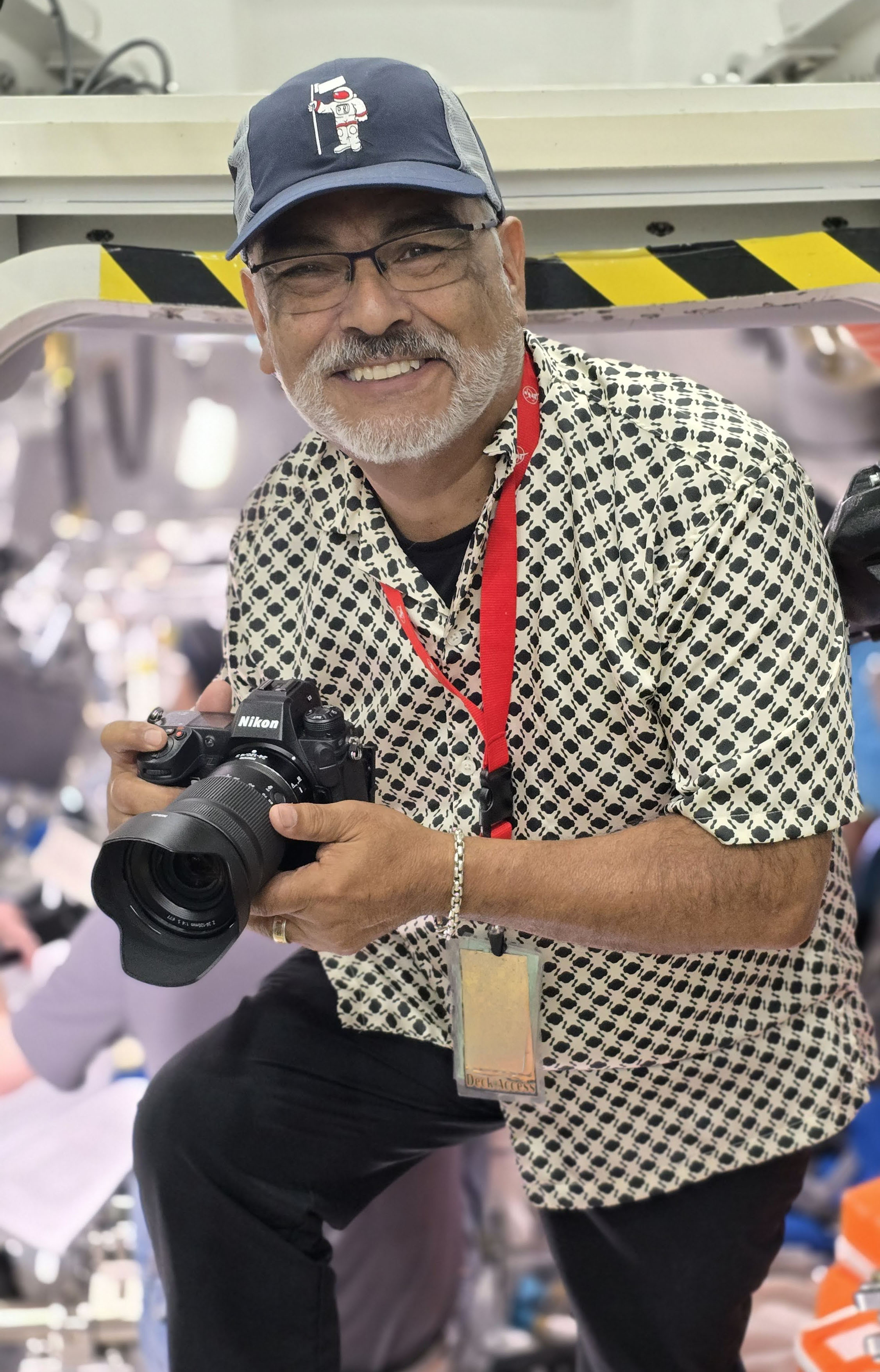
Robert Markowitz
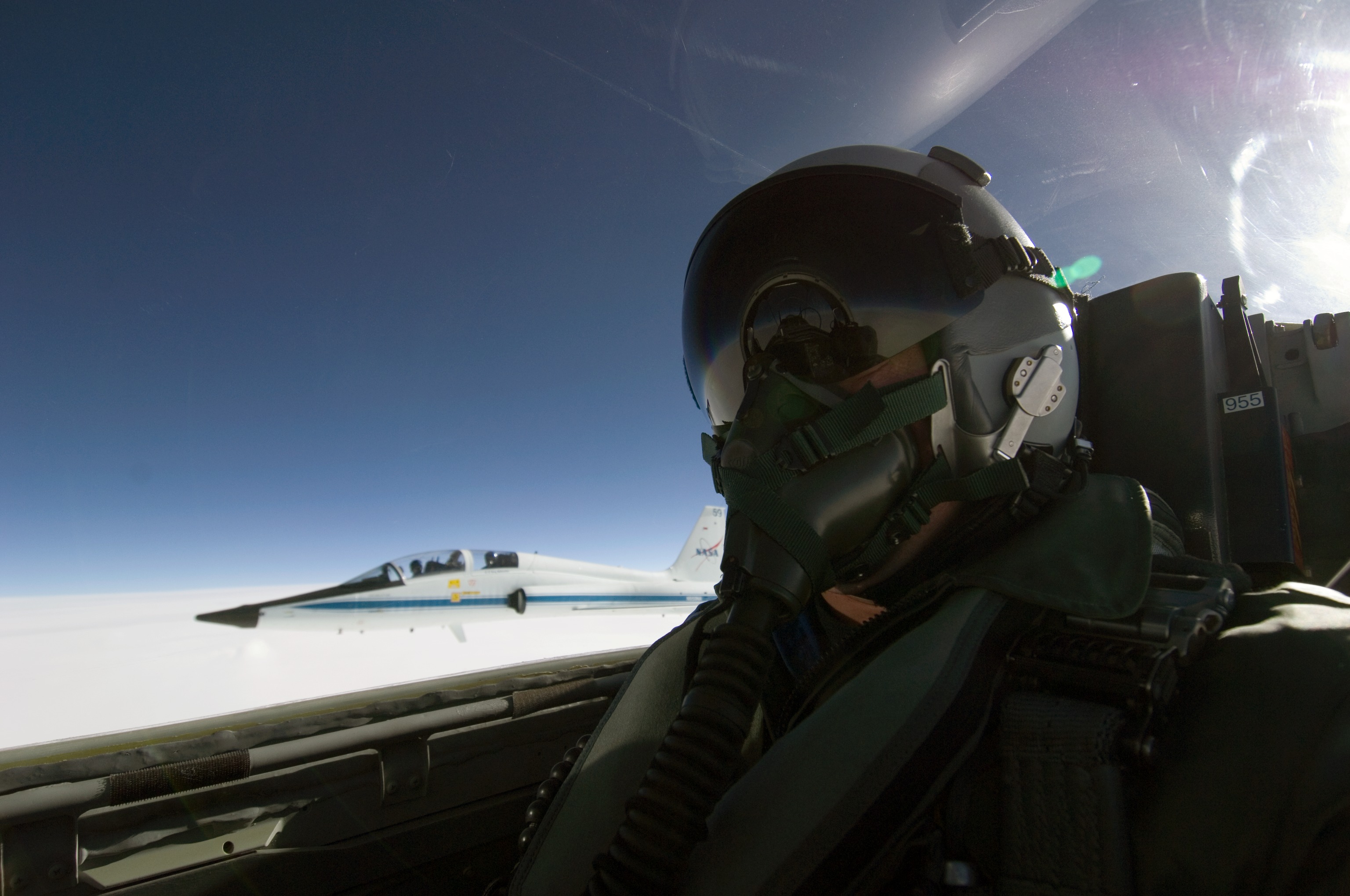
NASA photographer Robert Markowitz flies aboard a T-38 aircraft during flight operations.
NASA/Robert Markowitz
Being able to help tell the human spaceflight story, frame by frame, has been an incredible adventure.
“My favorite part of this job has always come down to the range of assignments we take on and the people I get to work with every day,” Markowitz said.
One of Markowitz’s early career highlights came during the filming of “Apollo 13,” when he served as the behind-the-scenes still photographer for nearly every KC-135 zero-gravity flight. “Looking back as a 25-year-old photographer at Johnson, I don’t think I fully appreciated how unique an opportunity it was to be there documenting those moments,” he said.
Markowitz says the job has challenged him to grow as both a photographer and a communicator. Whether photographing dozens of individual portraits in a day or coordinating a 300-person group photo, each assignment has strengthened his ability to adapt, collaborate, and connect with people.
“This work has shaped not just my career, but my life,” he said. “Being part of a team that captures and preserves the story of human spaceflight continues to be one of the great honors of my time at Johnson.”
NASA’s Artemis II flight control team works on console in the White Flight Control Room in the Mission Control Center in Houston during the mission’s lunar flyby on April 6, 2026.
NASA/Robert Markowitz
Former Expedition 1 crewmembers Yuri Gidzenko, Bill Shepherd, and Sergei Krikalev celebrate the International Space Station’s 25th anniversary of continuous human habitation at Space Center Houston on Jan. 19, 2026.
NASA/Robert Markowitz
The Counterweight-Offload Astronaut Suited Test and Evaluation Rig is displayed in Johnson’s Space Vehicle Mockup Facility.
NASA/Robert Markowitz
NASA’s Artemis II training team gathers in front of the Orion spacecraft mockup at the Space Vehicle Mockup Facility at Johnson Space Center on May 6, 2026.
NASA/Robert Markowitz
Country music artist Garth Brooks performs from mission control during a live event with the Expedition 52 crew aboard the International Space Station. From left are Dina Contella, deputy manager for the International Space Station in NASA’s Low Earth Orbit Program; NASA astronaut Stephanie Wilson; Garth Brooks; and Norm Knight, Flight Operations Director.
NASA/Robert Markowitz
Members of the Apollo 13 movie cast and crew take part in a zero-gravity flight aboard a KC-135 aircraft, owned by NASA at the time. Floating from left are actor Tom Hanks, who portrayed astronaut Jim Lovell; director Ron Howard; actor Bill Paxton, who portrayed astronaut Fred Haise; actor Kevin Bacon, who portrayed astronaut Jack Swigert; actor Gary Sinise, who portrayed astronaut Thomas Mattingly; and executive producer Todd Hallowell.
NASA/Robert Markowitz
Bill Stafford
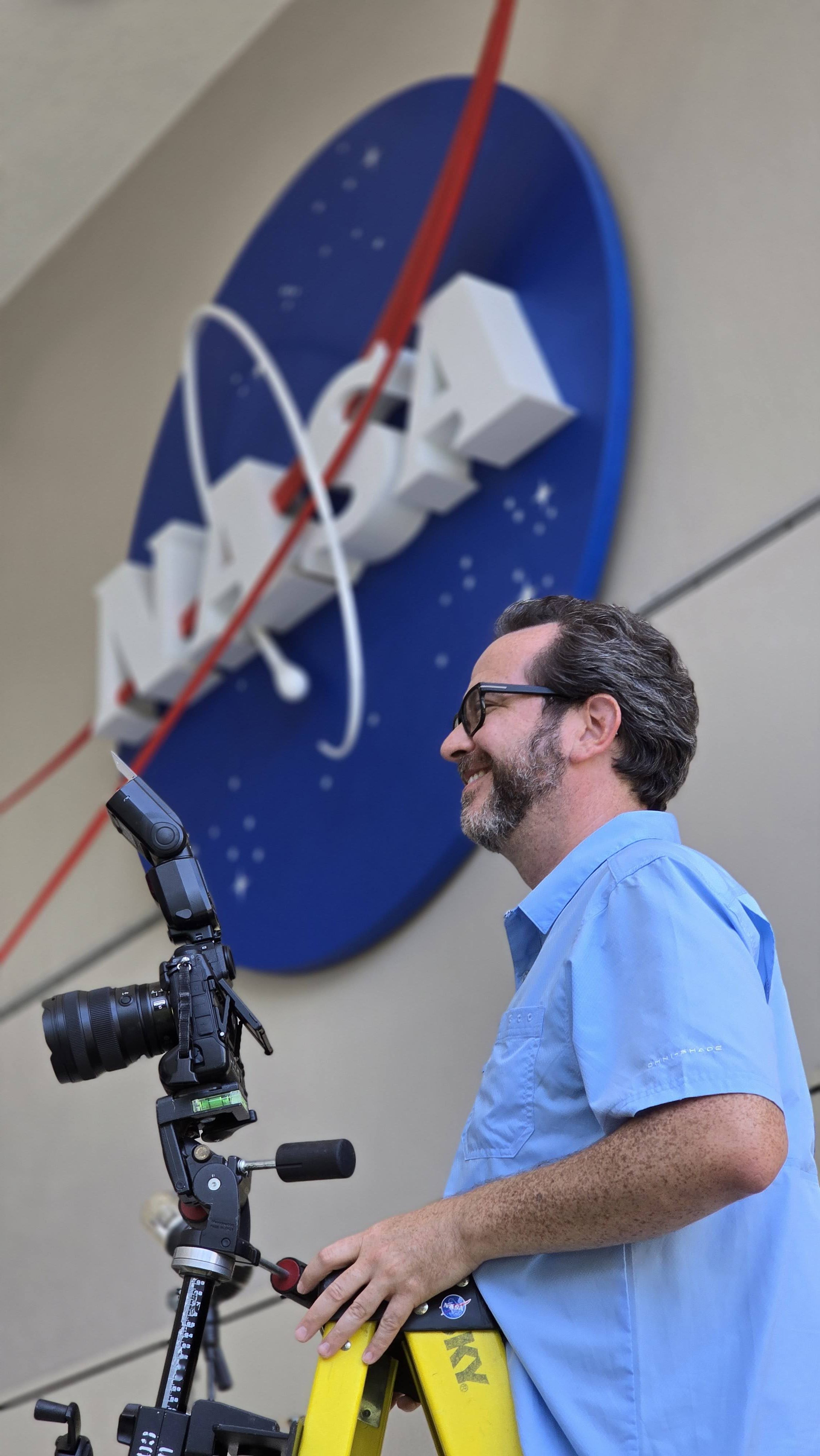
NASA photographer Bill Stafford photographs an event in the Teague Auditorium at NASA’s Johnson Space Center in Houston.
NASA/David DeHoyos
I love figuring out how to frame a single image so it captures not just a moment, but the significance behind it.
Bill Stafford
NASA Photographer
NASA photographer Bill Stafford’s path to Johnson began during his senior year of college, when a friend who was completing a photography internship at the center told him about an opening on the photography team. With a longtime interest in science and technology, Stafford saw the opportunity to combine those interests with photography in an extraordinary environment.
Stafford approaches each assignment as a technical challenge and a storytelling opportunity. Whether working around constraints in lighting, timing, or access, he uses composition, visual psychology, and an understanding of how a viewer’s eye moves through an image to shape the final photograph.
“My favorite part of the job is the problem-solving that comes with it,” Stafford said.
Working at Johnson has sharpened those instincts as he photographs spacecraft, hardware, astronauts, and the people behind NASA’s human spaceflight missions.
“So many of the subjects I photograph carry weight and history that I want the image to reflect,” he said.
NASA astronauts Reid Wiseman (right) and Victor Glover (left) participate in an Artemis II entry simulation at NASA’s Johnson Space Center in Houston.
NASA/Bill Stafford
NASA’s Joint Extravehicular Activity and Human Surface Mobility Program test team conducts a mock spacewalk to prepare for lunar surface operations and technology development for future Artemis missions.
NASA/Bill Stafford
NASA astronaut and Expedition 75 Flight Engineer Anil Menon participates in photography training at NASA’s Johnson Space Center in Houston.
NASA/Bill Stafford
NASA’s Exploration Extravehicular Mobility Unit is photographed inside a thermal vacuum chamber at NASA’s Johnson Space Center in Houston.
NASA/Bill Stafford
Participants test technology during NASA Spacesuit User Interface Technologies for Students (SUITS) test week at NASA’s Johnson Space Center in Houston.
NASA/Bill Stafford
James Blair
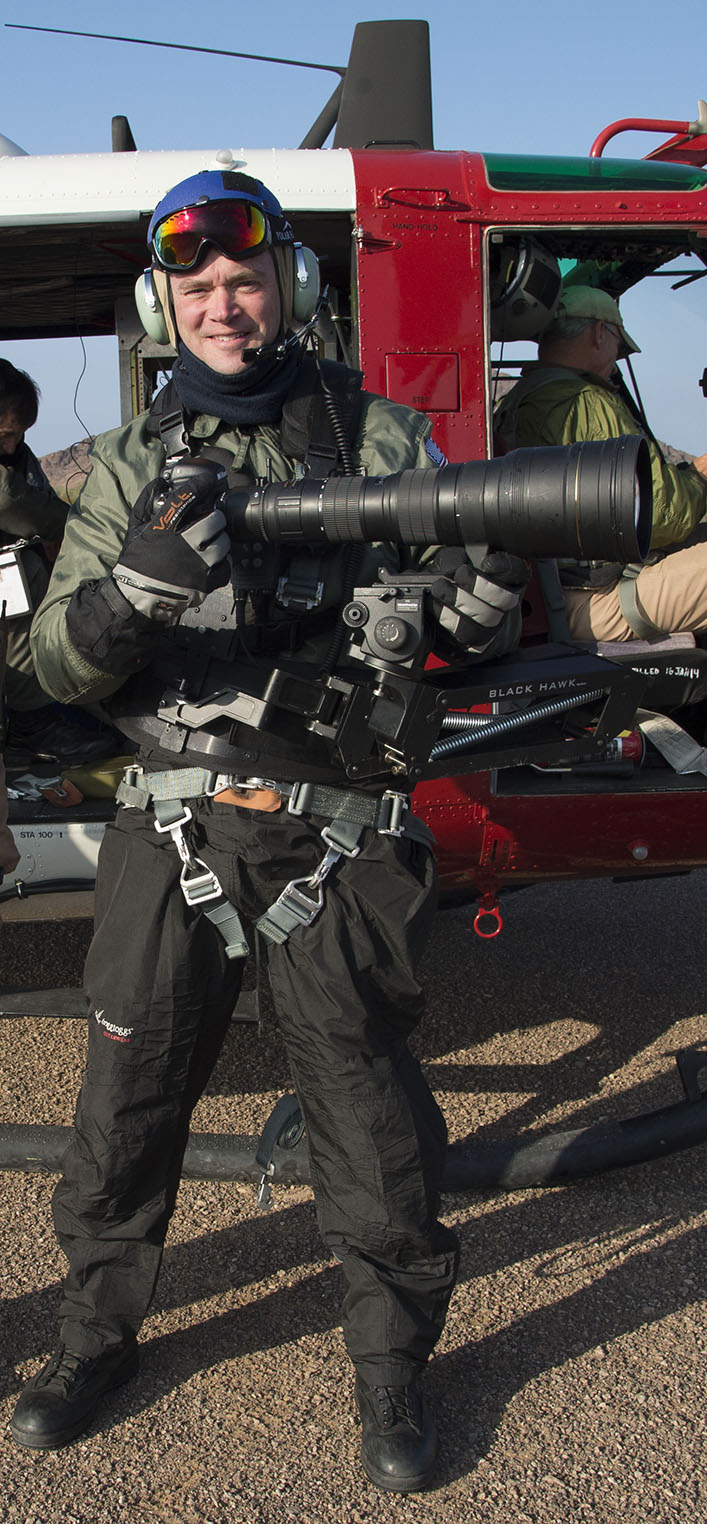
NASA photographer James Blair prepares to capture imagery during a flight operations assignment.
NASA
I truly enjoy capturing candid photos of people during decisive moments.
James Blair
NASA Photographer
From newspapers across the country to working as a photographer and photo editor for a publication in Ecuador, NASA photographer James Blair began his career in photojournalism. Photography has taken him around the world, a path that has continued at Johnson with assignments ranging from astronaut training to geology field training in Iceland.
“Since I was very young, I have always been fascinated by spaceflight and the technology it takes to reach beyond Earth’s atmosphere,” Blair said.
At Johnson, Blair combines that fascination with his photojournalism background to document the people and technology shaping NASA’s next era of exploration.
“I enjoy documenting the new hardware that is being developed to return us to the Moon,” he said. “From spacesuits to rovers and potential lunar habitats, I get to show the world what NASA has in store for the future of human spaceflight.”
U.S. Navy divers and Artemis II astronauts aboard an inflatable raft are approached by helicopters and lifted away to the recovery ship after egressing NASA’s Orion spacecraft.
NASA/James Blair
Artemis II crew members Christina Koch (middle) and Victor Glover (right) participate in an Artemis lunar imaging training using an Orion crew configuration at NASA’s Johnson Space Center.
NASA/James Blair
From left, JAXA (Japan Aerospace Exploration Agency) astronaut Aki Hoshide and NASA astronaut candidates Yuri Kubo and Cameron Jones participate in an Artemis geology field training expedition in Iceland.
From left, EVA task officer Bridget Scheib, chief training officer John Ray, NASA astronaut candidate Cameron Jones, geology instructor and Artemis science officer Kelsey Young, associate research scientist Patrick Whelley, geology instructor and Artemis curation lead Juliane Gross, and JAXA (Japan Aerospace Exploration Agency) astronaut Aki Hoshide participate in an Artemis geology field training expedition in Iceland.
NASA/James Blair
From left, Artemis IV chief training officer Bryce Prescott, geology instructor Jacob Richardson, and NASA astronaut Zena Cardman participate in an Artemis geology field training expedition in Iceland.
NASA/James Blair
Helen Arase Vargas
NASA photographer Helen Arase Vargas captures a news conference on lunar terrain vehicles for Artemis missions at NASA’s Johnson Space Center in Houston on April 3, 2024.
NASA/Robert Markowitz
I’ve always liked the idea of my work serving the public interest.
Helen Arase Vargas
NASA Photographer
NASA photographer Helen Arase Vargas began her career in photojournalism and reporting in Southern California before joining Boeing’s scientific photography team in El Segundo. Her experience photographing aerospace sparked an unexpected interest that eventually led her to Johnson.
“The best part of the job is my coworkers; cheesy, but there is so much to learn from everyone,” Arase Vargas said. “Our core team has so much knowledge. They are all quick to offer help and are great humans.”
Arase Vargas says much of the work at Johnson reflects the journalism ethics she learned early in her career and fulfills her desire to serve the public interest.
The range and volume of assignments also helped her become more comfortable working in different environments while continuing to develop her craft.
For Arase Vargas, documenting the Artemis II crew’s return to Ellington Field in Houston came with a heightened sense of responsibility.
“The world is watching, and all that imagery must be rushed out by the lab,” she said. “Your photo could be the one that ends up on every news site, and you don’t want to miss capturing the joy and celebration the moment deserves.”
NASA’s Artemis II crew returns to Ellington Field in Houston following the mission on April 11, 2026.
NASA/Helen Arase Vargas
The Artemis III crew poses for an official portrait in Houston, Texas. In the back row, from left, are NASA astronauts Andre Douglas and Frank Rubio. In the front row, from left, are ESA (European Space Agency) astronaut Luca Parmitano and NASA astronaut Randy Bresnik.
NASA/Helen Arase Vargas
ESA (European Space Agency) astronaut Sophie Adenot poses in an Extravehicular Mobility Unit during a portrait session at NASA’s Johnson Space Center.
NASA/Helen Arase Vargas
NASA’s 2025 Astronaut Candidate Class participates in geology training at Rio Grande del Norte National Monument in New Mexico on May 20, 2026.
NASA/Helen Arase Vargas
The 2025 Astronaut Candidate Class poses for a holiday photo during wilderness survival training at Fort Rucker in Alabama.
NASA/Helen Arase Vargas
NASA teams conduct nighttime operations training with a Lunar Terrain Vehicle Ground Test Unit at Johnson Space Center’s Rock Yard.
NASA/Helen Arase Vargas
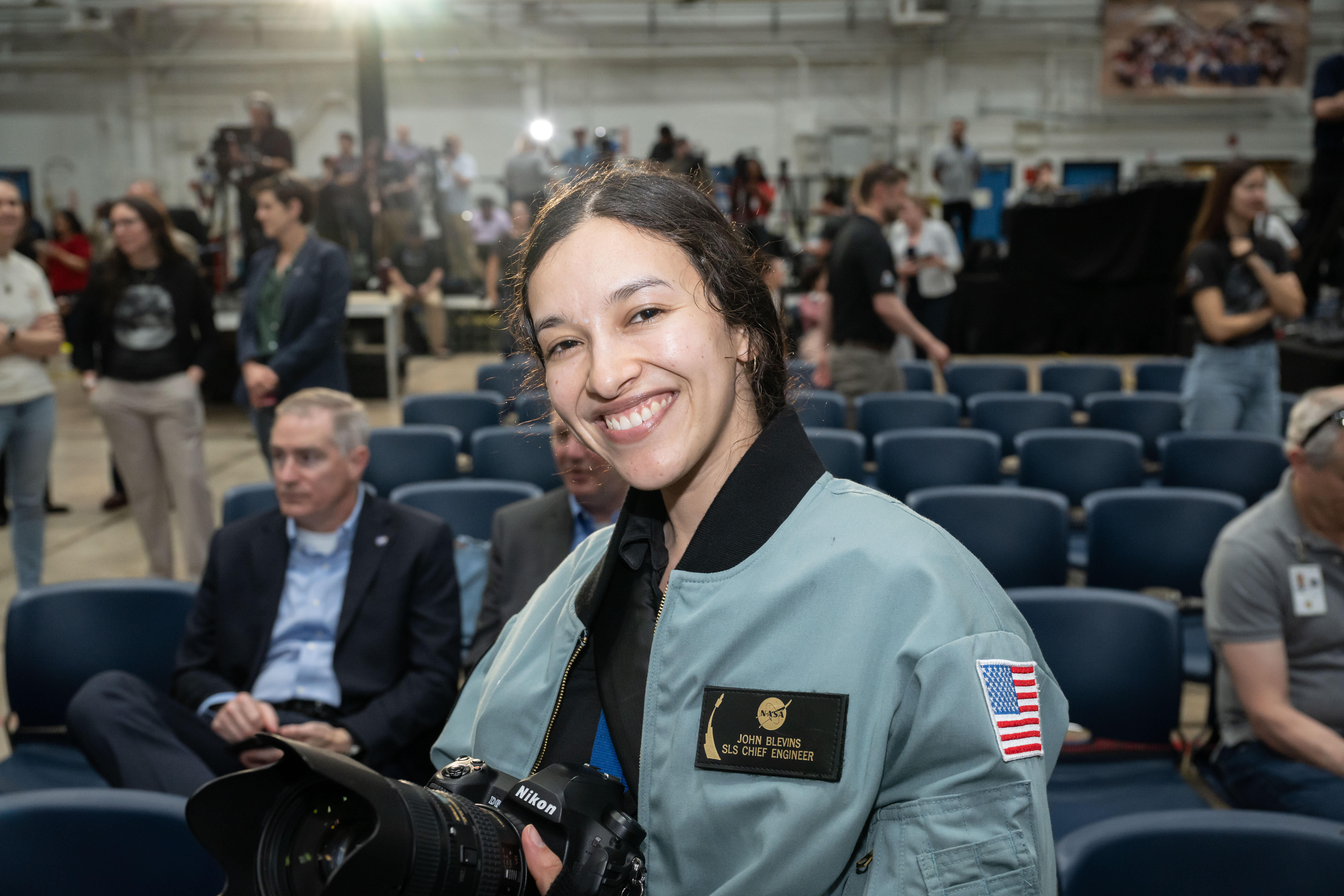
Luna Posadas Nava
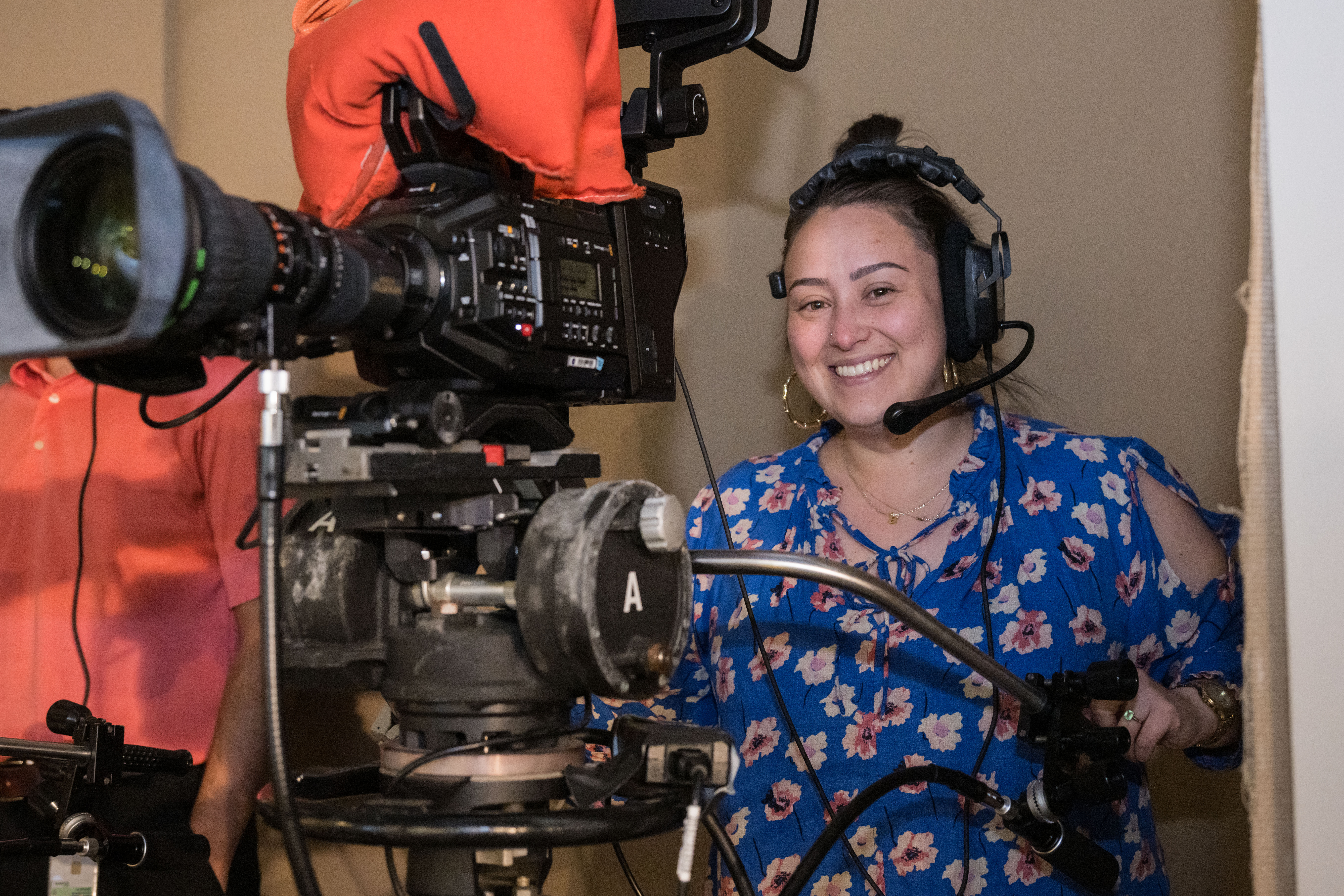
NASA photographer Luna Posadas Nava documents the Artemis II crew return at Ellington Field in Houston.
NASA/Luna Posadas Nava
I have used the camera as a bridge between curiosity and understanding.
Luna Posadas Nava
NASA Photographer
NASA photographer Luna Posadas Nava’s path to Johnson spans emerging technology, optics and imaging systems, and photographing artists across the East Coast. Her work grew from a desire to visualize and expand the boundaries of what is possible.
Joining Johnson shortly before the launch of NASA’s Artemis II mission, one of Posadas Nava’s first experiences was helping bring Moon Joy to the world. She documented the Science Evaluation Room, where scientists worked together to conduct real-time lunar science observations during the mission’s lunar flyby.
Posadas Nava said it was inspiring to witness the team at work and especially meaningful to see so many women contributing to the mission’s science.
Seeing the response from women in her own life and online reinforced for Posadas Nava the power of representation through photography.
“When we see ourselves in stories, we imagine new futures,” she said. “I hope my work helps more people see themselves in the story of exploration, because what we see shapes what we believe is possible.”
The Artemis II lunar science team celebrates in the Science Evaluation Room following the mission’s successful lunar flyby. Artemis II Deputy Lunar Science Lead Marie Henderson stands at left. From the right foreground are lunar science team members Ariel Deutsch; Maria Banks, behind her; Ryan Watkins, to her right; and Sara Schmidt.
NASA/Luna Posadas Nava
Artemis II deputy lunar science lead Jacob Richardson, left, and Artemis II lunar science team member Kiarre Dumes react to the astronauts’ verbal observations of the Moon during the mission’s lunar flyby on April 6, 2026.
NASA/Luna Posadas Nava
Artemis II science officer Angela Garcia, left, and lunar science team member Kiarre Dumes discuss science operations in the Science Evaluation Room at NASA’s Johnson Space Center.
NASA/Luna Posadas Nava
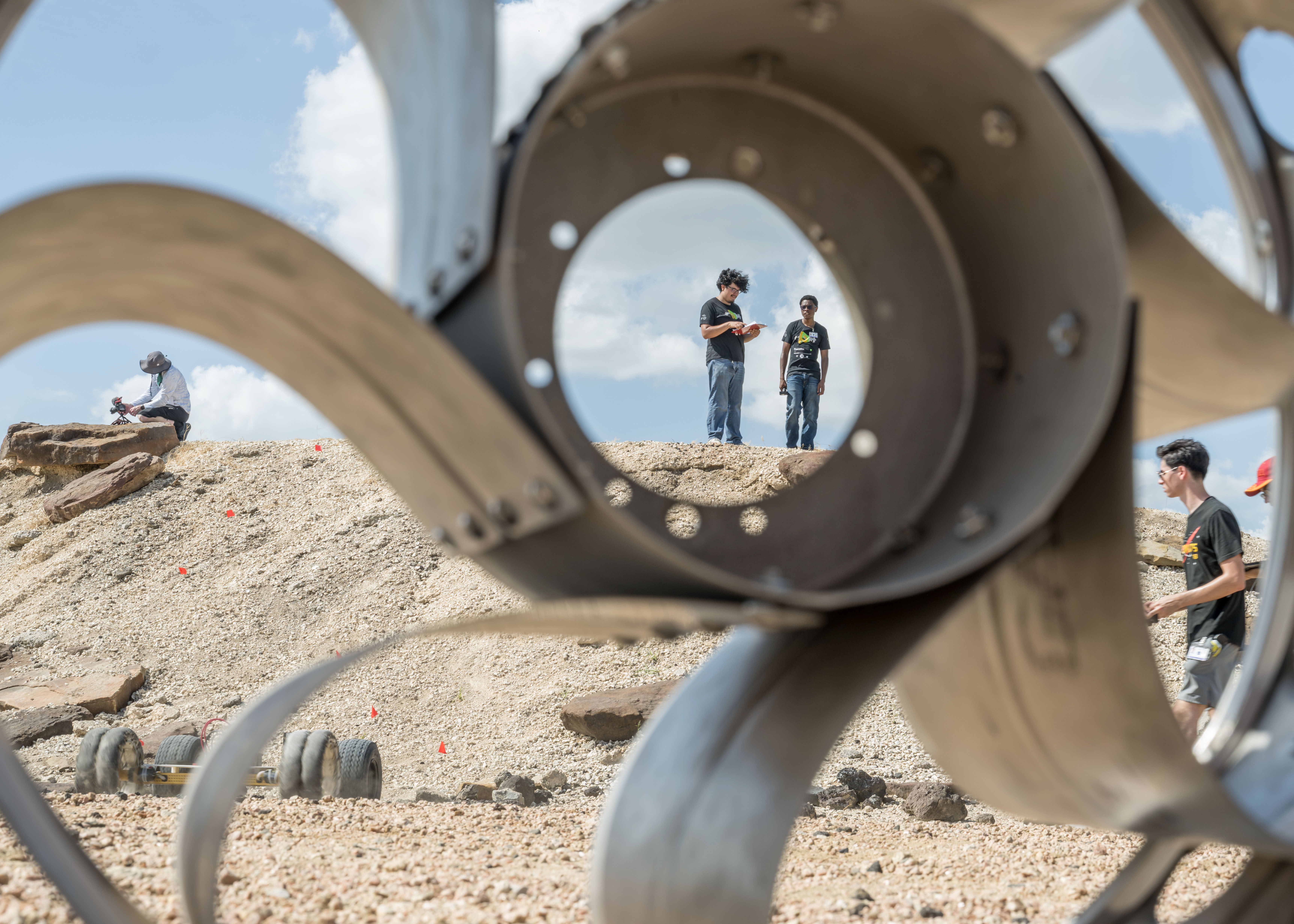
NASA engineers and teams from the Rock and Roll with NASA Challenge test rover prototypes at NASA’s Johnson Space Center Rock Yard in Houston on July 31, 2026.
NASA/Luna Posadas Nava
NASA’s Artemis III crew participates in a video shoot for the crew announcement at NASA’s Johnson Space Center on June 3, 2026.
NASA/Luna Posadas Nava
The Expedition 73 crew attends a debrief and awards ceremony at Space Center Houston on June 16, 2026.
NASA/Luna Posadas Nava
David DeHoyos
NASA photographer David DeHoyos is photographed during an assignment in the Space Vehicle Mockup Facility at NASA’s Johnson Space Center in Houston.
NASA
I am very aware of the importance of preserving history and what it means to others when our images are shared with the world.
David DeHoyos
NASA Photographer
Growing up in Houston during the Apollo era, NASA photographer David DeHoyos knew from an early age that he wanted to be part of the space industry. His interest in photography began with his mother’s Kodak Instamatic camera and continued through school and a decade working in photo labs. In 1991, that path brought him to Johnson’s photo lab and eventually behind the camera as a NASA photographer.
After more than three decades at Johnson, DeHoyos says connecting with people remains one of his favorite parts of the job. He enjoys learning about the people he photographs, sharing what he has learned about Johnson with visitors and new employees, and encouraging the next generation.
“I keep an assortment of NASA goodies in my camera bag, and the ultimate joy I get is giving a pin or sticker to a child and seeing their little faces just light up,” DeHoyos said. “It just warms my heart to encourage a youngster to work hard and pursue their dreams because that’s how I got here.”
For DeHoyos, photography is also about preserving moments that can take on greater meaning over time.
“I love the process of figuring out technical details to create an image that will make someone say, ‘Wow, cool shot, how did you do that?’” he said.
NASA’s Artemis II commander Reid Wiseman participates in emergency cabin leak training for the Orion spacecraft at NASA’s Johnson Space Center in Houston.
NASA/DavidDeHoyos
Artemis II Pilot Victor Glover returns to Ellington Field in Houston following the crew’s nearly 10-day mission around the Moon on April 11, 2026.
NASA/David DeHoyos
NASA astronaut Zena Cardman participates in emergency consultation training at NASA’s Johnson Space Center in Houston.
NASA/David DeHoyos
Members of NASA Johnson’s Extravehicular Activity, Robotics, and Crew Operations Division gather for a group photo in the Neutral Buoyancy Laboratory high bay.
NASA/David DeHoyos
NASA astronaut Anil Menon participates in a hardware review run at NASA’s Neutral Buoyancy Laboratory in Houston on April 23, 2025.
NASA/David DeHoyos
The Honeybee Robotics prototype undergoes lunar VSAT (Vertical Solar Array Technology) testing inside Chamber A at NASA’s Johnson Space Center in Houston.
NASA Challenge Tests Wheel Designs for Moon Base Mobility
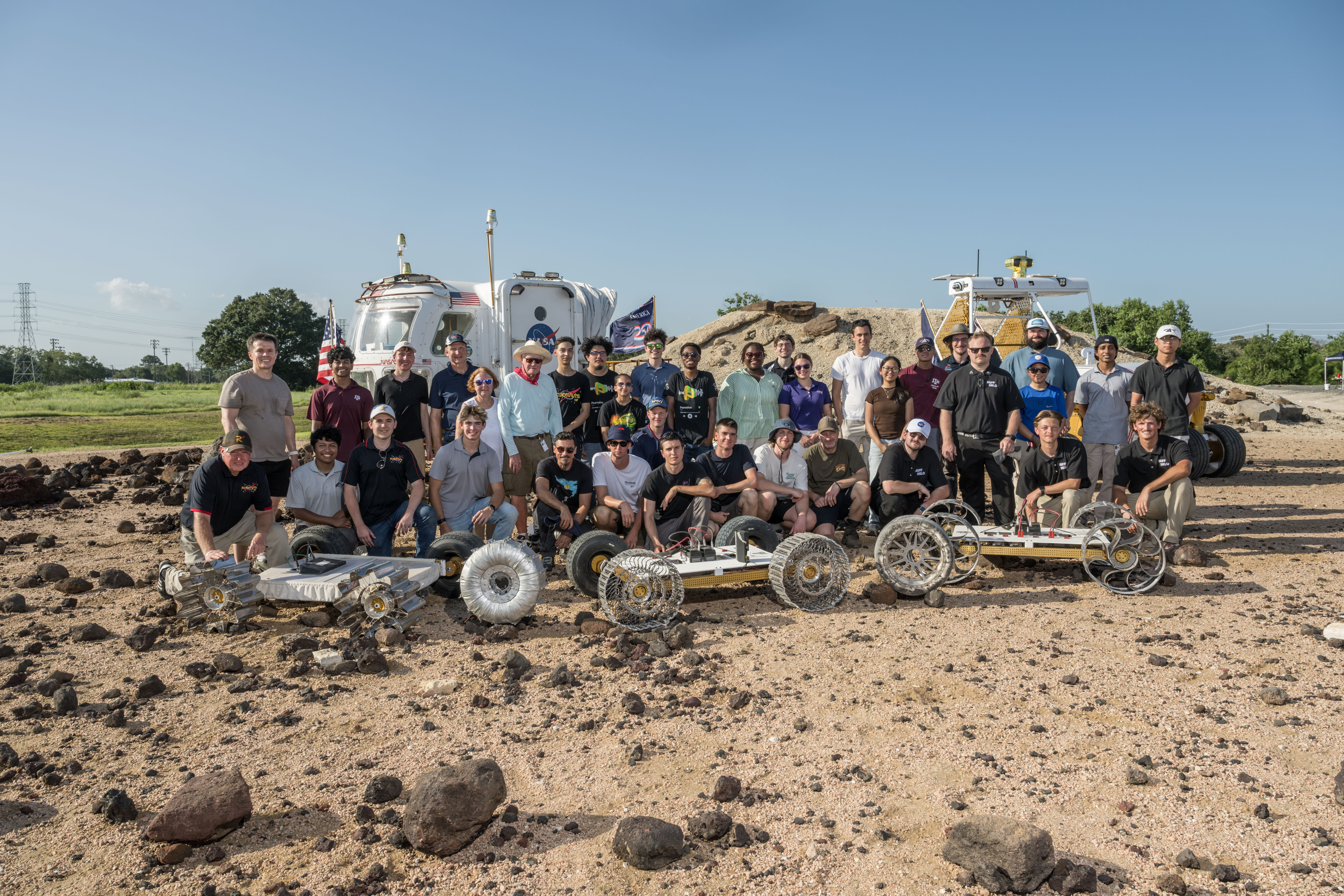
NASA engineers, NASA Robotics Academy students, and teams from the Rock and Roll with NASA Challenge pose with the wheel prototypes at NASA’s Johnson Space Center Rock Yard in Houston on July 31, 2026.
Credits: NASA/Luna Posadas Nava
NASA engineers, NASA Robotics Academy students, and teams from the Rock and Roll with NASA Challenge pose with the wheel prototypes at NASA’s Johnson Space Center Rock Yard in Houston on July 31, 2026.
NASA/Luna Posadas Nava
As NASA prepares to establish the Moon Base, advancing surface mobility will be key to helping crews and robotic systems travel farther across the lunar surface.
To help advance that capability, the Rock and Roll with NASA Challenge invited public innovators to design and build next-generation lunar rover wheels.
Five teams from 128 submissions and 49 countries advanced to the final phase of the competition, where they tested their prototypes on July 31 at NASA’s Johnson Space Center in Houston.
The Huff Helo lunar wheel prototype is tested at Johnson Space Center’s Rock Yard.
NASA/Luna Posadas Nava
The challenge sought lightweight, durable, and scalable wheels that could support longer-duration lunar surface operations. The designs also needed to be compliant enough to absorb impacts, maintain traction at higher speeds, and withstand the harsh lunar environment.
“Every additional kilometer a rover can reliably travel will expand how far we can explore, what science we can achieve, and what infrastructure we can build,” said Ed Herrera, robotics engineer at Johnson and co-leader of the challenge project.
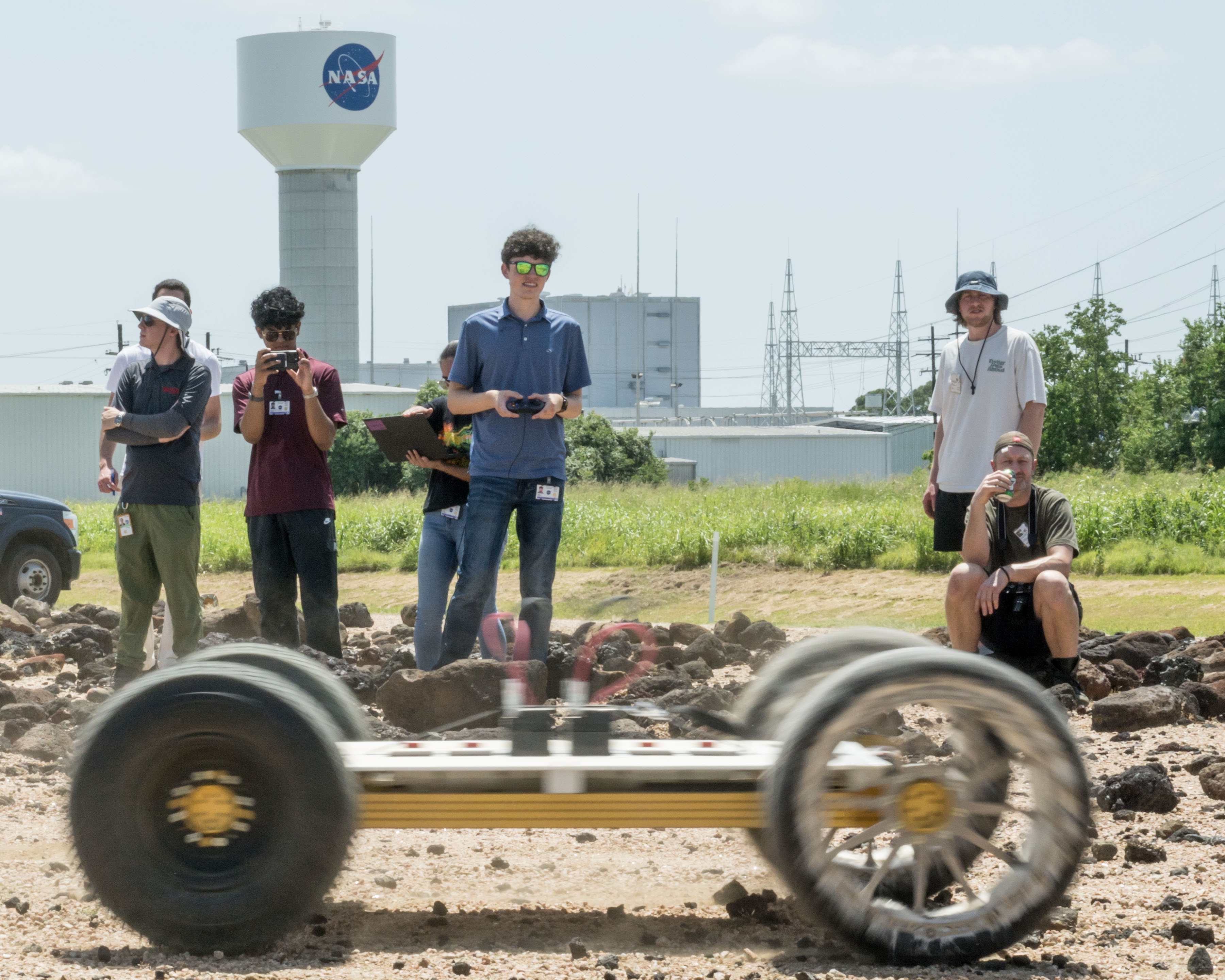
NASA Johnson uses ground prototypes to test mobility technologies, while lunar terrain vehicles will be delivered to the lunar surface through the Commercial Lunar Payload Services initiative. For the challenge, the wheels were fitted to MicroChariot, a 45-kilogram test rover, and put through a series of courses at Johnson’s Rock Yard to evaluate their performance across different types of terrain.
NASA Robotics Academy students navigate the lunar wheel prototype Scotch Pad Tyres fitted on the MicroChariot rover at Johnson’s Rock Yard.
NASA/Luna Posadas Nava
“Crowdsourcing gives us an opportunity to look beyond traditional approaches for lunar wheel design,” Herrera said. “The more wheel technologies we can develop and understand, the more options we have to meet the needs of different vehicles, terrains, and missions on the Moon and Mars.”
Those ideas were reflected in five distinctly different designs.
The HTR Variable Flex Lunar Wheel created by Hellenic Technology of Robotics SA uses an internal system designed to vary the wheel’s stiffness depending on terrain and vehicle needs. The team adapted technology it had been developing for terrestrial wheels for about a decade.
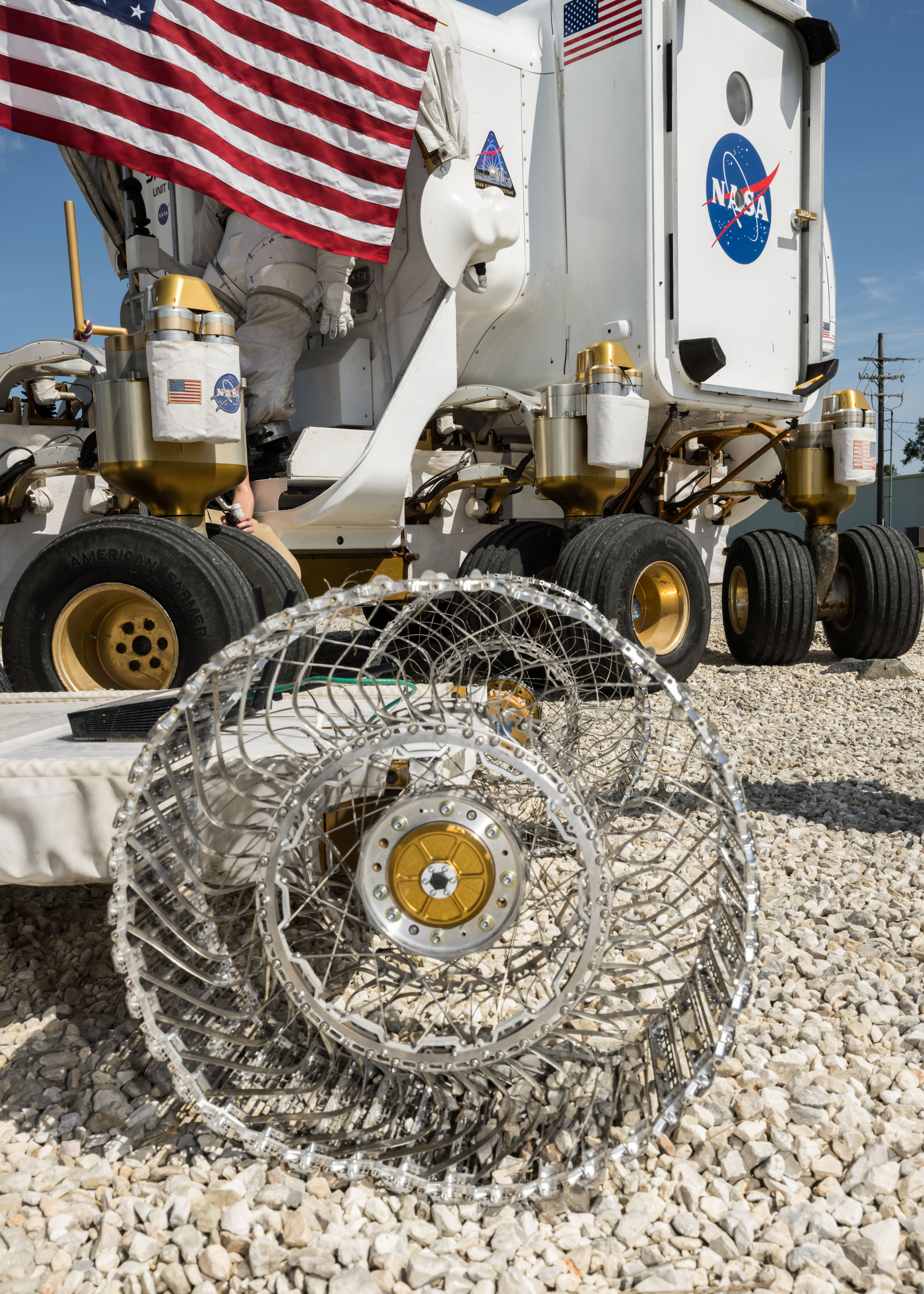
The Hiper Wheel created by Hyperbola uses tensioned cables and a corigated structure that provides spring-like behavior, allowing the wheel to flex without relying on traditional radial spokes.
The Huff Helo Flexible Titanium Wheel created by Huff Helo Inc. uses formed titanium sheet metal as both structure and spring. During testing, the team found that the strength of the design also made the wheel more rigid, causing it to bounce over some obstacles rather than conform to the terrain.
The Payne Aviation Wheel created by Deborah and Craige Payne took inspiration from aviation and history. Its designer, an aircraft mechanic, combined a pneumatic approach with ideas from early automobile tire designs.
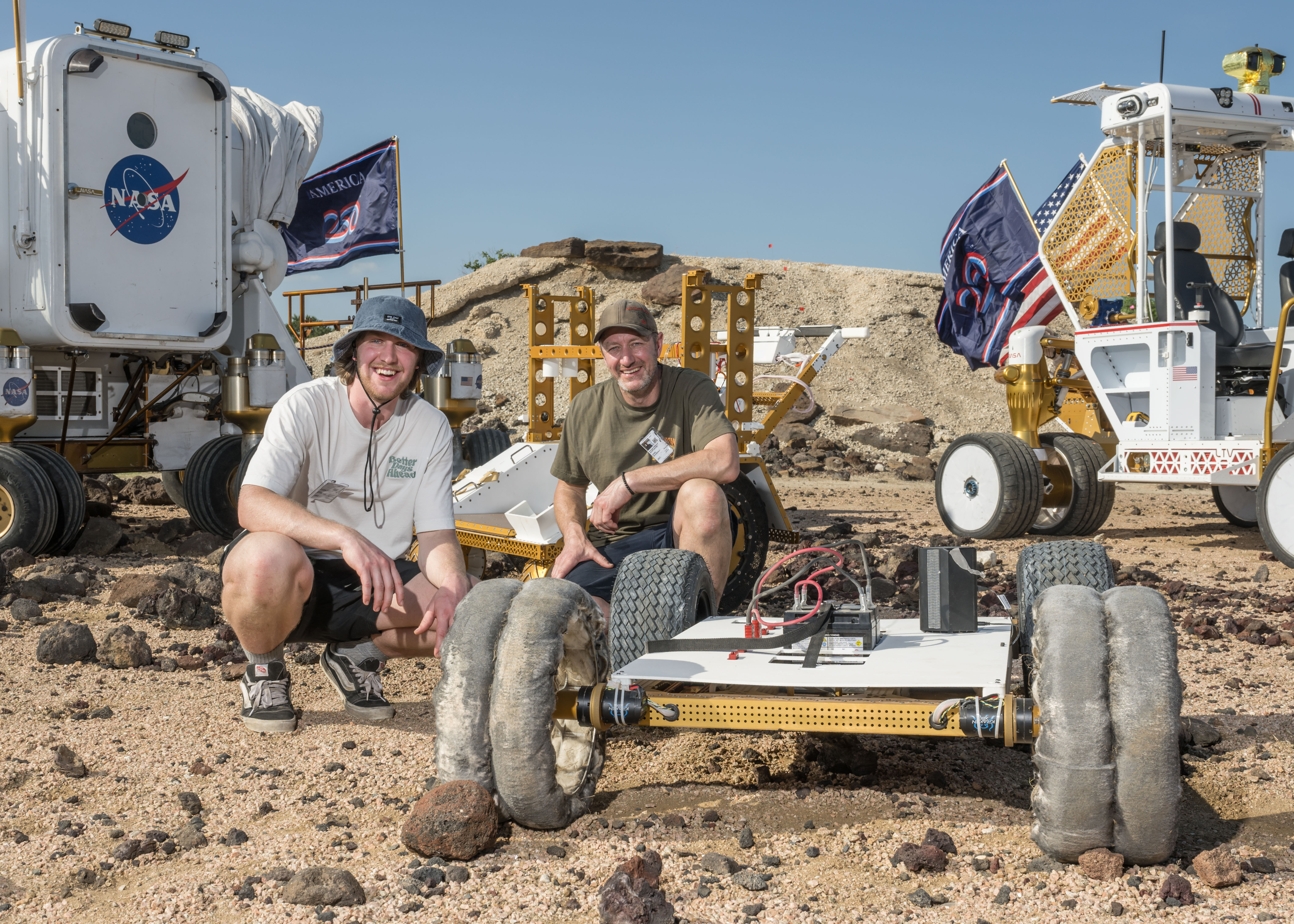
The winning Scotch Pad Tyres team poses with their prototype and MicroChariot at Johnson’s Rock Yard.
NASA/Luna Posadas Nava
The winning Scotch Pad Tyres concept came from an Australian mechanical engineer Daniel Bloomfield and his son Isaac Bloomfield. Their prototype uses a Nomex-based tire structure supported around an aluminum hub. The soft material allows the tire to deform around terrain, while internal support helps it maintain its shape. A treated outer surface of epoxy and corundum grit was integrated to improve traction.
The Rock Yard testing also demonstrated why different terrains may require different approaches. Loose material can affect traction, while rocks and slopes place different demands on wheels such as vehicle stability.
The HTR Variable Flex Lunar Wheel prototype sits alongside NASA’s Space Exploration Vehicle at Johnson’s Rock Yard.
NASA/Luna Posadas Nava
As lunar exploration expands, different vehicles will require different combinations of speed, load capacity, durability, and terrain performance.
Seeking that variety was part of the challenge design. The design options gave engineers different technologies to consider and potentially advance.
“This challenge brought in new ideas from outside traditional industries and helped us identify wheel technologies that may be suitable for longer-duration surface operations,” said Lucien Junkin, robotics engineer at Johnson and co-leader of the challenge project.
The next phase could evaluate how the wheels respond to lunar-like dust, vacuum, and extreme temperatures in Johnson’s thermal vacuum chambers. Engineers could also assess the designs over longer distances and at different sizes and loads.
“Mobility is key to everything we want to do on the Moon,” Junkin said. “The farther we want to explore, the more we need to advance the wheel technologies that can get us there.”
The Common Robotics Project of the Robotic Systems Technology Branch within Johnson’s Engineering Directorate conducted the Rock and Roll with NASA Challenge. NASA’s Center of Excellence for Collaborative Innovation, part of the Prizes, Challenges, and Crowdsourcing Program within the Research and Technology Mission Directorate, managed the challenge contract. Students in NASA’s Robotics Academy helped prepare hardware and support the competition, while engineers from NASA’s Glenn Research Center in Cleveland supported reviews of concepts and proposals. HeroX administered the challenge on behalf of NASA.
Preparations for Next Moonwalk Simulations Underway (and Underwater)
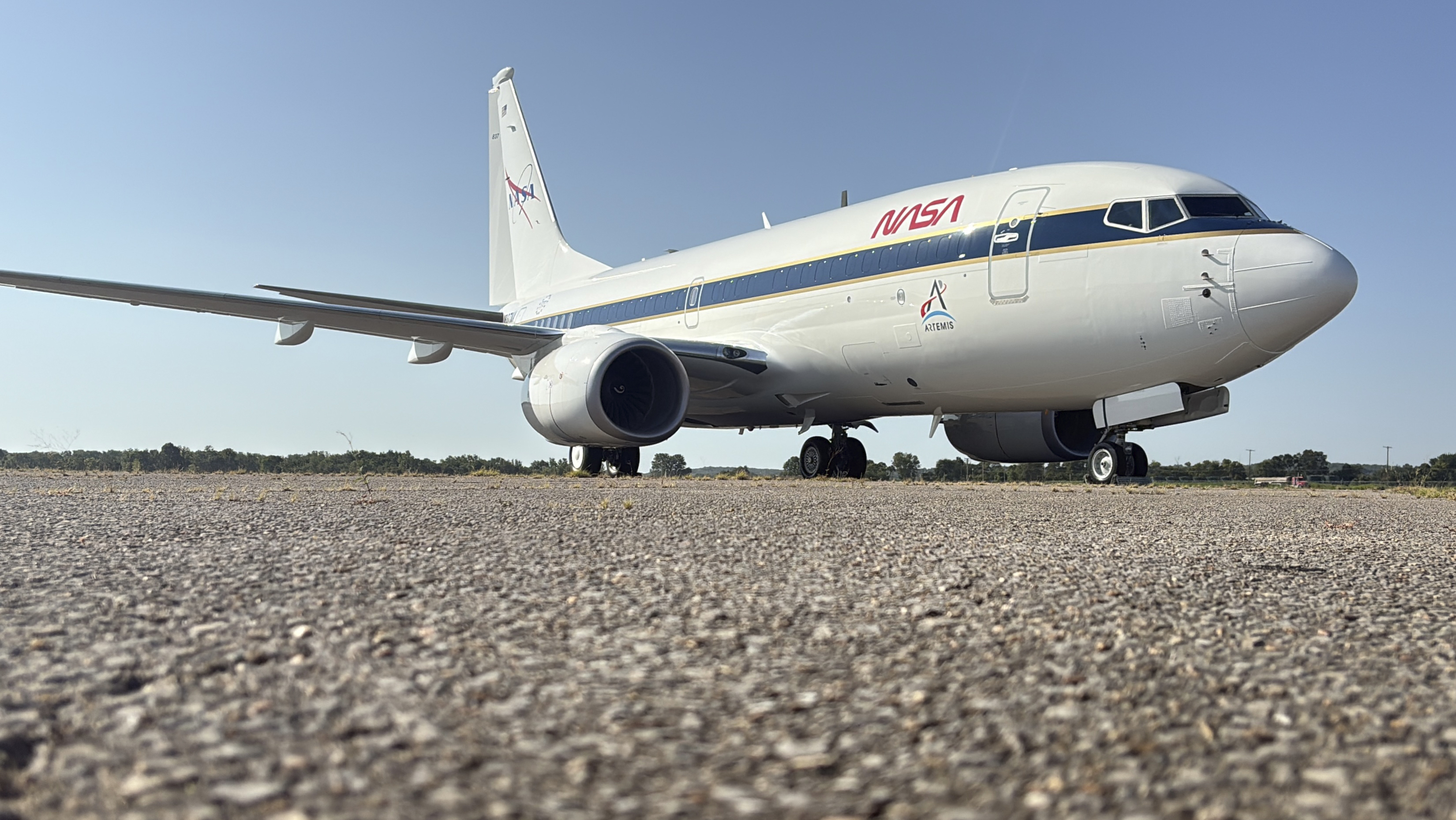
A newly painted NASA 737 aircraft sits on a ramp in Oklahoma on Thursday, Aug. 13, 2026.
NASA/Carla Escamilla
NASA’s 737 aircraft was painted this week in Oklahoma as it progresses with modifications for use as a reduced gravity test aircraft for the agency. NASA’s Armstrong Flight Research Center in Edwards, California, took ownership of the aircraft from the United States Air Force in June.
The aircraft will perform lunar-gravity parabolic flights to validate astronaut lunar suits and associated crew systems required to support Artemis mission objectives. These flights will happen at NASA’s Johnson Space Center in Houston for reduced-gravity operations, with NASA Armstrong oversight.
In addition, the aircraft will serve as a key asset for systems‑integration research for flight testing autonomy, sensors, and other digital systems.
The fully-integrated LEMS (Lunar Environment Monitoring Station) ready for environmental testing. A small suitcase-size instrument suite built at NASA Goddard, LEMS is designed to carry out continuous, long-term monitoring of the seismic environment at the Moon, including surface motion caused by moonquakes and meteorite impacts in the lunar south polar region.
NASA Goddard/Mike Guinto
NASA has declared “wrenches down” on the first completed payload designed for Artemis astronauts to deploy on the Moon’s surface. Engineers working on NASA’s Lunar Environment Monitoring Station, or LEMS, have completed hardware development and testing and the payload is ready for its permanent home near the lunar South Pole. With the hardware complete, LEMS is ready to support one of the Artemis program’s core goals: enabling sustained lunar science and exploration.
The LEMS instrument package contains two highly sensitive seismometers that will monitor ground vibrations from moonquakes and meteorite impacts, providing scientists with insights into the Moon’s interior and the seismic hazards astronauts might encounter at the surface. Its modular design allows the system to be adapted or expanded to host new instruments in the future, creating a reusable platform that can evolve as scientific priorities grow.
The payload will remain in a clean room at NASA’s Goddard Space Flight Center in Greenbelt, Maryland, where it was built, until it is assigned to an Artemis mission for deployment to the lunar surface.
“The completion of the LEMS scientific instrument is a major step in a new era of lunar surface science. Innovative science experiments will uncover, measure, and reveal the Moon’s secrets while astronauts open new frontiers for discovery,” said Joel Kearns, deputy associate administrator for exploration, Science Mission Directorate, NASA Headquarters in Washington. “And, behind the scenes, countless teams across NASA and our partners are pushing the boundaries of what surface instruments can do, building the tools that will make future exploration possible and safer.”
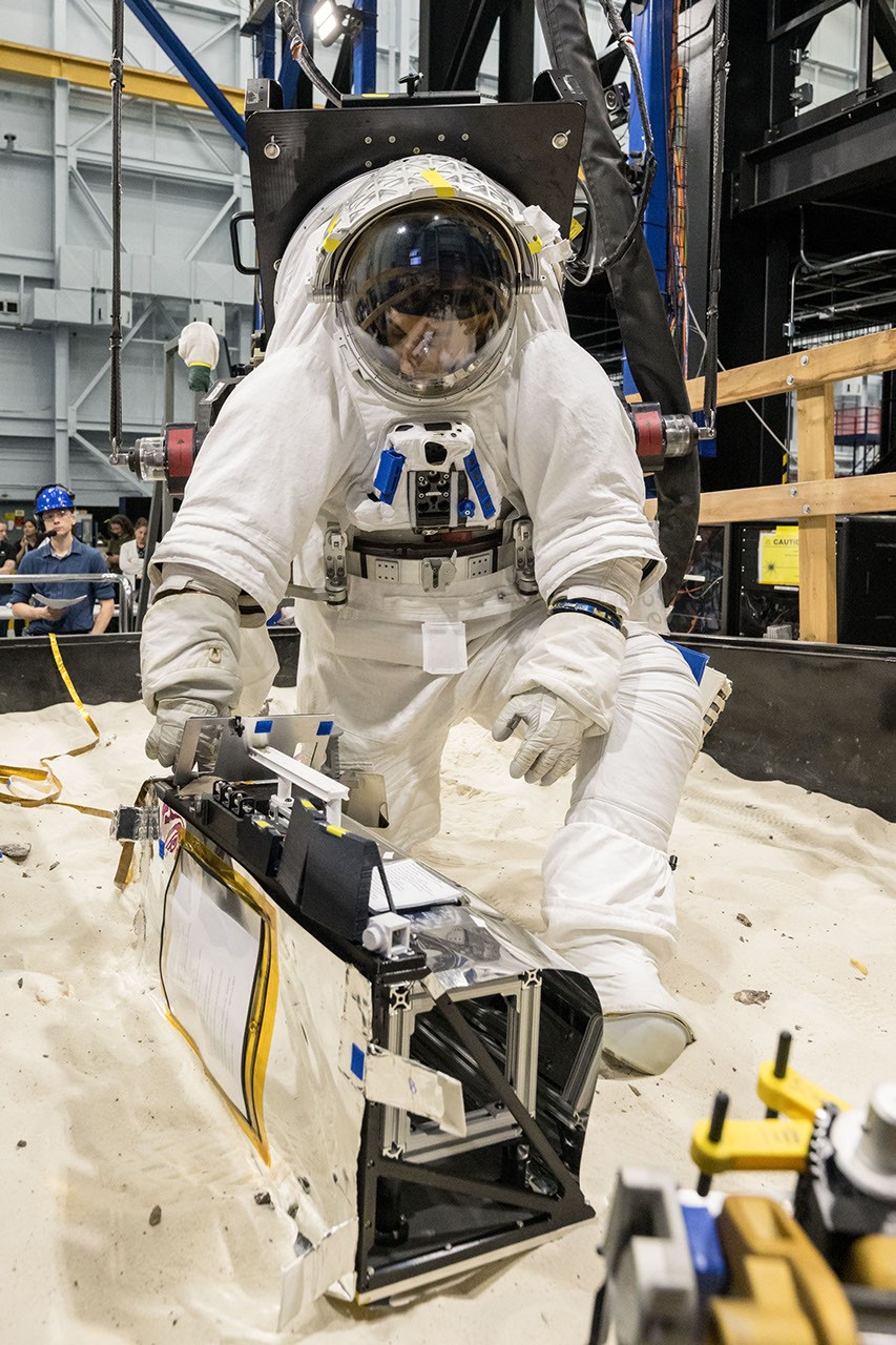
A scientist wearing NASA’s xEMU prototype space suit is testing the handling of a mockup version of NASA’s Lunar Environment Monitoring Station, or LEMS. The testing took place at the Active Response Gravity Offload System, a simulated reduced gravity environment at NASA’s Johnson Space Center in Houston.
NASA Johnson
The LEMS payload builds on a legacy of lunar seismic tracking. Apollo astronauts deployed a network of seismometers on the Moon’s nearside equatorial region between 1969 and 1972. Those instruments operated until 1977, recording about 13,000 moonquakes and other ground vibrations that helped scientists begin to understand the composition of the Moon’s interior. For decades, researchers have hoped to spread more seismometers, updated with new technologies, across the lunar surface.
Now, LEMS will carry the first seismometers to be deployed by future astronauts to listen for faint ground vibrations, collecting new clues to the Moon’s internal structure and ongoing seismic activity. The sensors will be the most compact, sensitive, and energy-efficient seismometers ever built for planetary exploration.
LEMS itself is about the size of a small suitcase, weighing 11 pounds in the Moon’s low-gravity environment. It will carry not just these seismic sensors, but everything it needs to function independently of humans after deployment. LEMS is built to manage its own power production via a lightweight, flexible solar array that conforms to the shape of the LEMS unit. It also will manage its operational activities to ensure continuous data collection based on a preset plan, and monthly data transmission to Earth. The payload will do all this while maintaining a stable internal temperature throughout the massive day-to-night temperature swings of the South Pole region.
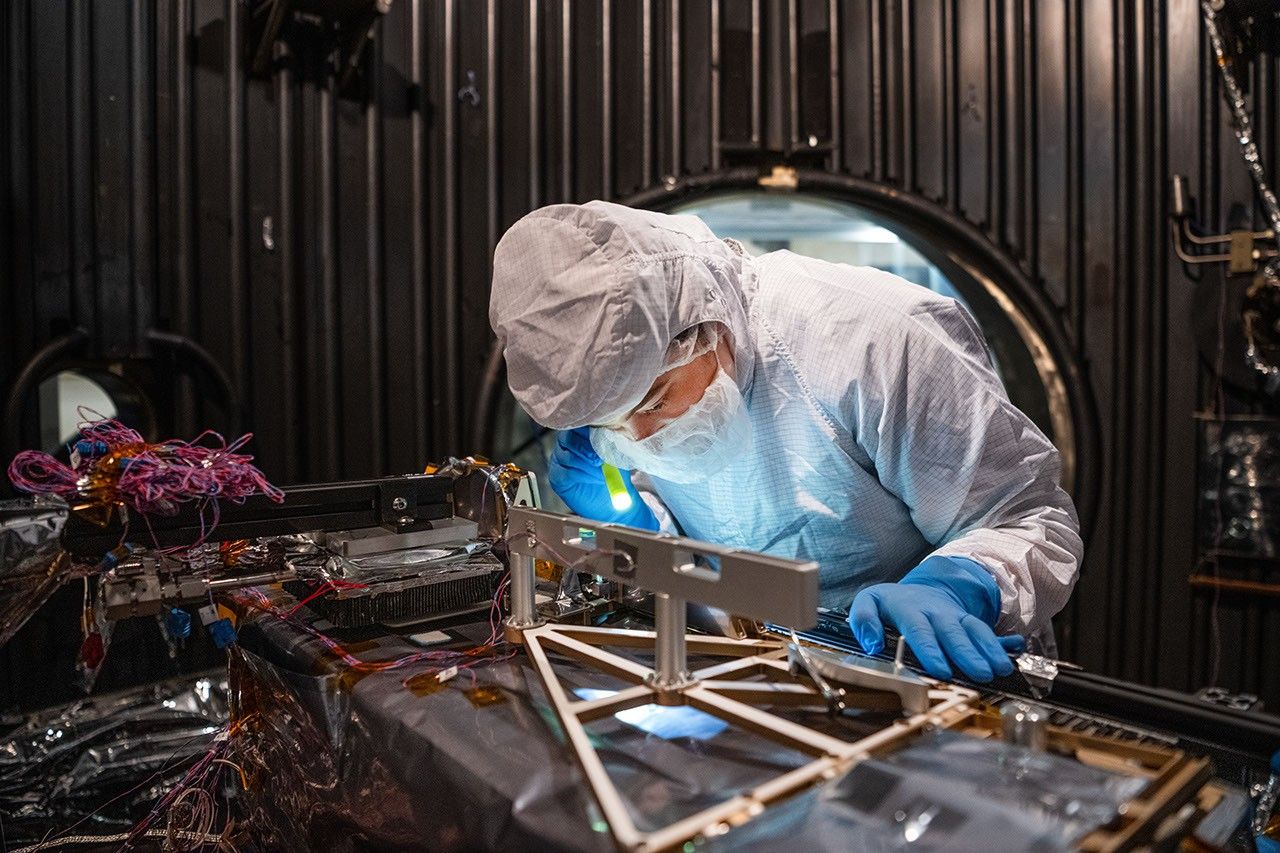
Mechanical Engineer Brie Ludwig inspects the Lunar Environment Monitoring Station (LEMS) in preparation for testing in a thermal vacuum chamber at Goddard Space Flight Center in Greenbelt, Maryland, on March 31, 2026. LEMS is a compact, autonomous, and self-sustaining seismometer suite designed to carry out continuous, long-term monitoring of the lunar seismic environment at the South Polar region.
NASA/Denny Henry
“When we conceived of LEMS, we weren’t just thinking about the next mission, we were thinking about the next generation of lunar exploration,” said Mehdi Benna, a University of Maryland Baltimore County scientist who leads LEMS from NASA Goddard. “Our vision was to create a scientific buoy for the Moon. Like an ocean buoy on Earth, LEMS is designed to be easy to build, adaptable to different scientific objectives, and capable of operating independently for years.”
Before any surface science could happen, Benna and his team had to ensure that LEMS could survive the trip to the Moon and the harsh environment of its surface. Over the past five months, LEMS and its components have been subjected to a demanding series of environmental and operational tests. Engineers verified LEMS can endure the violent shaking of launch, the journey to the lunar surface, and the Moon’s temperature and radiation environment. The team also showed that the instrument package’s mechanical and electrical design is safe for astronaut handling.
The LEMS payload was built to operate through the lunar night, which lasts two Earth weeks, without external power assistance or a heat source. Past lunar surface instruments relied on radioisotope heaters for warmth and power. But LEMS instead will withstand temperatures that dip to minus 400 degrees Fahrenheit in some areas by using advanced insulation materials, low-thermal-conductivity cables that minimize heat loss, and a thermal regulator that conducts heat away during the day to prevent overheating and helps retain heat at night.
These innovations reduce mass and power needs, setting the stage for lighter, energy-efficient instruments that can operate continuously at future Artemis landing sites and the NASA-led Moon Base.
The LEMS payload is led by University of Maryland Baltimore County and University of Maryland College Park. Technical implementation is led by NASA Goddard. The University of Arizona, in partnership with Silicon Audio, Inc., supplied LEMS’ two state-of-the-art seismometers. Morehead State University in Kentucky provided LEMS’ telecommunication system and will operate the instrument on the surface. Washington University in St. Louis will manage the instrument’s data processing and dissemination to the larger scientific community.
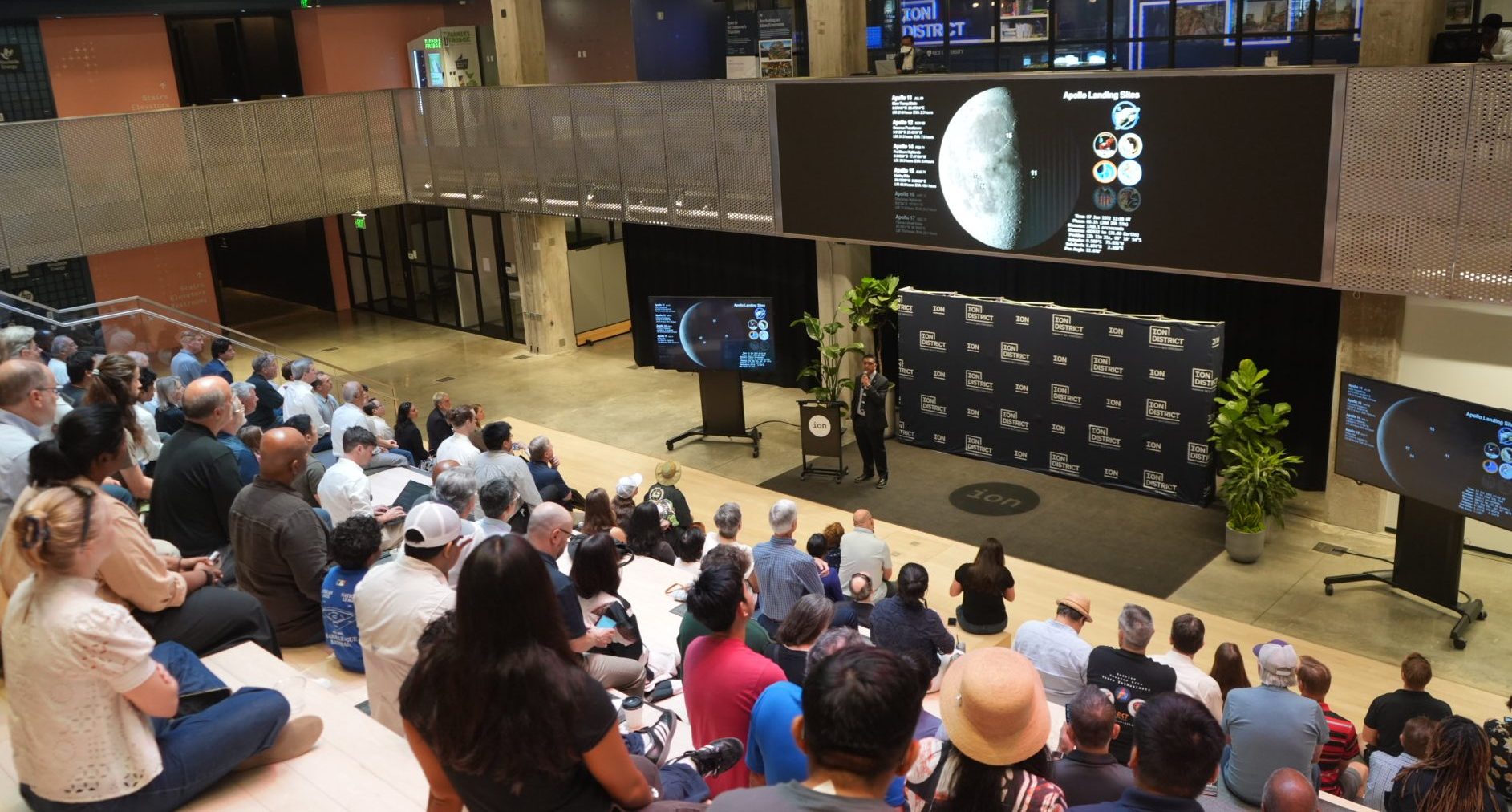
Shatel Bhakta, principal systems engineer for NASA’s Moon Base Program, gives a presentation during NASA Stories at the Ion in Houston on July 30, 2026.
Credits: NASA/Sumer Loggins
Shatel Bhakta, principal systems engineer for NASA’s Moon Base Program, gives a presentation during NASA Stories at the Ion in Houston on July 30, 2026.
NASA/Sumer Loggins
As NASA prepares to return astronauts to the lunar surface for longer stays and increasingly complex operations, building the Moon Base will require new ideas, advanced technologies, and expertise across many fields.
During NASA Stories at the Ion on July 30, Shatel Bhakta, principal systems engineer for NASA’s Moon Base Program, presented “Building the Moon Base: Challenges and Opportunities at the Lunar South Pole.” He discussed the work required to establish a sustained human presence at the Moon.
Through its growing partnership with Rice University and the Ion, NASA’s Johnson Space Center in Houston hosts recurring talks connecting agency experts with entrepreneurs, researchers, students, and industry leaders. The series gives Houston’s innovation community a closer look at the people and ideas shaping the future of exploration.
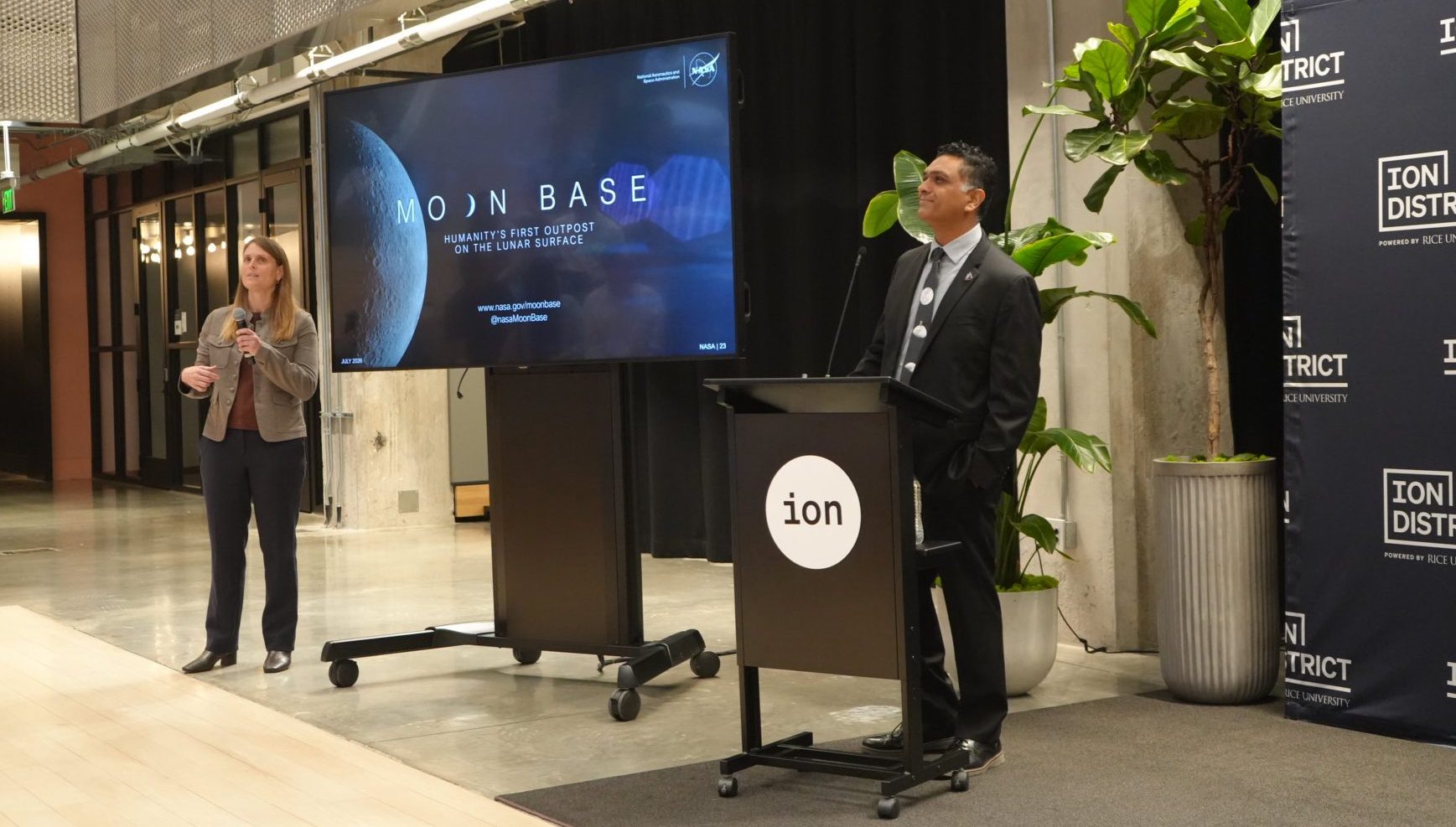
Shatel Bhakta, principal systems engineer for NASA’s Moon Base Program, presents during NASA Stories at the Ion. At left is Laura Neder, head of platform for the Rice Alliance for Technology and Entrepreneurship and the Ion District.
NASA/Sumer Loggins
Laura Neder, head of platform for the Rice Alliance for Technology and Entrepreneurship and the Ion District, welcomed attendees and introduced Monte Goforth, acting director of Business Development and Technology Integration at Johnson. Goforth delivered opening remarks on the value of sharing NASA’s work beyond the agency and bringing people together to support future exploration before introducing Bhakta.
Bhakta outlined how NASA is working toward long-duration human exploration of the lunar South Pole through the agency’s Moon Base Program.
As part of that effort, NASA is taking a step-by-step approach to Moon Base development. Early robotic missions and technology demonstrations will help NASA gather data about the lunar environment, test systems, and reduce risks before expanding infrastructure and human operations.
“This is probably going to be the most challenging endeavor NASA has ever undertaken,” Bhakta said.
Meeting that challenge will require collaboration between NASA and its commercial and international partners to develop solutions for operating in extreme environmental conditions.
Unlike the Apollo landing sites, areas near the lunar South Pole contain steep slopes, deep craters, and lighting conditions that change throughout the year. The Sun remains low on the horizon, creating shifting shadows that can complicate navigation and leave solar panels without sunlight for extended periods, increasing the need for energy storage and other power sources.
Because of the region’s rugged terrain, crews, rovers, and other surface systems may not always have a clear line of sight to Earth. NASA will need communications infrastructure to relay signals across the lunar South Pole.
Bhakta explained that Moon Base may not be a single cluster of connected structures. Terrain, lighting, power, and landing constraints could require habitats and other systems to be distributed across the lunar surface.
Attendees listen as Shatel Bhakta, principal systems engineer for NASA’s Moon Base Program, discusses the challenges of establishing a sustained human presence at the Moon.
NASA/Sumer Loggins
Lunar regolith, or Moon dust, remains one of the greatest challenges. Without mitigation, the sharp and clingy substance could damage equipment and spacesuits while posing health risks to astronauts. Its electrostatic properties can also change depending on lighting and environmental conditions.
Understanding how lunar regolith behaves will be essential to ensuring crews can safely live and work on the lunar surface.
Some permanently shadowed regions near the lunar South Pole may not have received direct sunlight for billions of years and may contain water ice and other volatile materials. These resources could support future exploration, but using them will require new mobility, power, and processing systems.
The Moon will also serve as a proving ground for missions farther into the solar system. Operating on the lunar surface will help NASA learn how crews, equipment, and infrastructure perform away from Earth before future human missions to Mars.
As NASA develops these capabilities, Bhakta explained that keeping the Moon Base architecture adaptable will require understanding how individual systems connect and work together.
“Don’t deal with the technology directly,” Bhakta said. “Deal with the interfaces.”
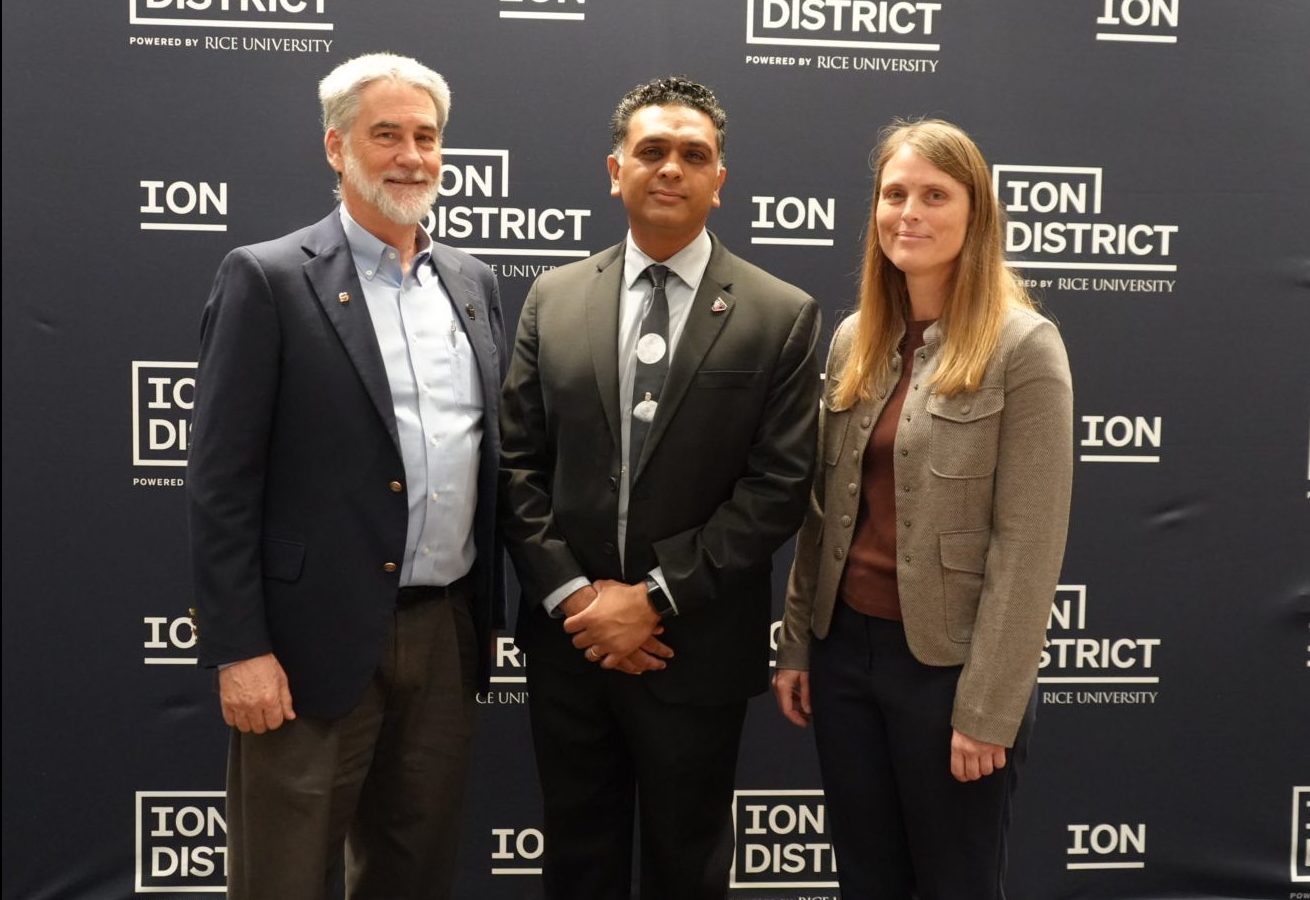
From left, Monte Goforth, acting director of Business Development and Technology Integration at NASA’s Johnson Space Center; Shatel Bhakta, principal systems engineer for NASA’s Moon Base Program; and Laura Neder, head of platform for the Rice Alliance for Technology and Entrepreneurship and the Ion District, pose during NASA Stories at the Ion.
NASA/Sumer Loggins
Building the Moon Base will take more than engineers and scientists. NASA will need communicators, business professionals, researchers, and people from many other fields to help solve problems and share the agency’s work.
“There are many ways to contribute,” Bhakta said. “Don’t be afraid that your skill set does not fit in.”
Moon Base build-up will offer multiple entry points for industry and international collaborators to participate, innovate, and contribute. From early demonstrations to long-term surface operations, there are multiple solicitations currently open.
NASA’s Lunar Development and Test Facility Prepares Artemis Hardware for Moon
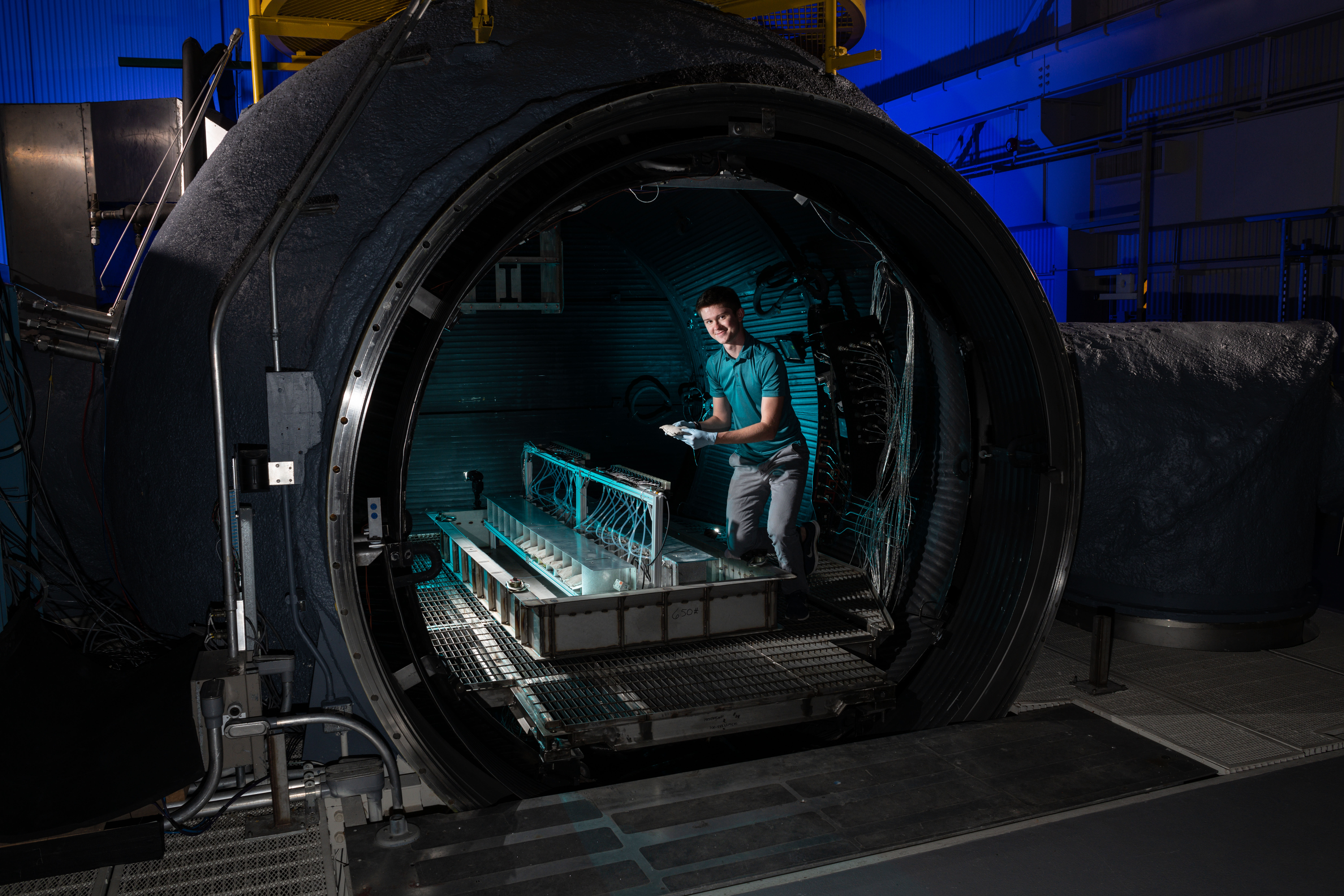
The Handheld Lunar Electrostatic Dust Mitigation tool is tested inside the Lunar Development and Test Facility at NASA’s Johnson Space Center in Houston.
Credits: NASA/Josh Valcarcel
Before astronauts return to the Moon’s surface through NASA’s Artemis program, the hardware they depend on must first prove it can survive the unforgiving lunar environment. At NASA’s Johnson Space Center in Houston, engineers at the Lunar Development and Test Facility are tackling one of exploration’s biggest challenges: Moon dust.
Unlike sand on Earth, lunar dust is sharp, abrasive, and clings to nearly everything. Without mitigation, lunar dust could damage equipment and spacesuits while posing health risks to astronauts. Understanding and mitigating the effects of lunar dust is essential as astronauts prepare to live and work on the surface of the Moon.
The Handheld Lunar Electrostatic Dust Mitigation tool is tested inside the Lunar Development and Test Facility at NASA’s Johnson Space Center in Houston.
NASA/Josh Valcarcel
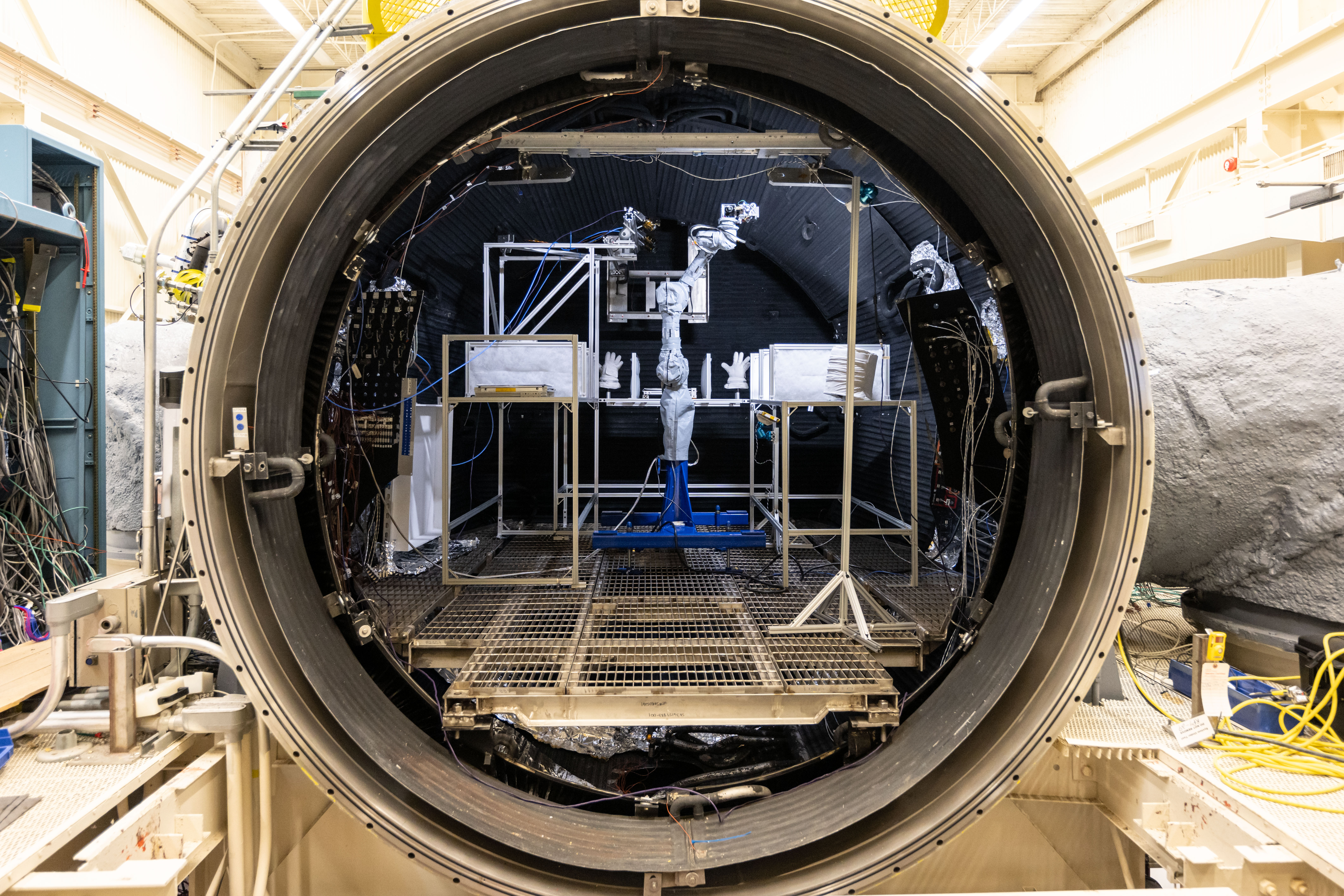
Located within the Energy Systems Test Area and managed by NASA engineers, the Lunar Development and Test Facility supports the development and testing of hardware in simulated lunar conditions. Engineers evaluate systems and subsystems inside vacuum chambers using lunar regolith simulant to better understand how spacesuits, spacecraft components, and mechanisms with moving parts and joints will perform during future Artemis missions.
Lunar spacewalking tools undergo a dust mitigation test inside Johnson’s thermal vacuum chamber.
NASA/Bill Stafford
NASA Johnson’s Propulsion and Power Division developed specialized systems that make the facility’s lunar simulations possible. The facility includes a dust containment and preparation laboratory for ambient testing, a 3-foot cube vacuum chamber, and a 15-foot thermal vacuum chamber.
Inside the chamber, engineers test hardware under realistic lunar conditions using lunar regolith simulant. The chamber uses a closed-loop nitrogen system to recreate the harsh lunar environment.
“The facility helps develop and test technologies needed for long-duration lunar exploration,” said Mike Salinas, Propulsion and Power Division branch deputy chief. “Engineers are advancing techniques to extract resources from lunar regolith, which can be turned into oxygen for astronauts and liquid oxygen for rocket propellant.”
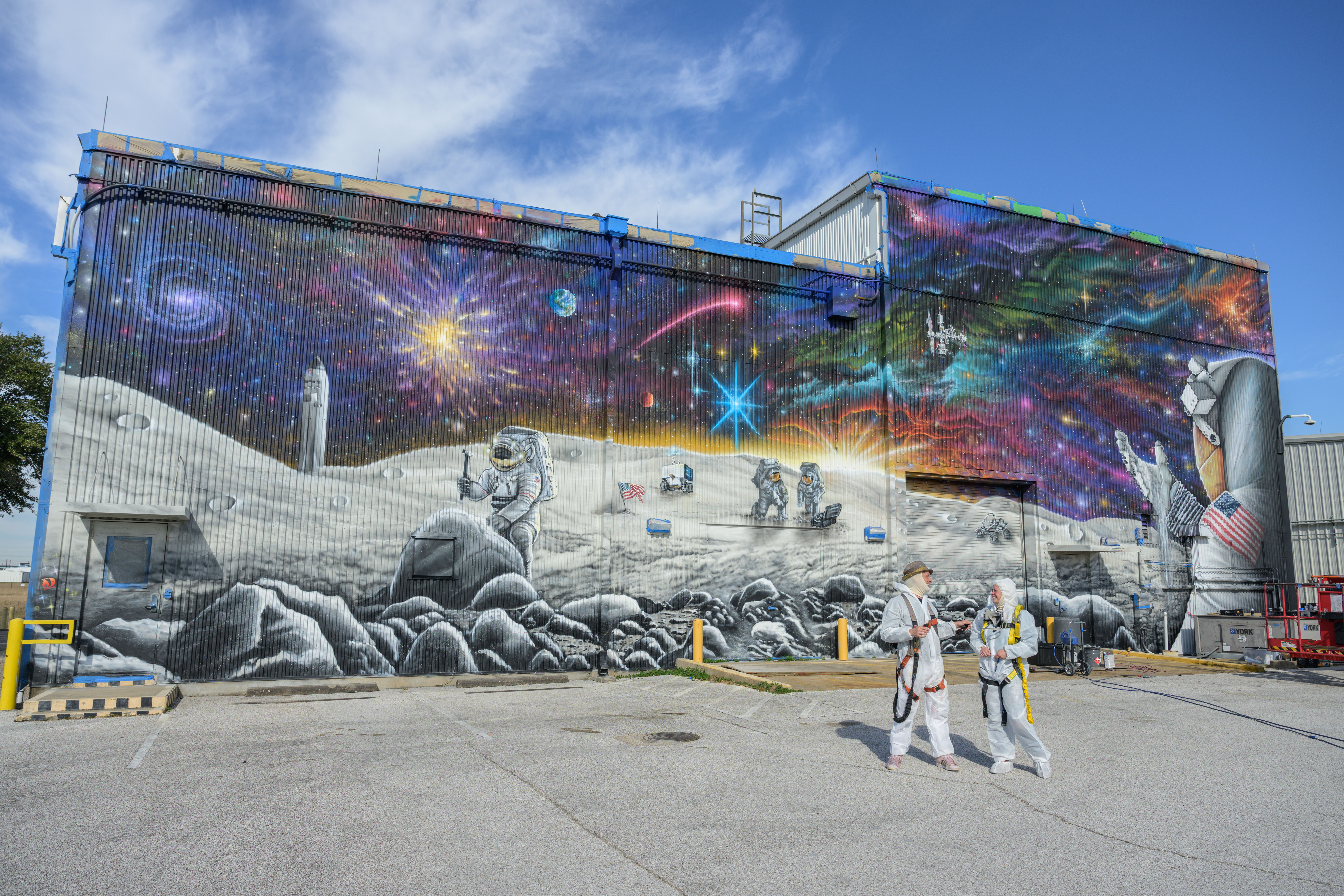
The spirit of exploration extends beyond the facility’s walls. Its exterior features a large-scale mural depicting astronauts exploring the lunar surface beneath a view of the cosmos. Completed in 2024 by artist Sebastian Boileau, the artwork celebrates the innovation, ingenuity, and discovery happening inside the building every day.
Artist Sebastien Boileau, left, and Margaret Braun pose in front of Johnson’s Lunar Development and Test Facility after the mural’s completion on Feb. 7, 2024.
NASA/Josh Valcarcel
Now, anyone can step inside the facility from anywhere. Explore NASA’s new 3D virtual tour of the Lunar Development and Test Facility to see where engineers are helping prepare the technologies that support this Golden Age of exploration and innovation.

 Login
Login