❌

Normal view

There are new articles available, click to refresh the page.
Before yesterdayHackaday

Hackaday Podcast Episode 386: Doomscroll Tamagotchis, Clavichords, and Vibrotrucks

11 September 2026 at 12:45

In this specially-numbered podcast episode that lines up quite nicely with our Retrocomputing Challenge, Elliot Williams and Kristina Panos met over surprisingly low latency and loud beverages to bring you the best of the previous week’s hacks.

But first, the news. German company Isar Aerospace can now claim that they’ve launched the first spacecraft into orbit from Europe. Be sure to check out the in-link, where we reported on the building of the spaceport.

In Hackaday news, the aforementioned Retrocomputing Contest had 64 entries at last check, which is just perfect for Episode 386. Will yours be the 65th?

Supercon Ten tickets are selling out, and per Elliot, the talks have been chosen, pending approval by each submitter.Β  Keep an eye on the blog for the official announcement!

After reviewing the news, Elliot reached into the ol’ Mailbag and found two missives, including another from [Vik Olliver] regarding the printing of LEGO. The other is from [Mendel Munkis], who has been enjoying Wikipedia offline since 2018, thanks to a 32-bit ARM9 processor. Then, it was on to the hacks.

Check out the links below if you want to follow along, and as always, tell us what you think about this episode inΒ the comments!

Download in lovely MP3.

Where to Follow Hackaday Podcast

Episode 386 Show Notes:

News:

Mailbag:

  • This week, we have a double feature!

Interesting Hacks of the Week:

Quick Hacks:

Can’t-Miss Articles:

HYDR8 Will Lead You to Water, But Will You Drink?

19 August 2026 at 19:00
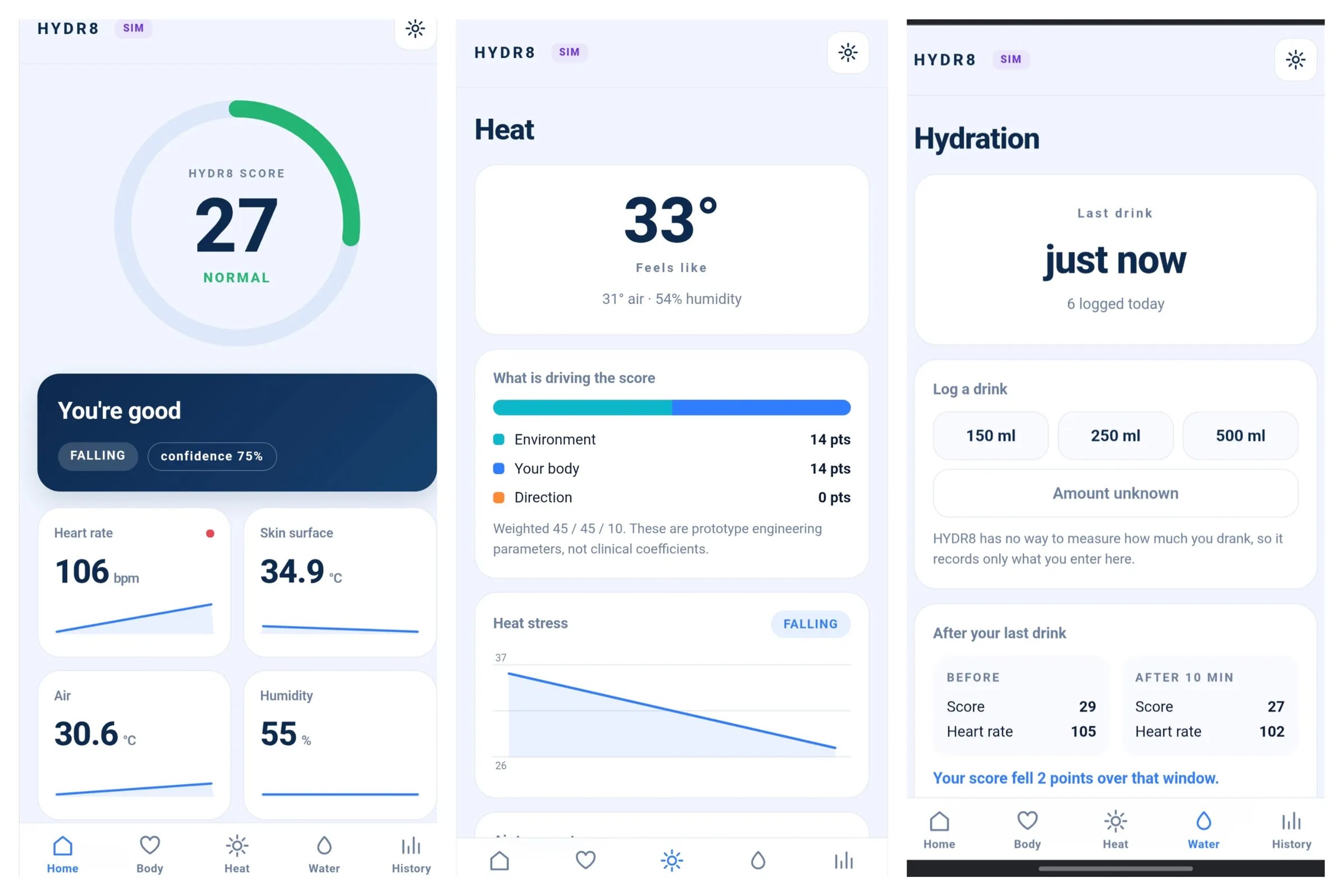
An arm and a hand: on the arm is a chunky blue box, and in the hand is a phone showing a dashboard.

[Ayushmaan] states up front that most of his free time is spent β€œbuilding things that probably didn’t need to exist”. Well, this one might be an anomaly, because it seems pretty useful to us.

HYDR8, as it says on the tin, is a wearable that knows when it’s time to hydrate. The impetus for this one was something we all chase: the flow state. [Ayushmaan] would sit down, get deep into work, and look up hours later to to find that he had a headache and a full water bottle. Phone reminders were soon swiped away in annoyance.

A triptych of screenshots showing the HYDR8 dashboard.This wearable is based on a XIAO ESP32-C3. It reads heart rate, oxygenation, skin temperature, and both the ambient temperature and humidity. It also learns your personal resting numbers range.

Taking all of this into consideration, it generates a heat/hydration stress score between 0-100. The thing is, HYDR8 tells you specifically what to do; sometimes it’s β€˜drink water’ and other times, it’s β€˜find shade’.

The wearable itself, while somewhat chunky, is pretty simple: it only shows the time and a message when it matters. The ESP32 hosts a full dashboard on your phone.

Keep in mind that this is not a medical device, it’s an experiment, a prototype. It can’t measure how hydrated you are. Instead, it measure hydration stress.

If you don’t want to wear anything, here’s a smart straw that uses a tiny turbine flowmeter and a Hall effect sensor to record the volume sipped, and detect whether the sipper is low on fluids. And if you find yourself under the hot lights of a wet bulb event, here’s how to survive it.

PolyShot Camera Focuses On Nostalgia

18 August 2026 at 14:30
An open-source, DIY, point-and-shoot digital camera.

Although we personally have yet to see anyone brandishing an old digital point-and-shoot camera, we hear they’re back in vogue. Why, though? People are nostalgic for that image quality. While he certainly could have simply picked up a vintage model somewhere for a likely inflated price, [Arnov Sharma] decided to build his own version and call it the PolyShot.

The core of this project is the Unihiker K10 dev board, which uses an ESP32-S3, a whopping 2 megapixel camera, and a micro SD card to capture photos and display them back on the screen. The tricky part, if you can call it that, is the custom PCB. It’s a simple board with just three buttons: shutter, gallery, and next image. We do like that the position of the battery compartment creates a nice grip.

The biggest difference here is that there is a few-second delay between pressing the shutter button and actually capturing the image, which you can see in the short videos below. So if you’re trying to get a shot of a skink or something equally speedy, we wish you good luck.

In a future iteration, [Arnov] wants to address the issue of image quality, because this project ended up evolving into a more traditional digital camera. He would also improve the battery life, for which the current expectancy is around three hours on a charge. Ultimately, [Arnov] wants to ditch the Unihiker and design everything from the ground up, using an ESP32-S3 module.

Β 

May This Balloon Banjo Resonate With You

17 August 2026 at 04:00
A small, 3D-printed banjo frame that uses a party balloon for the resonating chamber.

Most instruments, with maybe the exception of pianos, have consumable parts. Guitars need string changes, bows need rosin, saxophones need reeds. [Co:Creation Lab]’s balloon banjo requires both fishing line and a party balloon, lest it be semi-silent.

If you want to change the resonance, just increase or decrease the amount of air inside the balloon. Neither the balloon nor the strings need tools to adjust, but we might argue that tuning pegs are tools.

The balloon banjo was the result of a design constraint: a parent should be able to build it with their child. To that end, there are no metal screws, no recurring snap-fits in the assembly, and a single, internal, one-time-use snap fit for the adult’s tactile satisfaction. Instead, the balloon banjo uses 3D-printed screws. A six-year-old can turn them with their fingers, and it’s difficult to over-tighten them and strip the plastic threads.

Be sure to check it out in action after the break. If you would rather use extant plastic to make music, the Bottlephone 2.0 is calling.

❌
❌