A NASA Launch Services (NLS) II contract has been awarded by the agency to Relativity Space Inc., and its Terran R launch service in accordance with the contract’s on-ramp provision. The Terran R launch service will be available to NASA’s launch services to use for future missions.
The NLS II contracts are multiple-award, indefinite-delivery/indefinite-quantity contracts with an ordering period through June 2030 and an overall period of performance through December 2032. The NLS II contracts include an on-ramp provision that provides an opportunity annually for new launch service providers to compete for future missions and allows existing contractors to introduce launch vehicles not currently on their NLS II contracts.
The NLS II contracts support the goals and objectives of the agency’s Human Spaceflight Mission Directorate, Science Mission Directorate, and the Research and Technology Mission Directorate. Under the contract, NASA also can provide launch services to other government agencies, such as the National Oceanic and Atmospheric Administration.
NASA’s Launch Services Program Office at the agency’s Kennedy Space Center in Florida manages the NLS II contracts. For more information about NASA, visit:
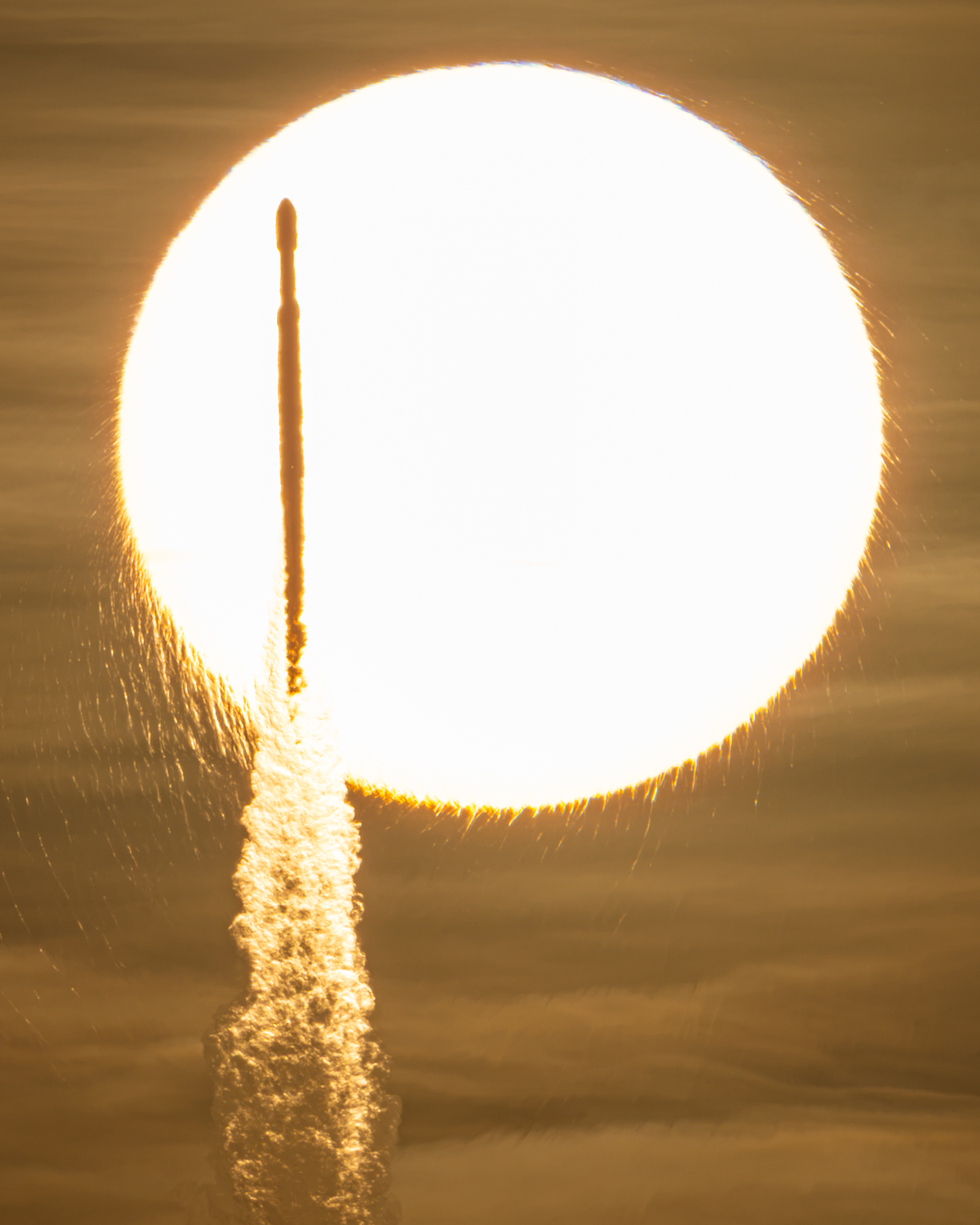
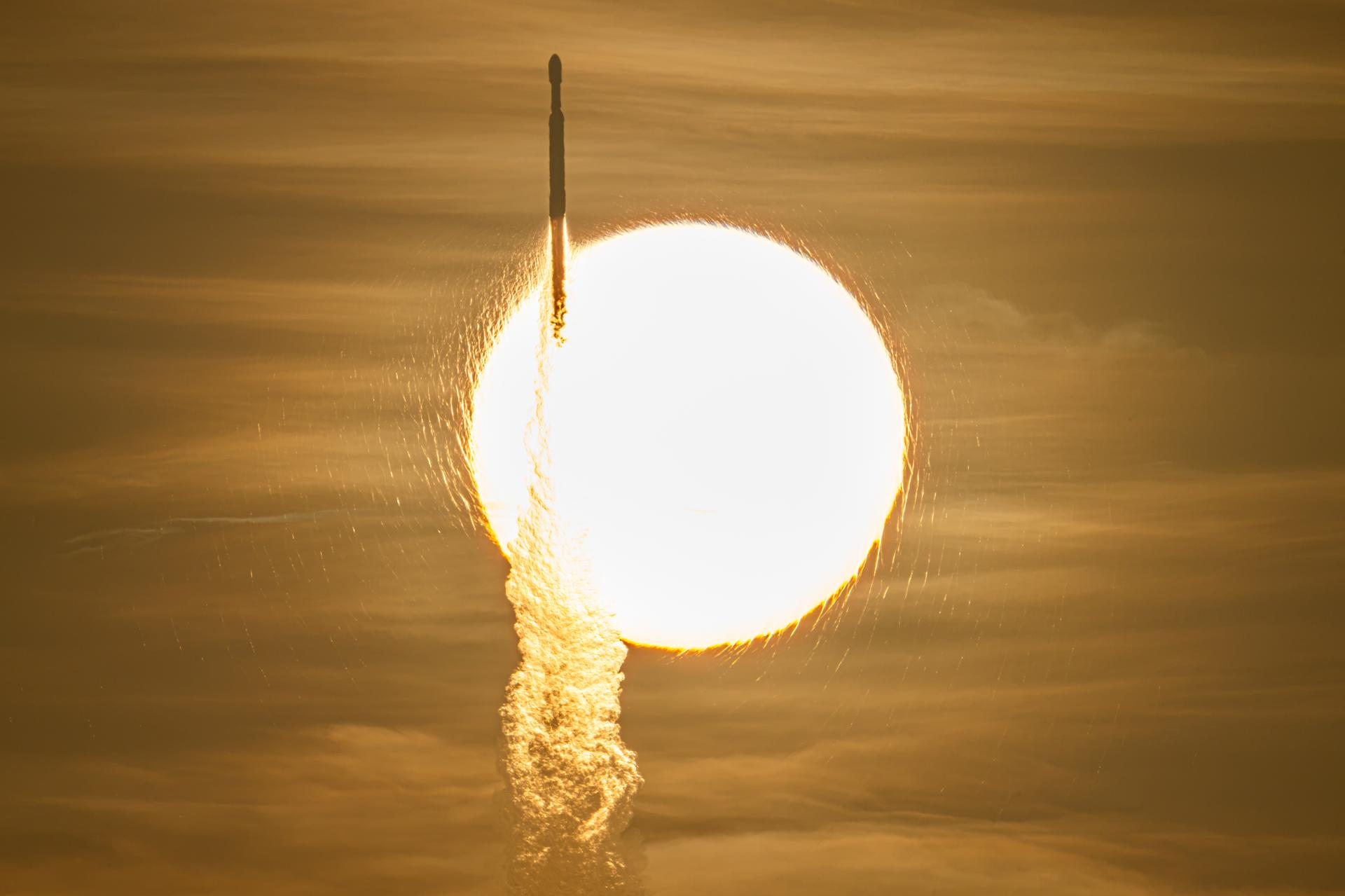
NASA’s Nancy Grace Roman Space Telescope, aboard a SpaceX Falcon Heavy rocket, transits the Sun during launch from the agency’s Kennedy Space Center in Florida on Aug. 30, 2026. Roman is named after the agency’s first chief astronomer.
Roman will survey billions of stars and galaxies with a field of view far larger than Hubble’s, helping scientists study dark energy, exoplanets, and the evolution of the universe.
A SpaceX Falcon Heavy rocket with NASA’s Nancy Grace Roman Telescope on board is seen transiting the sun during launch from Launch Complex 39A, Sunday, Aug. 30, 2026, at NASA’s Kennedy Space Center in Florida.
NASA/John Kraus
Now on a three-month, million-mile journey to its final orbit, NASA’s Nancy Grace Roman Space Telescope will soon reveal the universe’s darkest secrets. The mission launched at 7:26 a.m. EDT Sunday aboard a SpaceX Falcon Heavy rocket from Launch Complex 39A at the agency’s Kennedy Space Center in Florida.
Roman pairs a large field of view with crisp infrared vision to explore vast swaths of the sky and probe deeply into cosmic history. This flagship mission will help astronomers explore dark matter, dark energy, and worlds outside of our solar system, known as exoplanets. Its surveys will support a broad range of research extending far beyond the mission’s main science goals.
“Roman is exactly the kind of success story we want to see across NASA,” said NASA Administrator Jared Isaacman. “Delivered ahead of schedule and on budget, this mission reflects more than a decade of dedication from the NASA workforce and our industry partners. Now, Roman will give us a new atlas of the universe, push the boundaries of discovery, and demonstrate what is possible when America’s space program pairs bold ambition with disciplined execution.”
The ground control team at NASA’s Goddard Space Flight Center in Greenbelt, Maryland, began receiving telemetry data from Roman seven minutes after launch. The Falcon Heavy rocket performed as expected, separating from the observatory 31 minutes into the flight. After separating from the center core, the rocket’s boosters safely returned to the launch site for refurbishment.
“Roman will be a discovery machine that will bring us closer than ever before to answering humanity’s most profound questions about our cosmic history,” said Nicky Fox, associate administrator for the Science Mission Directorate at NASA Headquarters in Washington. “With its large field of view and fast survey speeds, Roman will usher us into a new era of discovery and make the invisible visible, setting the foundation for humanity’s search for life beyond our solar system.”
During launch and early orbit, Roman uses the Near Space Network’s ground stations and relay satellites to exchange tracking, telemetry, and command data with ground controllers. About 70 minutes after launch, the Deep Space Network takes over communications and guides Roman toward the second Sun-Earth Lagrange point, or L2, about one million miles from Earth. Roman connects to that network through the Canberra Deep Space Communication Complex in Australia first. Approximately six hours later it will transfer to the Madrid Deep Space Communication Complex in Spain and then to the Goldstone Deep Space Communication Complex in California, ensuring continuous contact with Roman throughout its journey.
The Roman team also confirmed successful deployment of the observatory’s solar panels and lower instrument sun shade an hour and 23 minutes after launch. Within the upcoming days, Roman’s high-gain antenna and visor-like deployable aperture cover will deploy, ground controllers will initiate the first of two-mid-course corrections, and the Coronagraph Instrument will power on. This instrument will demonstrate the technology that future missions like NASA’s Habitable Worlds Observatory concept could use to image Earth-like planets in the search for life in the universe. Roman’s Coronagraph will take a giant step in that direction by snapping pictures of Jupiter-like planets.
A few weeks into Roman’s voyage, its primary instrument, the Wide Field Instrument, will activate. This 300-megapixel infrared camera has 18 4K detectors, each about the size of a saltine cracker. These detectors collect photons of light that will be decoded into crisp cosmic panoramas. Thanks to the observatory’s rigid design and stable optical performance, it will rapidly scan the sky without needing substantial time between separate observations. The Roman telescope is designed to survey the universe a thousand times faster than NASA’s Hubble Space Telescope.
Throughout the rest of Roman’s three-month commissioning period, scientists will run the instruments through a series of calibrations and tests. NASA anticipates releasing Roman’s first images by early 2027.
Roman will send back 1.4 terabytes of data every day, the highest data rate of any NASA astrophysics mission, so far. Machine learning, artificial intelligence, and citizen scientists will help sift through it and flag significant findings, which astronomers can then study.
“We’ve never been able to view the universe with eyes like Roman’s before,” said Julie McEnery, Roman’s senior project scientist at NASA Goddard. “There’s no telling what more we’ll know and have seen by this time next year.”
Roman is the fourth primary mission NASA has launched on a Falcon Heavy rocket. Earlier this year, the agency’s Launch Services Program worked with SpaceX to accelerate the launch date to accommodate the space telescope’s early completion.
The telescope is managed at NASA Goddard with participation by the agency’s Jet Propulsion Laboratory in Southern California; Caltech/IPAC in Pasadena, California; the Space Telescope Science Institute in Baltimore; and a team of scientists from various research institutions. The primary industrial partners are BAE Systems Inc., L3Harris Technologies, and Teledyne Scientific & Imaging. Contributions to Roman also are made by ESA, JAXA, the French space agency CNES (Centre National d’Études Spatiales), and the Max Planck Institute for Astronomy in Germany.
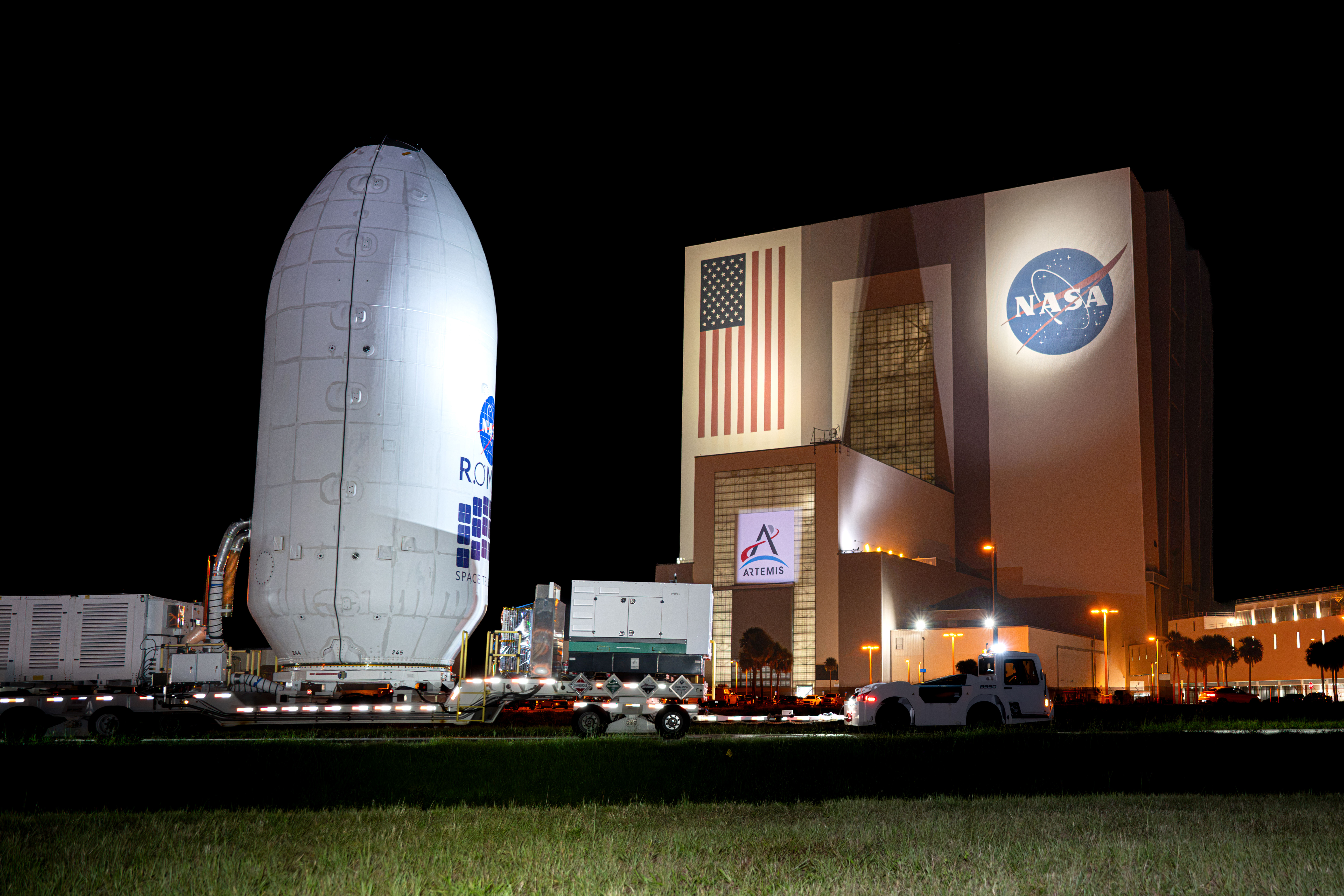
NASA’s Nancy Grace Roman Space Telescope, encapsulated in its payload fairing, travels from the Payload Hazardous Servicing Facility to the SpaceX hangar at Launch Complex 39A at NASA’s Kennedy Space Center on Tuesday, Aug. 25, 2026, ahead of mating to a SpaceX Falcon Heavy rocket.
Roman’s science instruments are designed to help researchers understand dark energy, the mysterious force accelerating the universe’s expansion. The observatory also will map how galaxies form, cluster, and evolve by tracing the influence of dark matter. Liftoff from NASA Kennedy is targeted no earlier than Sunday, Aug. 30, 2026.
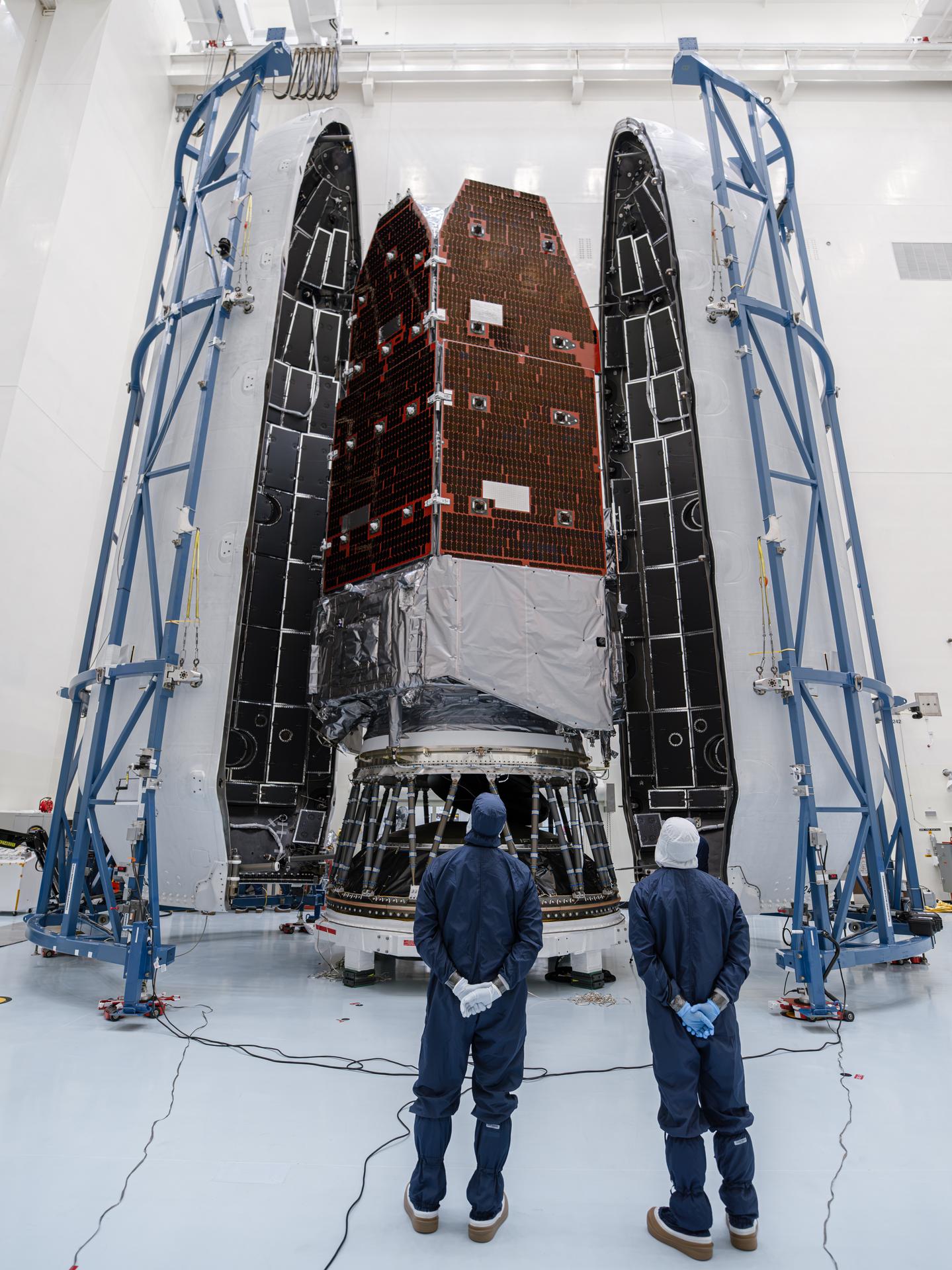
NASA’s Nancy Grace Roman Space Telescope is encapsulated within the payload fairing at the agency’s Kennedy Space Center in Florida, ahead of mating to a SpaceX Falcon Heavy rocket for launch.
Credit: NASA/Sydney Rohde (Rocz)
Coverage plans are ready for NASA’s Nancy Grace Roman Space Telescope prelaunch and launch activities. Roman is NASA’s next-generation observatory designed to explore some of the universe’s biggest mysteries, including dark energy.
NASA and SpaceX are targeting Roman’s liftoff for no earlier than 7:26 a.m. EDT Sunday, Aug. 30, aboard a SpaceX Falcon Heavy rocket from Launch Complex 39A at the agency’s Kennedy Space Center in Florida. Launch coverage begins at 6:20 a.m.
Live coverage of these events will stream through a variety of platforms. Learn where to watch online:
Named for NASA’s first chief astronomer, the Nancy Grace Roman Space Telescope will pair sharp infrared vision with a field of view at least 100 times larger than the agency’s Hubble Space Telescope. Its crisp, sweeping surveys will help scientists investigate dark energy and dark matter, discover and characterize exoplanets, map billions of galaxies, study black holes, and explore objects from our own solar system to the edge of the observable universe.
After launch and separation from the rocket, Roman will travel to the second Sun-Earth Lagrange point, or L2, about one million miles from Earth. The mission has a five-year primary lifetime with a goal of operating for 10 years, and Roman’s science data will be publicly available after processing.
NASA’s mission coverage is as follows (all times are Eastern and subject to change based on real-time operations):
Saturday, Aug. 29
9 a.m.: NASA’s Roman Space Telescope Mission Science Briefing: The briefing will take place in the NASA Kennedy Press Site auditorium with the following participants:
Shawn Domagal-Goldman, director, Astrophysics Division, NASA Headquarters
Julie McEnery, Roman telescope senior project scientist, NASA Goddard Space Flight Center
Vanessa Bailey, Roman Coronagraph Instrument scientist, NASA Jet Propulsion Laboratory
Kristen McQuinn, Roman Science Operations Center lead, Space Telescope Science Institute
Lee Armus, Roman Science Support Center lead, Caltech/IPAC
Media may ask questions in person or by phone. Limited auditorium space will be available for in-person participation. For the dial-in number and passcode, media should contact the NASA Kennedy newsroom no later than one hour before the briefing at: ksc-newsroom@mail.nasa.gov.
10:30 a.m.: NASA’s Roman Space Telescope Prelaunch News Conference: The news conference will take place in the NASA Kennedy Press Site auditorium with the following participants:
Nicky Fox, associate administrator, Science Mission Directorate, NASA Headquarters
Lucas Paganini, Roman telescope program executive, NASA Headquarters
Jackie Townsend, Roman telescope project manager, NASA Goddard
Denton Gibson, launch director, NASA’s Launch Services Program, NASA Kennedy
Julianna Scheiman, director, NASA Science and Dragon Programs, SpaceX
Justin McReynolds, launch weather officer, 45th Weather Squadron, U.S. Space Force
Media may ask questions in person or by phone. Limited auditorium space will be available for in-person participation. For the dial-in number and passcode, media should contact the NASA Kennedy newsroom no later than one hour before the briefing at: ksc-newsroom@mail.nasa.gov.
11:45 a.m.: NASA Administrator Jared Isaacman is expected to fly past the Nancy Grace Roman Space Telescope and Falcon Heavy rocket on the launchpad in his jet. The flyby will be shown live on the same stream as the prelaunch news conference, with a view of the launch pad during the transition. The flyby is subject to weather and operational considerations.
12 p.m.: In-person interviews will take place in the NASA Kennedy Press News Center:
Nicky Fox, associate administrator, Science Mission Directorate, NASA Headquarters
Lucas Paganini, Roman telescope program executive, NASA Headquarters
Dalia Kirschbaum, acting director, Sciences and Exploration Directorate, NASA Goddard
Josh Schlieder, Roman telescope project scientist, NASA Goddard
Jason Hylan, Roman telescope flight segment and observatory manager, NASA Goddard
Bertrand Mennesson, Roman Coronagraph Instrument project scientist, NASA JPL
Jeff Hanke, president, Space Systems, Space and Mission Systems, L3Harris Technologies
Wendy Minotti, program manager, Exquisite Imaging, Space and Mission Systems, L3Harris Technologies
Bonnie Patterson, vice president and general manager, Civil Space, Space and Mission Systems, BAE Systems
Sarah Lipscy, director, Strategic Operations, Space and Mission Systems, BAE Systems
Previously credentialed media interested in scheduling an interview should contact the NASA Kennedy newsroom at: ksc-newsroom@mail.nasa.gov.
Sunday, Aug. 30
6:20 a.m.: Launch coverage begins.
7:26 a.m.: Launch
9:30 a.m.: Postlaunch news conference with the following participants:
NASA Administrator Jared Isaacman
Nicky Fox, associate administrator, Science Mission Directorate, NASA Headquarters
Jackie Townsend, Roman telescope project manager, NASA Goddard
Julie McEnery, Roman telescope senior project scientist, NASA Goddard
Denton Gibson, launch director, NASA’s Launch Services Program, NASA Kennedy
Media may ask questions in person or by phone. Limited auditorium space will be available for in-person participation. For the dial-in number and passcode, media should contact the NASA Kennedy newsroom no later than one hour before the news conference at: ksc-newsroom@mail.nasa.gov.
Audio-only coverage
Audio-only coverage of the launch will be carried on the NASA “V” circuits, accessible by dialing 321-867-1220 or 321-867-1240. On launch day, mission audio countdown activities without NASA broadcast commentary will be carried on 321-867-7135.
Launch audio also will be available on Launch Information Service and Amateur Television System’s VHF radio frequency 146.940 MHz and KSC Amateur Radio Club’s UHF radio frequency 444.925 MHz, FM mode, heard within Brevard County on the Space Coast.
NASA website launch coverage
Launch day coverage will be available on the NASA website, including the livestream and blog updates as countdown milestones occur. On-demand streaming video and launch photos will be available shortly after liftoff. Follow mission updates on the Roman launch blog.
Attend launch virtually
Members of the public may register to attend the Roman launch virtually. NASA’s Virtual Guest Program includes curated launch resources, notifications about related opportunities or schedule changes, and a stamp for the NASA virtual guest passport following launch.
Watch, engage on social media
Let people know you’re watching the mission on X, Facebook, and Instagram by following and tagging these accounts:
The Roman telescope is managed at NASA Goddard with participation by the agency’s Jet Propulsion Laboratory in Southern California; Caltech/IPAC in Pasadena, California; the Space Telescope Science Institute in Baltimore; and a team of scientists from various research institutions. The primary industrial partners are BAE Systems Inc., L3Harris Technologies, and Teledyne Scientific & Imaging. Contributions to Roman also are made by ESA (European Space Agency), JAXA (Japan Aerospace Exploration Agency), the French space agency CNES (Centre National d’Études Spatiales), and the Max Planck Institute for Astronomy in Germany. NASA’s Launch Services Program, based at Kennedy, manages the launch service for the Roman mission.
For more information about NASA’s Roman telescope, visit:
NASA has selected four companies to provide payload processing facilities under the Spacecraft Processing Operations Contract on‑ramp provision. The provision enables qualified providers to offer commercial payload processing services for agency missions launching from multiple locations where capabilities were not available at the time of the initial contract award.
Contract awardees are:
All Points Logistics LLC
Blue Origin LLC
Firefly Aerospace
L3Harris Technologies Inc.
Through the contract, NASA procures facilities and services required to perform prelaunch processing of spacecraft and associated rocket hardware for delivery to the launch pad.
The Spacecraft Processing Operations Contract is a multiple-award, commercial, firm-fixed-price, indefinite-delivery/indefinite-quantity contract vehicle that has an aggregate ceiling price of $100 million with an ordering period through Feb. 1, 2033.
NASA’s Launch Services Program at the agency’s Kennedy Space Center in Florida will manage the contract. The program works with private industry, mission, and international partners to launch science payloads ranging from small satellites with colleges and universities to NASA’s highest-priority missions.
For more information about NASA’s launch services, visit:
In honor of America’s historic 250th anniversary, NASA announced on Friday MAX POWER, a public exposition of American air and space innovation, Nov. 7 and Nov. 8, on and near the agency’s Kennedy Space Center in Florida.
The multi-day, family-friendly event will showcase the next-generation aircraft, spacecraft, autonomous vehicles, and technologies that will help define the future of transportation in air and space, bringing together the public, innovators, investors, pilots, astronauts, engineers, and companies helping open this new frontier.
“This November, we are opening Kennedy Space Center’s historic Shuttle Landing Facility to the public for America’s newest and most exciting aerospace technology expo and airshow, and we are calling it MAX POWER,” said NASA Administrator Jared Isaacman. “For 250 years, America has advanced by building what did not exist, flying higher, moving faster, and reaching toward the near-impossible. There is no better place to celebrate that spirit than at NASA Kennedy, America’s gateway to the stars and the place where so many of our nation’s greatest achievements began.”
By bringing together the legacy of NASA with the companies and technologies shaping what comes next, MAX POWER aims to ignite the spirit of exploration and inspire the next generation of explorers, builders, and dreamers. In addition to the agency, Air Dot Show, Delaware North, Space Florida, Purpose Entertainment, and UP.Summit are external collaborators.
Some activities will take place at NASA Kennedy, including the Apollo Saturn V facility, and the Launch and Landing Facility currently leased by Space Florida. Others will take place at the Kennedy Space Center Visitor Complex adjacent to the center leading up to, and during, the festival.
Events include:
An air show featuring NASA aircraft, the U.S. Air Force Thunderbirds, and aerial demonstrations by multiple branches of the Department of War
Guest speaker series featuring NASA experts and Apollo and Artemis astronauts
Special exhibits and displays showcasing technology demonstrations, historic and current NASA hardware aircraft, commercial aviation displays, next-generation air mobility, and more
Behind-the-gates bus tours of NASA’s Kennedy Space Center, including the Gantry, Apollo Saturn V Center, and Vehicle Assembly Building
MAX POWER will give the public a front-row seat to the future of American aerospace, including advanced aircraft, autonomous systems, commercial space, NASA’s work to return Americans to the lunar surface, plans for a Moon Base, and the technologies strengthening America’s aerospace industrial base. Teams will highlight work in aviation, exploration, and innovation for the benefit of humanity.
“For a decade, UP.Summit has convened the companies, investors, entrepreneurs, and policymakers building the future of how the world moves,” said Cyrus Sigari, UP.Summit founder and mission commander. “This November we bring that community to Kennedy Space Center as part of MAX POWER. The public will stand next to the aircraft, spacecraft, and autonomous systems that will define the next 250 years and meet the people building them. MAX POWER is about lighting that spark in thousands of Americans and showing the world what this country builds when it aims high.”
“It is an honor to collaborate with NASA and bring an aviation spectacle to the skies over Kennedy Space Center as part of MAX POWER,” said Bryan Lilley, CEO of Air Dot Show. “There could not be a more iconic place to celebrate the past, showcase the present, and preview the future of American aviation and space exploration as our nation marks its 250th anniversary.”
“Kennedy Space Center Visitor Complex is where America’s history of aerospace innovation comes to life, from the aircraft that helped launch the space program to the spacecraft that carried us to the Moon and the technologies shaping what comes next,” said Therrin Protze, chief operating officer of Kennedy Space Center Visitor Complex. “MAX POWER brings that entire story together in one place, giving the public an up-close look at the past, present and future of American aerospace.”
“Florida has been part of some of the most historic moments in American space exploration, and we’re proud to welcome the nation to this storied site for MAX POWER this fall,” said Col. Rob Long (Ret.), president and CEO, Space Florida. “Together with NASA, we have spent generations building the infrastructure, talent, and spirit of innovation that make moments like this possible, and this event offers a front-row seat to that ongoing story.”
This event is open to U.S. and international media. To attend, media must RSVP by 5 p.m. on Tuesday, Oct. 6, to the Kennedy newsroom at: https://media.ksc.nasa.gov. NASA’s media accreditation policy is available online.
There are multiple “parks” and experiences planned, each of which require separate tickets to attend. To learn more and purchase tickets, visit:
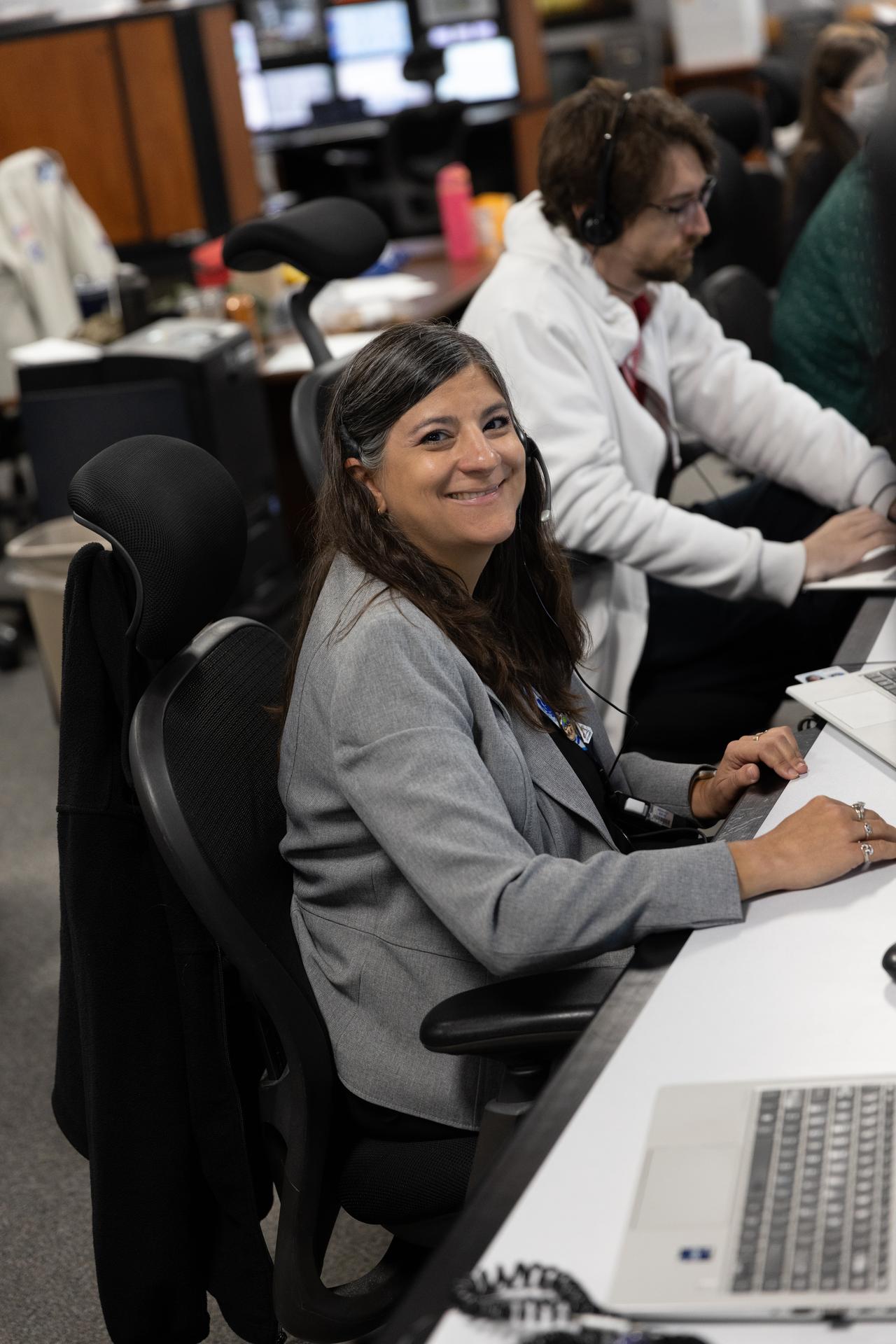
Lindsey Waitt, engineer with NASA’s Exploration Ground Systems Program, participates in a terminal countdown simulation for Artemis III on Thursday, Aug. 6, 2026, inside Firing Room 1 of the Rocco A. Petrone Launch Control Center at NASA’s Kennedy Space Center in Florida.
NASA/Clayton Rougelot
As a young girl raised in Worcester, Massachusetts, Lindsey Waitt dreamed of working for NASA. Her dream is now a reality as she embarks on her role as a NASA test project engineer with the Artemis launch team – an integral part of the agency’s missions that will enable humans to return to the surface of the Moon after launching from NASA’s Kennedy Space Center in Florida.
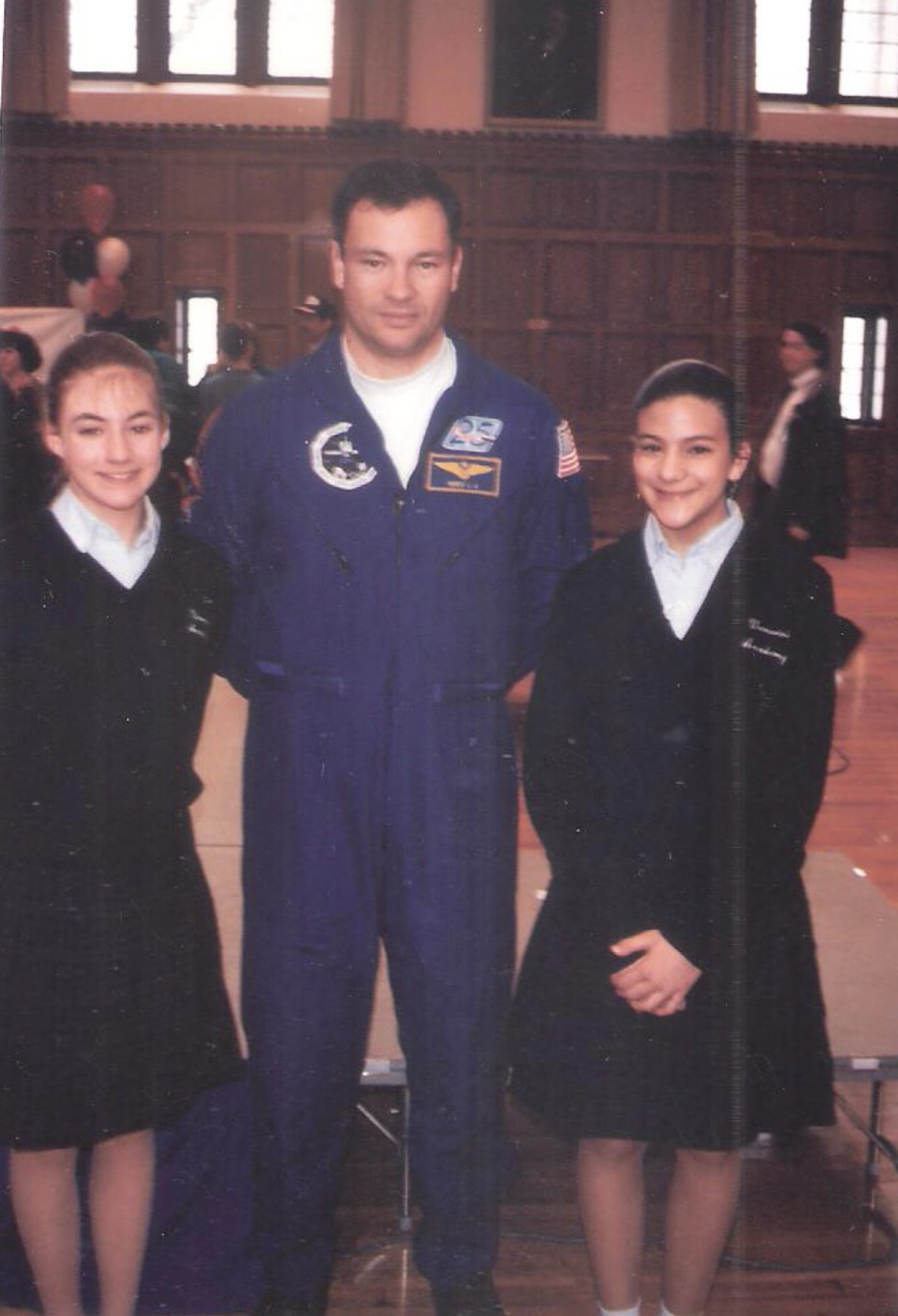
When she was in middle school in the late 1990’s, Waitt recalls meeting NASA Space Shuttle astronauts Michael Lopez-Alegria and Albert Sacco, Jr., a former professor at the college, during a visit to Worcester Polytechnic Institute (WPI) in Worcester, Massachusetts. She was inspired while listening to them recount their spaceflight experiences including an experiment on conducting research for growing cells on the Moon. She even posed for a picture and got their autographs. Little did young Waitt know, these would not be the only astronauts she would meet.
Lindsey Waitt (far right), poses for a photograph with NASA astronaut Michael Lopez-Alegria and her cousin at Worcester Polytechnic Institute in Massachusetts.
Photo credit: NASA/Lindsey Waitt
Her passion for learning about all things space and engineering led Waitt back to WPI where she studied engineering, absorbing different disciplines. She received her Bachelor of Science degree in Mechanical Engineering with a concentration in aerospace engineering and she left the school fueled by her passion to be a part of America’s space agency.
After graduation, she worked as a systems engineer on radar flight test missions for a defense contractor, and while excelling in her role, she realized it wasn’t the aerospace engineering field that she desired.
“It was an exciting program, and it was meaningful to be a part of a project focused on protecting the country from enemy attacks. But it wasn’t space,” Waitt said.
As the wife of a now retired sergeant first class officer in the United States Army, Waitt and her family traveled around the world during her husband’s enlistment, and she continued to follow NASA missions from around the globe. While Waitt was dedicated to raising her three young boys, she simultaneously pursued her master’s degree in Space Operations from the University of Colorado in Colorado Springs. Twelve years later, she made the courageous decision to fully return to her first career passion – working for NASA – despite nay-sayers suggesting too much time had passed for her to return to the industry.
The sky is not the limit, it's wide open now. The universe is the limit.
Lindsey waitt
Test project engineer
Waitt vividly remembers watching NASA astronauts Doug Hurley and Bob Behnken soar skyward during NASA’s first commercial crew mission to the International Space Station in 2020. Watching alongside her family, she even set up a rocket-shaped tent, and she and her children pretended to blast off from their yard as they cheered excitedly as the astronauts lifted off from what would be her future place of work.
After moving to Florida in 2022 to work at a small satellite company in Cape Canaveral, as a systems engineer and program manager, she continued to search for opportunities to work for the agency. Waitt vividly remembers watching Artemis I with her family. They had just moved to the Sunshine State, and she woke up in the early hours of the morning to watch the historic launch, having no idea she would be working on the next Artemis mission – the first time NASA sent humans around the Moon in over 50 years!
In 2024, Waitt began her career at Kennedy working for a contractor as a test project engineer during the Artemis II launch. As “problem-solvers,” test project engineers are the main hub of experts for technical tests and launch activities and they work to coordinate resolutions across the different subsystems that may arise during the dynamic operations associated with a rocket launch. Leading up to the Artemis II launch in April, Waitt quickly became certified to sit on the launch console during the dynamic pre and post-launch operations for the massive SLS (Space Launch System) rocket and Orion spacecraft and she eagerly watched from outside Kennedy’s Launch Control Center as the four crew members lifted off the launch pad towards the Moon.
When NASA announced its insourcing initiative earlier this year, Waitt seized the opportunity to fully realize her dream. She applied for a position and is now a NASA civil servant supporting the Artemis launch team as a test project engineer for NASA– a core position for the agency’s launch team. With Artemis III in front of her, Lindsey will see the buildup of launch operations from start to finish.
As the only female of the 14 test project engineers who work on the Artemis launch team, Waitt said she was fully embraced by the colleagues she stands beside.
“Everybody’s very open and welcoming,” Waitt said. “I’ve worked on teams before, but it’s never been like this. Everyone is so passionate about the mission, and everybody is working together to get things done quickly, but safely – that’s always first priority. We Are Going.”
This opportunity didn’t happen by chance. Waitt is embracing life’s journey and focused on making her dream come true, one launch at a time. “The sky is not the limit – it’s wide open now,” Waitt said. “The universe is the limit.”

 Login
Login