It is a classic Hackaday situation. You have an Egret GT E-scooter. It has a screen that shows the usual dash stats, but that led to an annoyance. You could accidentally enter firmware update mode and, from there, enter operational mode without the security PIN. [Ben] couldn’t let that stand, so he reverse-engineered the protocol and rewrote the firmware in Rust. As he put it, “… because I have to break… everything I own…” We get it.
The mobile app was useful for some basic info, since sniffing Bluetooth is fairly easy and analyzing mobile code is, more or less, straightforward. Analysis revealed some data that doesn’t show on the display and that several things are sent back to home base tagged with the scooter’s unique ID — another reason to gut the existing firmware.
Internally, the scooter uses the CAN Bus, so out came the oscilloscope and a homebrew CAN decoder. Surprisingly, the CAN bus is accessible on the USB-C port’s data pins. Officially, the port is only for charging phones, so you have to wonder what your phone makes of the alien signals on the data pins when it is charging.
Firmware updates actually come in at least three flavors: display, input panel, and main controller. Reverse engineering the firmware update process was crucial to installing the new firmware.
If you own a similar scooter, this post is a goldmine. If you don’t, it is still a very detailed breakdown of a reverse-engineering workflow, and you can apply many of the tools and techniques to your next project.
Of course, another option is to just keep the scooter and replace the brains. If you want to learn more about reverse engineering, there are literally dozens of Hackaday posts to help you get started.
During his continuing analysis of the architecture and microcode of Intel’s highly influential 8087 floating point unit (FPU) co-processor, [Ken Shirriff] has now arrived at the point where he can put together how the 8087’s microcode implements various x87 instructions. One of these, the FSCALE instruction turned out to be far more complicated than assumed, with one might assume to be a straightforward powers-of-two scaling turning out to entail over 140 micro-instructions and three levels of sub-routine calls just to handle all cases.
The annotated die shot in the heading image shows the functional blocks that are used by this one x87 instruction, to give some kind of idea of what amount of hardware even ‘just’ scaling a floating point number involves.
Much like with the x86’s CISC-style ISA, these 8087 instructions break down into individual steps that involve everything from loading values into registers, performing operations, checking for and handling error conditions as well as stack management. As can be seen in [Ken]’s breakdown of the FSCALE implementation in the 8087 it’s all very logical, taking a high-level instruction and doing all that’s needed for a robust implementation, without bothering the developer with the details.
Of note is that the 8087’s implementations led to the IEEE 754 floating point standard, providing what definitely at the time was one of the most mathematically accurate FPUs that somehow still was financially responsible enough to make it into a relatively affordable PC.
The Philips PM5139 is not famous. It won no great victories on the battlefield, nor was instrumental in changing the political landscape. It was just a useful function generator that you might find on a workbench somewhere, doing its job quietly and relatively accurately. [doctormord] has been doing the work to reverse engineer this humble piece of hardware.
The PM5139 is poorly documented; the only existing service manual out there is for the PM5138A, a less-capable sister model. Hence, there was some value in reverse engineering the device to understand it better. Work started with two EPROM dumps capturing what Philips put in the box all the way back in the early 1990s. From there, the code was examined and tinkered with until [doctormord] felt confident to modify it and improve upon what was already there. This was achieved with the aid of an 8051 emulator that could run the code to make it obvious what was going on. The result was a custom “V2.0” firmware that adds six arbitrary waveforms to the function generator and the ability to play simple music, amongst other tweaks.
The NEC V20 is an Intel 8088-compatible processor that features the same use of microcode, though with its own characteristics. This makes it important to use this same microcode if your goal is to create a cycle-accurate emulator of this processor, as [GloriousCow]’s goal is. Cue decoding the microcode ROM in a die shot of this CPU, in order to create a usable ROM image.
As with any fabricated ROM you can technically do it by hand, the ROM section in the die shot contained 29,928 bits which even at a pretty zippy pace would take up a considerable amount of time to parse. Here you can divide-and-conquer by handing parts of the ROM off to good friends, or you can use automation and some machine vision and theoretically get an answer as soon as you have finished writing and testing the tool.
Close-up of some of the microcode bits.
Although [Travis Goodspeed]’s MaskRomTool exists exactly to automate bit detection, it was found that there wasn’t enough contrast in the die shot for it to work reliably. What it did provide were the locations of the bits and from it 42×42 pixel PNG files of each bit.
Next a convolutional neural network (CNN) was trained to determine the difference between a 0 and 1 bit. This still took the manual classifying of 1,000 images, but seemed to work fairly well. Although some bits were marked as ambiguous, it was easy enough to use Mark 1 eyeballs to run a classification on these handful of images than to tweak the CNN model.
With this microcode in hand it was then possible to match it against the V20’s internal architecture to fully determine what each part does. Although not quite finished yet, there’s a GitHub repository containing the progress so far.
The V20’s microcode has been the focal point of much legal fighting back when NEC and Intel were still duking it out in how far one could make a CPU compatible with that of a competitor.
University of Washington College of Engineering Vice Dean Jihui Yang, right, and professor Xu Chen walk a robot dog on the UW campus. (Photo courtesy of Xu Chen)
Robotics jobs in the Pacific Northwest are multiplying faster than universities can train people to fill them. The University of Washington thinks it has an answer — or at least a start.
The university capped enrollment at 35 students for the inaugural cohort. More than 30 people had already signed up for an information session before applications even opened. It’s an early signal, engineering leaders say, of pent-up demand from regional powerhouses racing to hire engineers who can operate at the intersection of AI, software and hardware.
Program leaders say that skill set is rooted in a traditional, narrowly focused engineering degree that hasn’t kept pace with the rapid evolution of technology. UW is betting that the fix lies at the intersection of AI and hardware, echoing an industry buzzword called “physical AI.”
“Robotics is no longer confined to a single discipline,” said Xu Chen, a UW engineering professor and director of the Boeing Advanced Research Collaboration, who played a large role in the committee that designed the new programs. “The future will need a wide variety of robotics knowledge, and that’s what we built these programs to deliver.”
Applications opened Sept. 1 and will close Sept. 10, with UW aiming for a roughly one-week turnaround before notifying applicants. For its inaugural year, the university is intentionally keeping things small: 25 seats in the master’s program and 10 in the certificate track, which is designed for working professionals who want robotics training without leaving their jobs.
Chen said the small first cohort is by design, not a limitation. The goal, he emphasized, is to get the fundamentals right before scaling up. He expects the programs to roughly triple in size within three to five years.
“Companies are seeing newer potential in robotics as advanced computing and the wave of AI technology mature,” Chen said. “They see that their workforce will benefit from a modern robotics program, and that need is really what drove this.”
Getting there will take machines, and lots of them. UW is purchasing robots and computing hardware for its initial course offerings while also leaning on industry donations: robots, GPUs, and computing infrastructure among them, according to Chen.
Amazon and Microsoft anchored the effort early; the list of partners has since grown to include NVIDIA, Boeing, Dassault Systèmes — the French software company behind design tools like SolidWorks — and at least one smaller robotics manufacturer.
“The industry board was incredibly supportive from the start,” Chen said. “We’ve had almost a year of continuous meetings and collaboration with them and with representatives across our own engineering departments.”
The broader structure of the program is meant to make it easier for students from different corners of engineering, such as electrical, mechanical and computer science, to land in the same classroom and eventually choose their own path deeper into robotics through electives.
The program is also drawing on UW’s existing research muscle in the region. It taps directly into the Boeing Advanced Research Collaboration, which Chen directs, along with robotics labs inside the Paul G. Allen School of Computer Science & Engineering. That gives students a line into the same research infrastructure that already feeds Seattle’s aerospace and e-commerce giants.
The university’s ambitions extend well past this fall’s launch. Chen said UW has already mapped out longer-term plans for an undergraduate robotics degree and, eventually, a Ph.D. program, with the two new offerings serving as the foundation.
For now, the clearest sign of the program’s ambitions arrived this summer in an unlikely form: a pack of robot dogs let loose on UW’s campus.
“Seattle’s hills make it a uniquely difficult place for robots to move around, which is exactly why it’s a great place to study it,” Chen said.
Both students and faculty got a chance to operate the robots directly, Chen said. It was a hands-on moment that underscored how much more accessible robotics technology has become in just the last few years.
“It was exciting to see the students so happy to see the robots,” Chen said. “That’s the kind of energy we want to build this program around.”
University of Washington computer science professor Stuart Reges. (Twinkle Don’t Blink Photo via Fire.org)
The University of Washington has agreed to pay $600,000 to resolve a high-profile First Amendment lawsuit brought by computer science professor Stuart Reges, who was disciplined after including a parody land acknowledgment in a course syllabus.
The settlement, announced Thursday by the Foundation for Individual Rights and Expression (FIRE), follows a December ruling by the U.S. Court of Appeals for the Ninth Circuit that found university officials violated Reges’ academic freedom rights by retaliating against his speech and engaging in viewpoint discrimination.
“I am deeply grateful to FIRE for this legal victory which will remind public universities that they are obligated to respect the First Amendment rights of their students, faculty, and staff,” Reges said in a statement Thursday. He added that he hopes his protest helps reverse “a decade-long trend towards ideological conformity in academia.”
Under the agreement, UW agreed to pay $600,000 to FIRE to cover damages, legal fees, and costs. The settlement prohibits the university from taking further adverse action against Reges or removing the parody statement from his syllabi in perpetuity. While the appeal was pending, UW also rescinded and replaced Executive Order 31, the anti-harassment policy used during the investigation.
The dispute began in January 2022 after the Paul G. Allen School of Computer Science & Engineering recommended that faculty include a statement acknowledging Coast Salish Indigenous lands in their syllabi.
Reges, a teaching professor who has been at the school since 2004, opposed the policy. Instead, he included a parody invoking philosopher John Locke’s labor theory of property to claim Indigenous groups held “almost none” of the land occupied by the university.
UW officials responded by censoring the parody from Reges’ course syllabus, opening a yearlong disciplinary investigation under an anti-harassment policy, and creating a competing “shadow” section of his course so students could opt out of taking his class.
Although the university ultimately declined to formally discipline Reges, officials warned him that repeating the statement could trigger further punishment. Reges sued the UW in 2022, and while a U.S. District Court initially sided with the university, a three-judge panel for the Ninth Circuit reversed that decision, ruling that student discomfort cannot justify retaliating against a professor’s speech on matters of public concern.
Reges’ lawsuit named top university leadership as defendants, including then-UW President Ana Mari Cauce, Allen School Director Magdalena Balazinska, Vice Director Dan Grossman, and College of Engineering Dean Nancy Allbritton. Current UW President Robert J. Jones is named in the final agreement.
The Ninth Circuit panel’s decision established that university teaching materials like course syllabi are protected academic speech, setting a binding First Amendment precedent across public higher education institutions in the Western U.S.
The University of Washington provided the following statement to GeekWire:
“The University of Washington maintains that we acted appropriately, and this settlement is in no way an admission of any wrongdoing. Given the Ninth Circuit’s 2-1 decision overturning the federal district court’s decision in favor of the University, a settlement agreement was the most reasonable option due to the attorney fees and costs that would have resulted from the Ninth’s Circuit’s decision. Prof. Reges has retained his faculty position and continued teaching throughout this process, and his status with the UW remains unchanged.”
Reges remains an active faculty member. Under the terms of the deal, he is free to include the Locke property statement on future course materials without administrative interference.
If you tear into old TVs or recording equipment, you may see shields made from some exotic-looking metal. Old timers will tell you it’s called mu metal, and its purpose is to — sort of — shield things from magnetic fields. The qualification is important. Unlike a conductive RF shield, mu metal doesn’t really stop a magnetic field. Instead, it gives magnetic flux an easier path to follow around whatever you’re trying to protect.
What’s In The Metal?
Mu metal belongs to a family of soft magnetic nickel-iron alloys. A typical modern formulation is about 80% nickel and 15% iron, with molybdenum and a few other elements making up most of the remainder. What makes it useful is its extremely high magnetic permeability. Commercial material can have relative permeability around 100,000 or more, and some specialty alloys can reach even higher.
You can think about reluctance as the magnetic equivalent of resistance. Put a high-permeability shell around something sensitive, and magnetic flux would much rather travel through the shell than through the space inside it, just like current tends to take the path of least resistance.
This works particularly well for DC and low-frequency fields, exactly where your usual copper or aluminum EMI shield isn’t much help.
You May Have Seen It Before
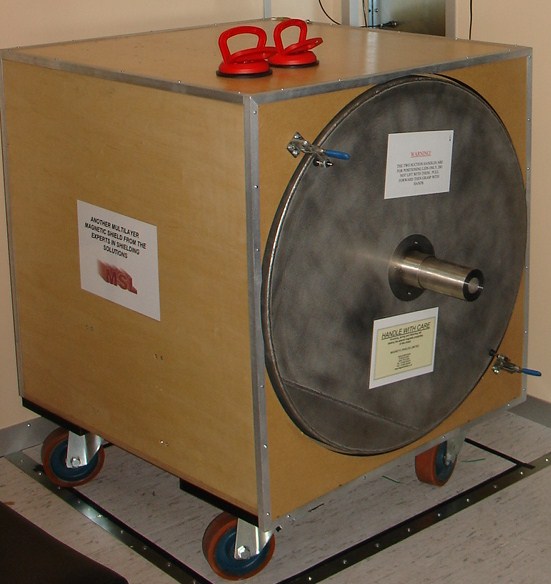
A multilayer magnetic shield box. (Photo by [Zureks] CC-BY-SA-3.0)Classic applications included shielding CRTs, tape heads, transformers, photomultipliers, and sensitive analog instruments. Put a transformer too close to the wrong part of an old television or audio amplifier and 60 Hz magnetic fields could cause very visible — or audible — trouble. The disappearance of CRTs and magnetic tape might make mu metal sound like another material destined for the antique electronics cabinet.
However, mu metal is still around. Modern applications include magnetometers, precision current sensors, electron microscopes, scientific instruments, and experiments that require extremely low magnetic fields. Commercial multi-layer mu-metal chambers are still sold for creating near-zero-field environments; with suitable construction and degaussing, some claim attenuation of static and low-frequency fields by factors approaching a million.
Quantum and cryogenic instrumentation have also created some 21st-century magnetic shielding problems. Ordinary mu metal loses performance at very low temperatures, so related nickel-iron alloys are made specifically for operation at liquid-nitrogen and liquid-helium temperatures.
Don’t Bend It
There are a couple of catches. First, mu metal gets much of its impressive permeability from its metallurgical structure. Machining, stamping, welding, or even bending it can introduce stresses and seriously degrade its magnetic properties. High-performance shields are therefore commonly formed first and then hydrogen annealed to restore their permeability.
So buying a sheet of wonderfully permeable material and folding it into a box isn’t necessarily the recipe for a wonderfully permeable box.
The second surprise is saturation. Mu metal is superb with weak fields but isn’t necessarily what you want closest to a powerful magnet. Its saturation induction is only around 0.75 tesla. In strong fields, manufacturers recommend combining it with a lower-permeability material having higher saturation capability, letting that outer layer tame the field before the mu metal handles what’s left.
History
British scientists Willoughby S. Smith and Henry J. Garnett patented mu metal in 1923 for inductive loading of submarine telegraph cables for a British company that built the Atlantic undersea telegraph cables. The seawater surrounding these cables added capacitance, requiring inductance to compensate. This was first done by wrapping the conductors with a helical wrapping of metal tape or wire of high magnetic permeability, which confined the magnetic field.
Mu-metal was invented to directly compete with permalloy, the first high-permeability alloy used for cable compensation, but it belonged to competitor Western Electric. Mu-metal was developed by adding copper to permalloy to improve ductility. Each 1.6 km of cable needed about 80 km fine mu-metal wire so there was a great demand for the alloy.
Other Tricks
Mu metal isn’t the only way to fight magnetic interference, as you can see in [FesZ’s] video below. Ordinary steel and other high-saturation magnetic alloys can redirect stronger fields. At higher frequencies, conductive copper or aluminum shields become effective through induced eddy currents. Ferrite is good at high frequencies, too, but is not very ductile nor is it very conductive. When you really need a quiet magnetic environment, active compensation coils can measure the ambient field and generate an opposing one.
But if the problem is a weak DC or low-frequency magnetic field, the basic trick hasn’t changed much. You just give the magnetic flux an easier path. Sometimes the old material in that 50-year-old television can be at home in a quantum computer, too.
NFL technology executives share how AI-driven social engineering makes attacks faster and more convincing, offering practical strategies for IT leaders to build non-punitive, multi-channel defenses.
Malek Itani, a Ph.D. student in the UW’s Paul G. Allen School of Computer Science & Engineering. (Photo courtesy of Malek Itani)
University of Washington Ph.D. student Malek Itani, who co-founded the AI-powered sound enhancement startup Hearvana, has been awarded the prestigious Marconi Society Paul Baran Young Scholar Award for his groundbreaking work in “superhuman” hearing technology.
Selected as one of just three global recipients from a record pool of nominees, Itani was recognized for developing on-device AI algorithms that enable real-time target speech extraction, “sound bubbles,” and semantic hearing on low-power hearables like earbuds and hearing aids.
Itani’s award comes less than a year after he and Paul G. Allen School of Computer Science & Engineering professor Shyam Gollakota co-founded Hearvana, a spinout aimed at commercializing their lab discoveries. The startup raised $6 million in pre-seed funding last fall to bring on-device acoustic intelligence to earbuds, hearing aids, and smart glasses.
By packing tiny, real-time neural networks onto low-power chips, the researchers hope to replace blunt noise cancellation with true semantic hearing — allowing users to filter out city traffic, amplify a single companion’s voice in a crowded room, or create a localized “sound bubble” on demand.
Itani’s work in the UW Mobile Intelligence Lab began with “acoustic swarms” — small, self-distributing robotic microphones that track and separate multiple speakers in a room. He and his collaborators then pivoted to personal audio devices, pioneering neural networks like IF-MLPNet and platforms like NeuralAids. These systems allow complex AI models to handle real-time sound separation directly on low-power wireless hearables without relying on heavy cloud compute or draining battery life.
“Malek has been a key part of every major contribution to the field of superhuman hearing in recent years,” Gollakota told the Allen School Blog. “He entered his Ph.D. with a background in RF and backscatter, but he rapidly mastered audio signal processing and deep learning, which is very impressive.”
“I feel like I’ve hit a niche that’s going to be so transformational, and it’s going to be in billions of devices,” Itani said. “It’s going to change the way we hear the world.”
Itani and his fellow Young Scholars will be formally recognized at the Marconi Awards Gala in San Francisco this November.
Cory Black is a former tech worker who left his career to focus on juggling, mostly of soccer balls. (Vitz Photography Photo)
Most tech workers are used to keeping multiple projects up in the air at once. Cory Black took the concept to a literal level.
A graduate of the Paul G. Allen School of Computer Science and Engineering at the University of Washington, and a former software engineer at Facebook, Black left his career behind to run away and join the circus.
Today, the work he’s juggling mostly involves soccer balls. Black, a 30-year-old from Bellevue, Wash., is one of the premier soccer freestylists in the world, doing things with his feet and hands that will leave you shaking your head.
Black is fresh off earning a bronze medal at the 2026 International Jugglers’ Association Championships in Fort Wayne, Ind., where he competed against top talent from Japan, Taiwan, and across the U.S.
His 5-minute routine (below) stood out by blending traditional hand-toss juggling with elite soccer freestyle — a rare combination he built over 16 years of kicking a soccer ball around and 11 years of hands-on juggling training.
It all started when he was 14 years old and playing youth soccer.
“My dad challenged me to juggle 100 times with my feet for $100,” Black told GeekWire. “Of course, that’s a ton of money when you’re a kid, so that’s all I did for a few weeks, and I got the money. Then I just started learning some tricks on YouTube and fell in love with learning the next one and next one, and figured out that it was a sport all to itself.”
Black quit traditional soccer in high school to focus entirely on freestyle, traveling to L.A. for his first U.S. Championships at age 16 and later heading to the World Championships in the Czech Republic. Unlike standard field play, soccer freestyle operates more like a breakdance battle, with competitors going head-to-head on stage to impress a panel of judges.
When it came time for college, Black followed his older brother to UW to study computer science at the Allen School. He spent his free time practicing tricks, but at the time, he didn’t view freestyle as a viable full-time career — most of his role models were just booking occasional corporate gigs for brands like Nike or Adidas.
After an internship in Silicon Valley, Black landed a full-time job as a software engineer at Facebook’s (now Meta’s) South Lake Union office in Seattle, where he spent three and a half years working on such things as content monetization tools for creators.
Juggling remained a constant backdrop to his engineering work; he kept juggling balls on his desk, tried teaching his teammates how to juggle, and practiced high tricks after hours in the office lounge. While training at a Seattle circus school, Black struck up a friendship with a former Cirque du Soleil choreographer who saw stage potential in his moves.
“After showing some of my tricks, he told me, ‘Hey, you can make this into a circus act,’ which I had never even imagined,” Black said. “I saw the opportunity … you can actually work with a circus and live with a circus and have a recurring way to support yourself.”
Cory Black is one of the world’s elite soccer freestylists, performing tricks with the ball that go far beyond what professional players pull off in games. (Philip Pavliger Photo)
Black took the leap, leaving Facebook to spend six to eight months building a full, stage-ready routine with his choreographer. To stretch his savings during the training period, he slept on his brother’s floor in Seattle for a year and a half before landing his first circus contract. That led to two years on the road with Flynn Creek Circus, living in a caravan and performing as a featured act.
After two seasons living on the road, Black transitioned into performing as a solo artist, booking corporate events, private shows, and local festivals. That solo pivot paid off big this past summer when Seattle hosted FIFA World Cup matches. Black stayed busy performing 28 separate shows across the city in six weeks, including fan events at Pacific Place Mall and outside the stadium for all six games. He made most of his money for the year during the stretch.
While moving from software engineering to stage performance brought a steep learning curve, Black sees surprising parallels between coding and juggling. He says engineers and jugglers are both drawn to complex patterns that have specific numbers associated with them. Managing five balls in the air fits that bill.
“If you go to local juggling clubs anywhere, there’s an unusually high amount of software people and engineers,” Black said. “Part of it is just being able to tackle hard, frustrating problems. If you haven’t gotten used to banging your head against a wall until you get something, you’re going to give up fairly easily.”
Black does occasionally lean on his engineering skills for side work. He broke his foot in December and took on what he calls “software adjacent” work. He’s also helped build websites for circus friends. But he has no interest in trading his soccer balls for a return to a tech desk job.
“Right now, I don’t plan on going back at all,” Black said. “Also, I don’t know what the landscape looks like after AI has kind of gone through everything.”
For now, he’s perfectly content sticking to debugging physical tricks on stage — where the only glitches in the code are the occasional dropped ball.
The phones! They were one of the basic utilities of the 20th century, and were just about as reliable as death and taxes. Even when then power grid went down, you still had a fair shot of getting a phone call through thanks to the reliability of the Plain Old Telephone Service.
Generally, we expect our telecommunications networks to be supremely reliable. There is no moment of the day when someone doesn’t need to make a call, particularly in emergencies, and the wheels of industry and commerce depend on constant connectivity these days. Tolerance for failure is generally very thin. Despite this, and the efforts of engineers to maintain uptime at as many nines as possible, Telstra fell badly short on July 8th, 2026. The company had a nationwide outage that affected 8.8 million people, leaving them unable to make calls or connect to the network at all.
The cause of the outage would prove to be particularly embarrassing. Telstra owns and operates a highly advanced cellular network, offering 4G and 5G service across the nation’s cities and much of its outback areas. The company may outwardly appear to be a shining beacon of modern connectivity, but there was something dank lurking in the company’s server closets. Namely, three aging network time servers that had the capacity to bring the whole system to its knees.
The NTP server in question is old enough to still rock a vacuum fluorescent display, something you don’t see on a lot of modern network hardware. Credit: Microsemi
The culprit? A Microchip Technologies SSU 2000 NTP server. The model dates back to the early 2000s. Twenty four years later, Telstra still relied upon three of the units to provide network time protocol (NTP) services across its network. The servers were generally perfectly adequate in this role on any given day. That was, until the Melbourne server had a wobble.
A technician was working in the early morning to replace a backup power feed in the chassis housing the server. This caused the server to be rebooted at 3:38 AM, which normally would not be a problem. However, at some point in the last two decades or so, the server had gone through a configuration change. While it was originally intended to be a Stratum 3 NTP server, getting its time reference from a Stratum 2 unit, that process had failed at some point. It had been reconfigured instead to use its internal GPS card to gain time directly from the satellite network instead. Unfortunately, the server was also remarkably old, and suffered from a well-documented GPS date rollover bug, such that when it rebooted, it reported the time as 2006 rather than 2026.
Victoria’s V/Line train services were unable to run, as the Telstra network outage made communication across the system impossible. Credit: Thomas Hobley, CC BY-SA 4.0
The problem that stemmed from this was because time is critical to authentication. An endless cascade of devices downstream of the NTP server picked up the wrong time, and started using it to sign digital certificates and the like. This immediately caused other systems on the network to reject the spurious traffic with certificates that were 20 years out of date. The impact was swift and vast—Telstra was quickly facing a nationwide outage affecting millions of customers.
The issue was first detected at 4:20 AM. The naughty server was isolated by 7:11 AM, but it would take until 10:30 AM to identify all the network components which had received erroneous time data. It took several hours further—until 4 PM—to properly quell the NTP issues. In the meantime, a significant portion of the country had seen its phones offline all day, and entire rail networks had ground to a halt as their Telstra-based communications systems went completely offline.
Later submissions to a government inquiry would reveal Telstra had received two reminders to patch the GPS card, in 2020 and 2022. The vendor itself had issued warnings about the GPS rollover bug as early as November 2000. A decision not to fix the bug had been taken as recently as January 2026, because the undocumented change to have the server rely on GPS time was unknown, and thus the update was considered unnecessary. Simply patching the system would have prevented the issue from ever occurring in the first place.
When the outage became apparent, Telstra notified the Triple Zero Custodian, a body founded in 2025 to oversee the integrity of the emergency service. Credit: Telstra submission to government inquiry
The issue once again brought telecommunications availability in Australia to the forefront of the conversation. Repeat outages across Australian mobile networks have led to particular concerns about the ability for people to reach emergency services by calling Triple Zero from mobile handsets. The latest failure on Telstra’s behalf has led the local telecommunications industry to issue new guidance to the public on what to do when a call to Triple Zero doesn’t go through.
Modern handsets are designed to switch to a different cellular network in the case an emergency call can’t be connected—a process called emergency camp-on. However, this process takes time, and the caller will often hear silence on the line while the phone is attempting to connect. The new advice is that callers should hang up and try again straight away if their first call to Triple Zero doesn’t connect within a few seconds. On the second call, though, the phone should be given up to a minute to find another network to get the call through.
In the case of this outage, camp-on functionality worked—some 3,200 Triple Zero calls were passed to Optus and TPG networks when Telstra’s failed. However, there were some ongoing issues that saw a further 604 Triple Zero calls fail over the period to 2 PM the next day.
Overall, Telstra’s failure was a major one. It’s rare for a major network to go down so completely and over such a wide geographical area. The fact that it happened because of an undocumented change to an ancient network appliance is all the more embarrassing. It will drive home the message that documenting even seemingly minor changes is important, with the lesson likely to be told in the halls of the Australian telco for some decades to come.
Like a lot of us [Liam Kloppers] had a problem with doomscrolling. Unwilling to go cold-turkey because he does find some utility in social media. He tried a number of things before deciding to say “Screw it” and just go full Pavlov on himself with some old-fashioned classical conditioning. Who needs willpower when you have electric shocks to dissuade you?
The key here was finding an electric-shock dog collar that could be controlled via a smartphone application, which meant he could reverse-engineer its Bluetooth protocol and get it linked up to his own software. The initial implementation ties his quick-and-dirty Python control program with a web server living on his laptop, which he’s configured MacroDroid to call on when his personal criterion for ‘doomscrolling’ is met.
With the shock collar wrapped around his leg, [Liam] was ready to test. It turns out dogs are a lot tougher than people, because even when set to a low level, the shock from the device made him toss his phone across the room and had him hesitant to even pick it up again.
Since he couldn’t bring himself to put the shock collar back onto his leg, he’s now thinking of an audible alarm, something we’ve seen work before. If you’re as unhappy with your habits as [Liam], perhaps consider a device like Commodore’s social-media-free phone before resorting to self-electrocution.
The Ting FX EP-2350 by Teenage Engineering is a standalone microphone with a few extras, including samples and built-in effect presets that can be modified by the user. It also has a distinctive design, and [Sam Holland] does an in-depth teardown that offers some insights that are worth keeping in one’s back pocket. The large, side-mounted lever in particular is an interesting bit, but more about that in a moment.
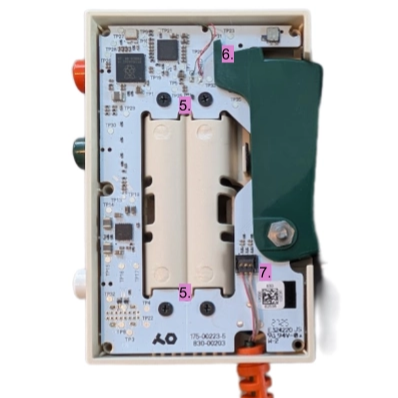
Inside the device is a single PCB, which has a cutout in the middle for a pair of AAA cells. A Raspberry Pi 2350 drives the device’s functions, supported by various components which [Sam] identifies, although he mostly looks at everything from the perspective of a mechanical engineer as he critiques the design. It’s a clean-looking, intentionally low-fi design that belies how complex the device really is.
The multi-function, chunky, spring-loaded side lever is of particular interest. It has three sensors: two switches and a potentiometer. One switch detects when the lever is at rest, or depressed by any amount at all. The potentiometer mates with the pivot point of the lever, allowing the device to directly sense how far the lever is pushed. The last switch triggers when the lever is pushed all the way in. Together, it forms an intuitive input that combines powering on (the device wakes up from sleep mode as soon as the lever is pressed) with the ability to adjust effects in proportion with how far the lever is pressed, while also bottoming out with a distinct click that itself acts as an input signal.
One other interesting bit is the light pipes that carry light from multiple indicator LEDs to the outside of the device. A textured surface acts as a diffuser and helps the lit surface look smooth, while a coating of silver paint prevents light bleed and (probably) maximizes light transmission through the plastic. Hot glue makes a pretty good light pipe material but if DIY light pipes end up in your next project, sanding the exit surface and giving the rest a coating of silver paint just might be worth a shot.
If you are a regular reader, then the odds are you have taken apart an electronic gadget, either for a fix, or simply because your curiosity got the better of you. Once inside, it’s all but impossible to help yourself from doing at least a little reverse engineering. That’s what happened when [PRBS23] took a look inside a MasterBuilt Gravity 800 Grill for a simple wire fix. But one thing led to the next, and now open source firmware for the grill is freely available!
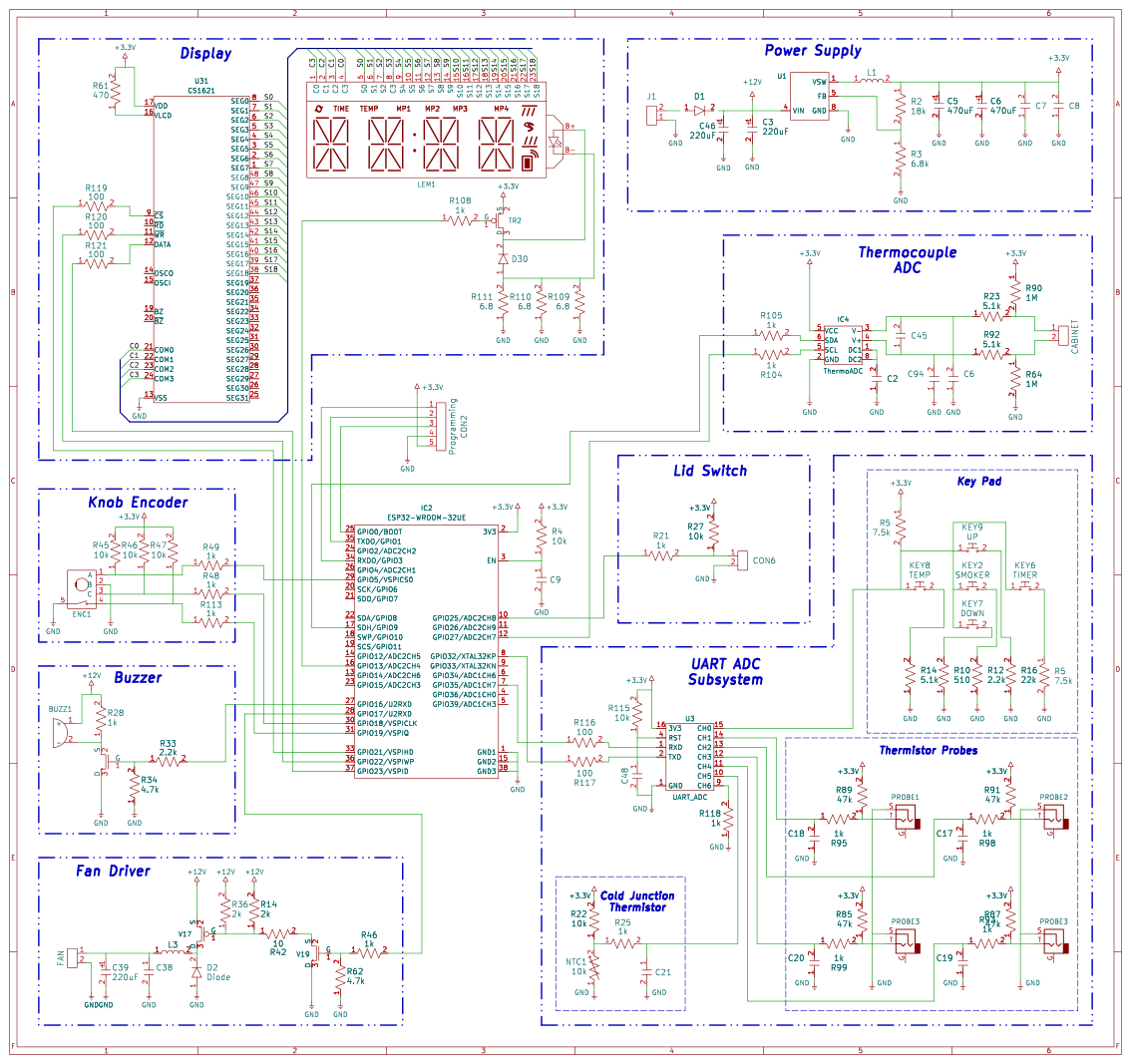
The thermistor along with the physical inputs are connected to a 16 pin chip, interfacing with the MCU over a 9600 baud UART connection. [PRBS23] cannot determine an ADC chip meeting these specifications, so the most likely answer is a cheap MCU programmed to act as a simple analog fronted.
The neatly labeled programming header is used to quite easily dump the firmware with the espflash utility. Analyzing this dump reveals a rather strange ADC correction function used by the original firmware. The necessity and overall utility of this function remains unclear, does corrects a maximum of around 40 degrees Fahrenheit.
Most of the other features ended up being at least somewhat easier. The CS1621 segmented display driver is reasonably well documented with datasheets making its implementation far easier. Likewise, the other odds and ends were implemented in a far more normal manner compared to the thermistors.
Magdalena Balazinska, left, outgoing director of the University of Washington’s Paul G. Allen School of Computer Science & Engineering, and Dan Grossman, the school’s vice director and newly named interim director. (UW Photos)
Top leadership is shifting at the University of Washington’s Paul G. Allen School of Computer Science & Engineering, as Director Magdalena Balazinska‘s term concludes after nearly seven years. Dan Grossman, the school’s vice director and a long-time faculty member, will take over as interim director.
The leadership transition officially takes effect Aug. 17.
The school and the UW College of Engineering announced the move Monday morning, following separate emails sent to Allen School faculty and staff by both professors (in full below).
Balazinska wrote that she will take a “long-awaited sabbatical” before returning to teaching, calling the transition something “we have been planning and discussing for a while.” Grossman sought to reassure the community that “the transition will be smooth and not the cause of any significant changes.”
According to the Allen School, Balazinska was initially appointed to a 5-year term, which is the norm. Extending the term of a director or chair is not considered unusual at the UW or in the Allen School, but Balazinska did not want to extend beyond an additional year or so.
The interim leadership structure with Grossman will remain in place for roughly a year while UW leadership considers recommendations from a Provost task force on how the institution should organize its broader computing, data science, and AI initiatives.
The Task Force on Computing and Data Science was established earlier this year to evaluate whether the university’s administrative and academic structures are properly built to support the rapid growth of computing, AI, and data science. A central focus of the mandate was assessing limitations in the current model — where computing resides within the College of Engineering — and identifying alternative organizational structures, including independent units or cross-university institutes, to enhance research leadership, external partnerships, and student pathways.
Grossman, who served on the task force, said that the group recently completed its report for Provost Tricia Serio and President Robert Jones to review. Balazinska said, “it will take time for the President and Provost to consider and act on recommendations related to task force findings.”
“UW is working seriously on how to best position itself to lead in computing in the decades ahead and the Allen School will, of course, be a key part of that,” Grossman wrote.
Major growth for Allen School
From left: Magdalena Balazinska, director of the Paul G. Allen School of Computer Science & Engineering; Andrew Connolly, director of the eScience Institute; Robert Jones, president of the University of Washington; and Sen. Patty Murray at the UW in January. (GeekWire File Photo / Taylor Soper)
Prior to leading the Allen School, she served as director of the UW eScience Institute and as the university’s first Associate Vice Provost for Data Science. In those roles, she spearheaded the creation of UW’s undergraduate and graduate data science degree tracks, pushing to integrate data-intensive discovery into fields ranging from astronomy to oceanography.
An expert in database management systems, Balazinska joined the UW faculty in 2006 after earning her Ph.D. in computer science from MIT.
Her research career has focused on scalable distributed data systems, cloud computing, big data processing, and image and video analytics. More recently, her work has expanded to multimodal data management and the intersection of AI and data systems.
Her work in the field earned her the inaugural Women in Database Research Award, as well as selection as an ACM Fellow.
Under Balazinska’s leadership, the Allen School saw a 50% surge in graduate degrees awarded since 2019 alongside the addition of 40 new faculty members.
The school awarded more than 800 degrees this year across its undergraduate, master’s and doctoral programs.
Balazinska, who is also the Bill & Melinda Gates Chair in Computer Science, oversaw a major modernization of the school’s core curriculum. Her tenure saw an overhaul of the introductory programming sequence, the launch of an undergraduate research program, a new Graduate Certificate in Modern AI Methods, and the creation of a Data Science minor, with an AI minor currently in development.
In her email, Balazinska expressed enthusiasm about returning to her core passion after taking time away during her sabbatical.
“I am looking forward to returning to research, advising, and teaching,” she wrote, noting that she plans to rejoin the Allen School faculty full-time following her break.
‘My dream job’
The Paul G. Allen School of Computer Science & Engineering — named for the late Microsoft co-founder — on the University of Washington campus in Seattle. (GeekWire Photo / Kurt Schlosser)
Grossman has served as vice director for nine years, and alongside Balazinska throughout her seven-year tenure, acting as her primary partner in managing the school’s academic programs, faculty affairs, and strategic planning.
“To me, the Allen School is much more than one of the leading computer science and engineering programs in the world,” Grossman said in a statement. “It has been my professional home since I completed my Ph.D. 23 years ago. It was my dream job then, and it’s my dream job now.”
A long-time UW faculty member and expert in programming languages and computing education, Grossman has frequently paired with Balazinska to navigate the department’s response to seismic industry shifts.
Most recently, the duo collaborated on public-facing efforts to address growing student anxiety surrounding AI’s impact on tech careers, advocating for curriculum updates that integrate AI tools while reinforcing core software engineering fundamentals.
Beyond administrative duties, Grossman has maintained a heavy presence in the classroom, teaching courses in programming languages, software design, and computer ethics. He also leads the school’s direct-admit seminar for first-year majors and created a popular online programming course on Coursera that reached thousands of students over the past decade.
“I could not be more grateful to Dan for stepping into the interim director role,” Balazinska noted in her email to staff. “He understands every corner of the Allen School, cares deeply about our students and faculty, and will provide outstanding leadership as the university navigates the next steps for computing.”
Nancy Allbritton, dean of the College of Engineering, said in a statement that Grossman’s appointment “will ensure strong leadership and continuity during a period of thoughtful planning for the future.”
Allbritton also expressed her gratitude to Balazinska for her “exceptional service and leadership” as the Allen School “strengthened its standing as one of the nation’s leading computing programs while advancing its impact in AI, data science, and emerging areas across research and education.”
Read Magdalina Balazinska’s email to Allen School faculty and staff:
Dear Faculty and Staff,
As we have been planning and discussing for a while, my term as Allen School director is coming to an end. Later today, the Dean will formally announce the appointment of Dan Grossman as Interim Director when my term officially ends on August 17th and I take a long-awaited sabbatical.
We will have an Interim Director for the next year or so because of the ongoing conversations on Computing, Data Science, and AI at UW, and how the University should organize itself and its efforts related to those important topics. Although the Provost Task Force is completing its work this summer, it will take time for the President and Provost to consider and act on the recommendations, and an interim appointment makes sense in that context.
My deep thanks to Dan for his willingness to assume this responsibility, and for the wonderful support he has provided to me in his role as Vice Director for the past 7 years. Dan and I have worked together ever since we joined UW as newly minted Assistant Professors over 20 years ago! Dan is a thoughtful leader who cares deeply about the success and well-being of our faculty, students and staff. I’m delighted that he agreed to take on this role at such a critical time for computer science education, for our University, and for higher education more generally.
As Director of the Allen School for nearly seven years, I’m incredibly proud of what we’ve accomplished — through some of the most turbulent times since we were founded as the “Computer Science Group” 60 years ago. We have not merely weathered those challenges — we’ve thrived.
Our accomplishments are too numerous to list in a short email, but a few highlights include:
We’ve grown substantially, graduating 50% more students today than in 2019, hiring 40 new faculty members (and also celebrating some retirements and other departures), and overhauling most of our processes to operate at this new, larger scale.
But we haven’t just grown, we’ve modernized our core educational programs, including our Ph.D. quals and undergraduate intro-to-programming sequence, while launching new ones: our Undergraduate Research Program, our Graduate Certificate in Modern AI Methods, the UW Data Science Minor (whose creation we co-led), and — now underway — a UW AI Minor. Along the way, we’ve introduced many new courses spanning quantum computing to AI-assisted software engineering.
Beyond the classroom, we’ve launched new research centers, initiatives, grand challenges, and research groups — including CREATE, Computing for the Environment, Globe.AI, and the Center for Learning, Computing, and Imagination, to name just a few among many others. We’ve also modernized our communications and website, expanded our research infrastructure, and raised very significant funds for new professorships, scholarships, fellowships, research projects, and other school activities.
We’ve also deepened our community support and activities — with new programming for undergraduates, graduate students, faculty, and staff.
While working on the above, we’ve celebrated everyone’s ideas, accomplishments, and impact including our students, researchers and staff winning some of the most prestigious honors on our campus and in our field. It has been wonderful to witness firsthand all that you have achieved and to cheer you on!
It has been a tremendous privilege to serve as director of the Allen School. I’m grateful to you — the members of our community — for giving your best every day to advance our educational and research missions and expand our impact, sharing your ideas for how we could improve, and giving me — and each other — grace as we navigated new and often unexpected challenges.
After a brief break in which I will see my daughter off to college(!), I’m looking forward to returning my attention full-time to advising my students and pursuing my research, while also supporting Dan in his new role together with the rest of the Allen School faculty and staff leadership.
Thank you for inspiring me, challenging me and supporting me over the past seven years. It has been a wonderful journey, and I learned so much about our community and myself along the way. And to my good friend and colleague Dan, congratulations!
magda
Read Dan Grossman’s email to faculty and staff:
Dear Allen School community,
Though you’ve already heard from Magda about the upcoming Allen School leadership transition, I wanted to send my own message as I work on transitioning into the Interim Director role.
First and foremost, I want to speak both for the full community and for myself personally in thanking Magda for her leadership over the last seven years. She has been truly extraordinary, managing both significant unexpected challenges (a pandemic is just one of several) and launching new initiatives across research, education, and how we organize ourselves that have set us up well for long-term success. Her steady, thoughtful, even-handed leadership is recognized throughout our community. Having worked closely with Magda, I want to add specifically, in case it isn’t as visible, two things: how she has sought out advice to reach consensus and develop new leaders, and how she has simply put in an enormous amount of time. Her sabbatical has been earned a thousand times over, but I’m also relieved that she isn’t going away and will be a key mentor and leader in the Allen School going forward. Thank you, Magda!
I want to assure everyone the transition will be smooth and not the cause of any significant changes – Magda has been planning to step down, and the staff and faculty leadership are ready. That’s not to say we won’t continue to change, in some ways rapidly, because that’s what we do as a leading school in a rapidly changing field and world. These are challenging times! The discussions I hear throughout the school on how we should adapt how we teach and learn, how we conduct research, and how we run the school’s operations are robust and exciting. They are also a lot of work by a lot of people, and I want to say that this work is not as ‘invisible’ as it may seem.
While these are challenging times in multiple ways, it is also a time of great opportunity. Technology continues to change all aspects of our lives and we are well positioned to create new technologies that make everyone’s lives better and that help our planet, while also influencing policies to ensure responsible use of new technologies. I see many opportunities for us to grow our partnerships with other units, with external collaborators, and within our School to accomplish those important goals while educating a highly skilled, knowledgeable, and ethical next generation of computer scientists and computer engineers.
Let me also emphasize that “the Allen School” needs your help in reaching our aspirations. No Director, interim or not, can alone do even a small fraction of everything we aim to do. To be honest, I find it a bit odd when I hear “the Allen School does X” or “the Allen School thinks Y.” “The Allen School” is us, nothing more and nothing less, a collection of hard-working people with diverse personalities, ideas, and preferred coffee/tea orders. (Strange fact about me: I don’t like tea.) I’m proud to be working alongside each of you, and I am excited for us to continue working together to set the future course of the Allen School.
As Magda mentioned, the rationale for not having done a Director search over the last year is that it is complicated by the ongoing university-level discussions and processes on Computing, Data Science, and AI at UW, and how the University should organize itself. I was on the relevant “Task Force” that recently completed its report, and now the Provost and President will need to make decisions and launch next steps. When we have information about these next steps and how they affect us, including the timing for a non-interim director search, I will be sure to let you know. We should be excited by this – UW is working seriously on how to best position itself to lead in computing in the decades ahead and the Allen School will, of course, be a key part of that.
Thank you in advance for everything we will accomplish in the year ahead. Please don’t hesitate to stop me in the hallway or send me an email with your ideas or even just to say hello.
Wenxin Fang of Redmond, Wash., holds the ZeroPivot Protractor that he designed and is selling through a new Kickstarter campaign. (Photo courtesy of Wenxin Fang)
Wenxin Fang was 14 years old when he realized he was fed up with fighting with a flimsy piece of plastic in math class.
As an eighth grader at Evergreen Middle School in Redmond, Wash., Fang kept bumping into the limits of standard classroom protractors — the cheap, clear tools generations of students have used to measure and plot angles. Frustrated by how often he had to realign the plastic arc just to mark a single line, he started sketching an alternative in his notebook.
Two and a half years and seven design iterations later, the incoming Tesla STEM High School junior is launching the ZeroPivot Protractor, a sleek, precision-machined aluminum hardware project aiming to drag an overlooked classroom staple into the modern era.
“I shouldn’t be fighting with a piece of plastic to draw an angle,” said Fang, now 17, during a call from China this week where he was meeting with suppliers ahead of production of his tool.
Fang launched a Kickstarter campaign on July 26 to fund the initial production run of the ZeroPivot. The campaign hit its initial target within 48 hours and has raised more than $2,200 from dozens of early backers.
Priced at $19, the ZeroPivot is positioned as a durable, high-precision upgrade over standard $3 plastic models. The funding will cover tooling costs and help manufacture the custom-machined aluminum components through HKAA Industrial, a supplier Fang vetted and partnered with during a visit to Shenzhen.
To make the tool work, Fang abandoned the traditional semi-circular design in favor of a guide-rail system made from anodized aluminum — a material choice he insisted on despite the higher production costs.
Unlike a standard protractor, which requires users to mark an angle’s vertex and rays in separate steps, the ZeroPivot features an adjustable sliding mechanism that allows users to plot and draw precise angles in a single fluid sweep.
“I went down this path of product design, trying to come up with something that’s small, that’s almost simplistic … that is able to improve the lives of people in tiny ways through good design,” Fang said.
Fang didn’t just keep his ideas trapped in his notebook. After coming up with the initial sketches, he brought them to his middle school engineering teacher, who encouraged him to build an actual prototype rather than treat it as a fleeting thought.
The ZeroPivot Protractor. (Photo courtesy of Wenxin Fang)
When he transitioned to high school, that mentorship expanded into a full support structure. A trio of teachers helped him turn his hobby into a legitimate consumer hardware launch:
Steven Bonomo, an engineering and product design teacher with a background working on Microsoft’s Surface Laptop line, guided Fang through user testing, ergonomics, and physical product design.
Andrew Christensen, who has a background in law, walked him through the corporate, operational, and legal logistics of starting his company, Bonae Artis LLC.
Karen Schaeffer, a graphic design teacher, helped him refine the brand identity and the final visual aesthetics of the product and its packaging.
That guidance proved essential as Fang spent the past year user-testing prototypes in class on himself and his classmates, refining the tool’s feel and mechanics in real classroom conditions.
Balancing the demands of a hardware startup with high school homework requires an intense level of discipline — and plenty of late nights.
“It’s a ton of work, that’s just the reality of it,” Fang said. “If you’re pushing a project by yourself, there’s not an external deadline there. What you have to do is set deadlines for yourself and say, ‘Hey, this iteration needs to get out by Sunday.’ I do late nights pretty often just to get something in on time.”
Diary of a protractor reinvention, from left: Wenxin Fang’s notebook sketches, touring a manufacturing facility in China, and various prototypes throughout the process. (Photos courtesy of Wenxin Fang)
For Fang, the ZeroPivot is just the starting point for a career he has been prepping for since childhood. His earliest memory of designing anything was at age 9 during Chinese Lunar New Year, when he used Lego bricks and superglue to create a custom ceiling hook to help his grandparents hang decorative lanterns.
Now aiming for a college degree and future career in product design and mechanical engineering, Fang sees the protractor project as proof of what simple, physical problem-solving can accomplish.
“That was kind of when I first realized, hey, I could make something so simple, and I could have somebody else use it, and it could be really nice for them,” Fang said.
With the Kickstarter campaign already funded, Fang is focused on executing the manufacturing run smoothly in China and delivering the finished ZeroPivot protractors to backers by his estimated February fulfillment target.
While he isn’t yet ready to reinvent the ruler or big pink eraser, Fang does envision creating more consumer hardware tools down the road. But his immediate motivation remains remarkably simple.
“I’m definitely focused on getting this through to fulfillment and getting this in people’s hands,” Fang said. “I think that is the most satisfying part of doing products — getting to see people using them.”

 Login
Login