
 Login

NASA SEES Interns Tackle Real-World Challenges in Lunar Exploration
4 min read
NASA SEES Interns Tackle Real-World Challenges in Lunar Exploration
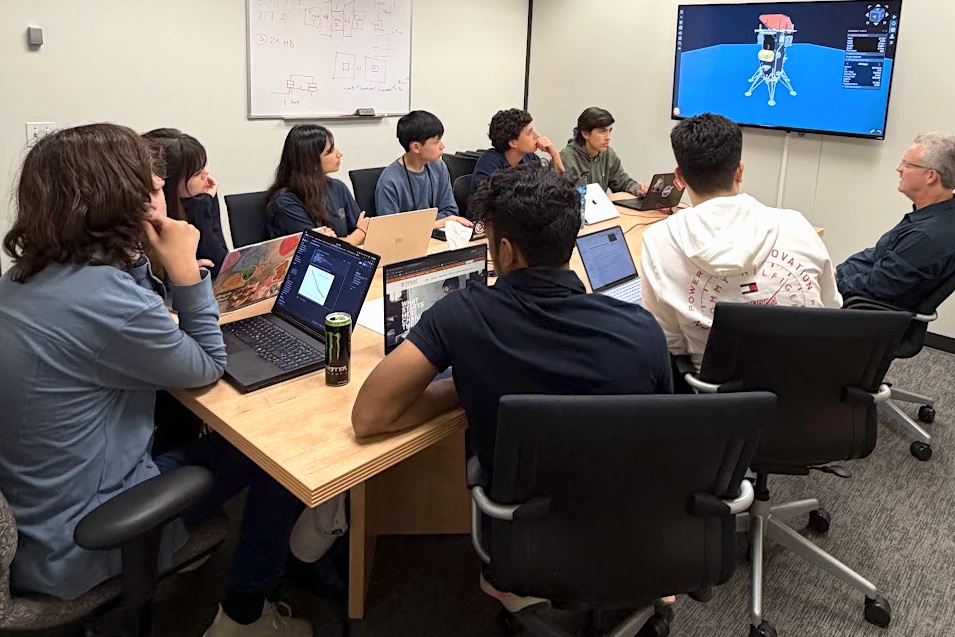
The NASA STEM (Science, Technology, Engineering, and Mathematics) Enhancement in Earth Science (SEES) Internship Program at the University of Texas Center for Space Research places high school students on small, mission-focused research teams mentored by NASA, academic, and industry experts. During summer 2026, the SEES Mission Architecture Tool for Research, Integration, and eXploration (MATRIX) team focused on applying a method for measuring propellant mass in microgravity, where liquid fuel clings to tank walls instead of settling – a challenge central to NASA’s Artemis missions.
The MATRIX team was mentored by Dr. Kevin Crosby, who, along with colleagues at NASA, developed the Modal Propellant Gauging (MPG) approach to microgravity propellant mass gauging at Carthage College in Kenosha, WI. MPG uses the acoustic response of propellant tanks to estimate the mass of fuel inside a tank. The method has been used successfully in several spaceflight experiments and is scheduled for demonstration on the Intuitive Machines IM-3 mission. The IM-3 lander, Trinity, is scheduled to touch down on the Moon in the Reiner Gamma region in 2027. The team developed models for predicting when MPG can take reliable readings during the mission, giving the interns direct experience with a technology preparing for spaceflight and lunar surface operations.
Reconstructing a Lunar Mission from Public Data
The MATRIX team relied entirely on publicly available sources, including Intuitive Machines’ published mission data. The NASA Jet Propulsion Laboratory’s Navigation and Ancillary Information Facility (NAIF) provided detailed trajectory records for the IM-1 and IM-2 missions. By comparing the IM-2 spacecraft’s reconstructed flight path with a model of its motion without engine thrust, the team identified engine burns and estimated the change in velocity associated with each burn.
Because a complete IM-3 trajectory is not public, the team wrote a reconstruction algorithm using published IM-1 and IM-2 flight data. To model fluid behavior, the team ran computational fluid dynamics (CFD) simulations to estimate slosh dynamics within the tanks and conducted Monte Carlo simulations to predict the range of possible propellant states.
Identifying Windows for Measurement
The team’s analysis showed that MPG can take reliable readings during the two primary burns, Lunar Orbit Insertion (LOI) and Powered Descent, and in some cases during Descent Orbit Insertion. The spacecraft’s starting mass had the greatest effect on how long each gauging window lasts. The MATRIX team also identified candidate IM-3 launch opportunities for 2027 and produced a landing analysis for the Reiner Gamma site that showed the distribution of possible landing sites near the target.
Presenting to the Scientific Community
The team briefed the Intuitive Machines propulsion group, walking the engineers through their methods and results and demonstrating that a rigorous analysis of an active lunar mission could be built from public data. The students presented their research, “Computational Models to Estimate Modal Propellant Gauging (MPG) Windows on the Intuitive Machines IM-3 Mission,” at the SEES Annual Symposium and the Wisconsin Space Grant Consortium Annual Conference. The team will present again at the American Geophysical Union (AGU) Annual Meeting in San Francisco in December 2026.
“This high school team, in a period of less than a month, developed a depth of understanding and facility with advanced methods that rivals advanced graduate students in the field,” said Crosby. “Their work product is exceptional, and their presentation to Intuitive Machines engineers impressed everyone with the sophistication and creativity of their work. The SEES program has consistently provided a unique environment for students to demonstrate they can achieve far more than what is asked of them, even in the most advanced classes.”
The SEES program gives 11th and 12th grade students direct experience with the data, tools, and analytical methods used across the aerospace industry. By applying NASA and commercial mission data to an active lunar mission, the MATRIX team contributed analysis relevant to propellant management, a capability needed for in-space refueling, fuel depots, and sustained exploration of the Moon and beyond. Thank you to all the mentors, project assistants, and volunteers who have made SEES possible for over a decade.
The SEES Mission Architecture (MATRIX) Team:
Raiymbek Abdy, The Woodlands, TX
Emmanuel Bravo, Boca Raton, FL
Winston Huang, San Francisco, CA
Adrianna Krajnovic, Dallas, TX
Marco Lo Cicero, Tomball, TX
Henry Martin, Milwaukee, WI
Reva Paul, Bethlehem, PA
Swayam Sahoo, North Chelmsford, MA
Project Mentor: Dr. Kevin M. Crosby, Carthage College and Wisconsin Space Grant Consortium
Project Assistant: Mauro Esquivel, mathematics teacher, McAllen, TX
For more information, visit: https://www.csr.utexas.edu/sees-internship/
The SEES project is supported by NASA cooperative agreement award number NNH15ZDA004C and is part of the NASA Science Activation Program portfolio, which connects learners with authentic NASA science experiences through partnerships with educators and community organizations.
Details
Related Terms
Explore More
Discover More Topics From NASA
James Webb Space Telescope
Webb is the premier observatory of the next decade, serving thousands of astronomers worldwide. It studies every phase in the…

Perseverance Rover
This rover and its aerial sidekick were assigned to study the geology of Mars and seek signs of ancient microbial…
Parker Solar Probe
On a mission to “touch the Sun,” NASA’s Parker Solar Probe became the first spacecraft to fly through the corona…
Juno
NASA’s Juno spacecraft entered orbit around Jupiter in 2016, the first explorer to peer below the planet’s dense clouds to…
