… at least document what failed and give the failure analysis a good effort. And then later on, you can “try, try again” or let someone else carry on with the work; they’ll have a good basis to start from.
We were talking about a project to use 10 W blue lasers to post-smooth 3D prints when I came up with this not-very-catchy catchphrase. The project itself is very much “in progress”, which is a nice way of saying that it hasn’t yet fully met its goals. But nonetheless I was entirely happy to watch not one, but two, videos where [I changed a thing] discussed the intricacies of laser-smoothing 3D prints, precisely because it sounds easy but absolutely isn’t, and because the problems were laid out so well.
I definitely take for granted how easy the slice-it-into-layers nature of FDM 3D printers makes path planning. After all, you can print interlocking knots, hinges, and even entire sections of chain mail as long as you only have to go one layer at a time. When you print this way, you never have to worry about the print head crashing into something that you’ve printed before, or being unable to reach into a small valley. To smooth two or more layers of a 3D print into each other, you are suddenly out of the comfy flatland. You have to worry about collisions, obstructions, and all the rest of actual 3D.
But those issues and more were carefully documented as [I changed a thing] went through his attempts at writing the software to drive the laser-augmented machine, and honestly that attention to the problems that were confounding him was worth a dozen “success” videos. In that sense, it worked on me a little like nerd sniping.
Those were my takeaways from the video series, then. One, it’s hard to do laser smoothing uniformly. But two, documenting the difficulties, considerations, and failures for your future self, or for others, is not just good practice, but can also encourage other people to help you with your project, or to take it on themselves. The more thought you put into how and why your project failed, the more bait you’re laying out for the next nerd. And that’s at least one part of what makes the open-source ethos work.
This article is part of the Hackaday.com newsletter, delivered every seven days for each of the last 200+ weeks. It also includes our favorite articles from the last seven days that you can see on the web version of the newsletter.
Want this type of article to hit your inbox every Friday morning? You should sign up!
Whether you like it or not, the use of LLMs to write code is kind of a big deal at the moment. We’ve been asking ourselves what, if anything, this means for us here at Hackaday. Should we try to figure out what percentage of a project was done by an actual human and how much was done by a machine? Does it really matter? What is our AI policy anyway?
Clearly, Hackaday is pro-human. We’re in it for the hackers as much as for the hacks. Our community is, like Soylent Green, made of people. It’s your inspirations and innovations that keep us reading and writing every day. And we produce 100% of our content the old-fashioned way, with projects selected through the taste and judgement of our writers, and their own words telling the story.
What about the hacks? We’ve seen a lot of projects recently that were coded with the help of an LLM. Does that diminish the work? In the end, what rings truest to us is what has always been Hackaday’s editorial guiding star: Is there something special in the hack that makes it worth talking about? Then we write about it. Was it written using vim or emacs? Did the author consult friends or a chatbot while working on the project? That’s not really relevant.
But in the past few years, the BS-generation machines have found our hobby, and we’re finding a lot more projects that don’t have any spark to them. We’re seeing circuits that make no sense, and claims that defy physics. Of course, we always have. The LLM-nonsense project is today’s version of the perpetual motion machines of old. Just like we never trust a hardware project that is all renders, seeing only AI-generated images is a huge red flag. It’s our job to separate out the wheat from the chaff for you all, but it’s something that you must be doing everyday as well.
We’ve seen amazing hacks over Hackaday’s 22-year history. Hackaday is older than YouTube and older than Stack Overflow. We’ve seen technology come and go. We’ve seen C-beams glitter in the dark near the Tannhäuser gate. (OK, maybe not.) And in the end, our AI policy is our same-old policy: we write up hacks that inspire us in the hope that they inspire you.
So if you’re using Claude to help you with the UI bits, or if you’re hand-writing it all in assembly, or wiring up the logic in diodes, we just want to see your cool hacks. And we hope that our collective signal will be so loud that we drown out the noise, at least in our own little corner of the hacker universe.
This article is part of the Hackaday.com newsletter, delivered every seven days for each of the last 200+ weeks. It also includes our favorite articles from the last seven days that you can see on the web version of the newsletter.
Want this type of article to hit your inbox every Friday morning? You should sign up!
₹11,111 for a meal. And that’s before taxes and beverages. Now that’s a number designed to raise an eyebrow.
But at RAGA, Chef Gaggan Anand’s first restaurant in India, you soon realise that this is not just another expensive tasting menu where you leave wondering where the next meal is coming from. This is a 22 course experience, and by the time you reach the end, you certainly won’t be looking for something else to eat.
RAGA Entry
Unstated luxury
The first impression is understated luxury. With an extra high ceiling and the kitchen spread across two floors, RAGA is as much a showcase of precision and craftsmanship as it is a restaurant.
There is a stunning open kitchen with some of the finest equipment, handcrafted Japanese crockery, Schott Zwiesel glasses and a kitchen and service team whose strength actually exceeds the restaurant’s seating capacity of just 32 guests.
A chef curated PDR is also expected to open soon, promising an even more personalised experience.
But the real theatre begins when the food arrives.
Gaggan’s cooking is not about simply making familiar Indian flavours taste better. It is about making you question what you are eating, how it was made and sometimes even what you thought you knew about it.
There is a cucumber preparation cut so impossibly thin that it almost disappears into a delicate gel that tastes remarkably like mint chutney. Another creation looks like something entirely unfamiliar, only to explode on the palate with the unmistakable flavour of Indian murmure.
There is nahari. Kashmiri tabak maaz. Modern chaat. Each appears in a form you may never have imagined.
And then comes the brain pepper fry. Except, given its flavour, texture and presentation, many diners may not guess that this apparently indulgent dish is actually vegetarian.
And yes, there is literally a course where you are expected to lick the plate.
That says something about the restaurant. RAGA isn’t afraid to have fun.
Yet it is the techniques, precision and presentation that make you understand why Gaggan Anand has consistently been regarded among the world’s finest chefs. Every course has a purpose. Every texture is considered. Every element has been thought through.
Even something as familiar as chicken wings gets a Gaggan treatment. A small rope is attached to the end so you can pick them up without getting your hands dirty.
Or take the very Indian matar. Even the peas have been painstakingly peeled, with the outer skin removed so that you get to the sweeter layer inside. It is an almost obsessive level of detailing, and this is precisely where you understand why RAGA needs such a large kitchen and service team for just 32 diners.
It is these little details that make the experience memorable.
RAGA is more than Gaggan
The name itself is a portmanteau.
RA comes from Rydo Anton, who is spearheading the restaurant in India, while GA stands for Gaggan Anand, the chef mentor whose vision shapes RAGA.
Joining them is Zorawar Kalra, one of the most influential names in Indian hospitality, whose concepts over the years have played an important role in shaping the contemporary Indian restaurant landscape.
Together, they have created something that feels less like an overseas chef opening a restaurant in India and more like a homecoming.
And perhaps that is what makes RAGA particularly exciting.
India’s restaurant scene has never had it this good. From Nisaba to Indian Accent and Comorin, and now RAGA, Indian cuisine is being interpreted with imagination, confidence and a global sensibility.
Will you get a reservation?
Absolutely not easily.
At least not in the initial months.
With just 32 seats and the curiosity surrounding Gaggan’s first Indian restaurant, reservations are bound to be fiercely sought after.
But the bigger question is whether RAGA will survive beyond the initial excitement.
My answer is yes. And not just survive. I believe it will flourish.
RAGA has the potential to become a destination restaurant for luxury travellers coming to India, particularly those who have experienced Gaggan’s restaurants overseas and faced months of waiting for a table.
And perhaps its biggest contribution will be inspiring more chefs and restaurateurs to think bigger about what Indian food can be.
At ₹11,111 plus taxes and beverages, RAGA certainly isn’t an everyday meal.
But then, this isn’t an everyday restaurant either.
Every course is a revelation. Every plate tells a story. And the experience is worth having at least once.
Address: RAGA, 21A, Janpath Road, Connaught Place, next to Le Meridien, Delhi
One of the stories of the last few weeks has been that AI companies have been scanning books in very large numbers in order to train their models with content guaranteed to have been written before 2002, and thus AI free. It’s caused some outrage, because of the size of the operation, and because the scanning process is destructive. In particular the phrase being bandied around is that these are rare books, and it’s this phraseology I find problematic. I think it’s time to unpack why that is the case.
It’s Not Book Burning, Folks
Before I worked for Hackaday I had a long career in and around the publishing industry, mostly on the electronic side, but from time to time crossing paths with my colleagues in the world of paper-based publishing. I understand the appeal of a good book, I’ve spend a lot of my life among bibliophiles, and let’s just say I own a few books myself. In particular I understand the symbolism of destroying books, bringing to mind as it does the actions of repressive regimes. I have stood in Bebelplatz in Berlin where the photo of Nazi student organisation members burning the library of Magnus Hirschfeld’s institute was taken in 1933, and if you know me, you’ll have an idea why that’s close to home. But for all that, what the AI companies are doing is not the same thing.
In this case they’re destroying the books for two reasons. Firstly, as I remember from a previous employer in the publishing world, it’s much easier to digitise a stack of papers than it is a bound book. Thus I’m pretty sure that’s one reason they remove the binding before digitising the pages. Then secondly, as I understand it it’s a copyright issue. If they buy a book, digitise it, and destroy the physical copy, they can legitimately claim that only one copy of it exists, and they hope, sidestep copyright claims from publishers.
When Rare Maybe Isn’t Really Rare At All
You’ll only see one of these numbers on a book published since 1970.
Perhaps the most pertinent question then is just what are the books being scanned and destroyed? They’re almost universally described as “rare”, but is that accurate or sensationalist? It brings to mind a dusty library filled with priceless tomes hand-transcribed by monks which it would be a crime to destroy, but there’s something that explodes that vision in an instant.
If you read the reports of what’s happening, they are ordering books by ISBN number. That’s an international system for identifying books, which was only introduced in 1970. If they’re ordering a book by its ISBN, it’s no medieval illuminated manuscript.
So the books being scanned and destroyed are relatively new, but can they still be described as rare? In that case just like anything else mass-produced since 1970, how many survive depends on the size of the original print run and how valued they have been since. So a few of these books can be physically rare in the sense of being uncommon, but if they are next-to-valueless, it’s fairly obvious nobody has particularly cared about their survival up to now. It’s likely that any books printed since 1970 which are both rare and of value will have their future assured, so the AI industry is not committing the wanton destruction of culture the reports would like to suggest.
You Need To Know Just How Many Books Get Pulped Every Year
People are often shocked when they find a dumpster full of books for recycling. Ricky Shore, CC BY-NC-ND 2.0.
I’m left feeling that a combination of the symbolism of destroying books along with a distaste for AI companies has inflated the status of these books well beyond their worth. If people truly had a care for old books they would be shocked to know how many are pulped each year by the paper recycling industry.
The publishing industry has been churning out mass-produced books for centuries now, so the world is awash with old books. Where do these newly-minted bibliophiles imagine they all go, to the Great Library In The Sky? I haven’t even touched yet upon the publishing industry, which pulps vast quantities of brand new unsold books every year. Where is the outrage, I ask?
We all love to dunk on AI companies, and Heaven knows, there are plenty of reasons to do so. Among all those reasons, sadly destructively digitising books is pretty low on the list. Please, ask the other questions, the ones they really don’t want to answer!
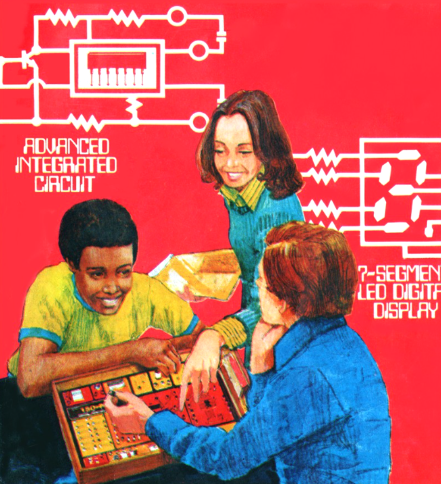
On Hackaday last week, and on the podcast, we were talking about one of the educational toys of yesteryear that launched a thousand careers, at least if the comment section is to be believed: the Radio Shack 200-in-1 electronics kit. The “toy” itself was basically a bunch of components with spring terminals, but the secret sauce was in in the instruction book, and maybe the marketing.
Tom had one of these when he was a kid, and told a great story about wanting it desperately based on the ads he had seen with kids Morse coding to each other. When he got the kit, and found out that “it was just a bunch of wires” he was fully pissed off. But he worked through the examples, learned some basic electronics, and the rest is history.
What I really love about this story is the siren’s call of a good project. Tom was pulled in, and maybe even fooled, by the advertising, but it probably changed his life. It’s funny how many of our folks can remember the first project that got them hooked as well. With me it was some simple audio effects pedals and then maybe later some simple BEAM robots, and for younger hackers maybe it was a 3D printer or Arduino project.
Digital or analog, the common ground here is that we all thought that some project was cool enough to warrant the sweat of learning enough to do it. Good instructions are helpful of course, and having the parts on hand never hurts. But it’s the promise of making something that you really want that I think underlies all good first projects. (And heck, every subsequent project as well.)
So while Tom, and a bunch of our readers, were looking back with nostalgia at the 200-in-1, I’m thinking about how many more than 200 projects I’ve seen made by our community, and even featured here on Hackaday, that are out there to provide the motivation to get someone started. Keep on hacking!
This article is part of the Hackaday.com newsletter, delivered every seven days for each of the last 200+ weeks. It also includes our favorite articles from the last seven days that you can see on the web version of the newsletter.
Want this type of article to hit your inbox every Friday morning? You should sign up!

 Login
Login