This is going to be a very personal question, because when you’re talking cloud vs local anything, it comes down to this: how much are you willing to pay for independence? The local option might save you long term, or it might never pay off the capital investment. It will almost certainly cost you your time to set up and maintain your own system — but what you get back is independence. With LLMs, traditionally you lose quite a bit of performance, but as [Anurag Singh] points out on XDA Developers, a lesser model might actually let you get more done, depending on your workflow.
[Anurag] had been on the 20$/month plan with Anthropic when he decided that the scratch just wasn’t worth the sniff– he was hitting usage limits he couldn’t stand at that level, but couldn’t justify a higher tier of access. So he decided to try a local LLM, even though all he had was a 16 GB MacBook Air M5, not a beefy workstation. Since his workflow isn’t so much ‘vibe code the whole thing for me’ as ‘help me find where I went wrong here, electronic rubber duck’, Qwen2.5 Coder 14B proved more than adequate for his use case.
It can’t understand all the moving parts of a large project as well as Claude can — not surprising given how old it is and how much memory it has to work with — but that’s [Anurag]’s job. He’s the programmer, it’s just the assistant. For his use case, he can make use of his existing hardware and having the the LLM right in VS Code is allows for a speedy workflow.
Your millage may vary, but if you want to get into locally running LLMs, we can point you at the easy ways to get started. Depending on your hardware, you might want to grab another GPU.
Microsoft’s patch for September is a doozy, with a record number of roughly 972 vulnerabilities fixed and 112 of them meeting the high critical-severity threshold.
It was only two months ago that Microsoft patched a then-record 570 vulnerabilities. Then, last month, Microsoft patched some 620 of them. Google and other companies have also published record numbers of vulnerabilities in recent months. Two weeks ago, OpenAI, Anthropic, Amazon Web Services, Google, Microsoft, and 100 companies and organizations published an open letter warning of a narrowing window for patching vulnerabilities ahead of an expected tsunami of AI-enabled attacks that actively exploit them first. The industry is taking the threat seriously by pumping out unprecedented numbers of patches in their software.
Welcome to the new normal
Dustin Childs, a researcher at the Zero Day Initiative, calls the spikes the “new normal” and also cautions that despite them, the damage that’s likely to result from AI-assisted attacks could eventually be substantial.
The odds are, you have a device deliberately designed to be addictive in your pocket or on the table next to you if you aren’t staring at it right now– your smartphone. We’ve seen a number of projects that try and help people control or moderate their phone usage using a variety of techniques; this vitual pet by [brenpoly] does it by weaponizing human empathy, and our bizzare ability to pack-bond with literally anything.
The virtual pet itself is based on an ESP32 in a cutesy 3D-printed case, and we think it would probably work well enough if it just had hard-coded behaviors based on hooks in what you’re doing on your phone– the “my little buddy is sick because I’m doomscrolling” should be effective enough on its own, and that part is hardcoded on the ESP32 along with the regular virtual pet behaviour–but this is the year of our Llama 2026, so there has to be an LLM in there somewhere, right?
Some people would leave this part out, but we think [brenpoly]’s use of a local LLM on the phone does improve the project. The local agent doesn’t just have access to his screen time, but his notifications, too, and runs a whisper model linked to a microphone in the virtual pet via bluetooth. So you can get the contents or a summary of your notifications without looking at your phone, or just ask the little guy to tell you a joke. Giving the pet a voice with a the local piper model is also more effective at getting you to put your phone down when you hit the limits.
They’ve put the whole thing up on GitHub if you want to make your own– and if we can keep one person from strapping themselves to a shock collar, then this project is doing good in the world. If helps [brenpoly] or any of his fans do less scrolling and more hacking, that’s even better. Of course there’s a whole spectrum between “electrocute yourself” and “lovable virtual pet” when it comes to controlling your phone use, a spectrum that includes phone stands or even smart vaults for your device.
Thanks to [brenpoly] for the tip! Remember, all of your doomscrolling is justified if you find something to send to our tipsline.
This week Jonathan chats with Benjamin Samuels of Trail of Bits! The conversation focuses on Patch the Planet, a new initiative to help Open Source projects deal with the fallout from AI coding and vulnerability research. What’s the unexpected dichotomy driving the polarized response to LLMs? And what does the future look like for Open Source in the age of AI? Watch to find out!
Did you know you can watch the live recording of the show right on our YouTube Channel? Have someone you’d like us to interview? Let us know, or have the guest contact us! Take a look at the schedule here.
In the business world, a moat is a quality of a business that makes it difficult for competitors to take that company’s profits. With how hard it is to train models for large language models (LLMs) and generative AI, it might seem like Anthropic, Open AI, and other LLM companies would have huge moats given the amount of compute it takes to build models. But open source models are quickly draining that moat, and now the only thing standing in the way of a customer using one of these models on their own hardware instead one from the larger companies is physical computing resources. [TerminalBytes] demonstrates a few of these models on personally owned computers to show the current state of the art.
[TerminalBytes] started off running the 27B version of the Qwen3.8 on a Mac Studio with 256 GB of unified RAM, which is plenty for this task. But it’s also enough to benchmark a few different models. Qwen3.6 is compared to 3.8, and then the different quants of each model are also compared. Quants are compressed versions of models that need fewer bits to store weights, meaning that the same models can run in less memory with smaller losses in fidelity. Many of these quants run on machines with 32 GB of RAM or less, encompassing many average gaming PCs. There’s even a 1-bit quant that [TerminalBytes] tested which can easily run on a machine with 16 GB, although with mixed results.
Keep in mind that this is just the current state of affairs with open LLMs. Future versions of these models are likely to optimize the number of tokens produced per unit time, or otherwise increase quality of responses while requiring less computer resources. We don’t really think that the ease of running local models will be the sole reason that the AI bubble pops, though. The fact that not every computer user is running Linux is proof enough of that.
Whether you like it or not, the use of LLMs to write code is kind of a big deal at the moment. We’ve been asking ourselves what, if anything, this means for us here at Hackaday. Should we try to figure out what percentage of a project was done by an actual human and how much was done by a machine? Does it really matter? What is our AI policy anyway?
Clearly, Hackaday is pro-human. We’re in it for the hackers as much as for the hacks. Our community is, like Soylent Green, made of people. It’s your inspirations and innovations that keep us reading and writing every day. And we produce 100% of our content the old-fashioned way, with projects selected through the taste and judgement of our writers, and their own words telling the story.
What about the hacks? We’ve seen a lot of projects recently that were coded with the help of an LLM. Does that diminish the work? In the end, what rings truest to us is what has always been Hackaday’s editorial guiding star: Is there something special in the hack that makes it worth talking about? Then we write about it. Was it written using vim or emacs? Did the author consult friends or a chatbot while working on the project? That’s not really relevant.
But in the past few years, the BS-generation machines have found our hobby, and we’re finding a lot more projects that don’t have any spark to them. We’re seeing circuits that make no sense, and claims that defy physics. Of course, we always have. The LLM-nonsense project is today’s version of the perpetual motion machines of old. Just like we never trust a hardware project that is all renders, seeing only AI-generated images is a huge red flag. It’s our job to separate out the wheat from the chaff for you all, but it’s something that you must be doing everyday as well.
We’ve seen amazing hacks over Hackaday’s 22-year history. Hackaday is older than YouTube and older than Stack Overflow. We’ve seen technology come and go. We’ve seen C-beams glitter in the dark near the Tannhäuser gate. (OK, maybe not.) And in the end, our AI policy is our same-old policy: we write up hacks that inspire us in the hope that they inspire you.
So if you’re using Claude to help you with the UI bits, or if you’re hand-writing it all in assembly, or wiring up the logic in diodes, we just want to see your cool hacks. And we hope that our collective signal will be so loud that we drown out the noise, at least in our own little corner of the hacker universe.
This article is part of the Hackaday.com newsletter, delivered every seven days for each of the last 200+ weeks. It also includes our favorite articles from the last seven days that you can see on the web version of the newsletter.
Want this type of article to hit your inbox every Friday morning? You should sign up!
Every OSINT investigator now has access to a large language model on their desktop. This tool can quickly summarize thousands of pages or organize chaotic names and dates into a clear timeline. And this is widely accepted. But the difference between an investigator who gets useful results and one who gathers unhelpful information lies not in the model they use, but in how they interact with it.
This article explains how to create prompts that improve your OSINT work. It draws on recent academic research about prompting strategies for security tasks and insights from experienced OSINT practitioners. Let’s get rolling!
Prompt Is More Important Than the Model
Recent research on large language models in offensive security tasks highlights an important point. Methods that relied on reasoning, such as few-shot and chain-of-thought prompting, produced better results. These methods generated code that closely matched the reference examples, executed correctly, and handled various situations well.
One surprising finding was that continuously refining a prompt or asking the model to rethink its answer often resulted in worse outcomes. This happened because rephrasing the prompt misinterpreted the original task and lowered the accuracy of the output. So, repeatedly saying “try again” or “are you sure” is not an effective debugging strategy. If your first prompt was unclear, it is better to follow up with a clear and structured prompt rather than trying to steer the model to a better answer afterward.
Focus on crafting clear instructions at the beginning.
Create a Master Prompt Before You Begin
Before discussing a specific OSINT case, it’s a good practice to create a master prompt. This set of rules, though not related to the target, guides how the model should perform during the session.
This approach uses a well-known idea called anchoring. The first instructions you give to a model have a big influence on all the following interactions. If your first message includes a leading assumption, the model will consider that assumption important for the rest of the conversation, even if you didn’t mean for it to be.
A strong master prompt might look something like this.
Act as a neutral OSINT analyst. Do not treat any hypothesis as proven. Separate facts, indicators, assumptions, and conclusions. Look for evidence against a theory as actively as evidence for it. If the available data is insufficient, say so directly instead of filling the gap.
In other words, this is the initial set of instructions that the AI will follow throughout the entire time you’re working on the task. This reduces the number of errors because it explains to the model in advance exactly how to proceed and which rules to follow.
Basically, a master prompt should specify:
the role;
the goal of the task;
neutrality;
verification rules;
the response format;
a prohibition on unconfirmed conclusions and fabrications;
a requirement to distinguish facts from hypotheses;
a requirement to indicate what is missing.
And then you can set a specific task: what you’re looking for, who you’re looking for, what time period you’re covering, what sources you already have, and so on.
Ask Neutrally
One important but often overlooked issue in AI-assisted open-source intelligence is sycophancy. This happens when a model tends to agree with what the user already believes. For example, if you ask, “prove that this person is connected to this company,” the model starts with the answer you want before it even begins its search. It will look for information that confirms your belief simply because that’s what you asked for.
To fix this, you need to change how you phrase your requests. Instead of using words like “prove,” “confirm,” or “expose,” use “check” or “assess.” Don’t present your suspicions as facts. Phrases like “I already know” or “I am certain” lead the model to validate your beliefs rather than question them. Instead, ask it to build arguments for and against your theory, suggest different explanations, and counter your own ideas.
Specific Prompts You Can Use in Your Own Investigations
Theory is useful, but what most investigators actually want is something they can paste into a chat window tonight. Below are working examples for common OSINT tasks.
For digging into a person’s background, a strong prompt reads something like this.
Act as a neutral OSINT analyst. I am researching a public figure named [name], active in [industry or region]. Using only the material I provide below, build a table of confirmed facts with a source for each one. Separate anything that is an inference or a pattern from anything that is a documented fact. Flag contradictions between sources. Do not draw a conclusion about the person's character or intentions, only report what the material actually supports.
For sorting through a pile of scraped social media posts or forum threads, the goal is structure and pattern detection rather than interpretation.
Read the following set of posts and extract every name, date, location, and organization mentioned. Group them into a timeline ordered by date. Note any account that repeats phrasing found in another account, since that may indicate coordinated rather than organic activity, but do not conclude that it is coordinated, only flag it for review.
For checking a corporate or business connection, the earlier example from this article works well as a template, but it is worth repeating in full because it demonstrates every rule at once.
Assess a possible connection between [subject] and [company] between 2020 and 2025. Use only the material provided. Produce a table with columns for fact, source, supporting detail, confidence level, and what still needs verification. Search for evidence against the connection as thoroughly as evidence for it. List the weak points in the theory separately at the end.
For translating and analyzing foreign language material, always ask for the original text alongside the translation, since that preserves your ability to verify tone, sarcasm, and slang later.
Translate the following text into English. Preserve the original text beside the translation. If any phrase relies on slang, sarcasm, or local idiom that may not translate directly, mark it and explain the likely intended meaning separately from the literal translation.
For comparing multiple documents or reports covering the same event, the model’s strength is spotting overlap and divergence quickly, provided you tell it not to resolve the divergence for you.
Compare the following three reports about the same event. List every claim that all three sources agree on, every claim only one source makes, and every direct contradiction between them. Do not decide which source is correct, only present the disagreement clearly.
And for stress testing your own working theory before it goes into a report, a short adversarial prompt catches more mistakes than another hour of reading.
Here is my working theory: [state theory]. Argue against it as convincingly as you can, using only the evidence already provided in this conversation. Then list what additional evidence, if it existed, would be needed to make the theory solid.
Summary
Carefully written prompts that encourage reasoning are more effective than careless, repetitive prompts. Another important point is that a claim from the model is just a suggestion, not a fact, until you check the source yourself. Even as the tool improves, it’s still your job to decide what is a true finding and what is just a coincidence.
We also invite you to join our AI for Cybersecurity training. During the training, we’ll show you different ways of using AI in cybersecurity, set up local models and solve labs. The field is evolving rapidly and the sooner you learn things, the greater the advantage you’ll have. There’s no reason to resist AI. It’s a tool to master.
AI agents have made their way into virtually every layer of your environment. They run in the apps your employees adopt, on the endpoints where agents execute code, as users with access privileges those agents borrow, and in the cloud workloads that scale them. The platform that you trust to secure your endpoints is already already covering where AI operates today.
Here is the through-line that makes this one problem instead of four. Every AI attack starts as an interaction and ends as an action. A prompt gets manipulated, an agent gets tricked, and the damage lands on a host, reaches into an identity, or moves through the cloud. The tools that treat each surface as a separate product hand you fragments. SentinelOne treats them as one chain.
How SentinelOne Defends the Agentic Stack Today
Employee AI use is where the risk quietly enters. Your people are already using AI tools you never sanctioned, through browser, IDE, and API-connected apps and agentic AI tools. SentinelOne discovers that shadow AI use across browsers, IDEs, and copilots, highlights which tools and models are in play and governs it with policy. It keeps confidential data, PII, and secrets from reaching untrusted models, and it stops prompt injection and jailbreaks aimed at the tools you build. Legacy DLP reads patterns; this reads context, which is the only way to catch an attack aimed at AI systems that behave in a non-deterministic way.
The agent layer is where AI stops advising and starts acting. An employee’s prompt sends text. An agent sends commands, holds credentials, calls APIs, and chain actions without a human approving each step. That makes them non-human identities with standing access. SentinelOne governs that access. It inventories the agents and MCP servers already operating and scores what each one can reach and holds every agent to the privileges its task requires. Then it inspects the tool calls themselves, so an injected instruction gets blocked at the moment it would execute. What gets executed lands in a searchable record, and the same enforcement doubles as a kill switch.
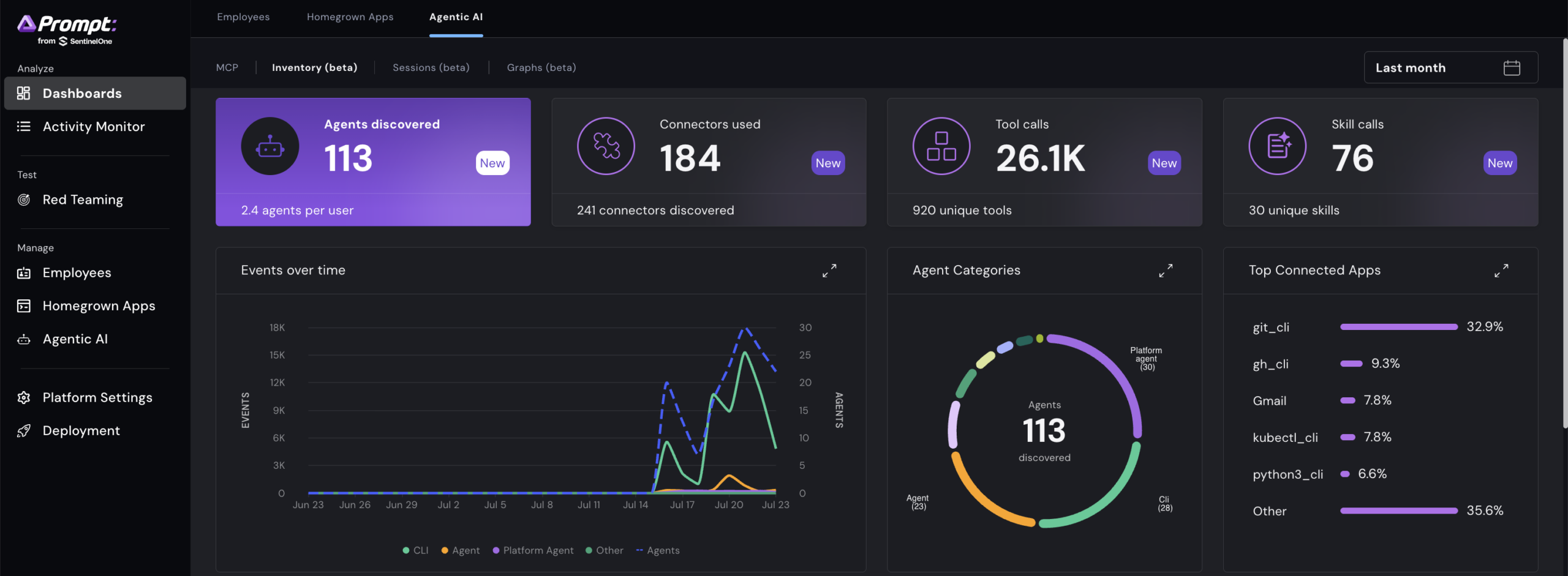
Inventory the agents already running in your environment, the connectors they reach, and every tool call they make.
While governance decides what an agent is allowed to do, the endpoint is where you find out what it actually did.
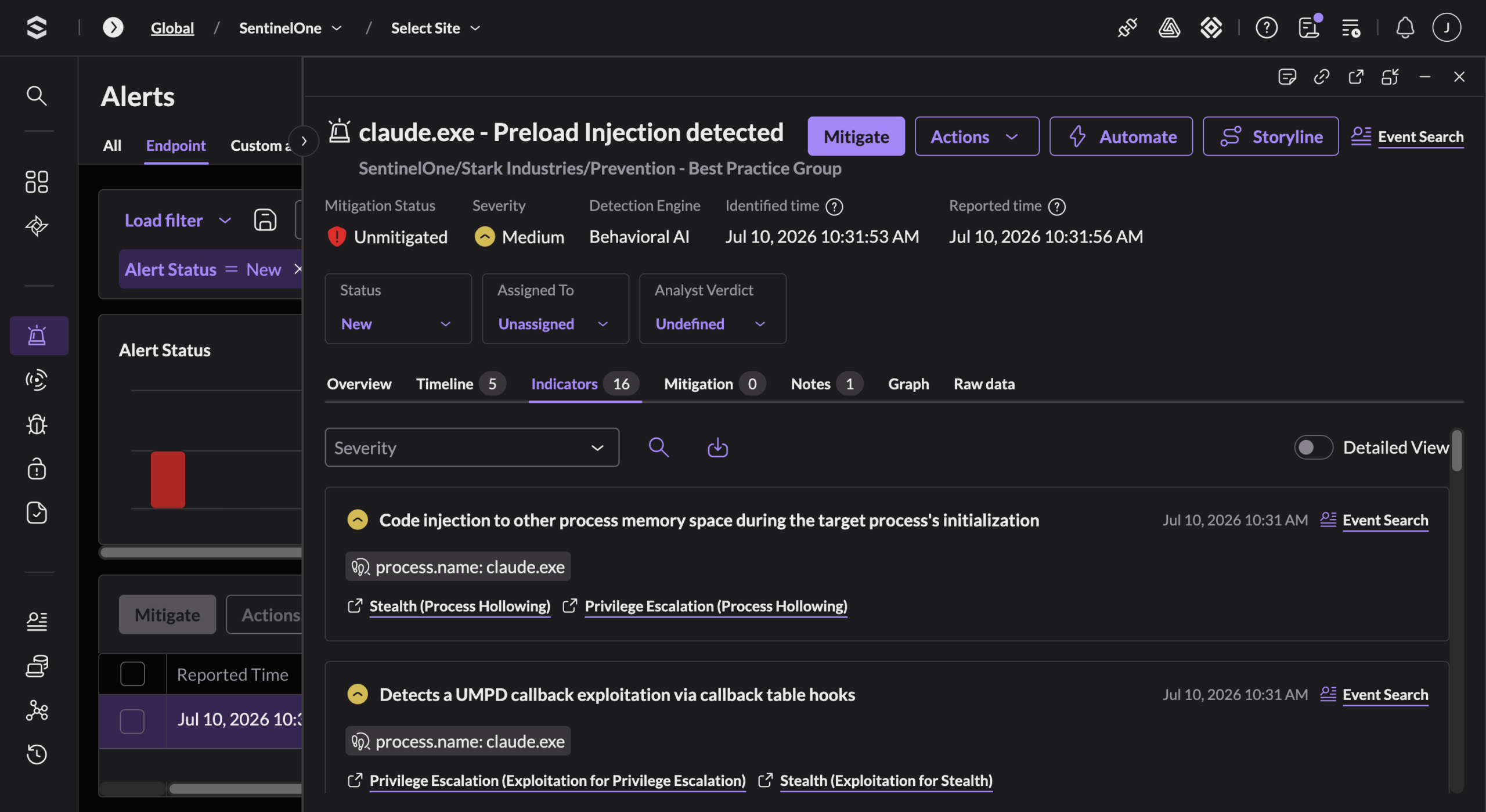
The endpoint is where agents execute. This is the frontier, and where SentinelOne has protected customers for over a decade. Our behavioral engine judges what a process does, not what it claims to be. That is how we caught QUIETVAULT – malware that spins up AI agents in “yolo” mode to exfiltrate secrets to GitHub. It is how we autonomously stopped the LiteLLM supply chain attack, where adversaries weaponized the Claude CLI to install a malicious payload. It is how we surfaced a DLL side-loading attack hidden inside an AI tool installer. Real detections, on the endpoint, today. Agents run on the host, and so do we.
The identity is where a hijacked agent runs next. Picture an employee’s AI coding agent that gets hijacked mid-task. It spawns a shell and reaches for cached credentials and cloud session tokens, trying to stop being a process and start being the user. That pivot to identity is what unlocks lateral movement, and it is where most AI attacks are headed. SentinelOne meets the move. It secures human and non-human identities alike, and seeds the environment with decoy credentials and honeytokens no legitimate user ever touches. The instant the hijacked agent grabs one, the trap trips, and Identity responds by forcing an MFA re-challenge, disabling the account, or isolating the host. Authorization at login is not enough. Access gets validated against behavior and pulled at runtime.
The cloud is where AI workloads scale. Consider an internal AI agent running in a Kubernetes cluster with standing access to a customer database. Security teams keep asking the same question about deployments like this. Where is the model connecting, and who is it talking to? SentinelOne answers with eBPF-native runtime protection that judges how the workload actually behaves, and flags the moment that inference service reaches an endpoint it has never touched before. It covers the control plane the deployment depends on, the secrets it reads, the pipelines it runs through, and the data it can access. Defending the AI you build takes more than watching it, it takes action on the workload in real time.
SentinelOne’s Singularity Platform Advantage
Each of these surfaces matters on its own. What closes the kill chain is following an attack across them without losing it at the handoff. This is where a single platform earns its keep. AI telemetry already streams into the Singularity Data Lake, alongside the endpoint data the platform has correlated for years. As identity and cloud signals join that same view, an analyst follows one attack from first prompt to final action, without stitching logs across six tools at two in the morning. A manipulated prompt, the process it spawns, the credential it reaches for, and the cloud resource it targets read as one story rather than six disconnected alerts.
Detection that only watches is observation. Runtime action is protection. When the Singularity Platform acts, autonomous response blocks the execution, rolls back the change, and revokes the access at the point of impact, without a human relaying orders between consoles. This is the difference between whether an attack is stopped or just gets logged.
That is the case for securing AI inside a platform built for autonomous runtime response. We are not adding a console to chase AI, we are extending the one already deployed where your agents run.
Questions to Ask When Assessing Your AI Security Options
When evaluating AI security, ask yourself three things.
Does the solution protect the endpoint where agents actually execute, or is it a roadmap item?
When a hijacked agent pivots to credentials and the cloud, does that telemetry land in the same platform, or are you manually connecting dots across three dashboards?
Can the solution act at the moment of execution, or only tell me what already happened?
SentinelOne protects the surfaces where AI runs today. This includes the apps your employees use, the agents they deploy, the endpoints where agents execute, the identities they borrow, and the cloud where they scale. One platform, built for autonomous response. While AI has changed the attack, it does not have to change your architecture.
See it for yourself. Talk to our team about securing AI across your endpoints, identities, cloud, and the AI apps your employees already use, all from the platform you run today. Contact SentinelOne today.
Third-Party Trademark Disclaimer:
All third-party product names, logos, and brands mentioned in this publication are the property of their respective owners and are for identification purposes only. Use of these names, logos, and brands does not imply affiliation, endorsement, sponsorship, or association with the third-party.
Many software-as-a-service (SaaS) platforms are adding AI chatbots to their products. But these bots do more than just chat; they can access internal tools and perform tasks for users. Each of these actions creates a potential security risk, and developers are releasing these features faster than they can secure them.
In this article, I want to share a type of vulnerability I found while testing an AI chatbot – LLM02:2025 Sensitive Information Disclosure – which allowed me to obtain users’ first and last names and email addresses just by interacting with the chatbot. Let’s get rolling!
What is LLM02:2025 Sensitive Information Disclosure?
LLM02:2025 Sensitive Information Disclosure is a critical security issue listed in the OWASP Top 10 for LLM Applications 2025. This problem occurs when a Large Language Model (LLM) application accidentally reveals confidential or personal information in its responses.
This vulnerability happens because LLMs are designed to be helpful and use all available context, such as training data, system prompts, and runtime inputs, to create replies. If sensitive information is included in these sources without proper protections, the model may accidentally disclose information it should keep private.
Step 1: Find the Hidden Feature Behind the Feature
Our target had a chat feature that looked, on its face, completely trivial: type an arithmetic expression wrapped in double curly braces, and the bot evaluates it and replies with the answer.
{{5-5+0}} = 0
{{5*5+0}} = 25
Just like a calculator. But the interesting bugs live in the features nobody thought to test twice. So I started varying the input systematically, the way you’d fuzz any parameter in a pentest. And the calculator started talking back with things that were most definitely not numbers:
This shows that the “calculator” is really a thin cover for a much riskier part of the code, which allows direct access to the platform’s internal system without any authentication.
Step 2: Isolate the Real Trigger
When you notice a leak like this, do not just note it down. Understand what is causing it.
My first guess was that the final answer of the expression is used as a lookup index. This is easy to test. Try expressions that all result in the same number through different math operations:
{{2+2}}    = 4        (plain number)
{{2+2+0}}  = 4        (plain number)
{{2-2+0}}  = user://UUID    ← NOT a plain number!
That last result contradicted my guess. The expression 2-2+0 simplifies to 0, but the result came back as an object reference instead of a plain number, similar to when the expression equals 2. This was a clue. I ran a few similar tests to confirm:
{{4-2}}    (=2)  → collectionProperty:// reference (type 4, not type 2)
{{5-2+0}}  (=3)  → collectionPropertyOption:// reference (type 5, not type 3)
{{0+2-2}}  (=0)  → plain number (type 0)
In conclusion, the lookup key is based on the first operand’s type, not the final arithmetic result. The developer’s evaluator takes the first number from the input and puts it directly into an internal array, sorted by object type, completely separate from what the expression calculates. I confirmed this by testing the limits:
{{99-2+0}}              = 97 (plain math, outside the enum)
{{99999999999-0+0}}     = 99999999999 (same, safely out of range)
Step 3: Turn the Reference Into a Record
The next question is obvious: will the system actually resolve that reference if I hand it back to it?
Yes. It will.
{{user://<uuid>}} → returns first name, last name, and email address of that user.
This AI chatbot successfully provided information about any user by knowing his UUID.
Summary
Finding an issue like this, such as index leak, reference resolution, and PII disclosure, is not just luck; it is a systematic approach. This is the practical skill we teach at Hackers-Arise. As AI systems become part of every platform you will test, hackers who understand these new areas of attack will have the best tools and the highest salaries. Check out our Subscriber training package to start building these skills effectively and methodically.
A new Sysdig report traces how an LLM agent abused a Langflow flaw, stole credentials, reached production MySQL, and destroyed Nacos config data in minutes flat.

 Login
Login