Welcome to Edition 9.10 of the Rocket Report! This week we're celebrating a historic moment in Europe when a German rocket company successfully put its launch vehicle into orbit. Isar Aerospace became the first purely commercial European company to reach orbit, and impressively it did so on just its second launch attempt. How quickly can they scale up operations? How quickly will the second European launch firm reach this goal? Big questions, which for now we don't have answers to.
As always, we welcome reader submissions, and if you don't want to miss an issue, please subscribe using the box below (the form will not appear on AMP-enabled versions of the site). Each report will include information on small-, medium-, and heavy-lift rockets as well as a quick look ahead at the next three launches on the calendar.
Isar Aerospace takes a huge step forward. Isar Aerospace, founded in 2018 by three students at a German university, successfully launched a privately developed rocket into low-Earth orbit on Saturday from a Norwegian spaceport inside the Arctic Circle. The two-stage rocket, Spectrum, became the first fully commercial launch vehicle in Europe to reach orbit, Ars reports. With Saturday’s success, Isar becomes the clear leader among a pack of several European launch startups vying to inject some competition into Europe’s stagnant launch market.
A new report says Seattle’s economy “may not be in decline, but it is in danger.” (GeekWire Photo / Kevin Lisota)
An independent study commissioned by the City of Seattle says the city’s tax structure is unique among its peers in the way it “specifically penalizes the hiring of senior, high-compensation workers,” with that penalty falling overwhelmingly on large tech employers.
Overall, Seattle’s business taxes are actually in line with competing cities, write researchers from the economic consulting firm Formation in the new report. But Seattle’s taxes are “particularly distortionary when it comes to hiring high-wage employees,” they add.
Mayor Katie Wilson helped design the tax, known as JumpStart, before taking office. But even the strongest supporters of new local and state taxes would concede that Seattle is “reaching the limits of how much it can tax the industries and people that it is depending upon to drive its growth,” the researchers write.
Another risk for the city is the resulting concentration of the tax base. Three-quarters of the payroll tax on large employers comes from 10 companies. Nine of them are in tech-related sectors.
A big company shifting 10,000 workers out of Seattle would cost the city about $50 million a year in payroll tax revenue, the researchers say in an accompanying slide deck, without naming Amazon explicitly. That’s more than a quarter of the $175 million deficit the city projects for next year.
In that way, much of the city’s financial future depends “on the marginal location and compensation decisions of a handful of employers,” the report says. Because much of the taxed compensation is vesting stock, it adds, the city’s revenue is exposed to “the single most volatile attribute of these firms — one the city has no ability to forecast or influence.”
Reducing that dependence through growth is the bigger point of the report.
The 127-page assessment, called “Seawall: Building a Resilient Seattle Economy,” goes well beyond the topic of taxes. The title refers to Seattle’s rebuilt waterfront seawall, engineered to hold back the water and also let marine life take hold. The researchers offer this as a model for protecting the city’s economic base while building a more diverse economy on top of it.
A decade of growth lifted wages at every level of the income spectrum, the report finds. Few other U.S. regions spread prosperity as broadly. But the same growth made Seattle far more expensive, especially for families.
Fast-forward to today, and the report sees an economy that’s dangerously concentrated, “significantly more AI-exposed than the national average,” short of the electricity it will need, and no longer producing mid-sized companies.
In danger, not in decline: The report is also careful to point out the city’s unique position and strengths. Seattle’s tech workforce is “almost peerless,” it says: 23% of the nation’s AI engineers are based in the region, and output per tech worker is more than double the national average.
The region also has the rare combination of a big tech industry and a strong manufacturing base.
Seattle “may not be in decline, but it is in danger,” the researchers write — “not because it is losing its place in the industry, but because the industry could undergo a radical change, and arguably already is.”
The concern that Seattle is becoming “the next Cleveland,” raised in a GeekWire column in February by Seattle tech veteran and angel investor Charles Fitzgerald, is “likely hyperbolic,” the researchers write. (They acknowledge that it “caused quite the stir this past winter.”)
The report points instead to Portland and Los Angeles as the more relevant warnings, citing Portland’s pileup of new business taxes and Los Angeles’ failure to turn a deep talent pool into jobs.
Fitzgerald responded Wednesday evening on his blog, Platformonomics, writing that the city “has finally acknowledged there is such a thing as an economy.” His main objection was who wasn’t in the room: “No businesses were involved, but that seems to be the norm hereabouts on economic matters.”
The report’s acknowledgments list dozens of interviewees, including the Seattle Metropolitan Chamber of Commerce, the Washington Roundtable and the Tech Alliance. No large tech employer is among them.
Ryan Donahue, a co-founder and managing partner at Formation, said in an email that the researchers interviewed many business representatives but no large companies directly, saying he expected a predictable message from their government affairs teams.
The person who led the report’s tax and cost analysis previously ran Amazon HQ2 recruitment at the Virginia Economic Development Partnership, the agency that landed the project for Arlington, Va., Donahue said, providing insights into how firms like Amazon weigh those decisions.
A path forward: The report recommends that the city focus on five industries: artificial intelligence, cleantech, maritime, life sciences and space. Cleantech is the priority, the report says, because Seattle owns or regulates much of what the sector needs, from Seattle City Light to building codes, permitting and land use.
The Seattle Office of Economic Development commissioned the report from Formation in 2025, under then-Mayor Bruce Harrell, to examine the drivers of the city’s business climate.
Harrell’s successor, Mayor Wilson, released the report Wednesday afternoon alongside an executive order convening a task force of business, labor, community and civic leaders, directing the city to improve permitting pathways, and calling for a proposal to create a Seattle Strategic Initiatives Fund.
In releasing the report, Wilson’s office said the findings “are independent and are not City policy.” But speaking on KUOW-FM’s Soundside as the report was released, the mayor called it “fantastic,” describing it as “super nuanced,” and urging listeners to take the time to read it.
The cost of a hire: JumpStart, the payroll expense tax, applies to large employers based on the compensation they pay to high-earning workers in Seattle. Approved by the City Council in 2020 and in effect since 2021, it was created to fund affordable housing, small-business support and climate programs, but the city has increasingly used it for general government operations.
Wilson helped create the tax before running for mayor, saying on her campaign website that she “played an instrumental role in designing and passing” the payroll tax.
Under JumpStart, hiring a software engineer at $650,000 in total compensation costs about $17,000 a year more in Seattle than in Bellevue, the report says. For an employee earning more than $1 million, the difference exceeds $33,000. San Francisco imposes no per-employee tax at all, and New York City’s equivalent is less than $6,000, according to the researchers.
That $17,000 reflects the tax’s top rate, which this year applies only to employers with about $1.3 billion or more in Seattle payroll. Two or three companies at most are in that tier, the report says. At the city’s lowest rate for that pay level, the same engineer would cost about $11,800, according to Seattle’s published rates.
The rate rises with an employee’s pay, and a company that crosses one of the city’s payroll thresholds pays the higher rate on every qualifying worker, not just the next hire.
“No other comparison city has a tax with both of these features,” the report says.
An issue of perception: Business leaders interviewed for the study described JumpStart as a problem “not primarily for its cost but because the process of enacting it communicated that the city’s governing orientation is fundamentally extractive.”
The researchers add: “Whether or not that characterization is fair, it is the operating perception, and perception shapes location decisions.”
But the researchers stop short of recommending a change. Taxes have “modest effects on firm location and expansion decisions,” they write, and Seattle is unlikely to lose its biggest employers to other regions, because the alternatives are either more expensive or have weaker talent.
“The Eastside is the only real threat in that regard,” the report says.
The study is blunt about what is at stake in keeping those employers. “If they leave,” it says, “Seattle won’t become more equal, it will just become poorer.”
What to do about taxes? The report does not recommend raising or lowering that top rate. Research on how firms respond to local taxes draws on thousands of firms across dozens of jurisdictions, it says, and “cannot tell us how any one firm will respond to any one tax change.”
With two or three firms in the top tier and “one firm by far the most dominant,” the question “is fundamentally a question about how that single firm will react.” It adds, “That is not a question this report, or the literature it draws on, is equipped to answer.”
GeekWire has contacted Amazon for comment on the report.
Other tax options that have been floated — vacancy taxes, wealth taxes, head taxes beyond JumpStart, expanded gross receipts schemes — are “either disallowed under state law or would, if enacted, likely push out the firms and workers Seattle most needs to retain,” the report says.
And once the state’s new 9.9% tax on income above $1 million takes effect in 2028, Seattle earners above that level will face a combined state and local marginal rate of about 10.5%. Pushing meaningfully above that, the report says, “would be a high-stakes tax experiment.”
Mayor Katie Wilson with business, labor and community leaders after signing an executive order on the economy Wednesday at the Seattle Office of Economic Development. (City of Seattle Photo)
Where Wilson stands: The mayor has already conceded the Bellevue point. “I don’t think it’s good that it is less expensive to do business in Bellevue than in Seattle,” she said in May. “We’re going to be taking that into consideration.”
She defended the tax in June, crediting it with helping Seattle recover from the pandemic and cautioning against blaming downtown’s problems on any single cause.
Her relationship with the tech community has been rockier. At a Seattle University event in April, asked about that state tax, Wilson said concerns about wealthy residents leaving were “super overblown” — then waved and said, “the ones that leave, like, bye.” The moment drew national coverage and criticism from Seattle investors.
A bet on cleantech: Taking a step back, the report says Seattle’s best opportunity is in cleantech, a category it defines broadly to include clean energy generation, energy efficiency and sustainable production methods and materials.
The shift is already showing up in local venture funding. Cleantech and energy companies took 3% of the venture capital raised by Seattle-area private companies from 2016 to 2020, and 20% from 2021 to 2025, according to Crunchbase data cited in the report. Three companies — TerraPower, Helion and Group14 — account for 70% of that.
The city “should be most concerned about AI but most active in cleantech,” the report says.
AI will ultimately be more important to Seattle’s future, the researchers explain, but the city has almost no ability to shape it. Cleantech is different: Seattle owns the electric utility, writes the building codes and controls permitting and much of the land.
The city can also use its own purchasing power to create a market for what these companies build, the report says, pointing to a New York program that used public housing demand to bring a new cold-climate heat pump into production.
To reach the top tier of cleantech ecosystems, the report says, Seattle would need a dedicated entity putting at least $5 million a year into growing the sector, funded through ratepayer charges, philanthropy, corporate sponsorship and competitive federal grants.
What’s next:According to the city, Wilson’s executive order calls for the task force to convene industry roundtables in the coming months. The report’s own first-year list runs to ten items, including a business-led commission on the city’s fiscal exposure, with an emphasis on AI, and structured visits with 50 companies across the five industries it identifies.
Others include naming a senior staffer in the mayor’s office to run the city’s AI agenda, and a childcare cost-sharing pilot split three ways between employee, employer and city, with the city’s share paid out of JumpStart.
On taxes, the report’s primary recommendation looks beyond City Hall. It urges Wilson to build a cross-partisan coalition of mayors and county executives to press Olympia for new municipal revenue tools, including changes to the state’s 1% cap on property tax growth.
A caller on KUOW asked Wilson whether there’s a limit to how much Seattle should grow. She said she shares the concern, then pointed back to the report, which she said makes clear there is “no graceful path” for Seattle to cool down its growth.
Welcome to Edition 9.09 of the Rocket Report! This edition includes an update from Blue Origin on the groundbreaking of a new Payload Processing Facility in Florida. It has been about a month since the company offered any meaningful news on its heavy-lift New Glenn rocket, which remains grounded after an on-pad explosion at Cape Canaveral Space Force Station in May. The official line from Blue Origin is that the company is targeting a return to flight with New Glenn by the end of the year, but there's good reason for skepticism.
As always, we welcome reader submissions. If you don't want to miss an issue, please subscribe using the box below (the form will not appear on AMP-enabled versions of the site). Each report will include information on small-, medium-, and heavy-lift rockets, as well as a quick look ahead at the next three launches on the calendar.
Isar Aerospace is ready to try again. Isar Aerospace is about to make the next attempt to launch the Spectrum rocket into orbit, with a weeklong launch window set to open Friday at Andøya Spaceport in Norway, the Norwegian Broadcasting Corporation (NRK) reports. The German launch company aims to deliver several small CubeSats to orbit with the two-stage Spectrum rocket. A test flight of the privately funded launcher failed shortly after liftoff last year, and Isar has attempted to launch the second Spectrum rocket several times since January, only to be thwarted by technical problems and the unavailability of the launch range in northern Norway.
Welcome to Edition 9.08 of the Rocket Report! Some major news this week from the state of Louisiana, previously associated with space due to NASA's aging Michoud Assembly Facility near New Orleans. Now the state has a chance to become the epicenter of SpaceX's Starship program as the company plans to invest up to $100 billion to construct factories and multiple launch pads for the super heavy lift rocket. It would utterly transform coastal Louisiana.
As always, we welcome reader submissions, and if you don't want to miss an issue, please subscribe using the box below (the form will not appear on AMP-enabled versions of the site). Each report will include information on small-, medium-, and heavy-lift rockets as well as a quick look ahead at the next three launches on the calendar.
ESA announces big launch challenge contracts. The European Space Agency said Thursday it signed contracts with a handful of European launch startups to help them continue development of their vehicles. "The European Launcher Challenge is ESA’s initiative to expand European launch service supply and ensure more robustness in Europe’s access to space," the space agency said of the award, which supports the development and operation of small launch vehicles in Europe. For some of these firms, the funding will provide a key lifeline.
The question has shifted. Security leaders spent several years debating whether AI would reshape security operations. That debate has settled. Now the conversation is about pace. How fast can the foundation be built, and what do organizations that moved early have to show for it?
For the second year, SentinelOne® commissioned 451 Research to survey 611 North American cybersecurity decision-makers and practitioners on the state of security operations strategy. The results confirm what we’ve been building toward, and they surface a finding that should recalibrate how most security leaders sequence their AI investments.
The Returns Didn’t Wait for the Roadmap
Many product roadmaps assume a clear sequence and start with building toward higher maturity first with returns following. The data shows that AI is running ahead of schedule.
Nearly all organizations surveyed (96%) are still operating AI at the earliest maturity levels:
Level 2: More senior triage analyst / basic incident responder and investigator
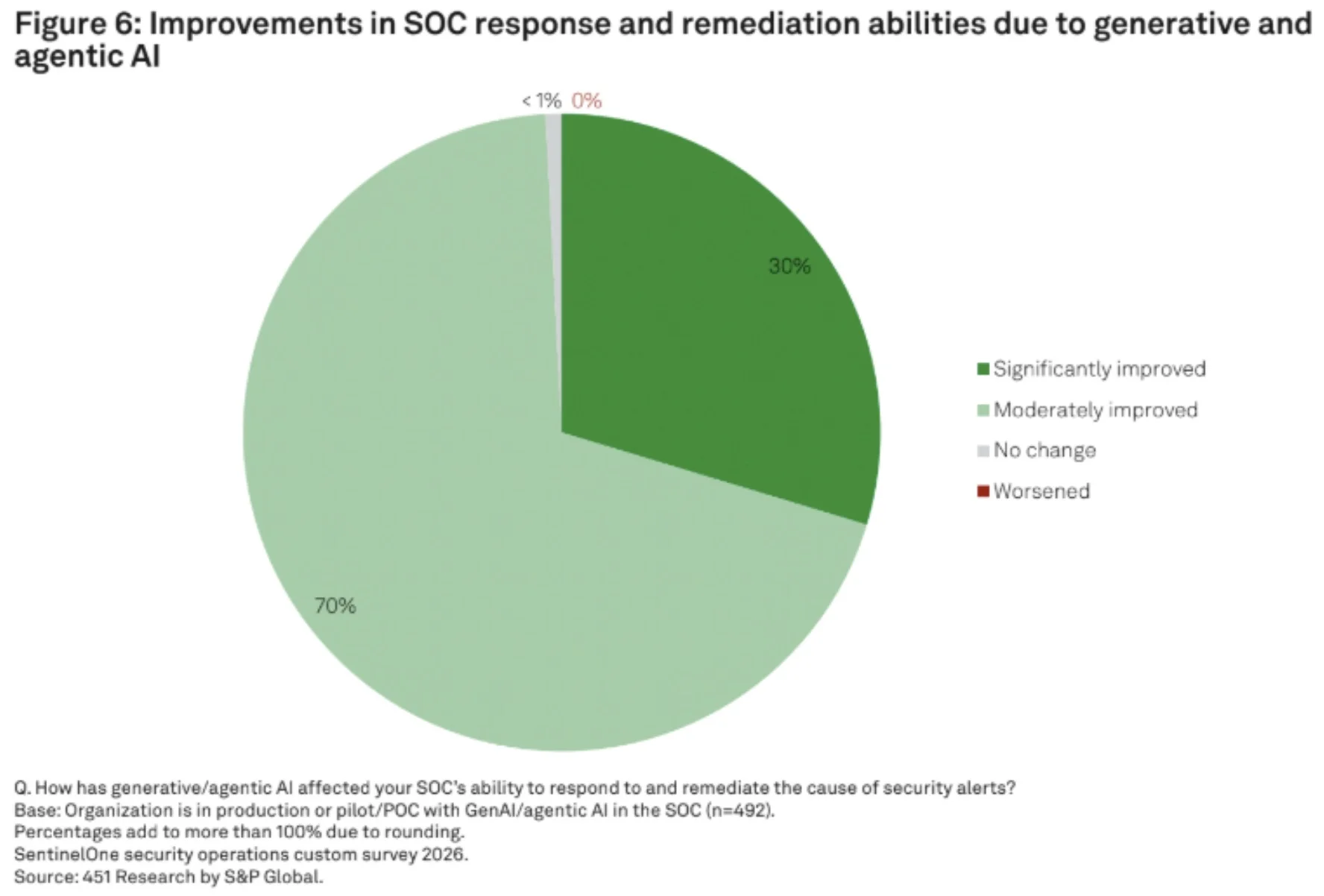
By most measures, AI adoption in the SOC is still early. And yet, 99% of those same organizations already report improvements in incident response and remediation.
The numbers are consistent. Early-stage AI (chatbots handling initial alert triage, automated tools sorting true positives from noise) is delivering before organizations reach advanced maturity. The gap between where most organizations are and what they are already getting is real and consistent across survey respondents.
Organizations waiting for higher AI maturity before building the supporting infrastructure are running the sequence backward. The returns are available now. The foundation built today determines how far those returns scale.
Platformization Has Reached A Verdict
The organizations accelerating AI adoption are also the ones consolidating onto platforms. A platform-oriented security architecture means moving from siloed, specialized tools to an integrated stack built on a foundation that coordinated AI decision-making can actually run on, and one that lets each new capability compound on the last.
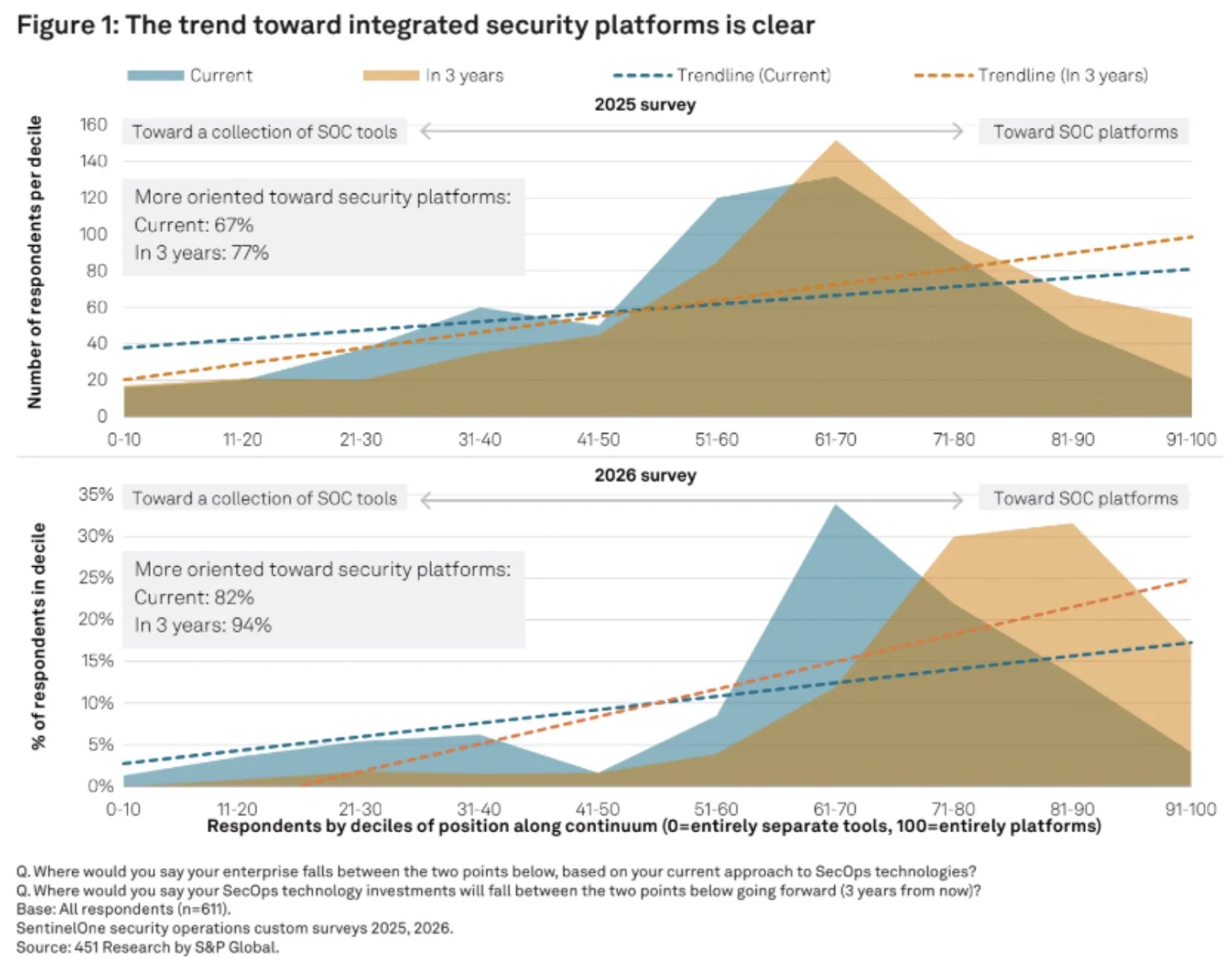
The platformization numbers from this year’s survey are clear. 82% of organizations describe themselves as platform-oriented, a 13-point jump in a single year, and 94% expect to be there within three years.
A common assumption is that platform adoption means replacing specialized tools. The data complicates that picture. The same technologies most frequently deployed as standalone tools (EDR, SIEM, CNAPP) are also the top anchors for integrated platforms. Organizations typically start with one of these and expand outward. What changes is the common data layer that enables coordinated AI decision-making, serving as the connective tissue underneath.
Platformization is not coincidental with AI’s emergence. Agentic AI needs connected, continuously updated data to accurately reason across signals and take autonomous action. Fragmented architectures, where telemetry is siloed and pipelines require manual effort, cannot support AI-driven SOC operations at scale. Platform adoption and AI adoption are converging because AI’s data requirements have made integration a structural necessity.
The survey makes the infrastructure connection an explicit one. The top-cited benefit of investing in a data lake for SecOps is supporting AI-driven SOC workloads and agents. Organizations that built the data foundation early have already cleared the barrier stalling others. Those who haven’t, face a prerequisite gap, and the distance is widening rapidly. Architectural readiness is the variable that determines how far AI investments can scale.
Job Satisfaction Is Rising
Every discussion of AI in the SOC centers on detection and response metrics. This report has those too, but there is a finding that security leaders managing attrition should weigh: analyst burnout is declining.
As AI handles repetitive, high-volume triage work, analysts report rising job satisfaction. The role is shifting away from processing an endless queue and toward investigation, threat hunting, and judgment-intensive work. In a market where SOC analyst turnover remains a persistent operational cost, that shift carries real dollar value.
The analyst role evolves, becoming more strategic and more consequential.
A New Attack Surface
The same AI systems changing how SOCs operate are also creating new targets. Adversaries are already probing AI infrastructure including agents, data pipelines, model endpoints, and the governance gaps that emerge when controls lag behind adoption. The report surfaces this tension clearly: Organizations are deploying AI faster than they are securing it.
An AI agent with misconfigured access or an unmonitored data pipeline is an exposure. Securing the AI infrastructure that powers the SOC is happening alongside deployment, whether organizations have planned for it or not. Those without a clear governance posture are accepting risk that may not be priced into their AI investment case.
The potential of GenAI and agentic AI in the SOC is already being realized. The organizations that capture it fully are those building governance alongside deployment. The platform that runs the Autonomous SOC and the platform that secures it are, increasingly, the same platform.
SentinelOne’s Vision: The Autonomous SOC
Everything the report surfaces, from AI returns arriving before maturity to platform consolidation to the improving analyst experience, points to how these are expressions of the same shift. The foundation that enables early AI returns is the same one that determines how far those returns scale, how capable analysts become, and how well the security of AI itself is governed.
The findings align with how SentinelOne has defined the path to autonomous security operations: A progression from AI-assisted triage at early maturity levels to increasingly autonomous investigation, threat hunting, and response, with humans in strategic and governing roles. The report validates that the market is moving through exactly that sequence. Organizations that understand the architecture behind it (the platform integration, the common data layer, the governance controls) are positioning themselves to capture returns at every stage rather than waiting for the destination.
The full 451 Research report goes further into detail, covering what progression looks like at each maturity level, the specific barriers organizations are encountering, and the data behind each finding in full.
All third-party product names, logos, and brands mentioned in this publication are the property of their respective owners and are for identification purposes only. Use of these names, logos, and brands does not imply affiliation, endorsement, sponsorship, or association with the third party.
This blog may include discussion of unreleased services or features. Any unreleased services or features referenced here are still in development and subject to change. Customers should make their purchase decisions based upon features that are currently available.
The Forescout 2026 H1 Threat Reviewfound that more than 37,000 vulnerabilities were published during the first six months of the year, representing a 51% increase year on year. More than half were classified as high or critical severity, while ransomware attack claims rose by 25% to 4,544 incidents, averaging 25 attacks every day.
The report, published by Forescout Research – Vedere Labs, analysed more than 37,000 vulnerabilities, over 1,000 tracked threat actors and thousands of cyberattacks observed between January and June 2026. Researchers found that rapid advances in AI, alongside growing geopolitical tensions, are increasing the pressure on security teams already struggling to prioritise risk.
Among the report‘s key findings, researchers discovered that nearly half of all additions to CISA’s Known Exploited Vulnerabilities (KEV) catalogue related to vulnerabilities published before 2026, reinforcing the continued risk posed by older, unpatched flaws. The number of active ransomware groups also increased to 103, while China, Russia and Iran collectively accounted for almost a third of tracked threat actors with significant activity during the reporting period.
The research also highlights the growing use of AI by threat actors to accelerate attacks, alongside increasingly sophisticated software supply chain compromises. At the same time, attackers continue to focus on network infrastructure, operational technology, IoT and IoMT devices, many of which receive less security oversight than traditional endpoints.
“AI is dramatically increasing the speed and scale of cyberattacks,” said Daniel dos Santos, VP of Research at Forescout.
“In observing attack patterns and threat actor activity, we can see that AI is helping threat actors discover and exploit vulnerabilities faster than security teams can realistically remediate them. At the same time, geopolitical conflicts are fuelling waves of opportunistic and state-aligned cyber activity, with organisations in critical infrastructure sectors increasingly at risk.”
He added that organisations need a better understanding of the assets connected to their networks so they can prioritise risk and contain threats before attackers can move laterally into critical systems.
The report also examines the evolution of Iranian cyber operations, noting that the distinction between state-sponsored actors, hacktivist groups and cybercriminal organisations is becoming increasingly blurred. Researchers found these groups are using a mix of espionage campaigns, ransomware and attacks targeting critical infrastructure and operational technology.
Barry Mainz, CEO of Forescout, said organisations must extend their focus beyond traditional endpoints to address unmanaged assets and connected devices.
“As attack surfaces continue to expand, security teams can no longer focus exclusively on traditional endpoints,” he said.
“Many organisations still have significant blind spots across unmanaged assets and IoT, OT, and IoMT devices. Threat actors understand this and are increasingly exploiting those gaps.”
The report recommends that organisations should continuously identify vulnerable assets, strengthen network segmentation, prioritise the highest-risk systems and accelerate response capabilities to reduce exposure across increasingly complex environments.

 Login
Login