NASA’s Freedom 250 F-5 team, including NASA Administrator Jared Isaacman, performs a flyover during the national anthem at an NFL game between the Cleveland Browns and the Carolina Panthers at Huntington Bank Field, Sept. 27, 2026, in Cleveland.
NASA/Jordan Cochran
As part of the agency’s Inspiration Tour, NASA will conduct a flyover at the University of Alabama vs. Texas A&M football game in Tuscaloosa, Alabama, on Saturday, Oct. 24. NASA Administrator Jared Isaacman will pilot one of three F-5 fighter jets during the flyover, highlighting NASA’s contributions to aeronautics and the agency’s continued commitment to advancing aviation technologies.
Ahead of the game, members of the news media are invited to visit the NASA Experience Zone on Champions Lane, where Isaacman will participate in a media opportunity at 11 a.m. CDT. Media interested in attending should confirm their attendance by 12 p.m. Friday, Oct. 23, with Lance D. Davis at lance.d.davis@nasa.gov to receive additional details and instructions.
Supported by NASA’s Marshall Space Flight Center in Huntsville, Alabama, the NASA Experience Zone will be open to the public from 10:30 a.m. to 2:30 p.m. CDT, with no game ticket required. The experience will give visitors an opportunity to meet NASA team members and learn more about the people and technologies advancing the agency’s missions in aeronautics and space exploration.
Attendees can engage with NASA team members and explore exhibits highlighting the agency’s Artemis campaign and efforts to return astronauts to the Moon, including:
An inflatable SLS (Space Launch System) rocket.
Displays featuring the Starship and Blue Moon human landing systems.
Information about NASA internship opportunities.
Photo opportunities featuring NASA exhibits and displays.
With stops across the nation, NASA’s Inspiration Tour convenes academic, industry, and public sector stakeholders to connect the agency with the people, technologies, and organizations that drive American leadership in space.
The tour will culminate in MAX POWER, a public exposition of American air and space innovation, Saturday, Nov. 7, and Sunday, Nov. 8, on and near the agency’s Kennedy Space Center in Florida. Held in honor of America’s historic 250th anniversary, the multi-day, family-friendly event will showcase the next-generation aircraft, spacecraft, autonomous vehicles, and technologies that will help define the future of transportation in air and space.
For more information about MAX POWER and the agency’s missions, visit:
Preparations for Next Moonwalk Simulations Underway (and Underwater)
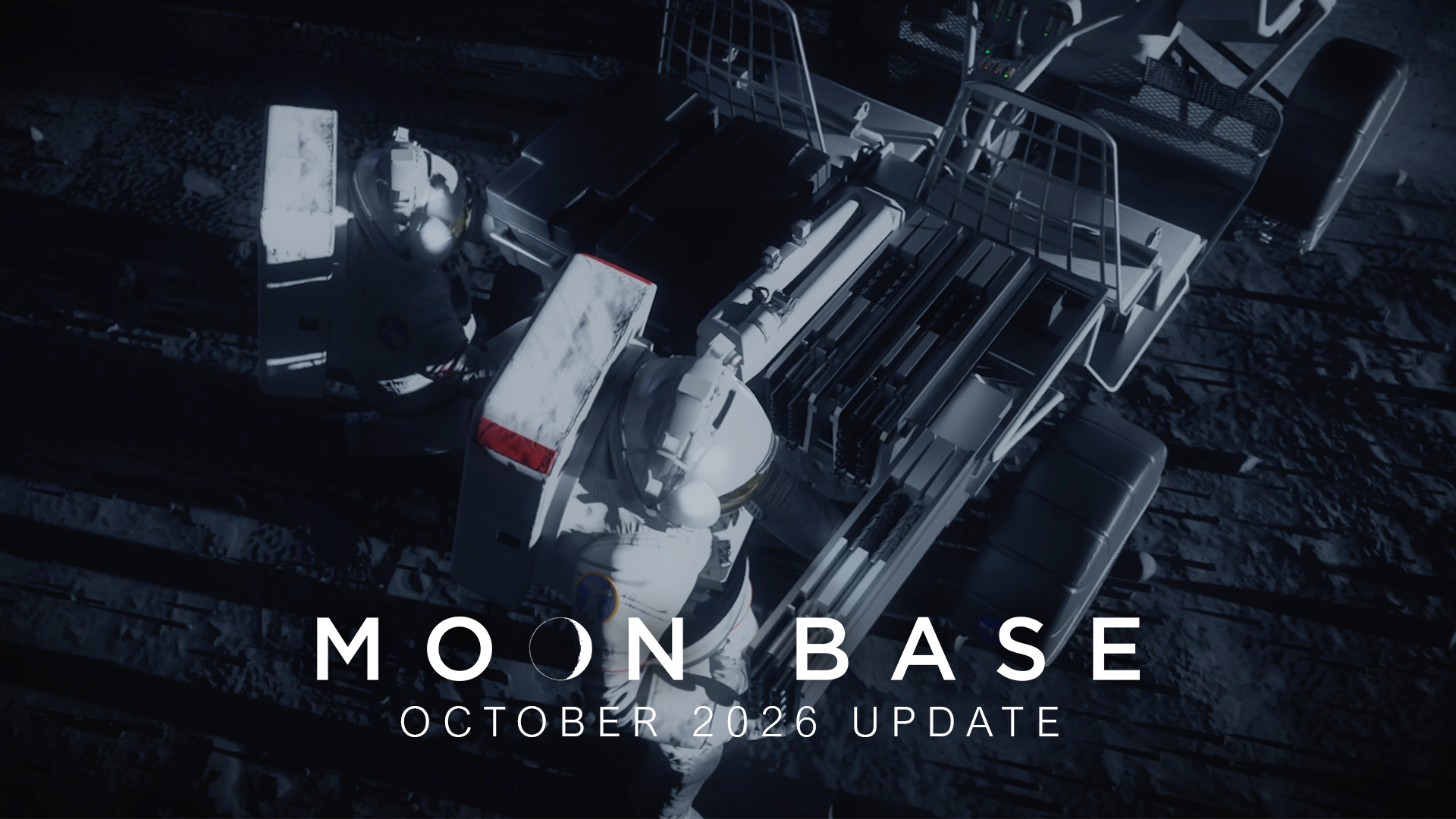
Artist’s rendering of astronauts working next to a lunar terrain vehicle on the lunar surface.
NASA
As NASA works to build the Moon Base, crewed and robotic lunar rovers will play a crucial role during early development through technology demonstrations, astronaut transport, terrain mapping, scientific investigations, and resource prospecting. Data from these early missions will inform future mobility systems and infrastructure needed for astronauts to live and work on the Moon.
On Tuesday, NASA released a Moon Base video update offering a closer look at the progress being made on the commercial lunar terrain vehicles and robotic rovers that will enable the surface mobility needed to build humanity’s first lunar outpost.
“Lunar rovers are central to our surface mobility strategy,” said Robert Pickle, director of the Surface Mobility Office within the agency’s Moon Base Program. “Their performance will lay the groundwork for the mobility systems that will define the next era of exploration and ultimately determine how effectively we can build, operate, and expand the infrastructure required for long‑duration exploration.”
Learn more about NASA’s VIPER
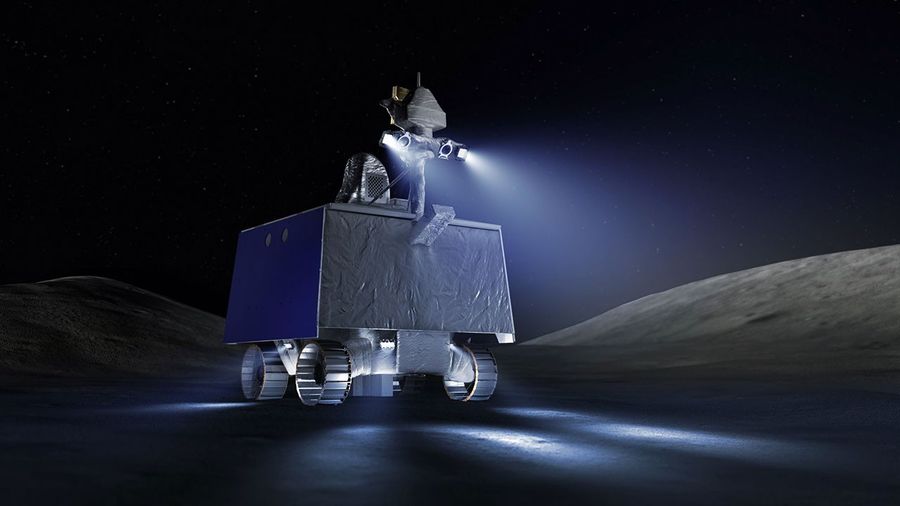
An artist’s concept of NASA’s VIPER lunar rover on the surface of the Moon.
NASA/Daniel Rutter
NASA’s VIPER (Volatiles Investigating Polar Exploration Rover) will embark on a mission to the lunar South Pole region in 2027 to venture into permanently shadowed craters looking for water and other valuable resources essential for sustainable exploration.
After delivery to the lunar surface by a Blue Moon Mark 1 lander, VIPER will travel more than 18 miles (30 kilometers), collecting information about the thermal, lighting, and terrain environment in the Moon’s South Pole region. This data could provide information about the origin and distribution of water on the Moon, help determine how lunar resources could be used for the Moon Base, as well as better understand the history of the Moon, Earth, and the processes that helped shape conditions for life.
Mission operations for VIPER will be run out of NASA’s Ames Research Center in Silicon Valley where teams are simulating possible scenarios for when the rover begins its mission on the Moon.
The VIPER rover is currently at NASA’s Johnson Space Center in Houston where it is fully built and undergoing final testing before traveling to NASA’s Kennedy Space Center in Florida for launch to the Moon.
Lunar terrain vehicles
To advance surface mobility on the Moon, NASA awarded Astrolab and Lunar Outpost task orders to build the first phase of Moon Base rovers capable of carrying crew, called lunar terrain vehicles (LTVs), that will be delivered to the Moon ahead of crewed Artemis missions. NASA awarded Blue Origin a task order to deliver the LTVs to the lunar South Pole region by 2028 through the agency’s CLPS (Commercial Lunar Payload Services) initiative.
The LTVs will be remotely operated from Earth, traversing up to 3.7 miles (6 kilometers) a day, mapping the lunar surface to help scientists produce high-resolution maps of the region, prior to crew arriving on future missions. The rovers also will collect information to help NASA and its partners learn about operating in this extreme environment, such as data on lighting, navigation, and how well the LTVs preserve energy and function when driving in and out of permanently shadowed regions that can reach minus 334°F (minus 203°C). This will help inform Moon Base development and improve on design and capability for future mobility systems, hardware, and infrastructure.
During missions on the lunar surface, Artemis astronauts will drive the LTVs as they explore geologically diverse areas of the lunar South Pole region, gathering geology samples to bring back to Earth for scientists to study. The LTVs will be able to support up to three moonwalks per Artemis mission, transport up to 176 pounds (80 kilograms) of lunar samples and tools, and travel up to six miles (10 kilometers) on a single battery charge.
Astrolab
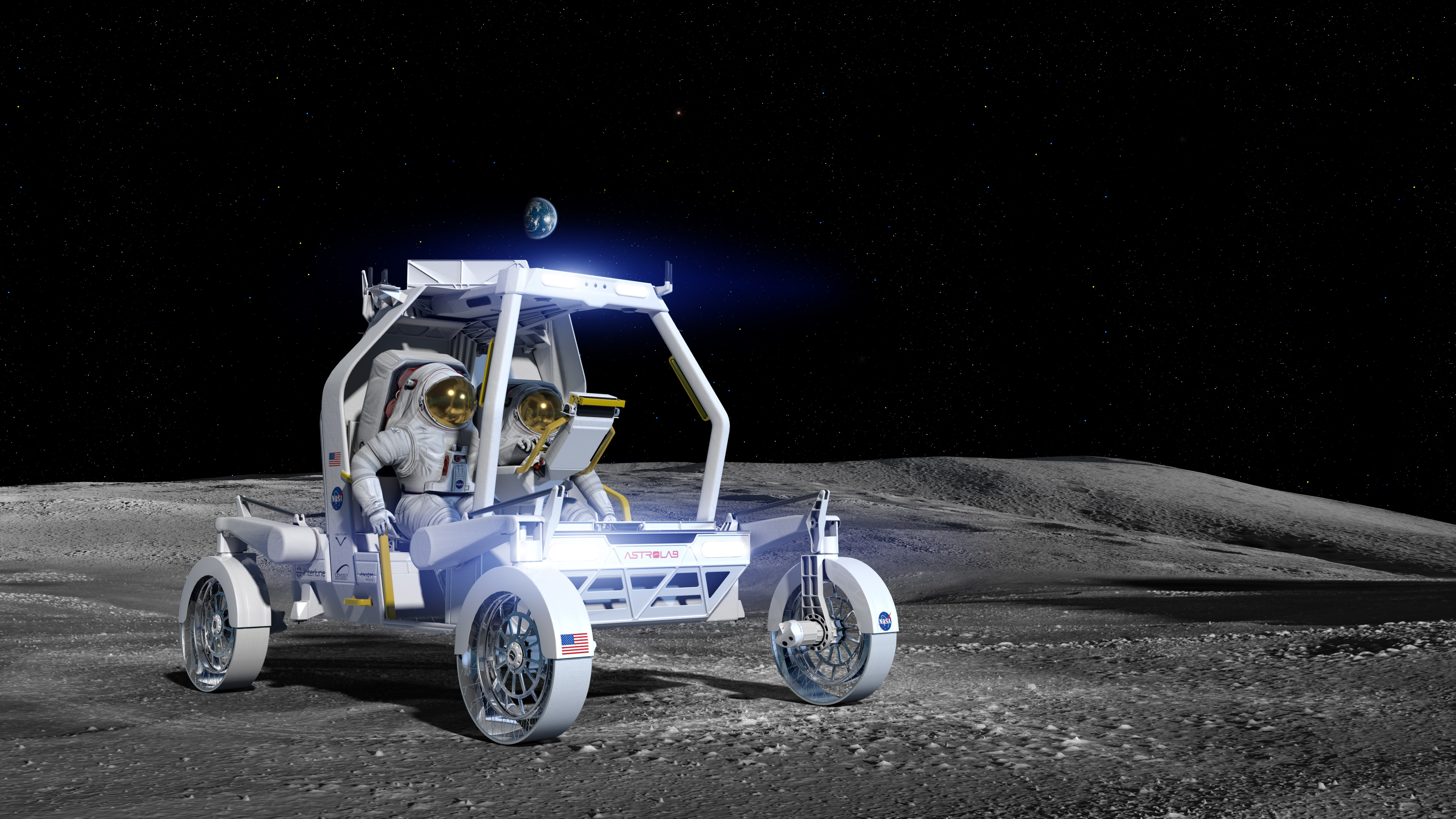
An artist’s concept of Astrolab’s Crewed Lunar Vehicle, or CLV-1, on the surface of the Moon.
Astrolab
Astrolab’s Crewed Lunar Vehicle 1, or CLV-1, is a rover adapted from the company’s FLEX (Flexible Logistics and Exploration Vehicle) LTV architecture. Astrolab recently delivered a mockup of CLV-1 to Axiom Space, where NASA astronauts wore mock-ups of the Artemis lunar spacesuit and evaluated the lunar rover’s design, crew cabin, and display interfaces.
Prior to CLV-1 arriving to the Moon, Astrolab will send its first robotic rover, FLIP (FLEX Lunar Innovation Platform), to the lunar surface as a payload on Voyager Technologies’ Griffin Mission One scheduled to launch in late 2026. FLIP will study the environment of the South Pole and serve as a testbed for critical subsystems on CLV-1, which will include similar tires, batteries, radios, and cameras.
In the next few weeks, Astrolab engineers will head to NASA’s Glenn Research Center in Cleveland where they will use the center’s Simulated Lunar Operations laboratory to evaluate the how CLV-1’s flexible, airless wheels perform while driving on a simulated lunar surface.
Lunar Outpost
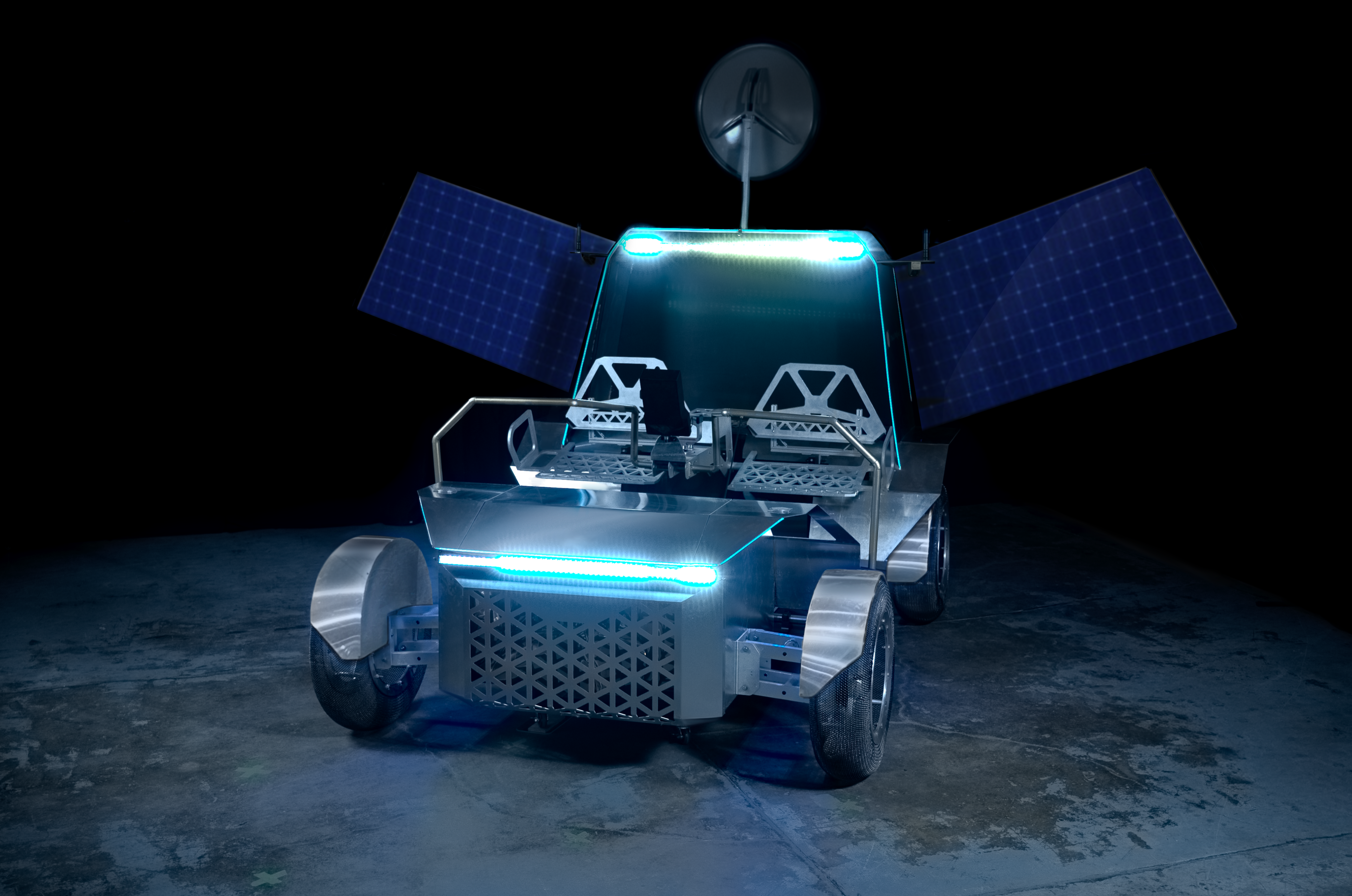
A full-scale prototype of Lunar Outpost’s Pegasus lunar terrain vehicle.
Lunar Outpost
Lunar Outpost’s Pegasus crewed LTV is a lighter, mission-ready evolution of the company’s Eagle LTV. Prior to the award, Lunar Outpost built two mockups of Pegasus and recently delivered a third static mockup to NASA’s Johnson Space Center for crewed testing. During the test, NASA astronauts wore pressurized spacesuits and evaluated the rover’s design, usability, and crew comfort.
In 2025, Lunar Outpost’s robotic exploration rover MAPP (Mobile Autonomous Prospecting Platform) operated at the Moon’s South Pole. During the mission, MAPP acted as a testbed and collected data, achieving flight-proven readiness for key hardware and software subsystems, like its automatic thermal control system, navigation cameras, and mission control software that will be used to remotely operate Pegasus. With a second MAPP rover scheduled to launch in early 2027, Lunar Outpost is advancing many of the key technologies that are directly transferable to Pegasus.
In the next few weeks, Lunar Outpost teams also will head to NASA Glenn to test and evaluate the soil mechanics, traction, and mobility of Pegasus’ spring mesh tires.
In the coming months, both Astrolab and Lunar Outpost will test drivable LTV mockups with NASA crew to evaluate how the rovers drive and operate in a simulated lunar environment. Lunar Outpost is scheduled to complete the preliminary design review of their LTV in October, and Astrolab is scheduled to complete their preliminary design review by the end of December. Both companies are on schedule to deliver the flight-ready hardware to NASA at the end of 2027.
As part of a Golden Age of innovation and exploration, NASA will send Artemis astronauts on increasingly difficult missions near the lunar South Pole to explore more of the Moon than ever before. In addition to providing economic benefits and advancing scientific discovery through its Moon missions, NASA will establish an enduring human presence on the lunar surface and build on the agency’s foundation for the first crewed mission to Mars.
There's a lot of ground to cover when you're building a Moon Base. From robotic rovers exploring the rugged lunar landscape to lunar terrain vehicles carryin...
NASA Administrator Jared Isaacman has named Stephen Cash director of the agency’s Marshall Space Flight Center in Huntsville, Alabama, effective Monday, Oct. 19. Cash, a veteran NASA engineer and aerospace executive, returns to lead the center where he began his career more than four decades ago.
“Marshall contributions to NASA’s missions are historic and it’s no question why it’s the Center of Excellence for propulsion,” said Isaacman. “Steve Cash is a Marshall legend, has spent his career around the hardware, the people and has been in the seat before making the decisions when human spaceflight is on the line. As Marshall continues its critical role in Artemis and takes on new challenges in advanced propulsion, nuclear power, and the systems that will carry us deeper into the solar system, Steve brings the experience, technical judgment, and mission focus needed to lead the center into that next chapter. I am also grateful to Rae Ann Meyer for the leadership she has provided to Marshall during this transition and for her continued service to NASA.”
“Leading a NASA center requires a commitment to its people and to the technical capabilities entrusted to them,” said Amit Kshatriya, NASA associate administrator and chief engineer. “Steve understands that the jewel of Marshall is its workforce and that engineering excellence is sustained by giving talented people the opportunity to design, build, test, and learn through hands-on work. As Marshall continues strengthening the manufacturing, structural loads and dynamics, and propulsion capabilities that underpin NASA’s exploration enterprise, Steve’s leadership will help ensure the workforce has opportunities to develop and apply the expertise needed to deliver the agency’s most ambitious missions.”
As center director, Cash will lead one of NASA’s largest field centers, overseeing a workforce of more than 5,000 civil service and contractor employees and a broad portfolio of propulsion, space systems, scientific research, and technology development activities. Marshall plays a critical role in NASA’s Artemis program, including the development of NASA’s SLS (Space Launch System) rocket, management of the Human Landing System Program, as well as other capabilities supporting sustained exploration of the Moon and future missions to Mars. Further, Marshall plays a key role in the advancement of nuclear power and propulsion, an area of focus that is expected to grow as NASA works towards sending the first humans to Mars.
“It is a profound honor to be back home at the Marshall Space Flight Center,” said Cash. “I am humbled to stand alongside the brilliant minds here as we continue to turn the impossible into everyday history.”
Cash began his NASA career at Marshall in 1982 and spent 34 years with the agency, holding senior engineering and management positions supporting some of the nation’s most significant human spaceflight programs.
During his NASA career, Cash served as manager of Marshall’s Space Shuttle Propulsion Office, overseeing critical propulsion systems supporting shuttle through its final missions. He later served as director of Marshall’s Safety and Mission Assurance Directorate from 2011 until his retirement in 2016, providing leadership in safety, reliability, and quality engineering to support mission success across the center.
Following his retirement from NASA, Cash continued his work in the aerospace industry, including serving as vice president for advanced space systems at Axient, supporting the development and execution of major spaceflight programs. In 2024, he was inducted into the Alabama Engineering Hall of Fame in recognition of his contributions to engineering and the nation’s space program.
Cash succeeds Rae Ann Meyer, who has served as Marshall’s acting center director since September 2025. Meyer, who previously served as Marshall’s deputy center director and associate director, has provided leadership and continuity across the center’s programs and operations during her tenure as acting director. Meyer will return to her role as Deputy Center Director.
Established in 1960, Marshall has played a central role in American space exploration for more than six decades, from developing the Saturn rockets that carried astronauts to the Moon during Apollo to advancing the propulsion systems, infrastructure, and technologies supporting the next era of human spaceflight.
For more information about NASA’s Marshall Space Flight Center, visit:
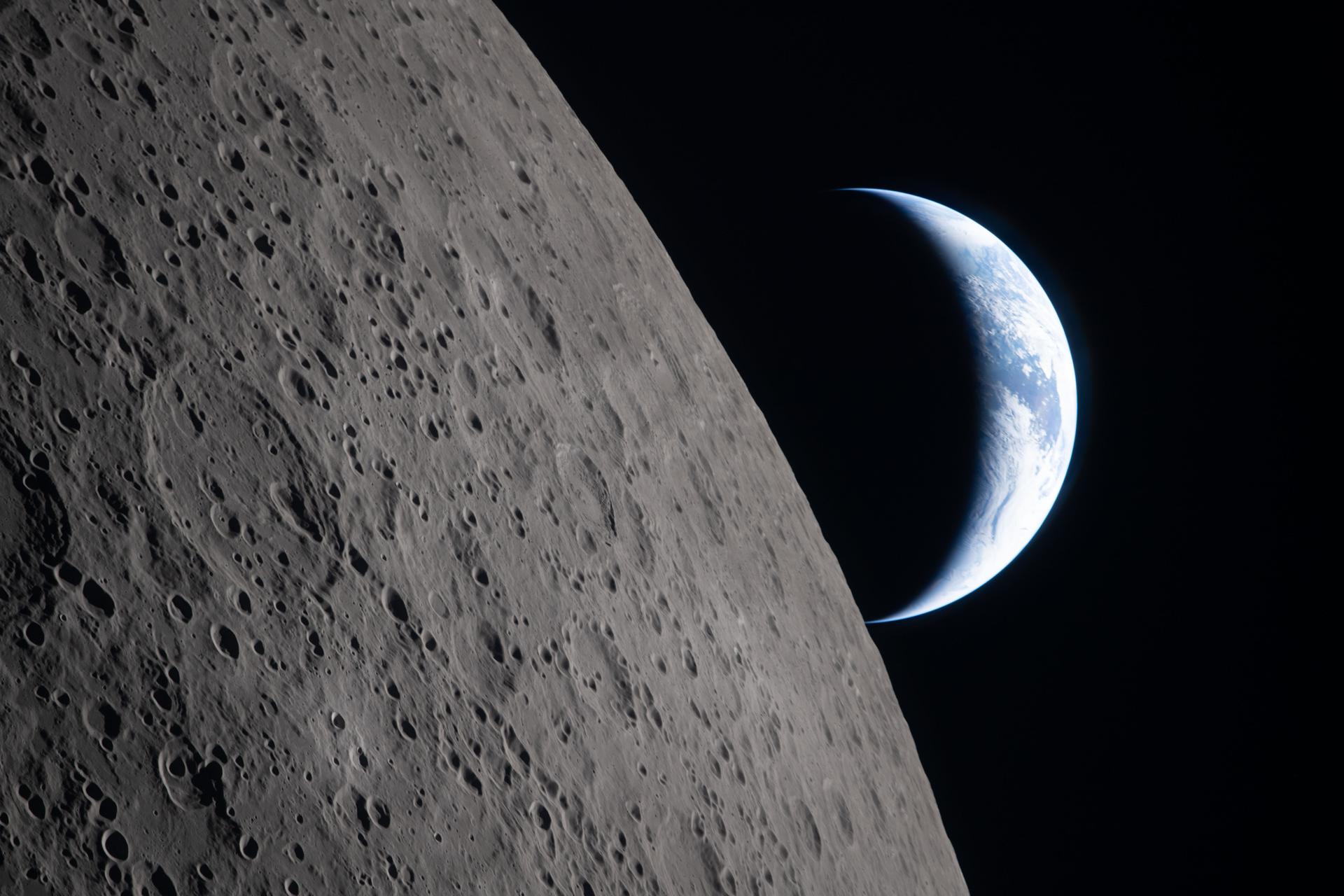
As the Artemis II crew members came close to passing behind the Moon and experiencing a planned loss of signal, they captured this image of a crescent Earth setting on the Moon’s limb on April 6, 2026. The edge of the visible surface of the Moon is called the “lunar limb.”
Credit: NASA
NASA will provide an update on its plans to return American astronauts to the surface of the Moon by 2028 at 2 p.m. EDT, Friday, Oct. 23, at the agency’s Kennedy Space Center in Florida.
The update will include details about NASA’s Artemis III mission that will send four astronauts to low Earth orbit next year to test critical systems needed for future lunar landings, and how plans to return American astronauts to the Moon by 2028 are progressing.
U.S. media interested in attending in person must apply online by 12 p.m., Friday, Oct. 16. To ask questions remotely, media must request the dial-in number from the Kennedy newsroom no later than one hour prior to the start of the update by emailing: ksc-newsroom@mail.nasa.gov. NASA’s media accreditation policy is online.
As part of a Golden Age of innovation and exploration, NASA will send Artemis astronauts on increasingly difficult missions near the lunar South Pole to explore more of the Moon than ever before. In addition to providing economic benefits and advancing scientific discovery through its Moon missions, NASA will establish an enduring human presence on the lunar surface and build on the agency’s foundation for the first crewed mission to Mars.
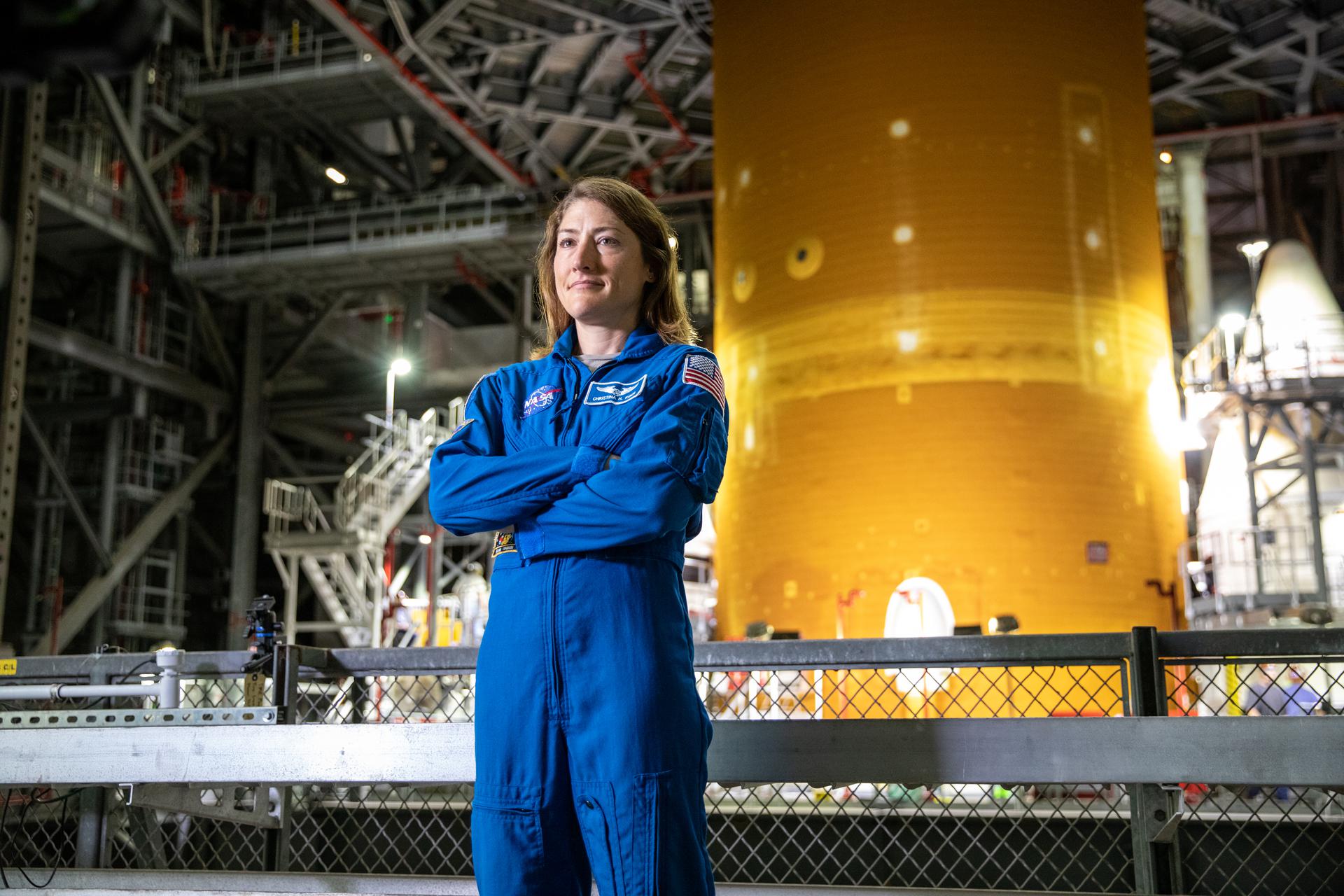
NASA astronaut Christina Koch stands inside Kennedy Space Center’s Vehicle Assembly Building on July 14, 2021, in front of the agency’s Space Launch System (SLS) rocket that ultimately powered the Orion spacecraft on the Artemis I mission. Koch later served as a crew member on the Artemis II mission in 2026, and on Oct. 13, 2026, NASA announced she will serve next as the agency’s acting deputy chief engineer.
NASA/Glenn Benson
NASA engineer and astronaut Christina Koch will serve as the agency’s acting deputy chief engineer beginning on Sunday, Nov. 1, following the retirement of Katherine Van Hooser, who will conclude more than 35 years of distinguished service to the agency on Wednesday, Oct. 21.
In her new role, Koch will help lead NASA’s engineering community, supporting technical oversight, mission readiness, and engineering excellence across the agency’s programs and projects. With this appointment, Koch will transition to management astronaut status and will no longer be eligible for future spaceflight assignments.
“Christina has seen NASA engineering from both sides of the equation: developing complex systems on the ground and trusting them with her life in space,” said NASA Administrator Jared Isaacman. “After spending nearly a year living and working aboard the International Space Station and helping lead America back around the Moon on Artemis II this year, she brings an extraordinary combination of technical expertise, operational experience, and judgment to this role. I am excited to see the impact she will have across NASA as we return Americans to the lunar surface, build the Moon Base, get underway on nuclear power in space, and develop the capabilities that will ultimately take us on to Mars.”
“Katherine has been an extraordinary leader throughout her career, bringing technical expertise, sound judgment, and an unwavering commitment to mission success to some of NASA’s most complex engineering challenges,” said Amit Kshatriya, NASA associate administrator and chief engineer. “Her leadership has strengthened our engineering community and helped guide the agency through critical milestones and transitions. Christina brings a unique combination of engineering expertise, operational experience, and proven leadership, both on the ground and in space. I am grateful to Katherine for her exceptional service and confident Christina will continue the tradition of technical excellence that is essential to everything we do at NASA.”
Koch most recently served as a mission specialist aboard NASA’s Artemis II mission in April, helping carry out the first crewed flight around the Moon in more than 50 years. She previously spent 328 consecutive days aboard the International Space Station, setting the record for the longest single spaceflight by a woman and participating in the first all-female spacewalks.
Koch began her NASA career as an electrical engineer at the agency’s Goddard Space Flight Center in Greenbelt, Maryland, developing scientific instruments for space missions. Before her selection as an astronaut in 2013, her experience also included scientific field engineering in Antarctica and the Arctic. She has since held leadership positions within NASA’s Astronaut Office and at the agency’s Johnson Space Center in Houston, bringing a combination of technical expertise, operational experience, and firsthand understanding of the demands of human spaceflight to her new role.
Van Hooser joined NASA in 1991 at the agency’s Marshall Space Flight Center in Huntsville, Alabama, beginning a distinguished career in propulsion engineering and technical leadership. Her early work focused on liquid rocket engine turbomachinery before she became chief engineer for the space shuttle main engine, leading engineering efforts through the final 21 shuttle flights. She later served as the first chief engineer for the Space Launch System’s Liquid Engines Element, helping advance the propulsion systems supporting NASA’s Artemis missions.
As Marshall’s chief engineer and, since 2023, NASA’s deputy chief engineer, Van Hooser provided critical technical leadership and oversight across the agency’s programs. Her steady guidance through complex engineering challenges and organizational transitions helped maintain continuity, strengthen collaboration, and keep mission readiness at the forefront of NASA’s work.
Learn more about NASA’s missions on the agency’s website:
NASA’s Freedom 250 F-5 team, including NASA Administrator Jared Isaacman, performs a flyover during the national anthem at an NFL game between the Cleveland Browns and the Carolina Panthers at Huntington Bank Field, Sept. 27, 2026, in Cleveland.
Credit: NASA/Jordan Cochran
As part of the agency’s Inspiration Tour flyover, NASA Administrator Jared Isaacman will pilot one of three F-5 fighter jets to kick off the New York Jets vs. Cleveland Browns game in East Rutherford, New Jersey, on Sunday, Oct. 11.
NASA team members will engage with fans at the agency’s Experience Zone, located at the Jets Tailgate Zone outside the stadium, from 10 a.m. to 1 p.m. EDT before the game. Fans can learn more about NASA’s return to the Moon under the agency’s Artemis dome, enjoy interactive games, and capture photos with a large, inflatable SLS (Space Launch System) rocket.
Isaacman will be available for limited media interviews during the game. To arrange interviews, please contact Camille Gallo at: camille.m.gallo@nasa.gov or 202-531-8057.
With stops across the nation, NASA’s Inspiration Tour convenes academic, industry, and public sector stakeholders to connect the agency with the people, technologies, and organizations that drive American leadership in space.
The tour will culminate in MAX POWER, a public exposition of American air and space innovation, Saturday, Nov. 7, and Sunday, Nov. 8, on and near the agency’s Kennedy Space Center in Florida. Held in honor of America’s historic 250th anniversary, the multi-day, family-friendly event will showcase the next-generation aircraft, spacecraft, autonomous vehicles, and technologies that will help define the future of transportation in air and space.
For more information about MAX POWER and the agency’s missions, visit:
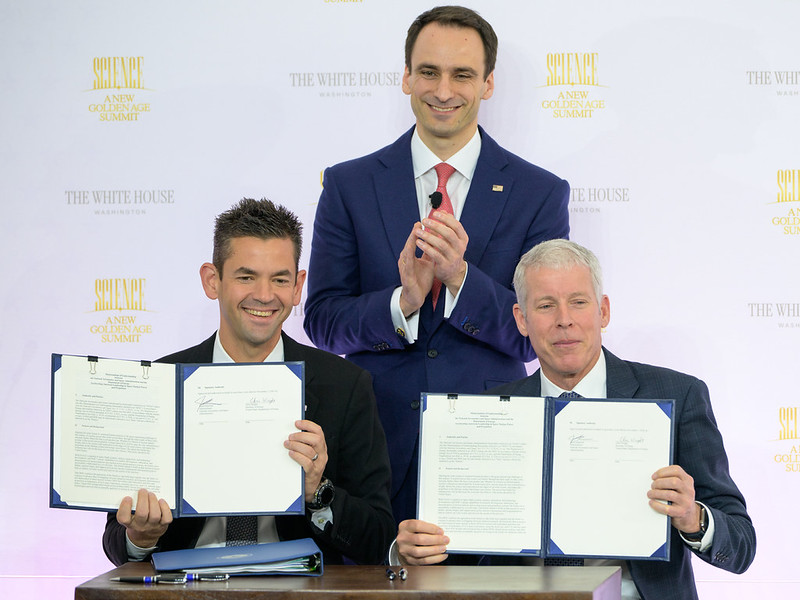
NASA Administrator Jared Isaacman, seated left, and U.S. Secretary of Energy Chris Wright, seated right, hold the signed Memorandum of Understanding, “Accelerating American Leadership in Space Nuclear Power and Propulsion,” as Director of the White House Office of Science and Technology Policy (OSTP) Michael Kratsios, looks on, during the Science: A Golden Age Summit, Thursday, Oct. 8, 2026, at the Donald J. Trump Institute of Peace in Washington.
NASA/Bill Ingalls
Editor’s note: This release was updated Oct. 8, 2026 with the formal name of the summit.
As the Golden Age of deep-space exploration begins, NASA and the U.S. Department of Energy are advancing the development of safe, reliable, next-generation nuclear technologies for space.
Together, the agencies will supercharge civil space exploration, unlock bold scientific discovery, and solidify American leadership in space nuclear power and propulsion.
“We are entering the ‘Nuclear NASA-era,’ which represents a major transformation for space exploration,” said NASA Administrator Jared Isaacman. “Nuclear power will allow us to go farther, operate longer, and field more capable spacecraft and instruments than ever before. The work we’re doing today is laying the foundation for the fission-powered spacecraft of tomorrow and opening an entirely new frontier for exploration and discovery.”
The new Memorandum of Understanding, “Accelerating American Leadership in Space Nuclear Power and Propulsion,” was signed Thursday between NASA and DOE, and establishes a framework for end-to-end collaboration. The agreement unites both agencies across the full spectrum of space nuclear development, spanning advanced research and fuel production to rigorous testing, launch integration, and operations. Across all these efforts, an uncompromising commitment to safety remains the central pillar.
The signing took place between Isaacman and U.S. Secretary of Energy Chris Wright during the Science: A Golden Age Summit, hosted by the Office of Science and Technology Policy at the Donald J. Trump Institute of Peace in Washington, and is effective Sunday, Nov. 1.
“Thanks to President Trump, America’s nuclear renaissance is reaching a new frontier,” said Wright. “The Energy Department is proud to partner with NASA as we help American space missions reach uncharted territory.”
President Trump’s December 2025 Executive Order on Ensuring American Space Superiority directs NASA to develop a launch-ready lunar surface reactor by 2030, a goal toward which NASA, partnering with DOE, is making steady progress. This pivotal agreement fortifies existing collaborations on fission and radioisotope power systems, propelling NASA’s vision for a sustained human presence on the Moon and accelerating the breakthrough technologies to enable our mission.
When NASA’s Space Reactor‑1 Freedom launches in 2028, nuclear propulsion will advance from laboratory research to operational deep‑space application. This milestone paves the way for Lunar Reactor‑1, the fission surface power system that will sustain the future Moon Base through darkness and shadow. Nuclear power will energize habitats, communications, instruments, rovers, resource usage, and critical lunar infrastructure, and it will be essential for the demanding energy needs of future Mars missions.
Together, SR‑1 and LR‑1 form the foundation of a robust domestic nuclear‑space industrial base. These programs are poised to power permanent lunar outposts, enable exploration of distant worlds, and cement American leadership in space for generations. These endeavors will expand humanity’s reach toward Mars, reinforce American preeminence in deep space, and pioneer innovative technologies that yield benefits here on Earth.
In addition to fission power, NASA continues to expand its use of radioisotope power systems. The Dragonfly mission to Saturn’s moon Titan, scheduled for launch in 2028, will rely on a Multi‑Mission Radioisotope Thermoelectric Generator and 24 Light Weight Radioisotope Heater Units to power and warm the car‑sized rotorcraft. Dragonfly will fly to various locations on Saturn’s moon Titan and investigate the moon’s habitability.
NASA and DOE additionally plan to support ESA’s (European Space Agency) Rosalind Franklin Mars rover studying the potential for past and current life on the Red Planet, by providing 24 similar heater units to maintain instrument temperatures in the extreme cold of the Martian environment.
NASA has awarded Modulate Space Corporation a contract to develop key elements of a 5G communications system for use on the lunar surface with built-in Wi-Fi 6, for NASA’s Glenn Research Center in Cleveland.
This accelerated effort is organized into two primary work areas that together will develop a scalable, standards-based communications capability designed to support future Moon Base surface operations.
The 5G System and Lunar Surface Communications Evaluation and Radio Propagation Measurements contract is a firm-fixed-price contract with a value of approximately $38 million. The performance period for the 5G Network-in-a-Box Development and Lab Demonstration runs from Thursday, Oct. 1, through Jan. 31, 2028. The performance period for the Lunar 5G and Wi-Fi Integrated Surface Network and Flight Demonstration on the Lunar Surface runs from Monday, Nov. 30, through Dec. 31, 2028.
Through these demonstrations, NASA will acquire technology development of hardware, firmware, and software needed to advance the integrated lunar communications system. This effort will give NASA insight into the system architecture and operational performance while providing the flexibility needed to evolve the technology for future lunar surface communications.
For more information about NASA and agency programs, visit:

 Login