2026 has been a weird year for me. I'm one of the most "pro DIY PC" people you'll ever meet. I built my first PC around 20 years ago, and I've never touched a prebuilt since then, except for the purpose of reviewing them. And yet, this year, I bought a prebuilt—not for me, but still.
Pavan Davuluri says Windows will keep serving human users while adding agentic workloads. (Microsoft Photo)
GeekWire is profiling over the next few weeks some of the people and teams that are shaping the evolution of Microsoft in what we’re calling its “Microsoft 2.5” era.
Just Don’t Call It an ‘Agentic OS.’ Given Microsoft’s one-pointed AI focus these days, it’s not surprising that the Windows organization is on the agentic train.
But Executive Vice President of Windows + Devices Pavan Davuluri has learned the hard way not to call Windows an agentic OS. He did so back in November 2025, via a tweet and blog post, and the customer backlash was quick and biting.
But Davuluri has not done a complete U-turn because of the criticism. Instead, he has changed how he talks about where Windows is going — which is still in an agentic direction.
“The user of Windows going forward will continue to be users … but it’s also going to add these agentic workloads,” the nearly 26-year Microsoft veteran Davuluri told GeekWire in a recent interview.
During his time at Microsoft, he’s held a variety of roles, from intern to General Manager of Surface, to Corporate Vice President of Windows Silicon & Systems Integration. He was appointed Executive Vice President of Windows + Devices in March 2026, reporting directly to CEO Satya Nadella.
Windows needs to evolve to support agentic workloads through new platform capabilities that the team is building under the covers, Davuluri said. These low-level capabilities, or “primitives,” affect how Windows handles security, identity, governance, observability, and performance when it comes to building and running agents natively.
These coming changes likely will affect the Windows file system, security model, PowerShell, and other foundational components.
Microsoft already is working on Windows identity and manageability to make them better able to service agents. Windows can assign agents a local ID, or a cloud-provisioned identity backed by Entra.
And it also has an early preview of technology known as Microsoft Execution Containers, meant to help secure agents by running untrusted code in sandboxes or virtual machines. It’s these system-level areas where the team is focusing first in preparation for a human+agent future, Davuluri said, rather than the UX/UI level.
Going Back to Basics. Windows has had a lot of very different leaders over the years, with very different management styles and priorities.
For his part, Davuluri said he plans to run the Windows and Surface teams with four principles in mind: Maintaining customer obsession; treating Windows as a complete end-to-end system (“full stack”); focusing on complete user experiences and workflows rather than individual features; and building Windows openly and transparently, with clearer communication about plans and priorities.
On the heels of his promotion to EVP, Davuluri committed publicly to the much-needed goals of improving Windows quality and reliability. In a blog post, he outlined some of the requested changes that his team would be making to Windows, ranging from fixing the way the Insider test program works, to more granular improvements like allowing users to reposition the Windows task bar.
And since then, the team largely has been delivering to the surprise and delight of many long-time Windows users.
Davuluri has also been working to shift the conversation from which new features are coming to a specific build to what are the outcomes Microsoft wants to enable for specific groups of Windows users.
“There is no one single sort of ring for a billion-plus users on the platform,” Davuluri said. Windows users encompass people who use the product in a variety of different ways, so “we need to get clarity in our minds on the things that we do that lift all boats that raise the entire platform — and things that we have to go do that are specific and unique to each of our sets of users based on how they primarily or typically use the device.”
Full-Stack Thinking. Is there still a role for Microsoft as a PC maker in the coming agentic future? Not surprisingly, given his heavily hardware-focused background, Davuluri insisted there is.
When Microsoft debuted its first Surface devices in 2012, officials said the company needed to build its own hardware to create reference designs and innovative form-factor examples for other Windows PC makers.
These days, most Surfaces that ship arguably are not better, spec- or design-wise, than other PCs. But Microsoft still needs to keep a hand in hardware design to understand the full stack, Davuluri claimed.
Surface plays a key role in how Microsoft develops platform abstractions, incubates support for technologies like pen, facial-recognition, and neural-processing units that later spread across Windows, and optimizes for silicon-to-cloud, he said.
While the company’s attempt to create a distinct category of “Copilot+” AI PCs fizzled, Microsoft continues to try to find AI-centric reasons to convince customers to choose Windows devices. Davuluri and others have referred to the idea of “unmetered intelligence” to attempt to make the case for running AI models locally on PCs.
This fall, Microsoft (and other Windows PC makers) plan to roll out new PCs built on the Nvidia RTX Spark platform. The coming Surface Laptop Ultra, which will be optimized for RTX Spark, is aimed at creators, developers and AI builders, all of whom — Microsoft is hoping — will be fueling the growth of its next target user category: Agents.
The commander and pilot of NASA's Artemis II mission have gained a new distinction five months after splashing down from the Moon: They're not fully retiring from the space agency.
Reid Wiseman and Victor Glover are the first astronauts to join NASA's emeritus program, enabling them to continue to support the work being done at Johnson Space Center in Houston. They will remain available to train and mentor the current workforce while still being able to pursue employment and opportunities outside of NASA.
"I have asked NASA ... to not use the term 'retire' as much, but technically emeritus is a retirement program," Glover told collectSPACE.com on Wednesday. "It's something we have typically done for scientists when they have groundbreaking research, and they want to go back to academia to teach or to research and publish."
A NASA Launch Services (NLS) II contract has been awarded by the agency to Relativity Space Inc., and its Terran R launch service in accordance with the contract’s on-ramp provision. The Terran R launch service will be available to NASA’s launch services to use for future missions.
The NLS II contracts are multiple-award, indefinite-delivery/indefinite-quantity contracts with an ordering period through June 2030 and an overall period of performance through December 2032. The NLS II contracts include an on-ramp provision that provides an opportunity annually for new launch service providers to compete for future missions and allows existing contractors to introduce launch vehicles not currently on their NLS II contracts.
The NLS II contracts support the goals and objectives of the agency’s Human Spaceflight Mission Directorate, Science Mission Directorate, and the Research and Technology Mission Directorate. Under the contract, NASA also can provide launch services to other government agencies, such as the National Oceanic and Atmospheric Administration.
NASA’s Launch Services Program Office at the agency’s Kennedy Space Center in Florida manages the NLS II contracts. For more information about NASA, visit:
Meta took days to remove ads containing AI-generated child sexual abuse material (CSAM) on Facebook and Instagram. Some ads featured photos of real kids, including a press photo of a young member of a European royal family and images swiped from a popular Instagram profile of a preteen girl deemed an influencer.
In an investigation published Tuesday, the Tech Transparency Project (TTP) reported that Meta failed to detect 332 ads containing CSAM this year. The “vast majority” of ads promoted AI apps made in China, while many ads promoted so-called “nudify” apps that make it easy for bad actors to use AI and digitally alter images of children.
TTP matched “multiple CSAM ads to photos of real children that appeared online.” These ads seem to violate federal child pornography laws, since the Justice Department has clarified that AI CSAM is just as harmful as CSAM. The young royal’s image was “animated into a video of her performing a graphic sex act,” TTP found. Other ads animated a photo of a 14-year-old Instagram influencer “showing off her new sports club uniform” into “a video of her performing oral sex.” A third “preteen” victim “posing in a pink athletic outfit with pigtails” in a series of stock photos was morphed into a video where she looks frightened as she’s molested by an adult male, TTP reported.
TON Foundation says Telegram Web3 mini-apps have passed 100 million monthly active users, marking another major distribution milestone for one of crypto’s most consumer-facing ecosystems.
That number is big enough to grab attention, but it needs a careful read.
Monthly active users in Telegram mini-apps can include off-chain bot interactions, app sessions, and wallet-adjacent activity. It should not be treated as the same thing as 100 million on-chain TON wallets all making direct transactions.
Still, even with that caveat, the scale is impressive.
TON has something most crypto networks badly want: access to a massive messaging platform where users already spend time.
For more details, visit the official Ton platform.
TL;DR
TON-linked Telegram mini-apps have passed 100 million monthly active users.
The figure includes Telegram mini-app activity, not only on-chain wallet transactions.
TON Space and Telegram-based onboarding remain central to the ecosystem’s growth story.
Why Telegram Distribution Matters
Crypto adoption usually struggles with distribution.
Projects build wallets, exchanges, apps, games, and payment systems, then spend huge amounts trying to attract users. TON starts from a different place because it is closely tied to the Telegram environment.
That does not guarantee adoption.
But it gives TON a user funnel most chains do not have. If people can discover mini-apps inside a messaging app they already use, onboarding feels less alien than downloading a new wallet and learning a new ecosystem from scratch.
That is a real advantage.
Mini-Apps Are Not Just Wallets
The mini-app category is broad.
Some apps may involve games, rewards, bots, payments, trading, social features, or wallet interactions. That means the 100 million MAU number is not a pure measure of on-chain financial activity.
And that is fine, as long as it is explained clearly.
The point is that Telegram-based Web3 apps are reaching a large user base. The next question is how much of that activity converts into durable wallet usage, transactions, payments, and application revenue.
TON Space Helps The Wallet Story
TON Space gives the ecosystem a self-custody wallet route inside Telegram.
That matters because mini-app engagement becomes much more powerful if users can move from playing, earning, or interacting into actual wallet activity without leaving the environment. The smoother that step is, the stronger TON’s consumer crypto case becomes.
Most chains have to build consumer distribution from scratch.
TON can build inside a platform where communication and app discovery already happen.
Bot Activity Needs A Caveat
The source materials note that MAU counts include off-chain Telegram bot interactions alongside direct on-chain wallet transfers.
That caveat should not be buried.
Bot-driven ecosystems can produce huge engagement numbers, but not every interaction has the same economic value. A user clicking inside a mini-app is different from a user holding assets, making payments, or interacting with DeFi.
The quality of activity matters.
Still, engagement is the first step. Without users, none of the deeper metrics can follow.
The TON Market View
TON’s 100 million MAU milestone shows why the network remains one of the most interesting consumer crypto plays.
The number is not a clean on-chain wallet count, and it should not be treated like one. But it does show that Telegram mini-apps are operating at a scale most crypto products never reach.
Now the real test begins.
Can TON convert attention into lasting wallet adoption, useful payments, real transaction volume, and sustainable apps?
That is the question. But reaching 100 million monthly active mini-app users gives the ecosystem a serious platform to work from.
This article draws on TON Foundation materials and Tonstat ecosystem data.
This article was written by the News Desk and edited by Samuel Rae.
This report is based on information released by Ton. at Ton
Telegram crypto trading bots bring automated trading directly into the messaging app, allowing users to execute trades, monitor markets, and manage strategies through chat. For businesses, they offer opportunities to deliver convenient trading tools while creating new revenue streams.
Why Are Indian Crypto Traders Turning to Telegram?
Telegram has become an increasingly popular communication and trading environment for Indian crypto users. Its large crypto-focused communities, real-time communication, automated trading tools, P2P discussions, and access to Web3 services make it attractive to traders looking for faster ways to discover market opportunities. However, Telegram-based crypto activity also carries significant risks, including scams, fraudulent signals, wallet-security threats, and unverified trading services.
Key Reasons for Telegram’s Popularity
P2P Trading Communities: Telegram groups allow traders to connect with P2P participants, discuss payment methods, share market information, and explore trading opportunities outside traditional exchange interfaces.
Speed and Trading Bots: Automated Telegram trading bots can monitor markets, interact with decentralized exchanges (DEXs), and execute predefined actions rapidly. Bots are particularly popular among traders following newly launched tokens and highly volatile assets.
Trading Signals and Communities: Crypto-focused channels and groups provide market commentary, technical analysis, trading signals, token updates, and discussions that help users stay informed about fast-moving markets.
Web3 Accessibility: Telegram’s growing integration with blockchain and Web3 ecosystems has made it easier for users to discover wallets, decentralized applications, token communities, and blockchain-based services from a familiar messaging environment
Direct Communication: Traders can communicate directly with project teams, signal providers, bot operators, and other market participants, creating an active environment for sharing information and opportunities.
Major Risks to Keep in Mind
Scams and Fake Signals: Fraudulent Telegram channels may promote unrealistic returns, fake trading results, manipulated screenshots, impersonation schemes, or misleading investment opportunities.
Wallet Security Risks: Some trading bots or third-party services may request sensitive wallet permissions or private-key access. Giving a malicious service excessive permissions can potentially result in significant asset losses.
Unverified Projects: Token promotions and trading recommendations shared through Telegram may not always come from verified or trustworthy sources. Traders should independently research projects before committing funds.
Regulatory Considerations: Indian users should also consider applicable tax, financial, and regulatory requirements when participating in crypto-related activities.
What Is a Telegram Crypto Trading Bot?
A Telegram crypto trading bot is an automated software program that operates through Telegram, allowing users to interact with trading tools through chat commands, menus, or buttons. Depending on its architecture, the bot can connect to a user’s crypto wallet, interact with decentralized exchanges (DEXs), or connect to a centralized exchange (CEX) through API credentials.
Unlike conventional exchange interfaces, Telegram trading bots bring trading functions directly into a messaging environment, making it possible to monitor markets, configure trades, and execute transactions without constantly switching between different applications.
How Telegram Trading Bots Work
Telegram trading bots combine automated trading functionality with a chat-based interface.
1. Wallet or Exchange Connection
The first step is connecting the bot to a trading environment. A DEX-focused bot may create or connect to a dedicated wallet, while a CEX-focused bot can use API credentials to communicate with an exchange account.
2. Funding
For wallet-based trading, users transfer cryptocurrency to the wallet associated with the bot. The available balance can then be used for eligible transactions. Users should carefully review the custody and withdrawal mechanisms before depositing funds.
3. Trading Commands
Users can interact with the bot through commands or interactive buttons. Depending on the platform, they may configure parameters such as the trading pair, transaction amount, slippage tolerance, gas settings, stop-loss levels, or other strategy conditions.
4. Trade Execution
Once the required conditions are met, the bot processes the trade. For DEX transactions, it can interact with blockchain smart contracts, while CEX bots typically communicate with exchange APIs. Automation can reduce the time required to identify and respond to market movements.
Key Features and Use Cases
Token Sniping
Token-sniping functionality monitors newly launched tokens and liquidity events, allowing automated systems to attempt transactions as soon as predefined conditions are satisfied. Execution speed does not guarantee a successful or profitable trade, particularly during periods of extreme volatility.
Copy Trading
Copy-trading functionality allows users to follow selected wallets or trading strategies and automatically replicate eligible transactions according to predefined settings.
Automated Trading Strategies
Bots can support strategies such as grid trading, dollar-cost averaging (DCA), scheduled buying, take-profit orders, and stop-loss mechanisms. Automation allows predefined rules to operate without requiring the user to manually place every transaction.
Token and Contract Analysis
Some Telegram trading bots incorporate security-analysis tools that examine token contracts, liquidity conditions, ownership structures, or other risk indicators before a trade is submitted. These checks can help identify potential warning signs, but they cannot guarantee that a token or smart contract is safe.
Risks to Keep in Mind
Custody and Private-Key Risks
Some Telegram trading bots operate with dedicated wallets or require access to wallet credentials. If private keys or signing authority are compromised, users could lose control of their assets. A dedicated trading wallet with limited funds can reduce potential exposure.
Phishing and Impersonation
Telegram is also used by scammers to create fake bots, impersonate legitimate projects, and distribute malicious links. Users should verify bot identities through official project channels and avoid entering sensitive credentials into unknown interfaces.
Smart Contract and Software Risks
Trading bots depend on software, APIs, smart contracts, and blockchain infrastructure. Bugs, vulnerabilities, failed transactions, network congestion, or incorrect configurations can result in financial losses.
Market Volatility
Automation can execute trades quickly, but speed does not eliminate market risk. Low liquidity, price slippage, MEV activity, sudden price movements, and failed transactions can significantly affect trading outcomes.
Essential Features of a Telegram Crypto Trading Bot
A well-designed Telegram crypto trading bot should combine automated execution, wallet management, risk controls, security mechanisms, and real-time portfolio monitoring. Since users interact with the system through Telegram, the interface should also make complex trading functions accessible through simple commands and interactive buttons.
Essential Trading Features
Instant Trade Execution: Allow users to buy and sell supported digital assets directly through Telegram by connecting with decentralized exchanges (DEXs), centralized exchanges (CEXs), or both.
Token Sniping: Monitor newly launched tokens and liquidity events and automatically submit transactions when predefined conditions are met.
Limit and Market Orders: Support market orders for immediate execution and limit orders that trigger when an asset reaches a specified price.
Copy Trading: Enable users to follow selected wallet addresses or trading strategies and automatically replicate eligible transactions according to configured parameters.
Strategy Automation: Support automated strategies such as Dollar-Cost Averaging (DCA), grid trading, scheduled purchases, and other rule-based trading approaches.
Risk Management and Security
Stop-Loss and Take-Profit: Allow users to establish predefined exit conditions to automatically close trades when selected profit or loss thresholds are reached.
Token and Contract Risk Analysis: Analyze available indicators such as liquidity, contract permissions, trading restrictions, token taxes, and ownership structures to highlight potential risks before a transaction.
MEV Protection: Incorporate transaction-routing and execution mechanisms designed to reduce exposure to certain MEV-related threats, including frontrunning and sandwich attacks.
Secure Wallet Management: Protect wallet credentials and signing mechanisms through strong encryption, secure key handling, access controls, and appropriate separation between application data and sensitive wallet information.
Transaction Confirmation Controls: Give users visibility into transaction details before execution and allow configurable confirmation requirements for higher-value transactions.
User Experience and Portfolio Tracking
Real-Time Alerts: Notify users about completed transactions, price movements, triggered stop-loss or take-profit conditions, failed transactions, and other important account events.
Portfolio Tracking: Display token balances, transaction history, portfolio allocation, and performance information across supported wallets or networks.
Interactive Menus: Use Telegram’s inline buttons, menus, and commands to create a straightforward interface for buying, selling, checking balances, adjusting settings, and managing strategies.
Multi-Chain Support: Connect with multiple blockchain networks when required, allowing users to manage trading activity across supported ecosystems from a single Telegram interface.
Transaction History: Maintain an accessible record of executed trades, transaction hashes, fees, prices, and other relevant information.
Advanced Features for a Competitive Telegram Trading Bot
For a more sophisticated product, additional functionality can include:
Multi-wallet management
Custom trading strategies
Whale-wallet monitoring
Price and liquidity alerts
Gas-fee optimization
Referral and affiliate systems
Trading performance analytics
Admin dashboards
Subscription and premium features
API integrations
AI-assisted market analysis
The right feature set ultimately depends on whether the bot is designed for DEX trading, CEX automation, copy trading, portfolio management, or a combination of these functions. Security, transparent transaction handling, and user-controlled risk settings should remain central to the product architecture.
How to Build a Telegram Crypto Trading Bot for Indian Traders?
Building a Telegram crypto trading bot requires integrating Telegram with exchange APIs or blockchain networks and adding automated trading logic, wallet management, security, and risk controls.
1. Create the Telegram Bot
Use @Bot to create the bot, configure its username, and securely store the Telegram API token.
2. Choose the Technology Stack
Use technologies such as Python or Node.js for the backend, with PostgreSQL or MongoDB for data management and Redis for caching.
3. Integrate Exchanges and Blockchains
Connect with CEX APIs or DEX infrastructure to support trading. Blockchain RPCs and DEX aggregators can enable on-chain transactions.
4. Add Trading Features
Implement functions such as market and limit orders, DCA, grid trading, copy trading, stop-loss, take-profit, and automated trade execution.
5. Secure Wallets and APIs
Protect private keys and API credentials using encrypted storage, restricted permissions, secure authentication, and strong access controls.
6. Test and Deploy
Start with paper trading and security testing before deploying the bot on reliable cloud infrastructure for continuous operation.
7. Consider Indian Compliance
For India-focused bots, maintain accurate transaction records covering trades, fees, deposits, withdrawals, and transaction hashes to support applicable tax and reporting requirements.
In short, a successful Telegram trading bot combines a simple chat interface with secure trading infrastructure, automation, risk management, and reliable transaction tracking.
How Does a Telegram Trading Bot Make Money?
A Telegram trading bot can generate revenue through transaction fees, subscriptions, exchange partnerships, and promotional opportunities.
Key Revenue Models
Transaction Fees: Charge a small fee on trades or swaps executed through the bot.
Subscription Plans: Offer monthly or yearly plans with premium features such as advanced automation, priority execution, whale alerts, or enhanced analytics.
Affiliate & Referral Commissions: Earn commissions by referring users to supported exchanges, trading platforms, or blockchain services.
Sponsored Token Promotions: Allow legitimate crypto projects to promote tokens through featured listings, trending sections, or promotional placements.
Advertising Revenue: Generate additional income through eligible Telegram advertising and revenue-sharing opportunities.
A combination of transaction fees and premium subscriptions can provide a scalable monetization model while keeping basic trading functionality accessible to users.
Conclusion
Telegram crypto trading bots are becoming an efficient way to bring automated trading directly into a familiar messaging environment. From instant execution and copy trading to portfolio tracking, risk management, and AI-powered strategies, these bots can support a wide range of crypto trading use cases.
For businesses looking to launch a secure and scalable solution, choosing the right technology, integrations, trading logic, and monetization model is essential. Malgo can help transform your Telegram trading bot concept into a customized solution designed around your business goals and target market.
High above Earth, thin veils of metallic haze drift through the edge of space. Known as sporadic E layers, these high-altitude “clouds” form from the vaporized dust of burnt-up meteors, earning their name from the unpredictable way they emerge and then dissipate. Now, new results from a NASA sounding rocket — a suborbital research rocket — that flew five detectors through one of these layers simultaneously reveal unexpected complexity in the layer for the first time.
Though invisible to the eye, sporadic E layers make their presence known to the radio signals we rely on for long-distance communication. When present, sporadic E can send those signals ping-ponging off in unexpected directions, rendering the technology temporarily unreliable.
Scientists have long sought a fuller understanding of these radio-disrupting clouds, but until recently, they had only sampled them one narrow slice at a time. The rocket, called the sporadic E Electrodynamics Demonstration, or SpEED Demon for short, launched from NASA’s Wallops Flight Facility in Virginia on Aug. 24, 2022, and demonstrated the first concurrent, multi-point view inside sporadic E. Its results, from a team led by Embry-Riddle Aeronautical University, are described in a new study in the Journal of Geophysical Research: Space Physics.
Sporadic E layers form in the ionosphere, a region of the upper atmosphere beginning around 40 miles (60 kilometers) up where the neutral gases begin to transform into plasma, or ionized gas. Some of the particles there come from meteors, which burn up and leave behind traces of iron, magnesium, and other metals. These metals occasionally clump into dense, cloud-like sheets — the sporadic E layers — that reflect radio waves.
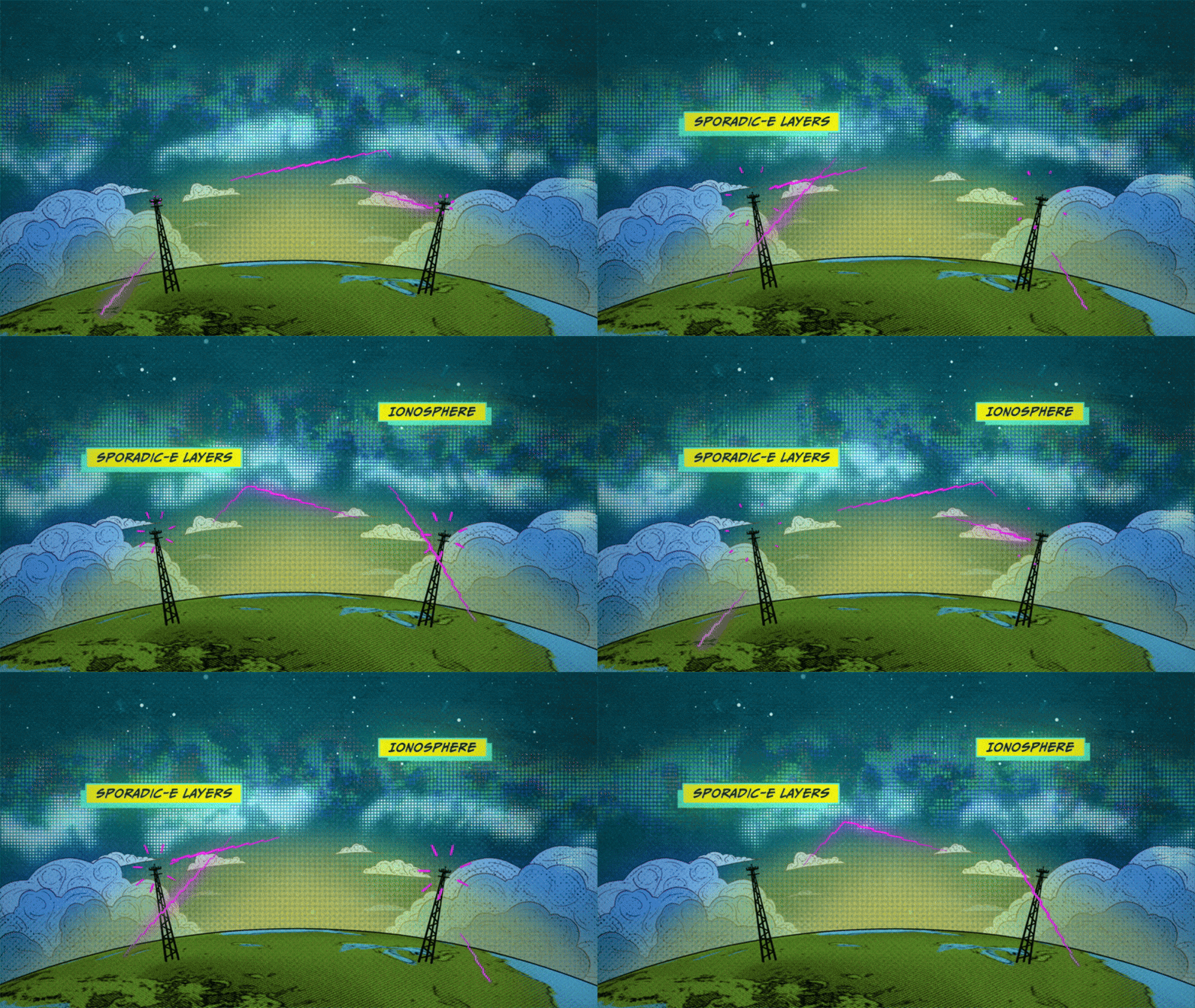
An animated illustration depicts Sporadic-E layers forming in the lower portions of the ionosphere, causing radio signals to reflect back to Earth before reaching higher layers of the ionosphere.
NASA’s Goddard Space Flight Center/Conceptual Image Lab
“Sporadic E layers are, in one sense, giant mirrors of radio frequency waves in the sky,” said Aroh Barjatya, the mission’s principal investigator and a professor of engineering physics at Embry-Riddle in Daytona Beach, Florida.
When a sporadic E layer forms, signals meant to travel out to space can ricochet back toward the ground. Air traffic controllers and marine radio users may pick up distant transmissions as though they were nearby, and radars scanning beyond the horizon can register so-called “ghosts,” or false targets. The effects reach everyday technology, too.
“The biggest source of error in the GPS in your phone, for example, is from the plasma in the ionosphere, and sporadic E layers can contribute to this uncertainty,” said Henry Valentine, the study’s lead author, who conducted the work at Embry-Riddle and is now a researcher at the U.S. Naval Research Laboratory.
Because sporadic E layers hover around 60 miles (100 kilometers) up—too high for weather balloons, too low for satellites — and form and dissipate unpredictably, they have long been the province of sounding rockets, which can be launched on short notice to catch one in the act. But a single rocket flies a single path, taking measurements only along a line. Barjatya likens the situation to viewing a scene through a crack in a wall. One can only observe what is happening along that narrow slit, missing out on the crucial context of whatever is occurring to the left or right of one’s view.
The SpEED Demon mission changed that. The mission was the first to deploy ejectable probes, called dropsondes, inside a sporadic E layer. Once inside, the rocket released four dropsondes that flew away from the main payload and from one another, each measuring the plasma along its own track and beaming its measurements back to ground stations. Together with the main payload, the probes sampled the layer in a total of five places at the same moment.
The SpEED Demon team poses with payload section during testing at NASA’s Wallops Flight Facility.
NASA Wallops/Berit Bland
“Now with multiple sensors, we’ve turned that crack into a picket fence,” Barjatya said.
The data revealed surprising complexity inside the sporadic E layer. Rather than a smooth, dense pancake of metallic particles, the layer that SpEED Demon flew through appeared uneven and structured, shaped by turbulent winds moving through the neutral air around it.
“A lot of times you think of sporadic E as this single sharp density layer, but what we saw in ours is it’s interacting with neutral wind and these swirling atmospheric turbulences,” Valentine said. “Rather than a flat pancake, it’s closer to a cinnamon roll.”
On the way down, the layer even split into two distinct peaks. The team found that shape was consistent with modulation by Kelvin-Helmholtz billows, the curling, wave-like instability that produces breaking-wave patterns in ordinary clouds. Because the flight was unable to measure the local winds and electric fields directly, the researchers are careful to call the billow explanation plausible rather than confirmed.
The SpEED Demon mission was designed as a technology demonstration — a test of whether the dropsonde technique would work at all. It did, and the team was quick to apply it again. Barjatya’s team used a similar multi-probe strategy to launch rockets into the paths of the October 2023 annular eclipse and April 2024 total solar eclipse, studying how the sudden darkness disturbed the upper atmosphere. In June 2025, they flew SpEED Demon’s most direct descendant, Sporadic-E ElectroDynamics, or SEED, into sporadic E layers from Kwajalein Atoll in the Marshall Islands, studying them at lower latitudes. Papers from those missions are in preparation.
A sounding rocket launch testing science instruments for future missions was successfully conducted at 9:16 p.m. EDT, Aug. 23, 2022, from NASA Wallops Flight Facility in Virginia.
NASA
After years of study, sporadic E layers are no longer as unpredictable as they once were. “They have a seasonality to them, with peak occurrence happening in the local summer,” Barjatya said.
Questions about how and when they form are increasingly fine-grained. The new deployable multi-point rocket sensor methodology, along with ground-based measurements, is likely to bring the picture even closer to completion. “The science community as a whole is now in its final stretches of fully understanding these giant radio frequency mirrors in the sky,” Barjatya said.
ByMiles Hatfield NASA’s Goddard Space Flight Center, Greenbelt, Md.
Instagram will limit recommendations for AI-generated influencer profiles that fail to disclose their synthetic identities under a new labeling policy.
Instagram will limit recommendations for AI-generated influencer profiles that fail to disclose their synthetic identities under a new labeling policy.
NASA awarded Blue Origin a contract Tuesday to develop the agency’s Mars Telecommunications Network, a next-generation communications system that will enable reliable, high-bandwidth communications and navigation services for current and future Mars missions.
The firm-fixed-price contract has a maximum potential value of approximately $700 million to deliver a high-performance Mars telecommunications orbiter to NASA no later than Dec. 31, 2028.
Blue Origin will design, develop, integrate, launch, and operate the network as a part of the agency’s broader space communications and navigation infrastructure. The architecture will consist of a high-performance telecommunications spacecraft orbiting Mars, transmitting science data, imagery, navigation information, and critical mission communications for spacecraft operating on and around the planet.
The award marks a milestone in NASA’s strategy to expand communications and navigation services beyond Earth and the Moon, establishing the foundation for sustained exploration of Mars in the coming decades.
Under the Artemis program, NASA is sending astronauts to explore the Moon and prepare for missions to Mars. Robotic missions will pave the way for human exploration of the Red Planet, and as these missions expand, demand for data will continue to increase. To meet this need, NASA is pursuing a purpose-built network capable of supporting a growing number of missions while providing greater capacity, reliability, and operational flexibility.
The selection follows NASA’s request for proposal issued in May. As the agency increasingly taps commercial partners for transportation and communications services in Earth orbit and to develop the Moon Base, the Mars Telecommunications Network initiative similarly seeks to harness private-sector capabilities while enabling NASA to focus on exploration and scientific discovery.
The network, managed by NASA’s Space Communications and Navigation program, is expected to be operational at Mars by 2030 and will support both current and future missions to the Red Planet, as NASA ventures deeper into space.
For more information about NASA’s space communications efforts, visit:
In the business world, a moat is a quality of a business that makes it difficult for competitors to take that company’s profits. With how hard it is to train models for large language models (LLMs) and generative AI, it might seem like Anthropic, Open AI, and other LLM companies would have huge moats given the amount of compute it takes to build models. But open source models are quickly draining that moat, and now the only thing standing in the way of a customer using one of these models on their own hardware instead one from the larger companies is physical computing resources. [TerminalBytes] demonstrates a few of these models on personally owned computers to show the current state of the art.
[TerminalBytes] started off running the 27B version of the Qwen3.8 on a Mac Studio with 256 GB of unified RAM, which is plenty for this task. But it’s also enough to benchmark a few different models. Qwen3.6 is compared to 3.8, and then the different quants of each model are also compared. Quants are compressed versions of models that need fewer bits to store weights, meaning that the same models can run in less memory with smaller losses in fidelity. Many of these quants run on machines with 32 GB of RAM or less, encompassing many average gaming PCs. There’s even a 1-bit quant that [TerminalBytes] tested which can easily run on a machine with 16 GB, although with mixed results.
Keep in mind that this is just the current state of affairs with open LLMs. Future versions of these models are likely to optimize the number of tokens produced per unit time, or otherwise increase quality of responses while requiring less computer resources. We don’t really think that the ease of running local models will be the sole reason that the AI bubble pops, though. The fact that not every computer user is running Linux is proof enough of that.
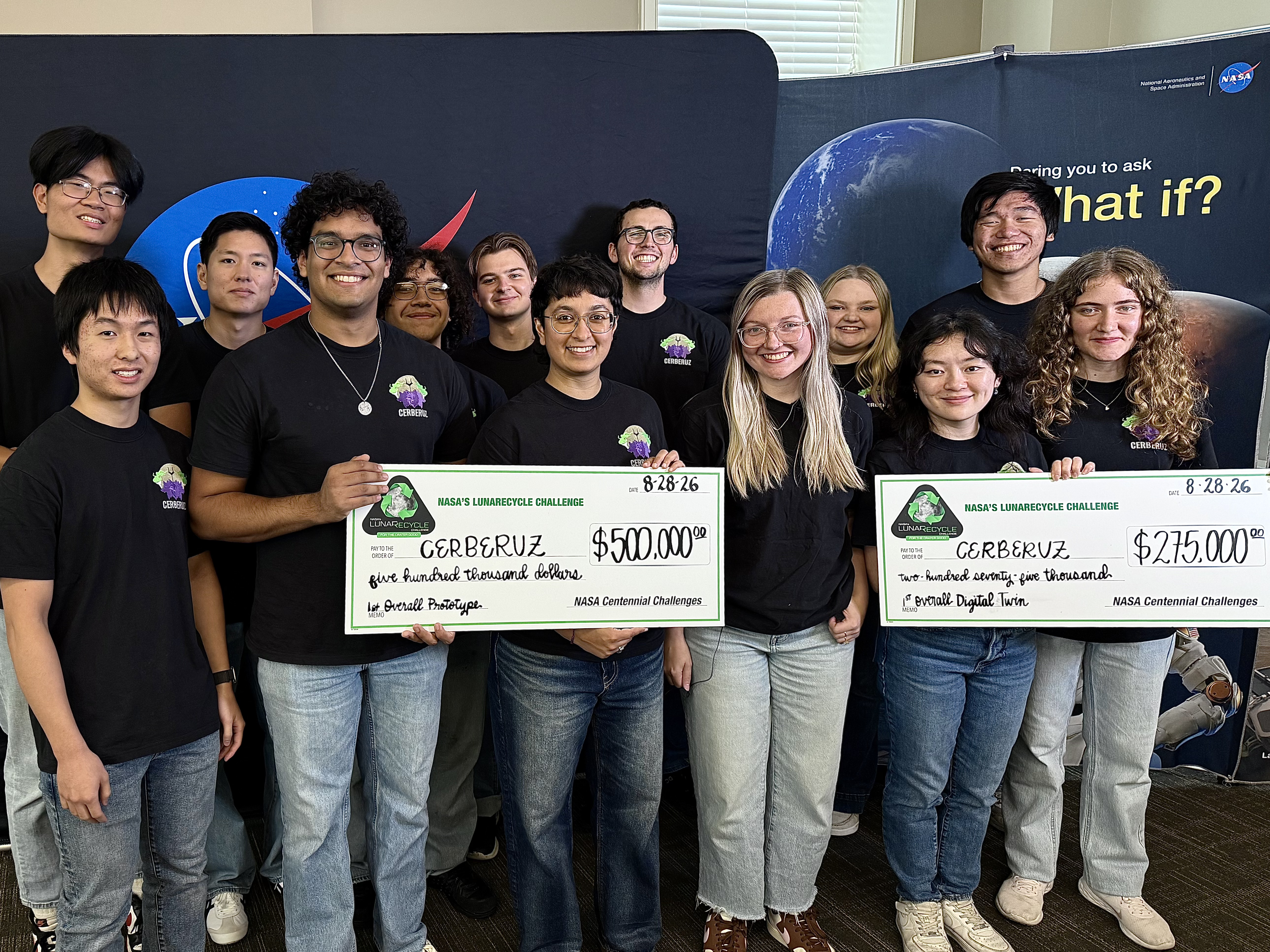
The Massachusetts Institute of Technology team won NASA’s LunaRecycle Challenge competition for their project, Composites for Extraterrestrial Recycling By Engineering the Reuse and Upcycling of Zotek (CERBERUZ).
Credit: NASA/Savannah Bullard
NASA named a team from the Massachusetts Institute of Technology (MIT) as the first prize winner for Phase 2 of the agency’s LunaRecycle Challenge, which focused on developing solutions for reducing waste during missions to the Moon or deep space by recycling common materials, like fabrics, plastics, foam, and metals.
The Composites for Extraterrestrial Recycling By Engineering the Reuse and Upcycling of Zotek (CERBERUZ) team, comprised of undergraduate, graduate, and doctoral students at MIT, received a total of $775,000 in awards.
The technology grinds mixed trash into a fine powder, repurposing materials such as Zotek foam as reinforcement rather than treating it as contamination that needs to be sorted out. The powder becomes feed for use as injection-mold finished parts or 3D-printing filament. The MIT team won in both the competition’s prototype development track and in the track focused on developing virtual models, known as “digital twins,” of recycling systems.
“The LunaRecycle Challenge finale is the culmination of two years of innovation spurred by this competition,” said Jennifer Edmunson, program manager for Centennial Challenges at NASA’s Marshall Space Flight Center in Huntsville, Alabama. “It’s incredible to see these technologies go from concept to prototype and digital twin demonstrations in that time. Driving rapid and creative innovation is what NASA challenges are all about.”
LunaRecycle is a $3 million, two-phase competition in partnership with The University of Alabama Lee J. Styslinger Jr. College of Engineering. Phase 2 of the competition required U.S. teams to submit a prototype, with an optional digital twin serving as a virtual model of it.
For Phase 2, 14 finalist teams from across the United States gathered at The University of Alabama’s Lee J. Styslinger Jr. College of Engineering, in Tuscaloosa, from Aug. 24 to Aug. 28 to demonstrate their technology prototypes. The digital twin models submitted by some teams were also presented alongside their respective prototypes.
The competitors’ backgrounds ranged from university students and faculty to entrepreneurs and space technology enthusiasts. Teams were encouraged to envision solutions that not only addressed recycling in deep space, but that also could have applications on Earth.
Along with the first prize winner, nine teams received prizes:
Prototype track winners:
Second place overall ($225,000): Terasynth from Orlando, Fla. with Lunar Re-Forge System
Most Innovative ($50,000): RECLAIM from Penn State University with the Resource Extraction and Conversion from Lunar Anthropogenic Inputs with Microwaves (RECLAIM) system
Highest Mass Efficiency ($50,000): Cislune from Rosemead, Calif. with the Carbon Recovery and Feedstock Transformation for Extraterrestrial Reuse (CRAFTER) system
Most Trash Types Recycled ($50,000): Team Lovegrove from Bob Jones University in Greenville, S.C. with LunaBrix
Additional digital twin track winners:
Second place overall ($125,000): Moon Made from Boulder, Co. with Fiber Forge
Most Innovative ($25,000): RECLAIM from Penn State University with the RECLAIM system
Best Visualization ($25,000): Waste Parrot Technologies from New York, N.Y.
People’s choice winner ($25,000):
Terasynth from Orlando, Fla. with Lunar Re-Forge System
“This competition highlights how collaborations can lead to incredible solutions,” said Chris Frangione, who manages the LunaRecycle Challenge in support of NASA Centennial Challenges contracted through Amentum Space Exploration Division. “Between the solver teams, The University of Alabama, and NASA, this finale showcases what can be achieved when we bring together resources and great ideas towards a common goal.”
The Phase 2 awards follow the success of the competition’s Phase 1, which received record-breaking interest from the global innovator community with more than 1,200 registrations – more than any competition in the 20-year history of NASA Centennial Challenges. For Phase 1, which concluded in 2025, participants from around the world could submit designs in either or both of the prototype or digital twin tracks. A panel of 50 judges evaluated nearly 200 Phase 1 submissions, selecting 17 teams representing five countries and nine U.S. states as winners. Phase 2 entries were required to be unrelated to Phase 1.
The LunaRecycle Challenge is managed at NASA’s Marshall Space Flight Center by Centennial Challenges, part of the Prizes, Challenges, and Crowdsourcing program within NASA’s Research and Technology Mission Directorate. NASA’s Centennial Challenges have a legacy of more than 20 years engaging the public to solve complex problems that benefit NASA’s broader initiatives. Past challenges have spurred advances in robotics, additive manufacturing, power and energy, textiles, chemistry, and biology.
LunaRecycle is also supported by subject matter experts at NASA’s Kennedy Space Center in Florida, NASA’s Ames Research Center in California’s Silicon Valley, and NASA’s Langley Research Center, in Hampton, Virginia.
We all know that the price of RAM and storage has shot up due to demand from the AI industry and other factors. In most cases that means we grumble about the price, but if we really need the part we can fork out for it. [CNX Software] are reporting that rather than continue to push up their prices, Pine64 are responding to the crisis by halting production of their Linux boards for the time being.
We’ve seen online comment over the now-exorbitant cost of other boards such as a fully-loaded Raspberry Pi, and this follows in that vein. If we had to guess we’d speculate that the high process have resulted in too little in the way of sales, which considering the knock-on impact on our community if other vendors follow suit, could be concerning.
If there’s one bright spot in the current situation, it’s that for many applications where a single-board computer might be used, a microcontroller might now be a better choice for the job than something running Linux. We’re in a very different situation from that we were in when cheap Linux boards appeared, the current generation of high-power microcontrollers have significantly closed the gap between the two. Given that microcontrollers have onboard memory and storage, their immunity from the price hikes makes them even more attractive. As to Pine64, we hope that sales of their other products make up for it.
Meta agreed to impose daily limits on children's social media use and pay nearly $18 billion in settlements with nearly every US state today, cutting short a trial in which Meta said several of the states were demanding over $1.4 trillion. The settlement requires court approval.
Meta is facing claims that it designed its products to foster compulsive use by children and failed to warn users of addiction and mental health risks. Meta, which already uses ID checks and face analysis to verify user ages, said it agreed to impose on people under 18 a "default two-hour daily time limit that teens can only turn off with a parent’s permission," a default block between midnight and 6 am, and a school mode in which notifications are muted by default from 8 am to 3 pm.
The two-hour daily "limit is cumulative across Facebook and Instagram, and time spent scrolling on both apps counts toward the total, including if we detect that someone has multiple accounts," Meta said. Teens will "receive prompts after every 15 minutes of continuous screen time on Facebook or Instagram," and "prompts when their total daily usage hits 60 minutes and 90 minutes."
Meta must overhaul Instagram and Facebook for young users by enforcing daily time limits, turning off push notifications during school hours, and blocking access late at night. (BigStock Photo)
Washington state will receive up to $339 million as part of a historic $17.1 billion multistate settlement with Meta, resolving allegations that the tech giant intentionally designed Facebook and Instagram with addictive features that harmed youth mental health.
Attorney General Nick Brown said Wednesday that the landmark agreement delivers on core youth-safety product changes — including hard caps on daily time limits, late-night scrolling blocks, and disabled push notifications during school hours — that state lawmakers failed to pass through legislation over the past two years.
“Let me say to the young people of Washington state: This agreement shows that your health and safety is more important than Meta’s profits,” Brown said in a news release.
Under the deal, Meta must overhaul Instagram and Facebook for young users by enforcing a two-hour combined daily time limit, turning off push notifications during school hours (8 a.m. to 3 p.m.), and blocking access late at night between midnight and 6 a.m. Teen users will also get the option to switch off algorithmic feeds in favor of a chronological timeline.
The agreement resolves claims brought by a coalition of 47 states, Washington, D.C., and three territories. While Meta acknowledged the settlement could cost up to $18 billion total over 10 years, it marked a rare legal resolution for a major platform facing nationwide youth safety litigation.
Outside the landmark Big Tobacco agreements of the late 1990s, the $17.1 billion deal represents the largest state consumer protection settlement in U.S. history. State officials and tech policy experts are framing the enforcement action as a similar watershed moment for regulating algorithmic harms and digital product design.
Washington state will receive a guaranteed baseline of $237 million from the core youth-safety agreement, with its payout potentially scaling up to nearly $339 million over the next decade if other major platforms like TikTok and Snapchat adopt comparable terms.
The Attorney General’s Office plans to use the funds to cover legal costs, bolster ongoing consumer protection enforcement, and directly fund state programs tackling the youth mental health crisis driven by social media use.
The settlement also mandates an independent third-party auditor to evaluate and report Meta’s technical compliance directly to state regulators annually over the next five years. Beyond usage limits, Meta must restrict social comparison features such as targeted beauty filters, hide public “like” counts for younger users, and implement stricter age verification to prevent children under 13 from creating accounts.
In addition to the core youth-safety agreement, Washington will receive a separate $10.2 million payment resolving long-standing state claims against Meta for sharing nonpublic user data with third parties like Cambridge Analytica during the 2016 election cycle.
Oregon Attorney General Dan Rayfield announced that his state’s share will total more than $125 million over 10 years.
In a public statement, Meta praised the agreement as setting a new benchmark for youth safety, while emphasizing that the restrictions should apply across the entire industry.
“While this is an important step, these protections will only be truly effective if our peers — TikTok and YouTube — put the same measures in place,” a Meta spokesperson said.
The agreement remains subject to final judicial approval in federal district court.

 Login
Login