❌

Normal view

There are new articles available, click to refresh the page.
Before yesterdayMain stream

NASA Awards Enable Research, Technology to Build Future Workforce

15 October 2026 at 11:57
3 Min Read

NASA Awards Enable Research, Technology to Build Future Workforce

An illustration of a suited Artemis astronaut looking out of a Moon lander hatch across the lunar surface, the Lunar Terrain Vehicle and other surface elements.
An illustration of a suited Artemis astronaut looking out of a Moon lander hatch across the lunar surface, a Lunar Terrain Vehicle and other surface elements.
Credits: NASA

NASA has selected 12 U.S. institutions to receive $12 million to accelerate academic research and technology development in support of the agency’s priorities for exploring the Moon, Mars, and deep space.

Through NASA’s Minority University Research and Education Project (MUREP) Space Technology Artemis Research (M‑STAR) initiative, selected institutions will each receive up to $1 million to grow their scientific and engineering capabilities, enhance faculty and student engagement in aerospace research, and expand their ability to compete for future federal and commercial research awards.

β€œWe are excited to launch this new cohort of M-STAR investigators,” said Alicia Baturoni Cortez, MUREP program manager in the agency’s Office of STEM Engagement. β€œNASA investments in our Nation’s research institutions create real opportunities for students and faculty to build skills, knowledge, and infrastructure, while helping NASA close technology gaps for long-duration operations on the Moon and eventually, Mars.”

As NASA enters a Golden Age of innovation and exploration, the M-STAR initiative supports the agency’s mission to develop innovative technologies that improve space transportation, human exploration, robotic discovery, and the growing space economy.

The awardees and their projects are as follows:

California State University, Sacramento
Adaptive Vision-Language-Action Models for Resilient Multi-Robot Collaboration in Unstructured Planetary Environments

University of Central Florida, Orlando
M-FAST: Multi-Fidelity Aerothermal Simulation & Testing for Artemis

University of Hawaii at Manoa
HI-STRIDE: Hawai’i Student Training in Radiation Instrumentation, Detection, and Exploration

University of Houston
RODEO: Rover-carried On-surface Deployables for Exploration Operations

University of Texas, San Antonio
Characterizing Physical and Mechanical Properties of Regolith at Cryogenic Conditions Using the Multi-Planetary Surface Simulator (MPS2)

Kean University, Union, New Jersey
Integrating Terrain Understanding of AI Models With Robust Control for Autonomous Path Planning

Virginia Commonwealth University, Richmond
BNNT-Reinforced Multifunctional Composites for Radiation-Tolerant, Hydrogen-Compatible Nuclear Thermal Propulsion (NTP) Secondary Hardware

Shaw University, Raleigh, North Carolina
Project ARES (Advanced Regenerative Environmental Systems): A Materials-by-Design Research and Workforce Development Platform for Environmental Control and Surface Infrastructure

Howard University, Washington
LumSHRS: Lunar monolithic Spatial Heterodyne Raman Spectrometer for Minirover In-Situ and Standoff Remote Sensing

Prairie View A&M University, Prairie View, Texas
Functionally Graded Interfaces for Directed-Energy-Deposition Repair of Copper-to-Superalloy Propulsion Hardware: An Integrated AI/ML Design-to-Validation Research Capability at Prairie View A&M University

University of New Mexico, Albuquerque
POWER-Artemis: Extreme-Environment Batteries and Fuel Cells for Sustained Moon and Mars Operations

Fayetteville State University, North Carolina
From Documents to Models: Method-Compliant Generative AI for Bootstrapping Model-Based Systems Engineering in NASA’s Artemis Enterprise (Doc2Model)

NASA’s Office of STEM Engagement fosters an ecosystem across education, industry, and government to cultivate a well‑prepared talent pool, while the agency’s Research and Technology Mission Directorate develops the transformative space technologies that enable future NASA missions and ensure U.S. leadership in aerospace. Together, they accelerate mission readiness by aligning cutting edge technological innovation with the workforce needed to carry it forward.
NASA Astronauts to Answer Questions from Florida Students

14 October 2026 at 15:12
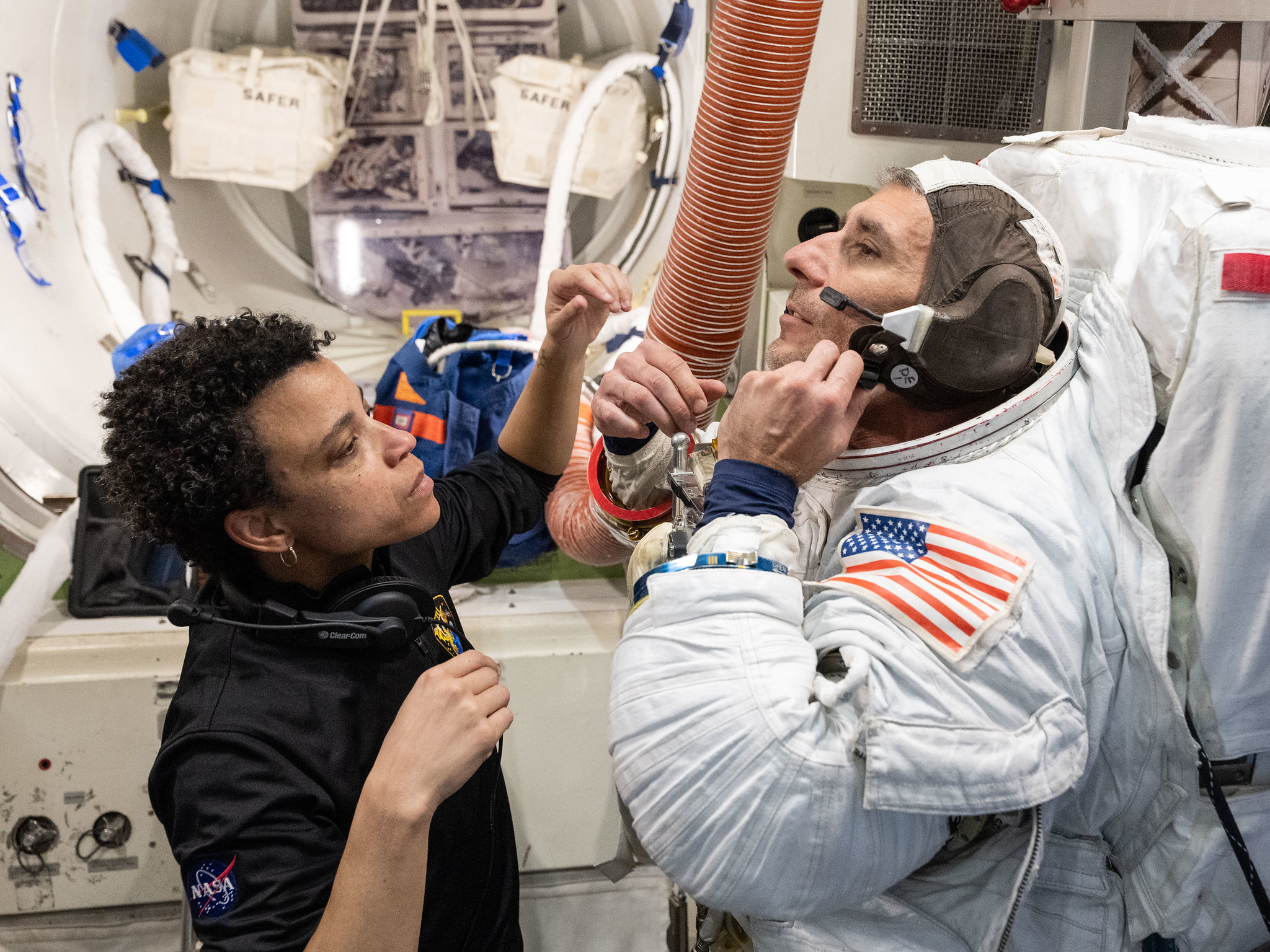
NASA astronaut Jessica Watkins assists NASA astronaut Luke Delaney as he practices suiting up in a spacesuit in an International Space Station airlock simulator on May, 5, 2026, at the agency's Johnson Space Center Space Vehicle Mockup Facility in Houston.
NASA astronaut Jessica Watkins assists NASA astronaut Luke Delaney as he practices suiting up in a spacesuit in an International Space Station airlock simulator on May 5, 2026, at the agency’s Johnson Space Center Space Vehicle Mockup Facility in Houston.
Credit: NASA

Editor’s Note: This article was updated Thursday, Oct. 15, 2026, to reflect a change to the event start time.

Students in Florida will hear from NASA astronauts Jessica Watkins and Luke Delaney as they answer prerecorded STEM questions while aboard theΒ International Space Station.

The Earth-to-space call will begin at 12:30 p.m. EDT Friday, Oct. 16, and will stream live on the agency’sΒ Learn With NASAΒ YouTube channel.

This event is hosted by Sally Ride Elementary School in Orlando, Florida, for students in grades K-12, and the community. This unique opportunity aims to deepen understanding of space exploration and enhance awareness of STEM careers.

Media interested in covering the event must RSVP no later than 5 p.m. EDT, Thursday, Oct. 15, to Jenny Morgan at (407) 858-3100, or at jenny.morgan@ocps.net.

For more than 25 years, people have lived and worked continuously aboard the International Space Station, advancing scientific knowledge and making research breakthroughs not possible on Earth. The space station helps NASA understand and overcome the challenges of human spaceflight, expand commercial opportunities in low Earth orbit, and build on the foundation for long-duration missions to the Moon, as part of the Artemis program, and to Mars.

For more information on NASA in-flight calls, visit:

https://www.nasa.gov/stemonstation

NASA Opens Applications for Second Season of ORBIT Student Challenge

29 September 2026 at 11:11
2 Min Read

NASA Opens Applications for Second Season of ORBIT Student Challenge

Following a successful inaugural year of ingenuity and career building, NASA ORBIT (Opportunities in Research, Business, Innovation, and Technology) has officially returned for a second season to bring university and college student innovation to the forefront of Earth technology development and deep-space exploration.

Registration for the 2026–2027 challenge is open through Monday, Nov. 16, 2026, through the NASA STEM Gateway.

Expanded for its second season with up to $500,000 in total prize funding, NASA’s ORBIT invites student teams to explore their boldest ideas and invent their brightest solutions. Through the competition, students must conduct targeted research, conceptualize early models, and perform feasibility analyses to refine their proposals. Top-performing teams earn a spot at the in-person Pitch Showcase to present their solutions to a panel of expert judges, who select award recipients based on their presentations and interactive Q&A sessions.

ORBIT has two challenge tracks for teams to choose from. Participants in the ORBIT Earth track must select a NASA-owned patent and develop novel commercial or nonprofit applications addressing critical terrestrial problems. Whether reimagining drones for reduced noise pollution or designing improved medical technology for better patient care, students must demonstrate clear pathways to public benefit.

The ORBIT Space focuses on next-generation space exploration technology designed to support NASA’s Artemis program and future initiatives to establish a sustainable human presence on the Moon, Mars, and beyond. Teams competing in this track develop viable concepts for power, communications, navigation, living solutions, astronaut health and well-being, and more.

Projects that successfully unite the goals of both the Earth and Space tracks can also qualify for a special Integration Bonus, but this season also introduces two new specialty recognitions: the Faculty Advisors’ Choice Award, celebrating professionalism and cross-team communications, and the Next Steps Award, recognizing teams with the strongest roadmaps to continuing their project development after the conclusion of the challenge.

Together with core prizes, ORBIT celebrates student excellence and drives key technical solutions while building a pipeline of interdisciplinary talent. The challenge provides students with immersive experience in NASA’s core missions, direct access to agency mentors, and industry-ready skills that bridge academia and aerospace careers.

For complete competition details, eligibility requirements, and official rules, visit: https://nasaorbit.org/

Registration is open until Nov.16, 2026, through the NASA STEM Gateway.

❌
❌