❌

Normal view

There are new articles available, click to refresh the page.
Before yesterdayMain stream

NASA, Partners Accelerate Lander Development for 2028 Moon Missions

By: Lee Mohon
23 October 2026 at 18:39
7 Min Read

NASA, Partners Accelerate Lander Development for 2028 Moon Missions

015B0749.NEF

As NASA returns humans to the lunar surface and establishes a long-term presence on our closest celestial neighbor, the agency and commercial human landing system providers Blue Origin and SpaceX have streamlined the designs and changed both concepts of operations for its future crewed landers.

Since NASA established initial contracts with Blue Origin and SpaceX for crewed missions to the Moon, the agency has redefined Artemis III to demonstrate rendezvous and docking capabilities between test versions of landers from each provider and the agency’s Orion spacecraft in low Earth orbit next year. In parallel, the companies are also developing crew and cargo versions of their landers for near-term Artemis missions.

“We are executing President Trump’s National Space Policy to complete the long-awaited return of American astronauts to the lunar surface in 2028 and establish a Moon Base,” said NASA Administrator Jared Isaacman. “We have a proven foundation in SLS and Orion, along with two lunar landers in development with Blue Origin and SpaceX. But NASA has no intention of sitting idly by as all the pieces come together. That is not how Apollo succeeded, and it is not how the near-impossible is achieved. NASA is energized, our core capabilities are being rebuilt, our machine shops are running 24/7, and our experts are in the field attacking the critical path. We are building a Super Bowl-caliber team to safely achieve these objectives and everything that comes next.”

NASA is energized, our core capabilities are being rebuilt, our machine shops are running 24/7, and our experts are in the field attacking the critical path. We are building a Super Bowl-caliber team to safely achieve these objectives and everything that comes next.

Jared Isaacman

Jared Isaacman

NASA Administrator

For the initial crewed missions to the Moon, Artemis astronauts will launch in the agency’s Orion spacecraft on top of the SLS (Space Launch System) rocket from NASA’s Kennedy Space Center in Florida. During each Artemis mission, a commercial human landings system will link up with Orion before taking two crew members to the lunar surface while two remain aboard Orion. To accelerate development toward a 2028 landing, the Artemis landers and Orion will no longer rendezvous in a near-rectilinear halo orbit around the Moon and instead meet up in an orbit that differs for each partner, informed by their systems.

Both companies are required to perform an uncrewed demonstration mission with their crewed landers prior to the near-term Artemis crewed missions to the Moon. NASA will certify lander systems prior to the crewed missions to ensure safety and mission success.

Starship lander concept of operations
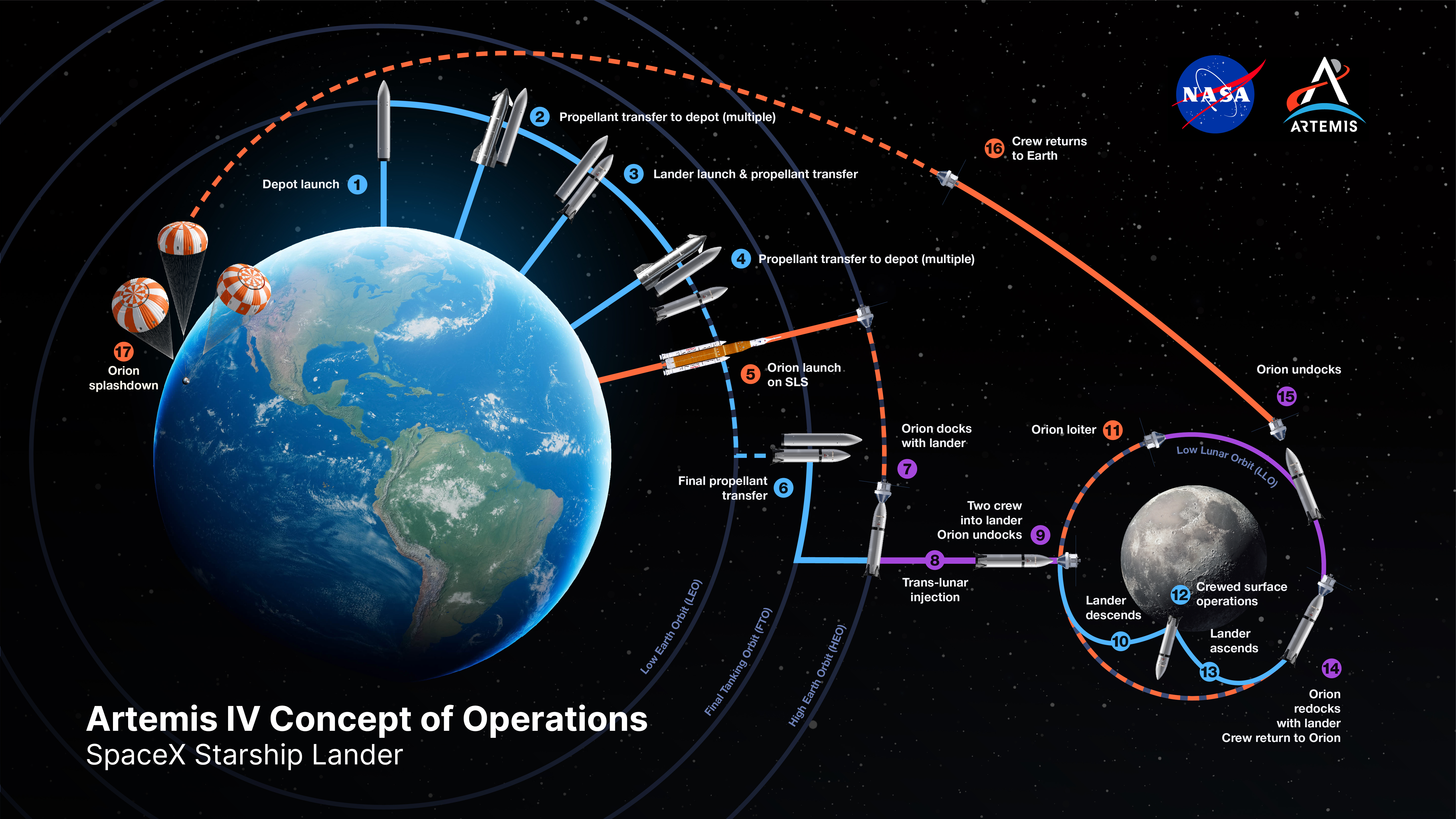
Artemis IV Concept of Operations (SpaceX Starship Lander) infographic.

SpaceX continues to plan for an in-space propellant aggregation approach to transfer super cold, or cryogenic, liquid propellant in space. The company will launch multiple versions of Starship to low Earth orbit prior to the launch of the Starship Human Landing System (HLS) from Florida. Similar to a gas station on Earth, the series of propellant “tanker” Starships in low Earth orbit will transfer propellant to the waiting “depot” Starship. The depot Starship will ultimately fuel the Starship lander for its journey to the Moon.

Under the revised operations, Starship HLS will await Orion and its crew in Earth orbit. The lander and Orion will rendezvous and dock in Earth orbit, then the Starship lander will perform a trans-lunar injection burn to send the combined lander and Orion stack to low lunar orbit. NASA is working to modify Orion to enable Starship to push it to the Moon. The lander will bring two crew members to the lunar surface for several days before delivering them back to Orion for the ride back to Earth.

Propellant aggregation in low Earth orbit allows for flexibility in the crew launch timing on SLS, while a trans-lunar injection burn performed by the Starship lander will enable direct access to low lunar orbit. This new concept of operations using low lunar orbit will significantly lower the amount of propellant Starship needs to aggregate in space while reducing the amount of time it can take for astronauts leaving the Moon’s surface in Starship to link back up with Orion. SpaceX will demonstrate the propellant aggregation approach during the uncrewed demonstration mission.

Blue Moon lander concept of operations
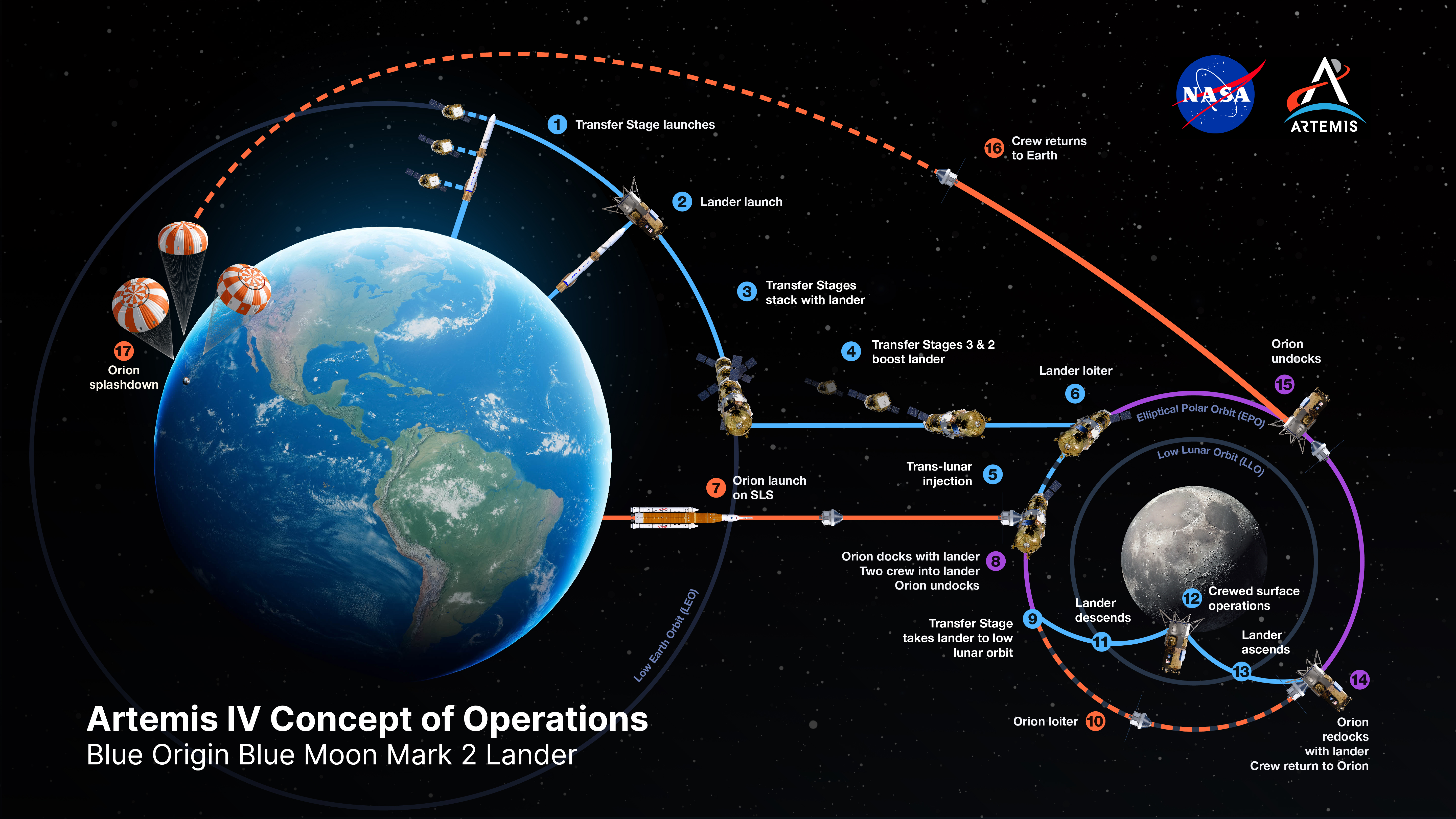
Artemis IV Concept of Operations (Blue Origin Moon Mark 2 Lander) infographic.

For its accelerated 2028 crewed lunar landing mission, Blue Origin will defer propellant transfer and use three transfer stages to send the Blue Moon Mark 2 Alpha Lander to the Moon. Based on existing Mark 1 and Mark 2 hardware, the stages operate like a multistage rocket. They launch into low Earth orbit, followed by the Mark 2 lander. Once docked, the stack departs for an elliptical polar orbit around the Moon, with each transfer stage separating as its propellant depletes. Compared with the previously planned near-rectilinear halo orbit, the elliptical polar orbit offers faster returns from the lunar surface to Orion, reduces Blue Moon lander propellant requirements, and maximizes the performance available by SLS.

This architecture provides multiple opportunities for SLS and Orion to launch the crew to elliptical polar orbit and dock with the Blue Moon Mark 2 lander. Two crew members then transfer to the lander and descend to the Moon’s South Pole. After surface operations, the lander returns to Orion, where the crew transfers for their journey back to Earth.

Blue Origin will incorporate lessons from earlier robotic Mark 1 missions supporting the agency’s Moon Base Program and demonstrate the full mission profile in an uncrewed lander transfer stage demonstration mission.

This artist concept depicts SpaceX's Starship lander on the lunar surface.
This artist concept depicts SpaceX’s Starship lander on the lunar surface.
SpaceX
This artist concept depicts Blue Origin's Blue Moon Mark 2 lander on the lunar surface.
This artist concept depicts Blue Origin’s Blue Moon Mark 2 lander on the lunar surface.
Blue Origin
Artemis IV Concept of Operations (Blue Origin Moon Mark 2 Lander) infographic.
NASA
Artemis IV Concept of Operations (SpaceX Starship Lander) infographic.
NASA

Returning American astronauts to the Moon

Ultimately, based on lander readiness, NASA will determine which company will be first selected to safely deliver astronauts to the Moon’s surface and back to lunar orbit in 2028. A second crewed landing opportunity will follow.

NASA is targeting two, approximately two-hour long lunar surface Moonwalks during initial surface missions. Astronauts will use the Moonwalks to collection lunar samples and test capabilities of the spacesuit provided by Axiom Space.

Earlier this year, NASA updated its contracts with Blue Origin and SpaceX for human landing systems and large cargo deliveries to the Moon. The updates align the agency’s human landing system requirements with acceleration efforts announced earlier this year to streamline Artemis mission architecture, expedite a lunar return, and support an increased mission cadence to the Moon.

Under the original HLS contracts, SpaceX’s Starship human landing system was assigned to the Artemis III and IV missions, while Blue Origin would use its Blue Moon Mark 2 human landing system for Artemis V. Under the contract realignments, both providers are participating in the Artemis III mission in low Earth orbit and neither lander provider has been assigned to a specific Artemis lunar landing mission.

“NASA and our lunar lander providers Blue Origin and SpaceX have been working hand in hand to ensure we can return American astronauts to the Moon by 2028,” said Jeremy Parsons, NASA’s Artemis program manager.“While work to realign with our partners in support of architecture updates announced at Ignition Day in March has been underway since then, updating the contracts ensures NASA and its partners are on the same page with requirements and other milestones to ensure continued insight into lander development to support mission success and the safety of our Moon crews.”

Both Blue Origin and SpaceX have added development milestones to provide NASA with more insight into lander development efforts, reducing risk and enhancing astronaut safety in preparation for crewed Moon landings. SpaceX is adding two demonstrations of its crew cabin, called Cabin 1, for its Starship lander. Blue Origin is adding new human-in-the-loop testing and hardware readiness milestones to streamline training development as well as ground and flight operations.

As part of a Golden Age of innovation and exploration, NASA will send Artemis astronauts on increasingly difficult missions near the lunar South Pole to explore more of the Moon than ever before. In addition to providing economic benefits and advancing scientific discovery though its Moon missions, NASA will establish an enduring human presence on the lunar surface and build on the agency’s foundation for the first crewed mission to Mars. 
About the Author

Corinne Beckinger

Public Affairs Official

NASA’s Artemis III Mission to Test Future Moon Lander Operations

23 October 2026 at 18:37

Before astronauts return to the lunar surface, NASA will first conduct one of the most ambitious and complex test missions in the agency’s history. 

Launching in 2027, Artemis III will send NASA astronauts Randy Bresnik, Frank Rubio, Andre Douglas, and ESA (European Space Agency) astronaut Luca Parmitano aboard the Orion spacecraft into low Earth orbit to perform a series of demonstrations with test versions, or test articles, of human landing systems being developed by industry partners Blue Origin and SpaceX. During the planned 14-day mission, crews and flight controllers will practice the rendezvous, docking, habitation, and operational procedures that will be essential when Artemis astronauts begin landing near the Moon’s South Pole in 2028. The mission is designed to reduce risk, validate hardware, and gain operational experience before NASA attempts a crewed lunar landing.  

“Every piece of this mission in Earth orbit is designed to reduce risk before we put astronauts back on the Moon,” said Jeremy Parsons, NASA’s Artemis program manager. “We’re launching three spacecraft on three different rockets and testing how they operate together — something NASA has never attempted. Every lesson we learn here gets us closer to landing on the Moon in 2028.” 

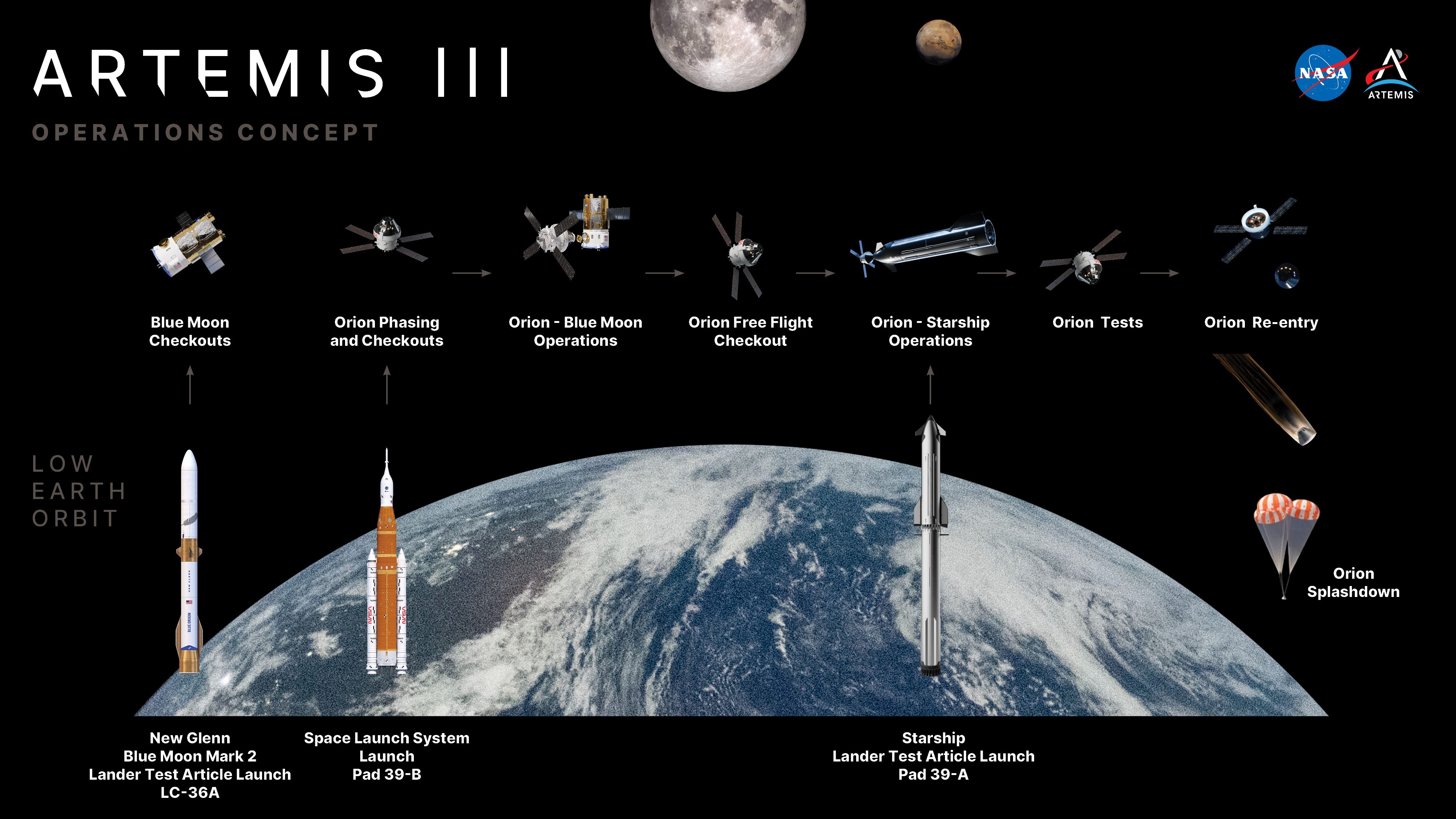
This graphic shows NASA’s concept of operations for Artemis III. The mission will send four astronauts to low Earth orbit next year to test critical systems needed for future lunar landings.
NASA

First stop: Blue Origin’s lunar lander test article 

Earlier Artemis missions used only NASA’s SLS (Space Launch System) rocket and Orion spacecraft. Artemis III will involve three separate spacecraft launched on three different heavy-lift rockets within a relatively short period of time. 

The mission begins with Blue Origin launching a test version of its Blue Moon Mark 2 lander into a circular low Earth orbit approximately 273 miles (237 nautical miles) above Earth. The spacecraft can remain on orbit for up to 30 days providing schedule flexibility. Artemis III is designed as a tightly choreographed campaign, with NASA planning to launch Orion on top of SLS from the agency’s Kennedy Space Center in Florida only days after the Blue Moon test article launch and confirmation the vehicle is healthy and ready for joint operations. 

Following launch, Orion will initially enter an elliptical Earth orbit of 18 x 1122 miles (16 x 975 nautical miles). It will use its service module to perform a series of maneuvers to transition to a circular orbit at about 345 miles (300 nautical miles) for thermal stabilization before then gradually setting up its rendezvous with the waiting Blue Moon lander test article. Because each spacecraft operates in slightly different orbital regimes optimized for its mission requirements, Artemis III requires a carefully choreographed sequence of orbital maneuvers and rendezvous operations throughout the flight. 

During the first two days of flight, the crew will check out Orion’s systems, prepare for proximity operations, and gradually position themselves for the mission’s first major objective: rendezvous and docking with the Blue Moon test vehicle. 

The operation represents NASA’s first opportunity to evaluate how Orion and a commercial lunar lander work together in space. Engineers will assess how software aboard both spacecraft, guidance systems, communications systems, and operational procedures perform in real-world conditions, while flight controllers gain experience coordinating activities across multiple teams and organizations. 

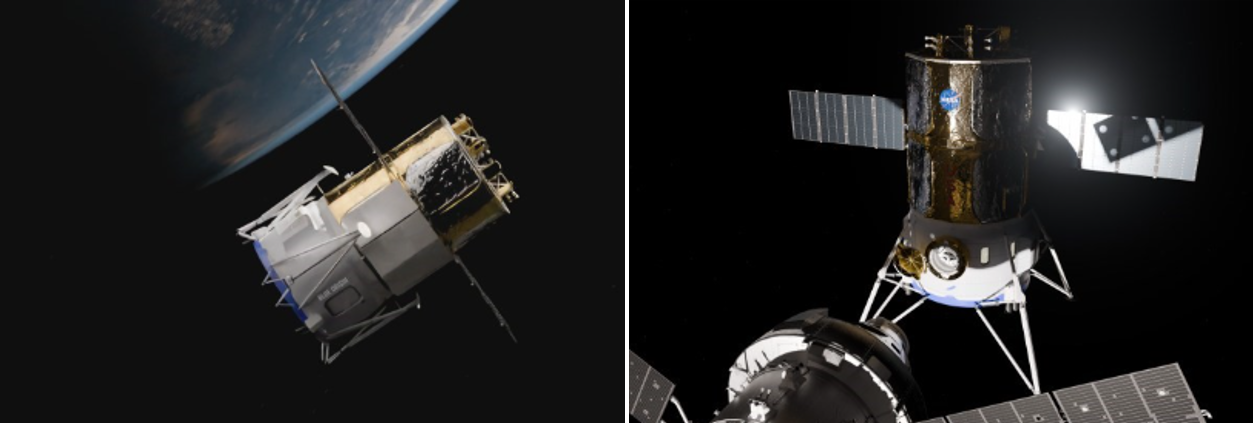
These artist’s concepts depict Blue Origin’s Blue Moon Mark 2 human landing system test article in Earth orbit and docked with NASA’s Orion spacecraft as part of NASA’s upcoming Artemis III demonstration mission in low Earth orbit.
Blue Origin

Once docked, astronauts will spend approximately two days conducting evaluations aboard the Blue Moon test article. Crew members will open the hatch and enter the spacecraft, allowing them to assess the cabin environment, controls, and life-support systems firsthand. Teams will verify the spacecraft’s ability to maintain the proper atmosphere and pressure. 

The Blue Moon test article incorporates many of the avionics, software, flight-control systems, crew-cabin technologies, and life-support functions planned for future lunar missions. Testing those systems in orbit will provide the first opportunity to evaluate how many of the lander’s flight systems perform in space as an integrated vehicle. 

By the time Orion undocks, NASA will have completed its first evaluation of a commercial lunar lander with crew, gathering data on spacecraft systems, crew operations, and spacecraft interoperability not possible on the ground. 

Starship docking demonstration  

After completing operations with Blue Origin’s lander, Orion will undock and reposition to support the next phase of the mission: a second rendezvous operation. 

SpaceX will launch a Starship Version 3 test article from Florida. Because Starship is designed for a much shorter on-orbit lifetime than Blue Origin’s lander, launch occurs later in the mission, allowing NASA to efficiently sequence the two docking demonstrations. Starship will enter a lower orbit at 206 nautical miles, optimized for communications coverage, and will carry an added docking system mounted at the forward end. 

These artist’s concepts depict NASA’s Orion spacecraft and SpaceX’s Starship human landing system test article during docking operations as part of NASA’s upcoming Artemis III demonstration mission in low Earth orbit.
SpaceX

Orion will rendezvous and dock with the spacecraft during a test expected to last up to two hours. Crew will not enter Starship during this test. The demonstration is focused on validating how Orion and Starship interact as a docked system in space. NASA and SpaceX plan to evaluate spacecraft controllability, communications, integrated software performance, and the dynamics associated with docking and undocking operations. 

The docking itself also presents a unique test, using different docking geometries. Orion will connect to a port beside Blue Moon’s crew cabin, then later align its forward docking system with the one at Starship’s nose. Testing both approaches during a single mission gives NASA an opportunity to assess different operational concepts while gathering valuable engineering data.  

Together, the two docking campaigns will demonstrate how Orion interfaces with two very different commercial lander architectures during a single mission. 

Testing Orion for future exploration 

Even after docking activities are complete, Artemis III will continue generating data that supports future missions. 

Once the Starship demonstration is complete, Orion and its crew will have up to five additional days available in orbit before beginning preparations for the journey home. NASA plans to use this time to complete a variety of test objectives that support future Artemis missions, including additional evaluations of the Orion Crew Survival System suits, docking sensor tests, acoustic and thermal measurements, human-factors assessments, and a range of science and technology demonstrations. 

Several investigations led by NASA will build on studies conducted during Artemis II, collecting additional data that will help inform future deep-space missions. The crew also will conduct a proof-of-concept study examining how astronauts could perform health-related assessments when they are unable to communicate directly with mission control, an important capability for future lunar surface expeditions and other missions farther from Earth. 

NASA also plans to fly a cellular biology experiment during the mission while researchers use the flight to test concepts for returning lunar samples to Earth. Teams will evaluate how future samples could be transported, received, and moved into curation facilities after landing, while also conducting assessments of Orion’s environment to better understand potential contamination considerations for future lunar missions. 

The mission also will include Earth and solar observations that help astronauts continue developing critical observation skills while taking advantage of the spacecraft’s unique orbital vantage point. Plant seeds will fly aboard Orion as well, providing opportunities for scientific study and educational engagement following the mission. 

Mission planners have also built flexibility into the flight timeline, providing additional opportunities to complete test objectives depending on how operations unfold in real time. 

When ready, Orion will begin phasing for return, and the crew will configure the cabin for reentry and splashdown, which will occur in the Pacific Ocean, off the coast of California. Orion and its crew will be recovered by NASA personnel and the United States Navy. 

Practicing for Moon missions 

Every activity performed during Artemis III supports a larger goal: reducing risk before astronauts return to the lunar surface. 

The mission will provide NASA with experience operating alongside multiple commercial partners while managing complex rendezvous and docking operations involving three different spacecraft. Engineers will gain insight into spacecraft interoperability, mission-control coordination, communications architecture, crew operations, and hardware performance. 

By the time Artemis III concludes with Orion’s splashdown on Earth, NASA will have demonstrated technologies and operational concepts that future lunar crews will rely on as they travel to and from the Moon.  

Most importantly, Artemis III will provide the operational experience needed to transform plans for future lunar landings into proven flight procedures. The lessons learned throughout the mission will help refine future exploration plans, strengthen partnerships with industry, and ensure astronauts are prepared for humanity’s next giant leap at the Moon. 

As part of a Golden Age of innovation and exploration, NASA will send Artemis astronauts on increasingly difficult missions near the lunar South Pole to explore more of the Moon than ever before. In addition to providing economic benefits and advancing scientific discovery through its Moon missions, NASA will establish an enduring human presence on the lunar surface and build on the agency’s foundation for the first crewed mission to Mars. 
To learn more about Artemis, visit: 

www.nasa.gov/artemis 

NASA Opens 2027 Human Lander Challenge for Lunar Communications

29 September 2026 at 17:27

3 min read

Preparations for Next Moonwalk Simulations Underway (and Underwater)

Banner image for 2027 Human Lander Challenge.
NASA

NASA’s 2027 Human Lander Challenge is seeking ideas from college and university students to help address one of the most critical needs for sustained lunar exploration: reliable communications.

As NASA prepares for long-term human presence on the Moon through the Artemis and Moon Base programs, communications systems will be just as important as spacecraft and rockets. A resilient communications system will connect astronauts, rovers, habitats, landers, mission support teams on Earth, and more. Reliable communications are essential for ensuring safety, coordinating complex operations, and enabling timely decision-making in the harsh and remote lunar environment.

“Reliable communications will be at the heart of our ability to explore and operate on the Moon,” said Jeremy Del Greco, Human Landing System program communications integration lead at NASA’s Marshall Space Flight Center in Huntsville, Alabama. “As Artemis and Moon Base missions expand our presence beyond Earth, we will need dependable connections across the lunar surface and beyond. The 2027 Human Lander Challenge gives students the opportunity to help shape the communications capabilities of tomorrow and support future lunar exploration.”

The 2027 competition invites United States-based collegiate teams and their faculty advisers to develop innovative, systems-level solutions to better understand, establish, and optimize lunar communications for landers and surface operations that can be implemented within three to five years.

Teams should submit a non-binding notice of intent by Thursday, Oct. 15, if they would like to participate. Proposal packages, including a five to seven-page proposal and a two-minute video, are due March 4, 2027.

While teams may propose solutions outside of the focus areas, NASA has identified three main categories to advance future lunar communications capabilities:

  • Hardware:
    • Space-rated wireless networks and electronics
    • Antenna signal propagation, modeling, and environmental mitigation
  • Software:
    • Data efficiency and link optimization
    • Network management and scheduling
  • Architecture
    • Surface communications system architecture
    • Orbital communications system architecture

Based on proposal package evaluations in phase 1, up to 12 finalist teams will be selected to receive $9,000 and advance to phase 2 of the competition, which includes a final design review in Huntsville, Alabama, home of NASA’s Marshall Space Flight Center, June 21–24, 2027. The top three teams from phase 2 will share a total prize of $18,000.

The Human Lander Challenge is administered by the National Institute of Aerospace on behalf of the agency and supports NASA’s efforts to foster innovative solutions to a variety of areas for long-duration human spaceflight plans at the Moon. The Human Lander Challenge is sponsored by the agency’s Human Spaceflight Mission Directorate’s Human Landing System Program Office.

Through the Artemis program, NASA will send astronauts to explore the Moon for scientific discovery, economic benefits, and to build the foundation for the first crewed missions to Mars – for the benefit of all.

For more information on NASA’s Human Lander Challenge and how to participate, visit:

https://hulc.nianet.org/

❌
❌