❌

Normal view

There are new articles available, click to refresh the page.
Before yesterdayNASA Breaking News

NASA, Partners Accelerate Lander Development for 2028 Moon Missions

By: Lee Mohon
23 October 2026 at 18:39
7 Min Read

NASA, Partners Accelerate Lander Development for 2028 Moon Missions

015B0749.NEF

As NASA returns humans to the lunar surface and establishes a long-term presence on our closest celestial neighbor, the agency and commercial human landing system providers Blue Origin and SpaceX have streamlined the designs and changed both concepts of operations for its future crewed landers.

Since NASA established initial contracts with Blue Origin and SpaceX for crewed missions to the Moon, the agency has redefined Artemis III to demonstrate rendezvous and docking capabilities between test versions of landers from each provider and the agency’s Orion spacecraft in low Earth orbit next year. In parallel, the companies are also developing crew and cargo versions of their landers for near-term Artemis missions.

“We are executing President Trump’s National Space Policy to complete the long-awaited return of American astronauts to the lunar surface in 2028 and establish a Moon Base,” said NASA Administrator Jared Isaacman. “We have a proven foundation in SLS and Orion, along with two lunar landers in development with Blue Origin and SpaceX. But NASA has no intention of sitting idly by as all the pieces come together. That is not how Apollo succeeded, and it is not how the near-impossible is achieved. NASA is energized, our core capabilities are being rebuilt, our machine shops are running 24/7, and our experts are in the field attacking the critical path. We are building a Super Bowl-caliber team to safely achieve these objectives and everything that comes next.”

NASA is energized, our core capabilities are being rebuilt, our machine shops are running 24/7, and our experts are in the field attacking the critical path. We are building a Super Bowl-caliber team to safely achieve these objectives and everything that comes next.

Jared Isaacman

Jared Isaacman

NASA Administrator

For the initial crewed missions to the Moon, Artemis astronauts will launch in the agency’s Orion spacecraft on top of the SLS (Space Launch System) rocket from NASA’s Kennedy Space Center in Florida. During each Artemis mission, a commercial human landings system will link up with Orion before taking two crew members to the lunar surface while two remain aboard Orion. To accelerate development toward a 2028 landing, the Artemis landers and Orion will no longer rendezvous in a near-rectilinear halo orbit around the Moon and instead meet up in an orbit that differs for each partner, informed by their systems.

Both companies are required to perform an uncrewed demonstration mission with their crewed landers prior to the near-term Artemis crewed missions to the Moon. NASA will certify lander systems prior to the crewed missions to ensure safety and mission success.

Starship lander concept of operations
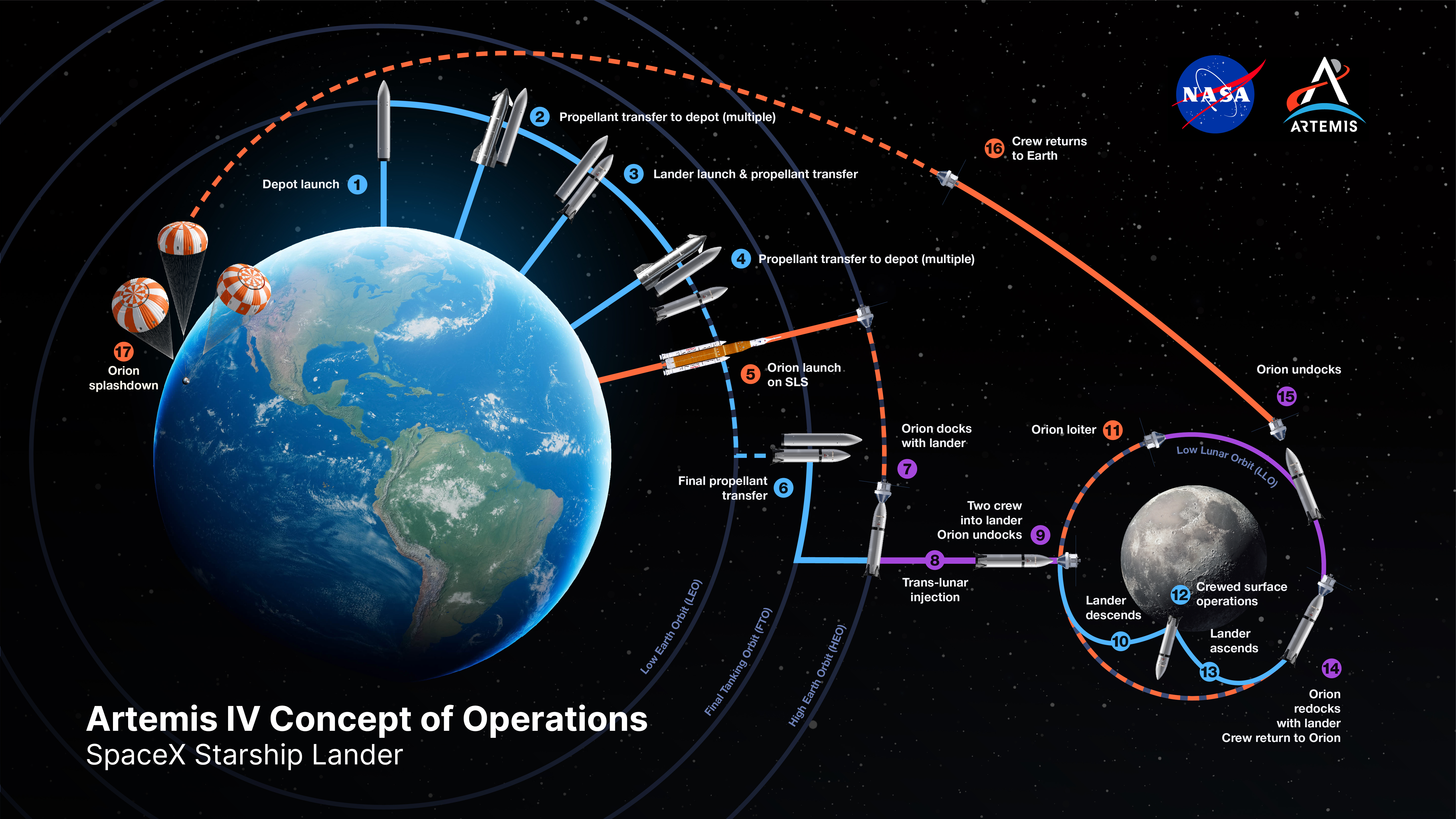
Artemis IV Concept of Operations (SpaceX Starship Lander) infographic.

SpaceX continues to plan for an in-space propellant aggregation approach to transfer super cold, or cryogenic, liquid propellant in space. The company will launch multiple versions of Starship to low Earth orbit prior to the launch of the Starship Human Landing System (HLS) from Florida. Similar to a gas station on Earth, the series of propellant “tanker” Starships in low Earth orbit will transfer propellant to the waiting “depot” Starship. The depot Starship will ultimately fuel the Starship lander for its journey to the Moon.

Under the revised operations, Starship HLS will await Orion and its crew in Earth orbit. The lander and Orion will rendezvous and dock in Earth orbit, then the Starship lander will perform a trans-lunar injection burn to send the combined lander and Orion stack to low lunar orbit. NASA is working to modify Orion to enable Starship to push it to the Moon. The lander will bring two crew members to the lunar surface for several days before delivering them back to Orion for the ride back to Earth.

Propellant aggregation in low Earth orbit allows for flexibility in the crew launch timing on SLS, while a trans-lunar injection burn performed by the Starship lander will enable direct access to low lunar orbit. This new concept of operations using low lunar orbit will significantly lower the amount of propellant Starship needs to aggregate in space while reducing the amount of time it can take for astronauts leaving the Moon’s surface in Starship to link back up with Orion. SpaceX will demonstrate the propellant aggregation approach during the uncrewed demonstration mission.

Blue Moon lander concept of operations
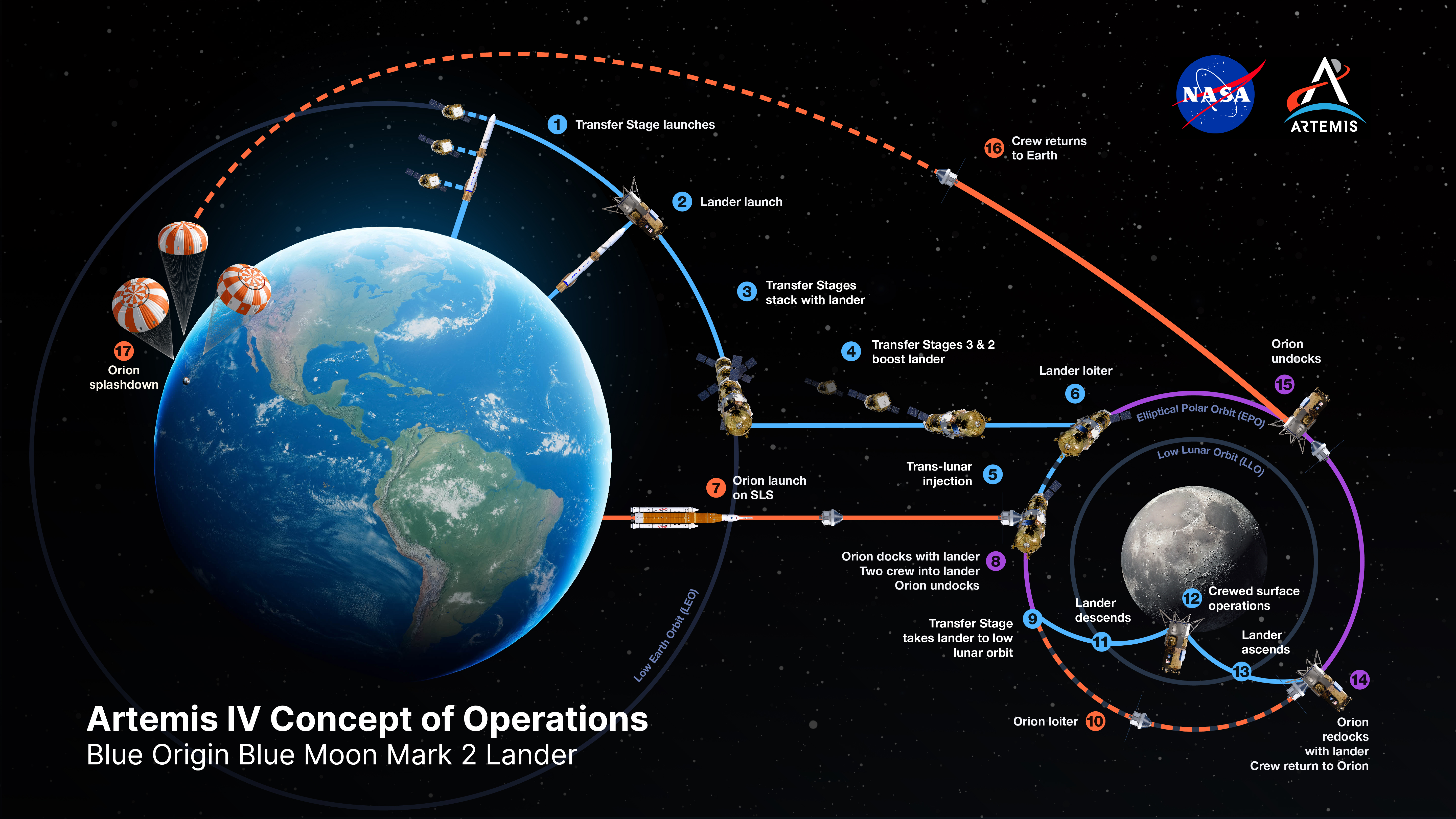
Artemis IV Concept of Operations (Blue Origin Moon Mark 2 Lander) infographic.

For its accelerated 2028 crewed lunar landing mission, Blue Origin will defer propellant transfer and use three transfer stages to send the Blue Moon Mark 2 Alpha Lander to the Moon. Based on existing Mark 1 and Mark 2 hardware, the stages operate like a multistage rocket. They launch into low Earth orbit, followed by the Mark 2 lander. Once docked, the stack departs for an elliptical polar orbit around the Moon, with each transfer stage separating as its propellant depletes. Compared with the previously planned near-rectilinear halo orbit, the elliptical polar orbit offers faster returns from the lunar surface to Orion, reduces Blue Moon lander propellant requirements, and maximizes the performance available by SLS.

This architecture provides multiple opportunities for SLS and Orion to launch the crew to elliptical polar orbit and dock with the Blue Moon Mark 2 lander. Two crew members then transfer to the lander and descend to the Moon’s South Pole. After surface operations, the lander returns to Orion, where the crew transfers for their journey back to Earth.

Blue Origin will incorporate lessons from earlier robotic Mark 1 missions supporting the agency’s Moon Base Program and demonstrate the full mission profile in an uncrewed lander transfer stage demonstration mission.

This artist concept depicts SpaceX's Starship lander on the lunar surface.
This artist concept depicts SpaceX’s Starship lander on the lunar surface.
SpaceX
This artist concept depicts Blue Origin's Blue Moon Mark 2 lander on the lunar surface.
This artist concept depicts Blue Origin’s Blue Moon Mark 2 lander on the lunar surface.
Blue Origin
Artemis IV Concept of Operations (Blue Origin Moon Mark 2 Lander) infographic.
NASA
Artemis IV Concept of Operations (SpaceX Starship Lander) infographic.
NASA

Returning American astronauts to the Moon

Ultimately, based on lander readiness, NASA will determine which company will be first selected to safely deliver astronauts to the Moon’s surface and back to lunar orbit in 2028. A second crewed landing opportunity will follow.

NASA is targeting two, approximately two-hour long lunar surface Moonwalks during initial surface missions. Astronauts will use the Moonwalks to collection lunar samples and test capabilities of the spacesuit provided by Axiom Space.

Earlier this year, NASA updated its contracts with Blue Origin and SpaceX for human landing systems and large cargo deliveries to the Moon. The updates align the agency’s human landing system requirements with acceleration efforts announced earlier this year to streamline Artemis mission architecture, expedite a lunar return, and support an increased mission cadence to the Moon.

Under the original HLS contracts, SpaceX’s Starship human landing system was assigned to the Artemis III and IV missions, while Blue Origin would use its Blue Moon Mark 2 human landing system for Artemis V. Under the contract realignments, both providers are participating in the Artemis III mission in low Earth orbit and neither lander provider has been assigned to a specific Artemis lunar landing mission.

“NASA and our lunar lander providers Blue Origin and SpaceX have been working hand in hand to ensure we can return American astronauts to the Moon by 2028,” said Jeremy Parsons, NASA’s Artemis program manager.“While work to realign with our partners in support of architecture updates announced at Ignition Day in March has been underway since then, updating the contracts ensures NASA and its partners are on the same page with requirements and other milestones to ensure continued insight into lander development to support mission success and the safety of our Moon crews.”

Both Blue Origin and SpaceX have added development milestones to provide NASA with more insight into lander development efforts, reducing risk and enhancing astronaut safety in preparation for crewed Moon landings. SpaceX is adding two demonstrations of its crew cabin, called Cabin 1, for its Starship lander. Blue Origin is adding new human-in-the-loop testing and hardware readiness milestones to streamline training development as well as ground and flight operations.

As part of a Golden Age of innovation and exploration, NASA will send Artemis astronauts on increasingly difficult missions near the lunar South Pole to explore more of the Moon than ever before. In addition to providing economic benefits and advancing scientific discovery though its Moon missions, NASA will establish an enduring human presence on the lunar surface and build on the agency’s foundation for the first crewed mission to Mars. 

About the Author

Corinne Beckinger

Public Affairs Official

NASA Invites Media to 2026 von Braun Space Exploration Symposium

By: Lee Mohon
22 October 2026 at 17:39

Members of the media are invited to join NASA at the 2026 von Braun Space Exploration Symposium from Monday, Oct. 26, to Wednesday, Oct. 28, at the University of Alabama in Huntsville.

This year’s symposium is focused on humanity’s return to the Moon, sustainable lunar infrastructure, advanced space propulsion, and the evolving space workforce.

Panels include discussions on Artemis II and III, space propulsion flash talks, building utilities and infrastructure for sustainable lunar operations, Moon base supply chain resilience, space nuclear technology, navigating the new NASA workforce, and engineering the future, featuring keynotes and awards presentations.

NASA speakers include:

  • Deputy Associate Administrator Casey Swails
  • Stephen Cash, director, NASA Marshall
  • Nicky Fox, associate administrator, Science Mission Directorate, NASA Headquarters
  • Charlie Blackwell-Thompson, Artemis II launch director, NASA Kennedy
  • Steve Creech, Human Landing System program manager, NASA Marshall
  • Debbie Whitis Korth, acting program manager, Orion Program, NASA Johnson

To request an interview with NASA speakers during the event, media must contact Lance D. Davis, lance.d.davis@nasa.gov, and Joel Wallace, joel.w.wallace@nasa.gov. Media interested in participating in-person or online must contact the American Astronomical Society to register.

Organized by the American Astronautical Society in collaboration with NASA’s Marshall Space Flight Center in Huntsville, Alabama, the annual event gathers leaders from government, industry, policy, and academia to discuss the current landscape of space exploration and help chart a path forward.

For more information on NASA Marshall, visit:

https://www.nasa.gov/marshall

-end-

Lance D. Davis
Marshall Space Flight Center, Huntsville, Ala.
256-640-9065
lance.d.davis@nasa.gov  

Share

Details

Last Updated
Oct 22, 2026
Editor
Lee Mohon
Contact

NASA to Conduct NCAA Flyover, Engage Fans at University of Alabama

By: Lee Mohon
21 October 2026 at 12:31
Looking up, three white and black fighter jets fly in formation across a bright, blue sky.
NASA’s Freedom 250 F-5 team, including NASA Administrator Jared Isaacman, performs a flyover during the national anthem at an NFL game between the Cleveland Browns and the Carolina Panthers at Huntington Bank Field, Sept. 27, 2026, in Cleveland.
NASA/Jordan Cochran

As part of the agency’s Inspiration Tour, NASA will conduct a flyover at the University of Alabama vs. Texas A&M football game in Tuscaloosa, Alabama, on Saturday, Oct. 24. NASA Administrator Jared Isaacman will pilot one of three F-5 fighter jets during the flyover, highlighting NASA’s contributions to aeronautics and the agency’s continued commitment to advancing aviation technologies.

Ahead of the game, members of the news media are invited to visit the NASA Experience Zone on Champions Lane, where Isaacman will participate in a media opportunity at 11 a.m. CDT. Media interested in attending should confirm their attendance by 12 p.m. Friday, Oct. 23, with Lance D. Davis at lance.d.davis@nasa.gov to receive additional details and instructions.

Supported by NASA’s Marshall Space Flight Center in Huntsville, Alabama, the NASA Experience Zone will be open to the public from 10:30 a.m. to 2:30 p.m. CDT, with no game ticket required. The experience will give visitors an opportunity to meet NASA team members and learn more about the people and technologies advancing the agency’s missions in aeronautics and space exploration.

Attendees can engage with NASA team members and explore exhibits highlighting the agency’s Artemis campaign and efforts to return astronauts to the Moon, including:

  • An inflatable SLS (Space Launch System) rocket.
  • Displays featuring the Starship and Blue Moon human landing systems.
  • Information about NASA internship opportunities.
  • Photo opportunities featuring NASA exhibits and displays.

With stops across the nation, NASA’s  Inspiration Tour  convenes academic, industry, and public sector stakeholders to connect the agency with the people, technologies, and organizations that drive American leadership in space.

The tour will culminate in MAX POWER, a public exposition of American air and space innovation, Saturday, Nov. 7, and Sunday, Nov. 8, on and near the agency’s Kennedy Space Center in Florida. Held in honor of America’s historic 250th anniversary, the multi-day, family-friendly event will showcase the next-generation aircraft, spacecraft, autonomous vehicles, and technologies that will help define the future of transportation in air and space. 

 For more information about MAX POWER and the agency’s missions, visit:


https://www.nasa.gov/maxpower

-end-

Lance D. Davis 
Marshall Space Flight Center, Huntsville, Ala. 
256-640-9065 
lance.d.davis@nasa.gov  

Share

Details

Last Updated
Oct 21, 2026
Editor
Lee Mohon
Contact

NASA Tests Dual Mode Propulsion CubeSat Ahead of Launch

By: Lee Mohon
25 September 2026 at 15:36

Spacecraft propulsion traditionally relies on volatile fuels and separate, bulky systems for different types of maneuvering in space. NASA is working to change that paradigm. Engineers at NASA’s Marshall Space Flight Center in Huntsville, Alabama, recently completed a rigorous series of environmental and physical tests on a new small satellite designed to make spaceflight safer and more efficient.

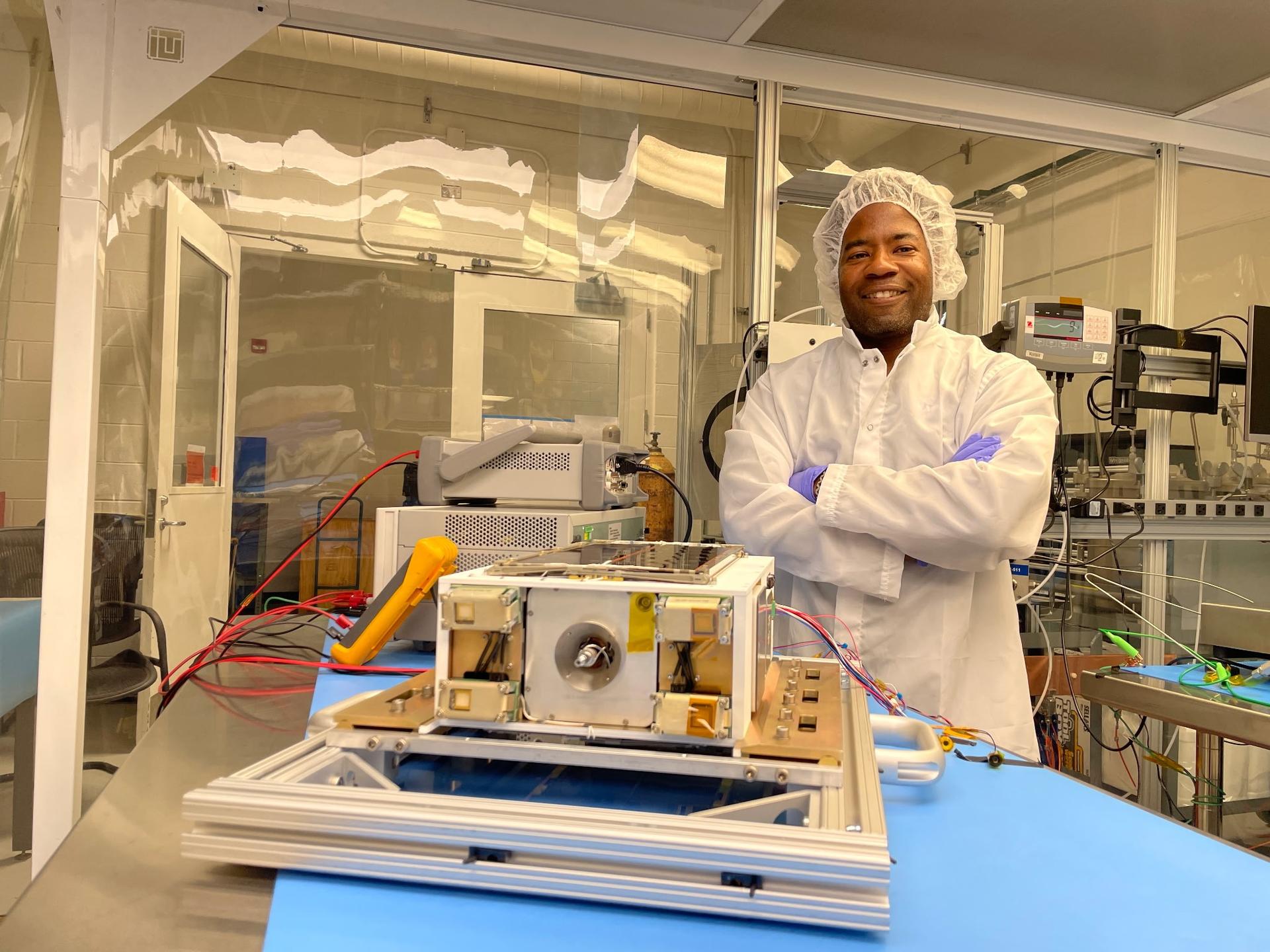
The ASCENT (Advanced Spacecraft Energetic Non-Toxic) Propulsion Dual Mode mission is a flight demonstration of a spacecraft about the size of a large shoebox. The mission will test a single, integrated propulsion system that uses a common fuel tank to feed two different types of engines.

An Album of photos showing NASA engineers and technicians in white protective clean room suits working on a small, rectangular spacecraft module. They are shown inspecting the hardware on a laboratory workbench, wrapping it in silver foil, and loading it into a large, metallic vacuum chamber at NASA's Marshall Space Flight Center
Dr. Nehemiah Williams, the demonstration’s project manager at NASA, prepares to start testing the mission’s flight hardware in a clean room at NASA’s Marshall Space Flight Center in Huntsville, Alabama. The mission will demonstrate a single, non-toxic propulsion system that combines both high-thrust and low-thrust capabilities into a common tank.
NASA/Charles Beason

Typically, spacecraft carry two separate propulsion systems to navigate: a high-thrust chemical system for rapid movements like entering orbit, and a low-thrust electric system for highly efficient, slow maneuvers like maintaining a position. This requires multiple fuel tanks and heavy plumbing, which eats up valuable space and weight.

The spacecraft being developed uses a single non-toxic propellant called ASCENT. By feeding both a high-thrust combustion engine and low-thrust electrospray thrusters from one central tank, the spacecraft saves critical mass and volume. For future missions, this means more room for scientific instruments and the ability to launch on smaller, less expensive rockets.

Bringing this concept to flight requires a nationwide collaborative effort. While NASA Marshall manages the mission, the spacecraft relies on electrospray thrusters developed by the Massachusetts Institute of Technology, a chemical propulsion module built by Plasma Processes, and a spacecraft bus integrated by the Georgia Institute of Technology.

“There are a lot of odds and ends, and a lot of small challenges and some big ones,” said Nehemiah Williams, the demonstration’s project manager at NASA Marshall. “But ensuring the functionality of the propulsion system across all these different teams is what makes the mission successful.”

Before a spacecraft can safely operate in the harsh environment of low Earth orbit, it must pass a battery of tests on the ground. Over the past few months, the engineering team at Marshall has put the flight hardware through its paces inside the center’s Small Spacecraft Servicing and Integration Lab.

To verify the integrity of the unified propulsion system, the team conducted extensive leak testing. Engineers performed a pressurized helium leak test of the spacecraft inside a vacuum chamber to ensure the integrity of the spacecraft’s seals, successfully proving those seals were working as intended. Because the system shares a single tank of ASCENT propellant to feed two different thruster types, ensuring that the fuel lines and valves are perfectly sealed is vital for mission safety and success.

An Album of photos showing NASA engineers and technicians in white protective clean room suits working on a small, rectangular (CubeSat) spacecraft module. They are shown inspecting the hardware on a laboratory workbench, wrapping it in silver foil, and loading it into a large, metallic vacuum chamber at NASA's Marshall Space Flight Center
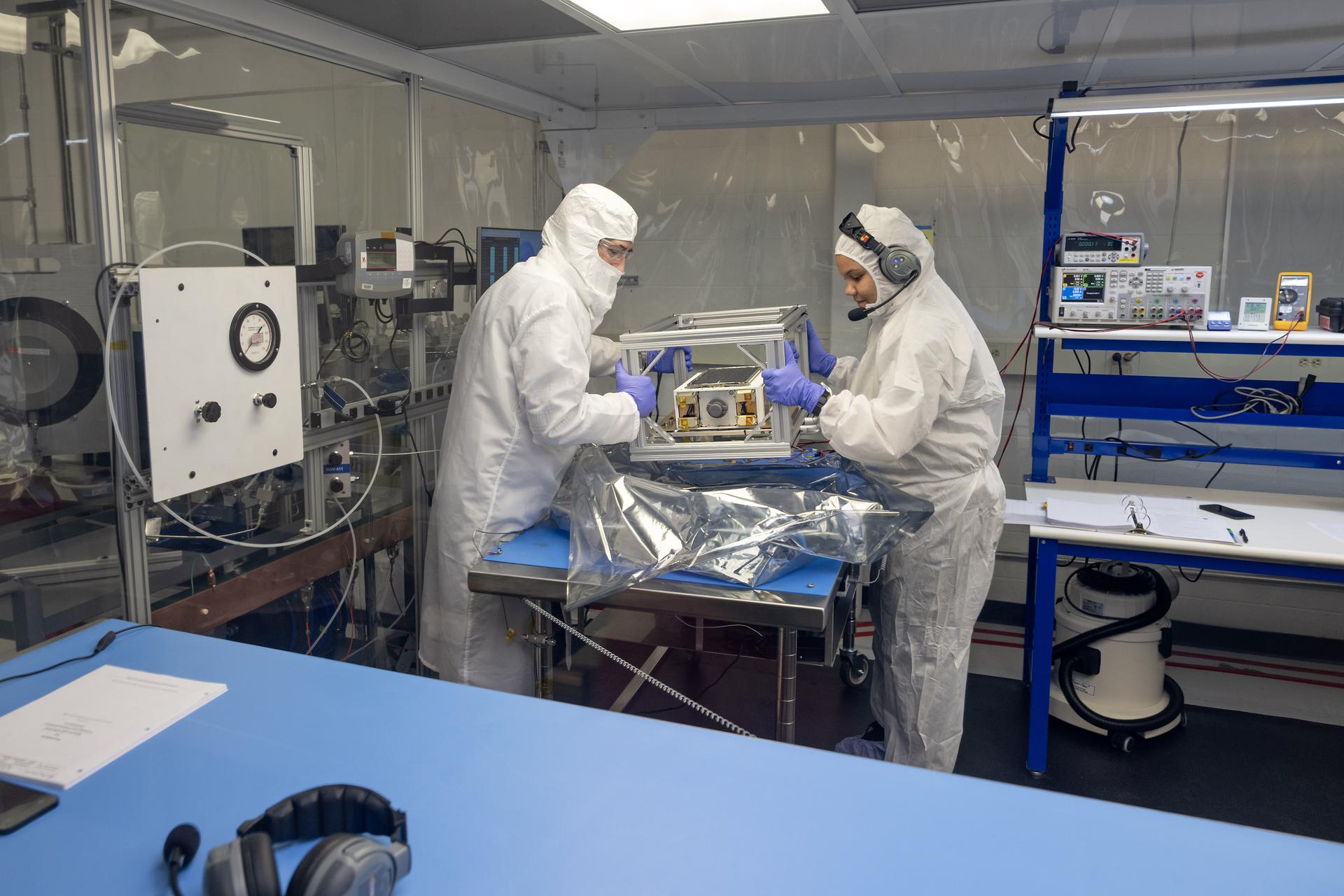
Propulsion subject matter expert Chris Burnside left, and propulsion lead Ebony Bland, right, prepare the mission’s flight hardware for testing inside a clean room at NASA’s Marshall Space Flight Center in Huntsville, Alabama. The 6-U CubeSat recently underwent rigorous spin, thermal vacuum, and leak tests to ensure its innovative, non-toxic propulsion system is ready for the extreme environment of space.
NASA/Charles Beason

The team also subjected the spacecraft to thermal vacuum testing. Space is an unforgiving environment characterized by a total lack of air and extreme temperature swings. By placing the spacecraft inside a specialized vacuum chamber that mimics these harsh conditions, engineers can ensure that the electronics, thrusters, and mechanical systems will operate normally once in orbit.

Additionally, the spacecraft underwent a spin test. Just like a tire on a car, a spacecraft needs to be perfectly balanced. The spin test measures the spacecraft’s mass properties and center of gravity. This validates the CubeSat’s ability to stably fly and maintain the correct attitude, allowing its antennas to communicate with Earth and its solar panels to accurately catch the Sun’s rays.

With the environmental and physical testing now complete, the mission is entering its final stages of preparation. The team will complete the final system checkouts, integrate the spacecraft’s solar arrays, and ship the hardware to its launch destination.

The ASCENT Propulsion Dual Mode mission is manifested to launch no earlier than October 1 as a payload aboard a SpaceX Falcon 9 rocket from Vandenberg Space Force Base in California.

Once deployed into an orbit about 325 miles above Earth, the spacecraft will begin a nine-month mission. After an initial checkout period, the operations team will execute short chemical and electric maneuvers. If successful, the spacecraft will spend several months performing multiple orbit-raising and lowering maneuvers, alternating between its high-thrust and low-thrust engines to prove the dual-mode concept works in space.

The ASCENT Propulsion Dual Mode mission is managed and funded by NASA’s Small Spacecraft & Distributed Systems (SSDS) within the agency’s Research and Technology Mission Directorate at NASA Headquarters in Washington. SSDS is based at NASA’s Ames Research Center in California’s Silicon Valley.

About the Author

Joel Wallace

Public Affairs Officer

Share

Details

Last Updated
Sep 25, 2026
Editor
Lee Mohon
Contact
Keep Exploring

Discover More Topics From NASA

❌
❌