Normal view

There are new articles available, click to refresh the page.
Yesterday — 26 July 2026Hackaday

2026 Frikkin Lasers Challenge: Measuring Nanometer-Scale Displacements with an Optical Cavity

26 July 2026 at 22:00
A plastic device sits on a desk, with a computer display and an oscilloscope behind it. A fiber-optic cable runs from the device to a laser diode source.

Optical cavities – two mirrors arranged to reflect light multiple times between them – form the basis of lasers and certain optical filters. Since any angle between the two mirrors results in light being scattered away, parallel alignment is essential, yet difficult to maintain. Nevertheless, [Timothy Giles] managed to 3D-print and align such an optical cavity, and used it to detect minute shifts in space and wavelength.

The cavity has two semi-transparent mirrors facing towards each other. One mirror is held in a 3D-printed mount, and the other is attached to the diaphragm of a speaker with a hole drilled through the center. The hole avoids the speaker coil, and allows light exiting the optical cavity through the semi-transparent mirror to appear on a paper target, which is monitored by a webcam. On the other side of the optical cavity, a laser diode coupled to a single-mode fiber shines in through the other mirror. Alignment is challenging, but the webcam makes it easier; as the mirrors tilt relative to each other, the pattern seen on the paper target changes, providing feedback for more precise adjustment.

Light reflected within the cavity can interfere constructively or destructively with incoming light, changing the brightness of the emitted beam. [Tim] used the speaker as a linear actuator to vary the cavity’s length, which, by counting the peaks in brightness, allowed him to measure the diaphragm’s displacement. This also demonstrated a laser diode’s wavelength instability: when the cavity was set to a constant length and the laser started up, the output brightness would cycle a few times. As the diode was warming up, its output wavelength was shifting, creating the same changing interference pattern.

To get a Gaussian beam distribution, [Tim] used a fiber-coupled laser; if you’d like to build one, we’ve seen a coupling mechanism built before. Most lasers are built around an internal optical cavity, but some instead use an external cavity.

2026 Hackaday Freaking Lasers Contest
Before yesterdayHackaday

This Week in Security: AI is a Mess, Hacking Car Chargers, an OpenSSL DoS, and Factories Under Attack

24 July 2026 at 10:00

[Ayush Paul] posts about extracting data from Claude agents while it accesses web data to fulfill user requests.

But it wasn’t that easy. [Ayush] discovered that Anthropic anticipated many of the attacks, and set up guardrails in an attempt to keep the agent from accessing arbitrary web sites. For Claude to access a website, the user has to specify it, it must be the results of a web search, or it must be referenced by a website previously specified by the user or returned in a search.

To convince the Claude agent to navigate a malicious site designed to extract data, Ayush formed a false warning that Cloudflare was blocking the agent for authentication purposes, and asked it to spell out the name of the agents owner by clicking a list of alphabetical links. Of course Claude trusts Cloudflare and wants to be helpful, so it cheerfully completed the task.

Once the agent is trapped in the false authentication loop, it can be interrogated for all sorts of information it knows about the owner: Ayush was able to convince it to disclose employer, and even data about the user that could be linked to security questions, like their home town.

Since Claude can be detected by the user agent (the field attached to web requests that tells the web server what sort of browser is requesting the page) custom information can be fed to the bot while users see a normal website; clicking a link looks completely normal, but asking an agent to summarize the site triggers fooling the bot into spilling the beans.

After reporting the issue, Ayush was told that Anthropic had already identified the issue internally, and eventually prevented the attack for now by preventing the agent from following links on external pages.

Grok sends entire codebases

Cereblab discovered that the Grok coding agent uploaded the entire content of the codebase it’s working with – and all Git history – to xAI servers, almost immediately. Even when told to never upload a file, the agent would reply “OK”, and then begin uploading the code bundle anyway.

If uploading your code to a remote server isn’t bad enough, and this could be extremely bad in some situations involving sensitive company code, including the entire Git history means that previously deleted files, like accidentally committed secrets or authentication credentials and tokens, were also leaked. Attempting to opt out by disabling options to improve the model by uploading code had no effect.

After gaining attention, Grok has added a privacy option to opt out of data retention. xAI has committed to deleting the retained uploaded code, but it is unclear if users will be told when their data has been removed. To actually prevent the agent from uploading local files to the xAI servers, even temporarily, a global flag “disable_codebase_upload” is required. Watch out, the privacy retention flags are only per-session!

Steam malware used to steal crypto

Court filings in Washington state this month revealed an attempt to steal cryptocurrency using malware uploaded to the Steam gaming platform. Publicly identified and taken off the store in 2025, the filing alleges the same individuals were behind multiple games containing crypto stealing trojans: “Dashverse”, “Lunara”, “PirateFi”, “BlockBlasters”, and “Lampy”.

PC World covered the initial discovery of the malware on Steam. While Steam, overall, seems to do a good job preventing malware titles, 2025 had several high-profile cases. Prosecutors say the malware netted approximately $200,000 in stolen cryptocurrency wallets as well as other stolen credentials including Steam accounts.

OpenSSL DoS in 11 Bytes

Okta posts about a denial of service in OpenSSL where a single pre-auth packet is able to cause an allocation of up to 16 megabytes of RAM.

The “11 bytes” headline is very catchy, but more important than the actual number of bytes is the general asymmetric behavior; an attacker can send a very small amount of data and achieve a disproportionately large result. The OpenSSL vulnerability only has local impacts, exhausting server memory rather than generating network traffic, but similar attacks in the network space can fuel denial of service storms when extremely small requests result in amplified results.

The bug is ultimately due to being insufficiently suspicious of remotely supplied content, in this case the pre-authentication fields in the connection message that define the length of the incoming client message. Since the memory is pre-allocated in the server, the client doesn’t need to actually transmit that much data – it simply needs to hold the connection open. Keeping the connection open isn’t even required for causing problems – repeatedly allocating large blocks of different sizes can lead to memory fragmentation where the memory allocator keeps grabbing larger and larger ranges of memory because there isn’t sufficient ram available in a contiguous chunk.924899

Fortunately this bug has already been addressed in OpenSSL 4.0.1 and backported to maintenance releases of previous versions.

Exposed Interfaces on Car Chargers

Saiflow has a report on a range of exposures via the electric vehicle charging infrastructure.

In CVE-2026-9039 Saiflow exposes the risks in some CCS2 EV charging stations. As part of the standard, communication is established between the charging station and the operator network, which is typically strongly secured via TLS and VPN use. A second connection, however, is established over the charging plug between the charging station and the vehicle; the vehicle is assigned an IPv6 address for communicating with the charger for various charging protocols.

The XCharge C6 charging station exposes SSH and basic telnet network services on all network interfaces, including the interface connected to the vehicle. To make it even worse, they allow root login, with password “root”, giving full admin access to the charging station.

Once inside the charging station, an attacker has access to the network connection from the charging station to the company network, as well as root control over the charging station itself, with the possibility of damaging the charger, changing the power output levels, or getting free charging. If a future vulnerability was found in the management interface of the vehicle, a compromised charger could be used to attack future connected vehicles.

The main lessons for vendors seem to be ones we’re familiar with already: never leave default credentials, especially not “root” and “root” in a product, and be aware of what networks you expose services on. Good lessons for all of us; let those who have never left a Raspberry Pi with default credentials on a network cast the first stone.

Hugging Face Breach

In news that has likely been impossible to avoid, Axios reports on a compromise of the Hugging Face platform by an OpenAI model. The reports around the incident echo the frequently weird boastful statements from OpenAI, who state “We consider this to be an unprecedented cyber incident” and they “are responding accordingly”, despite being the originators of and cause of said incident.

Multiple vulnerabilities in the Hugging Face API were combined to accomplish the breach, including an unknown vulnerability in the package registry system. OpenAI says that safeguards on their model had been disabled for the test, which seems irresponsible given the outcome. Under almost any normal situation, conducting an unsolicited test of the security of a company because safeguards were ignored is considered illegal hacking, not fodder for a pre-IPO press release and humble-brag.

Linux Kernel Discloses 442 Vulnerabilities

Possibly feeling that Microsoft has all the press for a record-breaking Patch Tuesday last week, the Linux kernel developers have announced 442 CVEs related to the kernel.

With this many vulnerabilities in one report, it’s nearly impossible to isolate at a glance which ones are truly impactful and which are simply incorrect behavior. While CVE entries have been created, none have been assigned severity scores yet.

It appears the majority of the vulnerabilities were found with Sashiko, an agent developed by the Linux Foundation and trained on the Linux kernel for finding vulnerabilities in new submissions.

LG to Ban Residential Proxy Apps

After recent negative press (some of which we covered here) about the prevalence of residential proxy apps on the LG platform, Krebs on Security now reports that LG is banning the behavior from apps on the platform.

This comes after Spur reported that 42% of apps on the platform contained libraries to enable always-on residential proxies, which allow access to the network the television is connected to. Residential proxies can be used as a pivot point to attack companies and bypass geographic IP restrictions, commit ad fraud, or access the internal home networks of users.

Iran Attacking Industrial Logic Controllers

CISA, the US cyber security agency, has issued a warning that Iranian based attackers are targeting industrial control systems made by Rockwell Automation, Schneider Electric, and Siemens.

These sort of controllers are found in manufacturing, waste processing, water treatment, and other industrial processes, and attackers have been able to upload custom control logic, overriding “safe operating parameters” according to the report. Most of us will never be responsible for these systems, but they impact our lives all the time.

Cisco Releases Open-Weight Vulnerability-Finding Models

Finally, Cisco has released a set of open-weight models to aid in searching a codebase for known vulnerabilities. The Antares models are open-weight models designed to run fully locally and search a code base for vulnerabilities related to lists of known CVE issues. Cisco has published the models on Hugging Face.

Are you using AI tooling for security scans or research?  How is it going?

BASICally, Its Retro Machine Language

23 July 2026 at 19:00

We enjoyed [Beej’s] trip down memory lane looking at a BASIC game, The Wizard’s Castle, written for the Exidy Sorcerer. It appeared in a 1980 magazine that included the title graphic above. It reminded us how, back in those days, we did things with BASIC that you shouldn’t be able to do and it often looks, today, rather cryptic.

In particular, even if you know modern BASIC, these few lines might give you a pause:

10 REM"_(C2SLFF4
40 POKE 260,218: POKE 261,1: T = USR(0): T = PEEK(-2049)
80 Q = RND(-(2*T+1))

Line 10 is a comment, but a strange one. Certainly that doesn’t matter, right? Actually, it is a key part of the action. On line 40, you can see some pokes to write directly to memory and a peek to read some memory value back. The USR function calls some machine language program. You may realize the whole thing is to get some value T to seed the random number generator in line 80.

This leads to a few obvious questions. First, how does USR know what to call? Second, where is the machine language program? The details varied by system, of course, but in this case, the program knows that location 259 has a jump instruction that USR called. So poking an address into 260 and 261 was telling USR where it should go.

But what’s at that address? Keep in mind that an old computer like the Sorcerer didn’t have megabytes of memory being swapped about by an operating system. That means that things tended to be in known places and that BASIC had to be judicious about storing source code.

As was common at the time, a line like “10 PRINT 1+1” would get tokenized. In this case, each line would get a pointer to the next line, a two-byte line number, a single-byte token for “PRINT” and then more bytes to represent the rest of the line. In the case of text in a string or a remark, the bytes were just the text with a zero to terminate the string.

The first line entered would always be at address 469. So? If you consider the format of the REM statement, there will be a pointer at 469 and 470, the line number at 471 and 472, and the REM token at 473. That means the other bytes just get poured into address 474 and beyond.

That might seem like an odd number until you look at the pokes in line 40. Keep in mind that POKE works on bytes, not words. So poking 1 into 261 gives you an address of 256 + whatever is in the low byte, in this case 218. Add 256 and 218, and you get… 474! So USR is going to call that odd string in line 10!

There is more to the detective story, but if you want to know exactly what the REM did, you can read the original post.

Echolocation for Drones

20 July 2026 at 16:00
A quadcopter with a clear, U-shaped shield up front and red propellers navigates between a close stand of moss-covered trees.

Bats are remarkable creatures, able to fly at night or inside the confines of caves without light to guide their way. A team of researchers at Worcester Polytechnic Institute (WPI) has determined how to use low power ultrasonic sensors to guide drones in obscured environments.

While radar, lidar, and GPS are all great for navigation and sensing, they can run into issues when light is obscured or can take too much power to be practical for the limited battery life of a drone. The researchers found that a dual sonar array could be used to implement a much lower power sensing system for a drone that performs well in environments that would stymie a computer vision system.

A shield placed behind the array cuts down on the sound of the propellers that would otherwise drown out the signal, and further signal analysis via a neural net separates the echoes of objects in front of the drone from the background. The prototype could navigate in various simulated environments like forests, smoke, and snow. It looks like it even got a chance to go for a flight in the actual woods. All the code and hardware designs are Open Source, so have at it!

We’ve covered mosquito-inspired drone sensors before, and if you want to get into echolocation yourself, apparently humans can learn to do it too.

via Entertainment Engineering.

A Feature-Rich Drum Machine

20 July 2026 at 14:30

A little over a month ago, we featured a project from [Igor] who built 64 bits of DRAM from scratch using discrete components. Jokes about memory pricing aside, he did have a use case for such a small amount of memory — he is using it in a custom-built drum machine. But featuring the memory build and not the drum machine was perhaps putting the cart before the horse, so in this video, [Igor] shows off the construction of each part of his impressive 16- or 64-step sequence drum machine.

This isn’t Igor’s first drum machine, either, although his previous build was a bit more limited. It had fewer steps in the sequence and didn’t quite have the range of his newer model. The upgraded version can play more steps but also includes force-sensitive drum pads based on piezo sensors and more voices (drums) as well. Each voice is built electronically using various op-amps and passive components, and [Igor] has the schematics for each of them, as well as every other part of the drum machine, for those looking to recreate any part of this on their own. There’s a lot going on in this lengthy video as well, so for the musically inclined, it’s worth taking a look in full.

Now that our horse is in the correct position in front of the cart, it’s worth going back and looking at the memory build if you missed it when it first ran. A small amount of memory makes the machine programmable rather than just playable, and truly expands the capabilities of a machine like this in the recording studio.

Recycling Laptops and iMacs Makes PC Building Fun and Affordable Again

19 July 2026 at 13:00

Building a PC used to be a fun adventure — what’s the latest, what’s the greatest, what can I afford? Well, that last question seems to have taken over and sucked all the fun out for a lot of people. [Matt] from [DIY Perks] on YouTube has hit upon a solution that’s brought back the fun, at least for him: recycling! The video is embedded below, and he runs a forum whose thread has more details.

Long story short, though, he’s flagging recycled laptop components as both good value for money and a fun rabbit hole to go down researching parts. The best part, of course, is that you can get a mobo with 32GB of RAM soldered on, and embedded RTX graphics, and a decent processor for about what you’d pay for that RAM on sticks these days. The big hack is getting the dang thing started: he needed to make a single-pin ribbon cable after identifying which pin on the keyboard membrane hit the power button. If you can score a laptop that does not power on from the keyboard, you’ll have an easier time in that regard.

To take recycling further, he shows how to delaminate cracked glass from an old Intel iMac to get a better-than-4K retina screen for nothing but sweat equity. The unit was heading for the bin, and his only cost was the effort it took to extract the LCD panel. Some of us might be able to skip the laptop and just use the iMac; it depends on how much compute is enough for your use case. Maybe a 10-year-old iMac’s guts will do; maybe last year’s gutted laptop isn’t enough.

We have to admit, the oak-and-aluminum all-in-one tripod he makes is very snazzy, though it may have too little brass to be on-brand for [DIY Perks]. The speakers, in case you were wondering, are also e-waste, recovered from an old TV. Perhaps the accent colour should have been green instead of blue!

Thanks to [Keith Olson] for the tip.

QT6 brings BASIC to the Web Browser, or Your Computer

19 July 2026 at 07:00

In the old days, you either swore by BASIC or you swore at it — but just about everybody got their start on the educational language. Nowadays, the kids are learning Python, but there’s a case to be made for BASIC — either for education, or just for nostalgic fun. BASIC-256 fills that niche, and now that it’s being ported to the oh-so-portable QT6 by [UglyMike], there’s even a webAssembly version that will let you run BASIC in your browser.

This version of BASIC is based on KidBASIC, which was aimed at the educational market. It’s got some handy-dandy graphics routines, 64-bit variables, and other quality-of-life features you can find in the docs. The new port is multi-platform, though the MacOS version has only been compiled for Apple Silicon — less of an issue than it used to be — and the web version naturally can’t get access to hardware for, e.g., serial ports, so it is somewhat more limited than a full install. There’s a second ARM build for Raspberry Pi along with the ubiquitous x86, but the project is open source, so if you really want to run this on an UltraSPARC system, you are welcome to compile it there. That said, this is a beta version, and the dev is actively looking for problems — so give it a go and let them know.

This isn’t the only open source BASIC out there — even Microsoft released their source code, at least for the 6502.

Thanks to [UglyMike] for the tip!

Write 2D and 3D Games in Modern MoonBASIC

18 July 2026 at 22:00

One of the major strengths of the BASIC programming languages has always been their no-fuss setup and rich set of commands for operations that would take considerably more work in a bare-bones language like C. MoonBASIC continues this legacy with a BASIC variant optimized for both 2D and 3D game development.

Included in the package are Raylib, Box2D, and Jolt, whose functionality is exposed via over 4,200 commands in their respective namespaces. You can also download a whole IDE package based around VS Code, use it on the command line, or add it to an existing VS Code installation.

A quick glance at the ‘getting started‘ guide gives a pretty good idea of what to expect of MoonBASIC, including a range of custom language additions and support for PBR materials, dynamic lighting, and other modern game engine features.

Whether writing a game in BASIC was on your bingo card for this year or not, it might be worth taking a look to see whether it’s your jam. After all, if BASIC was good enough for both AI and game development in the 1980s, surely it can be used for complex games in 2026.

MacSurf Hits 2.0 To Bring PowerPCs back Online

17 July 2026 at 11:30

There’s an interesting thing about retrocomputing — the moment that you realize your 25-year-old machine can do almost everything your average person uses a computer for. The problem is that the average person mostly uses a computer as an internet appliance, and the big missing piece for most old machines is hooking up to the modern internet. HTTPS is good to have, but isn’t so easy to implement when your browser gets megabytes of RAM instead of gigabytes.

That’s why MacSurf by [mplsllc] is so interesting, especially version 2.0 just released-– its explicit goal is to get as much of the modern web onto an OS 9 equipped PowerPC Macintosh as physically possible.

Before you get too excited– no, you won’t be hitting up YouTube.com or even GitHub. That’s just too big and bloated now, even if you can get past the HTTPS hurdle. You will, however, be able to access, say MacintoshGarden.org, whose out-of-order HTTPS certificates sent the last version for a tizzy. The forums at 68kMLA work, and threads load quickly thanks to the as-needed image loading added this version.

Other nice things added include a proper history and bookmark manager.  There’s still no tab support, but have you seen the modern web? You’re not fitting more than one webpage into RAM on a G3 no matter how hard you try. You can, however, download the web browser directly from the http-only MacSurf.org homepage.

We featured the first release of this netsurf-based browser, and have to admit we’re impressed with the speed of development. If you want a totally modern system on PPC instead of just an up-to-date browser, you might want to check out MorphOS.

Pinch Puts an Arduino On a USB-C Connector

By: Tom Nardi
15 July 2026 at 22:00

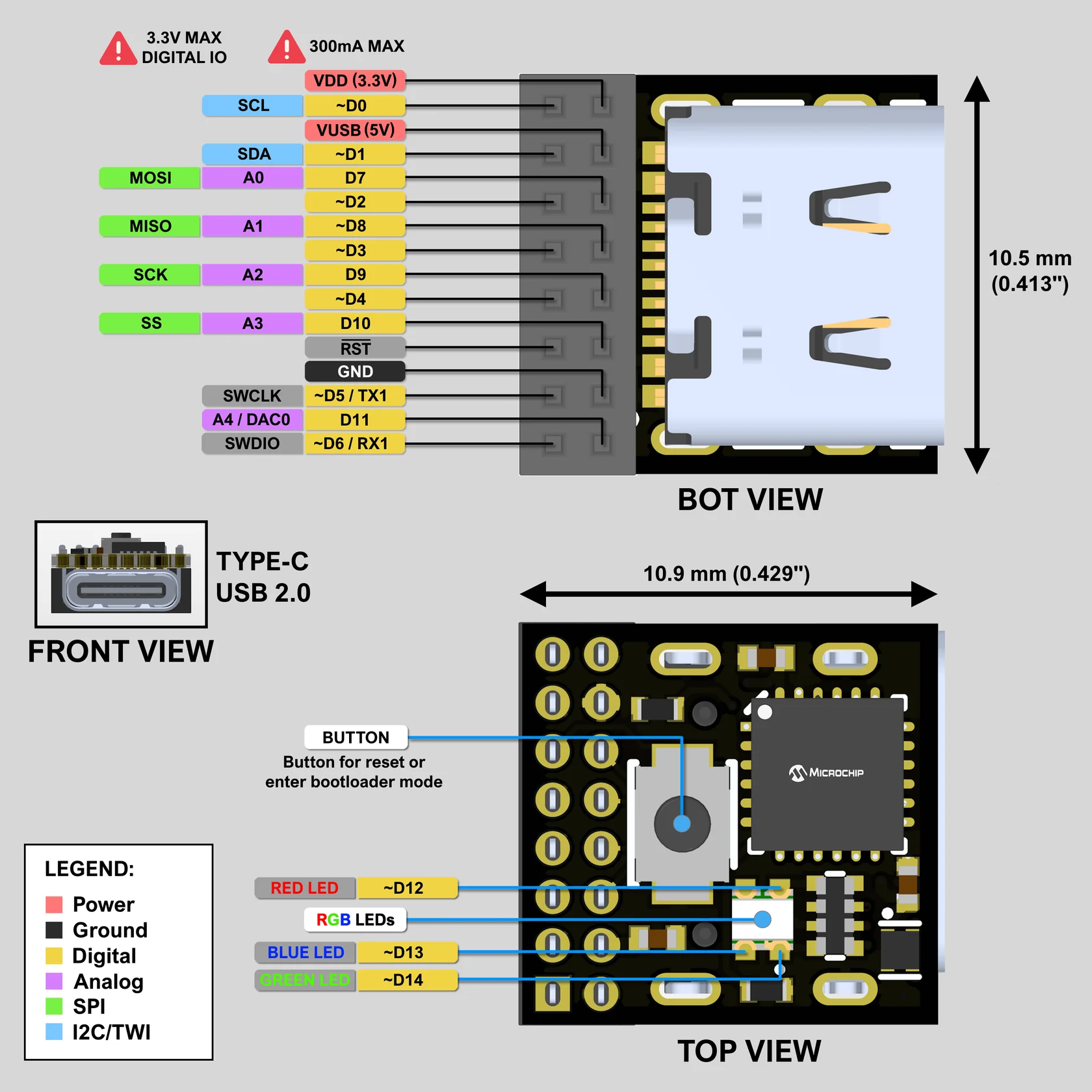
Compared to the Arduino Uno of old, modern microcontrollers are absolutely tiny — especially for the amount of processing power and I/O you get. But if you need something really small, like fits-on-the-tip-of-your-finger small, most of the turn-key development boards on the market are still a bit too big.

Enter the pinch from moddo, which they advertise as “The World’s Smallest 32-Bit Arduino-
Compatible Board.” We can’t vouch for its world-record status, but we certainly can’t think of a smaller one. At least not a complete solution like this, which offers native USB and 15 GPIO pins in addition to the usual suspects like SPI, I2C, PWM, and UART. In fact, it’s so small that it even includes a breakout board to make prototyping a bit easier.

Coming from something like an ESP32, the biggest adjustment will probably be working around the relatively limited specs of the SAMD11. The ARM Cortex-M0+ under the hood tops out at 48 MHz, and there’s only 4 KB SRAM and 16 KB flash (of which the bootloader eats up 4 KB). Still, not bad for something that occupies roughly the same surface area as a female USB-C connector.

We’re told the team is in the final stages of testing and production of the pinch, and you can currently pre-order the $16 board ahead of its planned September ship date. A circuit schematic and STEP 3D model are already available, and it looks like board design files aren’t far behind.

DOOM runs (slowly) in a IBM PC-Compatible CSS Sheet

15 July 2026 at 19:00

Just when you thought we’d run out of things to port DOOM to, here comes [Ahmed Amer] with his CSS-DOS, a massive 300 MB CSS style sheet, that runs not just DOS, but Windows 1.0 and, of course, DOOM. The CSS sheet isn’t holding a DOOM port this time, though — it’s holding a full IBM PC compatible, with a simulated 8086, 640 kB of RAM, floppy and VGA controllers. Yes, in one style sheet. We did mention it was 300 MB, right?

CSS is not a very good programming language. It’s got functions and if statements nowadays, but it doesn’t really do programs in the usual sense. That is, lists of instructions that feed one into another. You can’t change a variable without jumping through hoops. The sort of static behavior you get from a CSS sheet actually matches hardware architecture better than software, which was the key insight [Ahmed] had to make the project possible. It’s still not easy, or elegant, or perhaps even sane, as you can find out from the excellent write-up he has describing how he pulled this off. We particularly like the interactive guide to the full mountain of madness that is the .css file.

Now, we admit that “runs DOOM” may be an exaggeration — even if the maddeningly massive CSS sheet ran an IBM-AT full speed, that hardware can’t handle the game at any playable speed. It doesn’t emulate at anything close to full speed, though. Because this is such a gratuitously weird hack, it only runs at two instructions per second. No, not FPS, instructions, as in at the CPU level. Well, it could be worse, at least it’s not clock ticks. Still, if you’re time-dilated enough you can wait the 3 weeks to boot DOS, and the 3 months to load a level, you can play DOOM at 0.0001 FPS.

Look, we didn’t make the rules — they say everything has to try and run DOOM. They don’t say everything has to run it well.

Fibrous Muscles for Humanoid Robotics

By: Ian Bos
14 July 2026 at 11:30

At the current rate of robotics development, you might assume that we’re close to Skynet taking over. However, while we  likely wouldn’t do well in a physical fight against a robot, we can at least keep the bragging rights of having the cooler actuators. Or at least, that was the case before a new actuator came into town — introducing “Electrofluidic Fiber Muscles”.

Traditional robotic actuators use motors of some kind with a variety of gearboxes or linkages to turn rotational movement into usable movement. This isn’t always the most effective way to run some robotics movements, especially when modeling humans. This is why many have turned to pressurized modes of actuation. Though most don’t show quite the promise of the new player.

Electrofluidic Fiber Muscles use pressure to shorten muscle strands, similar to past actuators. However, these are a tad different, taking advantage of electrofluidic pressure. A small current under high voltage is able to drive a pressure gradient in a long tube. This tube can then be connected to both an extensor and flexor portion of an actuating circuit, similar to a biological mechanical system. Better yet, this driving pressure pump can be spun around the fibers themselves, making a tight package.

Unfortunately, it will probably be a bit till we see this inside a hobbyist robot. Until then, make sure to check out some other actuator feats!

Trying to Use a 2007 Samsung UMPC as Wii U Gamepad

11 July 2026 at 22:00

As unique the Nintendo Wii U Gamepad may appear to be, at its core it’s pretty much just a tablet with game controls stuck on it. Now that the communication between the Wii U and the Gamepad have been fully reverse-engineered and poured into easy to use software, this opens the possibility of using other tablets with suitable controls on them for Wii U Gamepad purposes, like the Windows-capable Samsung tablet that [Bringus Studios] decided to experiment on.

Originally designed to run Windows XP Tablet PC Edition, the Samsung Q1 series of ultra-mobile PCs (UMPC) was first released in 2007, featuring a 900 MHz Celeron M CPU. Amusingly [Bingus] mixes up mAh and mWh when comparing battery capacities, as the Li-ion battery pack for this UMPC is an 11.1V one, whereas a smartphone battery is 3.7V nominal.

To turn this UMPC into a Wii U Gamepad, first 32-bit Debian 12 is installed along with the Vanilla Wii U Gamepad project. The main challenge then is to find a Wi-Fi adapter that works for this purpose, as the connection uses a slightly non-standard handshake. Naturally the TP-Link USB WiFi adapter that [Bingus] used changed from its previous and better supported Mediatek chipset to a Realtek one with typical poor Linux support, requiring manual driver compiling.

After more troubleshooting, it’s unfortunately found that the 900 MHz Celeron M in this UMPC just isn’t up to the task, with the decoding of the compressed HDMI stream correspondingly pegging the CPU at 100% with all the frame dropping. It’s likely that this is due to a lack of h.264 hardware decoding support, as this would push this burden onto the CPU. The system uses the Intel 915GMS chipset with the GMA 900 iGPU, which appears to just provide hardware acceleration for MPEG 2.

To Build More Believable Bots, Simulate The Neurochemistry

11 July 2026 at 13:00

Giving machines the ability to communicate nonverbally has real value, and [Drew Smith] clearly thinks your robot deserves better than an emoji. He shared a very interesting approach with his project Kindalive.

Kindalive is a simulated dot-matrix robot face that responds believably to input text, modeling and expressing both short-term and long-term moods. It’s pure Python and modular enough to invite using it elsewhere, but that’s not the really interesting part.

What sets [Drew]’s project apart is the way he models eight key neurochemicals (including dopamine and cortisol) as the foundation from which to derive emotional states. That’s an approach we certainly haven’t seen before.

Conventional sentiment analysis uses a large language model (LLM) to apply discrete labels to communication, but Kindalive doesn’t do that. It even goes so far as to model the decay and interplay between its simulated neurochemicals to derive emotional states on the fly. It’s more fluid and organic, and reflects both short-term and long-term mood changes.

Physical representation of the emotional mix is done by altering twelve key facial movements (brow raise, lip corner pull, mouth open, and others of that nature) known as the Facial Action Coding System (FACS). These twelve elements combine to express emotion nonverbally with facial expressions. It’s what drives the simulated dot-matrix robot face seen in the image above, and could easily be used to drive a real LED matrix, or servos on an animatronic face.

Much of communication is nonverbal. Humans even weigh nonverbal higher when there’s a mismatch between the content of verbal and nonverbal communication. So, there’s clear value in having robots able to express themselves as such.

Importantly, a realistic and human-like face is entirely unnecessary — something every Star Wars fan already knows. Cartoon eyes and basic sounds are enough to make robots easier to relate to and work with, even if blinking is also important but hard to get just right.

Clay Extruder Enables Printable Pottery

11 July 2026 at 07:00
A clay vase sits in the center of a circular table, with an extruder in contact with the top surface. The extruder has a tube containing clay on the right side, with a motor mounted above an auger over the main nozzle.

Ceramic 3D printers, despite using the same fundamental mechanism as standard FDM printers, are much harder to find. Part of this comes down to the material properties of fired ceramics versus thermoplastics, but they’re also significantly harder to build; for example, in his ceramic printer build, [Joshua Bird] had to deal with severe material shrinkage, collapsing bridges, and the surprisingly abrasive effects of clay.

The centerpiece of the printer is the clay extruder: an air compressor pushes clay along a tube into the extruder, which uses an auger to squeeze the clay through the nozzle, while a gap at the top lets trapped air escape. The extruder has enough control for successful retractions, but rheology remained a challenge: the clay needed to be soft enough to flow through the nozzle, but stiff enough to form bridges without collapsing. [Joshua] thus pressurized the clay as much as possible, making it possible to use stiffer clay mixtures. The extruder’s greatest challenge was longevity: [Joshua] tried many 3D-printed plastic augers, but the clay abraded them all much too quickly, often in under an hour of use; a 3D-printed stainless steel extruder solved this.

Printing in ceramic isn’t a simple process: for each part, [Joshua] had to mix the clay, load it into the tube, clean the extruder, actually print the object, let it dry, fire it, apply glaze, and fire it again. The clay’s shrinkage during drying and firing destroyed many prints, but [Joshua] was nevertheless able to print a double-walled cup, a decorative climbing-themed cup, and even a chain-mail mesh.

The 3D printer’s motion system is a polar design, an adaptation of his earlier non-planar 3D printer, which might eventually make it easier to print overhangs. We’ve previously seen a similar auger-based clay extruder, an approach reminiscent of direct-granule FDM printing.

Reject Modernity, Return to 80s, Learn C.

10 July 2026 at 22:00

We’re not exactly sure how old [SnailMail] is, but he’s probably a member of Generation Alpha considering that to our wizened eyes the lad looks only slightly older than a fetus– which makes it all the more impressive that he’s written his own text editor, from scratch, in C– on a 386. See, [SnailMail] tried to learn the modern way, with IDEs that have code completion and AI integration, but his thoughts couldn’t gel in the modern environment. So he went online and bought an old IBM-compatible complete with monochrome amber monitor, and a whole 4MB of RAM. Big spender that he is, [SnailMail] upgraded that to 8MB.

Rather than fall victim to the siren song of Wolfenstien 3D or SimCity, he set out to learn to code: C, specifically, since that language bridges four decades between [SnailMail] and his new PC. Even more specifically, he got ahold of disks for Borland Turbo C and Turbo C++, which brings back memories for some of us. Of course the lad also had to learn how to use a DOS PC at the same time, but a teen in the 80s with a fresh box would have climbed the same steep learning curve. Some of you probably remember doing so yourselves. Just like you–or the hypothetical teen in the 80s–[SnailMail] did it not by googling or begging Claude for answers, but by digging into books. Many books.

After all the reading, he started with a text editor, something we remember being a pretty big project not given to first year students. Video evidence suggests he pulled it off. He describes how his solution works from about 8:00 in the video, so you greybeards in the audience can judge his work for yourself.

If you’re a member of Gen Alpha reading this and looking to learn to program, we cannot recommend this technique highly enough– [SnailMail] is going to have a better understanding of the underlying logic of computer science than a lot of CS grads being frocked today. Especially when you consider he ends by promising to learn assembly, something we heartily endorse.

Fixing a Dodgy Cheap Audio DAC

9 July 2026 at 07:00

One of the attractions of buying at the bottom end of the electronics market by mail order from China is that you never quite know what will come your way. Sometimes it’s a diamond in the rough, while with others it’s a mess. Occasionally along comes something which should work but doesn’t, and that’s the moment when you wonder if you could fix it. [Nyanpasu64] had just such a device, an HDMI to VGA converter with audio that didn’t work. What could be wrong?

The HDMI to VGA chip has an onboard audio digital-to-analog converter (DAC), and it’s a delta-sigma design. This type of DAC is frequently used in audio applications because it works by shifting its switching frequency many times higher than the input sample rate, thus reducing considerably the distortion. This one wasn’t performing as advertised though, and the problem turned out to be that switching frequency being all over the output. Clearly the filter wasn’t working, which led to the design of a new filter. The write-up is therefore an extensive dive into filter design, and in part also a discovery of the effect of impedance on them.

For a super-cheap module to cause so much work, one might ask why not simply spend a few more dollars and get a better one. But had they done that we wouldn’t have seen this write-up, so we’re sticking with team cheap.

We’ve looked at audio DACs, in the past.

An Analog Synth For The Modern World

8 July 2026 at 19:00

We cover so many projects here at Hackaday that lead the author down a rabbit hole of technological investigation that distracts us from the task of bringing them to you. Such a project is polyUAnalog, a very modern take on an analogue synthesizer. If you are imagining a synth of old with modules and patch cables, think again. The modern way to do this is it seems to use an individual synthesizer chip for each voice, resulting in a very versatile instrument indeed.

The integrated circuit in question is the AS3397, which when coupled on a PCB with a Raspberry Pi Pico makes for a self-contained single-voice analog synth. It’s controlled via I2C from a conductor board for which frustratingly the README doesn’t give a processor, but we think may be powered by another Pi Pico. This board does the job of taking MIDI and other controls, and farming them out tot he individual voices. The prototype has ten, but it can support many more.

It’s the work of a pair of researchers from the University of Angers in France, and we’re told it’s a side project from their work in the field of spectroscopy. There’s a video about it which we’ve placed below the break, and they’ve also written a paper about it.

Hacking Amazon Echo Show 8 3rd Gen via UART and eMMC

8 July 2026 at 13:00

Even with Amazon’s Echo Show devices running Linux in the form of the Android-derived FireOS, using them for non-Amazon approved purposes can be a chore at best. In the case of the Echo Show 8 even simple workarounds using ADB and the bootloader have been locked-down, requiring more drastic measures. Here [Vowed] over at the XDA forums shows off one such hack, involving directly tapping into the device’s eMMC.

Suffice it to say that this is not a hack for the faint of heart, with even the iFixit teardown guide for this device being rather daunting. Even after you get access to the mainboard, you still have to remove or cut open the metal can that covers the eMMC, so that you can unleash an eMMC programmer on it. It’s best to make sure to make a backup image of the original contents too, just in case you have to restore things.

With the shield out of the way you can solder fine wires to pads that connect to the eMMC to program it. You also have to solder wires to pads for the UART, though if you’re fancy you can also create a custom pogo pin adapter. With a serial connection established to the original firmware you can then enable features like ADB, and courtesy of the connected eMMC adapter it’s possible to directly alter system files to make rooting as easy as possible.

In addition to rooting the system you can also do a straight replacement of the eMMC contents, such as the demonstrated Debian installation. Even if not the most easy of mods, it’s good to see that it’s possible to repurpose these devices.

(Top image: Amazon Echo Show 8 3rd generation mainboard. Credit: iFixit, CC BY-NC-SA 3.0.)

Why the NES Put Out a Wobbly Picture

7 July 2026 at 04:00

The NTSC television standard is a masterpiece of mid-century engineering, to pack a color image into the transmission bandwidth of a monochrome one, and to do so while maintaining backward compatibility with earlier monochrome TV sets. In terms of its timings and choice of sync and carrier frequencies it’s elegantly thought out for maximum quality on a 1950s round-CRT color TV set.

The trouble is, that while the standards are exacting, the receivers are quite forgiving, and will display adequately even with substantially off-spec video. [Nicole Express] is here with an in-depth examination of a time when that was pushed just a little bit too far, explaining why the Nintendo Entertainment System (NES) displayed wobbly color images.

We’re treated to a run-through of the NTSC standard itself, and a look at how some of the other consoles and home computers of that era either had similar problems, or managed to avoid them. The key lies in the exacting timing required to achieve perfect interlacing, and the NES’s use of a single crystal to provide all the clocks. The dot clock on adjacent frames was almost right, but not quite, leading to a side-to-side wobble that while barely perceptible, was exacerbated by some graphics. It’s a fascinating read.

We’ve looked at composite video in detail in the past.


NES image: JCD1981NL, CC BY 3.0.

❌
❌