My car came with more USB ports than I thought I would need, and it's understandable to ignore any that don't charge your phone. But you can do a lot more with your ports than just charge a battery. Once you have a cable that works and isn’t useless, you can use those same ports to do a lot more to your car.
Oregon’s first hospital focused on women’s health will be built on the campus of Providence St. Vincent Medical Center in Portland. (Providence Illustration)
Providence will receive $1.1 billion — one of the largest gifts ever pledged to a U.S. healthcare institution — from Nike co-founder Phil Knight and his wife, Penny. The donation will allow the nonprofit health network to build Oregon’s first hospital focused on women’s health, increase support for cardiovascular services and improve patient care.
“Penny and I have always believed that real breakthroughs come from people willing to take on the toughest challenges,” Phil Knight said in a statement. “Providence has shown that kind of ambition in cardiovascular care, and we see the same opportunity to do something truly distinctive for women’s health.”
The new women’s hospital will be located on the campus of the medical center and provide care in specialties including gynecology, pregnancy, labor and delivery, menopause and cardiovascular care. Providence leaders note that many pregnant patients are also managing hypertension, diabetes, behavioral health and substance abuse, requiring more specialized services.
Providence St. Vincent Medical Center in Portland, Ore. (Providence Photo)
The Knights have previously donated $200 million over the course of 10 years to Providence Heart Institute, which sees nearly 63,000 patients each year across the Pacific Northwest, up from 40,000 a decade ago. Cardiovascular disease is the leading cause of death and hospitalization in the U.S.
The added support for the institute will help pay for diagnostic cardiac imaging, additional clinical trials, and the recruitment of leading doctors.
Knight, 88, co-founded Nike with Bill Bowerman in Eugene, Ore., in 1964. The business was originally called Blue Ribbon Sports before rebranding seven years later. Knight is currently worth an estimated $25.4 billion, according to Forbes.
“The Knights’ extraordinary gift is a generational investment, leading to bold and innovative ideas that will shape healthcare in Oregon for decades to come,” said Jennifer Burrows, chief executive of Providence Oregon.
Apparently, people hate typing. As every movie and TV show suggests, the future is talking to computers. There was a time when speech recognition was complex and not very good. But these days, even our lowly phones can do a pretty good job of speech recognition. Of course, one problem is that your phone probably isn’t actually doing the speech recognition. It sends it to the big business of your choice to interpret. I’ve been using Handy, a speech recognition system that works well for me. I’ve also looked at some that didn’t.
After all, it is sometimes nice to dictate to your computer, and it would be even nicer if you could keep your data local. On Windows, oddly enough, there is a well-developed speech feature that, as far as I can tell, almost no one talks about or uses. One video estimates that 99% of users don’t use it. Linux, of course, has many options, but historically, these have been difficult to set up or finicky.
Of course, the good news is that many of the Linux tools are open source and the models are quite good. That means other people have had the freedom to fork the tools and make them easier to use, at least in theory. The licensing of the models themselves may be different, but those will be hard to modify, anyway and they generally work well. The biggest problems on Linux isn’t the technology itself, but the tremendous variety of systems and setups.
Suppose you want to write a speech-to-text program. Will it work on ARM? What desktops will it integrate with? Can it use a GPU? What kind? What about specialized instructions in some CPUs? Then there’s the forced input situation; typing into arbitrary programs once you know what the user said. On X11, it is easy, but Wayland needs different handling.
A Shortcut
I’ve thought about using my phone with KDE Connect, which is an excellent program. It can let you use your phone as a keyboard and mouse for your Linux computer. Unfortunately, it is aimed at character-at-a-time input, and I’ve never found a way to make it work with voice.
Besides, the phone is beaming all the data to “the cloud.” You probably type things you’d rather not broadcast to the ether.
I had looked at Speech Note before, but it is sort of a speech recognition notepad. I didn’t find it seamless, and it didn’t work well on my system anyway. Vocalinux looks nice, but a quick test kept complaining that my Intel extensions were not available. Makes sense, since I have an AMD CPU. Even though the documentation said it should work, I was never able to get it to work.
The Easy Way
Turns out the application that worked readily on my machine was Handy. Keep in mind, Handy is just another tool that uses one of several models out there, along with other open-source tools. You might need to install some tools to deal with your system like xdotool or dotool, but they are probably already installed anyway. That isn’t to minimize the value of Handy. It is — well — Handy. You don’t have to load and configure models, set up a bunch of system-level hooks, or install a bunch of libraries. You install it, and it works.
You can configure it. The best model for you, for example, may depend on your machine and the languages you speak. You can configure the hotkeys and how the app types into your computer. But it does all the work of downloading and configuration.
No Cloud, Unless…
The models do run on your computer and you can make sure it takes advantage of your hardware. However, there is an optional alternate hotkey that takes your speech, processes it to text, and then sends it to your choice of AI engines to clean it up.
Of course, you could be running your own AI engine, but normally you’ll have it sent somewhere else with a prompt. You can tune the prompt or create your own, but the default one starts: “Clean this transcript: 1. Fix spelling, capitalization, and punctuation errors 2. Convert number words to digits (twenty-five → 25, ten percent → 10%, five dollars → $5) 3. Replace spoken punctuation with symbols (period → ., comma → ,, question mark → ?) 4. Remove filler words (um, uh, like as filler)…”
You do need an API key, but there are free options available. For experimenting purposes, I went to OpenRouter, generated a key, and attached it to one of several free models they have. The nice thing is that you can experiment with different models while keeping the same key.
If you search for free in the models box, you will find a few choices including openrouter/free which just picks a free model that isn’t too busy. That can be important because some of the models will introduce long wait times into your transcription.
On the other hand, you can make a new prompt, copy the original one in, delete the part about keeping the language the same, and add instructions to translate the output to French, and that will work, at least most of the time. So there are a lot of possibilities.
Rather than tell you all about it, we’d encourage you to install it and try it or watch the reveiw video below.
Special Mention
Although Handy is my first choice for day-to-day transcription use, there is another open source project that’s worth mentioning. Nerd Dictation is a very lightweight wrapper around the Vosk model. It does take a little bit to set up, and then it provides you with a command line tool that can start and stop dictation. Of course, you can assign those to macro keys. However, there is also a switch that allows you to simply output to stdout. That opens up a lot of possibilities for writing programs or even shell scripts that respond to voice.
To see what’s possible, run nerd-dictation begin --help. This will show you how to output to stdout, set a timeout, and handle other options.
Of course, the obvious project would be a voice typewriter. Many of the tools mentioned here either rely on or can use OpenWhisper and, of course, you can use it too, if you roll your own code.
UK government departments are still struggling to implement the tax laws governing IT contractors years after the controversial rules were introduced. IR35 has become hated by freelance tech workers who feel it removes the tax benefits of contracting, without offering the employee benefits of in-house roles in its stead. The latest accounts from the Foreign, Commonwealth and Development Office (FCDO) show that the UK tax collector is reviewing its implementation of IR35 for a second year after the department decided to place hundreds of workers inside the reach of the rules. In its 2024 -25 annual report, the FCDO said a total of 243 were found to be in scope of IR35 following “a full review of all IR35 off-payroll status determinations.” “This resulted in a high number of engagements that had previously been assessed as out-of-scope being reassessed as in-scope. A voluntary disclosure advising His Majesty’s Revenue & Customs (HMRC) of these changes in assessment has now been made, and the FCDO have accrued an estimate of the potential backdated tax owed within our 2024-25 accounts,” the report said. However, the most recent set of figures for 2025 -26 said workers determined as in-scope of IR35 has now leapt to 441. The continuing review “resulted in a significant reduction of out-of-scope engagements in the Department.” It said HMRC was also continuing to review its interpretation of the rules. Dave Chaplin, CEO of tax advisory company IR35 Shield, said: “The Foreign Office’s IR35 problems are becoming increasingly difficult to explain away. A year ago, roughly half its contractors were considered outside IR35. Now that figure has collapsed to just 12.” Chaplin said Freedom of Information requests had revealed the FCDO’s process used HMRC’s Status Tool (CEST), which organizations have had problems implementing. Use of the tool has dropped around 70 percent in two years, research revealed. “Businesses are expected to get IR35 right and face potentially significant tax bills when they don’t. The Government should expect no lower standard from its own departments,” Chaplin said. Government departments have long struggled to implement IR35. In 2022, the Public Accounts Committee found that difficulties meeting the rules in central government reflect poor implementation by HMRC and other government bodies. "Central government is spending hundreds of millions of pounds to cover tax owed for individuals wrongly assessed as self-employed. Government departments and agencies owed, or expected to owe, HMRC £263 million in 2020–21 due to incorrect administration of the rules," the report from Parliament’s spending watchdog said. Earlier this year, the UK’s competition regulator gave a conditional thumbs up to the government providing an extra £104.4 million to the Post Office — a publicly owned company — to settle a tax liability under IR35. ®
Here are the best delivery services and meal kits in 2026, including the Martha Stewart meal service, a GLP-1–supportive plan, and a budget-friendly option.
BuyWander co-founders Jordan Allen, left, and Brock Kowalchuk. (BuyWander Photo)
BuyWander, an auction-based online marketplace for returned and overstocked retail items, announced Tuesday that it has raised $21 million in a Series A funding round led by Madrona Venture Group and Inspired Capital.
The fresh capital comes on the heels of the startup relocating its headquarters from Spokane, Wash., to the Seattle area to tap into the region’s deep pool of tech and retail talent and accelerate its nationwide warehouse expansion.
Founded in 2023 by CEO Jordan Allen and CFO Brock Kowalchuk, BuyWander connects bargain-seeking shoppers with inventory from major retailers like Amazon, Target, Walmart, and Home Depot.
Bidding on all items starts at $1 in fixed seven-day auctions, with customers picking up their winning purchases directly from local fulfillment centers to bypass shipping costs. The new funding — which brings total raised to date to $28 million — will fuel technology investments and power nationwide market expansion following recent warehouse launches in Denver and Chicago.
“This is blue ocean right now,” Allen said in an interview with GeekWire. “Nobody’s really built an incredibly strong consumer brand in this retail return space — what we call the intersection of the weird meets the wonderful underneath this misfit inventory. These items deserve a second chance, and as people have to tighten up their wallets, we’re an incredible option for them to buy the things they want and love.”
BuyWander officially relocated its corporate headquarters from Spokane to the Seattle area in August, establishing its central hub out of Kent, Wash., where 45 of its employees are based. The startup initially entered the region with a cramped facility to prove out local demand, but recently upgraded to a 52,000-square-foot warehouse that can process three to five times more volume for local shoppers.
Across its expanding national footprint — which now spans eight fulfillment locations — BuyWander’s total workforce has surged to 325 people, with the vast majority working in intake, stocking, and customer service.
“Spokane was a wonderful place to start the company,” Kowalchuk said. “It was where we were living at the time, and we were able to get a lot of feedback very iteratively. But getting to the size where we are today and building out that leadership team really requires a little bit more talent density that Seattle can provide with deep roots in retail and deep roots in tech.”
Allen previously founded Stay Alfred, a Spokane-based short-term rental company that shut down in 2020, amid the pandemic, after expanding to more than 30 cities.
Dirt bikes, TVs, tools and more: A snapshot of auction items visible on BuyWander’s marketplace. (BuyWander.com screengrab)
Behind the scenes, AI is now helping BuyWander process and list hundreds of thousands of unique items each month. Historically, manual data entry and poor photography created a bottleneck for resale platforms. Today, automated tools instantly identify returned products, pull in retail valuations, and generate detailed listings with a single click.
“There’s been a ceiling on this business historically because of the technology required,” Allen said, adding that AI now optimizes everything from auction scheduling to appointment bookings. “It feels like World War II and Star Trek at the same time and we’re merging these two worlds together.”
To better capture regional markets, BuyWander plans to increase facility density in key metro areas. In the Puget Sound region, Allen noted that traffic and geography often create a barrier between regional hubs, pointing to plans to open four to five warehouses across the greater Seattle area over the next few years to keep pickup convenient for local shoppers.
Beyond bargain hunting, the circular model addresses a massive environmental headache for retailers, who often dispose of returned goods simply because their systems aren’t built to re-process them locally.
Total U.S. retail returns reach roughly $850 billion annually, driven heavily by online shopping, where return rates hover near 20%, according to data from the National Retail Federation and Happy Returns. For retailers, processing a single return can cost between 20% and 65% of the item’s original retail price once return shipping, inspection, and restocking are factored in — making local secondary marketplaces an increasingly vital alternative to taking a total loss.
“Some of these brands and retailers were throwing this stuff away, and it just feels kind of criminal,” Allen said, pointing out how returned items often get trucked back and forth across the country. “You can buy a Seahawks jersey, and it gets returned in the mail back to Hebron, Kentucky, and ends up loaded up on a truck, ending up in Miami. The stars really align when the stuff can be sold locally where the demand already was to begin with.”
BuyWander’s expansion is backed by rapid operational momentum, hitting 400% year-over-year growth as it expands nationally. The platform now counts 50,000 active and winning customers who have saved a cumulative $200 million — averaging roughly $4,000 in savings per customer. Over the past month alone, the company sold nearly 500,000 unique items across its eight warehouse locations, with goods selling for an average discount of 75% off retail prices.
According to Kowalchuk, roughly 80% of the returned goods arrive in “appears new” condition with only minor packaging damage. About 80% of buyers are end consumers using the platform for everyday shopping, while 20% are local resellers — a customer base Allen says grows almost entirely organically, with nine out of 10 shoppers joining via word-of-mouth referrals.
The platform offers a sprawling, unpredictable lineup of products — having sold everything from electronic cow milkers, log splitters, and commercial ice cream machines to everyday staples like hair dryers and air fryers.
“It is probably one of the best product discovery platforms out there,” Allen said, predicting the company will eventually sell a bit of everything listed on the internet. “We’ll get hilariously fun items, like foam blasters right after spring break or 12-foot tall skeletons right after Halloween. That’s why it’s odd, and that’s why the deals are so good.”
After saving a £300, 16-port Ubiquiti network switch from getting tossed into the trash, [Buy It Fix It] got the honor of trying to repair it. With four ports and their associated PoE function having some major issues it looked like it might take some debugging, but after taking the lid off, the cause seemed rather obvious.
One of the Broadcom BCM5911 controller chips had a rather suspicious chip of the plastic packaging missing, with additional probing of connected components showing that numerous MOSFETs and a diode having had their proverbial guts blown out and were shorted as well. Whatever happened to some connected Ethernet device would appear to have left a serious trail of damage that nearly wrecked the entire switch.
The biggest challenge here was probably to find a replacement for the Broadcom IC, as this isn’t an IC that stores like Digikey or Mouser stock any more. Fortunately it was still available for sale over at AliExpress for £1.84, with the usual caveat that it could be salvage, fake, a factory reject, etc. In this case it appears that it was a legit Broadcom IC, with the four affected ports springing back to life including powering a PoE camera.
With a total cost of about £5 plus the time invested it wasn’t a bad deal to save a pretty nice PoE switch with 16 Ethernet and 2 SFP ports.
“AI could be a great equalizer — or widen the gap,” Bill Gates writes in a new Gates Foundation report. (GeekWire File Photo / Todd Bishop)
The Gates Foundation is pledging to spend at least $1 billion over the next two years on artificial intelligence for health workers, farmers and teachers, largely in the world’s poorest countries, funding AI tools for people the market would otherwise overlook.
The bet is that AI can help reaccelerate the world’s progress against child mortality, poverty and disease, which has slowed sharply as governments cut global health funding.
The Seattle-based foundation’s new financial commitment, released Monday evening in conjunction with its 10th annual Goalkeepers Report, illustrates the double-edged sword of AI at a moment when the U.S. in particular is preoccupied with what the technology might damage or destroy.
Bill Gates, who issued his own AI warnings in an essay three weeks ago, writes in the new report that the risks “are real and deserve serious attention.” He adds, “AI could be a great equalizer — or widen the gap. This is not a long-range prediction. It’s a present-tense choice.”
In this case, Gates writes, he’s focusing on “the possibility that AI, if shaped well, could expand who has access to solutions, opportunities, and knowledge that has too often been out of reach.”
The window is short, he writes: “I believe that the decisions made in the next 12 to 18 months — about how AI is built, funded, and deployed — will determine whether this technology primarily benefits the people who already have the most or reaches those who have the least.”
Gates Foundation CEO Mark Suzman, in an interview with GeekWire, called the $1 billion a “down payment,” saying he expects the figure to grow significantly after the first two years.
For this first installment, 40% of the money will go to education, 40% to health care, 10% to agriculture and 10% to digital infrastructure, including datasets in languages the models don’t handle, according to the foundation.
More than 90% of the data used to train early large language models came from English-language sources, according to the report. Leading AI speech recognition systems make errors less than 6% of the time in English and more than 60% of the time in Yoruba, a West African language spoken by tens of millions of people, for example.
Most people in Africa use feature phones rather than smartphones, Suzman said, so the tools have to work by voice. That means collecting recordings of speech, not just written text, in local accents and including children’s voices. He said the foundation works with Google and Microsoft on AI language initiatives.
Winding down: Gates announced in May 2025 that he would give away virtually all his wealth and close the foundation in 2045, which requires doubling its spending over those 20 years. The foundation had previously planned to close 20 years after his death.
As part of that plan, the foundation will need to give away $200 billion before it shuts down. Its budgeted payout is $9 billion this year, the largest in its history. Suzman said the $1 billion over two years comes out of its core budget.
Goals for its final two decades include cutting preventable child deaths in half again, eradicating polio and malaria, and bringing tuberculosis and HIV under control.
The report’s data section shows how far off the pace the world is. Child mortality, neonatal mortality and HIV are all projected to miss their 2030 targets. HIV incidence is on track to fall only to 0.22 new cases per 1,000 people, more than 10 times the target of 0.02.
Early AI results: The report makes the case that AI could change those trajectories. It points to a number of tools already in use in different settings:
Penda Health, a network of affordable clinics in Nairobi, Kenya, where an AI tool built into patient records has raised diagnostic accuracy by 16 percentage points.
In the U.S., seventh graders using a tool called Kiddom Atlas across 21 middle schools gained the equivalent of six extra months of learning in a single year.
In India, the state of Maharashtra runs a free AI advisory service called MahaVISTAAR that has signed up more than 740,000 farmers, with 70,000 more joining every month.
The foundation has supported all three, according to the report’s endnotes. The endnotes also cite OpenAI’s account of its work with Penda Health on the clinical copilot.
One caveat: the evidence behind the examples is early. Suzman said the education work is “still on a relatively small scale,” and pointed to agriculture as the area already operating at size.
Suzman said the foundation spent years experimenting with AI without committing at this scale, wary of getting ahead of what the technology could actually deliver in its areas. Progress in the models over the past year, and results from early investments, convinced him otherwise.
“We now can state with a pretty high degree of confidence there are real deliverables that we can see across health, across education, across agricultural development,” he said.
What AI won’t fix: Asked whether AI can substitute for the money the U.S. and other governments have cut from global health, Suzman said: “Sadly, no.” The cuts run to “tens of billions of dollars,” he said, and they are hitting basic services now. He cited the purchase of bed nets and antiretroviral drugs, and care for mothers before and after birth.
“That’s affecting families right now with a real impact,” he said. “Ideally, you combine the two [AI and aid funding], and that’s how you get hugely accelerated progress.”
Suzman said the foundation will keep pressing the U.S. to remain a leader in global health. Despite the cuts, he said, it has been encouraging to see the country stay a partner in programs such as the Global Fund to Fight AIDS, Tuberculosis and Malaria, and he noted that Congress has moved to fund these areas more fully than the administration has.
“We believe that currently reflects the U.S. public’s broad view and support for these areas, when you can see the concrete results,” he said.
The Epstein review: Asked how the scrutiny of Gates’ ties to Jeffrey Epstein has affected the foundation’s work, Suzman pointed to the external review the foundation released in July.
Conducted by the law firm WilmerHale, it found no evidence that Epstein received foundation money or that the foundation knew of his crimes. It counted roughly 30 meetings from 2011 to 2014, involving Gates and nine other foundation leaders and staff, and found that staff had repeatedly raised concerns about associating with him.
The board adopted the recommendations that followed, among them centralized vetting of brokers and co-funders and tougher conflict-of-interest rules.
Suzman expressed optimism that the review has cleared the way for the foundation to keep working across the full range of governmental and philanthropic partnerships. “Hopefully it’s full speed ahead,” he said, “and with these AI shifts, that’s more important than ever.”
If you spend any time near a gym, you may be familiar with Bluetooth heart rate monitors — a small pack of electronics mounted on a strap round the chest which can relay heart rate data to an external logger or display. We’re pleased to see [Milos Rasic]’s project then, an open-source version of one of those monitors.
The heart rate capture is done by an AD8232, while the Bluetooth part is handled by a Seeed Studio XAIO ESP32 board. Power is provided by a single 3.7 V cell, with a boost converter to push that up to 5 V. The design omits a charge controller to keep things simple, so figuring out how to top off the cell is left as an exercise — no pun intended — for the user. Software is loaded through the Arduino IDE, which raises the possibility that other ESP32 CPUs could be supported with a bit of modification. All in all it’s a surprisingly simple project, and while the manufactured version is cheap enough it’s still very much worth having one that’s open source.
[Bas BotBerg] wanted to use a portable Bluetooth thermal printer to run off reports on sensor data collected by an ESP32-C3 microcontroller. But as is so often the case these days, the only official way to interface with the printer was through a proprietary smartphone application provided by the manufacturer. With no documentation on how the thing works, he set out to reverse engineer the printer’s communications protocol so he could control it from the MCU — but the route he took to get there was a bit different than what we usually see, and is an excellent case study for those who might have similar projects in mind.
The standard procedure for something like this, if it can be called that, is to use Android’s built-in debugging capability to log Bluetooth communications while running the manufacturer’s application. The resulting file can be fed into Wireshark, and with patience and some educated guesses, you can usually work out the various commands and values that get passed to the hardware.
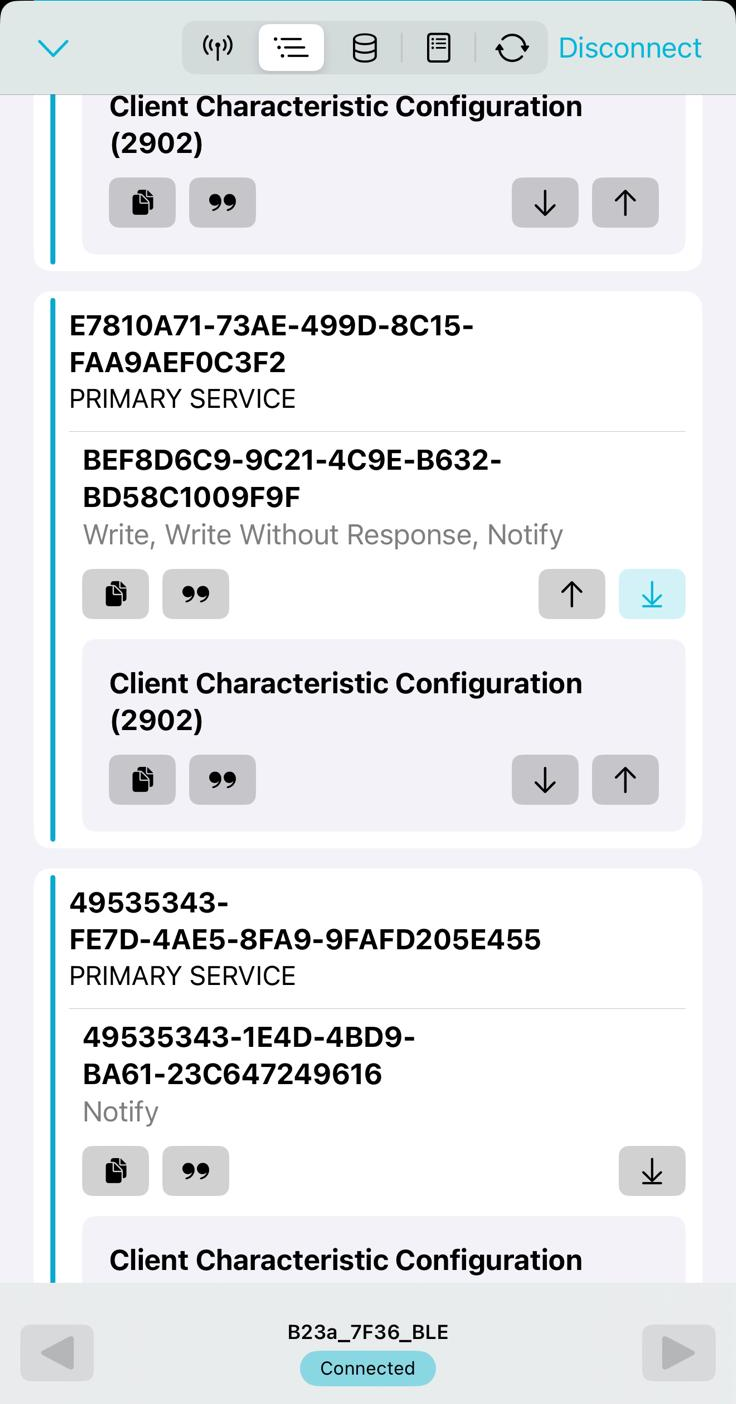
But in this case, [Bas BotBerg] ignored the manufacturer’s software and instead used an application that can query a device and list its Bluetooth Low Energy services and characteristics. Specifically, he looks for services that are marked as writable, and starts pushing data into them to see how the printer responds. For this he uses Python with the Bleak library, as it allows him to rapidly iterate and adapt his code. After a bit of poking and experimentation, he finds the proper incantation to get the printer’s motor to kick on an advance the paper — a critical first milestone that tells him he’s on the right path.
Once [Bas BotBerg] mapped out what data needed to be sent to what endpoints to operate the printer in Python, it was a relatively straightforward process to send those same payloads using C++ code on the ESP32. For extra style points he also brought in the Adafruit GFX library so he could produce icons and more easily format the output of the printer.
US Health Secretary Robert F. Kennedy Jr. will deliver a keynote address at an anti-vaccine conference being held in Washington, DC, later this week and hosted by the anti-vaccine organization he once led, Children's Health Defense (CHD). The organization announced Monday that Kennedy had signed on to the event.
Kennedy will appear alongside other high-profile figures in the anti-vaccine world, including Andrew Wakefield, the disgraced former doctor who was stripped of his medical license over a fraudulent, now-retracted study that falsely claimed a link between autism and the measles, mumps, and rubella (MMR) vaccine. An investigation by a medical board found that Wakefield had mistreated vulnerable children and that his actions amounted to serious professional misconduct.
Despite being ostracized from the medical community, Wakefield has become an enduring figure in the anti-vaccine community. His dangerous falsehood that vaccines cause autism has also endured—with significant help from CHD and Kennedy, who have embraced and widely promoted the erroneous link.
Anthropic's Dario Amodei was at the forefront of this change in tone, arguing in a nearly 4,000-word essay this weekend that "we must slow the pace at which we improve the capabilities of AI models" to avoid "a race to the bottom, spurred by commercial incentives, [that] can make [catastrophic] risks more acute."
Within hours, other AI leaders were echoing the same call. OpenAI co-founder and CEO Sam Altman posted his agreement on social media and said similar pacing discussions had been taking place at OpenAI. Alphabet Chief Scientist and Google DeepMind cofounder and chair Demis Hassabis said that Amodei's essay "points towards the right path forward," and renewed his own recent call for an industry-wide standards body. Microsoft CEO Satya Nadella posted that the company "welcome[s] the research, focus, and deliberate pacing needed to get alignment right as the design goal," ahead of the release of a lengthy "humanist AI" code of conduct for its models.
In a sudden shadowdrop, Bellevue, Wash.-based Valve Software announced on Monday that it’s launched its new standalone virtual-reality headset the Steam Frame.
Valve’s previous VR device, 2019’s Index, was designed to be installed semi-permanently in a single room. The Frame, conversely, is a standalone wireless device that consists of a lightweight headset and two hand controllers, much in the same spirit as the Meta Quest 2.
As with Valve’s other recent hardware projects, the Frame is essentially a specialized PC running the custom SteamOS 3, a Linux-based operating system. The Frame runs off of a Snapdragon 8 Gen 3 processor, with 16GB RAM, a microSD card slot, and two 2160 x 2160 LCD screens, one per eye. Oddly, it does not ship with its own dedicated power supply, but can be recharged using the same kind of USB-C plug as the Steam Deck uses.
As with the rest of Valve’s hardware, the Frame is designed to run games from your Steam library, but doesn’t necessarily run every game that’s currently on Steam. Instead, the Frame has its own verification system similar to the Steam Deck’s, with over 100 games currently hand-tested to be compatible with the Steam Frame. Every Frame also comes with Valve’s 2020 game Half-Life: Alyx as a pack-in bonus.
As with the Steam Machine, Valve plans to offer the first batch of Frames with a lottery system. To minimize the impact of scalpers, Valve intends to leave signups open for both models of the Frame until Thursday morning, then randomize the list once and email customers to let them know if they’re getting a Frame or will end up on the waiting list.
The Frame, top left, was the final entry for now in Steam’s hardware lineup. (Valve Photo)
Maybe most importantly, however, the Steam Frame’s starting price is $1,059 for a model with a 256GB internal storage drive. Users who want or need more storage can upgrade to a model with a 1 TB drive for $1,299.
Much as how its low price tag was the biggest point in the Steam Deck’s favor back in 2022, the Frame’s high price tag is an albatross around its neck. Reviews note that it’s a uniquely comfortable device and makes it easier than ever to fire up games in VR, but selling it for over $1,000 means it’s unavoidably aimed at the most hardcore members of what was already a niche market.
This is the same problem Valve hit with the launch of the Steam Machine back in June, and it’s likely to be an issue for every hardware manufacturer in the market for the foreseeable future. With AI companies gobbling up most of the RAM and hard drives on Earth for data center construction, in an event that’s often nicknamed the “RAMageddon,” any consumers who look to build or buy a new PC or console can expect a bad case of sticker shock for the foreseeable future.
That having been said, the Frame does position Valve to pick up where other companies have left off. Meta was previously the market leader in the VR space (PC Gamer claimed recently that Meta still commands roughly 54% of the VR market), but has made distinct cutbacks in 2026 in favor of refocusing on AI research and wearable computing.
Meta invested heavily in recent years on the assumption that virtual reality was the next big thing, and while it made big strides in making VR accessible, it appears to be in the process of rethinking that bet. VR still has plenty of fans and advocates, but it has yet to live up to the hype factor that it had in the late 2010s. The AI arms race, to some extent, appears to have eaten its lunch.
On paper, Meta’s pullback could’ve left space for Valve to shoulder-check its way into the VR market, but then RAMageddon hit. This wasn’t a bad plan as recently as last year, but the current state of the hardware market makes the Steam Frame a tough lift.
No matter where you park or how many precautions you take, cars get incredibly hot, especially when left in direct sunlight. Sometimes, you have no choice but to leave your phone baking in the car, but what happens to its battery while you're gone might make you think twice.

 Login
Login