❌

Normal view

There are new articles available, click to refresh the page.
Yesterday β€” 28 October 2026Main stream

Battery Prototype Uses Superextensive Quantum Effects to Charge Faster

28 October 2026 at 22:00

Although the term β€˜quantum battery’ is a bit of a vague term, the cell that [Kieran Hymas] et al. demonstrate in a recent paper does seem to suggest that it uses quantum effects to charge faster than would otherwise be possible, with this rate increasing faster than its volume, meaning at a superextensive rate.

The general idea behind a quantum battery is that these somehow use a quantum effect to store and release energy faster than would be possible using classical physics. First proposed in 2013, the initial Dicke model saw its theoretical quantum advantage shot down by 2020, leading to the search for alternative models.

We have previously seen claims of a quantum advantage in batteries based on the Sachdev-Ye-Kitaev model, such as by [Davide Rossini] et al., but this new paper may be the first prototype cell demonstrating a reproducible effect.

In the here demonstrated cell a microcavity is created with strong light-matter coupling, allowing for both energy storage and discharging, with the illuminated particles super-absorbing the light with what the researchers claim to be due to these particles cooperating using a quantum mechanism. Effectively scaling up the cell would thus scale up the charge- and discharge rate faster than in a conventional chemical cell.

Whether this demonstration can be replicated and expanded upon remains to be seen, naturally. The stored energy in this experiment was very small and the storage time only very brief, so for now it serves primarily as an interesting experimental result for researchers to dig through.
Before yesterdayMain stream

The Slurptop is Both Drool Worthy and Practical

24 October 2026 at 19:00

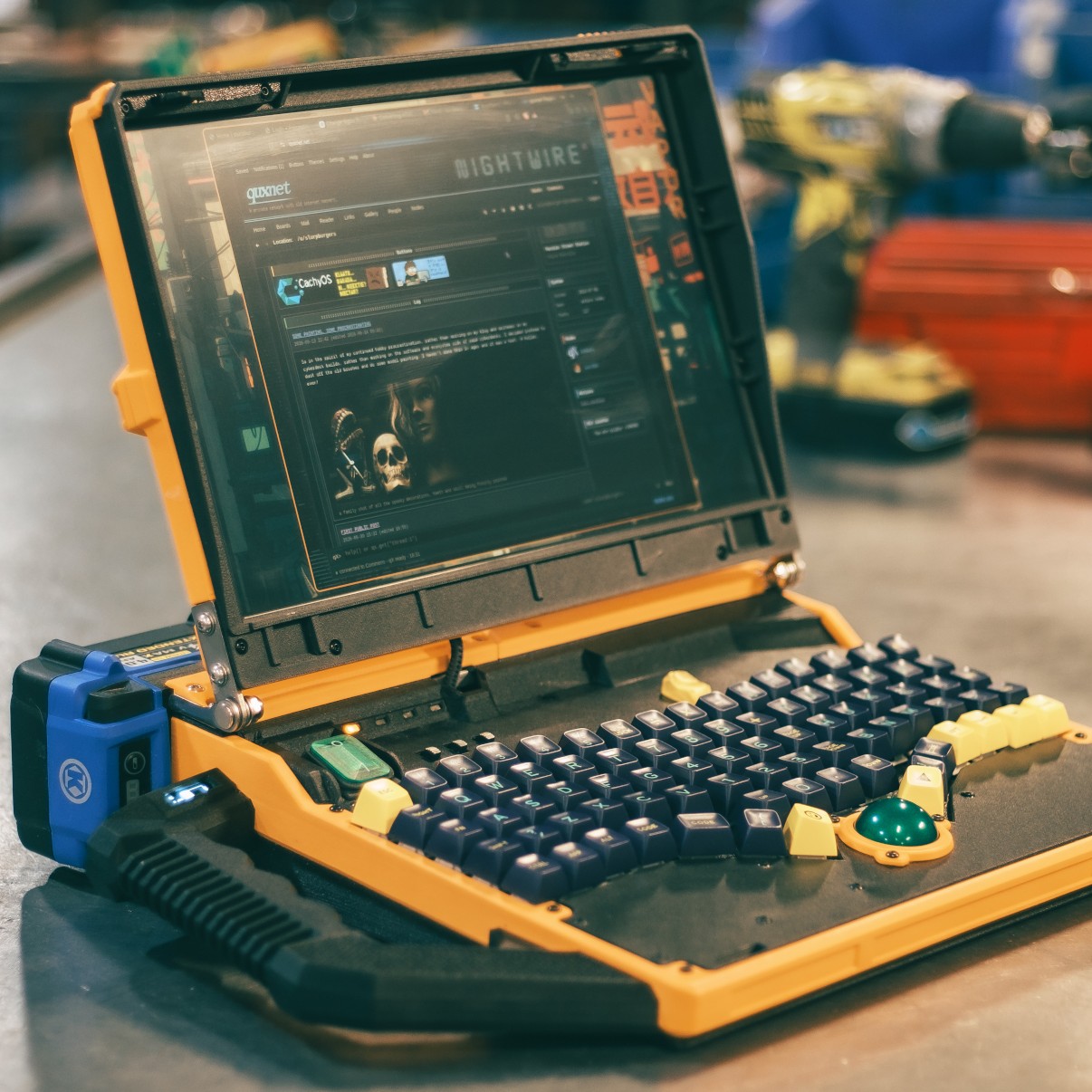
There are two kinds of cyberdeck: the kind someone makes on a lark and operates purely on β€˜rule of cool’, and the kind designed to do practical work. The Slurptop by [Slurpburgers] is decidedly in the second category β€” but that doesn’t mean it lacks for coolness. What’s cooler than a power-tool battery?

Custom laptop, open to show eronomic keyboard and trackball.
Don’t you just want to slurp that up?

That last feature might make this closer to the Neuromancer definition of cyberdeck than most featured on these pages. You still can’t jack it into your cortex, but it does have the β€˜assemble from off the shelf components at need’ vibe of the original concept. It also means there should be plenty of battery power to keep working with the power-hungry x86-based GMKtec MiniPC that runs this thing.

If the battery gets low, which it will after about 4 hours or so, swapping is easy β€” but not hot swapping. Luckily [Slurpburgers] grabbed a module meant for Uninterruptible Power Supplies to swap over to wall current, so this device can be plugged in whenever necessary. Alas, charging must be done on the factory charger, not the device, but that swapping really adds to the β€˜future of the past’ cyberpunk flare of the device in our opinion.

Speaking of the past, why did we ever stop putting mechanical keyboards and trackballs onto laptops? The inputs on this thing are glorious, and this writer’s hands envy the ergonomic curve of it while typing away on an old HP Pavilion’s sad and squishy low-profile keys. The trackball itself is a minor hack, being made using the guts of an old gaming mouse. Not everyone will approve of every design choice here, but that’s the point of doing it yourself β€” so like [Slurpburger], you can have it your way.

This is hardly the first time we’ve seen a clacky laptop but we can’t recall a cyberdeck made with tool batteries before.

Thanks to [JohnU] for the tip!

NASA Batteries Survive Extreme Cold and Heat

22 October 2026 at 22:00

One of the major limits of mass-produced batteries is the electrolyte. From lead-acid to lithium ion, there’s some temperature where the electrolyte will freeze and cause all sorts of problems, from cracked casings to various non-favorable chemical changes in the battery itself. But if there’ a solid electrolyte available, many of the downsides of charging and discharging batteries in extreme cold disappear. These batteries developed by NASA, for example, can survive some wild temperature swings.

The electrolytes used for these batteries are either a ceramic or polymer electrolyte, both of which are solid. In testing, the batteries could meaningfully operate at temperatures of -60Β° C and up to 80Β° C on the high end. Further, the solid electrolyte helps protect them even outside of these temperature ranges. Bringing the battery temperature down to -170Β° C was not enough to damage the battery at all, and using a small heater to bring the temperature back up to its operating range showed no capacity losses or other issues.

These batteries are eventually intended for use in some of the coldest places outside of Earth still accessible to humans (in theory) such as the south pole of the Moon where the temperatures regularly get that cold and stay cold for long periods, especially in permanently-shadowed craters or places on the Moon we might want to put some telescopes eventually. There are other terrestrial situations where these batteries might be useful as well, since they don’t need as much thermal management as other battery types.

5 Windows 11 power tweaks that stretch your laptop battery when outlets are gone

22 October 2026 at 12:30

Today I want to take a closer look at a set of tweaks and adjustments that can help you preserve battery life during emergency scenarios. Most battery-saving advice focuses on reasonable tasks that do have an impact, but this time we'll push it further.

Batteries help reduce emissions, but how do we reduce their emissions?

19 October 2026 at 16:03

The first order of business for the energy transition is electrifying applications like vehicles and heating and making sure that the electricity that powers them is made using renewables. But once the dominant slices of the emissions pie have shrunk, other categories with less potential to reduce emissions become important.

A new study led by Haiwei Zhou at the University of Melbourne focused on the emissions associated with making lithium-ion batteries, which many parts of the energy transition rely on. Those emissions aren’t zero, so as we use more and more batteries, that number will grow. Right now, the researchers estimate that these emissions only account for 0.18 percent of annual greenhouse gas releases, but they could increase by a factor of 10 or more by 2050.

Avoiding production

There are a number of ways to reduce the emissions required to make a battery. Some elements used in various lithium-ion battery chemistries are more energy-intensive to mine and refine than others. The battery manufacturing process involves many steps that could be made more energy-efficient. And then there’s recycling, which can put battery materials back into the loop while requiring much less energy than mining.

Read full article

Comments

Β© Oleg Nikishin

❌
❌