A colleague recently went to see The Prodigy live, and it made me nostalgic about my old PlayStation. Wipeout 2097 was one of the first games I owned for the console, and the song Firestarter still makes me think of the futuristic racing game. I really want to play it again, but instead of setting up RetroPie on a Raspberry Pi, I used an old phone.
Apple’s first foldable meets Samsung’s eighth-generation Fold. Here’s which makes more sense for Apple loyalists, multitaskers, and other premium buyers.
Apple’s first foldable meets Samsung’s eighth-generation Fold. Here’s which makes more sense for Apple loyalists, multitaskers, and other premium buyers.
The September 15 upgrade brings smart contracts, an AMM DEX, and RPC infrastructure to a chain that has never processed a single swap. Seven years of mobile mining come down to whether anyone builds on the other side. The most…
[Gadget Industry] bills it as “a PC inside a Mouse“, but that depends on your definition of a “PC”. This is a Personal Computer inside a mouse, yes, but there’s nothing IBM-compatible about the tiny ARM board he squeezes inside what’s normally a peripheral — it actually started life as a smartphone, which only takes this build up a notch compared to starting with a single-board computer like a Pi.
Specifically, he starts with a Galaxy S21 5G. Starting with a Samsung means he can leave the stock Android alone and just take advantage of Samsung’s DeX desktop mode, rather than layer a Linux environment on top or replace the operating system entirely with something like Postmarket OS, which are both viable options.
With the battery compartment removed, the phone guts fit with shocking ease in the once-wireless mouse. Of course that’s not a great thermal environment, but that’s what the brass is for. It acts as a heat spreader, which is about as much thermal management as the phone had from the get-go, so it should work well enough. It seems to in the video, certainly. If thermal throttling is a concern, while it’d be hard to fit in a mouse, there’s no beating liquid cooling.
If you walk into a big box store and look at Samsung tablets, you may be surprised to see that they almost feel more like picking up a Microsoft Surface than an iPad. Samsung has quietly made enough changes to Android that the latest Galaxy Tab slates don't look all that different from the Windows laptops across the aisle.
I’m an experienced programmer, and I’ve worked in many different languages. Sometimes being a programmer is a two-edged sword. You want to accomplish something, and you can do it easily — but it can be a lot of work to do it right. Maybe more work than you want to do.
Normally, I’ll kick out a few lines of script for something I want and be done, accepting that it isn’t production-hardened. This time, however, I decided to try an AI tool to see whether they could do the work I was too lazy to do myself. While I’ve played with chatbots, I wanted to try one of the dedicated coding agents, in this case, Codex. Outside of asking ChatGPT to write a simple function or find the cause of an error message, I haven’t done much coding with AI assistance, so I was interested to see what these agents brought to the table.
A Radio Problem
The problem was simple: I wanted an easy way to put buttons on my Linux desktop that launched Internet radio stations. Sure, I could open a player and paste in a long URL, but I’m far too lazy to remember all those URLs.
I searched for a way to make Shortwave — an Internet radio player — open a URL from the command line. Apparently, you can’t. Google Gemini suggested writing a script that launches cvlc, the command-line VLC player, with the URL as an argument.
That’s easy, so I did it. Of course, then I had to find the stream URLs for all my favorite stations. It turns out that Radio Browser maintains an extensive database of stations. I considered scraping the site or using its API, but honestly, the little script was becoming too much of a project.
Besides, I was already struggling to manage the media player’s lifetime. I didn’t want a new station playing on top of one that was already running, and I wanted a command to stop playback, so the script had already grown larger than I first imagined.
My first version used a temporary file containing the player’s process ID so a future script execution could kill the old player. That usually works, but it isn’t very robust, and I knew it. But how much work did I really want to do here? I decided I had done enough and turned the rest over to Codex, OpenAI’s coding assistant.
What Can Codex Do?
Codex is more than a chatbot that produces code snippets. With access to a project, and limited access to your machine, it can inspect existing files, edit them, run commands and tests, examine Git history, and manage commits and remotes. OpenAI describes Codex workflows as including coding, testing, analysis, code review, and repository automation.
The important distinction is that Codex works on the actual project. Instead of copying code out of a chat window, I could say, “Have a look at this shell script,” and it examined the script in place. It also noticed that I already had an uncommitted modification and avoided overwriting it. It also understands version control, and that turns out to be one of its really nice features.
Fixing Problems
My first request was:
Have a look at this shell script. I know it needs a trap. Is there a better way to keep it from accidentally killing something with a stale playradio.tmp?
Codex pointed out that a trap was not the only solution. The launcher exits immediately after starting VLC, so it is not around later to receive SIGCLD or clean up after the player. Sure, it could run something to wait around, but there was a cleaner way to get the job done.
It initially suggested verifying that the saved PID still belonged to cvlc. Then it caught a subtler problem in its own proposal: if Linux reused the PID for a different cvlc process, the name check could still kill the wrong player. This is probably very rare, but when it does happen, it will be a mysterious, hard-to-reproduce bug.
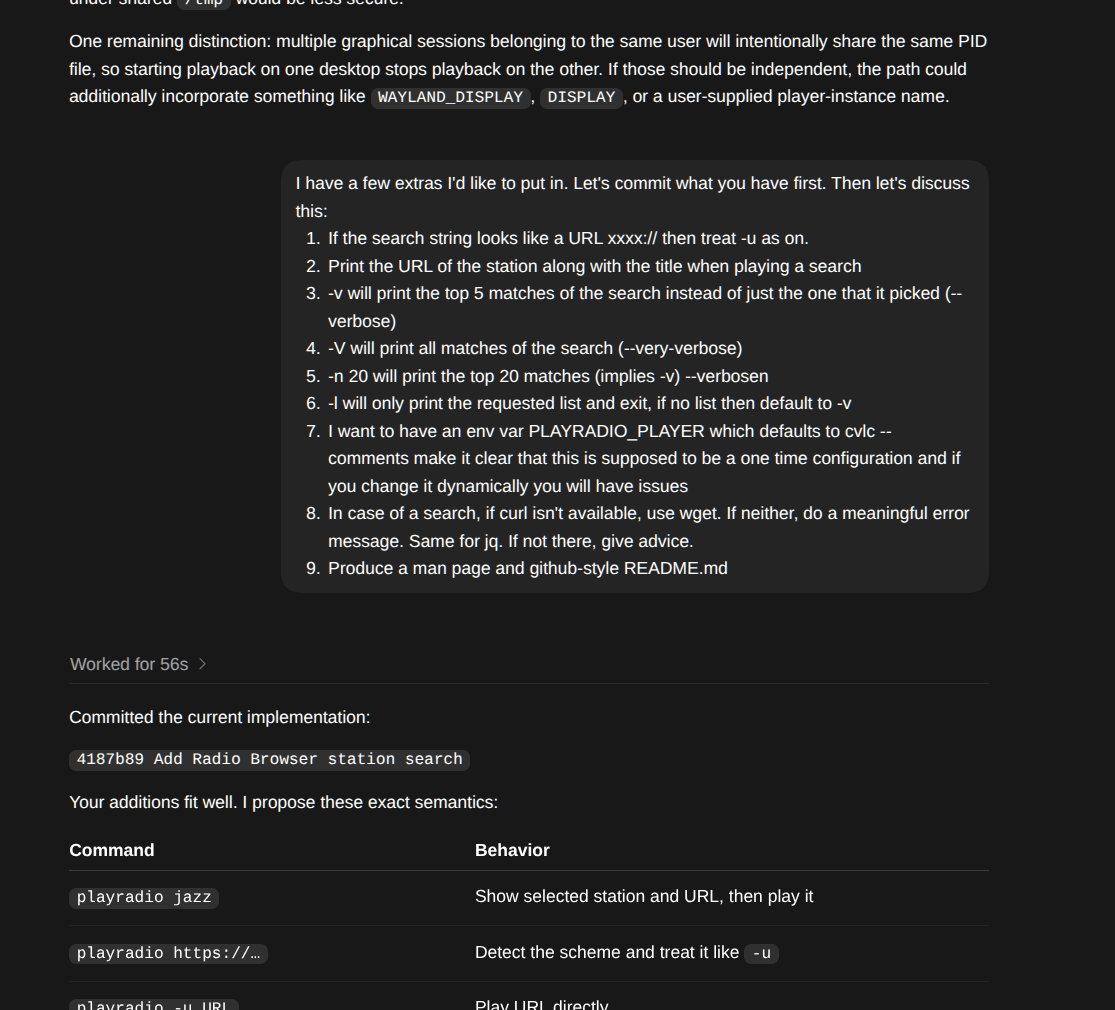
The final solution records both the PID and Linux’s process start-time token:
Part of a Codex session. Entire transcripts are on GitHub.
Before sending a signal, the script confirms that both still match. It also uses a private per-user runtime directory, serializes concurrent start and stop operations with flock, sends SIGTERM first, waits for a graceful shutdown, and rechecks the process identity before falling back to SIGKILL. That is considerably more thought than I wanted to put into a desktop radio button. Overkill? Maybe, but it is robust.
Another pleasant surprise was that Codex built a suite of tests to ensure that everything worked as it should. It runs these tests when it makes changes. So it doesn’t just create code. It creates code, executes it with test cases, and fixes any issues it discovers.
Searching the Database — and More
Once the process handling was safe, I asked:
Radio Browser allows you to search via API for radio stations. How hard would it be to make $1 a search string and take the best match, while allowing -u for a URL instead?
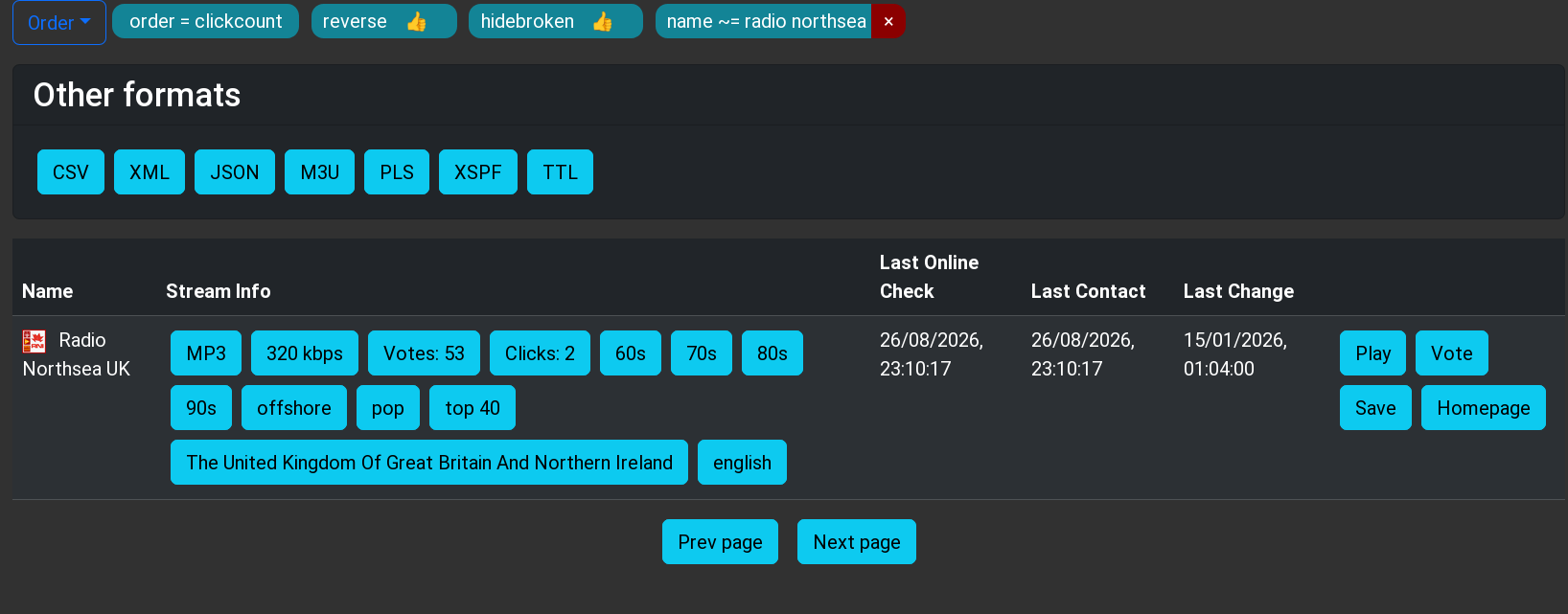
Codex checked the current API documentation, found that curl and jq were already installed, and implemented the search. It hides broken stations, orders matches by votes, selects the top result, and reports the selection back to Radio Browser’s click counter. I told it I wanted specific command-line options over several iterations. The program can play a URL, search the database for a station, or even just query the database. It can also give you a list and let you pick. (See the README.md for the entire interface.)
RadioBrowser is human-readable, but also provides the same data via API.
I did make a few requests. For example, if you pass a URI, the program should figure it out and skip the database search. I also wanted the player to be configurable through a PLAYRADIO_PLAYER environment variable. I asked it to fall back on wget if curl wasn’t installed. Missing dependencies should produce useful installation advice rather than mysterious failures. I also asked it to produce a GitHub-style README and a traditional Unix man page.
Human Guidance Still Matters
There were a few places where human intervention improved the result. For example, the PLAYRADIO_PLAYER configuration and its explanatory comment originally appeared near the bottom of the script. That works, but it is inconvenient for someone who wanted to edit the file. I asked Codex to move it near the top.
Another example was the first version of --pick. I had specifically suggested Bash’s select command, so Codex printed the formatted list and then let select print a second numbered list. It worked, but the duplication was distracting and, as far as Codex was concerned, it was what I asked for.
I pointed the duplication out. Codex replaced select with a simple numeric read, keeping the detailed table and adding only one extra row:
1 Jazz One
2 Jazz Two
3 Cancel
Station number:
This is a good example of how I think these tools work best. The AI handles the implementation, edge cases, tests, and documentation, while the human provides design input and flags anything awkward or that doesn’t fit the intended experience.
Does It Scale?
I’m not an expert at using these kinds of tools, but I think this worked very well. I generally asked for what I wanted and then made technical observations about the results.
I also tried this with a script, originally from [Petar Marinov], that I’ve used and modified for years to replace the cd command (see GitHub). I didn’t tell it what to do. I just let it look at the code. It correctly determined what it was supposed to do and made solid suggestions for making it more robust. It suggested features and even a major improvement to make it work not just with cd but with anything that changes pwd, like pushd. Of course, I couldn’t resist getting a man page and a README for free.
One feature I asked the tool to create was a simple bookmark system. It proposed and created a way to create and maintain a bash associative array that it persisted in a configuration file. That worked, but I knew it would be better, on many levels, to keep the bookmarks as proper symlinks. When I pointed this out, the AI did get it, saying:
That has several nice consequences:
changes from cdmark are instantly visible in every shell; no reload or synchronization issue
ls -l ~/.config/cdfunc/bookmarks is already a crude cdmark list
bookmarks can be created or removed manually with ordinary Unix tools
Syncthing/git/backup tools handle them naturally
no parsing, quoting, escaping, or rewriting a bookmarks file
no associative-array initialization at shell startup
broken bookmarks are naturally represented as broken symlinks
I think that’s substantially cleaner.
It also noted that this makes shell completion very simple, which I had not thought about. However, its implementation broke normal shell completion for the commands. It fixed that after I pointed it out. Well, actually, it took two tries to work out all the bugs. This is another case where human guidance is critical.
For a more advanced project, I forked a simple editor, kilo, and added a few Emacs commands. I asked Codex to review it. It found a number of bad edge cases, some in the original code, and fixed them. I then asked it to suggest Emacs-like features it could easily do. We added a ton! (see GitHub). It was impressive how well it analyzed and understood the code. I had done similar modifications to the code a few weeks earlier and, I have to admit, Codex understood the original code base much faster than I had.
Again, though, human guidance is necessary. Emacs uses an Esc prefix for some commands. You can also hold down the Alt key to get the same result. So pressing Alt+W in a terminal sends an Esc character and a W.
Initially, Codex wrote code to detect an Esc, wait a short time for a command, and then, if nothing came, treat it as a bare escape. It even understood that this would be a problem and mentioned it. Alt+W would work, but there was no way for a human to press Esc and then W in the time allotted. I prompted:
Yes I see that in the program. Would it be possible to have it wait indefinitely for ESC UNLESS a caller set some flag. So when other parts of the editor (search/save/etc.) are prompting for input they would set that flag (or call a separate entry point) and, at that point, ESC=>ESC. Any other time ESC is treated as a prefix (and perhaps ESC ESC gets sent as an escape just as a — ahem — escape hatch.
That fixed the problem. It is hard to remember that while Codex seems smart, it doesn’t have human judgment or human-level problem-solving skills. You have to supply that. Sure, it found problems in its own code. It found problems in my code. It devised solutions. But you still have to make sure those solutions make sense and sometimes nudge it — at least — in the right direction.
If you are interested, each of the GitHub repos (playradio, cdfunc, and kilo) has a session directory that contains transcripts of the AI chats that produced the final versions of the code. Admittedly, none of these started from a totally blank slate, but working on an existing code base is certainly a realistic test.
The Git Assistant
One feature I particularly liked was Codex’s ability to manage Git. I didn’t even try the GitHub plugin for Codex, which would probably be even better. I asked it to commit the current version before starting a new feature, which gave me a clean checkpoint. Later I said:
Commit please. I’m going to add a remote GitHub repo. Can you set this as origin and push it after the commit?
Codex committed the changes, added the remote, pushed the branch, configured upstream tracking, and verified that the working tree was clean. The entire evolution is visible in the repository’s history — from process-safety changes, to Radio Browser search, to configuration and documentation, to the interactive station picker.
You can see the final project and follow each commit in the repositories along with transcripts of the AI sessions. Having things in version control is especially useful with a tool like Codex. You can easily see what has changed and roll back if you like.
Wrap Up
The original script solved my immediate problem in a handful of lines. The finished utility solves the same problem safely, handles failures, searches a public database, supports different players, has good documentation, and leaves a traceable Git history. One important note. Codex and other agents have a limited context window, so you won’t get the same results trying to work with extremely large code bases unless you pay for a larger model. But for these tasks, normal consumer Codex worked well.
Could I have written all of that myself? Certainly. Would I have bothered to go this far? Probably not for what is basically a one-off desktop hack.
That may be the most useful role for a coding agent: They don’t always enable you to do something you couldn’t otherwise do. But they make it cheap enough in time and attention span to do all the boring and defensive coding and testing that you know you should do, but so often don’t. Codex didn’t replace me. It just augmented my patience.
Bill Gates, whose new essay warns of the risks ahead in the AI era, during a 2017 interview. (GeekWire File Photo / Kevin Lisota)
When Bill Gates talks, people listen. This week he published a lengthy essay on what AI is going to do to work, and told GeekWire that people inside AI companies who name the downsides get told, “Hey, you’re hurting our PR while we’re trying to raise trillions of dollars.”
He’s right about the hard part. The job displacement he describes lands on young workers first, and the safety net is funded by taxes on the very wages that AI erodes. He prescribes three treatments: new institutions at home and abroad, a tax on AI tokens and robots, and “Human Reserved,” a category of jobs only people may hold.
Gates has the diagnosis right but the prescription mostly wrong. I’d sign the robot tax tomorrow, because hiring a person costs you payroll tax every year while buying a robot gets written off in year one. The other two I’d send back.
Let’s start with what’s solid. Stanford’s Digital Economy Lab updated its “Canaries in the Coal Mine” work this month. Employment for 22-to-25-year-olds in the most AI-exposed occupations is running 19% below where it would be if it had kept pace with their peers in less exposed work, up from 15% a year ago. The same authors say they don’t see widespread, economy-wide displacement, and unemployment held at 4.1% in July.
The AI damage isn’t arriving as layoffs. It’s arriving as jobs that never get posted, and Gates is right that the young get it first.
Now the token tax. Tokens (essentially words) are what AI companies bill by. Taxing tokens is like taxing keystrokes: it measures effort, not displacement.
A high school class working through calculus with an AI tutor burns tokens continuously. A model that quietly retires a 40-person customer center might burn relatively few. The tax lands hardest on the uses Gates says he wants to protect.
Stanford’s AI Index put the cost of GPT-3.5-level performance at $20 per million tokens in November 2022 and seven cents by October 2024, a 280-fold drop. You’d be indexing the safety net to a number that falls every year while displacement rises.
And you can’t collect it. Inference runs on laptops and phones now, and on servers in whatever country declines to sign. A token tax is a tax on whoever uses an American API, and every dollar it adds makes a Chinese model look cheaper. We’d be slowing ourselves down and not China.
Gates says the institutions will take years to build, and also says we can’t afford to move slowly. He’s right twice, and that’s the problem. He wants the international body to borrow from nuclear inspections and aviation regulation. That may pan out in the long term, though the UN is the cautionary tale for the bureaucratic nightmare that the international community can produce.
Meanwhile we have functional agencies with jurisdiction today. The FDA can rule on AI in diagnosis. The FTC can go after AI-enabled fraud. We don’t need a new agency to say a bank can’t deny your mortgage because a model felt like it. We need the banking regulator to reiterate it forcefully.
That leaves Human Reserved, his best idea but his most privileged one. Gates would protect a job for either of two reasons: the role is deeply personal, like a caregiver, or the people who hold it are unlikely to find other work. Only one of those holds.
Freezing headcount because the workers have nowhere else to go protects the job for a while and makes the service more expensive along the way. Reserving the moments when a human being is the point is defensible, and Gates makes that case well. On a robot delivering the news that you have an incurable disease, he writes, “There’s no technical reason why it couldn’t,” and adds, “Yet it shouldn’t.” He’s right.
I made the case in WIRED nine years ago that displaced workers should move into caregiving, and that it would take real money to lift the pay enough to draw them.
The problem with Human Reserved is that it assumes there’s a human being available. Home health and personal care aides earn a median of $34,900 a year, and BLS projects roughly 765,000 openings in that occupation every year through 2034. At that wage, they keep coming open. A third of home care aides are immigrants, and tighter enforcement threatens that supply. A rule that reserves care for people, in a market with no spare people, reserves care for the families who can outbid everyone else.
Gates half-anticipates this, telling The New York Times he might be a flawed messenger because of his wealth. On this point he is. The caregivers who gave his father something irreplaceable were in that room because someone could pay them to be there.
So don’t fence AI out of the room. Put it to work in the hours nobody is paid to cover.
In February the Times ran Eli Saslow’s story about Jan Worrell, 85, living alone on Washington’s Long Beach Peninsula with an AI companion called ElliQ that engages her about eight times a day and pushes her to stay hydrated and moving. (I serve on ElliQ’s board, and I joined because the company builds a machine that extends a caregiver’s reach instead of replacing one.)
Her goal, she told her doctor, was to never live anywhere else. Fund enough aides to cover the hours that need a person and put the machine on the rest.
Here’s where I net out: equalize the tax treatment of labor and capital, which Congress could do next session, and route the proceeds into retraining and into topping up the pay of workers who land in lower-paying jobs. That’s a better answer than a protected job title.
Drop the token tax, build the caregiving workforce instead of fencing it off, and use the regulators we already have while somebody works on the ones we don’t.
Hashdex has begun liquidating its Hashdex Bitcoin ETF, ticker DEFI, marking the first closure of a US spot Bitcoin ETF since the category launched in 2024.
The fund ceased trading on NYSE Arca on August 17. Hashdex cited low assets under management, high operating costs, and a small asset base of about $14.7 million as reasons for winding down the product. Liquidating cash distributions are expected between August 24 and August 28.
The closure is notable, but it should not be misread.
This is not evidence that the entire spot Bitcoin ETF market is failing. Larger products continue to attract significant capital. The Hashdex closure is better understood as product consolidation inside an increasingly competitive ETF category.
TL;DR
Hashdex is liquidating its DEFI Bitcoin ETF.
The fund stopped trading on NYSE Arca on August 17.
The closure reflects one smaller ETF winding down, not broad failure of the Bitcoin ETF market.
Why DEFI Could Not Compete
The spot Bitcoin ETF market has become extremely concentrated.
Large issuers with strong distribution, tight spreads, low fees, and deep brand recognition have dominated flows. Smaller funds have had to fight for visibility in a market where investors can already choose from highly liquid alternatives.
That makes survival difficult.
A fund with only $14.7 million in assets faces a cost problem. ETF operations require administration, custody, compliance, market-making support, reporting, and exchange-listing maintenance. If assets remain too small, the economics can stop working.
That appears to be the Hashdex story.
A Closure Can Be Healthy
ETF closures are not unusual in traditional markets.
Funds close when demand is weak, assets are too small, or strategy overlap makes them unnecessary. That is part of how ETF markets mature. Strong products gather assets, while weaker or less differentiated products exit.
Crypto ETFs are now experiencing the same process.
The early post-approval period created many products chasing the same investor base. Over time, capital tends to settle around the deepest and most efficient funds.
That is not necessarily bad for investors. It can simplify the category and concentrate liquidity.
The Big Bitcoin ETF Story Remains Intact
The broader spot Bitcoin ETF market remains far larger than one fund.
BlackRock, Fidelity, and other major issuers have captured deep demand. ETF flows continue to act as a major sentiment gauge for Bitcoin traders. Large daily inflows still influence market psychology and, at times, price direction.
So Hashdex closing DEFI does not undermine the category.
It shows that not every product can win.
The distinction matters because the market may be tempted to treat the first closure as a symbolic blow. It is more accurately a sign that the category is moving from launch excitement into competitive sorting.
What Investors Should Watch
The next question is whether other smaller funds follow.
If more low-AUM spot Bitcoin ETFs close, that would suggest consolidation is accelerating. That may reduce product count but strengthen liquidity in surviving funds.
Investors should also watch fees.
Fee pressure can make it harder for smaller issuers to compete, especially when large firms can operate at scale and absorb thinner margins.
The ETF market rewards size, distribution, and liquidity. Crypto ETFs are no exception.
The Clean Read
Hashdex’s DEFI liquidation is a milestone because it is the first closure in the US spot Bitcoin ETF category.
But it is not a category-wide warning sign.
It is a reminder that ETF approval does not guarantee ETF success. Investors still choose products based on cost, liquidity, trust, and convenience. In a crowded Bitcoin ETF market, smaller funds may struggle to justify their place.
The category is not disappearing. It is consolidating.
At Black Hat USA 2026, Novee found GitHub workflow flaws in Claude Code, Gemini CLI and Codex that enabled RCE, credential theft and agent control in pipelines.
Cisco Talos found hackers using simple authorization claims to bypass AI guardrails, build DDoS attack tools, steal credentials and access live camera services.
It feels bad enough when an open letter signed by leading economists warns that AI might steal your job. The fact it may soon be better than you at making dinner? Insult to injury. But that’s exactly what the company 1X promised when it showed off a pair of new, impressively dexterous (and, to some, oddly sexy?) robotic hands in a July demo.
While the tech community was sharply divided over the appeal of those disembodied hands, almost everyone can agree that a few things are decidedly not sexy: Grok’s porn-pilled translation feature, Meta’s creepy glasses (which may soon get even creepier), and Big Tech’s emissions (which continue to skyrocket).
But while it’s not always the most popular technology, at least AI is paying off for one group: single chip workers in Korea, newly inundated with dating opportunities thanks to their giant bonuses. Who says you can’t buy love?
Jupiter Passes $1T In Cumulative Solana Swap Volume
Jupiter has passed $1 trillion in cumulative routing volume, cementing its role as one of the most important DeFi applications in the Solana ecosystem.
The milestone reflects aggregate swap volume routed across connected Solana liquidity pools. Jupiter is not just a single exchange pool. It is an aggregator, meaning it searches across venues to find better pricing and execution for users.
That role makes it central to Solana trading.
When users swap tokens on Solana, Jupiter is often part of the route. Passing $1 trillion in cumulative volume shows how much trading activity has flowed through the platform and how important aggregation has become for low-cost, high-speed DeFi.
TL;DR
Jupiter has passed $1 trillion in cumulative Solana routing volume.
The platform aggregates liquidity across connected Solana pools.
The milestone reinforces Jupiter’s role as a core Solana DeFi venue.
Liquidity is spread across pools, AMMs, order books, and protocols. If users have to manually search for the best route, trading becomes inefficient. Aggregators solve that problem by routing trades through the best available path.
Jupiter has become Solana’s most recognizable example of that model.
It helps users access deeper liquidity without needing to understand every underlying venue. That is especially useful on Solana, where low fees make smaller and faster trades more practical.
The $1 trillion milestone shows that users are not just experimenting with Jupiter. They are relying on it as part of Solana’s core market structure.
That matters because DeFi ecosystems are often judged by their liquidity layer.
If swaps are cheap, fast, and well-routed, the entire ecosystem becomes easier to use.
Solana DeFi Keeps Maturing
Solana’s early DeFi story was often overshadowed by meme coins and retail trading.
That attention brought volume, but it also made some investors question how much activity was durable. Jupiter’s cumulative volume milestone gives Solana a stronger infrastructure story.
A trillion dollars in routed volume does not happen without repeated use.
It suggests a large amount of trading activity has moved through Solana’s DeFi rails over time. That strengthens the argument that Solana is not only a speculative chain but also a serious venue for decentralized trading.
The launch of Jupiter’s Offerbook lending market adds another layer.
If Jupiter can expand from routing swaps into lending and broader market infrastructure, it may become even more central to Solana’s DeFi stack.
Cumulative Volume Needs Context
The number is impressive, but it should be understood properly.
Cumulative volume is not the same as current daily volume. It reflects all historical routing activity across connected pools. It does not mean $1 trillion is locked in the protocol, and it does not mean that every trade produced equal revenue or user value.
Still, cumulative volume is a useful adoption marker.
It shows that Jupiter has processed meaningful activity over a long period. For users, that can reinforce trust. For developers, it shows where liquidity is flowing. For Solana, it supports the network’s claim to be one of crypto’s leading trading environments.
The next question is how Jupiter maintains that position.
Competition in DeFi is constant. Aggregators need to keep routes efficient, interfaces clean, integrations broad, and execution reliable. If they fall behind, users can move quickly.
Jupiter Is Becoming More Than A Swap Router
The broader story is Jupiter’s evolution.
The platform started as a critical swap aggregator, but it has increasingly expanded into other Solana-native financial products. Offerbook is part of that shift, pointing toward a wider DeFi role beyond simple token swaps.
That matters for Solana.
A strong ecosystem needs anchor applications. Ethereum has Uniswap, Aave, Lido, and Curve. Solana needs its own set of core venues that users return to repeatedly. Jupiter is clearly one of them.
Passing $1 trillion in cumulative routing volume reinforces that position.
For traders, it shows where Solana liquidity is moving. For SOL supporters, it gives a concrete metric supporting the network’s DeFi maturity. For Jupiter, it raises expectations.
The platform now has to prove that it can keep growing beyond aggregation while maintaining the execution quality that made it important in the first place.
For now, the milestone is a strong signal: Solana DeFi has real volume, and Jupiter remains one of its main arteries.
This article is based on Jupiter’s public statement and platform data.
This article was written by the News Desk and edited by Samuel Rae.
This report is based on information released in official primary source disclosures at primary source documentation.
 Login
Login