If you don’t actually need one, you’d be forgiven for thinking a hearing aid just makes everything louder for the wearer. Especially since there are plenty of shady products out there which will do exactly that for just four easy payments of $29.99. But the reality is considerably more complex, as a proper hearing aid needs to be capable of selectively enhancing certain frequencies while squashing down others.
The technical challenges involved in pulling that off in a device small enough to fit inside the human ear and run off of a tiny battery are considerable — and while there’s undoubtedly been some degree of artificial price inflation going on over the years, there’s a reason proper hearing aids have been so much more expensive than their “As Seen on TV” counterparts. These same challenges are also why DIY and open source hardware hearing aids have struggled to gain much traction.
 But over the last few years the situation has changed. In 2022 the United States Food and Drug Administration (FDA) established the framework by which hearing aids could be sold over the counter (OTC). Although they’re generally less capable than their prescription counterparts and not suitable for individuals with profound hearing loss, the wide commercial availability of OTC hearing aids has kicked off a competition between manufacturers to deliver more affordable devices.
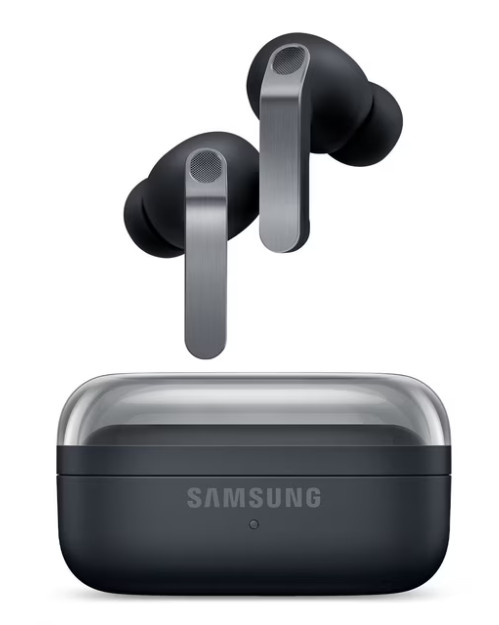
That competition entered a new phase earlier this month when the FDA granted approval for Samsung’s Galaxy Earbuds to fall under the same category. This follows a similar decision made about Apple’s AirPods back in 2024. The two biggest players in the smartphone market being able to offer their earbuds as OTC hearing aids represents a unique value proposition. Not only are they priced for mass market consumption, but many individuals who would be interested in purchasing an OTC hearing aid will already own them and need only to enable the feature with a software update.
Given how different the situation is today than even just five years ago it’s worth asking just what qualifies as a over-the-counter hearing aid, and how the shifting definition of these devices can inform the community’s efforts to develop open hardware solutions.
What is a Hearing Aid, Anyway?
We’ve already covered what a hearing aid isn’t, but before we go too much further it’s a good idea to clarify what exactly a hearing aid does in comparison to a simple audio amplifier, which in the industry are officially known as Personal Sound Amplification Products (PSAPs). This is a topic we’ve touched on previously here at Hackaday, but the short version is that since the 1980s or so, the frequencies that a hearing aid amplifies have been tailored to match the specific auditory deficiencies of the wearer.
Traditionally, getting a hearing aid prescribed would require going to an audiologist and getting an audiogram. This chart plots the results of a hearing test, and shows how well the patient can hear various frequencies. With this data, it’s possible to quantify the severity of a patient’s hearing loss and determine where a hearing aid could improve the situation. This information could then be programmed into a hearing aid to provide a bespoke amplification profile that takes into account the needs of the wearer.
It’s worth noting that this is only in the context of relatively modern digital hearing aids, essentially those created after the introduction of solid state electronics. Prior to that point, hearing aids were closer to what we would now consider PSAPs and amplified incoming audio indiscriminately.
Defining a Middle Ground
With this in mind, the primary difference between a prescription hearing aid and an OTC model is that the audiologist is cut out of the loop. That means there’s no audiogram, and in turn no data to program the hearing aid’s filters with. The specifics of this does vary from model to model, and both Samsung and Apple offer some basic audio testing tools that can help the user fine-tune their experience. But at this point, no OTC hearing aid product is capable of diagnosing the wearer’s hearing to the same level as a comprehensive hearing test performed by an audiologist
That being the case, it might seem like an OTC hearing aid is just a PSAP. But in their ruling, the FDA established the formal requirements for a device that falls somewhere in the middle. The full document, Medical Devices; Ear, Nose, and Throat Devices; Establishing Over-the-Counter Hearing Aids, comes in at around 200 pages if you’re looking for some light reading.
Fortunately, the agency provides a boiled-down list of what features a device must have to meet the definition of an OTC hearing aid. Some of the requirements have to do with the packaging and marketing of the product, which of course are important for a medical device, but it’s the technical parameters that we’re interested in.
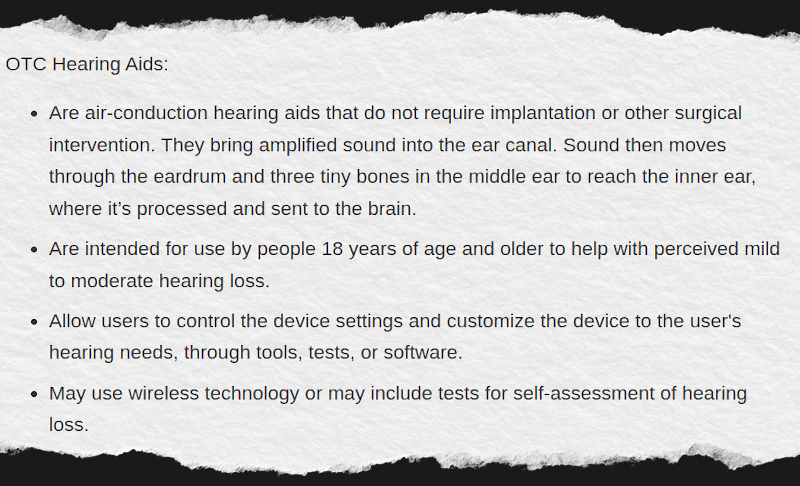
The FDA specifies that all OTC hearing aids must use air-conduction, that is, operate with a speaker inserted into the ear canal. The alternative would be bone conduction, which is generally used in cases with more profound hearing loss. The devices must also allow users to adjust, at least to some degree, the output to match their specific needs.
The intention with this second requirement goes deeper than a simple volume control as you’d have in an PSAP. In lieu of the sort of tailored output a prescription hearing aid would offer, the OTC device can offer a selection of pre-defined audio filter profiles which the user could flip through. At the risk of oversimplifying things, it’s a bit like the audio presets for different genres of music that modern headphones and earbuds usually offer in that the user can cycle through different profiles to find what best matches the current environment.
When combined with the acknowledgement that OTC hearing aids can utilize wireless technology to communicate with another device, it’s not hard to see how the smartphone fits into the equation. While a stand-alone device is capable of meeting the requirements necessary for OTC hearing aid classification, being able to connect to the user’s phone to easily switch between audio profiles on the fly makes for a greatly improved user experience. Additionally, by playing tones through the earbuds, software on the phone can perform a hearing test on the user — the results of which can be used to fine-tune the output beyond what’s possible with simple presets.
Hackers, Take Note
Of course, anyone looking to build an open source hearing aid probably isn’t looking for FDA approval. The goal is likely to make the technology cheaper and more accessible, especially in areas where getting a commercially produced hearing aid may be difficult. As such, the new over-the-counter classification may not seem terribly important for folks like us.
But that doesn’t mean we can’t pick up some tips from what companies like Samsung, Apple, and Jabra are doing. By bringing the user’s smartphone into the mix, they have made hearing aids more accessible and easier to operate. Instead of trying to pack all of the functionality directly into the wearable, using a smartphone to do some of that heavy lifting opens up a lot of new possibilities. There are naturally trade-offs when switching a hardware problem for a software one, especially when dealing with mobile operating systems, but it may be a compromise worth making if it means getting this sort of assistive tech to more people that need it.

 Login
Login