Normal view

There are new articles available, click to refresh the page.
Before yesterdayMain stream

Two July Windows Left: The CLARITY Act’s Senate Fight and What Failure Means

17 July 2026 at 06:46

The CLARITY Act, the bill that would define whether digital assets fall under SEC or CFTC jurisdiction, has two remaining floor windows before the August recess: the weeks of July 20 and July 27.

Miss both, and Senator Lummis has warned that market structure legislation could slip to 2030 or die entirely at the end of the 119th Congress in January 2027, forcing a full restart.

That is not a political projection, it is the structural consequence of a Senate calendar that leaves roughly three weeks of productive session after September before lawmakers enter full midterm campaign mode.

One year after Washington’s Crypto Week, the scorecard is uneven. The GENIUS Act became law on July 18, 2025, establishing the first federal framework for payment stablecoins.

🚨BREAKING:

SEN. LUMMIS SAYS THE CLARITY ACT WILL BE INTRODUCED WITHIN DAYS AFTER 10 MONTHS OF WORK

SENATE VOTE IS NOW TARGETED FOR THE WEEK OF JULY 20

BULLISH FOR CRYPTO pic.twitter.com/1BuG9FWUEs

— Midas (@DeFiMidas) July 14, 2026

An anti-CBDC provision eventually passed inside the 21st Century ROAD to Housing Act, becoming law automatically on July 10, the House voted 358–32, the Senate 85–5, margins that made Trump’s refusal to sign irrelevant.

The CLARITY Act, which passed the House 294–134 on July 17, 2025, cleared the Senate Banking Committee 15–9 on May 14, 2026, and has sat on the Senate Legislative Calendar since June 1 with no floor vote scheduled.

The distinction between GENIUS and CLARITY matters here. GENIUS governed one product. CLARITY governs the entire market. It answers the classification question that determines everything downstream: whether a given digital asset falls under SEC jurisdiction as a security or CFTC jurisdiction as a commodity.

Registration, custody, listing decisions, and disclosure posture all flow from that single determination. Without a statutory answer, the question gets resolved by whichever agency sues first, or whichever party holds the White House.

btc logo
Bitcoin (BTC)
24h7d30d1yAll time

Discover: The Best Token Presales

The Vote Math Is Getting Harder

Senate leadership needs 60 votes. The Republican coalition is already fractured. Senators Josh Hawley (R-Mo.) and Rand Paul (R-Ky.) were the only two Republicans to vote against the GENIUS Act; per Galaxy Digital analyst Alex Thorn, both are expected to oppose CLARITY as well.

Senator McConnell has missed votes due to an ongoing medical issue, and the death of Senator Lindsey Graham at 71 further narrows an already thin Republican majority. By Thorn’s calculation, leadership may need as many as nine Democratic crossovers to reach the threshold.

The CLARITY Act faces its last realistic Senate votes in July. With passage odds near 34%, here's what a failed bill means for U.S. firms.
Photo: Senator McConnell

Those crossovers are not secured. Senators Ruben Gallego (D-Ariz.) and Angela Alsobrooks (D-Md.) voted yes in committee but explicitly characterized those votes as conditional, not floor commitments.

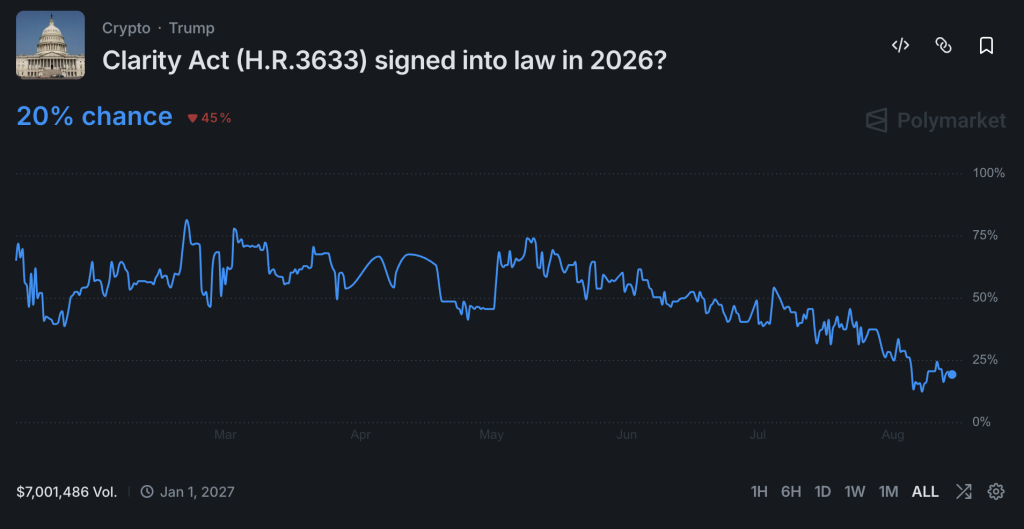
Polymarket’s current passage odds in 2026 are approximately 34% and falling.

Discover: The Best Crypto to Diversify Your Portfolio

Clarity Act: Four Disputes, Zero Resolutions

The first and most visible obstacle is ethics. Senator Elizabeth Warren (D-Mass.) wrote to Majority Leader John Thune and Minority Leader Chuck Schumer on July 13, demanding guardrails preventing senior officials and members of Congress from profiting off the crypto industry.

The letter cited approximately $1.4 billion in crypto-related income disclosed in the president’s 2025 financial filing. Senator Kirsten Gillibrand (D-N.Y.) has made enforceable ethics language covering officials’ crypto holdings a prerequisite for her support. The merged draft from the Banking and Agriculture committees omits ethics provisions entirely.

A compromise floated by Senator Lummis would allow state attorneys general to sue exchanges that list tokens issued by public officials in violation of the act – but Senate Republicans are unlikely to advance any ethics language the White House actively opposes. For a detailed breakdown of this standoff, see the ethics dispute driving the CLARITY Act delay.

The CLARITY Act is in trouble.

And it all comes to ethics provisions.

The newest text of the bill that was released has ZERO dem support – and they need 60 votes.

Apparently, the plan presented to Trump was different to what dems had agreed.

Unlikely to pass before midterms.

— Nic (@puckrin) July 17, 2026

The second dispute centers on law enforcement. The National District Attorneys Association argued to Senate leadership that Section 604, the Blockchain Regulatory Certainty Act provision, would materially impair criminal investigations by shielding non-custodial software developers from money transmitter obligations.

Senator Ron Wyden (D-Ore.) countered that developers who never control customer funds should not be classified as money transmitters for publishing code. Senators Mark Warner (D-Va.) and Catherine Cortez Masto (D-Nev.) have tied their votes directly to law enforcement’s sign-off.

Third: banking trade groups, including the ABA and ICBA, argue the bill creates a stablecoin yield loophole allowing digital asset platforms to offer interest-equivalent rewards that circumvent the GENIUS Act’s prohibition on issuer-paid interest.

The Independent Community Bankers of America has questioned the bill’s pace entirely. Fourth, and structurally acute: the CFTC has operated with a single commissioner, and the SEC has two vacancies. Rules issued by a lone CFTC commissioner could invite legal challenge and keep jurisdictional uncertainty alive. Senator Amy Klobuchar has proposed blocking the framework from taking effect until at least four CFTC commissioners are confirmed.

Don’t Miss Out on Our $1,000 USDT Airdrop on ByBit

The post Two July Windows Left: The CLARITY Act’s Senate Fight and What Failure Means appeared first on Cryptonews.

Clarity Act Stalls on Ethics Rules Curbing Trump’s Business Interests

16 July 2026 at 03:59

President Trump was expected to sit down with U.S. senators Thursday afternoon at the White House to try to resolve the ethics provision blocking the Digital Asset Market Clarity Act, an ethics provision that would restrict senior government officials, including the president, from holding personal crypto business interests while in office.

The meeting comes as the Senate faces a narrow window before its August recess. The current bill text does not include the ethics provision Democrats are seeking.

btc logo
Bitcoin (BTC)
24h7d30d1yAll time

Discover: The Best Token Presales

What the Ethics Provision Would Cover

Democrats have demanded a provision covering the president, vice president, members of Congress, and potentially their spouses and children.

The White House has reportedly pushed for any restriction to be framed as a general officeholder rule rather than language that explicitly targets Trump.

Trump’s Crypto Exposure and the Ethics Fight

Trump disclosed he made more than $1 billion from crypto-related activity in 2025, primarily from the $TRUMP memecoin and World Liberty Financial. The disclosure directly inflamed the ethics fight.

Resolving the ethics provision is seen as the last major issue capable of derailing the bill’s momentum. The bill’s next steps would depend on whether leaders can incorporate ethics language acceptable to enough senators.

Senator Lummis is drawing a line in the sand: Get the crypto bill to the President’s desk now.
The CLARITY Act is officially on the Senate Legislative Calendar (No. 423). 🚨
Crypto regulation is finally entering the chat. 🪙💼 https://t.co/0VoenmAsa5 pic.twitter.com/F9hNox9Xg2

— Hailey LUNC XRP (@TheMoonHailey) July 5, 2026

Senate Majority Leader John Thune has said he will press forward with a floor vote later in July, whether or not the final ethics language is set.

Discover: The Best Crypto to Diversify Your Portfolio

What Happens Before the Clarity Act August Deadline

The Senate departs for summer recess in the first week of August, and midterm election politics are expected to dominate the calendar after that. A revised near-final version of the Clarity Act text was expected to circulate this week, but may slip as talks continue.

Photo: Donald Trump

The open question is whether Trump will accept ethics language that materially restricts his own ongoing business interests. The White House meeting is an indication that negotiators are working toward a compromise, but the specific terms that emerge will determine whether enough Democrats back a floor vote.

The broader global push for crypto market structure frameworks adds context to how consequential U.S. action – or inaction – on the Clarity Act would be. A bill that resolves both the technical market-structure questions and the ethics conflict would set a baseline that other jurisdictions will reference. Stalling into the midterm cycle leaves that benchmark unset for at least another year.

Don’t Miss Out on Our $1,000 USDT Airdrop on ByBit

The post Clarity Act Stalls on Ethics Rules Curbing Trump’s Business Interests appeared first on Cryptonews.

FLEOA Backs Digital Asset CLARITY Act With Four DeFi Accountability Demands

14 July 2026 at 05:02

The Federal Law Enforcement Officers Association (FLEOA) endorsed the Digital Asset Market Clarity Act on July 10, coming just weeks before what many see as a make-or-break legislative deadline before the Senate’s August recess, and doing so with four specific demands to strengthen DeFi accountability language before the Senate votes.

The Senate’s August 8 recess acts as the de facto deadline for advancing the bill this legislative session. Industry insiders have framed the recess as a critical milestone for whether the bill moves this year.

Discover: The Best Token Presales

FLEOA Endorses, But Wants DeFi Provisions Tightened

In its July 10 statement to the Senate Banking Committee, the FLEOA said the current CLARITY Act text “represents meaningful progress toward balancing technological innovation with public safety.” The association commended the committee’s efforts to establish a regulatory framework that preserves criminal, anti-money-laundering, counterterrorism-financing, sanctions-enforcement, and investigative authorities.

FLEOA has submitted a letter to the U.S. Senate Committee on Banking, Housing, and Urban Affairs expressing its support for H.R. 3633, the Digital Asset Market Clarity Act, while offering targeted recommendations to strengthen the legislation and preserve essential federal law… pic.twitter.com/BS3AsBVFKZ

— FLEOA (@FLEOAORG) July 13, 2026

The endorsement is conditional in practice. The FLEOA urged lawmakers to narrow the bill’s DeFi protections, make it clearer who is accountable in decentralized finance (DeFi) systems, stop firms from avoiding regulation by claiming to be decentralized, revise “specific intent” language to make it easier to establish liability, and explicitly affirm the bill does not curtail existing federal investigative powers.

Those demands directly address the fault lines that have defined law enforcement’s relationship with the bill. In June, four organizations, the National District Attorneys Association, the National Association of Assistant United States Attorneys, the International Association of Chiefs of Police, and the National Sheriffs’ Association, sent concerns to the White House about Section 604, which seeks to protect developers from liability for illicit activity carried out by users on their decentralized platforms.

The opposition prompted the White House to invite law enforcement organizations objecting to the language of the bill to a meeting in late June.

Around the same time, the Major County Sheriffs of America shifted from opposition to neutral, and FLEOA moved to active support with conditions.

Discover: The Best Crypto to Diversify Your Portfolio

Second Endorsement in Nine Days Reframes the Law Enforcement Narrative

FLEOA’s statement came nine days after the National Organization of Black Law Enforcement Executives (NOBLE) backed the bill, giving proponents back-to-back institutional cover on the law enforcement front.

The sequential endorsements are being used to counter the argument that the CLARITY Act would weaken the government’s ability to police crypto crime.

btc logo
Bitcoin (BTC)
24h7d30d1yAll time

Ji Kim, CEO of the Crypto Council, said the group was expressing support for CLARITY and that the bill is strong on consumer protection and law enforcement.

The August Deadline Is Structural, Not Rhetorical

Senator Cynthia Lummis, on July 8, framed the stakes as generational: “This is likely our last chance to get real legislation for digital assets on the books before 2030.

If we fail to pass the Clarity Act, we are ensuring another country will write the rules for digital assets, and we spend the next decade catching up.” The statement is a lobbying argument as much as a forecast, but the structural point is accurate. The letter comes less than four weeks before the Aug. 8 Senate recess.

No rule can give the CFTC spot authority over digital assets, grant new sanctions authority against adversaries, or protect developers from unwarranted prosecution. Only Congress can. The Clarity Act is the only path that works. https://t.co/efPHXnhtmd

— Senator Cynthia Lummis (@SenLummis) July 14, 2026

For traders, the CLARITY Act’s passage would aim to strengthen the bill’s regulatory framework for digital assets, including enhancing DeFi accountability and preserving investigators’ existing powers. The ethics provision hurdle and Senate vote timing remain the next procedural test, with the Banking and Agriculture Committee versions still requiring reconciliation before a floor vote can proceed.

The FLEOA’s requested language changes, including calls to narrow DeFi protections, clarify accountability in DeFi systems, revise “specific intent” language, and affirm existing federal investigative authority, are central points in ongoing negotiations as lawmakers approach the Aug. 8 recess. The question of how the DeFi liability language is handled remains a focus of scrutiny.

Don’t Miss Out on Our $1,000 USDT Airdrop on ByBit

The post FLEOA Backs Digital Asset CLARITY Act With Four DeFi Accountability Demands appeared first on Cryptonews.

Ethics Standoff Clouds CLARITY Act Path as July Vote Window Narrows

13 July 2026 at 09:07

A revised CLARITY Act draft merging the Senate Banking Committee and Senate Agriculture Committee bills is expected this week, adding roughly 70 pages to the text, but the ethics provision Senate Democrats have made a precondition for their votes is not included.

Without that language, securing the seven or more Democratic votes needed to clear the 60-vote threshold for Senate cloture looks structurally difficult before the August recess.

The vote arithmetic is straightforward: Republicans hold 53 seats, meaning the bill needs at least seven Democrats to cross 60. The ethics standoff has been the central obstacle since Democrats first laid out their full demands last year, and that dynamic has not shifted with this draft.

One person familiar with the talks said directly that without the ethics language, sufficient Democratic support will be difficult to secure.

A new CLARITY Act draft could arrive this week; SEC/CFTC roles and custody rules are the first lines to watch. pic.twitter.com/am11leV0Mx

— BYDFi Alpha (@BYDFiAlpha) July 13, 2026

Galaxy Research has revised its 2026 passage odds down from 75% following Senate Banking Committee clearance to roughly 50-50. Prediction markets currently show approximately 37% odds of passage before August, a number that reflects the compressed timeline as much as the substantive impasse.

Discover: The Best Token Presales

What Democrats Are Demanding, And Why the White House Won’t Budge

The ethics provision at issue, Section 604 conflict-of-interest language, would bar senior government officials, elected officials, and their immediate family members from holding financial interests in or profiting from crypto assets while in office.

Sen. Kirsten Gillibrand (D-NY) has been unambiguous: no ethics language, no Democratic votes. The Van Hollen ethics amendment was defeated 13–11 along party lines in committee, and the White House has indicated it will not accept language that specifically targets the President – a direct reference to the Trump family’s crypto holdings and business interests.

🇺🇸 The U.S. House will hold a hearing on the Crypto CLARITY ACT in just 4 days, on July 17. pic.twitter.com/2f3qB2yttx

— Ash Crypto (@AshCrypto) July 13, 2026

That framing makes a clean compromise difficult. Any ethics language strong enough to satisfy Gillibrand and her Democratic colleagues is, by the White House’s own definition, the kind of language it has said it will reject.

The merged draft released this week sidesteps that problem by omitting the provision entirely, which solves nothing on the Democratic vote count. Democratic positioning on crypto legislation has hardened around this issue specifically, making a floor vote without a resolution a high-risk procedural move.

Discover: The Best Crypto to Diversify Your Portfolio

The July Window and What a Miss Would Mean for Crypto Regulation

Senate Majority Leader John Thune said last month he intends to bring the bill to the floor in July. The weeks of July 20 and July 27 are the two dates under active discussion for a floor vote, both of which fall immediately before the August recess, making this the last viable legislative window before the midterm campaign cycle absorbs the Senate’s attention.

The CLARITY Act passed the House 294–134 in July 2025, cleared the Senate Banking Committee 15–9 on May 14, 2026, and now sits on the Senate Legislative Calendar awaiting floor action.

Photo: John Thune

If the bill misses the summer window, analysts project its 2026 prospects deteriorate materially, the calendar resets, and there is no obvious mechanism to restart the process before midterm positioning takes over. Markets and institutional investors have been pricing in passage risk accordingly, with the bill’s progress, or lack of it – directly influencing sentiment across large-cap assets.

The optimistic path still exists: ethics language gets resolved in the three-to-four-week window after the draft release, floor vote happens late July, and the bill reaches the President’s desk in early August.

The pessimistic path, impasse holds, Democrats withhold votes, and the bill stalls, would prolong the patchwork of state regimes and enforcement-by-litigation that institutional participants have consistently identified as the primary barrier to deeper U.S. market participation.

The merged draft this week is a step in the legislative process; whether it is a step toward resolution or a formality before another delay depends entirely on what happens to the ethics provision in the next two weeks.

Don’t Miss Out on Our $1,000 USDT Airdrop on ByBit

The post Ethics Standoff Clouds CLARITY Act Path as July Vote Window Narrows appeared first on Cryptonews.

Ethics Deadlock Threatens Senate Crypto Bill Despite July Vote Target

11 July 2026 at 06:49

A merged Senate draft of the Digital Asset Market Clarity Act could be released as early as next week, with a floor vote targeted for the week of July 20, but the bill still lacks the Democratic support needed to clear the 60-vote threshold required to break a filibuster.

The new text combines work from the Senate Banking and Agriculture Committees and is said to have added more than 70 pages of material, with greater emphasis on consumer protections than either committee’s standalone version.

That scope signals meaningful negotiation happened, not a mechanical merge, but scope alone does not resolve the core political impasse.

btc logo
Bitcoin (BTC)
24h7d30d1yAll time

Discover: The Best Token Presales

Ethics Provision Remains the Wall

The central sticking point is an ethics provision Senate Democrats are demanding: a restriction barring senior government officials, including the president, from maintaining business ties with the crypto sector. No compromise has been reached, and sources familiar with the negotiation told CoinDesk progress has slowed to a crawl.

One idea in circulation would allow state attorneys general to sue for ethics violations, but nothing has solidified.

The stakes are concrete. Even the two Democrats who voted to advance the Banking Committee’s version have warned they may not support the final bill if the ethics question goes unresolved. Without several Democratic votes, the bill cannot clear the Senate, and that is the entire ballgame for crypto regulation in 2026.

JUST IN: 🇺🇸 CFTC Chair on passing the Clarity Act: "We're so close." 👀

"We have to get this done. It's absolutely critical that we have a federal standard for crypto assets." 🚀 pic.twitter.com/PXpkFX5aFD

— Bitcoin Magazine (@BitcoinMagazine) July 8, 2026

Beyond ethics, outstanding issues include federal preemption and the filling of minority seats on the SEC and CFTC. On July 9, the White House sent a letter to Senators John Thune and Chuck Schumer noting that Democrats had not submitted names for minority roles on those commissions.

Democrats had previously accused Trump and Thune of blocking the normal nomination process for independent agency seats, a dispute that remains unresolved and now layers additional friction onto an already compressed timeline.

The broader context of how U.S. regulators approach crypto oversight can be tracked through the SEC’s 2026 regulatory agenda, which is advancing on a parallel but separate track from this Senate legislation.

Discover: The Best Crypto to Diversify Your Portfolio

One Positive Signal: Wyden Backs DeFi Protections

Not everything is stuck. Senator Ron Wyden of Oregon sent a letter to Senate leadership on July 8 expressing support for the Blockchain Regulatory Certainty Act provisions embedded in the Clarity Act.

The BRCA would ensure crypto developers are not treated as money transmitters under federal regulations if they are not handling customer assets, a top priority for the DeFi sector, which has made preserving those protections a core demand throughout the Clarity negotiations. Senator Ron Wyden addressing an audience in Oregon.

Every positive development around the CLARITY Act gives Bitcoin another bullish push.

You have no idea what regulatory clarity means for crypto.

The entire crypto market cap is still tiny. You're very early! #Bitcoin is now trading above $64,000. pic.twitter.com/IEW61ESm0S

— Wilberforce Theophilus (@Eze_Wilberforce) July 10, 2026

Wyden’s letter does not resolve the ethics standoff, but it narrows the Democratic objection list somewhat. It also signals that at least some Democrats see enough in the bill’s market structure framework to engage constructively rather than simply walk away.

The Calendar Is Running Out

The Senate has three remaining weeks in July and the first week of August before recess. The legislative mechanics of advancing a bill of this complexity could consume several of those days on their own, and a defense spending bill may compete for floor time. Industry insiders have begun privately expressing doubt the bill survives this window, though advocates maintain no fatal deadline has passed yet.

Even a Senate passage would not end the process. The House would need to approve the Senate’s version before it goes to the president, and the House has been paralyzed by Republican infighting.

Trump has also declined to sign the Senate’s bipartisan housing bill while demanding voting-rule concessions, introducing further uncertainty about whether any bipartisan Senate product gets signed into law.

Photo: Donald Trump

The kind of regulatory uncertainty this legislative delay creates is not abstract; exchanges operating without clear U.S. frameworks face the compliance and liquidity pressures that platform failures have demonstrated when regulatory ambiguity intersects with operational stress.

If the merged draft drops next week and floor action follows the week of July 20, the Senate will have roughly two weeks to resolve ethics, preemption, and commission appointments, negotiate final text, secure Democratic votes, and pass a bill that still needs a functional House and a willing White House to become law. The window exists. It is narrow, and it is closing.

Don’t Miss Out on Our $1,000 USDT Airdrop on ByBit

The post Ethics Deadlock Threatens Senate Crypto Bill Despite July Vote Target appeared first on Cryptonews.

SEC’s 2026 Crypto Rulemaking Plan: Safe Harbors, Broker-Dealer Rules and ATS Amendments

8 July 2026 at 12:07

The SEC has formally placed three crypto rulemaking items on its 2026 regulatory agenda, according to the Agency Rule List, covering the offer and sale of crypto assets, broker-dealer financial responsibility rules, and Exchange Act amendments for crypto trading on alternative venues.

The moves signal a Commission that is building a structured exemptive regime in parallel with Congress, rather than waiting for legislation to force its hand.

Source: SEC

That distinction matters. The CLARITY Act remains unsigned as of early July. The SEC’s decision to queue its own rulemakings now, compresses the timeline for market participants who assumed the regulatory overhaul would arrive via statute first.

Three Items, Three Distinct Market Implications

The first item addresses how crypto assets are offered and sold, and explicitly contemplates certain exemptions and safe harbor provisions. The SEC has already proposed an innovation exemption allowing firms to issue and trade tokenized securities, specifically tokenized U.S. stocks, and that guidance is likely to fall under this rulemaking bucket.

Chair Paul Atkins has framed the broader agenda as embracing innovation, bringing more products onshore, and providing clarity regarding tokenized securities.

For token issuers currently navigating registration ambiguity, a codified safe harbor is the most commercially significant item on the agenda.

It determines whether a project can sell tokens to U.S. retail participants at all, and under what disclosure conditions. The specifics, thresholds, timelines, and the definition of sufficiently decentralized governance remain unresolved, which is precisely why the rulemaking notice is consequential.

Photo: Paul Atkins

The second item targets broker-dealer financial responsibility rules: specifically, Rules 15c3-1 (net capital), 15c3-3 (customer protection), 17a-3, and 17a-4 (books and records), with amendments proposed to address how these apply to crypto assets.

The SEC had previously outlined conditions allowing certain DeFi platforms to operate without registering as broker-dealers. The coming rulemaking could codify those conditions or tighten them, a distinction that will determine whether front-end interface providers and aggregators face full registration burdens or a narrower compliance path.

The third item is a set of Exchange Act amendments covering crypto trading on ATSs and national securities exchanges. This is the market structure piece, the rules governing how venues operate, what disclosures they owe, and how order flow in crypto-asset securities is treated relative to traditional equities.

An ATS operating in crypto currently sits in a compliance gray zone; amended Exchange Act rules would clarify whether existing ATS registration frameworks apply as-is or require a parallel crypto-specific track.

Atkins’ Framing and the Political Context

Chair Atkins, according to the primary source, highlighted the Commission’s effort to embrace innovation, bring more products onshore, create clear rules for capital raising within the crypto ecosystem, and provide clarity regarding tokenized securities, framing all three items as part of delivering on President Trump’s goal to make the U.S. the world’s crypto capital.

That framing is politically deliberate: it ties the SEC’s rulemaking pace directly to an executive mandate, which insulates the agenda from internal resistance and signals to institutional market participants that the direction is durable.

President Trump, at the official kickoff of Trump accounts, stated he was a big fan of crypto and suggested Bitcoin could eventually be included in those accounts.

The political tailwind behind the crypto regulation overhaul is not ambiguous, but political will and regulatory execution are separate variables, and the SEC’s agenda items are proposals, not final rules.

The post SEC’s 2026 Crypto Rulemaking Plan: Safe Harbors, Broker-Dealer Rules and ATS Amendments appeared first on Cryptonews.

NOBLE Endorses CLARITY Act as Major County Sheriffs Drop Opposition

7 July 2026 at 10:31

The CLARITY Act picked up its first major public law enforcement endorsement on July 1 when the National Organization of Black Law Enforcement Executives (NOBLE) formally backed the bill, and two days later Major County Sheriffs of America withdrew its opposition entirely, shifting to neutral.

Two organized law enforcement bodies moving constructively on the same digital asset legislation within 72 hours is not coincidental, it reflects deliberate outreach and signals that the Senate floor fight is now a live negotiation, not a procedural formality.

btc logo
Bitcoin (BTC)
24h7d30d1yAll time

Discover: The Best Token Presales

NOBLE’s Endorsement: What the Organization Said and Why It Matters

NOBLE’s July 1 letter to Senate Majority Leader John Thune and Minority Leader Chuck Schumer was addressed to the two officials who control Senate floor timing, a deliberate signal that the endorsement was meant to move the legislative calendar, not just the public narrative.

The organization, which represents more than 3,000 members across nearly 60 chapters worldwide including chief executives and command-level officials, cited four specific provisions driving its support: expanded regulatory obligations on digital asset businesses, enhanced forfeiture authorities, new transparency requirements, and oversight rules for digital asset kiosks.

Critically, NOBLE addressed the enforcement-gap argument head-on. The organization stated explicitly that the legislation does not alter the federal criminal authorities investigators and prosecutors rely on daily, money laundering, unlicensed money transmitting, conspiracy, aiding and abetting, and sanctions enforcement statutes all remain intact under the bill’s current text.

🚨NEWS: The Major County Sheriffs of America (MCSA) has shifted to a “neutral” position on the Clarity Act after what it describes as “continued discussions in recent days regarding parts of Section 604,” aka the Blockchain Regulatory Certainty Act.

In a letter to Senate Banking… pic.twitter.com/24XIZTfWHR

— Eleanor Terrett (@EleanorTerrett) July 3, 2026

That framing directly rebuts the criticism that had dogged earlier CLARITY Act drafts, where anti-corruption groups argued the bill could create exploitable gaps in illicit-finance enforcement.

Stand With Crypto, the crypto advocacy group representing more than 2.6 million U.S. supporters, called NOBLE the first major law enforcement organization to publicly endorse the CLARITY Act.

That distinction matters for Senate Democrats who have been most vocal about enforcement preservation, an endorsement from a respected law enforcement body with NOBLE’s institutional standing provides political cover that no industry lobbying group can supply.

“Law enforcement voices are engaging constructively on digital asset legislation, and the first major endorsement is on the books.”

Stand With Crypto said this after the NOBLE letter was made public, per reporting on the NOBLE endorsement development.

Discover: The Best Crypto to Diversify Your Portfolio

Major County Sheriffs Move to Neutral on Section 604

Major County Sheriffs of America, whose members collectively serve more than 130 million citizens through offices employing at least 700 personnel each, sent its own letter on July 3, this one addressed to Senate Banking Committee Chairman Tim Scott and ranking member Elizabeth Warren.

MCSA’s position shift from opposition to neutral turned on Section 604, the provision incorporating the Blockchain Regulatory Certainty Act, which establishes liability protections for blockchain developers and service providers who do not custody or control digital assets.

Close-up of a man's uniform with a security badge and radio.
Photo by Kindel Media on Pexels

MCSA said continued review and discussions around Section 604 clarified how the administration interprets and plans to implement that provision.

The organization stopped short of endorsement, it explicitly noted room to further strengthen the legislation to support both responsible innovation and state and local law enforcement needs, but it withdrew formal opposition.

Removing an active opponent from the ledger is not the same as gaining a supporter, but in a Senate that requires 60 votes for floor passage, eliminating organized resistance from an association representing major population centers carries real procedural weight.

Don’t Miss Out on Our $1,000 USDT Airdrop on ByBit

The post NOBLE Endorses CLARITY Act as Major County Sheriffs Drop Opposition appeared first on Cryptonews.

SEC Drops MetaMask Case Against ConsenSys With No Fine or Wrongdoing

7 July 2026 at 08:21

The SEC has closed its enforcement investigation into ConsenSys over MetaMask Swaps and MetaMask Staking, with no fine and no admission of wrongdoing, a result that directly challenges the regulatory theory that non-custodial wallet interfaces constitute unregistered brokerage operations.

The dismissal removes the most immediate enforcement threat against the primary retail gateway into the Ethereum ecosystem and hands wallet developers a defensible precedent heading into what remains an unsettled legal landscape for DeFi regulation.

The SEC filed its original complaint in June 2024, alleging that ConsenSys had brokered transactions in crypto asset securities since at least October 2020 and collected transaction-based compensation through MetaMask’s integrated services.

I'm pleased to announce that Consensys and the SEC have agreed in principle that the securities enforcement case concerning MetaMask should be dismissed. Subject to the approval of the Commission, the SEC will file a stipulation with the court that effectively closes the case.…

— Joseph Lubin (@ethereumJoseph) February 27, 2025

The agency’s staking theory went further, targeting MetaMask’s routing integrations with Lido and Rocket Pool as unregistered securities offerings, a framing that, if upheld, would have forced wallet developers across the ecosystem to gut core functionality from non-custodial interfaces.

ConsenSys had pre-empted the suit with its own action against the SEC in April 2024, challenging the agency’s authority over Ethereum-related software and its attempted classification of Ethereum as a security.

The SEC separately closed its Ethereum 2.0 probe in June 2024, and a federal court dismissed ConsenSys’ Texas suit in September 2024, ruling the SEC’s parallel enforcement action had already reduced any credible prosecution threat. That sequence effectively narrowed the live dispute to the MetaMask case now resolved.

Discover: The Best Token Presales

Joe Lubin Calls Dismissal a Win for Blockchain Software Developers

ConsenSys founder Joe Lubin announced the resolution, saying the company and the SEC had agreed in principle that the securities enforcement case concerning MetaMask should be dismissed. Lubin described the outcome as “a good step for blockchain software developers,” adding that ConsenSys had been “committed to fighting this suit until the bitter end.”

“I’m pleased to announce that Consensys and the SEC have agreed in principle that the securities enforcement case concerning MetaMask should be dismissed. Subject to the approval of the Commission, the SEC will file a stipulation with the court that effectively closes the case.”

Photo: Joe Lubin

A ConsenSys official confirmed to Bloomberg that the SEC would not impose a fine. The clean exit matters: ConsenSys’ core legal argument – that wallet software should not be regulated as a traditional broker simply because it routes users to protocols, has now effectively prevailed without requiring a court ruling that could have cut either way.

Discover: The Best Crypto to Diversify Your Portfolio

Why the Outcome Matters Beyond ConsenSys and Metamask

MetaMask is not a peripheral product in the Ethereum stack. It is the dominant retail interface through which users reach DeFi protocols, NFT markets, liquid staking, and on-chain transactions, making the SEC’s original broker theory a structural threat to Ethereum’s entire user-access layer.

A ruling that swap routing or staking integrations inside a non-custodial wallet trigger broker-dealer registration requirements would have had cascading implications for every wallet developer offering comparable functionality. That scenario is now off the table, at least in this enforcement cycle.

The closure also fits the broader pattern of SEC crypto enforcement pullbacks under post-Gensler leadership, which has included dropped or paused actions against Gemini, Uniswap Labs, Robinhood Crypto, and OpenSea.

This month, the SEC has dropped its cases against Coinbase, Robinhood, and now ConsenSys company behind Metamask.

Maybe this panic selling won't last forever?

— dubzy (@dubzyxbt) February 28, 2025

A legislative push for formal crypto regulatory clarity is running in parallel, and the SEC’s retreat on ConsenSys reinforces the direction of travel.

Wallet developers and DeFi front ends now have a cleaner operating environment than they did six months ago – though the absence of a court ruling means the underlying legal questions on broker classification remain open for a future administration or enforcement wave to revisit.

For Ethereum specifically, regulatory clarity at the wallet layer feeds directly into the ecosystem’s mainstreaming trajectory. Institutional staking inflows into Ethereum have been building through 2025, and a MetaMask enforcement loss would have introduced friction at exactly the point where retail and institutional demand converge. That particular risk is now resolved.

Don’t Miss Out on Our $1,000 USDT Airdrop on ByBit

The post SEC Drops MetaMask Case Against ConsenSys With No Fine or Wrongdoing appeared first on Cryptonews.

CLARITY Act Faces Four-Week Senate Deadline Before August Recess

6 July 2026 at 05:04

The Digital Asset Market Clarity Act missed the July 4 signing deadline that White House crypto adviser Patrick Witt had floated in May, and the bill is now operating on a hard four-week runway before the Senate breaks for summer recess on August 7.

The bill is not dead, but the calendar math is unforgiving, and the ethics standoff that has blocked Democratic votes remains unresolved.

Don’t Miss Out on Our $1,000 USDT Airdrop on ByBit

The Senate Arithmetic Is the Real Problem

The CLARITY Act has traveled further than any previous crypto market structure effort. The House passed it in July 2025 by 294 to 134.

The Senate Banking Committee advanced the bill on May 14 by 15 to 9, and it was placed on the Senate Legislative Calendar under General Orders on June 1, technically eligible for floor action. What it is not eligible for is skipping the 60-vote cloture threshold, and Republicans cannot reach 60 alone.

The latest update is that the original target of getting the CLARITY Act signed by July 4 has now been missed, pushing the bill into a much tighter legislative window. While much of the Senate-side coordination can still move forward behind the scenes during the summer recess,… https://t.co/FMoVcO0dXl

— SoSoValue (@SoSoValueCrypto) July 6, 2026

Only two Democrats voted for the bill in committee: Ruben Gallego of Arizona and Angela Alsobrooks of Maryland. Getting from two to seven or more Democratic floor votes requires resolving the conflict-of-interest provision, then filing cloture, then burning the better part of a Senate work week on debate and passage, all before August 7.

After that, the fall calendar is dominated by the NDAA and appropriations fights, and midterm campaigning makes bipartisan deal-making structurally harder. The August recess deadline has been visible for months; the bill simply hasn’t closed the gap.

Trump’s $1.4 Billion Disclosure Gives Democrats a Talking Point, Not New Leverage

President Trump’s annual financial disclosure revealed roughly $1.4 billion in crypto-linked income for 2025, spread across memecoin royalties, World Liberty Financial token sales, and other streams, plus disclosed crypto holdings exceeding $100 million.

Senator Elizabeth Warren, the ranking Democrat on Banking, responded that any bill reaching the floor must stop officials and their families from “profiting off the crypto industry.” Gallego said he would do “everything I can” to crack down on what he called corrupt dealings, a reminder that his committee vote was never a floor guarantee.

The disclosure doesn’t change the underlying negotiation. Democrats already wanted the ethics language before the number was public; the number gives them a sharper headline, not additional deal leverage.

The Digital Asset Market Clarity Act must clear a 60-vote cloture bar and an unresolved ethics standoff before the Senate recesses.
Photo: Donald Trump

The White House position, as Witt has framed it, is acceptance of rules applying “across the board” but rejection of anything singling out one officeholder. That standoff predates the disclosure and will have to be resolved on the same terms regardless. Concerns about crypto profits by administration officials have drawn scrutiny beyond just this bill; conflicts around senior officials and digital asset holdings have become a recurring theme in Washington.

Compounding the Democratic asks, a recent Supreme Court ruling that the president can fire independent-agency commissioners at will has undercut one Democratic demand in the SEC and CFTC negotiations, a bipartisan commissioner slate. If the president can dismiss those officials freely, the negotiated value of a bipartisan slate erodes before it’s even written into statute.

Discover: The Best Crypto to Diversify Your Portfolio

The post CLARITY Act Faces Four-Week Senate Deadline Before August Recess appeared first on Cryptonews.

The First Major Law Enforcement Group Just Endorsed the CLARITY Act, And It Could Flip the Senate Vote

3 July 2026 at 06:34

The National Organization of Black Law Enforcement Executives (NOBLE) has become the first major law enforcement organization to publicly endorse the Clarity Act, sending a letter directly to Senate Majority Leader John Thune and Minority Leader Chuck Schumer backing the crypto regulation framework ahead of a critical August legislative window.

The move directly undercuts the dominant opposition narrative and could provide political cover for soft-no Democrats whose holdout hinges on unresolved enforcement concerns.

In their letter, NOBLE argued that the bill’s provisions “provide law enforcement with meaningful new capabilities while preserving longstanding criminal enforcement authorities”, a direct rebuttal to claims that the legislation creates dangerous enforcement gaps.

The organization specifically flagged enhanced tools against money laundering, digital asset kiosk crime, and unlicensed money transmitting businesses as concrete gains for investigators.

🚨NEWS: The National Organization of Black Law Enforcement Executives (NOBLE) has endorsed the Clarity Act, becoming the first major law enforcement organization to publicly support the legislation, which includes the Blockchain Regulatory Certainty Act (BRCA).

In a letter to… pic.twitter.com/j48csWyxVW

— Eleanor Terrett (@EleanorTerrett) July 2, 2026

The endorsement matters structurally because it splits the law enforcement community at a moment when Democratic senators, including Angela Alsobrooks, are conditioning their votes on the resolution of those exact LE objections.

NOBLE alone does not guarantee the 60 Senate votes needed for passage, but it weakens the bipartisan cover that opposition groups provided and strengthens the pro-bill side in final-language negotiations.

Discover: The Best Crypto to Diversify Your Portfolio

Clarity ACT: The Law Enforcement Split and the DeFi Safe-Harbor Fight

Four major law enforcement organizations, the National Sheriffs’ Association, the International Association of Chiefs of Police, the National District Attorneys Association, and the National Association of Assistant United States Attorneys, remain formally opposed.

Their core objection targets Section 604 of the bill, which incorporates the Blockchain Regulatory Certainty Act (BRCA) and creates regulatory safe harbors for non-custodial blockchain developers and DeFi infrastructure providers.

“Following our review of the legislation and its potential operational impact, NOBLE believes the CLARITY Act contains several provisions that would provide law enforcement with meaningful new capabilities while preserving longstanding criminal enforcement authorities.”

👏 https://t.co/GMT1f2PkSw

— Lindsay Fraser (@lindsayfraser0) July 2, 2026

Don’t Miss Out on Our $1,000 USDT Airdrop on ByBit

Critics argue these carve-outs could place certain actors beyond the reach of Bank Secrecy Act obligations and money-transmitter laws, creating blind spots for narcotics trafficking, sanctions evasion, and terrorist financing.

NOBLE’s counter-argument is that the Clarity Act classifies digital-asset intermediaries as financial institutions for AML purposes, requiring customer identification, due diligence, and suspicious-activity reporting, and that the bill “does not alter the longstanding federal criminal authorities that investigators and prosecutors rely upon every day,” as stated in their Senate letter.

The most likely resolution path is targeted amendments narrowing the BRCA safe-harbor language to satisfy prosecutors and police associations without gutting the regulatory certainty the industry is lobbying for.

The bill’s market-structure core is also significant beyond the enforcement debate: the Senate version explicitly classifies Bitcoin and Ethereum as digital commodities under CFTC jurisdiction, ending the SEC-CFTC turf war that has defined regulatory uncertainty for the last several years. That designation is what major banks and asset managers are waiting on to advance tokenization of equities and real-world assets at scale.

Senators Cynthia Lummis and Tim Scott, chair of the Senate Banking Committee, are driving toward a floor vote before the chamber’s long recess begins on August 10. Scott stated that “the Clarity Act provides clear rules of the road for digital assets, protecting consumers and helping keep the future of finance in America.”

America has led every great technological revolution — the railroad, the internet, the smartphone. Digital assets are next. The Clarity Act makes sure we don't hand that lead to someone else.

— Senator Cynthia Lummis (@SenLummis) July 2, 2026

Lummis has publicly criticized Elizabeth Warren for opposing the bill’s progress in the wake of President Trump disclosing $1.4 billion in crypto income, a disclosure that has added political friction to an already contested ethics title in the legislation.

Negotiators returned from the July recess on July 13, and the House Financial Services Committee held a hearing on July 17 focused on the bill’s innovation framework.

The remaining work requires reconciling the Senate Banking and Agriculture Committee versions into a single package, locking down the DeFi enforcement language, and finalizing ethics provisions that would restrict senior officials and members of Congress from operating crypto enterprises they regulate, a provision some Republicans are also wary of.

With passage odds tightening against the August deadline, NOBLE’s endorsement shifts negotiating leverage toward the bill’s supporters without resolving the substantive amendments still required.

Whether the Senate can reconcile outstanding provisions before the recess remains the central variable for what Bloomberg Intelligence rates as a 60% probability event this month, and what crypto bill 2026 watchers on Polymarket are pricing at 40% for the full year.

Discover: The Best Token Presales

The post The First Major Law Enforcement Group Just Endorsed the CLARITY Act, And It Could Flip the Senate Vote appeared first on Cryptonews.

SEC’s Peirce Expects CLARITY Act Senate Vote Before August Recess

2 July 2026 at 09:54

SEC Commissioner Hester Peirce said on the Searching for Mana podcast that she expects the CLARITY Act to pass the full Senate this summer, adding an authoritative internal voice to a timeline the market has treated as optimistic but far from guaranteed.

The bill cleared the House on a 294–134 bipartisan vote in July 2025 and advanced out of the Senate Banking Committee on a 15–9 vote in May 2026, meaningful procedural progress, but still short of a floor vote, a merged text, and a presidential signature.

That distinction matters. Peirce is not a neutral observer offering a general forecast, she is a sitting SEC commissioner and former Senate Banking Committee staffer who knows exactly how many gates remain.

Her saying this publicly signals that the agency’s leadership does not regard the summer timeline as aspirational cover, but as a live expectation.

The procedural math is tighter than the headline optimism suggests. The Senate Banking Committee text and a parallel Agriculture Committee bill, the latter focused on commodities and derivatives, must be merged before a floor vote. That merged text then needs 60 votes to clear cloture, a threshold that requires sustained bipartisan cooperation.

JUST IN: 🇺🇸 SEC Commissioner Hester Peirce on the Clarity Act: "I'm still optimistic it will get done this summer."

"I expect that we'll see it pass soon." 🚀 pic.twitter.com/DwiZcJwy2a

— Bitcoin Magazine (@BitcoinMagazine) July 1, 2026

Democrats Ruben Gallego of Arizona and Angela Alsobrooks of Maryland joined all 13 Republicans in committee, which is an encouraging signal, but committee votes and floor votes are different arithmetic problems.

The urgency is not theoretical. More than 100 crypto firms and trade associations have signed a public letter pressing Senate leadership to move the bill forward, and Treasury Secretary Scott Bessent has framed passage as critical to maintaining U.S. financial leadership and the dollar’s reserve status.

Agency guidance is reversible, a future administration can undo every no-action letter and staff bulletin without legislation. Statutory clarity from this bill is not. That asymmetry is what makes the summer window consequential beyond a single news cycle for digital assets markets.

btc logo
Bitcoin (BTC)
24h7d30d1yAll time

Discover: The Best Token Presales

CLARITY Act: How Crypto Oversight Gets Split Between SEC, CFTC, and the Howey Test

Peirce outlined the bill’s core mechanics plainly. The CLARITY Act would divide jurisdiction over crypto between the SEC and the CFTC based on a three-bucket classification framework.

Digital commodities, Bitcoin and Ethereum are the clearest cases, with Solana likely included, would fall under CFTC jurisdiction for spot market oversight, a structure that does not currently exist in statute. Assets that qualify as investment contracts would remain under SEC oversight. Permitted payment stablecoins would sit under joint supervision.

The Howey Test clarification is the piece with the most direct market-structure implication. Under current law, whether a token constitutes part of an investment contract depends on a fact-intensive analysis that the SEC has applied inconsistently, leaving issuers and secondary market participants exposed to retroactive enforcement.

The CLARITY Act would codify a clearer standard for when that test applies to a given token, resolving the ambiguity that has kept major Layer 1 tokens in a classification gray zone and suppressed U.S. exchange listings.

Peirce has long argued the prior enforcement-first approach made honest builders indistinguishable from fraudsters; this provision would give developers a statutory framework to build against rather than a body of contradictory staff positions.

The Clarity Act has 16+ illicit finance safeguards, not loopholes:

✅ Sec 201: BSA/AML applies to crypto
✅ Sec 303: new sanctions to hit Iran
✅ Sec 305: exchanges can freeze dirty money

If you don’t like crypto, then say it, but stop these baseless attacks. https://t.co/JZVhjC9Efn

— Senator Cynthia Lummis (@SenLummis) July 1, 2026

The developer liability protection in the bill addresses a separate but related risk. Under the prior SEC regime, software developers faced exposure when third parties used their protocols in ways regulators later deemed unlawful.

The CLARITY Act would shield developers from that liability in cases where a decentralized network lacks a centralized intermediary exercising control, a protection that directly affects DeFi protocol builders and open-source contributors who currently operate under meaningful legal uncertainty.

Peirce framed the window directly: “This is a rare window where you have a lot of regulatory goodwill.

Use that to build things that last, things that matter,” she said.

Photo: Hestor Pierce

SEC Chair Paul Atkins reinforced the same directional signal in separate remarks to the Economic Club of New York and in a Fox News interview, saying President Trump had challenged the agency to make the U.S. the crypto capital of the world and faulting the prior administration for treating digital assets as suspect by nature.

Atkins pledged to bring innovators who had left the country back to build under American law, framing consistent with Peirce’s comments and indicative of aligned SEC leadership on the bill’s importance. The Trump administration’s deep financial exposure to the crypto sector adds political weight to that commitment beyond rhetoric.

Don’t Miss Out on Our $1,000 USDT Airdrop on ByBit

The post SEC’s Peirce Expects CLARITY Act Senate Vote Before August Recess appeared first on Cryptonews.

Trump’s Government Filing Just Revealed $1.4 Billion in Crypto Earnings Last Year, And His Stablecoin Is Already Under Scrutiny

1 July 2026 at 13:32

Donald Trump’s annual financial disclosure, filed with the U.S. Office of Government Ethics, shows at least $1.4 billion in crypto-related earnings for 2025, drawn from three distinct revenue lines: governance token sales through World Liberty Financial (~$800M), royalties from the TRUMP meme coin (~$635M), and an equity sale tied to Stablecoin Holdco (~$197M).

Reuters estimated the Trump family’s total crypto income since the president returned to the White House at $2.3 billion, placing the OGE filing’s $1.4 billion figure as 2025 income alone, not the cumulative haul.

The distinction matters: the disclosure covers the president personally; the Reuters total sweeps in family-linked entities across the broader ecosystem.

Photo: Donald Trump

Crypto is now formally, under government reporting requirements, the dominant driver of Trump’s personal income, not real estate, not licensing, not Mar-a-Lago, which itself generated more than $77 million last year.

Discover: The Best Token Presales

What the OGE Filing Actually Shows: Three Revenue Streams, One Dominant Theme

The largest component is World Liberty Financial, the DeFi platform the Trump family launched in mid-2024. Trump-linked companies received almost $800 million from WLF, broken down as more than $520 million from governance token sales and more than $250 million from the sale of business interests.

A separate $538 million tranche came from a deal in which WLF sold tokens to ALT5 Sigma, a Trump-affiliated publicly traded crypto treasury firm, an arrangement that illustrates how interconnected the Trump crypto ecosystem has become across entities.

The structural setup that makes those numbers possible: a Trump family-owned entity, DT Marks DEFI LLC, holds entitlement to 75% of token-sale proceeds after expenses, per Reuters. WLF raised $1.4 billion through the sale of 30 billion governance tokens in total.

That revenue-share arrangement is not incidental, it is the engine behind the bulk of the Trump crypto earnings disclosed in the filing. For context on how institutional tokenization infrastructure of this scale is being built across the broader market, the Securitize NYSE listing offers a parallel structural reference point.

I analysed the 900+ pages of the Trump financial disclosure report.

He extracted 1.1 BILLION from crypto, divided like this:

> $635.1M → TRUMP memecoin
> $236.3M → WLFI token sales
> $196.9M → Sale of ownership interests in the USD1 stablecoin venture
> $65.6M → Sale of… pic.twitter.com/F9Uaf1HbCV

— dethective (@dethective) June 30, 2026

The TRUMP meme coin generated $635 million in disclosed income, flowing through CIC Digital LLC almost entirely as royalties tied to a license agreement with Celebration Coins.

Reuters’ parallel investigation put the family’s take from the $TRUMP venture at approximately $616 million in the first half of 2025, a figure close enough to the OGE number to confirm the royalty structure is the primary mechanism. The meme coin’s revenue model depends on trading volume and the royalty rate extracted from that activity, not on price appreciation per se, which means the income stream is partially insulated from token price volatility.

The third line, Stablecoin Holdco, generated nearly $197 million from an equity sale. Bloomberg’s coverage values the underlying USD1 stablecoin business at more than $300 million.

The USD1 stablecoin, issued by World Liberty Financial, has been the subject of intense legislative scrutiny given that the president signed the GENIUS Act stablecoin legislation while holding a direct financial stake in a competing stablecoin issuer. That overlap is not hypothetical, it is now documented in a government ethics filing.

One figure the disclosure excludes: the Trump family still holds World Liberty founder tokens worth approximately $3.8 billion at current market rates, but those remain locked and illiquid and were therefore excluded from income tallies. The realized figures in the filing are large enough on their own.

Don’t Miss Out on Our $1,000 USDT Airdrop on ByBit

The post Trump’s Government Filing Just Revealed $1.4 Billion in Crypto Earnings Last Year, And His Stablecoin Is Already Under Scrutiny appeared first on Cryptonews.

CLARITY Act Faces Sub-50% Odds as Senate Clock Ticks Toward August

1 July 2026 at 12:28

Jefferies analyst Andrew Moss and his team warned Monday that the CLARITY Act, the defining crypto regulation bill of this Congress, faces a compressing Senate window, with Polymarket odds of passage by end-2026 now sitting at 48%, down from 70% in mid-May.

The bank is flagging elevated near-term crypto volatility across both tokens and blockchain-related equities as the legislative outcome sharpens into a binary event.

The drop in prediction-market odds reflects three converging pressures: unresolved ethics provisions, outstanding disputes over illicit finance language, and a Senate floor calendar that offers roughly 20 legislative days before the August recess.

JUST IN: Investment bank Jefferies warns crypto markets could face volatility as the CLARITY Act's Senate path narrows, with @Polymarket odds of passage by year-end falling from 70% to 48%. pic.twitter.com/WrI6iNauhV

— CoinDesk (@CoinDesk) June 30, 2026

Miss that window and the market structure bill does not simply get rescheduled, it gets repriced entirely. “Failure to pass Clarity before the August recess could push the bill out to next year, or even later, if Democrats flip the Senate in November,” Moss and his colleagues said in the note.

Jefferies specifically flagged Coinbase (COIN), Circle (CRCL), and Bullish (BLSH) as the crypto-linked equities most exposed to legislative-driven swings, alongside select tokens.

Discover: The Best Token Presales

CLARITY Act: The August Recess Is the Real Deadline

The CLARITY Act cleared the Senate Banking Committee on May 14 in a 15-9 bipartisan vote, drawing all Republican members and two Democrats. That looks like momentum. The procedural math that follows does not.

Before any full Senate floor vote, lawmakers must reconcile two separate committee-passed versions, the Banking Committee’s bill and the Senate Agriculture Committee’s Digital Commodity Intermediaries Act, then align the merged text with the House-passed H.R. 3633 (which cleared 294-134 in July 2025), and clear a 60-vote cloture threshold to overcome a filibuster.

That is four distinct procedural gates, compressed into approximately 20 working legislative days before recess. First, the Banking and Agriculture versions contain substantively different approaches to CFTC jurisdiction over digital commodities, and no merged text has been published as of late June.

The Clarity Act protects consumers, promotes responsible innovation, and reaffirms our Nation’s commitment to be the global financial services leader. The American people deserve a vote. https://t.co/2erF6UUc9f

— Senator Cynthia Lummis (@SenLummis) June 29, 2026

Second, the ethics provisions attached during committee markup have not found consensus, with some members seeking to strip them and others treating them as non-negotiable. Third, law enforcement agencies have raised objections to specific DeFi exemption language, adding another negotiating variable that could slow floor scheduling.

JPMorgan made a similar call earlier in June, warning that the crypto market structure bill may have only a limited window for passage this year as the congressional calendar tightens ahead of midterm elections.

The stablecoin yield debate, which Standard Chartered has estimated could redirect up to $500 billion in deposits if resolved permissively, remains an open variable that complicates any rushed compromise. If the bill slips past August, it re-enters a Senate environment potentially reshaped by November elections, at which point Democratic gains could shift the 60-vote calculus against it entirely.

What Jefferies Is Actually Flagging, And What Polymarket Already Priced In

The Jefferies note is not the first sell-side warning on this timeline, but the 22-point collapse in Polymarket odds since mid-May gives it harder backing than prior analyst commentary.

Galaxy Digital’s Alex Thorn cut his firm’s passage probability from 60% to 50% on June 26, citing calendar compression rather than policy disputes as the primary driver. Jefferies has now landed below that level on the prediction market, suggesting the street is converging on sub-50% as the base case.

What the Jefferies note adds is equity-specific granularity. For Coinbase, the exposure is direct: the exchange’s product suite, staking, lending, rewards on USDC holdings, operates in the regulatory gray zones the CLARITY Act would either sanction or constrain. A delay preserves the current ambiguity but also preserves enforcement risk, particularly with an SEC that has shown willingness to act on custody and yield products.

Source: Polymarket

For Circle, the situation is genuinely mixed: the current bill text would reportedly close the loophole enabling third parties like Coinbase to offer rewards on USDC, which could suppress USDC growth metrics, while a delay gives Circle more runway to diversify revenue beyond stablecoin reserve income before that provision lands.

The detail most readers are missing is the asymmetry in the delay scenario. Recent guidance from the SEC, CFTC, and OCC has improved the near-term operating environment for institutional crypto participants, but Jefferies is explicit that agency guidance is reversible.

A future administration can undo every no-action letter and staff bulletin without legislation. The CLARITY Act would create durable statutory clarity that agencies cannot unwind unilaterally, that distinction is what makes the bill material beyond a single news cycle.

Don’t Miss Out on Our $1,000 USDT Airdrop on ByBit

The post CLARITY Act Faces Sub-50% Odds as Senate Clock Ticks Toward August appeared first on Cryptonews.

❌
❌