Normal view

There are new articles available, click to refresh the page.
Before yesterdayMain stream

Raiders star Ashton Jeanty backs Nukleus, a tech platform for athletes and their advisors

11 September 2026 at 09:11
Las Vegas Raiders running back Ashton Jeanty, an investor in Nukleus and a spokesperson for the platform. (Nukleus Photo / Ben Miller)

Hector Rivas spent a decade building ThriftBooks into one of the country’s largest used-book sellers, before an unlikely second act: co-founding a sports agency representing NFL players.

That career change led him to the problem behind his newest startup, and to the Las Vegas Raiders running back who just invested in it.

Nukleus founder and CEO Hector Rivas. (LinkedIn Photo)

Nukleus, based in Issaquah, Wash., is building what Rivas calls an operating system for the business of sports. The idea is a single workspace for everyone in an athlete’s orbit: agent, lawyer, CPA, financial advisor, marketing team, and others. It lets them all work from the same contracts, deadlines and records, rather than each keeping a separate pile of emails and spreadsheets.

The idea came out of Rivas’s years at Disruptive Sports, the agency he co-founded in 2020 and left earlier this year.

Ashton Jeanty, who signed a four-year, $35.9 million rookie contract with the Raiders in 2025, has taken equity in the company and signed on to serve as its public face.

Nukleus has also named four strategic investors: Mat McBride, Microsoft’s executive vice president and CFO for commercial products and infrastructure; WaFd Bank President and CEO Brent Beardall; investor Skyler Nelson, previously of Vulcan Capital and its successor firm Cercano; and Dr. Brett Kindle of the Andrews Institute in Gulf Breeze, Fla.

The company has a team of 12 based out of its Issaquah office, plus a supporting engineering team in India. Most of the team is engineering.

Other executives include CTO Eric Ahlstrom, previously at Microsoft, Unity, Oracle and ESPN; chief creative officer Ben Miller, a former creative director at the University of Washington and CAA Sports; and CFO Matt Porter, who worked with Rivas at ThriftBooks, EcoGoodz and Disruptive.

Nukleus closed a pre-seed round from friends and family in 2025 and is raising again now. Rivas declined to disclose the amount raised by the company so far.

From books to football: Rivas was ThriftBooks’ first CEO, running the used-book seller for about a decade after it launched in 2003. Based in the Seattle area, the company grew during his tenure from a storage unit in Kirkland, Wash., to 10 distribution facilities in 10 states, by his account.

He went on to found EcoGoodz, a used-goods and overstock brokerage, and in 2020 co-founded Disruptive Sports Agency with agent Henry Organ.

Rivas, an NFLPA-certified contract advisor, worked the business side of the agency. He left earlier this year to build Nukleus full time.

The years inside the agency are what produced the idea.

Everyone in a player’s orbit was working off “their own version of the truth,” Rivas explained via email: the agent, the lawyer, the CPA, the financial advisor, the marketing team. The athlete, he said, “was the one absorbing the cost of that disconnect,” in slower decisions and deals that fell through the cracks.

The pitch in Las Vegas: Jeanty and Rivas knew each other from Rivas’s years at the sports agency, and Rivas said the running back had been tracking what he was building.

“Because Ashton and I already knew each other, and he’d been aware of what I was building, the conversation came together naturally,” Rivas said.

He flew to Las Vegas to walk Jeanty through the model, the team, and where the company was headed. Rivas said Jeanty’s equity reflects both money invested and his role promoting the platform.

In a statement, Jeanty described the job of running his own career.

“Coming into the NFL, you become a CEO, directing a team of agents, advisors, and marketers, whether you’re ready or not,” he said. “Nukleus is what finally gets them all on the same page, so I can actually run that team the way it should be run. That’s why I invested in it.”

Where things stand: The product is in a free beta with about 30 users, including athletes, agents, agencies, lawyers and marketing staff. Nukleus plans to charge $99 per user per month for a starter plan and $249 for a full-featured one, with custom enterprise pricing. Athletes join free.

Alongside contract storage, deadline tracking and a shared workspace, the company is building AI tools meant to answer questions about contract terms and league rules.

Others are working similar territory. Agent Live 360 sells software built specifically for sports agents, and Opendorse, which says it works with more than 1,000 sports agents, offers tools to negotiate, approve and track deals. Nukleus says it differs from narrower tools by serving everyone in an athlete’s orbit.

The bigger bet: The company is looking well past a single app.

“Long-term, I don’t see this as a tool athletes use, I see it as the infrastructure the entire business of sports runs on,” Rivas said. “Every athlete becomes the center of their own connected team, and every professional working with them, across every sport, at every level, operates on one shared system instead of a hundred disconnected ones.”
reMarkable Paper Pure Trades Tablet Features for Focus

8 September 2026 at 12:47

The $399 reMarkable Paper Pure trades apps, notifications, and color for focused writing. Review its features, limitations, battery life, and value.

The post reMarkable Paper Pure Trades Tablet Features for Focus appeared first on TechRepublic.

reMarkable Paper Pure Trades Tablet Features for Focus

8 September 2026 at 12:47

The $399 reMarkable Paper Pure trades apps, notifications, and color for focused writing. Review its features, limitations, battery life, and value.

The post reMarkable Paper Pure Trades Tablet Features for Focus appeared first on TechRepublic.

2026 Hugo Award Winners Include Ursula Le Guin-Authored Graphic Novel

6 September 2026 at 03:34
This year's Hugo Award winners were announced last weekend at Worldcon — the world's longest-running science fiction/fantasy convention. The Orange County Register reports there were fans "clad in capes, gowns and elaborate character costumes," with famous attendees including Game of Thrones author George R. R. Martin, who held a book signing: Martin attended his first Worldcon in 1971 in Boston, before he published his first novel. Fresh out of his graduate studies, Martin, then 22 years old, found a community of fellow comic book fans and genre enthusiasts... "It was a transformative experience," Martin said. "Worldcon is the heart of the science fiction fandom." Four years later, Martin won his first Hugo Award for his novella, "A Song for Lya," which made him the award's youngest winner — a record he held until Sunday night, when 25-year-old Los Angeles writer H. H. Pak took home the award for Best Novelette. [Read that novelette here...] Notable writers and artists, such as "Star Trek: The Next Generation" screenwriter Ronald D. Moore and graphic artist Stan Sakai, announced the [Hugo award] categories. In their acceptance speeches, winners acknowledged the enduring strength of their community amidst rapidly evolving physical and social environments. They also praised the power of speculative fiction in facilitating dialogue on real-world issues and the importance of human-made art. Among the winners were C. B. Lee, whose novel "Coffeeshop in an Alternate Universe" won the Lodestar Award for Best Young Adult Book; the team behind Apple TV's "Murderbot: 'All Systems Red," which won for Best Dramatic Presentation, Short Form; and John Scalzi, who took home the trophy for Best Series [for Old Man's War]. The night concluded with its most anticipated award — Best Novel — which went to " The Everlasting" by Alix. E. Harrow, a fantasy time-loop novel about a scholar forced to rewrite his nation's history. AppleTV's Murderbot episode beat nominated episodes from other several popular streaming series: Doctor Who (âoeThe Story & the Engineâ) Pluribus (âoeWe Is Usâ) Severance (âoeCold Harborâ) The Wheel of Time (âoeThe Road to the Spear) Overall the awards committee had received 23,543 nominations this year for 4,299 works and individuals, according to the official Hugo Awards site. Other interesting winners: Best Graphic Story or Comic: A Wizard of Earthsea: A Graphic Novel, written by Ursula K. Le Guin, adapted and art by Fred Fordham Best Short Story: "In My Country" by Thomas Ha Best Novella: The River Has Roots Best Related Work: Inventing the Renaissance: The Myth of a Golden Age by Ada Palmer Best Dramatic Presentation, Long Form: Sinners Best Game or Interactive Work: Clair Obscur: Expedition 33

Read more of this story at Slashdot.

Gemini Notebook Now Lets You Reference Books, Turn Them Into Different Formats

By: BeauHD
28 August 2026 at 07:00
Google is adding an "Expert Intelligence" feature to Gemini Notebook (formerly known as NotebookLM) that lets users cite and work directly from more than 100,000 books they own through Google Play Books. Those books can be used as sources for things like quizzes, infographics, and Audio Overviews. Digital Trends reports: For now, Google is offering one free book to users in the US as part of the launch campaign, with a caveat -- "while supplies last." At the moment, Expert Intelligence is only available in the Gemini Notebook app and its web dashboard, but down the road, Google says that it will also appear within the core Gemini app and AI mode in Search. The broad idea behind expert intelligence is to combine what you can already do with Gemini, and expertise sourced from your favorite books. So, if you're asking Gemini to create a meal plan that is based entirely on chicken and spinach, you can ask the AI assistant to look for relevant recipes in one of Martha Stewart's cookbooks that you own. You can use these books as a source and turn them into Infographics, Audio Overviews, and Quizzes, among other formats. Google has partnered with select authors on Featured Notebooks that provide extra insights and context beyond their books. It's also worth noting that access is still tied to book ownership, so anyone using a shared Gemini notebook must own or purchase the book to fully use the feature.

Read more of this story at Slashdot.

Inside the Warehouse Where Amazon Scans and Destroys Books For AI Training

By: BeauHD
26 August 2026 at 16:00
Last week, 404 Media published a story that revealed an Amazon warehouse where the company scans and destroys thousands of books for AI training data. Today, the publication has released an interview with one of the Amazon employees at the warehouse. "The employee worked at Amazon's VGT3 warehouse, which is housed in the same facility as LAS8, where Amazon operates its print-on-demand business," reports 404 Media. "Both operations are part of a larger complex of Amazon facilities in Las Vegas, Nevada." Slashdot reader alternative_right shares an excerpt from the report: [...] What does it look like when they cut the spines off the books? It's a machine people operate. Each of these machines is just like a little workstation, and there'll be one person at each of these stations. It's really safe because it has a little cover and it has a little area where you slide the book into, remove your fingers from the area, and then you press a button, and it just comes down and slices it. And then you remove the books after the blade is gone. After they cut the spines they have these kind of library carts, kind of like how you would stack books, but instead, it's a stacks of paper and little cardboard things to separate -- I'm guessing -- the different books. I saw the pages being thrown in a shuttle after they were scanned. We were walking by and we went over to one of the shuttles and looked into it because we could tell they were throwing the old books in it or the cut books in it, and it's just a bunch of loose paper like just sheets thrown in there. What do you think about Amazon doing this? At first what they were telling people is that it was for Kindles, but I just didn't believe that. I instantly was like, I don't think that's how they do it because of publication rights and stuff, copyright and everything. Then I saw it was for AI. I don't like it only because I wish I could take these books. There's so much knowledge and so much stuff in them and some of them look like they might be rare, and I've heard that they order rare books, and that's why I say some of these are so obscure. I definitely don't like the idea that they can't be reused or anything like that afterwards. They're reducing the amount of available copies for other people.

Read more of this story at Slashdot.

AI Book Scanning: Just What Is A Rare Book?

25 August 2026 at 13:00

One of the stories of the last few weeks has been that AI companies have been scanning books in very large numbers in order to train their models with content guaranteed to have been written before 2002, and thus AI free. It’s caused some outrage, because of the size of the operation, and because the scanning process is destructive. In particular the phrase being bandied around is that these are rare books, and it’s this phraseology I find problematic. I think it’s time to unpack why that is the case.

It’s Not Book Burning, Folks

Before I worked for Hackaday I had a long career in and around the publishing industry, mostly on the electronic side, but from time to time crossing paths with my colleagues in the world of paper-based publishing. I understand the appeal of a good book, I’ve spend a lot of my life among bibliophiles, and let’s just say I own a few books myself. In particular I understand the symbolism of destroying books, bringing to mind as it does the actions of repressive regimes. I have stood in Bebelplatz in Berlin where the photo of Nazi student organisation members burning the library of Magnus Hirschfeld’s institute was taken in 1933, and if you know me, you’ll have an idea why that’s close to home. But for all that, what the AI companies are doing is not the same thing.

In this case they’re destroying the books for two reasons. Firstly, as I remember from a previous employer in the publishing world, it’s much easier to digitise a stack of papers than it is a bound book. Thus I’m pretty sure that’s one reason they remove the binding before digitising the pages. Then secondly, as I understand it it’s a copyright issue. If they buy a book, digitise it, and destroy the physical copy, they can legitimately claim that only one copy of it exists, and they hope, sidestep copyright claims from publishers.

When Rare Maybe Isn’t Really Rare At All

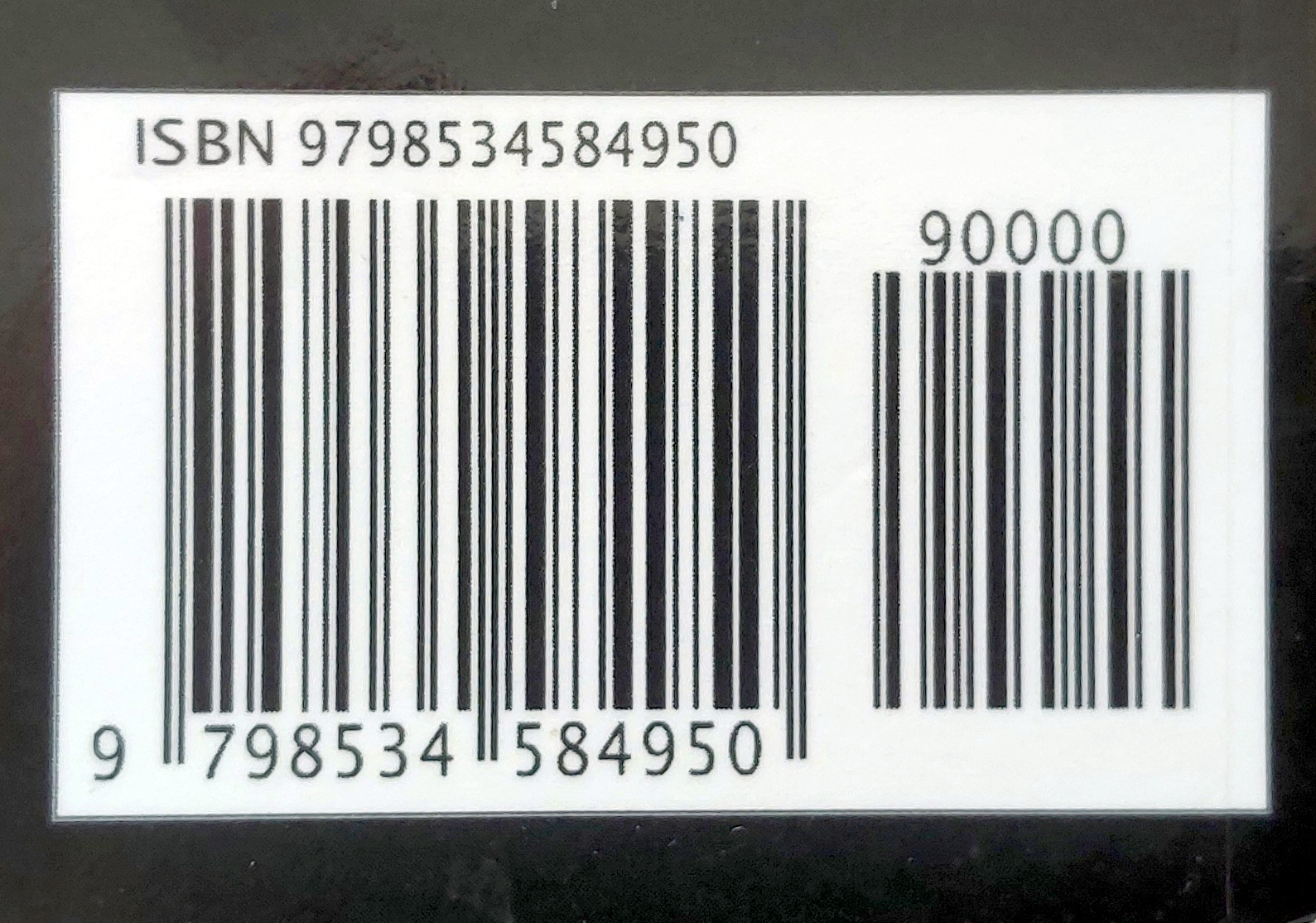
The ISBN panel with barcode from Bil Herd's Back Into The Storm.
You’ll only see one of these numbers on a book published since 1970.

Perhaps the most pertinent question then is just what are the books being scanned and destroyed? They’re almost universally described as “rare”, but is that accurate or sensationalist? It brings to mind a dusty library filled with priceless tomes hand-transcribed by monks which it would be a crime to destroy, but there’s something that explodes that vision in an instant.

If you read the reports of what’s happening, they are ordering books by ISBN number. That’s an international system for identifying books, which was only introduced in 1970. If they’re ordering a book by its ISBN, it’s no medieval illuminated manuscript.

So the books being scanned and destroyed are relatively new, but can they still be described as rare? In that case just like anything else mass-produced since 1970, how many survive depends on the size of the original print run and how valued they have been since. So a few of these books can be physically rare in the sense of being uncommon, but if they are next-to-valueless, it’s fairly obvious nobody has particularly cared about their survival up to now. It’s likely that any books printed since 1970 which are both rare and of value will have their future assured, so the AI industry is not committing the wanton destruction of culture the reports would like to suggest.

You Need To Know Just How Many Books Get Pulped Every Year

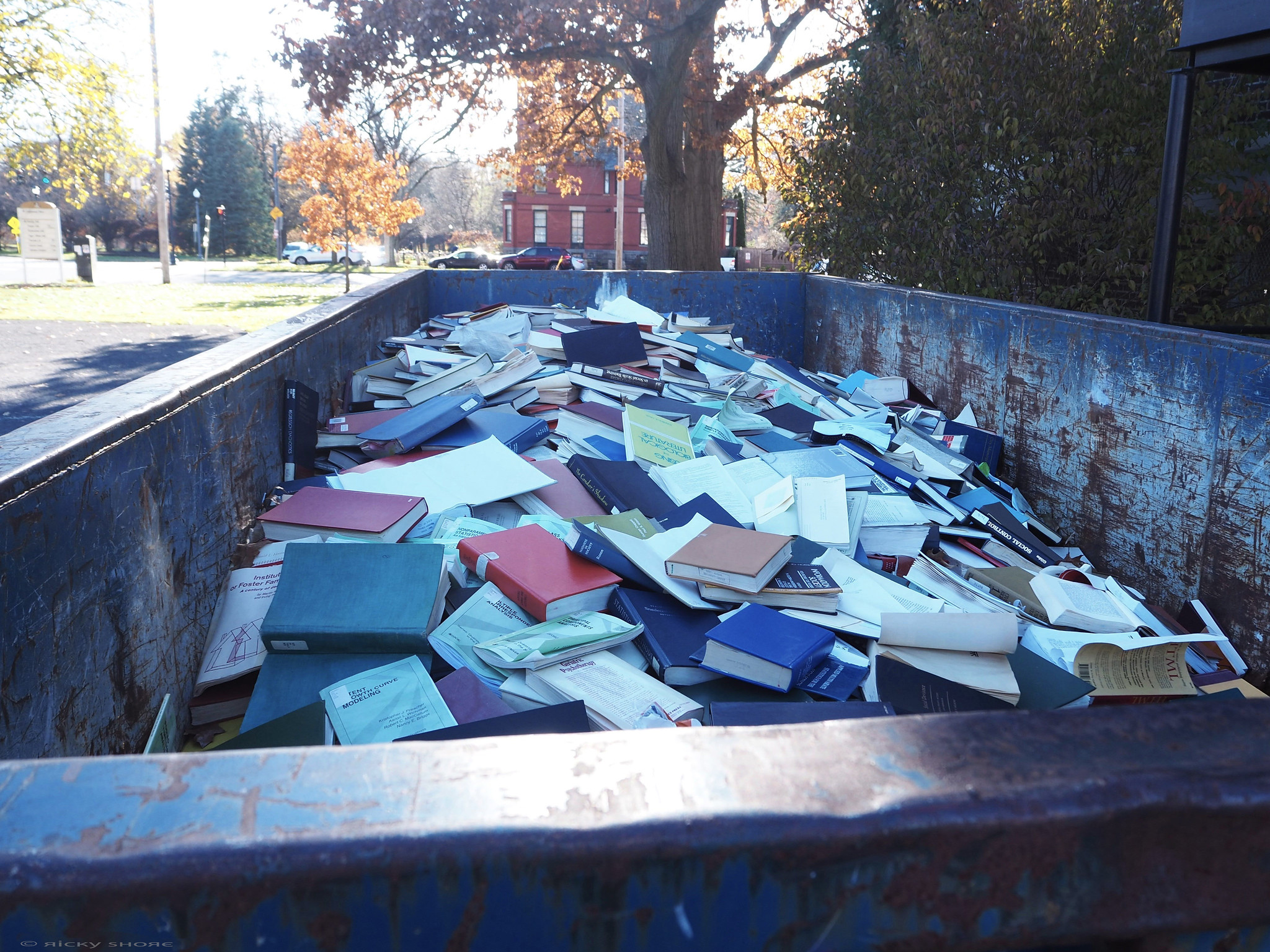
A dumpster full of books
People are often shocked when they find a dumpster full of books for recycling. Ricky Shore, CC BY-NC-ND 2.0.

I’m left feeling that a combination of the symbolism of destroying books along with a distaste for AI companies has inflated the status of these books well beyond their worth. If people truly had a care for old books they would be shocked to know how many are pulped each year by the paper recycling industry.

The publishing industry has been churning out mass-produced books for centuries now, so the world is awash with old books. Where do these newly-minted bibliophiles imagine they all go, to the Great Library In The Sky? I haven’t even touched yet upon the publishing industry, which pulps vast quantities of brand new unsold books every year. Where is the outrage, I ask?

We all love to dunk on AI companies, and Heaven knows, there are plenty of reasons to do so. Among all those reasons, sadly destructively digitising books is pretty low on the list. Please, ask the other questions, the ones they really don’t want to answer!

Header image: Yair Haklai, CC BY-SA 4.0.

Reading isn’t Rocket Science… But In This Case…

20 August 2026 at 04:00

While Hackaday’s bread and butter is, of course, hacks, we sometimes cover things that most of us are interested in that are probably out of reach for the typical hacker. Space, for example, is undeniably cool, even though your chances of putting yourself or even your own rover on the Moon aren’t very good at the moment (but, of course, give it time). If you are looking for something to put on your e-reader and you are also interested in space, save your money and get some downloadable books directly from NASA.

There’s something for everyone on the site. The site has four main categories: aeronautics, Hubble, science, and NASA history. Aeronautics has two volumes of “NASA’s Contributions to Aeronautics,” a book on the X-15, and a book about aviation pressure suits. Want to know more about the giant wind tunnel at Langley?

For the Hubble, you’ll find titles that have great images, of course, but also a book with an overview of the telescope or, if you prefer, about gravitational lensing.

The science titles go really deep with books on black holes, Landsat, the Cassini mission, and the Spitzer telescope. If you prefer history, there’s everything from a history of near-Earth object research to lessons from the Columbia tragedy for engineers, managers, and leaders. We were also interested in the book “Archaeology, Anthropology, and Interstellar Communication.”

The books are typically available in EPUB or PDF, and they are all free. Just what you need for your next plane trip or to round out your Calibre library.

We do love free books, we just can’t get enough.

Bitcoin as Digital Real Estate: An Excerpt from Leon Wankum’s Digital Real Estate

18 August 2026 at 13:55

Bitcoin Magazine

Bitcoin as Digital Real Estate: An Excerpt from Leon Wankum’s Digital Real Estate

Bitcoin can be understood through an analogy with real estate.16 Michael Saylor, Executive Chairman and Co-Founder of Strategy (formerly MicroStrategy), has compared investing in bitcoin to buying real estate in downtown Manhattan during the early stages of its development. As population, commerce, and cultural activity concentrated in the city, demand for limited land surged, dramatically increasing property values. Many of the world’s wealthiest families built their fortunes by owning scarce real estate. When something limited is in high demand, its value rises. As the saying commonly attributed to Mark Twain goes, “Buy land—they’re not making it anymore.”

Scarcity plays a central role in determining value, which is why real estate in densely populated areas is more expensive than in sparsely populated ones. Real estate has utility value—it can be used for living or production—but its price is largely driven by the limited supply of land in prime locations. There are only so many properties that can be built in Manhattan, London, Shanghai, Mumbai, Paris, Beijing, Tokyo, or Venice. What ultimately makes these locations valuable is what occurs on top of them: the people, the capital, the creativity, the energy. As a city flourishes, whether through rising population, growing business activity, or cultural relevance, demand for that scarce land surges.

The value of land does not rise in a vacuum; it rises because it captures an expanding layer of economic activity that cannot be easily replicated or relocated. This dynamic is further amplified by fiat monetary expansion, which channels ever more liquidity into real estate, raising nominal prices well above what utility and income-generating capacity alone would support. Market mechanisms such as speculation and the widespread expectation of rising prices reinforce this scarcity and deepen that perception.

Bitcoin operates under a similar logic. Just like prime real estate, it gains value as more people, capital, economic activity, and trust accumulate around it. At the same time, the economic network built on top of it—financial infrastructure, global adoption, liquidity, and digital connectivity—can continue expanding globally through digital networks without corresponding expansion of the underlying monetary base. Adoption on the internet occurs globally and continuously—much faster than in the physical world, where economic expansion is constrained by geography.

But there is a crucial difference. In real estate, prices are shaped by development potential, location-specific utility, and relative scarcity, which is frequently intensified by regulations and policy decisions. Government interventions such as tax incentives for investors, zoning laws, and restricted building permits can artificially limit supply, pushing prices higher. These dynamics are further amplified by speculative behavior and the widespread expectation of continued price increases, making scarcity appear more absolute than it is. Bitcoin’s scarcity, by contrast, is absolute: its supply is fixed at twenty-one million, beyond the reach of policy decisions or political interference. Real estate’s manufactured constraints highlight the importance of distinguishing between natural and engineered scarcity in asset evaluation.

Owning bitcoin is comparable to owning a plot in a growing, borderless economy not tied to any government or geography. As more people and businesses adopt bitcoin, the value of that digital “plot” increases. The difference is mobility—this digital plot is not tied to any location and can be transferred globally within minutes. Unlike land, bitcoin enables the rapid, low-friction transfer of value anywhere in the world, subject only to network conditions and liquidity constraints.

Holding bitcoin provides a new way to participate in the global economy. While bitcoin operates on a global network, its effects are local. By enabling individuals to hold and transfer value without centralized permission, it allows participation in economic systems that are less dependent on institutions able to impose restrictions, exclude participants, or change rules unilaterally.

Bitcoin’s accounting model reinforces the real estate comparison. In a traditional bank account, value is recorded as a balance held by an institution. In Bitcoin, ownership is defined by direct control over individually defined units—unspent transaction outputs (UTXOs)—recorded on the network.

You can think of each bitcoin as a square of land that remains under your control until it is spent. Once spent, that square disappears, and new squares are created for the recipient. Each UTXO can be independently transferred or combined in future transactions. The result is a continuously evolving map of property claims secured by cryptography rather than institutional authority.

The analogy has limits. Bitcoin differs from real estate used to generate income. It generates no operating cash flow and is best understood as a scarce digital asset whose value lies in absolute scarcity and optionality rather than income. But like real estate, bitcoin functions as a long-term savings vehicle and increasingly as collateral, capable of supporting credit formation and broader economic activity while absorbing monetary demand. This makes real estate a useful framework for understanding bitcoin’s evolving role within capital markets and monetary systems.

This post Bitcoin as Digital Real Estate: An Excerpt from Leon Wankum’s Digital Real Estate first appeared on Bitcoin Magazine and is written by Leon Wankum.

How an AirTag planted by a reporter led to a secret Amazon site where old books are cut apart and scanned

17 August 2026 at 20:54
The reporting tool in question. (BigStock Photo / hadrian)

Amazon is reportedly cutting the spines off old books and scanning the pages at a Las Vegas facility, presumably to train AI models on text that exists almost nowhere else.

The company won’t confirm that’s the reason. It gave us the same statement it provided to 404 Media, which broke the story: it “purchases books through commercial channels to help develop and improve the products and services our customers use.”

But what really got my attention (and professional admiration) was 404 Media’s means of discovering this was happening at all: reporter Emanuel Maiberg put an Apple AirTag in a rare book and watched where it went, like a biologist tracking an endangered salmon.

Maiberg, a co-founder of 404 Media, has been digging into this topic for a while. He reported in July that booksellers were seeing a massive surge in bulk orders from buyers who didn’t haggle.

According to Maiberg’s latest story, a seller informed him that they’d received an order for about 1,000 books through the marketplace Biblio, and agreed to slip an AirTag supplied by 404 Media into one of them. 404 Media granted the seller anonymity because the seller was worried the disclosure would hurt their business.

The book flew out of a California airport to Milwaukee, sat for two weeks in a distribution warehouse outside Kenosha, Wis., then went west by truck, making an overnight stop in Grand Junction, Colo., before arriving at an Amazon warehouse in Las Vegas known as LAS8.

As Maiberg recounts in the story, he was initially confused. LAS8 is largely a print-on-demand operation. It prints and ships books as customers order them, the opposite of destroying them.

But the AirTag put the book at the north end of the building, which Amazon employees who posted on a workers’ forum described as a separate operation with its own code: VGT3. Its logo, painted at the entrance, is a T. rex with an open book in its hands. Employees described a split operation: some workers cut books, others received them and scanned bar codes.

Booksellers told Maiberg the bulk orders never included the very rarest books, the ones old enough to predate ISBNs, suggesting that buyers were working methodically through the serial numbers assigned to every published book.

A history of reportorial tracking

This technique of journalistic investigation has actually been around for a while.

The Basel Action Network, a Seattle nonprofit, started planting GPS trackers inside old printers and monitors in 2014, dropping them at Goodwill locations and recyclers around the country to find out where America’s electronic waste actually ends up.

Nearly a third of the tracked devices were exported. Two old TVs dropped at Oregon recyclers traveled to a warehouse in south Seattle, then to the Port of Seattle, and to junkyards in Hong Kong. BAN’s trackers led to federal conspiracy charges against Total Reclaim, the Seattle recycler that had been handling that Oregon e-waste.

Over the years, others have adopted the same tactics. ABC News put trackers in plastic bags dropped at Walmart and Target recycling bins in 10 states, and Finland’s public broadcaster hid them in used clothing to trace where donated fast fashion actually ends up.

What’s different now is the hardware. BAN worked with MIT and used cellular trackers that needed a data plan. Maiberg used a $29 AirTag that reports its position by pinging any nearby iPhone.

What’s going on at VGT3?

Sure, it’s possible that the slicing and scanning at Amazon’s VGT3 could be for something other than training AI models. Amazon has digitized books for two decades, for example, going back to Search Inside the Book. But that program runs on files publishers submit themselves. It doesn’t require buying used copies on the open market and cutting the spines off.

The circumstantial evidence pointing to AI is strong.

The books are rare titles with almost no resale market, but that’s exactly what makes them valuable as training data. The text was never digitized, and books printed before the AI boom are free of the machine-generated writing that degrades AI models trained on it.

The bookseller who sold the tracked shipment put it plainly to Maiberg: the books have historical and sentimental value, and the AI companies destroying them don’t care about that.

Cutting the spine is faster for scanning. It’s also the specific act that made Anthropic’s version of this legal: in June 2025, a federal judge ruled that buying print books, stripping the bindings and scanning them was fair use, because the digital copy replaced an original that no longer existed.

The same ruling went against Anthropic on books it had downloaded from pirate sites, which is the claim the company has since settled for $1.5 billion.

As someone who has covered Amazon for a while, I should note that this could be some “peculiar” project that actually looks nothing like anything people are speculating about, which will only become clear “in the fullness of time,” to use some of the favorite phrases inside a company known for being “willing to be misunderstood for long periods of time.”

But in the meantime, it’s pretty fascinating to see everyday technology being used in a creative way to uncover something that otherwise might have never come to light.

❌
❌