
❌

Normal view

There are new articles available, click to refresh the page.
Before yesterdayMain stream

An Analog Synth For The Modern World

8 July 2026 at 19:00

We cover so many projects here at Hackaday that lead the author down a rabbit hole of technological investigation that distracts us from the task of bringing them to you. Such a project is polyUAnalog, a very modern take on an analogue synthesizer. If you are imagining a synth of old with modules and patch cables, think again. The modern way to do this is it seems to use an individual synthesizer chip for each voice, resulting in a very versatile instrument indeed.

The integrated circuit in question is the AS3397, which when coupled on a PCB with a Raspberry Pi Pico makes for a self-contained single-voice analog synth. It’s controlled via I2C from a conductor board for which frustratingly the README doesn’t give a processor, but we think may be powered by another Pi Pico. This board does the job of taking MIDI and other controls, and farming them out tot he individual voices. The prototype has ten, but it can support many more.

It’s the work of a pair of researchers from the University of Angers in France, and we’re told it’s a side project from their work in the field of spectroscopy. There’s a video about it which we’ve placed below the break, and they’ve also written a paper about it.
Bite Into Strange Sounds With NOISFERATU

30 June 2026 at 11:30

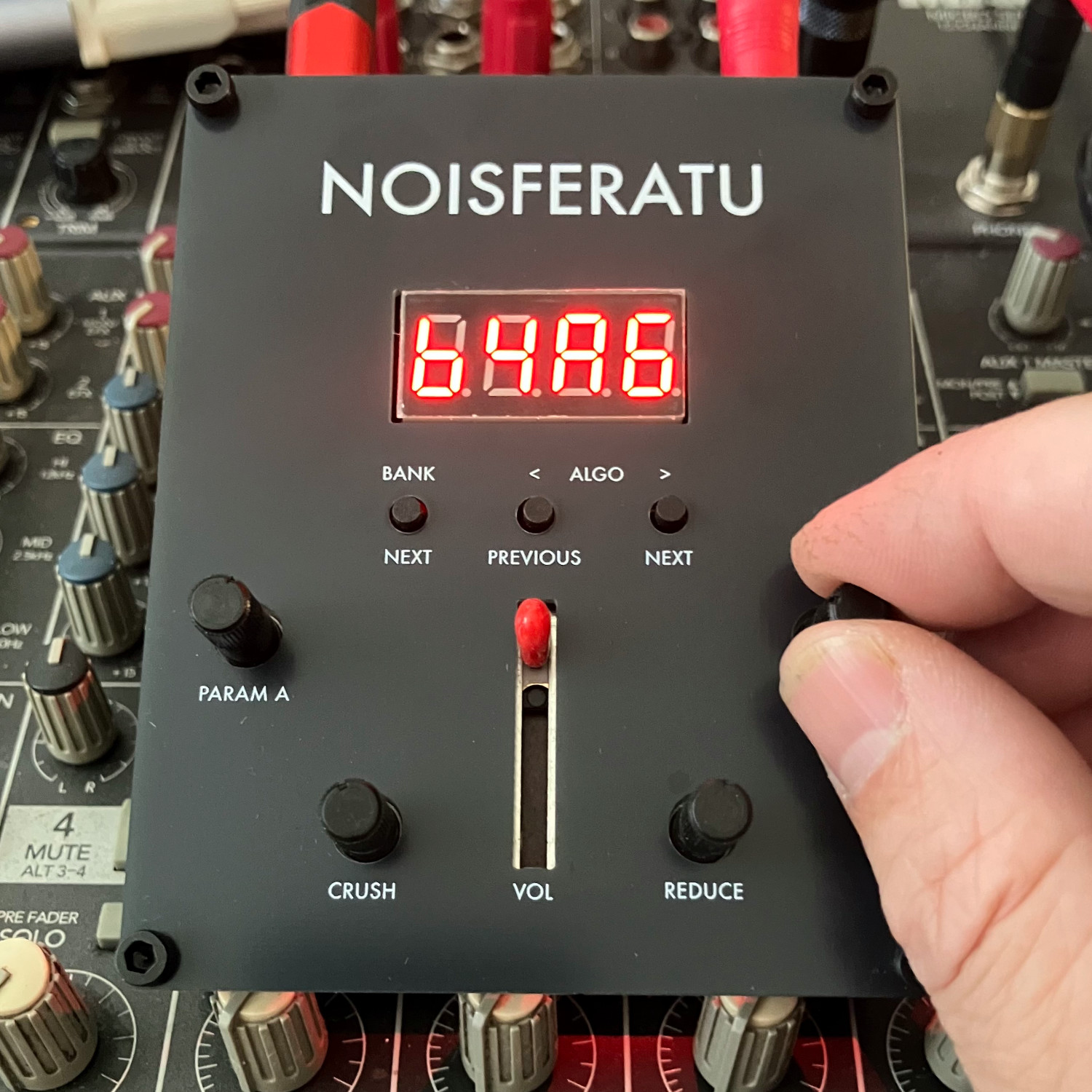
The NOISFERATU is an open source generative textural sound synthesizer, or as creator [Robert Heel] puts it, β€œa sound designer’s dream and audiophile’s worst nightmare”.

NOISFERATU offers 45 different sound algorithms grouped into five banks to produce a dazzling range of evolving soundscapes and patterns that resist repetition or settling, each influenced and shaped β€” the word controlled does not quite apply β€” by a volume slider and a few hardware knobs.

So what does it actually sound like? Check out the video embedded below to give it a listen, it’s pretty trippy.

Hardware-wise NOISFERATU is centered around the Seeed Studio XIAO SAMD21 microcontroller board, takes power over USB-C, and has a headphone jack for sound output. We love the artwork on the dual-sided front panel, too.

DIY synthesizers based on logic chips have a long and proud history, and seeing the different directions people can go by incorporating microcontrollers is always a delight.

If NOISFERATU’s experimental sound and noise sounds up your alley, the design files and code on GitHub have everything one should need to build one. Kits are for sale direct from the designer, as well.

❌
❌