The commander and pilot of NASA's Artemis II mission have gained a new distinction five months after splashing down from the Moon: They're not fully retiring from the space agency.
Reid Wiseman and Victor Glover are the first astronauts to join NASA's emeritus program, enabling them to continue to support the work being done at Johnson Space Center in Houston. They will remain available to train and mentor the current workforce while still being able to pursue employment and opportunities outside of NASA.
"I have asked NASA ... to not use the term 'retire' as much, but technically emeritus is a retirement program," Glover told collectSPACE.com on Wednesday. "It's something we have typically done for scientists when they have groundbreaking research, and they want to go back to academia to teach or to research and publish."
Sixty years after television audiences first tuned in to see the voyages of the Starship Enterprise, an astronaut on board the International Space Station has paid tribute to Star Trek by flying the badge of the franchise's latest fictional captain.
Expedition 75 flight engineer Sophie Adenot with European Space Agency (ESA) donned the Delta badge originally worn by actor Anson Mount for a video recorded from aboard the space station. Mount portrays Christoper Pike in the Paramount+ streaming series Star Trek: Strange New Worlds. Paramount and ESA both released the clip on their Instagram feeds.
"For 60 years, Star Trek has brought us stories of friendship and exploration. I'm wearing Captain Pike's badge aboard the ISS in celebration of continuing the real world work of science and exploration," said Adenot. "For me, exploration and science are about curiosity and cooperation daring to go a little farther together, learning from what we discover and build, and turning that knowledge into a better future for everyone."
The first Japanese citizen to launch into space, Toyohiro Akiyama was also the first commercially sponsored cosmonaut and the world's first journalist to file reports while on a spaceflight.
Akiyama, 84, died last Wednesday, August 26, of lower gastrointestinal bleeding, news agencies in Japan reported. A funeral was held with his close relatives in attendance.
As a correspondent for the Tokyo Broadcasting System (TBS), Akiyama was chosen out of his 162 fellow employees who applied to fly to space in celebration of the network's 40th anniversary. He trained at the Gagarin Cosmonaut Training Center in Star City, located outside of Moscow, and was assigned to the Soyuz TM-11 crew.
Last time we found out the idea of space stations is surprisingly old. By the 1950s, everyone knew we’d be working in beautiful space stations that rotated like a wheel to give us the illusion of gravity. Of course, that didn’t happen. But we did get some practical space stations, even before the current crop. The road to get there, though, was predictably bumpy.
Convair: From TASSEL to MARS
Convair had been studying multi-person orbital stations under Krafft Ehricke since the late 1950s. One result was TASSEL, an acronym for the Three Astronaut Space System Experimental Laboratory. Proposed in 1960, TASSEL was a three-man laboratory intended for an Atlas-Centaur launch into a roughly 200-nautical-mile orbit and missions lasting two or three weeks.
Around the same time, the Air Force asked contractors for proposals for a Military Test Space Station, or MTSS. Convair was one of five companies selected for the study in 1960. The surviving record suggests that Convair’s TASSEL work fed directly into its MTSS proposal.
Then Convair did something unusual for an era overflowing with beautiful paintings of spacecraft that never existed: they built theirs. Well, sort of.
During late 1960 and early 1961, the company constructed a full-scale ground mockup called the Manned Astronomical Research Station, or MARS. The station itself was about ten feet in diameter and fourteen feet high, with two floors for working, cooking, housekeeping, and sanitary facilities. A Mercury-like reentry capsule beneath it brought the whole assembly to about 28 feet tall. You can see a contemporary video about the program below. There’s also a cache of photos and a post by [The Space Review] explaining it all.
MARS obviously wasn’t going to orbit, but that wasn’t the point. Engineers could use it to work on the less photogenic parts of putting people in orbit: life support, oxygen consumption, water regeneration, contaminant monitoring, controls, displays, and simply discovering whether people and equipment actually fit where the drawings said they would. Crews later spent as long as 30 hours inside the mockup.
Exactly where MARS fits among Convair’s various proposals is still being pieced together. Archival evidence indicates that it grew out of TASSEL and closely overlapped Convair’s submission for the Air Force MTSS program. Photographs in the San Diego Air and Space Museum archive are even identified as “MTSS/MARS.” Whatever name was on the proposal of the week, by 1961 Convair had progressed from drawing space stations to building a high-fidelity example on the ground.
Olympus and MOL
Olympus was nearly 140,000 pounds, 150 feet wide, and each arm provided 35,000 cubic feet (NASA).
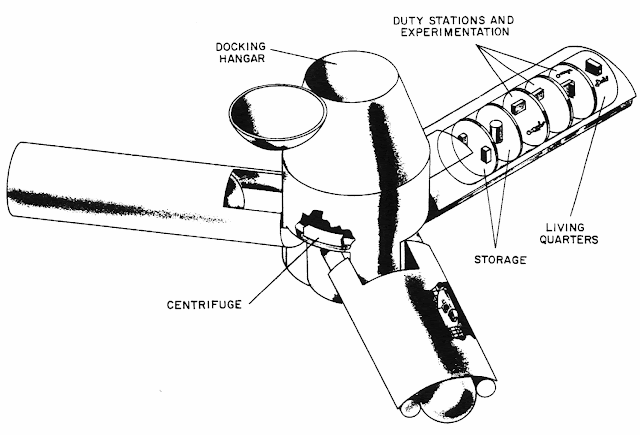
NASA wasn’t far behind. In 1962, Edward Olling at the Manned Spacecraft Center proposed Project Olympus. It would have been an 18-person station intended for launch around 1966 or 1967. It wasn’t the classic doughnut. Instead, three long arms extended from a large central hub, and rotation would provide different artificial-gravity levels at different distances from the center. The station would orbit about 300 nautical miles above Earth.
This is especially interesting because Olympus wasn’t a far-future colony study. It was being considered while Mercury was still flying. Then President Kennedy gave NASA a somewhat more pressing assignment involving the Moon.
Olympus joined the large pile of spacecraft that looked great in presentations.
The U.S. Air Force had another station that got considerably closer to hardware: the Manned Orbiting Laboratory, or MOL. Approved in 1965, MOL would have put two military astronauts into a polar-orbiting station attached to a modified Gemini spacecraft (Gemini B). Its actual classified purpose was high-resolution reconnaissance. You can see some silent footage of some of the hardware in the video below.
They selected astronauts. They built hardware. They modified a Gemini capsule with the unnerving idea of putting a hatch through its heat shield so the crew could crawl into the laboratory behind it. MOL was canceled in 1969 without a crewed station ever flying.
Meanwhile, docking — one of the basic tricks required to make stations useful — was becoming real.
Dock of the Bay
On January 16, 1969, Soyuz 4 and Soyuz 5 docked in orbit. There was no pressurized tunnel connecting them. So Yevgeny Khrunov and Aleksei Yeliseyev put on spacesuits, climbed outside Soyuz 5, traveled across the docked spacecraft, and climbed into Soyuz 4. Two spacecraft had effectively become a tiny space station, but changing rooms required going outside.
Apollo 9 flew less than two months later and provides an interesting parallel. The command module and lunar module could dock, and crews could normally transfer internally. But what if the tunnel couldn’t be used? NASA planned to demonstrate a contingency EVA transfer from the lunar module to the command module.
Rusty Schweickart was supposed to perform the exercise, but space sickness caused NASA to shorten his EVA. He tested the lunar EVA suit and portable life-support backpack from the LM porch while Dave Scott partially exited the command module, but the complete external transfer was never performed.
Salyut and Almaz
On April 19, 1971, the Soviet Union launched Salyut 1, the first actual space station. The first crew failed to dock successfully. The second crew, Soyuz 11, spent more than three weeks aboard, but all three cosmonauts died during reentry when their Soyuz depressurized. There is some video from Salyut 1, but no audio.
The Salyut name also concealed a second program. Some of the stations were civilian Salyuts, while others were military Almaz reconnaissance stations similar in purpose to MOL. Salyut 2, 3, and 5 belonged to the Almaz line, although Salyut 2 failed before a crew could arrive.
Later Salyut stations gained a second docking port. That was a huge improvement because Progress cargo ships could bring supplies and fuel while a Soyuz remained attached as the crew’s ride home. Long-duration spaceflight was becoming practical rather than heroic improvisation. Of course, none of them rotated.
Skylab
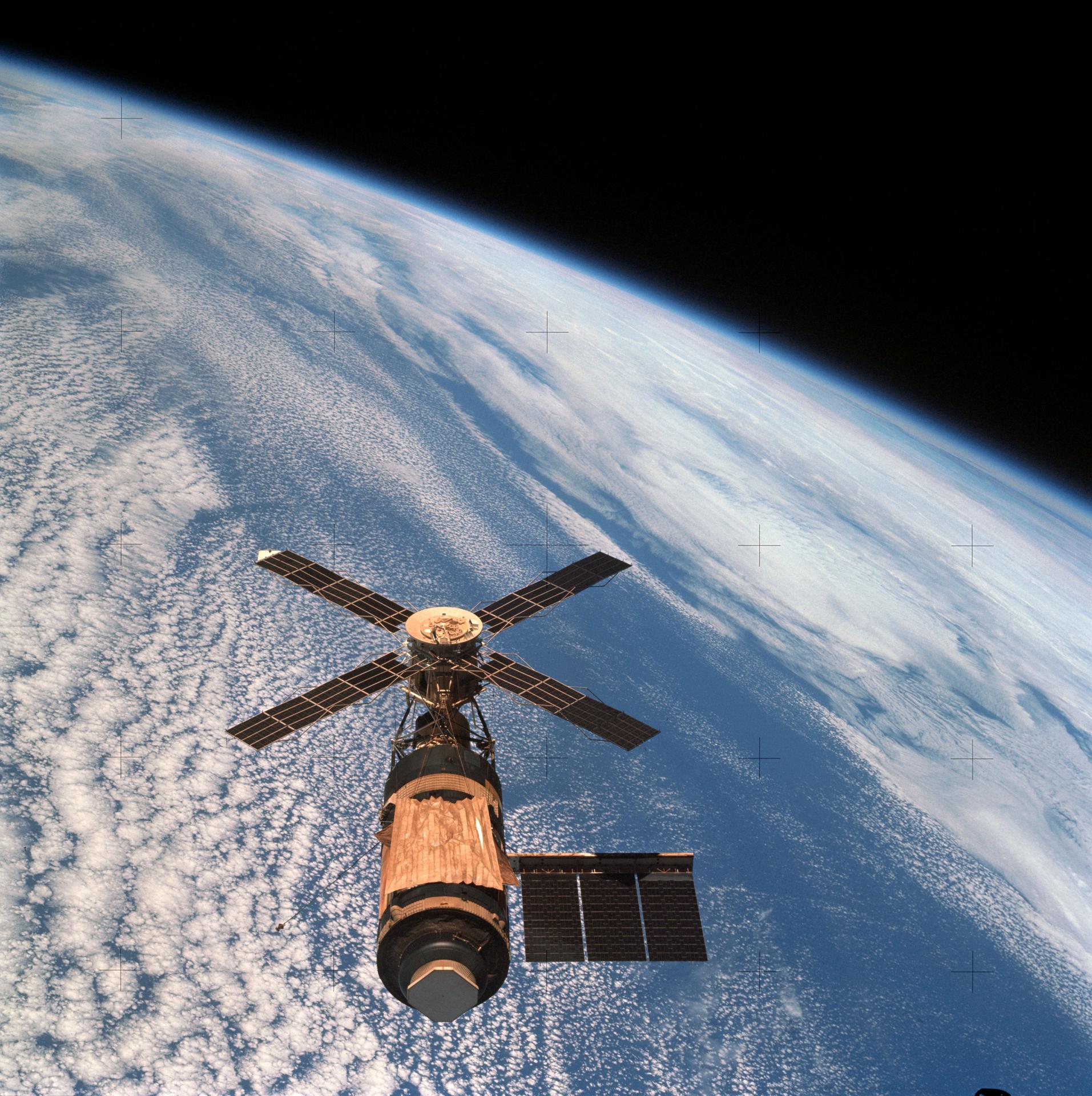
Skylab as the last crew says goodbye (NASA).
The United States took a different route. Skylab was essentially an enormous converted Saturn V upper stage. Launched in 1973, it gave its crews something previous spacecraft had lacked: room.
Three crews occupied Skylab, staying as long as 84 days. They conducted solar astronomy, Earth observations, medical studies, and experiments designed to determine what happens when human beings spend months rather than days in weightlessness. After all, why build a giant rotating station if people could simply learn to live without gravity?
Then again, we learned that long-term microgravity isn’t free. Bones, muscles, cardiovascular systems, eyes, and assorted other bits of the human body complain when they don’t have proper gravity. Still, a nonrotating station was far easier to build, so rotating wheels stayed on the drawing board.
Freedom Isn’t Free
By the 1980s, NASA was ready to try again. In his 1984 State of the Union address, President Ronald Reagan directed NASA to build a permanently occupied space station within a decade. What eventually became known as Space Station Freedom was supposed to be a large modular facility assembled by the Space Shuttle.
It would support research, Earth observation, satellite servicing, and eventually serve as a staging point for missions beyond Earth orbit.
Freedom went through redesign after redesign as costs and requirements fought each other. It did not rotate. While NASA redesigned Freedom, the Soviets quietly launched something considerably more important.
Peace In Orbit
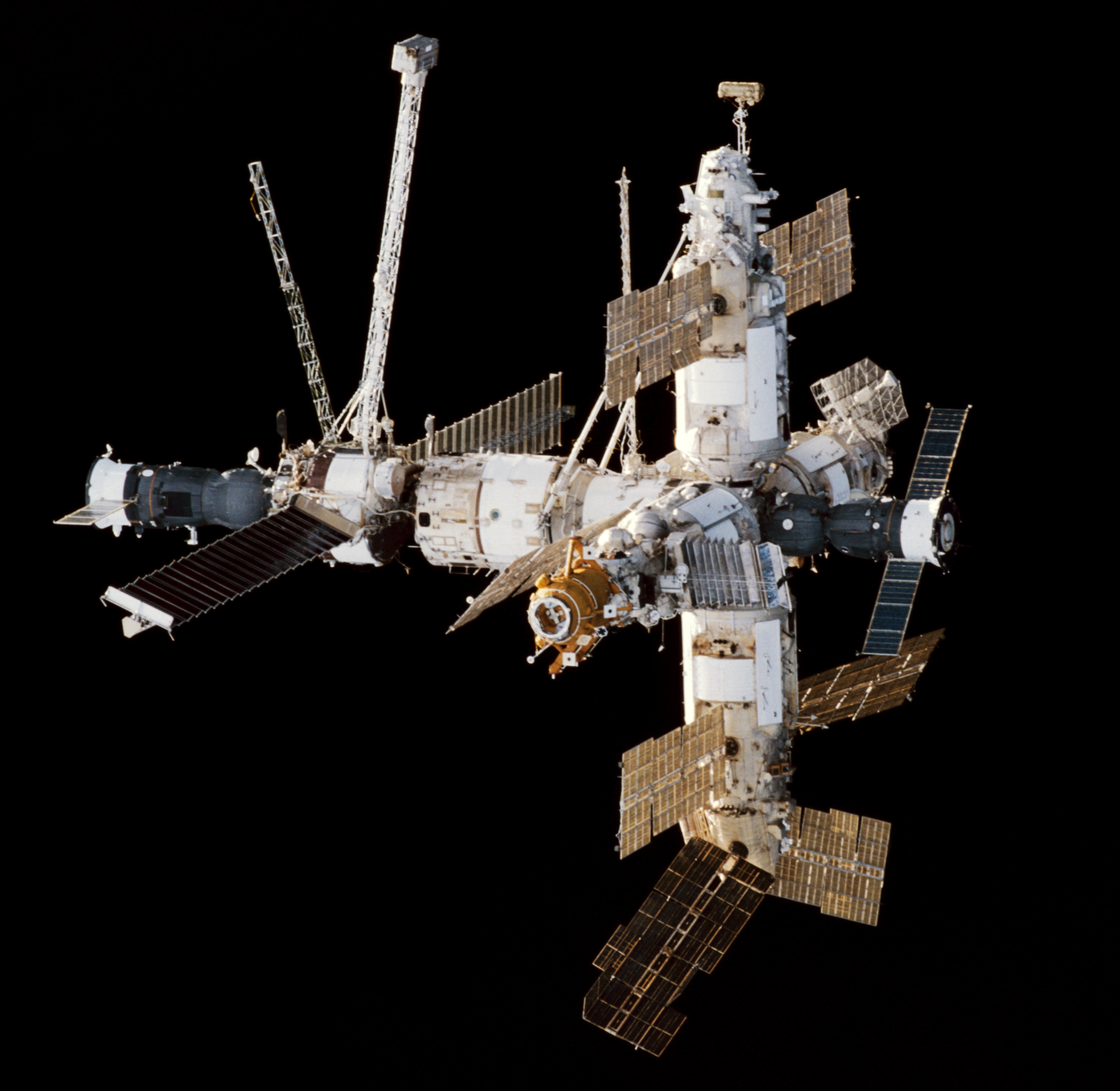
Mir seen from STS-89 (NASA).
On February 20, 1986, the Soviet Union launched the core module of Mir.
The name means “peace,” although the Russian word can also mean “world.” Unlike the earlier Salyuts, Mir was designed from the beginning as a modular station. Additional laboratory and equipment modules arrived over the years and docked around its core.
It looked nothing like Noordung’s wheel. It looked more like somebody had been assembling an enormous machine in a garage and kept finding useful places to bolt things on.
Mir represented decades of incremental Soviet experience: Soyuz, docking, Salyut, Progress, long-duration crews, orbital repairs, and modular construction. It demonstrated that a space station could become not merely a spacecraft but a place — one that crews could maintain, modify, repair, and inhabit for months at a time.
Where’s My Wheel?
That may be the most surprising thing about the history of space stations. The rotating station wasn’t some goofy 1950s science-fiction invention. Serious engineers were proposing artificial gravity before anyone had launched anything into orbit. Oberth discussed rotating stations in 1923. Noordung drew a remarkably complete wheel station in 1929. Von Braun made the concept famous in the 1950s. NASA seriously studied rotating stations in the 1960s. The physics works.
We’ve simply never needed artificial gravity badly enough to pay the cost.
If you can tolerate microgravity, a station can be a collection of pressure vessels, trusses, solar arrays, and docking ports. If you insist on one g at a comfortable rotation rate, suddenly you are contemplating a structure hundreds or perhaps thousands of meters across.
Still, Edward Everett Hale put people aboard an artificial moon in 1869. Noordung put them aboard a rotating wheel in 1929. Kubrick had airline passengers walking around one in 1968. So after more than a century and a half of talking about space stations, I have only one question: When do I finally get my rotating space station?
People have lived in space stations for decades now, but something is wrong with them. Where are the big rotating wheels? You know the ones. They show up in old paintings of the future and, perhaps most memorably, in 2001: A Space Odyssey. Spin a great wheel in space, and people can stroll around inside with something that feels suspiciously like gravity. It seems like an obvious idea.
It is also an old idea. Much older than actual spaceflight, in fact. But to find the beginning of the space station, we have to go back to a time when powered aircraft were still several decades in the future.
A Moon Made of Bricks
In 1869, Edward Everett Hale published The Brick Moon in The Atlantic Monthly. The moon in question wasn’t natural. Hale imagined building a 200-foot-diameter sphere made from bricks and putting it into orbit as a navigation aid. Sailors could sight it and use its known orbit to determine their longitude. There was only one small problem: the thing was accidentally launched with people aboard.
That makes The Brick Moon generally regarded as not only the first fictional artificial satellite, but also the first fictional space station. Hale followed it in 1870 with Life on the Brick Moon, describing how the accidental colonists got along up there.
Hale didn’t have rockets. He proposed flinging the thing into the sky with giant flywheels, but, then again, it was 1869, so we’re inclined to cut him some slack. As the 19th century turned into the 20th, however, people started doing the math.
Konstantin Tsiolkovsky is best remembered for putting rocket flight on a sound theoretical footing. The Russian schoolteacher wrote extensively about orbital flight and space habitation, envisioning people living in orbit long before anyone had demonstrated that a liquid-fueled rocket actually worked. His ideas included rotating habitats to provide artificial gravity.
Hermann Oberth’s 1923 book Die Rakete zu den Planetenräumen — The Rocket into Planetary Space — Oberth went beyond fiction and seriously considered a permanently inhabited station. He envisioned it being periodically supplied by smaller rockets, serving as an observation and communications platform, and even acting as a jumping-off point for trips farther into space. He also suggested spinning the station to give the crew artificial gravity.
Enter The Wheel
Noordung’s space station concept from his 1929 book.
But the space station that looks like the space station in your head probably comes from a different Hermann. Herman Potočnik was an Austro-Hungarian army officer and engineer who wrote under the name Hermann Noordung. In 1929, he published Das Problem der Befahrung des Weltraums, translated by NASA many years later as The Problem of Space Travel: The Rocket Motor.
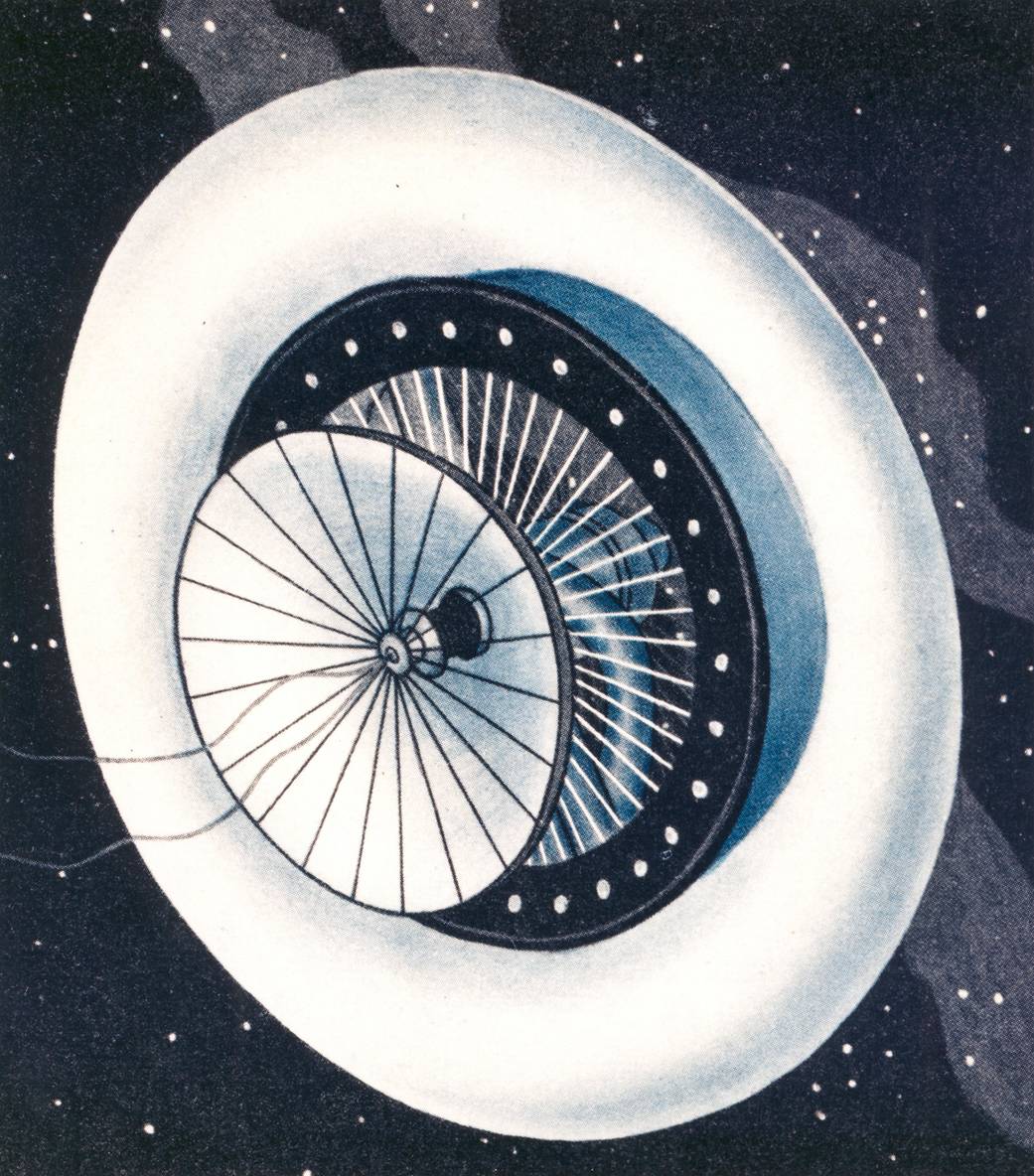
Noordung didn’t merely say, “We should have a space station.” He drew one. His station consisted of several components, but the memorable one was the Wohnrad — literally the habitation wheel. Living quarters occupied a rotating ring connected to a central hub. Rotation provided artificial gravity, while other portions of the complex could remain weightless. He considered power, communications, observing Earth, astronomy, docking, and the practical business of living in orbit. NASA calls his work one of the first detailed technical designs for a space station.
If you have seen Wernher von Braun’s famous wheel station from the 1950s, you may notice something. Von Braun certainly knew Noordung’s work — he had cited it years earlier — and the family resemblance between Noordung’s 1929 Wohnrad and the wheel station that von Braun and Willy Ley presented to American readers in Collier’s in 1952 is hard to miss. The only place we have found the articles is the reprints in Horizons, by the AIAA (start with page 46).
Whatever the exact family tree, von Braun was the man who put the wheel-shaped station into American popular culture. In 1952 he described a 250-foot-class rotating station in Collier’s, accompanied by some gorgeous Chesley Bonestell artwork. A few years later he took the idea to television with Walt Disney.
If you’ve never seen these, they are worth your time. Disney’s 1955 Man in Space and Man and the Moon let von Braun explain a remarkably detailed vision of rockets, orbital stations, and trips to the Moon to a mass television audience. A generation of kids grew up expecting this stuff. What happened?
Gravity, More Or Less
The attraction of the wheel is simple. You can’t really make gravity, at least not without bringing along a planet-sized lump of mass, but acceleration will do nicely. Stand on the inside of a rotating ring, and the floor keeps accelerating you toward the axis. In your rotating frame, it feels as though something is pushing you outward against the floor.
The acceleration is a=ω2r where (r) is the radius and (ω) is the angular velocity. Sadly, the numbers explain part of the problem.
If you want one Earth gravity at the floor, you need to either spin fast or have a large ring. For example, at 1 RPM the ring has to be 1.79 km in diameter. Speed up to 2 RPM, and you can get away with 447 meters. At 4 RPM, you are down to 112 meters.
Seems like you could just keep going faster, but there’s a problem. Four RPM doesn’t sound very fast until you are inside the thing moving your head around.
Humans can adapt to rotation, but increasing the speed makes Coriolis effects increasingly noticeable. Move your head, climb a ladder toward the hub, throw something, or even walk spinward instead of anti-spinward, and the results aren’t quite what your inner ear expects. NASA artificial-gravity studies have often used approximately four RPM as an important practical region for human tolerance, although this isn’t a hard physical limit and training matters.
There’s also a gravity gradient. Your feet are farther from the axis than your head, so they weigh slightly more. Make the radius large enough, and you won’t notice. Make the station small enough, and things get strange quickly. So bigger is better except when it comes to cost, of course.
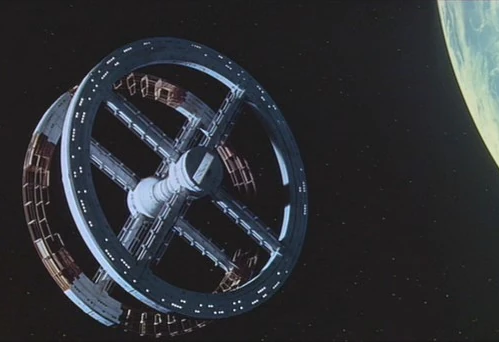
Space Station V, still under construction. Note the window placement.
There is another oddity that movies sometimes get wrong. The outside circumference of the wheel is the floor. “Down” is away from the hub. Imagine a tire in space. You aren’t walking around on one of the flat sidewalls with the axle beside you. You are walking around the inside of the tread. So when a movie gives you a nice conventional room with a picture window on what looks like the outer wall, stop and think about where gravity ought to be pointing. Depending on the geometry, that window would probably be underfoot.
Stanley Kubrick got this wonderfully right in 2001: A Space Odyssey. Both Space Station V and the rotating centrifuge aboard Discovery make “down” follow the rotation. The famous jogging sequence works precisely because the circular wall of the set becomes the floor as the camera watches.
Next Time
Next time, I’ll look at early attempts to make a space station ranging from TASSEL, MTSS, and MARS to real Soviet and U.S. stations that had varying degrees of success. Spoiler alert: none of them are going to rotate for gravity.
Of course, people didn’t just imagine space stations. They also imagined moon bases, both fictional and actual.

 Login
Login