Raycast's new iPhone keyboard combines swipe typing, AI writing tools, voice dictation, GIF search, and text shortcuts. You can now access its productivity features without switching keyboards.
The project started as an attempt to produce a set of C64 keycaps for an Ajazz 75% keyboard layout, but [Levente] kept pushing until it developed into a universal set. The keys have C64 legends, plain legends, or blank, and work for ANSI boards from 60% to full size. There are a few ways they can be printed. — you can do two-color printing with an FDM machine, or you can print the caps alone and fill the legends with paint, either in FDM or resin.
As a part of this work, [Levente] had to obviously create the glyphs to print upon all the keycaps. He thus decided to release that as the C64 keyboard font, in fact. It’s available in TTF and OTF formats, and you can preview the font in your browser, if so desired. It includes the function key labels, the 63 PETSCII graphic font legends, and various symbols, punctuation, and selected accented letters, too.
We’ve seen lots of vintage C64 parts recreated from scratch. It’s been at the point for a while where you can build a new machine with what’s available off the shelf. They said Amiga would never die, but it’s the earlier Commodore that really lives on today…
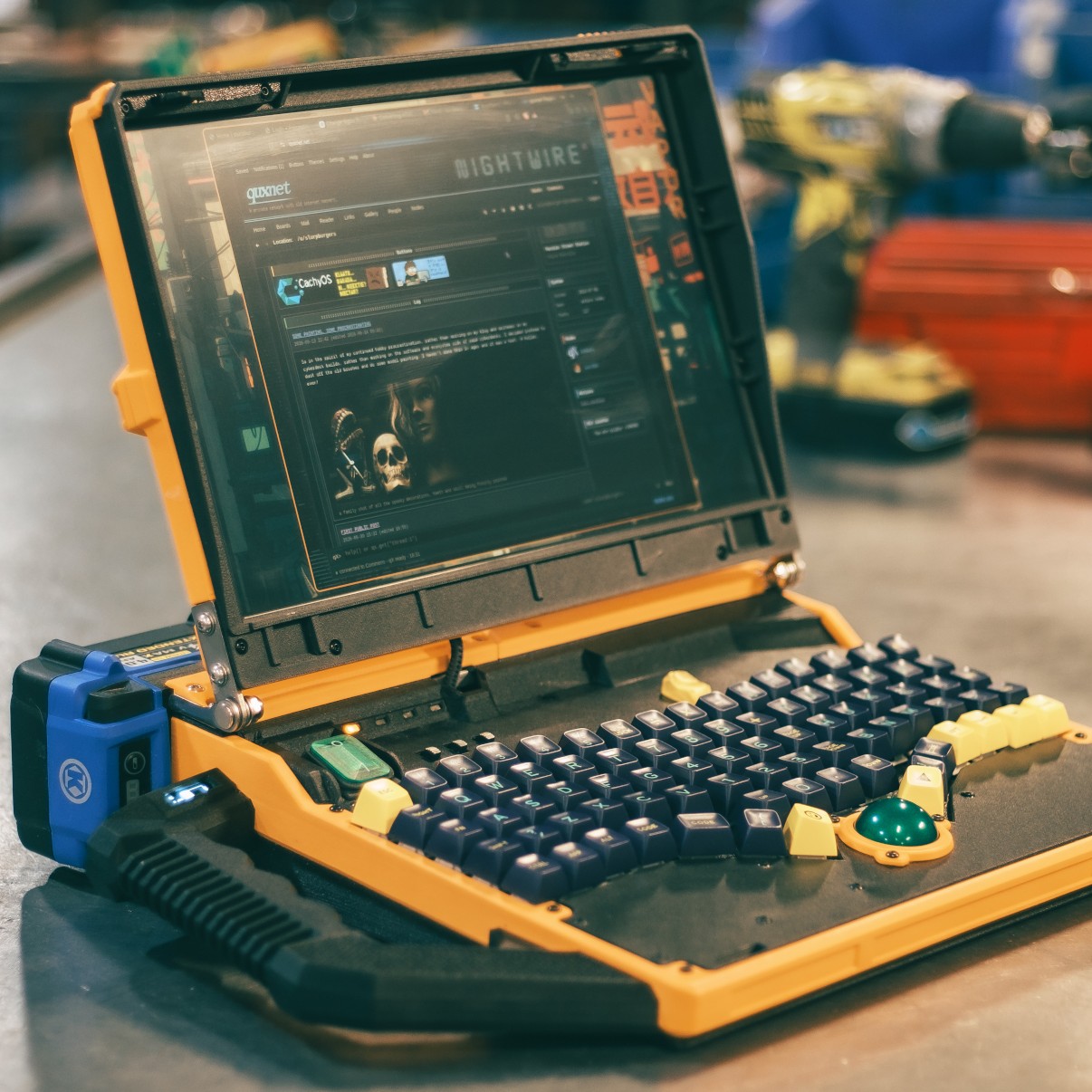
There are two kinds of cyberdeck: the kind someone makes on a lark and operates purely on ‘rule of cool’, and the kind designed to do practical work. The Slurptop by [Slurpburgers] is decidedly in the second category — but that doesn’t mean it lacks for coolness. What’s cooler than a power-tool battery?
Don’t you just want to slurp that up?
That last feature might make this closer to the Neuromancer definition of cyberdeck than most featured on these pages. You still can’t jack it into your cortex, but it does have the ‘assemble from off the shelf components at need’ vibe of the original concept. It also means there should be plenty of battery power to keep working with the power-hungry x86-based GMKtec MiniPC that runs this thing.
If the battery gets low, which it will after about 4 hours or so, swapping is easy — but not hot swapping. Luckily [Slurpburgers] grabbed a module meant for Uninterruptible Power Supplies to swap over to wall current, so this device can be plugged in whenever necessary. Alas, charging must be done on the factory charger, not the device, but that swapping really adds to the ‘future of the past’ cyberpunk flare of the device in our opinion.
Speaking of the past, why did we ever stop putting mechanical keyboards and trackballs onto laptops? The inputs on this thing are glorious, and this writer’s hands envy the ergonomic curve of it while typing away on an old HP Pavilion’s sad and squishy low-profile keys. The trackball itself is a minor hack, being made using the guts of an old gaming mouse. Not everyone will approve of every design choice here, but that’s the point of doing it yourself — so like [Slurpburger], you can have it your way.
Text messaging has been around on cellular networks en masse for around three decades now. It’s so common that it’s difficult to remember a time without it. Its two-way quick messaging is incredibly useful, but for even simpler communications there’s a one-way system that predates it. Pagers are able to receive simple messages, but outside of hospitals are rarely used nowadays. Eventually some added in two-way communications like this Motorola T900, but they’re still mostly obsolete. That’s why [zindustries87] converted it to operate on the Meshtastic network instead.
To get this pager working, a lot of reverse engineering was needed. There is essentially no documentation on the chips in these devices, so the screen and keyboard both were reverse-engineered to work with other hardware. In this case, [zindustries87] found space for a Heltec V4 with an ESP32-S3, a popular Meshtastic node with a small form factor. Some programming was needed to get everything communicating together, but from the looks of things it seems to have basic functionality.
[zindustries87] points out that this is a prototype, and didn’t know going in if the keyboard and screen could be brought back to life, or if the other hardware would fit in the case. But with it working on this level, they plan to add a number of other features in and possibly build a drop-in PCB replacement for these devices. They were once fairly popular so there are plenty around, and they’re a good form factor for a dedicated Meshtastic device that doesn’t need a smartphone to work. The only other ways of bringing pagers back to life involve bootstrapping an entire pager network, and Meshtastic is a bit more useful than that now.

 Login