ETH Zurich's experimental implant uses continuous glucose monitor readings to lower blood sugar without insulin. See how it works and what mouse tests found.
ETH Zurich's experimental implant uses continuous glucose monitor readings to lower blood sugar without insulin. See how it works and what mouse tests found.
Preparations for Next Moonwalk Simulations Underway (and Underwater)
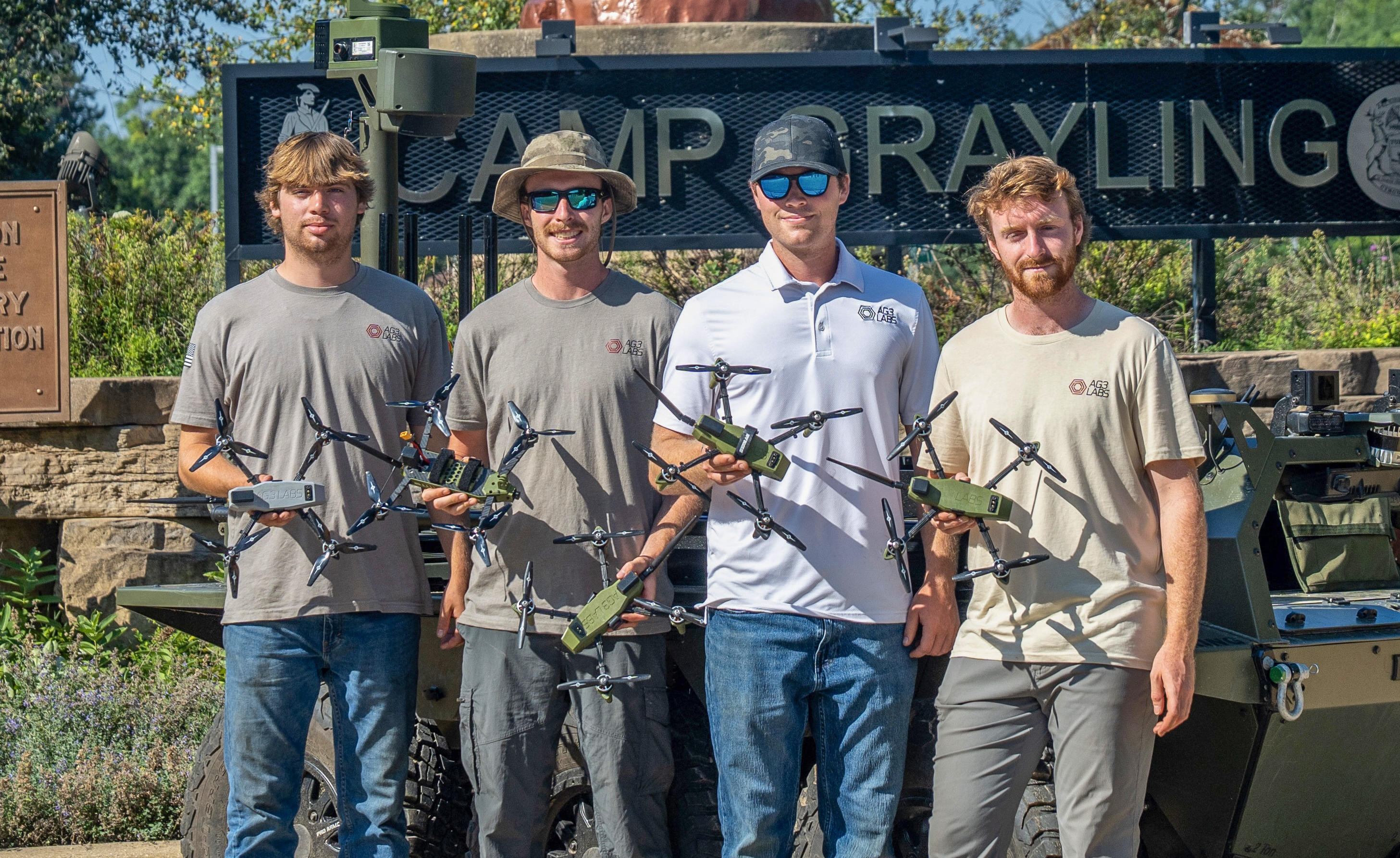
Four co-founders of AG3 Labs –from left Matt Atkinson, Gavin Gardner, Ryan Atkinson, and Gryson Gardner – show off the military training drones their company builds at a U.S. Army event at Camp Grayling in Michigan. As a student, Gavin was on a Michigan State team twice selected for participation in NASA’s University Student Research Challenge. His NASA experience served as a foundation for the creation of AG3.
AG3 Labs
Five years ago, Gavin Gardner was a Michigan State University engineering student researching next-generation drone technology as part of a NASA grant. Garder expected the research to be demanding – but he was surprised that navigating the financial side of the work presented an even greater challenge.
Although Gardner was used to leading fellow students in a lab setting, he and his team were completely new to things like creating budgets, handling large sums of money, and promoting their work for crowdfunding.
That’s why demonstrating both engineering and entrepreneurship skills are major tentpoles of NASA’s University Student Research Challenge (USRC), an initiative that provides grants to teams of college students interested in helping the agency realize its aeronautical research goals.
“Half the battle is building your product,” Gardner said recently. “The other half is selling the product in a way that everyone else can understand what you’re doing and not talking in nerdy, engineering ways.”
We hope that every team that participates in the program sees, like Gavin, how they can grow technically, entrepreneurially, and use the opportunity as a launchpad for their own innovative careers.
STEVEN HOLZ
NASA USRC Manager
Gardner and his Michigan State USRC alumni teammates are still using those lessons today, as aerospace developers. In 2024, they founded their own company, AG3 Labs, which specializes in drones for military training exercises.
“I don’t think I would discredit our technical expertise in getting us to where we are today, but I know that USRC was a booster that really amplified our trajectory at such a young age,” Gardner said.
NASA USRC manager Steven Holz said Gardner’s experience shows what students can accomplish when they receive both a grant and guidance – enabling a future workforce and contributing to the aviation industry.
“We are proud to see the success of USRC alumni,” Holz said. “We hope that every team that participates in the program sees, like Gavin, how they can grow technically, entrepreneurially, and use the opportunity as a launchpad for their own innovative careers.”
Research path
Gardner’s path to running his own company began with a middle school age trip to Space Camp, where he began realizing that he wanted to be an engineer.
The engineering bug also bit his brother, Gryson Gardner, and the two of them would often be found in their Michigan garage tinkering with various machinery, including drones and electronic kits.
When Gardner arrived at Michigan State, he looked for extracurricular groups and found one dedicated to the increasingly popular hobby of drones. He gained hands-on, practical experience in how drones are made and operated.
In 2021, Gardner received an email from a friend who told him they had just won a USRC grant from NASA for an activity called Aerial Intra-city Delivery Electric Drones (AIDED), and they needed help building a new drone.
“We had this idea that instead of flying through the whole city, why can’t a drone just hitchhike a ride on a city bus like everyone else does?” Gardner said.
The concept was for a cargo-carrying drone to take off, dock on top of public transportation such as a bus, charge its batteries while riding along, and then take off for its final leg of the delivery. The team built and flew a full-scale drone to prove the concept but decided against pursuing a commercial venture.
“The commercial drone market kind of scared us a little bit with the large number of regulations that go into operating such a novel idea like this with flying over people in a dense city,” Gardner said.
But the team’s demonstration of technical prowess and confidence led to a second USRC award from NASA in 2023 – the Laser Energized Aerial Drone System (LEADS), which focused on using a laser to transfer power directly to a drone in flight.
While working on LEADS, which led to flying a prototype, Gardner’s network of contacts within the drone community expanded to include NASA personnel at the Glenn Research Center in Cleveland, who made him aware of internship opportunities, which he applied for and was accepted while in graduate school.
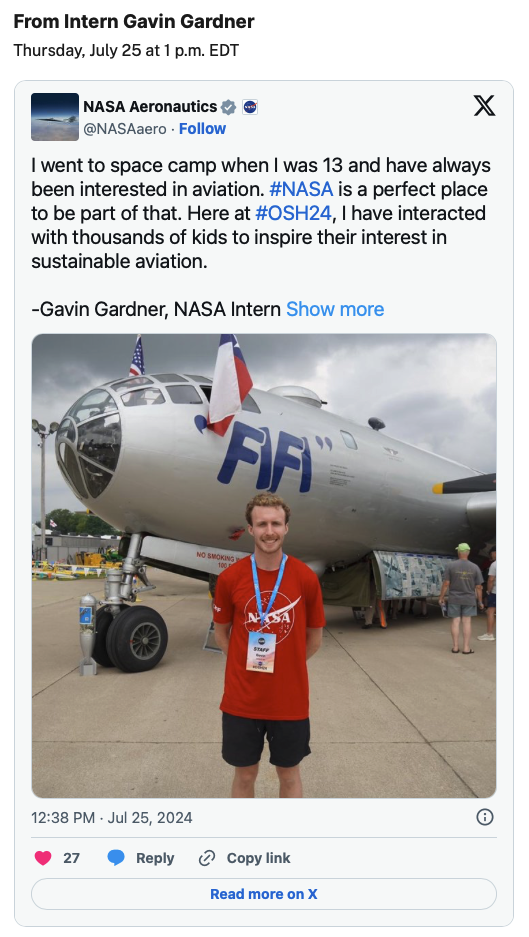
Gavin Gardner, a University Student Research Challenge participant who went on to co-found his own drone company, also was a NASA intern in 2024 and wrote this social media post.
Student challenge paves way for opportunity
As his graduation in the spring of 2025 with a master’s degree approached, Gardner took the initial steps in late 2024 to co-found with his brother and other USRC alumni AG3 Labs after a friend suggested the military could use low-cost drones to test effective counter drone systems.
An initial award from the U.S. Army led to more contracts, allowing the company to expand and ramp up its operations, where today their production capability enables thousands of drones to be built each month.
Gardner credits his experience with USRC, especially when it came to learning more about the business side of running a technical operation, with helping create the opportunities for success he and his team are experiencing today.
About the Author
Jim Banke
Aeronautics Senior Writer
Jim Banke is a veteran aviation and aerospace communicator with more than 40 years of experience as a writer, producer, consultant, and project manager based at Cape Canaveral, Florida. He is part of NASA Aeronautics' Strategic Communications Team and is Senior Writer for the Aeronautics Division within the Research Technology Mission Directorate. In 2007 he was recognized with a Distinguished Public Service Medal, NASA's highest honor for a non-government employee.
Senseonics has begun testing Freedom, an implanted glucose monitor that could track blood sugar for a year without wearable hardware. Here's how it would work.
Senseonics has begun testing Freedom, an implanted glucose monitor that could track blood sugar for a year without wearable hardware. Here's how it would work.
WHOOP plans to test whether wearable coaching can help improve blood sugar and blood pressure. See how its Abu Dhabi study could affect future health wearables.
WHOOP plans to test whether wearable coaching can help improve blood sugar and blood pressure. See how its Abu Dhabi study could affect future health wearables.
Building a nuclear power plant is one of the world’s most complex construction projects. It requires thousands of trucks to ship parts, often to remote regions, where huge teams of skilled workers like electricians and welders come together to assemble everything over many years.
Financing such projects is difficult, in part because no one wants to risk loaning money to a project that might never generate power and revenue, whether that’s due to technical failures, the inability to recruit enough talent, or regulatory hurdles.
Explore Google Chrome's features, Gemini AI, Auto Browse, security settings, privacy controls, and Chrome Enterprise tools in this complete cheat sheet.
Explore Google Chrome's features, Gemini AI, Auto Browse, security settings, privacy controls, and Chrome Enterprise tools in this complete cheat sheet.
China's Unitree unveils the H2-X humanoid robot with kung fu moves and rescue demonstrations, but questions remain about its autonomy, safety and endurance.

 Login